REVIEW 4 major objections 4 minor 12 references
Will Agents Replace Us? Perceptions of Autonomous Multi-Agent AI
T0 review · 4 major / 4 minor · reviewed 2026-08-07 · deepseek-v4-flash
Pith's one-line read Surveying 130 tech professionals, this paper claims that attitudes toward autonomous AI agents split into three coherent segments, with 73% insisting humans keep final decision-making authority and regulatory concerns topping the barrier…
desk verdict A usable descriptive survey undermined by a load-bearing contradiction between the cluster profiles in the text and the supplementary table. read the letter →
The pith
A machine-rendered reading of the paper's core claim, the machinery that carries it, and where it could break.
The reading
What carries the argument
The carrying machinery is a ten-question fixed-choice survey with categorical responses, analyzed through Multiple Correspondence Analysis (MCA), K-Modes clustering, Chi-squared association tests with Cramér's V, and a fixed-effects logistic regression. MCA reduces the categorical answers into dimensions, and K-Modes clustering on the retained dimensions produces three clusters chosen by an elbow rule on inertia; the first two MCA dimensions explain 18.57% of total inertia and three explain 23.83%. The association analysis documents interconnected belief systems between questions, while the logistic regression's null result is itself load-bearing: it supports the paper's conclusion that deployment decisions are not explained by the measured perceptions.
What would settle it
Re-run the segmentation directly on the raw categorical responses without MCA truncation, and test cluster stability by bootstrapping; if the three-cluster structure does not reappear with high agreement, or if the elbow at k=3 disappears, the claimed segments are artifacts. A second check would be a larger, more diverse sample testing whether the 73% human-final-authority preference and the 33% compliance-barrier figure replicate.
Extended reading notes
Core claim
The paper's central claim is that perceptions of autonomous AI agents form three distinct respondent segments. One segment sees AI replacement as already happening, is already deploying agents in some cases, worries most about self-modification and human oversight, and wants open-source transparency; a second, smaller segment is skeptical that creativity can be automated and frequently has no opinion; a third segment also sees replacement as underway but is more focused on regulatory/technical-readiness barriers and on future human roles of oversight and creative direction. Across segments, 73% of respondents favor humans holding final decision-making authority, and large majorities expect programmers to become supervisors or high-level designers rather than disappear. The paper further claims that, despite these clear descriptive patterns, no attitude measured in the survey reliably predicts whether an organization is currently deploying agents; the logistic regression model was not statistically significant.
Load-bearing premise
The load-bearing assumption is that the first few MCA dimensions, which capture only about 19-24% of the total variance in responses, preserve enough meaningful structure for the elbow-chosen three clusters to represent real opinion segments rather than artifacts of the reduction.
Editorial extensions
If this is right
- Organizations planning to deploy AI agents should invest in compliance frameworks and audit mechanisms, since regulatory/compliance concerns are the most frequently cited barrier.
- A 73% preference for human final authority implies human-in-the-loop approval workflows will be a baseline expectation, not an optional feature, for agent systems.
- The three segments imply different engagement strategies: one group is deployment-oriented but worried about self-modification and oversight, another is skeptical or disengaged, and a third is held back by regulatory concerns.
- Because the measured attitudes do not predict deployment, current adoption appears driven by organizational or external factors that the survey did not capture, such as resources, leadership, or sector-specific rules.
- Most respondents expect programmers to shift into supervisory and high-level design roles, so workforce planning should center on upskilling for oversight rather than replacing programmers outright.
Reading between the lines
- If this sample reflects the broader AI-interested professional population, the null predictive model suggests that adoption decisions hinge on institutional factors such as budget, leadership, and compliance infrastructure rather than individual beliefs; a direct test would be to measure those organizational variables alongside attitudes.
- The low MCA explained variance (about 19-24%) makes the three-cluster result provisional; re-running clustering directly on raw response patterns or with a larger, more diverse sample could confirm or dissolve the segments.
- The combination of a 73% human-authority preference and a 33% compliance barrier implies that agent vendors building auditable, human-approval workflows may encounter less resistance than those optimizing purely for autonomy, a hypothesis the paper does not test.
- The sample's primarily Western, tech-savvy composition limits cross-cultural reach; whether the same three segments appear in other regions and professional groups is an open extension.
Editorial analysis
A structured set of objections, weighed in public.
Referee Report
Summary. This paper reports a survey of 130 mostly technical professionals about autonomous multi-agent AI systems. The authors describe response distributions (e.g., 73% favoring human final authority, 33% citing regulatory/compliance concerns as the main deployment barrier), pairwise association analyses, a K-Modes clustering of MCA-transformed responses that yields three respondent segments, and a logistic regression predicting current deployment that is not statistically significant. The paper's central claims are that three distinct respondent segments with coherent attitudes exist and that governance and compliance concerns, not just technical readiness, shape adoption.
Significance. If the segmentation result were reliable, the paper would provide a useful empirical map of stakeholder attitudes toward AI agents, with practical relevance for governance, workforce planning, and deployment strategy. The manuscript has clear strengths: the descriptive distributions are transparently reported; the null logistic regression is honestly reported rather than spun; the data and code are publicly available; and the limitations section explicitly acknowledges the low MCA explained variance and the convenience-sample bias. These strengths are outweighed, however, by load-bearing internal inconsistencies in the cluster analysis and in the multicollinearity reporting, which currently compromise the reproducibility of the main RQ4 result.
major comments (4)
- [Section 3.3 and Supplementary Table S1] Cluster profiles in the text disagree with the modal responses in Supplementary Table S1 for at least five survey items, and the disagreement is not cosmetic. Specifically, Section 3.3 assigns to Cluster 0 the beliefs that regulatory/compliance or technical readiness is a deployment barrier (Q3), that the company deploying the agents is responsible (Q4), that one can sacrifice control for efficiency (Q7), that reasoning failures under uncertainty are a concern (Q8), and that future human roles will be oversight and creative direction (Q10). Supplementary Table S1 lists these modal responses under Cluster 2, not Cluster 0. Conversely, Section 3.3 assigns to Cluster 2 the beliefs that the organization is currently deploying agents (Q3), that all decisions need human approval (Q4), that job security is a concern (Q7), that human oversight is needed (Q8), and that future work will involve new types of jobs (Q10); Table S1 lists these under Cluster 0. Additional discrepancies appear on Q2 and Q9. Because the table and the text cannot both be correct, a reader cannot determine what the three clusters actually are, and the central RQ4 finding is not reproducible as written.
- [Section 3.4, multicollinearity reporting] The text contains a direct internal contradiction about the Variance Inflation Factors. The first paragraph of Section 3.4 states that 'A warning for moderate multicollinearity (Variance Inflation Factor > 5 for some predictors) was noted,' while the final paragraph states that 'Multicollinearity checks confirmed acceptable Variance Inflation Factors (<5) for all predictors.' These statements cannot both be true. Since the regression is non-significant, the contradiction affects the interpretation of the standard errors and the strength of the null conclusion; the authors must state which check is correct and adjust the interpretation accordingly.
- [Methods 2.3 and Section 3.3] The clustering is performed on MCA dimensions that explain only 18.57% of total inertia (two dimensions) and 23.83% (three dimensions), and the paper itself acknowledges in Section 4.3 that 'a substantial portion of the variance in responses is not captured' and that the clusters are 'suggestive rather than definitive.' This is not merely a caveat: because the K-Modes solution lives in a low-variance subspace, the three 'distinct' segments may be artifacts of the retained dimensions and the elbow-based choice of k. To support the central RQ4 claim, the authors should add a stability analysis (e.g., bootstrap cluster agreement, comparison with K-Modes applied directly to the raw categorical responses, or internal validity indices) and soften the abstract and conclusion wording from 'reveal three distinct clusters' to match the evidentiary strength.
- [Section 3.3, Cluster 1 description] The text characterizes Cluster 1 as 'marked by skepticism,' but the supplementary table shows that its modal response is 'No opinion' on Q2, Q5, Q6, Q7, Q8, Q9, and Q10. A cluster whose dominant pattern is non-response is better described as disengaged or uncertain rather than skeptical; interpreting a non-attitude as a position overstates the coherence of the segment and is part of the same tendency to over-interpret cluster structure that affects the other cluster descriptions.
minor comments (4)
- [Section 2.3] The phrase 'Dimensions were retained to explain at least 18.57% of total inertia' is confusing: 18.57% is the value for the first two retained dimensions, not a pre-set retention threshold. Please rephrase to describe the retention criterion actually used.
- [Supplementary Table S1 caption] The caption describes Q1–Q10 as 'qualitative questions,' but the survey items are fixed-choice categorical questions; 'qualitative' is misleading and should be replaced with, for example, 'categorical.'
- [References] Several reference entries contain 'doi:TBD' (Wrona et al., Khemka and Houck, Hauptman et al., Brown et al.), which are incomplete and need to be resolved before publication.
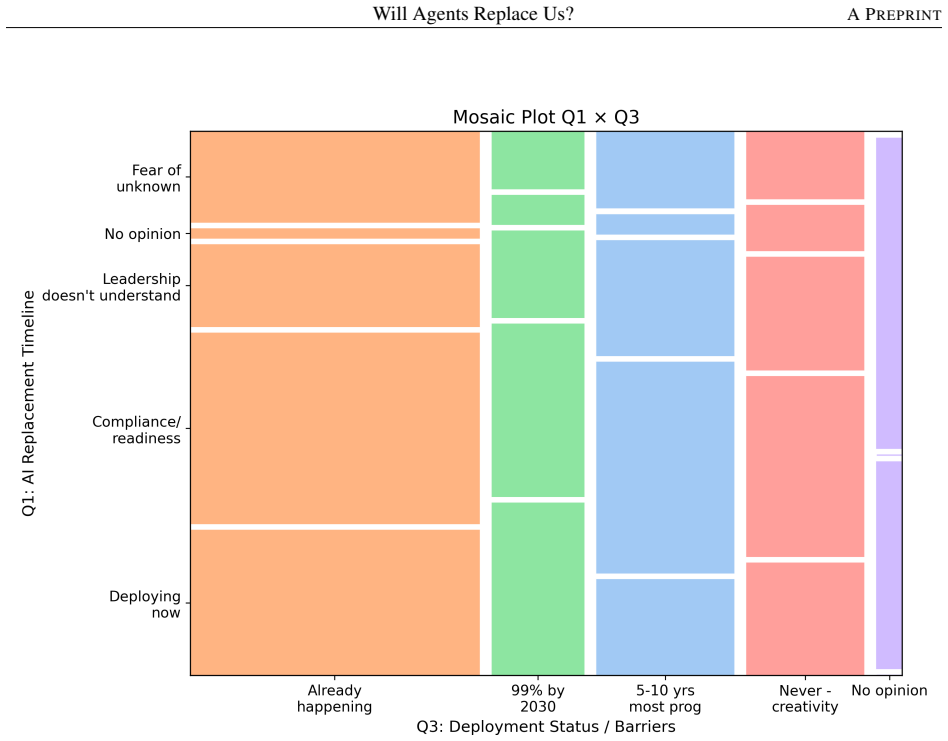
- [Figure numbering] The manuscript's figure numbering is inconsistent: Section 3.2 refers to 'Supplementary Figure 1,' while the supplementary appendix labels the mosaic plot as 'Figure 1' and then numbers later figures 2–5. Use a single consistent numbering scheme and reference each figure unambiguously.
Circularity Check
No circularity: the survey's clusters and regressions are descriptive summaries or non-significant fits, not predictions derived from their own conclusions.
full rationale
The paper is a descriptive survey study. Its central quantitative moves are response distributions, chi-square association tests, Multiple Correspondence Analysis (MCA), K-Modes clustering, and a logistic regression that is explicitly reported as non-significant. None of these reduce by construction to the paper's own inputs or conclusions. The clustering uses MCA coordinates and an inertia-based elbow selection; the cluster profiles in Section 3.3 are modal summaries of observed response patterns, not predictions generated from a fitted parameter. The logistic regression found no statistically significant predictors and the paper states this plainly, so there is no fitted input being renamed as a prediction. The stated limitations—low MCA explained variance (18.57% for two dimensions, 23.83% for three) and fixed-choice survey constraints—are validity concerns, not circularity. The mismatch between Section 3.3 cluster descriptions and Supplementary Table S1 is an internal consistency/reproducibility problem, but it is not a circularity pattern enumerated in the review criteria. There are also no load-bearing self-citations: the reference list is entirely external prior work, and no uniqueness theorem or prior result by the same author is invoked to force the analysis. Therefore no circular step can be exhibited with a quote and a specific reduction, and the appropriate finding is no significant circularity.
Assumptions & free parameters
free parameters (2)
- Number of K-Modes clusters (k) =
3
- Number of MCA dimensions retained =
3 (23.83% inertia)
assumptions (3)
- domain assumption Survey responses accurately reflect respondents' true perceptions.
- standard math Respondents are statistically independent observations.
- domain assumption The K-Modes clustering in the MCA-reduced space captures meaningful latent attitude segments.
Cite this review
Pith. "Pith review of Will Agents Replace Us? Perceptions of Autonomous Multi-Agent AI." pith.science (2026). https://pith.science/paper/QLJXTEXN
@misc{pith2026250602055,
  author       = {Pith},
  title        = {Pith review of: Will Agents Replace Us? Perceptions of Autonomous Multi-Agent AI},
  year         = {2026},
  howpublished = {\url{https://pith.science/paper/QLJXTEXN}},
  note         = {Machine review of arXiv:2506.02055}
}
read the original abstract
Autonomous multi-agent AI systems are poised to transform various industries, particularly software development and knowledge work. Understanding current perceptions among professionals is crucial for anticipating adoption challenges, ethical considerations, and future workforce development. This study analyzes responses from 130 participants to a survey on the capabilities, impact, and governance of AI agents. We explore expected timelines for AI replacing programmers, identify perceived barriers to deployment, and examine beliefs about responsibility when agents make critical decisions. Key findings reveal three distinct clusters of respondents. While the study explored factors associated with current AI agent deployment, the initial logistic regression model did not yield statistically significant predictors, suggesting that deployment decisions are complex and may be influenced by factors not fully captured or that a larger sample is needed. These insights highlight the need for organizations to address compliance concerns (a commonly cited barrier) and establish clear governance frameworks as they integrate autonomous agents into their workflows.
Figures


Figures from the paper (2 more)


Reference graph
Works this paper leans on
-
[4]
doi:10.1126/science.adh2586. A. Hauptman, Y . Gu, and S. Jain. Designing adaptive autonomous agents for team collaboration: task structure and human preferences for autonomy. InProceedings of the ACM Conference on Computer-Supported Cooperative Work and Social Computing (CSCW), pages 103–126,
-
[8]
Alan Chan, Kevin Wei, Sihao Huang, Nitarshan Rajkumar, Elija Perrier, Seth Lazar, Gillian K
URL http://arxiv.org/abs/2504.16736. Alan Chan, Kevin Wei, Sihao Huang, Nitarshan Rajkumar, Elija Perrier, Seth Lazar, Gillian K. Hadfield, and Markus Anderljung. Infrastructure for ai agents,
-
[9]
Stephan Schneider and Ali Sunyaev
URLhttp://arxiv.org/abs/2501.10114. Stephan Schneider and Ali Sunyaev. Determinant factors of cloud-sourcing decisions: reflecting on the it outsourcing lit- erature in the era of cloud computing.Journal of Information Technology, 31(1):1–31,
-
[12]
URL https://cdn-dynmedia-1.microsoft. com/is/content/microsoftcorp/microsoft/final/en-us/microsoft-brand/documents/ Taxonomy-of-Failure-Mode-in-Agentic-AI-Systems-Whitepaper.pdf . Authored by members of Microsoft’s AI Red Team, Committee on AI and Research Ethics (AETHER) working groups, and other AI experts across Microsoft. 9 Will Agents Replace Us?A PR...
-
[2016]
Filippo Santoni de Sio and Jeroen van den Hoven
doi:10.1057/jit.2014.25. Filippo Santoni de Sio and Jeroen van den Hoven. Meaningful human control over autonomous systems: a philosophical account.Frontiers in Robotics and AI, 5:15,
-
[2017]
Isabella Seeber, Eva Bittner, Robert O
doi:10.1016/j.techfore.2016.08.019. Isabella Seeber, Eva Bittner, Robert O. Briggs, Gert-Jan de Vreede, Triparna De Vreede, Aaron Elkins, Ronald Maier, Alexander B. Merz, Sarah Oeste-Reiß, Nils Randrup, Gerhard Schwabe, and Matthias Söllner. Machines as teammates: a research agenda on ai in team collaboration.Information & Management, 57(2):103174,
-
[2018]
doi:10.3389/frobt.2018.00015. Microsoft Corporation. A taxonomy of failure modes in agentic ai systems. Technical re- port, Microsoft Corporation, April
arXiv 2018
- [2020]
Show all 12 references
-
[2022]
Zihan Liu, L
doi:TBD. Zihan Liu, L. Wong, and S. Park. Cultural differences in public perceptions of ai conversational agents: a comparative analysis of social media discourse in the us and china. InProceedings of the CHI Conference on Human Factors in Computing Systems, pages 1–15, 2024b....
-
[2023]
Minjie Shen and Qikai Yang
URLhttp://arxiv.org/abs/2309.07864. Minjie Shen and Qikai Yang. From Mind to Machine: The Rise of Manus AI as a Fully Autonomous Digital Agent, May
-
[2024]
Mansi Khemka and Brian Houck
doi:10.1145/3597503.3608128. Mansi Khemka and Brian Houck. Beyond the tool: understanding developer attitudes towards ai assistants in software engineering practice.IEEE Transactions on Software Engineering, 50(2):189–207,
-
[2025]
Erik Brynjolfsson and Andrew McAfee.The Second Machine Age: Work, Progress, and Prosperity in a Time of Brilliant Technologies
URLhttp://arxiv.org/abs/2504.01990. Erik Brynjolfsson and Andrew McAfee.The Second Machine Age: Work, Progress, and Prosperity in a Time of Brilliant Technologies. W. W. Norton & Company, New York,
Reviewed August 7, 2026 · model on record in the stance chip above.
Discussion (0). Continue with ORCID to comment.