REVIEW 3 major objections 5 minor 3 cited by
Rethinking Regularization Methods for Knowledge Graph Completion
T0 review · 3 major / 5 minor · reviewed 2026-08-07 · deepseek-v4-flash
Pith's one-line read This paper claims that a deliberately designed penalty term can push knowledge graph completion models past their previous test-set ceilings, and that a new sparse regularizer, SPR, outperforms existing regularizers across model families.
desk verdict A simple and plausibly useful KGC regularizer with broad but statistically thin experiments, and a theoretical appendix that is simply wrong. read the letter →
The pith
A machine-rendered reading of the paper's core claim, the machinery that carries it, and where it could break.
The reading
What carries the argument
The load-bearing object is the sparsification operator select-small(x, δ): it sorts the squared components of a nonnegative vector, finds the largest prefix whose cumulative sum is at most δ, masks those coordinates to zero, and penalizes only the unmasked remainder. SPR (Sparse Peak Regularization, as named in the appendix) applies this operator to the squared head embedding, squared tail embedding, and their element-wise products with the squared relation embedding, then sums the four retained norms as the regularizer. Lemma 1 shows the discarded mass never exceeds δ, so the penalty is a bounded-error, deterministic hard-thresholding version of the full squared norm; the appendix also contrasts its zero-gradient variance with dropout's positive variance.
What would settle it
Rerun the main comparison (e.g., CP/ComplEx/RESCAL on WN18RR and FB15K-237) with at least ten random seeds per condition and compute paired confidence intervals for the SPR-minus-ER difference in MRR; if the intervals contain zero on most datasets, the claimed advantage of SPR over the nearest regularizer is not supported, and if they exclude zero, the central ranking claim survives.
Extended reading notes
Core claim
The central discovery claim is that the ceiling of a KGC model is not fixed by its architecture: a regularizer that selectively penalizes significant embedding coordinates raises test MRR and Hits@k beyond the best unregularized result. The proposed SPR regularizer does this by sorting the squared components of each entity embedding, relation embedding, and entity-relation interaction, masking the smallest components whose cumulative sum stays below a threshold δ, and applying the penalty only to the unmasked remainder. The paper reports consistent gains when SPR is added to CP, ComplEx, RESCAL, GIE, CompGCN-TransE/ConvE, and the temporal model HGE, with improvements on the order of 2–9% in MRR over no regularization and small but consistent advantages over N3, DURA, and ER.
Load-bearing premise
The comparisons that rank SPR above other regularizers rest on single test-set runs with no error bars or significance tests, so differences of a few thousandths in MRR (for example ComplEx on YAGO3-10, where SPR and ER both reach 0.584) are assumed to be real signal rather than seed noise or hyperparameter luck.
Editorial extensions
If this is right
- Adding SPR is a drop-in change to the loss, so the same regularizer should transfer to other translation-based, tensor-decomposition, GNN-based, and temporal scoring functions without architectural modification.
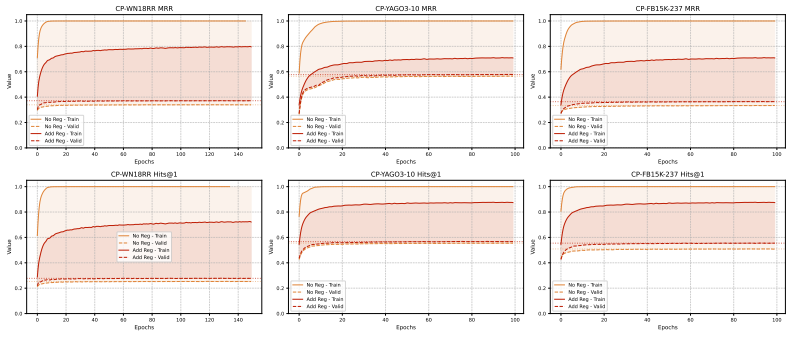
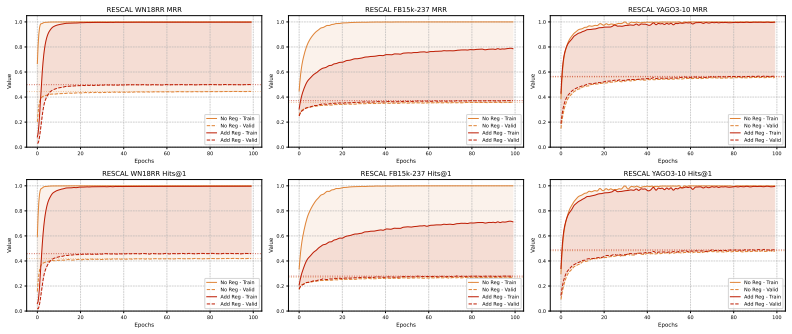
- Because SPR masks only small coordinates, models trained with it should be less prone to memorizing noise and less sensitive to embedding dimension, which the paper's training-versus-validation curves support.
- The same penalty improves the temporal model HGE on ICEWS14 and ICEWS05-15, extending the benefit from static knowledge graphs to temporal ones.
- If the ceiling-breaking claim holds, choosing and tuning a regularizer becomes as important to KGC performance as the model architecture itself, and re-running established baselines with SPR should shift reported leaderboards.
Reading between the lines
- The paper leaves implicit that SPR is a deterministic, per-vector hard-thresholding denoiser: it keeps the highest-energy coordinates and discards a controlled amount of small-coordinate mass, so the same construction could transfer to other high-dimensional embedding tasks where most coordinates are noise, such as recommender or molecule embeddings.
- Because δ is fixed and grid-searched while the mask depends on each vector's own energy, a natural testable extension is an adaptive δ tied to gradient norm or per-vector norm, which the paper itself flags as future work.
- The 'break through upper bounds' claim is demonstrated at a fixed training budget; an implicit, testable consequence is that SPR shifts the entire test-performance-versus-epoch curve rather than just speeding convergence, which could be checked by plotting SPR against N3 at matched epoch counts.
Editorial analysis
A structured set of objections, weighed in public.
Referee Report
Summary. The paper studies regularization for knowledge graph completion (KGC). It empirically compares several existing regularizers (F2, N3, DURA, ER, Dropout) on CP, ComplEx, GIE, and RESCAL models across WN18RR, FB15K-237, YAGO3-10, UMLS, and Kinship, and additionally on CompGCN and the temporal model HGE. The authors propose SPR, a regularizer that masks the smallest squared embedding coordinates before applying a penalty, and claim that regularization not only reduces overfitting but also lets KGC models exceed their unregularized performance, with SPR outperforming existing methods. The paper includes a theoretical appendix that attempts to show SPR has lower Rademacher complexity than Dropout, an optimal-in-class property, and lower gradient variance.
Significance. If the empirical ranking were solid, SPR would be a simple, model-agnostic regularizer applicable to translation-based, tensor-decomposition, GNN-based, and temporal KGC models, which is practically valuable. The paper's breadth of model and dataset coverage is a strength, and the appendix gives useful implementation details, hyperparameter grids, and links to baseline code. However, the theoretical analysis in Appendix A.6.1 and A.7 contains concrete mathematical errors, and the central empirical comparison rests on single runs without error bars or significance tests. Several SPR-versus-competitor gaps are within 0.005 MRR, so the claim that 'SPR is better than other regularization methods' is not currently established by the evidence presented.
major comments (3)
- [A.6.1 and A.7] The Rademacher-complexity comparison between SPR and Dropout is derived in the wrong direction. From the mask definition, ||x_sparse||_2^2 = ||x||_2^2 - sum_{masked} x_d^2 and sum_{masked} x_d^2 <= delta, so ||x_sparse||_2 >= sqrt(||x||_2^2 - delta). The stated bound R_SPR <= C E[||x||_2 sqrt(1 - delta/||x||_2^2)] = C E[sqrt(||x||_2^2 - delta)] is therefore a lower bound on C E||x_sparse||_2, not an upper bound, and substituting it into the upper bound is invalid. Under the paper's own condition delta < p||x||_2^2, sqrt(||x||_2^2 - delta) > sqrt(1-p)||x||_2, so the actual SPR bound is strictly larger than the Dropout bound, contradicting the claim R_SPR < R_drop. This is load-bearing because the only formal argument that SPR has lower capacity than Dropout rests on this comparison.
- [A.6.1, 'Optimal in class property' and 'Concrete signal-noise example'] The claim that SPR chooses x_sparse = argmin_{z in S_delta} ||z||_2^2 is false. SPR masks the smallest coordinates, which retains the largest coordinates and therefore does not minimize the retained squared norm. For example, with x = (100,1) and delta = 1, SPR gives (100,0) with squared norm 10000, while z = (99,1) is feasible and has squared norm 9802. In the signal-noise example, the expected Dropout penalty (1-p)(k a^2 + (n-k)epsilon^2) is strictly smaller than SPR's penalty k a^2 for p > 0, so the statement that SPR achieves a smaller penalty is also false. These errors invalidate the optimal-in-class and signal-noise arguments.
- [Section 4.2, Tables 1 and 2; Section 4.4, Table 3 and Figure 5] All reported results are single runs with no error bars, multiple seeds, or significance tests. Several SPR-versus-competitor differences are tiny: on YAGO3-10 in Table 1, ComplEx-SPR and ComplEx-ER both achieve MRR 0.584; in Table 2 on UMLS, ComplEx-SPR has MRR 0.909 while ComplEx-ER has 0.910. Because hyperparameters are selected on validation for each method and the same machine is used, such small differences cannot be distinguished from seed or optimizer noise. Since the paper's central contribution is an empirical ranking of regularizers, the claim that SPR is better than other regularization methods is not established by the reported evidence.
minor comments (5)
- [Appendix A.9] The text states that SPR improves the CP model's MRR from 0.438 to 0.449 on WN18RR, but Table 1 reports CP-SPR with MRR 0.479; the inconsistency should be reconciled.
- [Section 4.5 and Figure 6] The main text says the visualization uses the FB15K-237 dataset, while the Figure 6 caption says WN18RR; one of these is wrong.
- [Eq. (10)] The second term in the SPR definition is written as ||V^t_i||^2_sparse but should be ||V^t_k||^2_sparse, matching the other tail-entity terms.
- [Appendix A.3] The metric 'MR' is described as 'Mean Reciprocal' but the formula given is the mean rank; correct the terminology to avoid confusion.
- [References and appendix text] Some references are incomplete (e.g., 'Xia et al.' has no year or venue), and 'UNLS' appears in Appendix A.4.2 where 'UMLS' is meant.
Circularity Check
No substantive circularity: the empirical comparison is independent; only Lemma 1 is a definitional restatement of the SPR mask, and the flawed Dropout comparison is a mathematical error, not a circular one.
-
self definitional
[Section 3.2, Eqs. (3)-(4), and Lemma 1 in Section A.5]
"Let S be the largest integer such that: sum_{i=1}^S x_(i) <= delta. Then, the sparsified version of x is given by: x_sparse = x ⊙ (1 - M(x)). Lemma 1 ... suppose that the operator select-small(x, delta) produces a binary mask M ... Such that the cumulative sum of the 'dropped' entries is bounded by delta, i.e., sum_{i:M_i=1} x_i <= delta. Then the difference between the full sum and the sparsified sum is bounded as: |sum_j x_j - sum_j (x_j)_sparse| <= delta."
The lemma's assumption is exactly the construction of the mask: Eq. (3) defines S as the largest index such that the cumulative sum of the smallest entries is at most delta, and Eq. (4) zeroes those entries. The claimed 'sparsification error bound' is therefore a restatement of the definition rather than a derived result. The paper lists 'theoretical analysis' among its contributions, but this particular lemma adds no independent constraint; any violation would contradict the mask's defining inequality. It is not load-bearing for the empirical ranking of SPR against other regularizers.
full rationale
The central claim is empirical: SPR is defined in Section 3.2 and compared with F2, N3, DURA, ER, and Dropout on held-out test sets in Tables 1-3 and Figure 5. The threshold delta and regularization rate are tuned by grid search on validation data (Appendix A.3.1) and then applied to test data, which is standard hyperparameter selection rather than a fitted prediction. The small, single-run MRR differences are a statistical weakness, not circularity. The only definitional moment is Lemma 1, whose conclusion is already guaranteed by Eq. (3); this is a minor self-definitional lemma and does not force the empirical result. Appendix A.6.1 and A.7 contain an invalid Rademacher comparison (the retained norm is lower-bounded, not upper-bounded, by sqrt(||x||^2 - delta), so the displayed SPR bound and the R_SPR < R_drop conclusion do not follow), but an incorrect proof is a correctness problem, not a circular reduction. No load-bearing self-citation or imported uniqueness argument appears; the self-citation [Li et al., 2025] is merely one of many cited KGC models in the introduction.
Assumptions & free parameters
free parameters (3)
- sparsification threshold δ =
not reported per model; grid search over {0.05,0.1,0.2,0.3,0.4,0.45,0.5}
- regularization rate λ =
not reported per model; grid search over {5e-1,5e-2,5e-3,5e-4,5e-5}
- embedding dimension =
not reported; grid search over {50,100,400,1000,2000,3000,4000}
assumptions (3)
- domain assumption Rademacher complexity bounds linear/bilinear KGC scorers by a constant times expected l2 norm of embeddings
- domain assumption Lipschitz constant C exists and is comparable for Dropout and SPR
- domain assumption The mask M(x) can be treated as fixed when computing gradients
Cite this review
Pith. "Pith review of Rethinking Regularization Methods for Knowledge Graph Completion." pith.science (2026). https://pith.science/paper/QLVTGZOR
@misc{pith2026250523442,
  author       = {Pith},
  title        = {Pith review of: Rethinking Regularization Methods for Knowledge Graph Completion},
  year         = {2026},
  howpublished = {\url{https://pith.science/paper/QLVTGZOR}},
  note         = {Machine review of arXiv:2505.23442}
}
read the original abstract
Knowledge graph completion (KGC) has attracted considerable attention in recent years because it is critical to improving the quality of knowledge graphs. Researchers have continuously explored various models. However, most previous efforts have neglected to take advantage of regularization from a deeper perspective and therefore have not been used to their full potential. This paper rethinks the application of regularization methods in KGC. Through extensive empirical studies on various KGC models, we find that carefully designed regularization not only alleviates overfitting and reduces variance but also enables these models to break through the upper bounds of their original performance. Furthermore, we introduce a novel sparse-regularization method that embeds the concept of rank-based selective sparsity into the KGC regularizer. The core idea is to selectively penalize those components with significant features in the embedding vector, thus effectively ignoring many components that contribute little and may only represent noise. Various comparative experiments on multiple datasets and multiple models show that the SPR regularization method is better than other regularization methods and can enable the KGC model to further break through the performance margin.
Figures


Figures from the paper (8 more)




Forward citations
Cited by 3 Pith papers
-
Adaptive Fuzzy Time Series Forecasting via Partially Asymmetric Convolution and Sub-Sliding Window Fusion
A fuzzy sliding-window plus partially asymmetric convolutional model reports state-of-the-art MAE/RMSE on most of 43 benchmark time series datasets.
-
Complementarity-driven Representation Learning for Multi-modal Knowledge Graph Completion
MoCME combines expert-network fusion weighted by estimated mutual information and entropy-based negative sampling, and reports state-of-the-art multi-modal knowledge graph completion on five benchmarks.
-
Co-Evidential Fusion with Information Volume for Medical Image Segmentation
A semi-supervised segmentation method using evidential fusion and information-volume weighting reports better Dice on four medical benchmarks, but its novelty relative to the authors' own prior papers is unclear.
Reference graph
Works this paper leans on
-
[1]
and 2xd for retained components. This selective penaliza- tion targets larger components, unlike L2 regularization’s uniform gradient: ∇xd ΩL2 = 2xd, which shrinks all dimensions equally [Bishop and Nasrabadi, 2006]. Discussing the implications of selective penalization. This selective approach offers key benefits: Noise Reduction: By penalizing dominant ...
work page 2006
-
[3]
Kg-bert: Bert for knowledge graph completion.arXiv preprint arXiv:1909.03193,
Liang Yao, Chengsheng Mao, and Yuan Luo. Kg-bert: Bert for knowledge graph completion.arXiv preprint arXiv:1909.03193,
arXiv 1909
-
[5]
Table 4: Dataset Statistics Dataset #Entity #Relation #Train #Valid #Test WN18RR [Dettmers et al., 2018] 40,943 11 86,835 3,034 3,314 FB15K-237 [Toutanova and Chen, 2015] 14,541 237 272,115 17,535 20,466 Y AGO3-10 [Mahdisoltani et al., 2013] 123,182 37 1,079,040 5,000 5,000 Kinship [Kemp et al., 2006] 104 26 8,544 1,068 1,074 UMLS [McCray, 2003] 135 46 5,...
work page 2018
-
[10]
These values correspond to the widely used metrics in KGC tasks: Hits@1, Hits@3, and Hits@10, respectively. A.3.1 Implementation Details All our experiments were conducted on a server equipped with 1T RAM, an Intel(R) Xeon(R) Gold 6226R CPU @ 2.90GHz, and 8 V100 GPUs with 32 GB each. 15 All baseline models were reproduced from the GitHub of their respecti...
-
[13]
Hge: embedding temporal knowledge graphs in a product space of heterogeneous geometric subspaces
Jiaxin Pan, Mojtaba Nayyeri, Yinan Li, and Steffen Staab. Hge: embedding temporal knowledge graphs in a product space of heterogeneous geometric subspaces. InProceedings of the AAAI Conference on Artificial Intelligence, volume 38, pages 8913–8920, 2024b. Alberto García-Durán, Sebastijan Dumanˇci´c, and Mathias Niepert. Learning sequence encoders for temp...
-
[14]
Linhao Luo, Jiaxin Ju, Bo Xiong, Yuan-Fang Li, Gholamreza Haffari, and Shirui Pan. Chatrule: Mining logical rules with large language models for knowledge graph reasoning.arXiv preprint arXiv:2309.01538, 2023b. Nitish Srivastava, Geoffrey Hinton, Alex Krizhevsky, Ilya Sutskever, and Ruslan Salakhutdinov. Dropout: a simple way to prevent neural networks fr...
arXiv 1929
-
[15]
13 A Appendix A.1 Limitations and Future Works Although in this paper, we have demonstrated through a large number of experiments that regularization methods are crucial for the KGC model. And the simple and easy-to-use SPR regularization method we proposed has also achieved very good results. However, we also noticed two limitations of this paper and are...
work page 2024
-
[16]
The CP model approximates an N-order tensor as a sum of several rank-1 tensors. For a third-order tensorA, the CP decomposition [Hitchcock, 1927] can be written as A ≈Pd f=1 hf ◦r f ◦t f , where d is the rank of the decomposition (often equal to the embedding dimension), and hf ,r f ,t f are the vectors corresponding to the head entity, relation and tail ...
work page 1927
Show all 21 references
-
[19]
Consequently, the difference between the full sum and the sparsified sum is given by: nX i=1 Ai − nX i=1 Ai (1−m i) = nX i=1 Aimi. Since mi is nonzero only for the indices corresponding to the S smallest elements (as determined by π), this expression is exactly equal to : SX s...
2014
-
[20]
Proof.Because Dropout masks are sampled independently of the data and the parameters, they act as exogenous noise. Writing the Dropout-regularised objective as Ldrop(θ,m) =ℓ(θ) +λ∥m⊙x(θ)∥ 2 2, the gradient decomposes into ∇θLdrop =∇ θℓ(θ)| {z } data / parameters +λm⊙x(θ), so V...
2014
-
[1927]
Embedding entities and relations for learning and inference in knowledge bases.arXiv preprint arXiv:1412.6575,
Bishan Yang, Wen-tau Yih, Xiaodong He, Jianfeng Gao, and Li Deng. Embedding entities and relations for learning and inference in knowledge bases.arXiv preprint arXiv:1412.6575,
-
[2003]
A survey on temporal knowledge graph completion: Taxonomy, progress, and prospects
Jiapu Wang, Boyue Wang, Meikang Qiu, Shirui Pan, Bo Xiong, Heng Liu, Linhao Luo, Tengfei Liu, Yongli Hu, Baocai Yin, et al. A survey on temporal knowledge graph completion: Taxonomy, progress, and prospects. arXiv preprint arXiv:2308.02457,
-
[2011]
Embedding entities and relations for learning and inference in knowledge bases
Bishan Yang, Scott Wen-tau Yih, Xiaodong He, Jianfeng Gao, and Li Deng. Embedding entities and relations for learning and inference in knowledge bases. InProceedings of the International Conference on Learning Representations (ICLR) 2015,
2015
-
[2013]
Reasoning on graphs: Faithful and interpretable large language model reasoning.arXiv preprint arXiv:2310.01061, 2023a
Linhao Luo, Yuan-Fang Li, Gholamreza Haffari, and Shirui Pan. Reasoning on graphs: Faithful and interpretable large language model reasoning.arXiv preprint arXiv:2310.01061, 2023a. Ke Liang, Yue Liu, Hao Li, Lingyuan Meng, Suyuan Liu, Siwei Wang, Sihang Zhou, and Xinwang Liu. ...
-
[2014]
Complex embed- dings for simple link prediction
Théo Trouillon, Johannes Welbl, Sebastian Riedel, Éric Gaussier, and Guillaume Bouchard. Complex embed- dings for simple link prediction. InInternational conference on machine learning, pages 2071–2080. PMLR,
-
[2015]
Rotate: Knowledge graph embedding by relational rotation in complex space.arXiv preprint arXiv:1902.10197,
Zhiqing Sun, Zhi-Hong Deng, Jian-Yun Nie, and Jian Tang. Rotate: Knowledge graph embedding by relational rotation in complex space.arXiv preprint arXiv:1902.10197,
1902 arXiv
-
[2018]
Tucker: Tensor factorization for knowledge graph completion.arXiv preprint arXiv:1901.09590,
Ivana Balaževi´c, Carl Allen, and Timothy M Hospedales. Tucker: Tensor factorization for knowledge graph completion.arXiv preprint arXiv:1901.09590,
1901 arXiv
-
[2019]
Learning hierarchy-aware knowledge graph embeddings for link prediction
Zhanqiu Zhang, Jianyu Cai, Yongdong Zhang, and Jie Wang. Learning hierarchy-aware knowledge graph embeddings for link prediction. InProceedings of the AAAI conference on artificial intelligence, volume 34, pages 3065–3072, 2020b. 11 Ines Chami, Adva Wolf, Da-Cheng Juan, Freder...
2005 arXiv
-
[2022]
L2 regularization for learning kernels.arXiv preprint arXiv:1205.2653,
Corinna Cortes, Mehryar Mohri, and Afshin Rostamizadeh. L2 regularization for learning kernels.arXiv preprint arXiv:1205.2653,
-
[2023]
Temporal knowledge graph completion: A survey.arXiv preprint arXiv:2201.08236,
Borui Cai, Yong Xiang, Longxiang Gao, He Zhang, Yunfeng Li, and Jianxin Li. Temporal knowledge graph completion: A survey.arXiv preprint arXiv:2201.08236,
-
[2024]
Mole-bert: Rethinking pre-training graph neural networks for molecules
Jun Xia, Chengshuai Zhao, Bozhen Hu, Zhangyang Gao, Cheng Tan, Yue Liu, Siyuan Li, and Stan Z Li. Mole-bert: Rethinking pre-training graph neural networks for molecules. InThe Eleventh International Conference on Learning Representations. Kurt Bollacker, Colin Evans, Praveen P...
2008
Reviewed August 7, 2026 · model on record in the stance chip above.
Discussion (0). Sign in to comment.