REVIEW 3 major objections 4 minor 65 references
Exact quantum dynamics background of dispersion interactions: case study for CH$_4\cdot$Ar in full (12) dimensions
T0 review · 3 major / 4 minor · reviewed 2026-08-14 · deepseek-v4-flash
Pith's one-line read Twelve-dimensional vibrational states of CH4-Ar set the benchmark for 3D rigid-monomer models.
desk verdict A solid, first-of-its-kind 12D study with one genuine loose end: the highest 'bound' states need convergence evidence before the all-bound-states claim can stand. read the letter →
The pith
A machine-rendered reading of the paper's core claim, the machinery that carries it, and where it could break.
The reading
What carries the argument
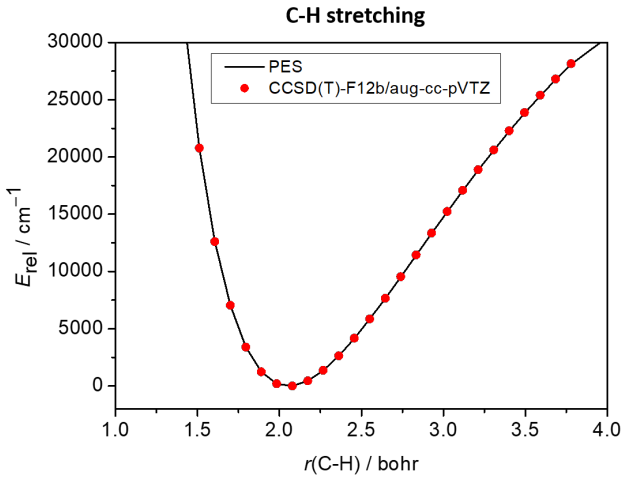
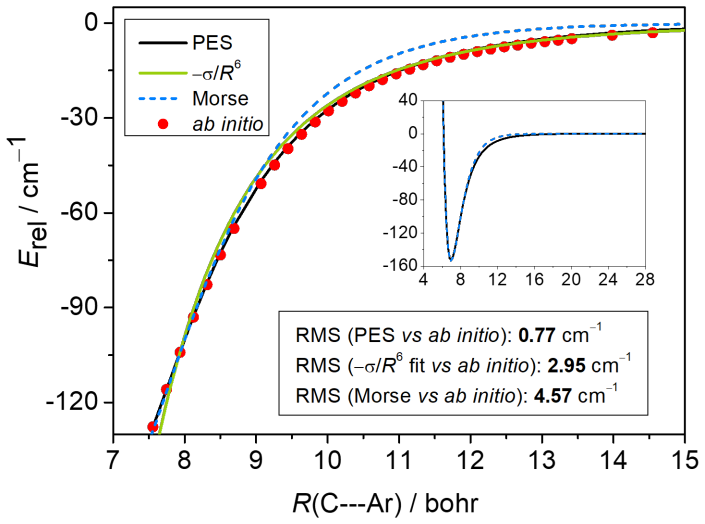
The load-bearing machinery is the FullD-2019 potential energy surface combined with the GENIUSH\textendash Smolyak variational procedure. The PES is a permutationally invariant polynomial of Morse-type variables $y_{ij}=\exp(-r_{ij}/a)$ fit to 15,995 CCSD(T)-F12b/aug-cc-pVTZ points, with terms up to degree 7; the Morse variables give smooth dissociation, and the high-order terms reproduce the intermediate-range $R^{-6}$ dispersion character without a switching function. The variational procedure builds the kinetic energy operator automatically from user-defined internal coordinates and uses Smolyak sparse grids to prune the direct product basis and grid, controlling the exponential cost of 12 dimensions. A second key ingredient is the choice of generalized normal coordinates referenced to the effective ground-state methane structure, which builds in the dominant static anharmonicity and lets a tiny methane basis capture monomer-flexibility effects. Convergence of the intermolecular excitation energies relies on error cancellation between the zero-point-dominated reference and excited states.
What would settle it
Recompute the 12D bound states with a methane basis larger than $b=3$ ($b=4$ or more) and check whether any intermolecular excitation energy shifts by more than roughly $0.05~\mathrm{cm}^{-1}$; a larger shift would mean the claimed convergence, and hence the derived 3D-model errors, is not stable.
Extended reading notes
Core claim
The central claim is that the full-dimensional bound-state vibrational energies of CH$_4$\cdot Ar computed on the new FullD-2019 PES are converged enough to serve as a reference, and that relative to this reference the standard rigid-monomer approximations are accurate to about $1~\text{cm}^{-1}$ or worse unless adjusted. The 12D computation with the smallest methane basis ($b=0$, a single 9D harmonic-oscillator function) gives intermolecular excitation energies within $0.40~\text{cm}^{-1}$ rms of the $b=3$ reference; the $b=1$ computation with ten methane functions gives $0.07~\text{cm}^{-1}$ rms. The rigorously constrained 3D model built at the ground-state average methane structure has $0.93~\text{cm}^{-1}$ rms and incorrectly predicts an extra bound state, while an adjusted 3D model that tunes the methane C\textendash H distance in the kinetic energy operator to reproduce the effective rotational constant recovers the correct count and $0.32~\text{cm}^{-1}$ rms. The PES itself matches benchmark dissociation energies at the global and secondary minima within $0.3$ and $2.6~\text{cm}^{-1}$, and its isolated-methane levels reproduce experimental values through the pentad with $2.88~\text{cm}^{-1}$ rms.
Load-bearing premise
The load-bearing premise is that the $b=3$ 12D excitation energies are converged, which relies on error cancellation between the zero-point and excited intramolecular states; if that cancellation fails, the reported rms values and the comparison with 3D models lose their reference.
Editorial extensions
If this is right
- The $b=0$ 12D computation, with a single methane basis function, gives an rms of $0.40~\text{cm}^{-1}$ against the converged $b=3$ results, making it a cheap yet accurate alternative to 3D models.
- The $b=1$ 12D computation (ten methane basis functions) reaches $0.07~\text{cm}^{-1}$ rms, much better than both 3D models, while taking only about 20 hours on 20 cores.
- The rigorously constrained 3D model built at the ground-state average structure has $0.93~\text{cm}^{-1}$ rms and predicts a spurious triply degenerate bound state; the full-dimensional calculation corrects that.
- The PES reproduces benchmark dissociation energies at the global and secondary minima within $0.3$ and $2.6~\text{cm}^{-1}$, respectively, and its isolated-methane vibrational levels match experiment to $2.88~\text{cm}^{-1}$ rms through the pentad.
- Because the surface dissociates correctly, the method can be extended to methane-excited predissociative states, where intramolecular-to-intermolecular vibrational energy transfer becomes observable.
Reading between the lines
- The paper does not state this, but the $b=0$ result implies that a rigid-monomer model using the ground-state effective structure already captures most monomer-flexibility effects, which could be tested quickly on other atom\textendash molecule complexes without running full-dimensional calculations.
- The convergence tests are for relative excitation energies; the zero-point energy itself is estimated to be $1$\textendash$2~\text{cm}^{-1}$ too high at $b=3$, so absolute dissociation thresholds carry that uncertainty even though relative levels are stable.
- Following the paper's stated route, repeating the 12D computation with a methane basis that includes excited normal-mode combinations ($b=6$ or $7$) and comparing predissociative line positions with measured spectra would be a sharper test of the surface and of the reduced-model assessment.
- Because the degree-7 Morse-variable fit reproduces the $R^{-6}$ tail without an explicit dispersion term, the same fitting strategy may transfer to other dispersion-bound complexes; a direct test would be fitting a known long-range potential and checking whether the recovered asymptotic falloff matches $1/R^6$.
Signed reviews
Editorial analysis
A structured set of objections, weighed in public.
Referee Report
Summary. The paper reports the first full-dimensional (12D) variational bound-state computation for the CH4–Ar van der Waals complex. The authors construct a new permutationally invariant, full-dimensional ab initio PES (FullD-2019) from 15,995 CCSD(T)-F12b/aug-cc-pVTZ points, benchmark its dissociation energies at the global and secondary minima against composite CCSD(T)-F12b/CCSDT(Q)/core-correlation estimates, and then solve the 12D vibrational Schrödinger equation with the GENIUSH–Smolyak approach. Convergence of the intermolecular basis is reported at the 0.01 cm−1 level, and the methane-fragment basis is varied from pruning parameter b=0 to b=3. The resulting b=3 excitation energies are used as the reference to assess two rigid-monomer 3D models, finding rms deviations of 0.93 cm−1 (rigid-geometry model) and 0.32 cm−1 (rotationally adjusted model). The paper also shows that a 12D computation with only a single methane harmonic-oscillator function (b=0) already outperforms the purely rigid 3D model, with rms 0.40 cm−1, and that including ten methane functions (b=1) reduces the rms to 0.07 cm−1. The central claims are that the FullD-2019 PES is of near-spectroscopic quality and that the 12D calculations provide a valid benchmark for reduced-dimensionality models of this complex.
Significance. If the results hold, this is a significant methodological and systems-oriented contribution. It provides a new full-dimensional PES for a weakly bound complex of a polyatomic molecule and a rare-gas atom, and it demonstrates the feasibility of genuinely 12D variational bound-state calculations with the GENIUSH–Smolyak machinery. The PES fitting quality (rms below 1 cm−1 up to 55,000 cm−1) and the benchmark dissociation energies are carefully established, and the comparison of 3D rigid-monomer models against full-dimensional results is a direct, useful assessment of a widely used approximation. The manuscript is generally clear, with extensive convergence data for the lower states, and the reported energies and rms values are internally consistent with the tables. The main open issue concerns the highest bound state(s), whose convergence and even bound-state character are not yet fully established; this does not undermine the lower-state conclusions but does affect the claim that the table lists all bound states and the associated bound-state-count comparisons.
major comments (3)
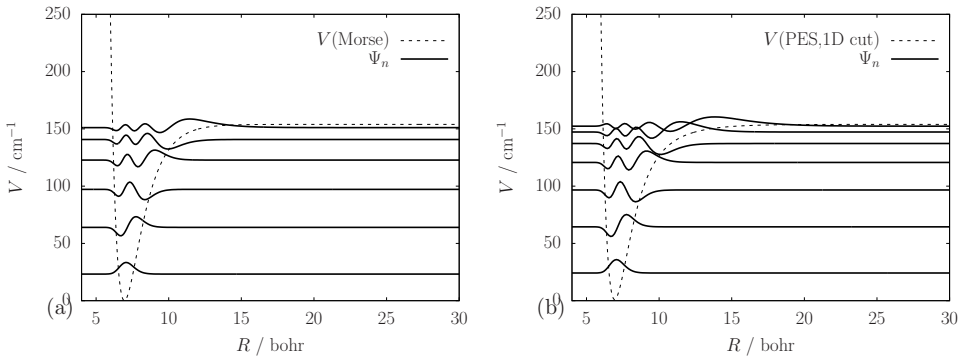
- [Section III.D, Table V] The highest 12D state(s), rows #44–46 at 99.32 cm−1, are the only rows without any Δ0, Δ1, or Δ2 convergence entries, and they have no counterparts in either 3D column. The text claims that Table V lists all bound states, and later uses the bound-state count to argue that the 3D(⟨B⟩0) model reproduces the correct number of bound states. For these top states, however, there is no evidence that the b=3 energy is converged with respect to the methane-fragment basis. The state also lies close to the dissociation limit: using the b=3 numbers in the text, De(GM)=153.13 cm−1, CH4 ZPVE(b=3)=9692.41 cm−1, and complex ZPVE(b=3)=9745.40 cm−1 give D0≈100.14 cm−1, while Section III.D states that the b=3 complex ZPVE is 1–2 cm−1 too high; the correspondingly corrected D0 is 99.35–100.35 cm−1, placing the 99.32 cm−1 state inside the uncertainty of the dissociation threshold. The manuscript should provide convergence data for these states, or at least a quantitative discussion of why they are bound, before asserting that the table contains all bound states and before using the bound-state count in the 3D assessment.
- [Section III.D, text vs. Table V] The statement that the 3D(⟨B⟩0) model 'reproduces the correct number of bound states' is not supported by Table V as printed. Table V shows no entries for #44–46 in either 3D column, so the 3D(⟨B⟩0) model appears to have only 44 bound states, while the 12D b=3 column lists 47. If the 3D model actually has the three extra states, the table is incomplete; if it does not, the 'correct number' claim is incorrect. This discrepancy affects the central comparison between the full-dimensional and reduced-dimensional models and should be resolved in revision.
- [Section III.D, text] The sentence claiming that the 3D(⟨r⟩0) model 'erroneously predicts an additional, triply degenerate, bound state below the dissociation asymptote' is difficult to reconcile with Table V, in which the 3D(⟨r⟩0) column contains no state beyond the 12D list and actually shows fewer bound states than the 12D column. The reader cannot identify the additional state or the comparison basis. Please clarify which state is meant and how it relates to the 12D results, or correct the statement so that the table and text agree.
minor comments (4)
- [Table V, row #44–46] The row for states #44–46 lacks any assignment (j, nR, Γ). Even if the states are genuine, providing at least a symmetry or angular-momentum label would help the reader assess their character; if no assignment is possible, a brief explanation is needed.
- [Table V, footnote b] Footnote b states that the intermolecular radial and angular representations are 'sufficient for converging the figures shown in the table,' but the highest-state row has no convergence figures. Please qualify the statement to indicate which rows are covered.
- [Section III.D, ZPVE discussion] The estimate that the b=3 ZPVE is 1–2 cm−1 too high is stated without showing the underlying comparison for the complex itself. Since this estimate drives the uncertainty in D0 and thus the bound-state interpretation of the top state, a more explicit derivation or a small convergence table for the complex ZPVE would be valuable.
- [Abstract and Section I] The phrase 'single harmonic oscillator basis function (9D)' is slightly confusing because a single 9D function is an entire 9D Hartree-product function, not one oscillator in one dimension. A wording such as 'a single 9D harmonic-oscillator basis function (b=0)' would be clearer.
Circularity Check
No circularity: PES is ab initio fitted, bound states are variational outputs, and the adjusted 3D model is explicitly labeled as an adjustment.
full rationale
The paper's derivation chain is self-contained: the FullD-2019 PES is fitted to 15,995 CCSD(T)-F12b/aug-cc-pVTZ ab initio energy points, and the 12D bound-state energies are obtained by variational solution of the nuclear Schrödinger equation using the GENIUSH–Smolyak method, with no experimental or target bound-state energy used as a fitting input. The convergence of the 12D excitation energies is tested directly through increasing methane-basis pruning parameters b = 0, 1, 2, 3 (Table V). The 3D(⟨B⟩0) model does adjust a KEO C–H distance to reproduce a rotational constant, but the paper explicitly calls this an 'adjusted' model and the adjusted quantity is not the bound-state excitation energy being compared; hence it is not a fitted input renamed as a prediction. The only overlapping self-citation, Ref. [40], is an independently published methodological paper that is not used to justify a target-dependent result. The unquantified convergence of the highest states #44–46 is a correctness/convergence concern, not a circularity, because the paper does not define those energies in terms of the comparison target.
Assumptions & free parameters
free parameters (5)
- PES polynomial expansion coefficients (9355) =
Not listed individually (in ESI)
- Morse variable exponent a =
2.0 bohr
- PES fit weights E0, E1 =
E0=0.05 hartree, E1=0.5 hartree
- Morse radial basis parameters D, alpha, gamma =
D=150 cm^-1, alpha=0.65, gamma=0.00033
- 3D(⟨B⟩0) adjusted C-H distance =
r_fit(C-H)=2.072988169 bohr
assumptions (4)
- domain assumption CCSD(T)-F12b/aug-cc-pVTZ electronic structure method provides accurate interaction energies for the CH4-Ar complex (within a few cm^-1 for dissociation energies).
- domain assumption A polynomial of Morse-like variables up to degree 7, invariant under permutation of identical atoms, can represent the full-dimensional PES without significant interpolation artifacts.
- standard math The variational principle holds: the computed vibrational energies are upper bounds to the exact eigenvalues of the Hamiltonian defined by the PES and the kinetic energy operator.
- domain assumption Atomic masses (rather than nuclear masses) are used for the vibrational problem, neglecting the small difference from electron mass.
Cite this review
Pith. "Pith review of Exact quantum dynamics background of dispersion interactions: case study for CH$_4\cdot$Ar in full (12) dimensions." pith.science (2026). https://pith.science/paper/QNC3BADI
@misc{pith2026190805432,
  author       = {Pith},
  title        = {Pith review of: Exact quantum dynamics background of dispersion interactions: case study for CH$_4\cdot$Ar in full (12) dimensions},
  year         = {2026},
  howpublished = {\url{https://pith.science/paper/QNC3BADI}},
  note         = {Machine review of arXiv:1908.05432}
}
abstract
A full-dimensional \emph{ab initio} potential energy surface of spectroscopic quality is developed for the van-der-Waals complex of a methane molecule and an argon atom. Variational vibrational states are computed on this surface including all twelve (12) vibrational degrees of freedom of the methane-argon complex using the GENIUSH computer program and the Smolyak sparse grid method. The full-dimensional computations make it possible to study fine details of the interaction and distortion effects and to make a direct assessment of the reduced-dimensionality models often used in the quantum dynamics study of weakly-bound complexes. A 12-dimensional (12D) vibrational computation including only a single harmonic oscillator basis function (9D) to describe the methane fragment (for which we use the ground-state effective structure as the reference structure) has a 0.40 cm$^{-1}$ root-mean-square error (rms) with respect to the converged 12D bound-state excitation energies, which is less than half of the rms of the 3D model set up with the $\langle r \rangle_0$ methane structure. Allowing 10 basis functions for the methane fragment, the rms of the bound state vibrational energies is reduced to 0.07 cm$^{-1}$, which is much better than the 3D models. The full-dimensional potential energy surface correctly describes the dissociation of the system, which together with further development of the variational (ro)vibrational methodology opens the route for the study of the role of dispersion forces on the excited methane vibrations and the energy transfer from the intra- to the intermolecular vibrational modes.
Figures


Figures from the paper (2 more)
Reference graph
Works this paper leans on
-
[1]
Benchmark dissociation energies Geometries of the global (GM) and secondary minima (SM) of the CH 4·Ar complex are optimized using the explicitly-correlated coupled cluster singles, doubles, and perturbative triples electronic structure method, CCSD(T)-F12b [41], with the aug-cc-pVQZ correlation- consistent basis set [42], followed by harmonic frequency c...
-
[2]
Full-dimensional PES development A full-dimensional analytic ab initio PES, named FullD-2019 PES, is developed based on 15 995 energy points computed at the CCSD(T)-F12b/aug-cc-pVTZ level of theory at geometries covering the configuration space relevant for the interaction between methane and argon. Note that previous test computations by one of us showed ...
work page 2019
-
[3]
Benchmark dissociation energies In Table I, we present the benchmark dissociation energies corresponding to the global and secondary minimum geometries of the CH4·Ar complex and compare them to the dissociation energies determined on the newly developed analytic FullD-2019 PES. The correction terms listed in Table I allow for estimating the accuracy of th...
work page 2019
-
[4]
Accuracy of the analytic PES The newly developed full-dimensional analytic PES of the CH 4·Ar complex, FullD-2019 PES features extremely low root mean square (rms) fitting deviations, listed in Table II, with 7 rms values being lower than 1 cm−1 up to 55 000 cm−1 relative to the global minimum of the PES. In accord with these low rms values the one-dimensi...
work page 2019
-
[5]
J. N. Murrell, S. Carter, S. C. Farantos, P. Huxley, and A. J. C. Varandas, Molecular Potential Energy Functions (Wiley, New York, 1984)
work page 1984
- [6]
- [7]
-
[8]
G. C. Groenenboom, E. M. Mas, R. Bukowski, K. Szalewicz, P. E. S. Wormer, and A. van der Avoird, Phys. Rev. Lett. 84, 4072 (2000)
work page 2000
Show all 65 references
-
[9]
Cencek, K
W. Cencek, K. Szalewicz, C. Leforestier, R. van Harrevelt, and A. van der Avoird, Phys. Chem. Chem. Phys. 10, 4716 (2008)
2008
-
[10]
Wang and J
Y. Wang and J. M. Bowman, J. Chem. Phys. 134, 154510 (2011)
2011
-
[11]
G. R. Medders, V. Babin, and F. Paesani, J. Chem. Theory Comput. 9, 1103 (2013)
2013
-
[12]
Babin, G
V. Babin, G. R. Medders, and F. Paesani, J. Chem. Theory Comput. 10, 1599 (2014)
2014
-
[13]
Jankowski, G
P. Jankowski, G. Murdachaew, R. Bukowski, O. Akin-Ojo, C. Leforestier, and K. Szalewicz, J. Phys. Chem. A 119, 2940 (2015)
2015
-
[14]
G´ ora, W
U. G´ ora, W. Cencek, R. Podeszwa, A. van der Avoird, and K. Szalewicz, J. Chem. Phys. 140, 194101 (2014)
2014
-
[15]
T. G. A. Heijmen, P. E. S. Wormer, A. van der Avoird, R. E. Miller, and R. Moszynski, J. Chem. Phys. 110, 5639 (1999)
1999
-
[16]
Sarka, A
J. Sarka, A. G. Cs´ asz´ ar, S. C. Althorpe, D. J. Wales, and E. M´ atyus, Phys. Chem. Chem. Phys. 18, 22816 (2016)
2016
-
[17]
Sarka, A
J. Sarka, A. G. Cs´ asz´ ar, and E. M´ atyus, Phys. Chem. Chem. Phys.2, 15335 (2017)
2017
-
[18]
M. P. Metz, K. Szalewicz, J. Sarka, R. T´ obi´ as, A. G. Cs´ asz´ ar, and E. M´ atyus, Phys. Chem. Chem. Phys. 21, 13504 (2019)
2019
-
[19]
Jeziorska, P
M. Jeziorska, P. Jankowski, K. Szalewicz, and B. Jeziorski, J. Chem. Phys. 113, 2957 (2000)
2000
-
[20]
Wang and T
X.-G. Wang and T. Carrington, Jr., J. Chem. Phys. 146, 104105 (2017)
2017
-
[21]
Wang and T
X.-G. Wang and T. Carrington, Jr., J. Chem. Phys. 148, 074108 (2018)
2018
-
[22]
Avila and E
G. Avila and E. Matyus, J. Chem. Phys. 151, 154301 (2019)
2019
-
[23]
F´ abri, A
C. F´ abri, A. G. Cs´ asz´ ar, and G. Czak´ o, J. Phys. Chem. A117, 6975 (2013)
2013
-
[24]
Wodraszka, J
R. Wodraszka, J. Palma, and U. Manthe, J. Phys. Chem. A 116, 11249 (2012)
2012
-
[25]
D. Papp, J. Sarka, T. Szidarovszky, A. G. Cs´ asz´ ar., E. M´ atyus, M. Hochlaf, and T. Stoecklin, Phys. Chem. Chem. Phys. 19, 8152 (2017)
2017
-
[26]
P. M. Felker and Z. Bacic, J. Chem. Phys. 151, 024305 (2019)
2019
-
[27]
J. M. Bowman, S. Carter, and X. Huang, International Reviews in Physical Chemistry 22, 533 (2003)
2003
-
[28]
Avila and J
G. Avila and J. T. Carrington, J. Chem. Phys. 131, 174103 (2009)
2009
-
[29]
Avila and J
G. Avila and J. T. Carrington, J. Chem. Phys. 134, 054126 (2011). 25
2011
-
[30]
Avila and J
G. Avila and J. T. Carrington, J. Chem. Phys. 134, 064101 (2011)
2011
-
[31]
Leclerc and T
A. Leclerc and T. Carrington, J. Chem. Phys. 140, 174111 (2014)
2014
-
[32]
P. S. Thomas and T. Carrington, J. Chem. Phys. 146, 204110 (2017)
2017
-
[33]
Halverson and B
T. Halverson and B. Poirier, The Journal of Physical Chemistry A 119, 12417 (2015)
2015
-
[34]
Brown and T
J. Brown and T. Carrington, J. Chem. Phys. 145, 144104 (2016)
2016
-
[35]
N. K. Madsen, I. H. Godtliebsen, S. A. Losilla, and O. Christiansen, J. Chem. Phys. 148, 024103 (2018)
2018
-
[36]
Baiardi and M
A. Baiardi and M. Reiher, J. Chem. Theory Comput. 15, 3481 (2019)
2019
-
[37]
W. H. Miller, N. C. Handy, and J. E. Adams, J. Chem. Phys. 72, 99 (1980)
1980
-
[38]
J. M. Bowman, X. Huang, N. C. Handy, and S. Carter, J. Phys. Chem. A 111, 7317 (2007)
2007
-
[39]
Lauvergnat and A
D. Lauvergnat and A. Nauts, 119, 18 (2014)
2014
-
[40]
Leforestier, Phil
C. Leforestier, Phil. Trans. R. Soc. A 370, 2675 (2012)
2012
-
[41]
T. G. A. Heijmen, T. Korona, R. Moszynski, P. E. S. Wormer, and A. van der Avoird, J. Chem. Phys. 107, 902 (1997)
1997
-
[42]
R. E. Miller, T. G. A. Heijmen, P. E. S. Wormer, A. van der Avoird, and R. Moszynski, J. Chem. Phys. 110, 5651 (1999)
1999
-
[43]
Wangler, D
M. Wangler, D. A. Roth, I. Pak, G. Winnewisser, P. E. S. Wormer, and A. van der Avoird, J. Mol. Spectrosc. 222, 109 (2003)
2003
-
[44]
Avila and E
G. Avila and E. M´ atyus, J. Chem. Phys. 150, 174107 (2019)
2019
-
[45]
T. B. Adler, G. Knizia, and H.-J. Werner, J. Chem. Phys. 127, 221106 (2007)
2007
-
[46]
T. H. Dunning, Jr., J. Chem. Phys. 90, 1007 (1989)
1989
-
[47]
Raghavachari, G
K. Raghavachari, G. W. Trucks, J. A. Pople, and M. Head-Gordon, Chem. Phys. Lett. 157, 479 (1989)
1989
-
[48]
K´ allay and J
M. K´ allay and J. Gauss, J. Chem. Phys. 123, 214105 (2005)
2005
-
[49]
D. E. Woon and T. H. Dunning Jr., J. Chem. Phys. 103, 4572 (1995)
1995
-
[50]
Werner, P
Molpro, version 2015.1, a package of ab initio programs, H.-J. Werner, P. J. Knowles, G. Knizia, F. R. Manby, M. Sch¨ utz, and others, see http://www.molpro.net
2015
-
[51]
K´ allay, Z
MRCC, a quantum chemical program suite written by M. K´ allay, Z. Rolik, I. Ladj´ anszki, L. Szegedy, B. Lad´ oczki, J. Csontos and B. Kornis, See also Z. Rolik, M. K´ allay, J. Chem. Phys., 2011, 135, 104111, as well as: www.mrcc.hu
2011
-
[52]
Czak´ o, I
G. Czak´ o, I. Szab´ o, and H. Telekes, J. Phys. Chem. A118, 646 (2014). 26
2014
-
[53]
B. J. Braams and J. M. Bowman, Int. Rev. Phys. Chem. 28, 577 (2009)
2009
-
[54]
J. M. Bowman, G. Czak´ o, and B. Fu, Phys. Chem. Chem. Phys. 13, 8094 (2011)
2011
-
[55]
M´ atyus, G
E. M´ atyus, G. Czak´ o, and A. G. Cs´ asz´ ar, J. Chem. Phys.130, 134112 (2009)
2009
-
[56]
F´ abri, E
C. F´ abri, E. M´ atyus, and A. G. Cs´ asz´ ar, J. Chem. Phys.134, 074105 (2011)
2011
-
[57]
Wang and T
X.-G. Wang and T. Carrington Jr, J. Chem. Phys. 141, 154106 (2014)
2014
-
[58]
J. S. Coursey, D. J. Schwab, J. J. Tsai, and R. A. Dragoset, Atomic Weights and Isotopic Compositions (version 4.1): http://physics.nist.gov/Comp [last accessed on 12 May 2018]. National Institute of Standards and Technology, Gaithersburg, MD. (2015)
2015
-
[59]
D. W. Schwenke and H. Partridge, Spectrochim. Acta 57, 887 (2001)
2001
-
[60]
A. V. Nikitin, M. Rey, and V. G. Tyuterev, Chem. Phys. Lett. 501, 179 (2011)
2011
-
[61]
Ferenc and E
D. Ferenc and E. M´ atyus, Mol. Phys.117, 1694 (2019)
2019
-
[62]
Wei and T
H. Wei and T. Carrington, Jr., J. Chem. Phys. 97, 3029 (1992)
1992
-
[63]
B. R. Johnson and W. P. Reinhardt, J. Chem. Phys. 85, 4538 (1986)
1986
-
[64]
Tennyson and B
J. Tennyson and B. T. Sutcliffe, J. Chem. Phys. 77, 4061 (1982)
1982
-
[65]
Schiffel and U
G. Schiffel and U. Manthe, Chemical Physics 374, 118 (2010). 27
2010
Reviewed August 14, 2026 · model on record in the stance chip above.
Discussion (0). Continue with ORCID to comment.