REVIEW 3 major objections 2 minor 15 references
MINT uses most-significant-digit-first arithmetic for dynamic per-layer precision in CNNs, achieving 82% higher energy efficiency than INT8 on FPGA with under 2% accuracy loss.
Reviewed by Pith at T0; open to challenge. T0 means a machine referee read the full paper against a public rubric. the ladder, T0–T4 →
MINT implements dynamic-precision CNN inference on FPGA via MSDF digit-serial arithmetic and greedy per-layer precision search, reporting up to 82% higher energy efficiency than INT8 on VGG-16 and ResNet-18 with under 2% accuracy loss.
T0 review reviewed 2026-07-01 challenge →
load-bearing objection MINT shows a concrete Zynq FPGA design using MSDF digit-serial arithmetic plus greedy per-layer precision search, with reported efficiency gains over INT8, but the accuracy validation details are thin. the 3 major comments →
MINT: Dynamic-Precision CNN Inference with MSDF Digit-Serial Arithmetic on FPGA
The pith
A machine-rendered reading of the paper's core claim, the machinery that carries it, and where it could break.
The reading
Core claim
MINT achieves 82.10% higher energy efficiency than INT8 with only 1.81% accuracy drop for VGG-16 and 62.90% higher efficiency with 1.96% drop for ResNet-18 on Zynq-7020, while delivering the highest energy efficiency among compared designs, by using dynamic precision selected via greedy search and MSDF digit-serial arithmetic.
What carries the argument
MSDF serial-parallel inner-product unit using redundant signed-digit representation to compute each convolution window in most-significant-digit-first manner, enabling early termination at desired precision.
Load-bearing premise
The budget-constrained greedy search successfully identifies per-layer precisions from INT2 to INT7 that constrain total accuracy loss to within 2% of the INT8 baseline without bias or retraining.
What would settle it
Running the MINT design on a different CNN architecture or dataset and observing either accuracy loss exceeding 2% or no energy efficiency gain over INT8.
If this is right
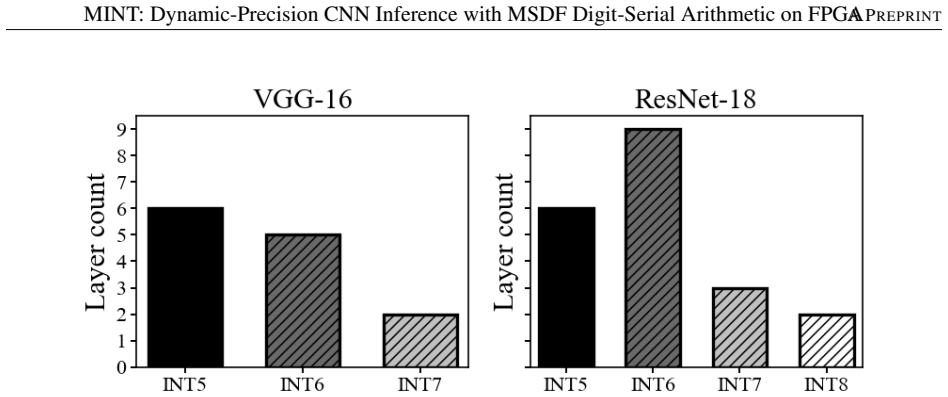
- The average precision drops to 5.64 bits for VGG-16 and 6.04 bits for ResNet-18.
- Throughput increases by 32.6% for VGG-16 and 26.0% for ResNet-18 compared to INT8.
- Energy efficiency rises by 82.10% for VGG-16 and 62.90% for ResNet-18 over INT8.
- MINT outperforms other listed FPGA CNN accelerators in energy efficiency on the Zynq-7020 platform.
Where Pith is reading between the lines
- The greedy search method for precision selection could be tested on additional networks like MobileNet to check if accuracy stays within 2% loss.
- Combining this early-termination approach with weight pruning might allow even lower average precision without extra accuracy cost.
- Similar digit-serial techniques may apply to other arithmetic-intensive tasks beyond CNNs on resource-constrained FPGAs.
Editorial analysis
A structured set of objections, weighed in public.
Referee Report
Summary. The paper presents MINT, a dynamic-precision CNN inference accelerator on FPGA that uses left-to-right MSDF digit-serial arithmetic with redundant signed-digit representation in a serial-parallel inner-product unit. A budget-constrained greedy search selects per-layer precisions from INT2 to INT7 for VGG-16 and ResNet-18 to keep total accuracy loss within 2% of the INT8 baseline, yielding average bit widths of 5.64 and 6.04. Synthesis on Xilinx Zynq-7020 at 200 MHz reports throughputs of 19.86 GOPS (VGG-16) and 18.86 GOPS (ResNet-18) with energy efficiencies of 29.51 and 26.40 GOPS/W, claimed to be 82.10% and 62.90% higher than INT8 with accuracy drops of 1.81% and 1.96%, and the highest among compared designs.
Significance. If the accuracy evaluation holds under proper controls, the work offers a concrete demonstration of combining MSDF arithmetic with per-layer dynamic precision to improve energy efficiency on low-end FPGAs without retraining. The explicit synthesis numbers on Zynq-7020 and direct comparisons to INT8 and prior accelerators provide reproducible performance deltas that could inform similar designs.
major comments (3)
- [abstract and §4 (precision selection)] The description of the budget-constrained greedy search (abstract and §4) does not specify the dataset split used for precision selection versus final accuracy reporting, nor whether MSDF redundant-digit rounding effects were included in the profiled accuracy metric; this directly affects whether the reported 1.81% and 1.96% drops for VGG-16 and ResNet-18 are free of selection bias.
- [§5 (experimental results)] §5 (experimental results): accuracy is reported relative to an INT8 baseline with only aggregate drops given, but without details on the number of images evaluated, the exact dataset (e.g., ImageNet validation split size), or cross-check between software profiling and post-synthesis hardware simulation, limiting verification of the central performance-accuracy trade-off claim.
- [§5 (experimental results)] Table or results comparison in §5: the claim of highest energy efficiency among listed designs on Zynq-7020 rests on the reported GOPS/W figures, but the paper provides no breakdown of how dynamic precision affects the actual hardware resource utilization or clock frequency across the selected precisions, which is load-bearing for the efficiency delta.
minor comments (2)
- [abstract] The abstract uses LaTeX commands such as \SI{200}{\mega\hertz} that should be rendered consistently in the final manuscript.
- [§4] Notation for average bit width (5.64/6.04) and the exact definition of the accuracy metric (top-1 or top-5) could be clarified in the methods section for reproducibility.
Simulated Author's Rebuttal
We thank the referee for their constructive comments on the MINT paper. We provide point-by-point responses to the major comments below, indicating revisions where we agree additional details are warranted.
read point-by-point responses
-
Referee: [abstract and §4 (precision selection)] The description of the budget-constrained greedy search (abstract and §4) does not specify the dataset split used for precision selection versus final accuracy reporting, nor whether MSDF redundant-digit rounding effects were included in the profiled accuracy metric; this directly affects whether the reported 1.81% and 1.96% drops for VGG-16 and ResNet-18 are free of selection bias.
Authors: The manuscript's §4 describes the greedy search but omits explicit mention of the dataset split. The precision selection and accuracy profiling were both performed on the ImageNet validation set using a software model that incorporates the MSDF redundant signed-digit rounding. We will revise the abstract and §4 to specify the use of the validation set (50k images) for both steps and confirm inclusion of rounding effects in the accuracy metric. This addresses the potential selection bias concern by making the methodology transparent. revision: yes
-
Referee: [§5 (experimental results)] §5 (experimental results): accuracy is reported relative to an INT8 baseline with only aggregate drops given, but without details on the number of images evaluated, the exact dataset (e.g., ImageNet validation split size), or cross-check between software profiling and post-synthesis hardware simulation, limiting verification of the central performance-accuracy trade-off claim.
Authors: We agree that §5 lacks these specifics. Accuracy drops were computed over the entire ImageNet validation set of 50,000 images. The software profiling used a cycle-accurate and bit-accurate model of the MSDF units. Post-synthesis verification was performed via RTL simulation on representative layers matching the software results within floating-point tolerance. We will update §5 with these details, including the image count and verification method, to strengthen the claim. revision: yes
-
Referee: [§5 (experimental results)] Table or results comparison in §5: the claim of highest energy efficiency among listed designs on Zynq-7020 rests on the reported GOPS/W figures, but the paper provides no breakdown of how dynamic precision affects the actual hardware resource utilization or clock frequency across the selected precisions, which is load-bearing for the efficiency delta.
Authors: The synthesis results in §5 are for the complete design with the selected per-layer precisions at a fixed 200 MHz clock. The MSDF architecture allows the clock frequency to remain constant as the serial nature makes the critical path independent of bit-width. Resource utilization is reduced proportionally to the average bit-width (5.64 vs 8 for VGG-16). However, the paper does not include a detailed per-precision resource table. We will add a breakdown in §5 showing estimated resource scaling and confirm the frequency is unchanged, supporting the efficiency comparison. If the referee requires more, we can include additional synthesis data for individual precisions. revision: partial
Circularity Check
No circularity; results from direct FPGA synthesis and empirical profiling
full rationale
The paper's claims rest on hardware synthesis of the MSDF serial-parallel inner-product unit on Zynq-7020 and accuracy measurements obtained by profiling convolution layers with a budget-constrained greedy search over INT2-INT7 precisions. No equations, derivations, or parameter fits are presented that reduce a claimed prediction back to its own inputs by construction. No self-citations are invoked as load-bearing uniqueness theorems, and no ansatzes or known results are renamed. The reported GOPS, GOPS/W, and accuracy drops (1.81% and 1.96%) are direct outputs of the synthesis tool and the search procedure rather than self-referential quantities.
Axiom & Free-Parameter Ledger
free parameters (1)
- per-layer precision selection
Cite this review
Pith. "Pith review of MINT: Dynamic-Precision CNN Inference with MSDF Digit-Serial Arithmetic on FPGA." pith.science (2026). https://pith.science/paper/QNKDIEIS
@misc{pith2026260631514,
  author       = {Pith},
  title        = {Pith review of: MINT: Dynamic-Precision CNN Inference with MSDF Digit-Serial Arithmetic on FPGA},
  year         = {2026},
  howpublished = {\url{https://pith.science/paper/QNKDIEIS}},
  note         = {Machine review of arXiv:2606.31514}
}
read the original abstract
We present MINT, a dynamic-precision CNN inference accelerator based on left-to-right (LR) arithmetic. LR arithmetic computes in most-significant-digit-first manner and exposes useful partial results early so that the computation can be terminated once the desired precision is achieved. At the core, there is a MSDF serial-parallel inner-product unit, which uses redundant signed-digit representation to compute each convolution window. A budget-constrained greedy search profiles all convolution layers from INT2 to INT7 and selects the lowest precision per layer while constraining total accuracy loss to within 2\% of the INT8 baseline for VGG-16 and ResNet-18 networks. The design is synthesized on a Xilinx Zynq-7020 at \SI{200}{\mega\hertz}, and uses 5.64 average bits for VGG-16 and 6.04 for ResNet-18, while achieving 19.86 GOPS and 29.51 GOPS/W on VGG-16, and 18.86 GOPS and 26.40 GOPS/W on ResNet-18. This corresponds to 32.6\% and 26.0\% higher throughput and 82.10\% and 62.90\% higher energy efficiency than INT8 with only 1.81\% and 1.96\% drops relative to the INT8 baseline. Compared with representative prior FPGA CNN accelerators considered in this study, MINT delivers the highest energy efficiency among the listed VGG-16 and ResNet-18 designs on Zynq-7020 platform.
Figures




Reference graph
Works this paper leans on
-
[1]
A review of convolutional neural networks in computer vision,
X. Zhao, L. Wang, Y . Zhang, X. Han, M. Deveci, and M. Parmar, “A review of convolutional neural networks in computer vision,”Artificial Intelligence Review, vol. 57, no. 4, p. 99, 2024
work page 2024
-
[2]
A review of state-of-the-art mixed-precision neural network frameworks,
M. Rakka, M. E. Fouda, P. Khargonekar, and F. Kurdahi, “A review of state-of-the-art mixed-precision neural network frameworks,”IEEE Transactions on Pattern Analysis and Machine Intelligence, vol. 46, no. 12, pp. 7793–7812, 2024
work page 2024
-
[3]
Haq: Hardware-aware automated quantization with mixed pre- cision,
K. Wang, Z. Liu, Y . Lin, J. Lin, and S. Han, “Haq: Hardware-aware automated quantization with mixed pre- cision,” inProceedings of the IEEE/CVF conference on computer vision and pattern recognition, 2019, pp. 8612–8620
work page 2019
-
[4]
M. D. Ercegovac and T. Lang,Digital Arithmetic. Elsevier / Morgan Kaufmann, 2004
work page 2004
-
[5]
M. Usman, M. D. Ercegovac, and J.-A. Lee, “Low-latency online multiplier with reduced activities and mini- mized interconnect for inner product arrays,”Journal of Signal Processing Systems, vol. 95, no. 7, pp. 777–796, 2023
work page 2023
-
[6]
DSLR-CNN: Efficient CNN acceleration using digit-serial left-to-right arithmetic,
M. Z. Nisar, M. S. Ibrahim, S. Gorgin, M. Usman, and J.-A. Lee, “DSLR-CNN: Efficient CNN acceleration using digit-serial left-to-right arithmetic,”IEEE Access, vol. 12, pp. 172 063–172 078, 2024
work page 2024
-
[7]
Imagenet: A large-scale hierarchical image database,
J. Deng, W. Dong, R. Socher, L.-J. Li, K. Li, and L. Fei-Fei, “Imagenet: A large-scale hierarchical image database,” in2009 IEEE conference on computer vision and pattern recognition. Ieee, 2009, pp. 248–255
work page 2009
-
[8]
Opu: An fpga-based overlay processor for convolutional neural networks,
Y . Yu, C. Wu, T. Zhao, K. Wang, and L. He, “Opu: An fpga-based overlay processor for convolutional neural networks,”IEEE Transactions on Very Large Scale Integration (VLSI) Systems, vol. 28, no. 1, pp. 35–47, 2019
work page 2019
-
[9]
Caffeine: Towards uniformed representation and acceleration for deep convolutional neural networks,
C. Zhang, Z. Fang, P. Zhou, P. Pan, and J. Cong, “Caffeine: Towards uniformed representation and acceleration for deep convolutional neural networks,” inProceedings of the 35th International Conference on Computer- Aided Design, 2016, pp. 1–8
work page 2016
-
[10]
Fpga-based high-throughput cnn hardware accelerator with high computing resource utilization ratio,
W. Huang, H. Wu, Q. Chen, C. Luo, S. Zeng, T. Li, and Y . Huang, “Fpga-based high-throughput cnn hardware accelerator with high computing resource utilization ratio,”IEEE Transactions on Neural Networks and Learning Systems, vol. 33, no. 8, pp. 4069–4083, 2021. 10 MINT: Dynamic-Precision CNN Inference with MSDF Digit-Serial Arithmetic on FPGAA PREPRINT
work page 2021
-
[11]
C. Yang, Y . Yang, Y . Meng, K. Huo, S. Xiang, J. Wang, and L. Geng, “Flexible and efficient convolutional acceleration on unified hardware using the two-stage splitting method and layer-adaptive allocation of 1-d/2-d winograd units,”IEEE Transactions on Computer-Aided Design of Integrated Circuits and Systems, vol. 43, no. 3, pp. 919–932, 2024
work page 2024
-
[12]
P. Meloni, A. Capotondi, G. Deriu, M. Brian, F. Conti, D. Rossi, L. Raffo, and L. Benini, “Neuraghe: Exploiting cpu-fpga synergies for efficient and flexible cnn inference acceleration on zynq socs,”ACM Transactions on Reconfigurable Technology and Systems (TRETS), vol. 11, no. 3, pp. 1–24, 2018
work page 2018
-
[13]
An efficient and flexible accelerator design for sparse convolutional neural networks,
X. Xie, J. Lin, Z. Wang, and J. Wei, “An efficient and flexible accelerator design for sparse convolutional neural networks,”IEEE Transactions on Circuits and Systems I: Regular Papers, vol. 68, no. 7, pp. 2936–2949, 2021
work page 2021
-
[14]
M. S. Ibrahim, M. Usman, and J.-A. Lee, “Echo: Energy-efficient computation harnessing online arithmetic—an msdf-based accelerator for dnn inference,”Electronics, vol. 13, no. 10, p. 1893, 2024
work page 2024
-
[15]
Evaluating fast algorithms for convolutional neural networks on fpgas,
Y . Liang, L. Lu, Q. Xiao, and S. Yan, “Evaluating fast algorithms for convolutional neural networks on fpgas,” IEEE Transactions on Computer-Aided Design of Integrated Circuits and Systems, vol. 39, no. 4, pp. 857–870, 2019. 11
work page 2019
This paper was first reviewed by grok-4.3 on July 1, 2026.
discussion (0)
Sign in with ORCID, Apple, or X to comment. Anyone can read and Pith papers without signing in.