REVIEW 1 major objections 1 minor 41 references
2.5D Root of Trust: Securing the Chiplet Ecosystem
T0 review · 1 major / 1 minor · reviewed 2026-06-26 · grok-4.3
Pith's one-line read An active interposer can act as a physically isolated 2.5D root of trust that enforces memory permissions and blocks coherence attacks on commodity chiplets without any changes to those chiplets.
desk verdict The paper sketches a conceptual 2.5D Root of Trust via an active interposer but leaves the trust model and enforcement mechanisms at a high level without supporting analysis. read the letter →
The pith
A machine-rendered reading of the paper's core claim, the machinery that carries it, and where it could break.
The reading
What carries the argument
The active interposer fabric configured as a physically isolated 2.5D root of trust, with embedded transaction monitors and coherence message checkers that inspect and gate all inter-chiplet traffic.
What would settle it
Demonstration of a coherence forging attack or unauthorized memory access that succeeds despite the presence of interposer-embedded monitors and checkers.
Extended reading notes
Core claim
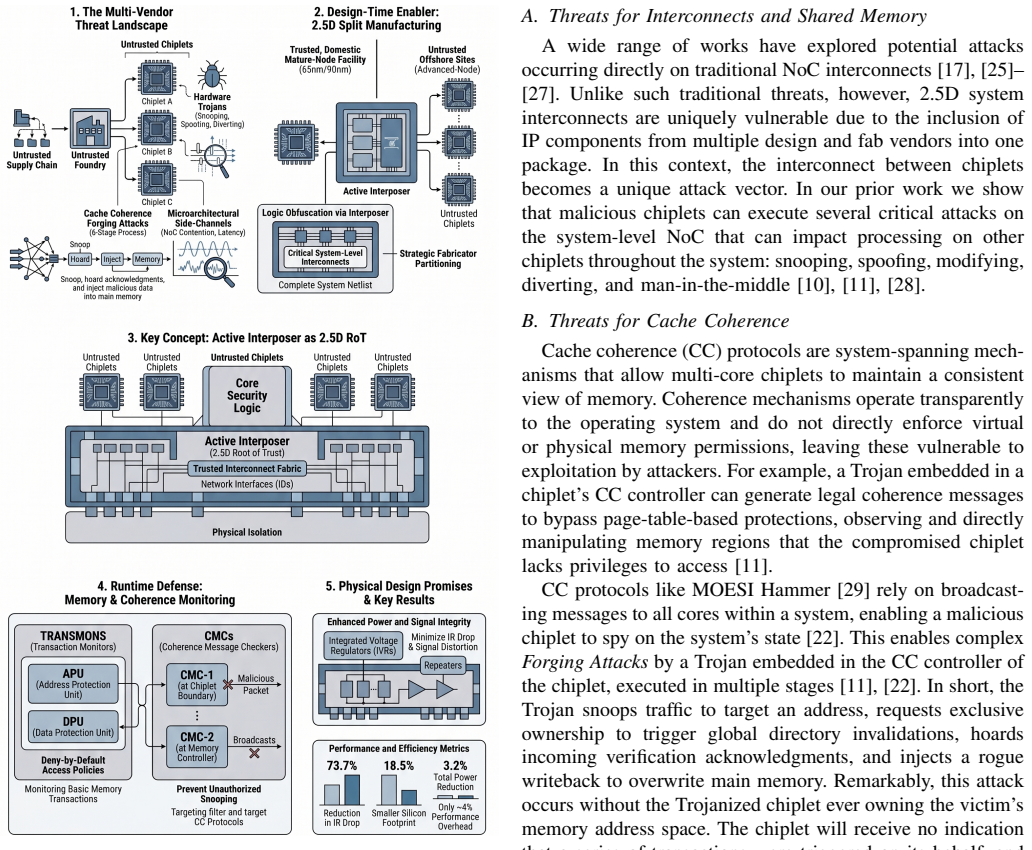
By embedding transaction monitors and coherence message checkers within the trusted interposer fabric, the system enforces memory access permissions by construction and neutralizes coherence-level attacks without need for modifying or securing the commodity chiplets.
Load-bearing premise
The interposer can be fabricated and operated as a fully trusted component even when sourced from potentially untrusted vendors.
Editorial extensions
If this is right
- Memory access permissions become enforced directly by the interposer hardware rather than by the chiplets.
- Coherence-level attacks are blocked at the message level without requiring changes inside individual chiplets.
- The same interposer defenses address interconnect snooping, spoofing, and man-in-the-middle attacks.
- EDA flows for the interposer can be used to reduce overall system power and improve signal integrity.
- Heterogeneous multi-vendor chiplet systems become viable without securing every participating die.
Reading between the lines
- The same monitor placement could extend to other 2.5D or 3D integration schemes where a central fabric is already present.
- Designers could prioritize interposer trust over per-chiplet security features when sourcing parts from multiple foundries.
- Runtime monitoring in the interposer might also limit the effectiveness of certain microarchitectural side channels that rely on shared coherence traffic.
Editorial analysis
A structured set of objections, weighed in public.
Referee Report
Summary. The manuscript is a perspective paper surveying security threats in 2.5D chiplet ecosystems (interconnect attacks, cache coherence exploits, and microarchitectural side channels) and proposing an active interposer as a physically isolated 2.5D Root of Trust. The central claim is that embedding transaction monitors and coherence message checkers in the interposer fabric enforces memory access permissions by construction and neutralizes coherence-level attacks without modifying commodity chiplets; design-time 2.5D split manufacturing is examined to address untrusted vendors for any component including the interconnect, and EDA flows are reviewed that also improve power, signal integrity, and footprint.
Significance. If the architectural proposal holds, it offers a concrete way to concentrate trust in the interposer for heterogeneous multi-vendor systems, reducing the attack surface on individual chiplets. The survey of threat categories and existing strategies provides a useful framing for the field. The paper explicitly credits split manufacturing as a design-time complement to runtime isolation and notes concurrent benefits to power and signal integrity.
major comments (1)
- [Abstract] Abstract: the central claim that the active interposer can be positioned as a 'physically isolated 2.5D RoT' that 'enforces memory access permissions by construction' rests on the assumption that split manufacturing suffices to prevent subversion of the embedded transaction monitors and coherence checkers even when the interconnect fabric originates from an untrusted vendor. No concrete mechanism, threat model, or verification argument is supplied showing that the monitors themselves remain sound under this supply-chain constraint.
minor comments (1)
- The phrase 'so-called transaction monitors' is introduced without a definition or forward reference; a one-sentence description of their intended function would aid readability.
Simulated Author's Rebuttal
We thank the referee for this constructive comment on the abstract. The observation correctly identifies that our high-level positioning of the active interposer as a 2.5D RoT rests on an implicit assumption about split manufacturing that is not elaborated with mechanisms or arguments in the current text. We will revise accordingly.
read point-by-point responses
-
Referee: [Abstract] Abstract: the central claim that the active interposer can be positioned as a 'physically isolated 2.5D RoT' that 'enforces memory access permissions by construction' rests on the assumption that split manufacturing suffices to prevent subversion of the embedded transaction monitors and coherence checkers even when the interconnect fabric originates from an untrusted vendor. No concrete mechanism, threat model, or verification argument is supplied showing that the monitors themselves remain sound under this supply-chain constraint.
Authors: We agree that the manuscript, as a perspective paper, presents the active interposer proposal at an architectural level and does not supply a concrete mechanism, threat model, or verification argument demonstrating that split manufacturing alone suffices to protect the embedded monitors and checkers. The text treats split manufacturing as a complementary design-time defense that, together with the runtime isolation properties of the interposer, enables the RoT claim, but this dependency is not made explicit. We will revise the abstract to qualify the claim (e.g., “under the assumption of trusted interposer fabrication via split manufacturing”) and will add a short discussion paragraph noting that detailed supply-chain verification of the interposer remains an open research question. This change will align the stated claims with the scope and depth of the paper. revision: yes
Circularity Check
No circularity: conceptual proposal without derivations or self-referential steps
full rationale
The paper is a perspective survey on 2.5D chiplet security threats and defenses. It presents no equations, fitted parameters, predictions, or derivation chains. The central proposal—that an active interposer can serve as a trusted RoT by embedding monitors and checkers—rests on stated architectural assumptions about physical isolation and split manufacturing rather than any reduction to prior inputs by construction. No self-citations are invoked as load-bearing uniqueness theorems, and no ansatzes or renamings of known results appear. The absence of mathematical or empirical modeling means the circularity patterns do not apply.
Assumptions & free parameters
assumptions (1)
- domain assumption The interposer can be manufactured and operated as a trusted component separate from untrusted chiplets.
invented entities (1)
-
2.5D Root of Trust via active interposer
Cite this review
Pith. "Pith review of 2.5D Root of Trust: Securing the Chiplet Ecosystem." pith.science (2026). https://pith.science/paper/QO6YXM5R
@misc{pith2026260622198,
  author       = {Pith},
  title        = {Pith review of: 2.5D Root of Trust: Securing the Chiplet Ecosystem},
  year         = {2026},
  howpublished = {\url{https://pith.science/paper/QO6YXM5R}},
  note         = {Machine review of arXiv:2606.22198}
}
read the original abstract
The semiconductor industry is rapidly transitioning from monolithic systems-on-chip toward heterogeneous, multi-vendor 2.5D chiplet ecosystems integrated via silicon interposers. While this paradigm shift offers immense benefits in yield, cost, and time-to-market, it radically expands the attack surface. Integrating chiplets from untrusted foundries and design houses introduces vulnerabilities to hardware Trojans, IP piracy, and system-level communication exploits. Critically, chip-level security features and conventional Root of Trust (RoT) proposals are insufficient in this context: any component, including the interconnect fabric itself, may be sourced from an untrusted vendor. This perspective paper surveys state-of-the-art security strategies for interposer-based 2.5D integration, focusing on three threat categories: interconnect attacks (snooping, spoofing, and man-in-the-middle), cache coherence exploits including complex forging attacks, and microarchitectural side-channel threats. We examine design-time defenses via 2.5D split manufacturing and, more crucially, runtime defenses that establish an active interposer as a physically isolated 2.5D RoT. By embedding so-called transaction monitors and coherence message checkers within the trusted interposer fabric, the system enforces memory access permissions by construction and neutralizes coherence-level attacks without need for modifying/securing the commodity chiplets. Finally, we review the EDA flows required to realize these defenses and show they concurrently improve power and signal integrity while reducing overall system footprint.
Figures
Reference graph
Works this paper leans on
-
[1]
Understanding chiplets today to anticipate future integration opportunities and limits,
G. H. Loh, S. Naffziger, and K. Lepak, “Understanding chiplets today to anticipate future integration opportunities and limits,” inProc. DATE. IEEE, 2021, pp. 142–145
2021
-
[2]
Architecture, chip, and package co- design flow for 2.5 d ic design enabling heterogeneous ip reuse,
J. Kim, G. Murali, H. Park, E. Qin, H. Kwon, V . Chaitanya, K. Chekuri, N. Dasari, A. Singh, M. Leeet al., “Architecture, chip, and package co- design flow for 2.5 d ic design enabling heterogeneous ip reuse,” in Proc. DAC, 2019, pp. 1–6
2019
-
[3]
2.2 amd chiplet architecture for high-performance server and desktop products,
S. Naffziger, K. Lepak, M. Paraschou, and M. Subramony, “2.2 amd chiplet architecture for high-performance server and desktop products,” inProc. ISSCC, 2020, pp. 44–45
2020
-
[4]
Pioneering chiplet technology and design for the amd epyc™ and ryzen™ processor families: Industrial product,
S. Naffziger, N. Beck, T. Burd, K. Lepak, G. H. Loh, M. Subramony, and S. White, “Pioneering chiplet technology and design for the amd epyc™ and ryzen™ processor families: Industrial product,” inProc. ISCA. IEEE, 2021, pp. 57–70
2021
-
[5]
Apple unveils M1 Ultra, the world’s most powerful chip for a personal computer,
Apple Inc., “Apple unveils M1 Ultra, the world’s most powerful chip for a personal computer,” Apple Newsroom, Mar. 2022. [Online]. Available: www.apple.com/newsroom/2022/03/ apple-unveils-m1-ultra-the-worlds-most-powerful-chip-for-a-personal-computer/
2022
-
[6]
Amd instinct™ mi300x: a generative ai accelerator and platform architecture,
A. Smith and V . K. Alla, “Amd instinct™ mi300x: a generative ai accelerator and platform architecture,”IEEE Micro, 2025
2025
-
[7]
Sapphire rapids: The next-generation intel xeon scalable processor,
N. Nassif, A. O. Munch, C. L. Molnar, G. Pasdast, S. V . Lyer, Z. Yang, O. Mendoza, M. Huddart, S. Venkataraman, S. Kandulaet al., “Sapphire rapids: The next-generation intel xeon scalable processor,” inProc. ISSCC, vol. 65, 2022, pp. 44–46
2022
-
[8]
D. Blythe, “ XeHPC Ponte Vecchio ,” inProc. HotChips, 2021, pp. 1–34. [Online]. Available: https://doi.ieeecomputersociety.org/10.1109/ HCS52781.2021.9567038
Show all 41 references
-
[9]
3.3 a 14nm 1ghz fpga with 2.5 d transceiver integration,
D. Greenhill, R. Ho, D. Lewis, H. Schmit, K. H. Chan, A. Tong, S. Atsatt, D. How, P. McElheny, K. Duwelet al., “3.3 a 14nm 1ghz fpga with 2.5 d transceiver integration,” inProc. ISSCC, 2017, pp. 54– 55
2017
-
[10]
2.5d root of trust: Secure system-level integration of untrusted chiplets,
M. Nabeel, M. Ashraf, S. Patnaik, V . Soteriou, O. Sinanoglu, and J. Knechtel, “2.5d root of trust: Secure system-level integration of untrusted chiplets,”IEEE Transactions on Computers, vol. 69, no. 11, pp. 1611–1625, 2020
2020
-
[11]
Coherence attacks and countermeasures in interposer- based chiplet systems,
G. A. Chacon, C. Williams, J. Knechtel, O. Sinanoglu, P. V . Gratz, and V . Soteriou, “Coherence attacks and countermeasures in interposer- based chiplet systems,”ACM Transactions on Architecture and Code Optimization (TACO), vol. 21, no. 2, pp. 1–25, 2024
2024
-
[12]
Security technology building a secure system using trustzone technology (white paper),
A. ARM, “Security technology building a secure system using trustzone technology (white paper),”ARM Limited, 2009
2009
-
[13]
Intel® software guard extensions (intel® sgx) support for dynamic memory management inside an enclave,
F. McKeen, I. Alexandrovich, I. Anati, D. Caspi, S. Johnson, R. Leslie- Hurd, and C. Rozas, “Intel® software guard extensions (intel® sgx) support for dynamic memory management inside an enclave,” inProc. Hardware and Architectural Support for Security and Privacy, 2016, pp. 1–9
2016
-
[14]
Securing system-on-chips: Hardware protection in the age of chiplets,
L. Liu, “Securing system-on-chips: Hardware protection in the age of chiplets,” PUFsecurity, May 2023, accessed: Apr. 11,
2023
-
[15]
Available: https://www.pufsecurity.com/document/ securing-system-on-chips-hardware-protection-in-the-age-of-chiplets/
[Online]. Available: https://www.pufsecurity.com/document/ securing-system-on-chips-hardware-protection-in-the-age-of-chiplets/
-
[16]
From monolithic SoCs to chiplets: A new hardware security paradigm,
Rambus, “From monolithic SoCs to chiplets: A new hardware security paradigm,” Semiconductor Engineering, Feb. 2026, accessed: Apr. 11, 2026. [Online]. Available: https://semiengineering.com/ from-monolithic-socs-to-chiplets-a-new-hardware-security-paradigm/
2026
-
[17]
Packet header attack by hardware trojan in noc based tcmp and its impact analysis,
V . J. Kulkarni, R. Manju, R. Gupta, J. Jose, and S. Nandi, “Packet header attack by hardware trojan in noc based tcmp and its impact analysis,” inProc. 15th Int. Symp. on Networks-on-Chip, ser. NOCS ’21, 2021, p. 21–28. [Online]. Available: https://doi.org/10.1145/3479876.3481597
2021 doi
-
[18]
A survey of network-on-chip security attacks and countermeasures,
S. Charles and P. Mishra, “A survey of network-on-chip security attacks and countermeasures,”ACM Comput. Surv., vol. 54, no. 5, May 2021. [Online]. Available: https://doi.org/10.1145/3450964
2021 doi
-
[19]
3d integration: Another dimension toward hardware security,
J. Knechtel, S. Patnaik, and O. Sinanoglu, “3d integration: Another dimension toward hardware security,” inProc. IOLTS, 2019, pp. 147– 150
2019
-
[20]
Large-scale 3d chips: Challenges and solutions for design automation, testing, and trustworthy integration,
J. Knechtel, O. Sinanoglu, I. A. M. Elfadel, J. Lienig, and C. C. N. Sze, “Large-scale 3d chips: Challenges and solutions for design automation, testing, and trustworthy integration,”IPSJ Transactions on System and LSI Design Methodology, vol. 10, pp. 45–62, 2017
2017
-
[21]
On mitigation of side-channel attacks in 3d ics: Decorrelating thermal patterns from power and activity,
J. Knechtel and O. Sinanoglu, “On mitigation of side-channel attacks in 3d ics: Decorrelating thermal patterns from power and activity,” inProc. DAC, 2017. [Online]. Available: https: //doi.org/10.1145/3061639.3062293
2017 doi
-
[22]
The hardware trojan war,
S. Bhunia and M. Tehranipoor, “The hardware trojan war,”Cham,, Switzerland: Springer, 2018
2018
-
[23]
Hardware trojan threats to cache coherence in modern 2.5d chiplet systems,
G. A. Chacon, C. Williams, J. Knechtel, O. Sinanoglu, and P. V . Gratz, “Hardware trojan threats to cache coherence in modern 2.5d chiplet systems,”IEEE Computer Architecture Letters, 2022
2022
-
[24]
Secure interposer-based heterogeneous integration,
M. Shafkat, M. Khan, C. Xi, A. A. Khan, M. T. Rahman, M. M. Tehra- nipoor, and N. Asadizanjani, “Secure interposer-based heterogeneous integration,”IEEE Design & Test, vol. 39, no. 6, pp. 156–164, 2022
2022
-
[25]
On hardware security and trust for chiplet-based 2.5D and 3D ICs: Challenges and innovations,
J. Suzano Da Fonseca, F. Abouzeid, G. Di Natale, A. Philippe, and P. Roche, “On hardware security and trust for chiplet-based 2.5D and 3D ICs: Challenges and innovations,”IEEE Access, vol. 12, pp. 29 778– 29 794, 2024
2024
-
[26]
Security assurance for system-on-chip designs with untrusted ips,
A. Basak, S. Bhunia, T. Tkacik, and S. Ray, “Security assurance for system-on-chip designs with untrusted ips,”IEEE Transactions on Information F orensics and Security, vol. 12, no. 7, pp. 1515–1528, 2017
2017
-
[27]
Fort-NoCs: Mitigating the threat of a compromised NoC,
D. M. Ancajas, K. Chakraborty, and S. Roy, “Fort-NoCs: Mitigating the threat of a compromised NoC,” inProc. DAC. ACM, 2014, pp. 158:1–158:6
2014
-
[28]
Secure memory accesses on networks-on-chip,
L. Fiorin, G. Palermo, S. Lukovic, V . Catalano, and C. Silvano, “Secure memory accesses on networks-on-chip,”IEEE Transactions on Comput- ers, vol. 57, no. 9, pp. 1216–1229, 2008
2008
-
[29]
An interposer-based root of trust: Seize the opportunity for secure system-level integration of untrusted chiplets,
M. Nabeel, M. Ashraf, S. Patnaik, V . Soteriou, O. Sinanoglu, and J. Knechtel, “An interposer-based root of trust: Seize the opportunity for secure system-level integration of untrusted chiplets,”CoRR, vol. abs/1906.02044, 2019. [Online]. Available: http://arxiv.org/abs/1906. 02044
1906 arXiv
-
[30]
Cache hierarchy and memory subsystem of the amd opteron processor,
P. Conway, N. Kalyanasundharam, G. Donley, K. Lepak, and B. Hughes, “Cache hierarchy and memory subsystem of the amd opteron processor,”IEEE Micro, vol. 30, no. 2, p. 16–29, 2010. [Online]. Available: https://doi.org/10.1109/MM.2010.31
2010 doi
-
[31]
Concerted wire lifting: Enabling secure and cost-effective split manufacturing,
S. Patnaik, M. Ashraf, H. Li, J. Knechtel, and O. Sinanoglu, “Concerted wire lifting: Enabling secure and cost-effective split manufacturing,” IEEE Transactions on Computer-Aided Design of Integrated Circuits and Systems, vol. 41, no. 2, pp. 266–280, 2022
2022
-
[32]
Rethinking split manufacturing: An information-theoretic approach with secure layout techniques,
A. Sengupta, S. Patnaik, J. Knechtel, M. Ashraf, S. Garg, and O. Sinanoglu, “Rethinking split manufacturing: An information-theoretic approach with secure layout techniques,” inProc. ICCAD, 2017, pp. 329–336
2017
-
[33]
Raise your game for split manufacturing: restoring the true functionality through beol,
S. Patnaik, M. Ashraf, J. Knechtel, and O. Sinanoglu, “Raise your game for split manufacturing: restoring the true functionality through beol,” inProc. DAC, 2018. [Online]. Available: https: //doi.org/10.1145/3195970.3196100
2018 doi
-
[34]
Attacking split manufacturing from a deep learning perspective,
H. Li, S. Patnaik, A. Sengupta, H. Yang, J. Knechtel, B. Yu, E. F. Young, and O. Sinanoglu, “Attacking split manufacturing from a deep learning perspective,” inProc. DAC, 2019. [Online]. Available: https://doi.org/10.1145/3316781.3317780
2019 doi
-
[35]
A new paradigm in split manufacturing: Lock the feol, unlock at the beol,
A. Sengupta, M. Nabeel, M. Ashraf, J. Knechtel, and O. Sinanoglu, “A new paradigm in split manufacturing: Lock the feol, unlock at the beol,”Cryptography, vol. 6, no. 2, 2022. [Online]. Available: https://www.mdpi.com/2410-387X/6/2/22
2022
-
[36]
Un-split: Attacking split manufacturing using link pre- diction in graph neural networks,
L. Alrahis, L. Mankali, S. Patnaik, A. Sengupta, J. Knechtel, and O. Sinanoglu, “Un-split: Attacking split manufacturing using link pre- diction in graph neural networks,” inSecurity, Privacy, and Applied Cryptography Engineering, 2024, pp. 197–213
2024
-
[37]
Best of both worlds: Integration of split manufacturing and camouflaging into a security-driven cad flow for 3d ics,
S. Patnaik, M. Ashraf, O. Sinanoglu, and J. Knechtel, “Best of both worlds: Integration of split manufacturing and camouflaging into a security-driven cad flow for 3d ics,” inProc. ICCAD, 2018, pp. 1–8
2018
-
[38]
A modern approach to ip protection and trojan prevention: Split manufacturing for 3d ics and obfuscation of vertical interconnects,
——, “A modern approach to ip protection and trojan prevention: Split manufacturing for 3d ics and obfuscation of vertical interconnects,” IEEE Transactions on Emerging Topics in Computing, vol. 9, no. 4, pp. 1815–1834, 2019
2019
-
[39]
Securing computer hardware using 3d integrated circuit (ic) technology and split manufac- turing for obfuscation,
F. Imeson, A. Emtenan, S. Garg, and M. Tripunitara, “Securing computer hardware using 3d integrated circuit (ic) technology and split manufac- turing for obfuscation,” inProc. USENIX Security, 2013, pp. 495–510
2013
-
[40]
Security-aware 2.5 d integrated circuit design flow against hardware ip piracy,
Y . Xie, C. Bao, and A. Srivastava, “Security-aware 2.5 d integrated circuit design flow against hardware ip piracy,”Computer, vol. 50, no. 5, pp. 62–71, 2017
2017
-
[41]
Design flow for active interposer-based 2.5- d ics and study of risc-v architecture with secure noc,
H. Park, J. Kim, V . C. K. Chekuri, M. A. Dolatsara, M. Nabeel, A. Bo- jesomo, S. Patnaik, O. Sinanoglu, M. Swaminathan, S. Mukhopadhyay, J. Knechtel, and S. K. Lim, “Design flow for active interposer-based 2.5- d ics and study of risc-v architecture with secure noc,”IEEE Tran...
2020
Reviewed June 26, 2026 · model on record in the stance chip above.
Discussion (0). Sign in to comment.