REVIEW 4 major objections 4 minor 42 references
Future electron–positron colliders could discover the leptophilic gauge boson Z_l, reaching couplings as low as 10^-4 at low mass and masses up to about 3 TeV at high energy.
Reviewed by Pith at T0; open to challenge. T0 means a machine referee read the full paper against a public rubric. the ladder, T0–T4 →
A parton-level projection shows FCC-ee and CEPC can discover a leptophilic Z' down to g_l about 10^-4, while ILC and CLIC extend the search to TeV-scale masses.
T0 review reviewed 2026-08-05 challenge →
load-bearing objection First systematic collider comparison for leptophilic Z', but the signal normalization is unvalidated and the sensitivity contours should be treated as provisional. the 4 major comments →
Searching for the Leptophilic Gauge Boson Z$_{l}$ at Future $e^{+}e^{-}$ Colliders
The pith
A machine-rendered reading of the paper's core claim, the machinery that carries it, and where it could break.
The reading
Core claim
The paper's central claim is that a leptophilic U'(1) gauge boson Z_l, if it exists with a mass below or near a future e+e− collider's energy, would appear as a sharp resonance in the e+e− → μ+μ− cross section, and that the four major proposed colliders have complementary discovery reaches. At FCC-ee and CEPC, running at 240 GeV with very high luminosity, the 5σ reach dips to couplings g_l ≈ 10^-4 for masses near 100–240 GeV. At ILC and CLIC, the reach shifts to larger masses: the 250/500 GeV ILC stages and the 380 GeV CLIC stage cover the sub-TeV region, and the 1.5 and 3 TeV CLIC stages extend sensitivity to Z_l masses up to about 1.5 and 3 TeV with g_l of order 10^-3. The significance is
What carries the argument
The central object is the Z_l boson, a new vector gauge boson associated with a U'(1)_l symmetry that gauges universal lepton number; its defining property is that it couples to e, μ, τ and their neutrinos with strength g_l but essentially not to quarks, so it evades the strong bounds from hadron colliders. The mass arises from a singlet Higgs field carrying lepton charge, and the model's parameter space is constrained by the relation M_Zl/g_l ≳ 7 TeV from precision electroweak data. The search mechanism is resonant production: in e+e− → μ+μ−, the Z_l appears as a peak when the centre-of-mass energy matches its mass; the sensitivity is set by counting dimuon events in a 10 GeV invariant-mass
Load-bearing premise
The reach curves assume the simulated effective collision-energy distribution from initial-state radiation and beamstrahlung, with the beam parameters in Table 1, matches the real machines' energy spread; the paper gives no benchmark validation for that simulation.
What would settle it
A precise measurement of e+e−→μ+μ− at off-resonance energies (e.g., √s = 240 GeV at FCC-ee) that disagrees with the paper's simulated Standard Model background by more than the quoted statistical error would invalidate the background model on which the 5σ contours rest.
If this is right
- FCC-ee and CEPC, running near 240 GeV, can discover a leptophilic Z_l with coupling as low as g_l ~ 10^-4, making them the most sensitive probes of weakly coupled leptophilic forces at low mass.
- The high-energy CLIC stages (1.5 and 3 TeV) can extend the discovery reach to Z_l masses around 1.5–3 TeV at couplings of a few × 10^-3, territory inaccessible to the circular machines.
- The combined reach of the four machines covers a wide, complementary swath of the (M_Zl, g_l) plane, from g_l ~ 10^-4 at 100 GeV to g_l ~ 10^-3 at 3 TeV.
- Because the e+e− and τ+τ− modes are background-dominated (Bhabha scattering and missing-energy neutrinos, respectively), the μ+μ− final state is the decisive search channel for a leptophilic boson at e+e− colliders.
- The adopted bound M_Zl/g_l ≳ 7 TeV implies that at a given mass the coupling cannot be arbitrarily large, so the regions plotted in the reach plots are the only regions colliders of these energies can hope to test.
Where Pith is reading between the lines
- The same resonance-search logic should apply to other anomaly-free leptophilic combinations such as L_μ − L_τ; the reach curves here suggest that high-luminosity circular machines would probe their small couplings, while linear colliders would chase their heavy partners.
- Since the 10 GeV invariant-mass window is much wider than the intrinsic width of a very weakly coupled Z_l, a narrower or adaptive window could push the g_l ~ 10^-4 limit further down, at the cost of larger background-systematic sensitivity.
- If a Z_l were found, its leptophilic nature could be tested by comparing the μ+μ− and τ+τ− rates and by measuring the forward–backward asymmetry in the dimuon channel; those observables are not included in the present significance formula.
- The paper's reach plots assume the ISR/beamstrahlung implementation reproduces the real machines' energy spread; a direct measurement of the effective luminosity spectrum at each collider (e.g., from Bhabha scattering) would provide the first concrete validation and could be used to convert the contours into actual run plans.
Editorial analysis
A structured set of objections, weighed in public.
Referee Report
Summary. The paper studies a Standard Model extension with a gauged universal lepton number U(1)_ℓ, whose gauge boson Z_ℓ couples to e, μ, τ and their neutrinos. The analysis is based on e+e− → μ+μ− at FCC-ee, CEPC, ILC, and CLIC, simulated in CalcHEP with initial-state radiation and beamstrahlung. The authors define a simple significance formula with a 10 GeV invariant-mass window and |η|<2, and present 3σ/5σ reach contours in the (M_Zℓ, g_ℓ) plane. The central claims are that circular colliders reach couplings down to g_ℓ ∼ 10^-4 at low masses and that high-energy linear colliders extend the reach into the TeV range.
Significance. The paper addresses a timely question and, if correct, would provide a useful systematic comparison of future e+e− colliders for a leptophilic Z′. The model is explicit and the parameter scan is not circular: no parameter is fitted to data, and the electroweak precision bound is taken from external literature. The main weakness is the absolute normalization of the signal cross sections, which appears inconsistent with the Lagrangian; since the significance in Eq. (7) uses the absolute signal yield, the quoted reach contours are suspect. The model also lacks a discussion of gauge anomalies. These issues are concrete and testable, and they must be resolved before the numerical conclusions can be accepted.
major comments (4)
- [§3, Eq. (3), Figs. 5 and 6] The plotted on-resonance cross sections are incompatible with the model's own Lagrangian. For a vector-like coupling g_ℓ to all leptons, Γ(Z_ℓ→ℓ+ℓ−) ≈ g_ℓ² M/(12π). For g_ℓ=0.03 and M=240 GeV the total width is of order 26–34 MeV (depending on neutrino chiralities), and the exact on-peak σ(e+e−→μ+μ−) is 12π Γ_ee Γ_μμ/(M² Γ_tot²) ≈ 20–30 pb, with further suppression after convolution with ISR/beamstrahlung. Yet the 'No(ISR+BS)' curve in Fig. 5 and the ISR+BS curve in Fig. 6 show values many orders of magnitude larger (up to 10^6–10^7 pb). This indicates that the width used in the CalcHEP implementation is not the g_ℓ-dependent width following from Eq. (3). Because Eq. (7) scales with the square root of the signal yield, an inflation by several orders of magnitude in cross section shifts the 5σ contours to substantially larger g_ℓ. The central claim of sensitivity down to g_ℓ ∼ 10^-4 is th
- [§2, Eqs. (3)–(5)] The model gauges U(1)_ℓ with only SM leptons charged. This Abelian symmetry is anomalous: the SM fermion content does not cancel U(1)_ℓ³, U(1)_ℓ × SU(2)², or U(1)_ℓ × U(1)_Y² anomalies. The singlet scalar Φ introduced in Eq. (3) does not cancel these anomalies. The authors should either add anomaly-cancelling fermions (which would modify the Z_ℓ couplings and width) or clearly state that this is a simplified effective model with the anomaly completion implicit. This is not merely a formal concern: the precision bound of Eq. (6) is borrowed from a specific Z′ framework, and the Z_ℓ width used in the simulation depends on the full particle content.
- [§3, Table 1, Figs. 9–12] The reach contours depend entirely on the effective collision-energy distribution produced by ISR and beamstrahlung, especially for a narrow resonance. No validation of the CalcHEP ISR/BS implementation is provided against known analytic results or independent Monte Carlo codes. The energy spread changes between the circular and linear machines, and small changes in this spread can alter the on-resonance luminosity by a large factor, moving the reach in g_ℓ by orders of magnitude for narrow Z_ℓ states. The authors should benchmark the ISR/BS spectra (e.g., reproduce the SM muon-pair invariant-mass distribution and demonstrate stability under beam-parameter uncertainties) before the claimed complementarity can be considered robust.
- [§3, Eq. (7)] The significance formula uses only statistical fluctuations of the SM background and ignores systematic uncertainties, detector efficiencies, and acceptance corrections beyond the simple |η|<2 and |M−M_Zℓ|<10 GeV cuts. At FCC-ee/CEPC luminosities of order 1 ab^-1, even sub-percent systematic uncertainties on a large μμ background can dominate the significance. This is acknowledged as a future extension in the conclusions, but for the central 5σ discovery claim the numerical reach contours should at least quantify how much they degrade under a plausible systematic uncertainty. This is a load-bearing limitation rather than a purely presentational one.
minor comments (4)
- [Table 2] The entries in Table 2 are internally inconsistent with Eq. (6). For example, M_Zℓ=0.25 TeV gives g_ℓ ≤ 0.036, not 0.25; M_Zℓ=0.38 TeV gives 0.054, not 0.035; and '0.24' appears twice with different g_ℓ values. The table should be corrected (or regenerated) so that g_ℓ ≤ M_Zℓ/(7 TeV) is satisfied throughout.
- [Section numbering] The text jumps from Section 3 directly to Section 5 (Conclusions). The definitions of Eq. (7) and Figs. 9–12 belong to a missing Section 4. The section numbering should be fixed.
- [Figure captions] Some captions mix 'Z_l', 'Zℓ', and 'MZl'; they should use a single notation consistently (e.g., M_Zℓ or M_{Z_ℓ}). In addition, the x-axis of Fig. 6 is truncated at g_ℓ=10^-2 while the text discusses g_ℓ=0.03; the axis range should be extended or the discussion adjusted.
- [References] Reference [11] appears to have an incomplete author list ('J.W. Brockway' alone for a 2010 Phys. Lett. B paper) and reference [31] may be incomplete. The reference list should be checked against the published versions.
Circularity Check
No significant circularity: reach is computed from an explicit Lagrangian and parameter scan; self-citations are historical and non-load-bearing.
full rationale
The derivation chain is self-contained. The model is defined by the explicit Lagrangian in Eqs. (1)-(5); signal and SM background cross sections are computed in CalcHEP from this Lagrangian, and the collider parameters in Table 1 are external machine specifications. No parameter is fitted to data that is then 'predicted'; couplings and masses are scanned freely. The precision bound M_Zl/g_l > 7 TeV (Eq. (6)) is imported from an external reference [34] and acts as an input constraint, not as a restatement of the reach. The significance formula (Eq. (7)) is a standard statistical estimator, not a tautological definition of the signal. The paper's self-citations [18]-[21] are historical attributions for the massive leptophilic gauge boson and do not carry any derivation step; there is no imported uniqueness theorem and no ansatz smuggled via citation. The acknowledged lack of detector simulation and systematic uncertainties (Conclusions) is a validation/correctness limitation, and the unvalidated normalization of the plotted resonance peaks is an internal consistency concern, but neither reduces the prediction to its inputs. Therefore no circular step is present.
Axiom & Free-Parameter Ledger
free parameters (2)
- Invariant mass window |M_mu+mu- - M_Zl| < 10 GeV =
10 GeV
- Muon pseudorapidity acceptance |eta_mu| < 2 =
2
axioms (4)
- domain assumption Gauged universal lepton number U(1)_L with SM fermion content is a consistent gauge theory
- domain assumption No kinetic mixing between U(1)_Y and U'(1)
- domain assumption The EWPT bound M_Zl/g_l > 7 TeV from Ref. [34] applies to this model
- domain assumption Poisson statistics with negligible systematic uncertainties are adequate for significance
invented entities (1)
-
Complex scalar PHI carrying lepton charge
no independent evidence
Cite this review
Pith. "Pith review of Searching for the Leptophilic Gauge Boson Z$_{l}$ at Future $e^{+}e^{-}$ Colliders." pith.science (2026). https://pith.science/paper/QOVEBSRY
@misc{pith2026250818496,
  author       = {Pith},
  title        = {Pith review of: Searching for the Leptophilic Gauge Boson Z$_l$ at Future $e^+e^-$ Colliders},
  year         = {2026},
  howpublished = {\url{https://pith.science/paper/QOVEBSRY}},
  note         = {Machine review of arXiv:2508.18496}
}
read the original abstract
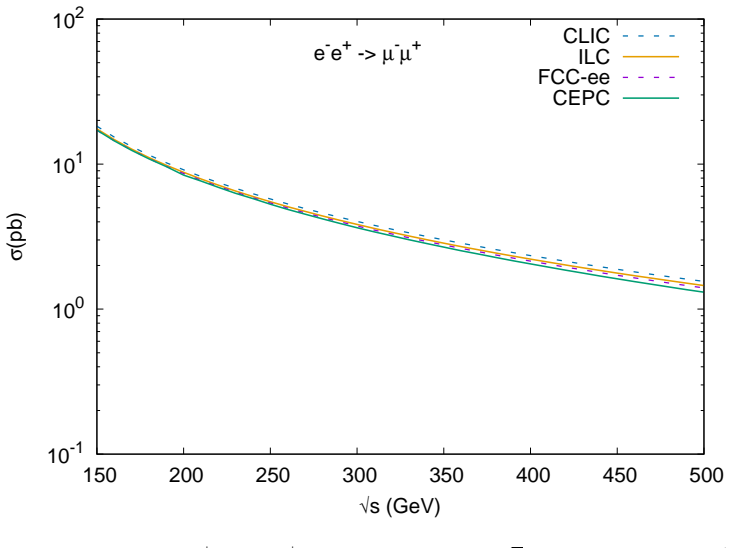
We study the discovery prospects of the leptophilic photon Z\_l, a hypothetical gauge boson beyond the Standard Model, at future electron-positron colliders. Our analysis is based on the process e+e- -> mu+mu- and consistently includes realistic effects such as initial state radiation and beamstrahlung. Using the benchmark parameters of FCC-ee, CEPC, ILC, and CLIC, we demonstrate the complementarity of circular and linear colliders: circular machines achieve excellent sensitivity to very small couplings, down to g\_l ~ 10^{-4}, while high-energy linear colliders extend the search reach into the TeV domain.
Figures


Reference graph
Works this paper leans on
-
[1]
Introduction Proton decay into an electron and a photon ( p → eγ) is strictly forbidden by baryon and lepton number conservation. The idea of gauging these conserved numbers, namely baryon and lepton numbers, in analogy with the electric charge in QED, was fir st suggested by Lee and Yang in 1955 [1] and by Okun in 1969 [2], respectively. This fascinat ing...
work page 1955
-
[2]
The Model To gauge the leptonic quantum number, we extend the Standard Mo del (SM) gauge group SUC(3) × SUW (2) × UY (1) by an additional abelian symmetry U ′ ℓ(1). With the experimental discovery of neutrino oscillations[33], it is no longer valid to conserve electron, muon, and ta u lepton numbers individually. Instead, we introduce a single universal l...
-
[3]
Production of the Z l boson at the electron positron colliders Future e+e− colliders are designed to provide extremely high luminosities and precis ion measurements, not only for Standard Model (SM) particles such a s the Higgs boson but 4 also for exploring physics beyond the SM. The leptophilic boson Zℓ, introduced through the additional U ′ ℓ(1) gauge ...
- [4]
-
[5]
Conclusions In this work, we have investigated the discovery potential of the le ptophilic gauge bo- son Zℓ at future electron–positron colliders, namely FCC-ee, CEPC, ILC, and CLIC. The analysis was based on the process e+e− → µ+µ−, with Initial State Radiation (ISR) and Beamstrahlung (BS) consistently included through the CalcHEP framework. Our results ...
work page 2000
-
[6]
T.D. Lee, C. N. Yang, Phys. Rev. 98 (1955) 1501
work page 1955
- [7]
-
[8]
A.K. C ¸ ift¸ ci, S. Sultansoy, S ¸. T¨ urk¨ oz, Phys. Lett. B355, 494 (1995)
work page 1995
- [9]
- [10]
-
[11]
S.N. Gninenko, Phys. Lett. B 413, 365 (1997), arXiv:hep- ph/9708465
-
[12]
V.A. Ilyin, L.B. Okun, A.N. Rozanov, Nucl. Phys. B 525, 51 (1998), arXiv:hep-ph/9707479
Pith/arXiv arXiv 1998
-
[13]
CHARM II Collaboration (P. Vilain et al.), Phys. Lett. B 4 34, 200 (1998)
work page 1998
- [14]
- [15]
-
[16]
A. J. Buras, A. Crivellin, F. Kirk, C. A. Manzari, and M. M ontull, arXiv:2104.07680 [hep-ph] (2021)
Pith/arXiv arXiv 2021
-
[17]
K. Asai, T. Moroi, and A. Niki, arXiv:2104.00888 [hep-p h] (2021)
Pith/arXiv arXiv 2021
- [18]
-
[19]
M. Fabbrichesi, E. Gabrielli, and G. Lanfranchi, J. Phy s. G 47, 010501 (2020)
work page 2020
- [20]
-
[21]
J. Beacham et al., J. Phys. G: Nucl. Part. Phys. 47, 01050 1 (2020)
work page 2020
-
[22]
S.O. Kara, M. Sahin, S. Sultansoy and S. Turkoz, Journal of High Energy Physics JHEP08(2011) 072, 2011
work page 2011
-
[23]
S. Akkoyun, S.O. Kara, Central European Journal of Phys ics, 11, 345, 2013
work page 2013
-
[24]
S.O. Kara, S. Akkoyun, T. Bayram, International Journa l of Modern Physics A, 29, 1450171, 2014
work page 2014
-
[25]
S.O. Kara, S. Akkoyun, Acta Physica Polonica B, 55,6-A4 2024
work page 2024
- [26]
- [27]
-
[28]
M. J. Boland et al. [CLIC and CLICdp], CERN 004 (2016) arX iv:physics.acc-ph/1608.07537
Pith/arXiv arXiv 2016
-
[29]
T.K. Charles et al. (CLICdp, CLIC Collaborations), Rep ort No. CERN-2018-005-M, 2018
work page 2018
- [30]
- [31]
- [32]
-
[33]
A. Belyaev, N. D. Christensen and A. Pukhov, Comput. Phy s. Commun. 184 (2013) 1729-1769, arXiv:hep-ph/1207.6082
Pith/arXiv arXiv 2013
- [34]
- [35]
- [36]
-
[37]
K. Nakamura et al. , (Particle Data Group) , J. Phys. G 37 ( 2010) 075021
work page 2010
-
[38]
G. Cacciapaglia, C. Cs´ aki, G. Marandella, A. Strumia, , Phys. Rev. D 74, 033011 (2006), arXiv:hep-ph/0604111
Pith/arXiv arXiv 2006
-
[39]
F. del Aguila, J. de Blas, M. P´ erez-Victoria, J. High En ergy Phys. 2010, 033 (2010), arXiv:1005.3998 [hep-ph]
Pith/arXiv arXiv 2010
- [40]
- [41]
-
[42]
R.G. Suarez, B. Pattnaik and J. Zurita, Phys. Rev. D 111, 035029 (2025), arXiv:2410.12903 [hep-ph]. 15
Pith/arXiv arXiv 2025
This paper was first reviewed by deepseek-v4-flash on August 5, 2026.
discussion (0)
Sign in with ORCID, Apple, or X to comment. Anyone can read and Pith papers without signing in.