REVIEW 4 major objections 5 minor 85 references
MetaSTNet: Multimodal Meta-learning for Cellular Traffic Conformal Prediction
T0 review · 4 major / 5 minor · reviewed 2026-08-07 · deepseek-v4-flash
Pith's one-line read MetaSTNet claims that a simulator-trained meta-learning model yields accurate cellular traffic forecasts and statistically valid prediction intervals from only a small amount of real-world data.
desk verdict Plausible engineering combination, but the conformal coverage guarantee in Eq (10) is asserted without the exchangeability it requires; reject, but a revised version with a proper split or proof could be worth another look. read the letter →
The pith
A machine-rendered reading of the paper's core claim, the machinery that carries it, and where it could break.
The reading
What carries the argument
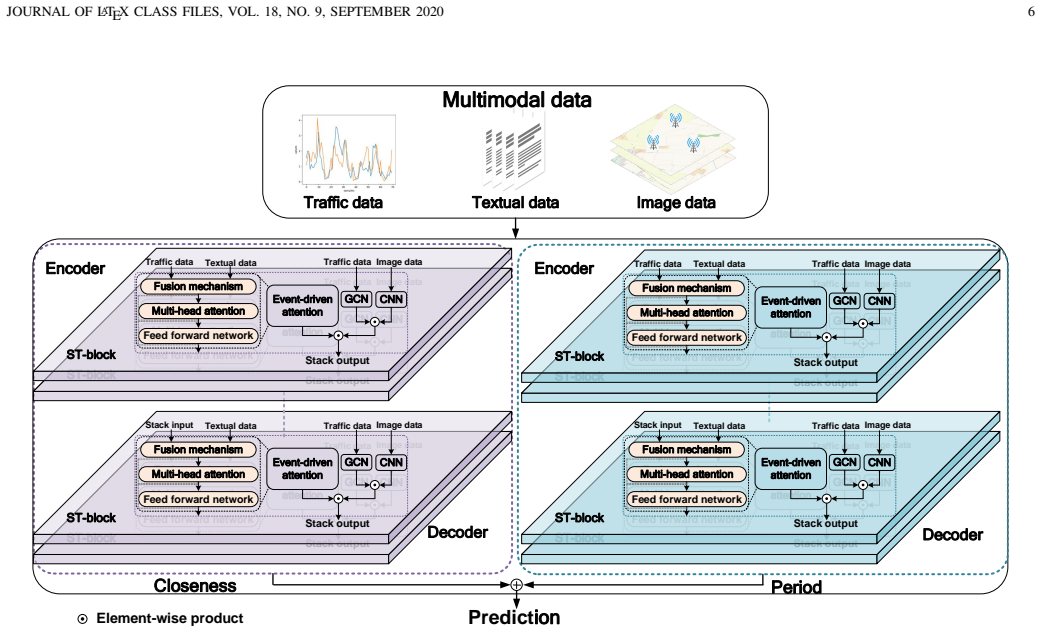
The machinery that carries the argument is threefold. First, bi-level meta-learning: an inner loop trains task-specific parameters on simulated tasks, and an outer loop optimizes a shared initialization via approximate implicit differentiation, so the model can fine-tune on a few real samples. Second, multimodal spatiotemporal blocks: event-driven attention fuses traffic and text, GCN and CNN extract spatial structure from traffic and images, and two parallel encoder-decoder structures capture hourly closeness and daily periodicity. Third, growing-window forward-validation cross conformal prediction: the target-task training data is split into $K$ disjoint folds; fold $k$ fine-tunes the model and fold $k+1$ supplies nonconformity scores, whose empirical quantile defines the interval width. The interval construction is what produces the claimed coverage guarantee, and the split scheme is what adapts conformal prediction to time series.
What would settle it
Split a long real-world traffic record so that calibration comes from one period (e.g., a normal week) and evaluation from a distinctly different regime (e.g., a holiday or a failure event); if the nominal 90% intervals cover much less than 90% of the test points, the exchangeability assumption behind the guarantee is violated.
Extended reading notes
Core claim
The central discovery is that a sim-to-real meta-learning model can deliver strong point predictions for cellular traffic with only a small amount of real-world data, and that the same model can output calibrated prediction intervals when the training sequence is split by a growing-window forward-validation scheme and fed to cross conformal prediction. Concretely, the paper reports lower MAE and RMSE than nine baselines on the Milano, Trento, and LTE datasets, and shows that with $K=5$ folds its cross conformal intervals achieve higher coverage rates than inductive conformal prediction at comparable widths. The guarantee in Eq. (10) is stated per dimension for each predicted volume, with nonconformity scores taken as absolute residuals and the interval built as $\hat{y} \pm \hat{\epsilon}$, where $\hat{\epsilon}$ is the $\lceil(1-\alpha)(L+1)\rceil$-th smallest calibration residual.
Load-bearing premise
The coverage guarantee in Eq. (10) assumes the calibration errors and future test errors are exchangeable with each other, but the paper's growing-window split over time series does not show (or prove) that this holds.
Editorial extensions
If this is right
- Operators with only two weeks of real-world traffic data can obtain point forecasts that beat baselines trained on a month of data.
- Setting $K=5$ in the cross conformal split gives higher empirical coverage than inductive conformal prediction on the tested datasets, at comparable interval widths.
- Increasing the ratio of simulation to real data up to about 4:1 steadily improves point accuracy, after which performance plateaus.
- The prediction interval guarantee applies per output dimension and per time step, so uncertainty can be reported for each cell and each forecast horizon.
- The model's computational complexity matches existing spatiotemporal baselines ($O(n^2 d + n d^2)$) while adding interval outputs.
Reading between the lines
- A reader should treat the coverage statement as conditional: the paper does not prove exchangeability for its forward-validation split, so the intervals are best viewed as empirically calibrated rather than universally guaranteed.
- The same training recipe could transfer to other scarce-data spatiotemporal forecasting tasks, such as urban mobility or energy demand, where a simulator and auxiliary modalities exist.
- A direct test of the split's validity would be to feed the same model residuals into a weighted conformal procedure that adapts to distribution shift and compare coverage under holiday or outage regimes.
- The paper's result suggests that simulation can serve as a data multiplier for network AI, reducing the need for costly real-world data collection.
Signed reviews
Editorial analysis
A structured set of objections, weighed in public.
Referee Report
Summary. The paper proposes MetaSTNet, a multimodal meta-learning framework for cellular traffic prediction that trains on simulated data and adapts to real-world target tasks with limited data. It combines a spatiotemporal encoder-decoder architecture with event-driven attention, GCN/CNN spatial encoders, and a bi-level meta-learning optimization. For uncertainty quantification, the paper uses cross conformal prediction with a growing-window forward-validation split and claims a finite-sample coverage guarantee in Eq (10). Experiments on Milano, Trento, and LTE traffic datasets compare point prediction accuracy and interval coverage against several baselines.
Significance. If correct, the paper would be among the first to provide calibrated prediction intervals for cellular traffic in a few-shot setting, with an architecture that exploits sim-to-real meta-learning and multimodal auxiliary data. The empirical study is broad: three real-world datasets, thirteen models, ablations, and interval evaluation. However, the central theoretical claim—the finite-sample coverage guarantee in Eq (10)—is not supported by the proposed method's assumptions, and the point-prediction comparisons lack statistical rigor. The contribution as stated therefore does not meet the standard for publication.
major comments (4)
- [Section III.A, Eq (10) and Fig 1] The coverage guarantee in Eq (10) is asserted for the growing-window forward-validation CCP scheme, but the scheme does not produce exchangeable nonconformity scores. The calibration scores come from models fine-tuned on different prefixes (fold k is used for fine-tuning and fold k+1 for scoring), while the test score comes from a model fine-tuned on all training plus calibration data. The paper itself states in Section II.C that CCP is 'unsuitable for time series prediction,' yet the modified split is introduced without any proof of a weaker validity condition, such as the weighted exchangeability of Barber et al. [68]. The cited references for Eq (10), [60] and [61], require i.i.d. or exchangeable data, which is not established. Consequently, Section V.D's empirical coverage comparisons do not constitute evidence of a calibrated interval; realized coverage on nonstationary, autocorrelated traffic data can deviate arbitrarily from 1-α even when the plotted curves appear close.
- [Table III, Section V.A] The point prediction results are reported as single MAE/RMSE values without error bars, repeated runs, or significance tests. The claim that MetaSTNet is 'significantly superior' is therefore not statistically substantiated. This is load-bearing for the first contribution (few-shot prediction accuracy), since the differences between MetaSTNet and the best baselines are often small (e.g., 1-hour Milano MAE 2.481 vs. 2.498 for MetaSTNet/oExt).
- [Section III.A and Algorithm 1] The relationship between the K-fold growing-window split and the final calibration set Dcal used in Eqs (5)–(6) is not specified. It is unclear whether the nonconformity scores from all folds 2..K are pooled into the empirical quantile, or whether Dcal is a separate held-out set; the text defines Dmeta_test = {Dtr, Dcal, Dts} and then says training samples are divided into K folds, without reconciling the two. This ambiguity prevents reproduction and obscures the exchangeability analysis. In addition, 'Algorithm 1' is referenced in Section III.B but is not present in the manuscript.
- [Table IV, Section V.C] The claim that simulation data improves prediction accuracy is contradicted by the reported numbers: the 1-hour MAE at ratio 1:1 (2.547) is worse than 'Real-world data only' (2.530), and the improvement is non-monotonic. The text says 'prediction accuracy improves as the ratio of synthetic data gradually increases,' which the table does not support.
minor comments (5)
- [Section II.C] In the related-work discussion, 'Kamil˙e et al.' appears to refer to Stankevičiūtė et al. (reference [59]); please correct the author name.
- [Section V.F, Table V] The text says DeepAuto and dmTP show 'an exponential increase' with data size, but the listed complexity O(n^2 d) is quadratic; please correct the wording.
- [Section III.B, Eq (11)] The fusion mechanism adds H_tra and H_txt; the dimensions of these representations must be aligned and this should be stated explicitly.
- [Section IV.D] In the hyperparameter settings, 'the number of the head is 8' should read 'the number of heads is 8'.
- [Figures 3 and 4] The x-axis label in the subplots appears to be '1-α' but is partially cut off in the rendering; please ensure the axis labels are legible and consistently formatted.
Circularity Check
No circularity: the conformal interval construction uses held-out calibration folds and imports its coverage guarantee from external conformal-prediction theory rather than from a fitted or renaming step.
full rationale
The paper's derivation chain is not circular. The prediction intervals are constructed by fine-tuning meta-learned parameters on training folds, computing nonconformity scores R_i = |y_cal - yhat_cal| on calibration folds (Eq. 6), taking the l-th smallest score as epsilon, and forming intervals as yhat +/- epsilon (Eqs. 7-9). The coverage statement in Eq. (10) is not a definitional identity or a renamed fit; it is an imported finite-sample guarantee from the external conformal-prediction literature ([60], [61]), applied to the paper's split. The main weakness is that the growing-window forward-validation split (Section III.A, Fig. 1) is not shown to yield exchangeable nonconformity scores, and the paper itself notes that standard CCP is unsuitable for time series (Section II.C). That is an applicability or validity gap, not a circularity: the guarantee is neither defined in terms of the conclusion nor obtained by fitting to the test set. The empirical coverage curves (Figs. 3-4) are computed on held-out test data, so the reported coverage is not forced by construction. The selection of K by comparing test-curve performance is a model-selection concern, not a circular reduction of the interval method. There are self-citations (e.g., [13], [2]-[4]), but they are background references and do not carry the load of the central claim. No uniqueness theorem or ansatz is smuggled in via self-citation. Hence the paper is self-contained against external benchmarks and the circularity score is 0.
Assumptions & free parameters
free parameters (2)
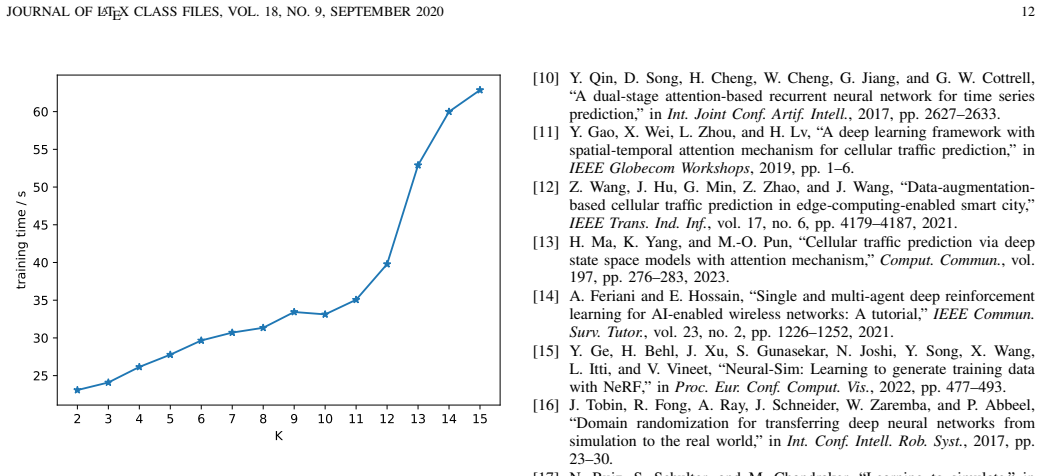
- K (number of CCP folds) =
5
- simulator traffic generation parameters =
not reported
assumptions (4)
- ad hoc to paper Nonconformity scores from the growing-window calibration folds are exchangeable with test-period residuals, so Eq (10) gives coverage >= 1-alpha.
- domain assumption All tasks obey the same distribution T_i ~ P(T).
- domain assumption Simulation data distribution is close enough to real traffic to provide transferable meta-knowledge.
- standard math Bi-level optimization via approximate implicit differentiation converges to a useful meta-initialization.
Cite this review
Pith. "Pith review of MetaSTNet: Multimodal Meta-learning for Cellular Traffic Conformal Prediction." pith.science (2026). https://pith.science/paper/QP3TLWSI
@misc{pith2026250521553,
  author       = {Pith},
  title        = {Pith review of: MetaSTNet: Multimodal Meta-learning for Cellular Traffic Conformal Prediction},
  year         = {2026},
  howpublished = {\url{https://pith.science/paper/QP3TLWSI}},
  note         = {Machine review of arXiv:2505.21553}
}
read the original abstract
Network traffic prediction techniques have attracted much attention since they are valuable for network congestion control and user experience improvement. While existing prediction techniques can achieve favorable performance when there is sufficient training data, it remains a great challenge to make accurate predictions when only a small amount of training data is available. To tackle this problem, we propose a deep learning model, entitled MetaSTNet, based on a multimodal meta-learning framework. It is an end-to-end network architecture that trains the model in a simulator and transfers the meta-knowledge to a real-world environment, which can quickly adapt and obtain accurate predictions on a new task with only a small amount of real-world training data. In addition, we further employ cross conformal prediction to assess the calibrated prediction intervals. Extensive experiments have been conducted on real-world datasets to illustrate the efficiency and effectiveness of MetaSTNet.
Figures


Figures from the paper (3 more)


Reference graph
Works this paper leans on
-
[68]
Conformal prediction beyond exchangeability,
R. F. Barber, E. J. Candes, A. Ramdas, and R. J. Tibshirani, “Conformal prediction beyond exchangeability,”Ann. Stat., vol. 51, no. 2, pp. 816– 845, 2023
work page 2023
-
[60]
Conformalized quantile regression,
Y . Romano, E. Patterson, and E. Candes, “Conformalized quantile regression,” inAdv. Neural Inf. Process. Syst., vol. 32, 2019
work page 2019
-
[61]
Ensemble conformalized quantile regression for probabilistic time series forecasting,
V . Jensen, F. M. Bianchi, and S. N. Anfinsen, “Ensemble conformalized quantile regression for probabilistic time series forecasting,”IEEE Trans. Neural Networks Learn. Sys., 2022
work page 2022
-
[1]
Traffic prediction of wireless cellular networks based on deep transfer learning and cross-domain data,
Q. Zeng, Q. Sun, G. Chen, H. Duan, C. Li, and G. Song, “Traffic prediction of wireless cellular networks based on deep transfer learning and cross-domain data,”IEEE Access, vol. 8, pp. 172 387–172 397, 2020
2020
-
[2]
Deep network analyzer (DNA): A big data analytics platform for cellular networks,
K. Yang, R. Liu, Y . Sun, J. Yang, and X. Chen, “Deep network analyzer (DNA): A big data analytics platform for cellular networks,”IEEE Internet Things J., vol. 4, no. 6, pp. 2019–2027, 2017
2019
-
[3]
PC2A: Predicting collective contex- tual anomalies via LSTM with deep generative model,
S. Dou, K. Yang, and H. V . Poor, “PC2A: Predicting collective contex- tual anomalies via LSTM with deep generative model,”IEEE Internet Things J., vol. 6, no. 6, pp. 9645–9655, 2019
2019
-
[4]
Active learning for wireless IoT intrusion detection,
K. Yang, J. Ren, Y . Zhu, and W. Zhang, “Active learning for wireless IoT intrusion detection,”IEEE Wirel. Commun., vol. 25, no. 6, pp. 19–25, 2018
2018
-
[5]
Cisco annual Internet report (2018–2023) white paper,
Cisco, “Cisco annual Internet report (2018–2023) white paper,” Tech. Rep., October 2021
2018
Show all 85 references
-
[6]
LNTP: An end-to-end online prediction model for network traffic,
L. Zhang, H. Zhang, Q. Tang, P. Dong, Z. Zhao, Y . Wei, J. Mei, and K. Xue, “LNTP: An end-to-end online prediction model for network traffic,”IEEE Network, vol. 35, no. 1, pp. 226–233, 2021
2021
-
[7]
Toward QoS prediction based on temporal transformers for IoT applications,
A. Hameed, J. Violos, A. Leivadeas, N. Santi, R. Gr ¨unblatt, and N. Mitton, “Toward QoS prediction based on temporal transformers for IoT applications,”IEEE Trans. Netw. Serv. Manage., vol. 19, no. 4, pp. 4010–4027, 2022
2022
-
[8]
Spatio-temporal wireless traffic prediction with recurrent neural network,
C. Qiu, Y . Zhang, Z. Feng, P. Zhang, and S. Cui, “Spatio-temporal wireless traffic prediction with recurrent neural network,”IEEE Wirel. Commun. Lett., vol. 7, no. 4, pp. 554–557, 2018
2018
-
[9]
Short-term residential load forecasting based on LSTM recurrent neural network,
W. Kong, Z. Y . Dong, Y . Jia, D. J. Hill, Y . Xu, and Y . Zhang, “Short-term residential load forecasting based on LSTM recurrent neural network,” IEEE Trans. Smart Grid, vol. 10, no. 1, pp. 841–851, 2019
2019
-
[10]
A dual-stage attention-based recurrent neural network for time series prediction,
Y . Qin, D. Song, H. Cheng, W. Cheng, G. Jiang, and G. W. Cottrell, “A dual-stage attention-based recurrent neural network for time series prediction,” inInt. Joint Conf. Artif. Intell., 2017, pp. 2627–2633
2017
-
[11]
A deep learning framework with spatial-temporal attention mechanism for cellular traffic prediction,
Y . Gao, X. Wei, L. Zhou, and H. Lv, “A deep learning framework with spatial-temporal attention mechanism for cellular traffic prediction,” in IEEE Globecom Workshops, 2019, pp. 1–6
2019
-
[12]
Data-augmentation- based cellular traffic prediction in edge-computing-enabled smart city,
Z. Wang, J. Hu, G. Min, Z. Zhao, and J. Wang, “Data-augmentation- based cellular traffic prediction in edge-computing-enabled smart city,” IEEE Trans. Ind. Inf., vol. 17, no. 6, pp. 4179–4187, 2021
2021
-
[13]
Cellular traffic prediction via deep state space models with attention mechanism,
H. Ma, K. Yang, and M.-O. Pun, “Cellular traffic prediction via deep state space models with attention mechanism,”Comput. Commun., vol. 197, pp. 276–283, 2023
2023
-
[14]
Single and multi-agent deep reinforcement learning for AI-enabled wireless networks: A tutorial,
A. Feriani and E. Hossain, “Single and multi-agent deep reinforcement learning for AI-enabled wireless networks: A tutorial,”IEEE Commun. Surv. Tutor., vol. 23, no. 2, pp. 1226–1252, 2021
2021
-
[15]
Neural-Sim: Learning to generate training data with NeRF,
Y . Ge, H. Behl, J. Xu, S. Gunasekar, N. Joshi, Y . Song, X. Wang, L. Itti, and V . Vineet, “Neural-Sim: Learning to generate training data with NeRF,” inProc. Eur. Conf. Comput. Vis., 2022, pp. 477–493
2022
-
[16]
Domain randomization for transferring deep neural networks from simulation to the real world,
J. Tobin, R. Fong, A. Ray, J. Schneider, W. Zaremba, and P. Abbeel, “Domain randomization for transferring deep neural networks from simulation to the real world,” inInt. Conf. Intell. Rob. Syst., 2017, pp. 23–30
2017
-
[17]
Learning to simulate,
N. Ruiz, S. Schulter, and M. Chandraker, “Learning to simulate,” in Proc. Int. Conf. Learn. Represent., 2019
2019
-
[18]
From synthetic to natural - single natural image dehazing deep networks using synthetic dataset domain randomization,
A. F. Shamsuddin, K. Ragunathan, A. P., D. R. S. P. M., and P. Sankaran, “From synthetic to natural - single natural image dehazing deep networks using synthetic dataset domain randomization,”J. Vis. Commun. Image Represent., vol. 89, p. 103636, 2022
2022
-
[19]
Understanding domain randomization for sim-to-real transfer,
X. Chen, J. Hu, C. Jin, L. Li, and L. Wang, “Understanding domain randomization for sim-to-real transfer,” inProc. Int. Conf. Learn. Represent., 2022
2022
-
[20]
Sim-to-real transfer in deep reinforcement learning for robotics: a survey,
W. Zhao, J. P. Queralta, and T. Westerlund, “Sim-to-real transfer in deep reinforcement learning for robotics: a survey,” inIEEE Symp. Ser. Comput. Intell., 2020, pp. 737–744
2020
-
[21]
A survey of deep meta- learning,
M. Huisman, J. N. van Rijn, and A. Plaat, “A survey of deep meta- learning,”Artif. Intell. Rev., vol. 54, no. 6, pp. 4483–4541, 2021
2021
-
[22]
Meta- learning in neural networks: A survey,
T. M. Hospedales, A. Antoniou, P. Micaelli, and A. J. Storkey, “Meta- learning in neural networks: A survey,”IEEE Trans. Pattern Anal. Mach. Intell., pp. 4483–4541, 2021
2021
-
[23]
Meta-learning approaches for learning-to-learn in deep learning: A survey,
Y . Tian, X. Zhao, and W. Huang, “Meta-learning approaches for learning-to-learn in deep learning: A survey,”Neurocomputing, vol. 494, pp. 203–223, 2022
2022
-
[24]
Mobile big data: The fuel for data-driven wireless,
X. Cheng, L. Fang, L. Yang, and S. Cui, “Mobile big data: The fuel for data-driven wireless,”IEEE Internet Things J., vol. 4, no. 5, pp. 1489–1516, 2017
2017
-
[25]
Time-wise attention aided convolutional neural network for data-driven cellular traffic prediction,
W. Shen, H. Zhang, S. Guo, and C. Zhang, “Time-wise attention aided convolutional neural network for data-driven cellular traffic prediction,” IEEE Wirel. Commun. Lett., vol. 10, no. 8, pp. 1747–1751, 2021
2021
-
[26]
Mobile demand forecasting via deep graph-sequence spatiotemporal modeling in cellular networks,
L. Fang, X. Cheng, H. Wang, and L. Yang, “Mobile demand forecasting via deep graph-sequence spatiotemporal modeling in cellular networks,” IEEE Internet Things J., vol. 5, no. 4, pp. 3091–3101, 2018
2018
-
[27]
Deep transfer learning for intelligent cellular traffic prediction based on cross-domain big data,
C. Zhang, H. Zhang, J. Qiao, D. Yuan, and M. Zhang, “Deep transfer learning for intelligent cellular traffic prediction based on cross-domain big data,”IEEE J. Sel. Areas Commun., vol. 37, no. 6, pp. 1389–1401, 2019
2019
-
[28]
Recent advances and trends in multimodal deep learning: A review,
J. Summaira, X. Li, A. M. Shoib, S. Li, and J. Abdul, “Recent advances and trends in multimodal deep learning: A review,”arXiv preprint arXiv:2105.11087, 2021
2021 arXiv
-
[29]
A review of uncertainty quantifi- cation in deep learning: Techniques, applications and challenges,
M. Abdar, F. Pourpanah, S. Hussain, D. Rezazadegan, L. Liu, M. Ghavamzadeh, P. W. Fieguth, X. Cao, A. Khosravi, U. R. Acharya, V . Makarenkov, and S. Nahavandi, “A review of uncertainty quantifi- cation in deep learning: Techniques, applications and challenges,”Inf. Fusion, vo...
2021
-
[30]
Few-shot conformal prediction with auxiliary tasks,
A. Fisch, T. Schuster, T. Jaakkola, and D. Barzilay, “Few-shot conformal prediction with auxiliary tasks,” inProc. Int. Conf. Mach. Learn., vol. 139, 2021, pp. 3329–3339
2021
-
[31]
Nested conformal prediction and quantile out-of-bag ensemble methods,
C. Gupta, A. K. Kuchibhotla, and A. Ramdas, “Nested conformal prediction and quantile out-of-bag ensemble methods,”Pattern Recogn., vol. 127, p. 108496, 2022
2022
-
[32]
Bilevel optimization: Convergence analysis and enhanced design,
K. Ji, J. Yang, and Y . Liang, “Bilevel optimization: Convergence analysis and enhanced design,” inProc. Int. Conf. Mach. Learn., 2021, pp. 4882– 4892
2021
-
[33]
Characterization and prediction of mobile-app traffic using Markov modeling,
G. Aceto, G. Bovenzi, D. Ciuonzo, A. Montieri, V . Persico, and A. Pescap´e, “Characterization and prediction of mobile-app traffic using Markov modeling,”IEEE Trans. Netw. Serv. Manage., vol. 18, no. 1, pp. 907–925, 2021. JOURNAL OF LATEX CLASS FILES, VOL. 18, NO. 9, SEPTEMBE...
2021
-
[34]
Cellular traffic load prediction with LSTM and Gaussian process regression,
W. Wang, C. Zhou, H. He, W. Wu, W. Zhuang, and X. Shen, “Cellular traffic load prediction with LSTM and Gaussian process regression,” in IEEE Int. Conf. Commun., vol. 6, 2020, pp. 1–6
2020
-
[35]
Spatiotemporal modeling and prediction in cellular networks: A big data enabled deep learning approach,
J. Wang, J. Tang, Z. Xu, Y . Wang, G. Xue, X. Zhang, and D. Yang, “Spatiotemporal modeling and prediction in cellular networks: A big data enabled deep learning approach,” inProc. IEEE Conf. Comput. Commun., 2017, pp. 1–9
2017
-
[36]
Cellular network traffic prediction incorporating handover: A graph convolutional ap- proach,
S. Zhao, X. Jiang, G. Jacobson, R. Jana, W.-L. Hsu, R. Rustamov, M. Talasila, S. A. Aftab, Y . Chen, and C. Borcea, “Cellular network traffic prediction incorporating handover: A graph convolutional ap- proach,” inIEEE Commun.Soc. Conf. Sens., Mesh Ad Hoc Commun. Netw. worksho...
2020
-
[37]
Spatio-temporal analysis and prediction of cellular traffic in metropo- lis,
X. Wang, Z. Zhou, F. Xiao, K. Xing, Z. Yang, Y . Liu, and C. Peng, “Spatio-temporal analysis and prediction of cellular traffic in metropo- lis,”IEEE. Trans. Mob. Comput, vol. 18, no. 9, pp. 2190–2202, 2019
2019
-
[38]
Attention is all you need,
A. Vaswani, N. Shazeer, N. Parmar, J. Uszkoreit, L. Jones, A. Gomez, L. Kaiser, and I. Polosukhin, “Attention is all you need,” inAdv. Neural Inf. Process. Syst., 2017
2017
-
[39]
DeepAuto: A hierarchical deep learning framework for real-time prediction in cellular networks,
A. Bhorkar, K. Zhang, and J. Wang, “DeepAuto: A hierarchical deep learning framework for real-time prediction in cellular networks,”arXiv preprint arXiv:2001.01553, 2019
2001 arXiv
-
[40]
Spatial-temporal attention-convolution network for citywide cellular traffic prediction,
N. Zhao, Z. Ye, Y . Pei, Y .-C. Liang, and D. Niyato, “Spatial-temporal attention-convolution network for citywide cellular traffic prediction,” IEEE Commun. Lett., vol. 24, no. 11, pp. 2532–2536, 2020
2020
-
[41]
Citywide cellular traffic prediction based on densely connected convolutional neural networks,
C. Zhang, H. Zhang, D. Yuan, and M. Zhang, “Citywide cellular traffic prediction based on densely connected convolutional neural networks,” IEEE Commun. Lett., vol. 22, no. 8, pp. 1656–1659, 2018
2018
-
[42]
ST-Tran: Spatial-temporal transformer for cellular traffic prediction,
Q. Liu, J. Li, and Z. Lu, “ST-Tran: Spatial-temporal transformer for cellular traffic prediction,”IEEE Commun. Lett., vol. 25, no. 10, pp. 3325–3329, 2021
2021
-
[43]
From Twitter to traffic predictor: Next-day morning traffic prediction using social media data,
W. Yao and S. Qian, “From Twitter to traffic predictor: Next-day morning traffic prediction using social media data,”Transp. Res. Part C Emerg. Technol., vol. 124, pp. 1–26, 2021
2021
-
[44]
Packet-level prediction of mobile-app traffic using mul- titask deep learning,
A. Montieri, G. Bovenzi, G. Aceto, D. Ciuonzo, V . Persico, and A. Pescap `e, “Packet-level prediction of mobile-app traffic using mul- titask deep learning,”Comput. Networks, vol. 200, p. 108529, 2021
2021
-
[45]
DeepTP: An end-to- end neural network for mobile cellular traffic prediction,
J. Feng, X. Chen, R. Gao, M. Zeng, and Y . Li, “DeepTP: An end-to- end neural network for mobile cellular traffic prediction,”IEEE Network, vol. 32, no. 6, pp. 108–115, 2018
2018
-
[46]
AutoSTG: Neural architecture search for predictions of spatio-temporal graph,
Z. Pan, S. Ke, X. Yang, Y . Liang, Y . Yu, J. Zhang, and Y . Zheng, “AutoSTG: Neural architecture search for predictions of spatio-temporal graph,” inProc. World Wide Web Conf., 2021, pp. 1864–1855
2021
-
[47]
Meta-MSNet: Meta-learning based multi-source data fusion for traffic flow prediction,
S. Fang, X. Pan, S. Xiang, and C. Pan, “Meta-MSNet: Meta-learning based multi-source data fusion for traffic flow prediction,”IEEE Signal Process. Lett., vol. 28, pp. 6–10, 2021
2021
-
[48]
dmTP: A deep meta- learning based framework for mobile traffic prediction,
Z. Zhang, F. Li, X. Chu, Y . Fang, and J. Zhang, “dmTP: A deep meta- learning based framework for mobile traffic prediction,”IEEE Wirel. Commun., vol. 28, no. 5, pp. 110–117, 2021
2021
-
[49]
Fine-grained trajectory-based travel time estimation for multi-city scenarios based on deep meta-learning,
C. Wang, F. Zhao, H. Zhang, H. Luo, Y . Qin, and Y . Fang, “Fine-grained trajectory-based travel time estimation for multi-city scenarios based on deep meta-learning,”IEEE Trans. Intell. Transp. Syst., pp. 1–13, 2022
2022
-
[50]
STG-Meta: Spatial- temporal graph meta-learning for traffic forecasting,
J. Li, W. Pan, Q. Deng, Z. Wang, and W. Zhu, “STG-Meta: Spatial- temporal graph meta-learning for traffic forecasting,” inProc. Int. Jt. Conf. Neural Networks, 2021, pp. 1–8
2021
-
[51]
Learning from multiple cities: A meta-learning approach for spatial-temporal prediction,
H. Yao, Y . Liu, Y . Wei, X. Tang, and Z. Li, “Learning from multiple cities: A meta-learning approach for spatial-temporal prediction,” in Proc. World Wide Web Conf., 2019, pp. 2181–2191
2019
-
[52]
cST-ML: Continuous spatial- temporal meta-learning for traffic dynamics prediction,
Y . Zhang, Y . Li, X. Zhou, and J. Luo, “cST-ML: Continuous spatial- temporal meta-learning for traffic dynamics prediction,” inProc. IEEE Int. Conf. Data Min., 2020, pp. 1418–1423
2020
-
[53]
Meta-learning framework with applications to zero-shot time-series forecasting,
O. Boris N., C. Dmitri, C. Nicolas, and B. Yoshua, “Meta-learning framework with applications to zero-shot time-series forecasting,” in AAAI Conf. Artif. Intell., vol. 35, no. 10, 2021, pp. 9242–9250
2021
-
[54]
A meta-learning scheme for adaptive short-term network traffic prediction,
Q. He, A. Moayyedi, G. Dan, G. Koudouridis, and P. Tengkvist, “A meta-learning scheme for adaptive short-term network traffic prediction,” IEEE J. Sel. Areas Commun., vol. 38, no. 10, pp. 2271 – 2283, 2020
2020
-
[55]
Zero-shot and few-shot time series forecasting with ordinal regression recurrent neural networks,
B. P. Orozco and S. J. Roberts, “Zero-shot and few-shot time series forecasting with ordinal regression recurrent neural networks,” inProc., Euro. Symp. Artif. Neural Networks, Comput. Intell. Mach. Learn., 2020, pp. 503–508
2020
-
[56]
DeepRTP: A deep spatio-temporal residual network for regional traffic prediction,
Z. Liu, M. Huang, Z. Ye, and K. Wu, “DeepRTP: A deep spatio-temporal residual network for regional traffic prediction,” inInt. Conf. Mob. Ad- Hoc Sens. Networks, 2019
2019
-
[57]
ST-DenNetFus: A new deep learning approach for network demand prediction,
H. Assem, B. Caglayan, T. S. Buda, and D. O’Sullivan, “ST-DenNetFus: A new deep learning approach for network demand prediction,” inJoint Eur. Conf. Mach. Learn. Knowl. Disc. Databases, vol. 11053, 2018, pp. 222–237
2018
-
[58]
Conformal prediction interval for dynamic time- series,
C. Xu and Y . Xie, “Conformal prediction interval for dynamic time- series,” inProc. Int. Conf. Mach. Learn., 2021
2021
-
[59]
Conformal time- series forecasting,
K. Stankevi ˇci¯ut˙e, A. M. Alaa, and M. van der Schaar, “Conformal time- series forecasting,” inAdv. Neural Inf. Process. Syst., vol. 8, 2021, pp. 6216–6228
2021
-
[62]
Stable conformal prediction sets,
E. Ndiaye, “Stable conformal prediction sets,” inProc. Int. Conf. Mach. Learn., 2022, pp. 16 462–16 479
2022
-
[63]
Conformal prediction: A unified review of theory and new challenges,
M. FONTANA, G. ZENI, and S. V ANTINI, “Conformal prediction: A unified review of theory and new challenges,”Bernoulli, vol. 29, no. 1, pp. 1–23, 2023
2023
-
[64]
Locally valid and discriminative pre- diction intervals for deep learning models,
Z. Lin, S. Trivedi, and J. Sun, “Locally valid and discriminative pre- diction intervals for deep learning models,” inAdv. Neural Inf. Process. Syst., vol. 34, 2021, pp. 8378–8391
2021
-
[65]
Introduction to conformal predictors,
P. Toccaceli, “Introduction to conformal predictors,”Pattern Recogn., vol. 124, p. 108507, 2022
2022
-
[66]
A gentle introduction to confor- mal prediction and distribution-free uncertainty quantification,
A. N. Angelopoulos and S. Bates, “A gentle introduction to confor- mal prediction and distribution-free uncertainty quantification,”arXiv preprint arXiv:2107.07511, 2021
2021 arXiv
-
[67]
Distribution-free predictive inference for regression,
J. Lei, M. G’sell, A. Rinaldo, R. J. Tibshirani, and L. A. Wasserman, “Distribution-free predictive inference for regression,”J. Am. Stat. Assoc., vol. 113, pp. 1094 – 1111, 2018
2018
-
[69]
conformalInference.multi and conformalInference.fd: Twin packages for conformal prediction,
P. Vergottini, M. Fontana, J. Diquigiovanni, A. Solari, and S. Vantini, “conformalInference.multi and conformalInference.fd: Twin packages for conformal prediction,”arXiv preprint arXiv:2206.14663, 2022
2022 arXiv
-
[70]
Predictive inference with the jackknife+,
R. F. Barber, E. J. Candes, A. Ramdas, and R. J. Tibshirani, “Predictive inference with the jackknife+,”Ann. Stat., vol. 49, no. 1, pp. 486–507, 2021
2021
-
[71]
A comparison of machine learning model validation schemes for non-stationary time series data,
M. Schnaubelt, “A comparison of machine learning model validation schemes for non-stationary time series data,” Tech. Rep. 11/2019, 2019. [Online]. Available: http://hdl.handle.net/10419/209136
2019
-
[72]
Convergence of meta-learning with task-specific adaptation over partial parameters,
K. Ji, J. D. Lee, Y . Liang, and H. V . Poor, “Convergence of meta-learning with task-specific adaptation over partial parameters,” inAdv. Neural Inf. Process. Syst., 2020
2020
-
[73]
FEDformer: Frequency enhanced decomposed transformer for long-term series fore- casting,
T. Zhou, Z. Ma, Q. Wen, X. Wang, L. Sun, and R. Jin, “FEDformer: Frequency enhanced decomposed transformer for long-term series fore- casting,” inProc. Int. Conf. Mach. Learn., vol. 162, 2022, pp. 27 268– 27 286
2022
-
[74]
Temporal fusion trans- formers for interpretable multi-horizon time series forecasting,
B. Lim, S. ¨O. Arik, N. Loeff, and T. Pfister, “Temporal fusion trans- formers for interpretable multi-horizon time series forecasting,”Int. J. Forecast., vol. 37, no. 4, pp. 1748–1764, 2021
2021
-
[75]
Pyraformer: Low-complexity pyramidal attention for long-range time series modeling and forecasting,
S. Liu, H. Yu, C. Liao, J. Li, W. Lin, A. X. Liu, and S. Dustdar, “Pyraformer: Low-complexity pyramidal attention for long-range time series modeling and forecasting,” inProc. Int. Conf. Learn. Represent., 2022
2022
-
[76]
Adversarial sparse transformer for time series forecasting,
S. Wu, X. Xiao, Q. Ding, P. Zhao, Y . Wei, and J. Huang, “Adversarial sparse transformer for time series forecasting,” inAdv. Neural Inf. Process. Syst., vol. 33, 2020, pp. 17 105–17 115
2020
-
[77]
Meta graph transformer: A novel framework for spatial–temporal traffic prediction,
F. S. C. Z. S. X. Xue Ye, Shen Fang, “Meta graph transformer: A novel framework for spatial–temporal traffic prediction,”Neurocomputing, vol. 491, pp. 544–563, 2022
2022
-
[78]
A multi-source dataset of urban life in the city of Milan and the province of Trentino,
G. Barlacchi, M. D. Nadai, R. Larcher, A. Casella, C. Chitic, G. Torrisi, F. Antonelli, A. Vespignani, A. Pentland, and B. Lepri, “A multi-source dataset of urban life in the city of Milan and the province of Trentino,” Sci. Data, vol. 2, no. 1, 2015
2015
-
[79]
Telecommunications - SMS, Call, Internet - MI,
T. Italia, “Telecommunications - SMS, Call, Internet - MI,” 2015. [Online]. Available: https://doi.org/10.7910/DVN/EGZHFV
2015 doi
-
[80]
Social Pulse - Milano,
SpazioDati and D. P. di Milano, “Social Pulse - Milano,” 2015. [Online]. Available: https://doi.org/10.7910/DVN/9IZALB
2015 doi
-
[81]
MilanoToday,
Citynews, “MilanoToday,” 2015. [Online]. Available: https://doi.org/10. 7910/DVN/QWOE1R
2015
-
[82]
Telecommunications - SMS, Call, Internet - TN,
T. Italia, “Telecommunications - SMS, Call, Internet - TN,” 2015. [Online]. Available: https://doi.org/10.7910/DVN/QLCABU
2015 doi
-
[83]
Social Pulse - Trentino,
SpazioDati, “Social Pulse - Trentino,” 2015. [Online]. Available: https://doi.org/10.7910/DVN/5H0NUI
2015 doi
-
[84]
TrentoToday,
Citynews, “TrentoToday,” 2015. [Online]. Available: https://doi.org/10. 7910/DVN/NYQ23N
2015
-
[85]
Semi-supervised classification with graph convolutional networks,
M. Welling and T. N. Kipf, “Semi-supervised classification with graph convolutional networks,” inProc. Int. Conf. Learn. Represent., 2017. JOURNAL OF LATEX CLASS FILES, VOL. 18, NO. 9, SEPTEMBER 2020 14 Hui Mareceived her B.Eng. degree in 2014 and M.S. degree in 2017 from Jian...
2017
Reviewed August 7, 2026 · model on record in the stance chip above.
Discussion (0). Continue with ORCID to comment.