REVIEW 3 major objections 5 minor 7 cited by
Highly Efficient Non-relativistic Edelstein effect in p-wave magnets
T0 review · 3 major / 5 minor · reviewed 2026-08-12 · deepseek-v4-flash
Pith's one-line read Coplanar p-wave magnets convert charge to spin up to 25 times more efficiently than the best spin-orbit-based materials, without needing heavy elements.
desk verdict A solid symmetry-based prediction of a non-relativistic Edelstein effect in p-wave magnets, with a concrete material proposal that needs a sharper check on the experimental magnetic order and the quasiparticle broadening. read the letter →
The pith
A machine-rendered reading of the paper's core claim, the machinery that carries it, and where it could break.
The reading
What carries the argument
The carrier of the argument is the spin-space-group symmetry $[C_{2\perp}\|\mathbf{t}]$: a 180-degree rotation of spin space about an axis perpendicular to the plane of the coplanar spins combined with a translation by half a lattice vector. In a p-wave magnet this symmetry survives while inversion is broken, forcing the spin-polarization direction in the band structure to be perpendicular to the spin plane and producing the odd-parity p-wave spin splitting. The response is then calculated with Kubo linear response; the dominant term is the intra-band Fermi-surface contribution, which is even under time reversal, while the inter-band Berry-curvature-like term is forbidden because p-wave magnets preserve time-reversal symmetry in momentum space through the $\mathcal{T}\mathbf{t}$ operation. Exchange-driven hopping $t_J$ rather than spin-orbit coupling controls the magnitude, which is why light-element candidates can compete.
What would settle it
A spin-torque ferromagnetic resonance or magneto-optical Kerr measurement of current-induced spin density in CeNiAsO would settle it: if the out-of-plane susceptibility $\chi^{zx}$ comes out near the relativistic baseline (about 0.5 $\hbar$ Å/V) rather than the predicted 13 $\hbar$ Å/V, or if the dominant spin polarization is in-plane rather than out-of-plane, the central claim would be contradicted.
Extended reading notes
Core claim
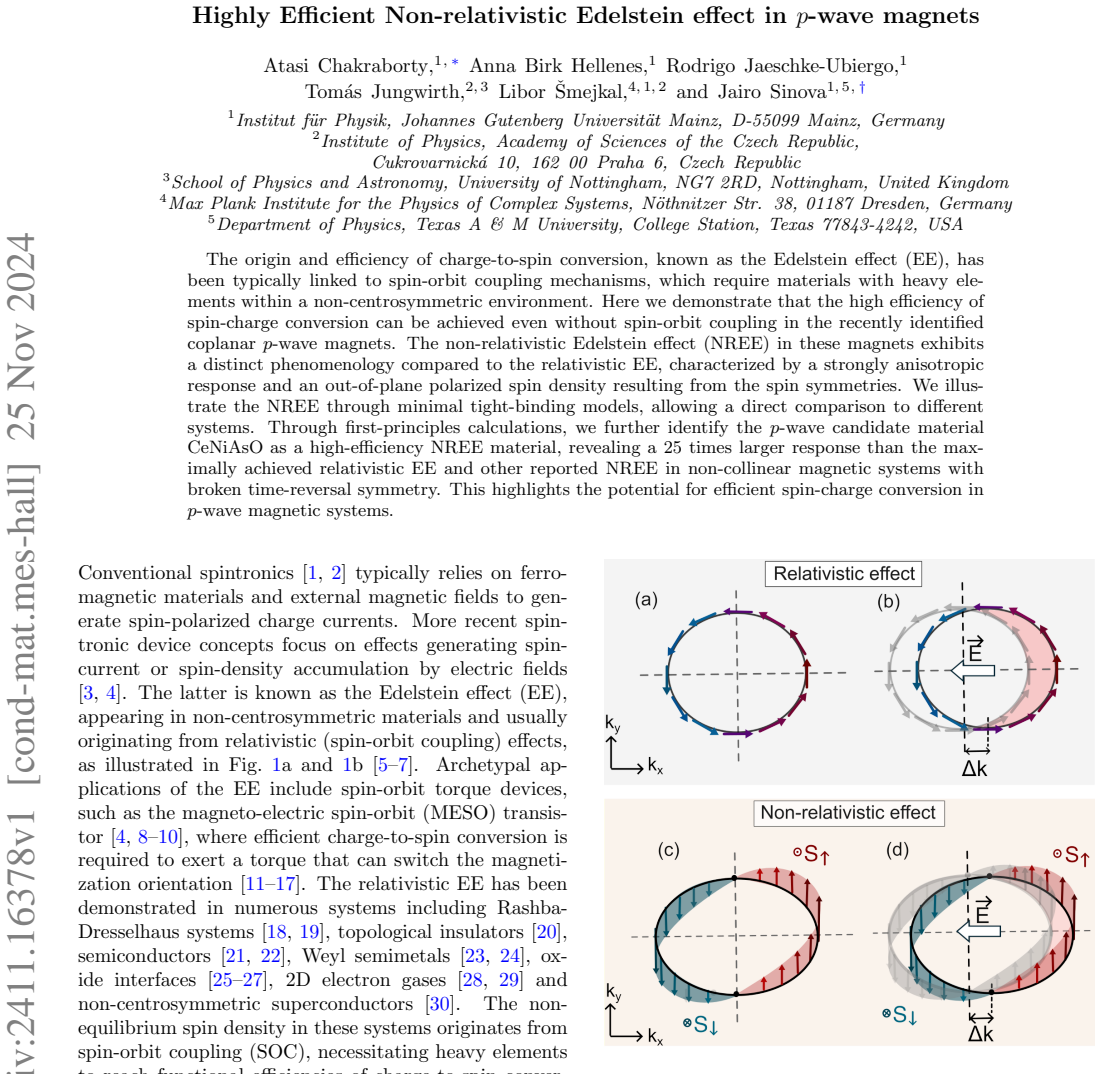
The paper's central claim is that the non-relativistic Edelstein effect (NREE) exists in p-wave magnets: magnets with coplanar non-collinear order whose spin-space group contains the element $[C_{2\perp}\|\mathbf{t}]$—a 180° spin rotation about an axis perpendicular to the spin plane followed by a translation. This symmetry forces the band structure to split into opposite out-of-plane spin polarizations with odd-parity p-wave character, while the combined time-reversal-and-translation symmetry $\mathcal{T}\mathbf{t}$ keeps time-reversal symmetry in momentum space and zero net magnetization. Under an applied electric field, the intra-band Fermi-surface term of the Kubo response produces an out-of-plane spin accumulation with only $\chi^{zx}$ and $\chi^{zz}$ components finite; the inter-band T-odd term vanishes. In density-functional-theory calculations on CeNiAsO with spin-orbit coupling switched off, the integrated $\chi^{zx}$ susceptibility is about 13 $\hbar$ Å/V, 25 times larger than the best reported relativistic Rashba value and the NREE of LuFeO$_3$, establishing p-wave magnets as high-efficiency non-relativistic spin-charge converters.
Load-bearing premise
The whole result hinges on CeNiAsO having exactly the periodic, all-spins-in-one-plane magnetic pattern the calculation assumes; if the real magnetic order is incommensurate or its symmetry is only approximate, the tensor components and the 25-fold enhancement could change or wash out.
Editorial extensions
If this is right
- Charge-to-spin conversion no longer requires heavy elements or inversion-breaking crystal fields; coplanar p-wave magnets with light elements should show Edelstein responses comparable to or larger than standard spin-orbit systems.
- The NREE tensor in p-wave magnets has only out-of-plane susceptibility components, so rotating the electric-field direction or measuring the spin-polarization direction cleanly distinguishes this effect from the in-plane Rashba Edelstein effect.
- CeNiAsO, with its predicted susceptibility of about 13 $\hbar$ Å/V, becomes a concrete candidate material for efficient spin-orbit-torque-type devices based on a non-relativistic mechanism.
- The vanishing of the inter-band contribution means the effect is governed entirely by the Fermi-surface intra-band term, giving a transparent single-band picture of the spin accumulation.
- The angular dependence of the NREE in the Kagome model shows a nodal direction independent of chemical potential, providing a sharp experimental signature for p-wave magnets.
Reading between the lines
- By the same symmetry logic, other coplanar non-collinear magnets carrying the $[C_{2\perp}\|\mathbf{t}]$ element should show the same out-of-plane-only NREE tensor, so a systematic computational screen of such magnetic orders could turn up materials with even larger responses than CeNiAsO.
- The calculation fixes the magnetic order to an exact commensurate pattern, whereas the experimentally reported magnetism in CeNiAsO can be incommensurate; if the real order breaks the $[C_{2z}\|\mathbf{t}_{a/2}]$ symmetry, the predicted 25-fold enhancement may be reduced or averaged away, and this is a testable open question.
- One could test the mechanism directly by comparing in-plane and out-of-plane Edelstein responses in a heavy-element candidate: a dominant out-of-plane component would confirm that exchange-driven NREE, not spin-orbit coupling, is doing the work.
- If the NREE is as strong as predicted, current-driven manipulation of the coplanar order itself—analogous to spin-orbit torques but without spin-orbit coupling—becomes a plausible route, which the paper only gestures at.
Signed reviews
Editorial analysis
A structured set of objections, weighed in public.
Referee Report
Summary. The paper proposes a non-relativistic Edelstein effect (NREE) in p-wave magnets, i.e., coplanar non-collinear magnets with a combined spin-rotation-and-translation symmetry [C2⊥||t] that preserves time-reversal symmetry in momentum space. Using Kubo linear response, the authors compute the NREE susceptibility in a minimal four-band model and in a Kagome-lattice model, finding a large, strongly anisotropic, out-of-plane spin polarization. They then perform DFT-based Wannier tight-binding calculations for CeNiAsO and report a unit-cell-integrated NREE susceptibility of about 13 ℏÅ/V, which they state is 25 times larger than the values for LuFeO3 and for archetypal relativistic Rashba/topological-insulator systems. The paper concludes that p-wave magnets are promising materials for efficient charge-to-spin conversion without spin-orbit coupling.
Significance. The conceptual advance is significant: identifying a non-relativistic, exchange-driven charge-to-spin conversion mechanism in p-wave magnets, with a distinctive out-of-plane polarization and strong anisotropy, would broaden the materials palette for spintronics beyond heavy-element SOC systems. The symmetry-based classification and the explicit model calculations are strengths; the minimal-model and Kagome results are internally consistent and the tensor forms follow from the stated spin group. The DFT calculation for CeNiAsO is a concrete material prediction, but its validity depends on assumptions about the magnetic ground state and on numerical inputs that are not fully disclosed in the main text. If the material-specific claim is confirmed, the work would be an important step toward practical NREE devices; however, the current manuscript leaves the central quantitative claim under-supported.
major comments (3)
- [Material Candidate: CeNiAsO] The paper states that CeNiAsO 'shows a co-planar commensurate magnetic order' and cites Wu et al. (Ref. [47]), whose title is 'Incommensurate Magnetism Near Quantum Criticality in CeNiAsO.' This is a direct factual discrepancy: the cited experimental work reports an incommensurate magnetic ground state. The DFT calculation constrains the moments to a commensurate coplanar order with the exact spin-space symmetry [C2z||t_a/2], but if the true order is incommensurate, that symmetry is not exact, and the derived tensor form (only χ_zx and χ_zz) and the nodal-line protection are not strictly valid. The 13 ℏÅ/V susceptibility could be modified or averaged away. The authors must clarify the experimental magnetic structure, justify the commensurate approximation used in the calculation, or explicitly reframe the CeNiAsO result as a hypothetical commensurate phase rather than a prediction for the physical ground state.
- [Methods / Eq. (3)] The intra-band susceptibility in Eq. (3) scales as 1/Γ, where Γ is the quasiparticle broadening. The main text specifies Γ = 0.1 eV for the minimal model and Γ = 0.01 eV for the Kagome model, but it never reports the Γ used for the Wannier tight-binding calculation of CeNiAsO. Without this value, the quoted absolute magnitude of 13 ℏÅ/V is not reproducible. Please state the Γ value (or the range of values) used in the material calculation and discuss how the claimed enhancement depends on this parameter.
- [Abstract and Discussion] The abstract and the concluding paragraph claim the CeNiAsO NREE is '25 times larger' than the 'maximally achieved relativistic EE' and than 'other reported NREE,' but the numerical comparison in the main text is only made against LuFeO3 (0.5 ℏÅ/V, giving a factor of about 26). The corresponding value for the relativistic benchmark (α-Sn, Ref. [20]) or for the Rashba 2DEG in comparable units is not given. Moreover, the Rashba 2DEG susceptibility is a sheet quantity (units ℏ/V·Å) while the CeNiAsO value is a unit-cell-integrated bulk quantity (units ℏÅ/V), so the direct comparison may be dimensionally inconsistent. Please provide the specific benchmark value used and, if necessary, recast the comparison in a consistent dimensional framework.
minor comments (5)
- [Eq. (2)] The text above Eq. (2) calls the object a 'spin-current response function,' but the equation and the surrounding discussion refer to the spin-density response to an electric field; please correct the terminology.
- [Fig. 4f] The caption states that dashed curves show 'modifications of the specific components in the presence of SOC,' but the Methods describe calculations with constrained moments and with SOC switched off. It would be helpful to state explicitly how the SOC-included results were obtained (e.g., a separate DFT calculation with SOC, or a perturbative treatment).
- [Introduction] The phrase 'the much larger spin-splitting (almost 2 orders of magnitude larger) relative to the relativistic EE' is a quantitative claim but no source or figure is given in the main text; please provide a reference or move the quantitative statement to the SI.
- [References] Ref. [35] is cited as 'Arxiv Prepr.'; please update it with the published version or a complete arXiv identifier.
- [Abstract] The word 'demonstrate' overstates what is a theoretical prediction; consider using 'show' or 'predict.'
Circularity Check
No significant circularity: the CeNiAsO NREE susceptibility is a first-principles Kubo response calculation with no fitted parameters, and the p-wave classification from the authors' prior work is a parameter-free symmetry derivation independent of the computed magnitude.
full rationale
The central quantitative claim (CeNiAsO χ_zx ~ 13 ℏÅ/V, about 25 times the LuFeO3 value of 0.5 ℏÅ/V) is obtained from a Kubo linear-response calculation on a DFT-derived Wannier tight-binding Hamiltonian. No parameter of the response calculation is fitted to the target observable; the inputs are the crystal structure and an assumed magnetic order, and the benchmarks (LuFeO3 from Ref. [33], Rashba 2DEG estimate) are external to the present authors' work. The p-wave classification and the symmetry-allowed tensor form (only χ_zx and χ_zz) are taken from the authors' own Ref. [35], but that is a parameter-free group-theoretic spin-symmetry classification whose assumptions (coplanar order, [C2⊥||t]) do not include the computed susceptibility magnitude; under the stated evidence rules it counts as independent support rather than circularity. The out-of-plane spin polarization follows from the defining [C2⊥||t] symmetry, but the paper explicitly states that the polarization magnitude is k-dependent and not protected, and the numerical magnitude is a computed result rather than a restatement of the definition. One nontrivial caveat is empirical rather than circular: the paper calls the CeNiAsO order "co-planar commensurate" and cites Wu et al. PRL 122, 197203, whose title reports "Incommensurate Magnetism Near Quantum Criticality in CeNiAsO." If the true magnetic order is incommensurate, the exact [C2z||t_a/2] symmetry and the associated tensor form are not exact. This is a correctness/consistency risk, not a self-referential derivation, and does not affect the circularity score.
Assumptions & free parameters
free parameters (5)
- Quasiparticle lifetime broadening Gamma =
Not reported for CeNiAsO; 0.01 eV in the Kagome model and 0.1 eV in the Rashba comparison.
- Exchange-dependent hopping ratio tJ/t =
0.25
- Exchange and hopping strength |J| = |th| =
1.0 eV
- Canting angle theta_s =
pi/6 (30 degrees)
- Rashba strength alpha_R and mass m0 for comparison =
alpha_R = 1e-9 eV*m, m0 = free-electron mass
assumptions (4)
- domain assumption The p-wave magnet classification and symmetry constraints from Ref. [35] correctly identify CeNiAsO and dictate the allowed NREE tensor components.
- standard math The Kubo linear-response expression with constant relaxation time Gamma describes the current-induced spin accumulation.
- domain assumption The experimental magnetic order of CeNiAsO is commensurate with the T-t symmetry used in the DFT setup.
- domain assumption PBE-GGA without LDA+U or DMFT accurately describes the Ce 4f states near the Fermi level.
Cite this review
Pith. "Pith review of Highly Efficient Non-relativistic Edelstein effect in p-wave magnets." pith.science (2026). https://pith.science/paper/QPFI4VPN
@misc{pith2026241116378,
  author       = {Pith},
  title        = {Pith review of: Highly Efficient Non-relativistic Edelstein effect in p-wave magnets},
  year         = {2026},
  howpublished = {\url{https://pith.science/paper/QPFI4VPN}},
  note         = {Machine review of arXiv:2411.16378}
}
read the original abstract
The origin and efficiency of charge-to-spin conversion, known as the Edelstein effect (EE), has been typically linked to spin-orbit coupling mechanisms, which require materials with heavy elements within a non-centrosymmetric environment. Here we demonstrate that the high efficiency of spin-charge conversion can be achieved even without spin-orbit coupling in the recently identified coplanar p-wave magnets. The non-relativistic Edelstein effect (NREE) in these magnets exhibits a distinct phenomenology compared to the relativistic EE, characterized by a strongly anisotropic response and an out-of-plane polarized spin density resulting from the spin symmetries. We illustrate the NREE through minimal tight-binding models, allowing a direct comparison to different systems. Through first-principles calculations, we further identify the p-wave candidate material CeNiAsO as a high-efficiency NREE material, revealing a 25 times larger response than the maximally achieved relativistic EE and other reported NREE in non-collinear magnetic systems with broken time-reversal symmetry. This highlights the potential for efficient spin-charge conversion in p-wave magnetic systems.
Figures


Figures from the paper (1 more)

Forward citations
Cited by 7 Pith papers
-
Odd-parity Magnetism Driven by Antiferromagnetic Exchange
Coplanar antiferromagnetic order in non-symmorphic crystals can induce odd-parity spin splitting, nematic order, or scalar odd-parity order, with microscopic models and 67 material candidates identified.
-
Dynamical Polarization from Hidden Spin and Orbital Textures in p-Wave Magnets
Optically driven p-wave magnets develop a resonantly enhanced ac spin polarization at the 2J_sd exchange gap and a rectified, polarization-controlled dc orbital polarization invisible to period-averaged treatments.
-
Majorana flat bands and anomalous proximity effects in $p$-wave magnet--superconductor hybrid systems
A two-dimensional hybrid of an s-wave superconductor and a p-wave magnet hosts chiral-symmetry-protected flat-band Majorana bound states and a disorder-robust quantized zero-bias conductance peak.
-
Coexistence of $p$-wave magnetism and superconductivity
p-wave magnets can coexist with conventional s-wave superconductivity, and the superconducting state strongly enhances the transverse spin current these magnets generate.
-
The fate of $p$-wave spin polarization in helimagnets with Rashba spin-orbit coupling
Antiferromagnetically coupled helimagnetic chains preserve p-wave spin polarization under Rashba spin-orbit coupling for any helix period, while single chains only do so for even periods.
-
Non-relativistic linear Edelstein effect in helical EuIn2As2
In the helical and broken-helical phases of EuIn2As2, magnetic exchange creates non-relativistic spin textures that yield a phase-distinguishing Edelstein response, about five times larger in the helical phase.
-
Symmetry, microscopy and spectroscopy signatures of altermagnetism
A review of the symmetry, microscopic origin, and detection of altermagnetism, a collinear magnetic phase with alternating spin polarization in momentum space.
Reference graph
Works this paper leans on
-
[47]
S. Wu, W. A. Phelan, L. Liu, J. R. Morey, J. A. Tutma- her, J. C. Neuefeind, A. Huq, M. B. Stone, M. Feygenson, D. W. Tam, B. A. Frandsen, B. Trump, C. Wan, S. R. Dunsiger, T. M. McQueen, Y. J. Uemura, and C. L. Bro- holm, Incommensurate Magnetism Near Quantum Criti- cality in CeNiAsO, Phys. Rev. Lett. 122, 197203 (2019), arXiv:1707.09645
work page Pith review arXiv 2019
-
[20]
J. C. Rojas-S´ anchez, S. Oyarz´ un, Y. Fu, A. Marty, C. Vergnaud, S. Gambarelli, L. Vila, M. Jamet, Y. Oht- subo, A. Taleb-Ibrahimi, P. Le F` evre, F. Bertran, N. Reyren, J. M. George, and A. Fert, Spin to Charge Conversion at Room Temperature by Spin Pumping into a New Type of Topological Insulator: α -Sn Films, Phys. Rev. Lett. 116, 096602 (2016), arXi...
work page Pith review arXiv 2016
-
[1]
I. ˇZuti´ c, J. Fabian, and S. Das Sarma, Spintronics: Fun- damentals and applications, Rev. Mod. Phys. 76, 323 (2004), arXiv:0405528 [cond-mat]
work page 2004
-
[2]
Maekawa, Concepts in Spin Electronics, Concepts Spin Electron
S. Maekawa, Concepts in Spin Electronics, Concepts Spin Electron. 9780198568, 1 (2007)
work page 2007
-
[3]
Sinova, S
J. Sinova, S. O. Valenzuela, J. Wunderlich, C. H. Back, and T. Jungwirth, Spin Hall effects, Rev. Mod. Phys. 87, 1213 (2015)
2015
-
[4]
Current-induced spin-orbit torques in ferromagnetic and antiferromagnetic systems
A. Manchon, J. ˇZelezn´ y, I. M. Miron, T. Jungwirth, J. Sinova, A. Thiaville, K. Garello, and P. Gambardella, Current-induced spin-orbit torques in ferromagnetic and antiferromagnetic systems, Rev. Mod. Phys. 91, 035004 (2019), arXiv:1801.09636
work page Pith review arXiv 2019
-
[5]
a. G. Aronov and Y. B. Lyanda-Geller, Nuclear electric resonance and orientation of carrier spins by an electric field, JETP Lett. 50, 431 (1989)
work page 1989
-
[6]
V. M. Edelstein, Spin polarization of conduction elec- trons induced by electric current in two-dimensional asymmetric electron systems, Solid State Commun. 73, 233 (1990)
1990
Show all 53 references
-
[7]
Gambardella and I
P. Gambardella and I. M. Miron, Current-induced spin- orbit torques, Philos. Trans. R. Soc. A Math. Phys. Eng. Sci. 369, 3175 (2011)
2011
-
[8]
Lesne, Y
E. Lesne, Y. Fu, S. Oyarzun, J. C. Rojas-S´ anchez, D. C. Vaz, H. Naganuma, G. Sicoli, J.-P. Attan´ e, M. Jamet, E. Jacquet, J.-M. George, A. Barth´ el´ emy, H. Jaffr` es, A. Fert, M. Bibes, and L. Vila, Highly efficient and tun- able spin-to-charge conversion through Rashba c...
2016
-
[9]
D. C. Vaz, P. No¨ el, A. Johansson, B. G¨ obel, F. Y. Bruno, G. Singh, S. McKeown-Walker, F. Trier, L. M. Vicente- Arche, A. Sander, S. Valencia, P. Bruneel, M. Vivek, M. Gabay, N. Bergeal, F. Baumberger, H. Okuno, A. Barth´ el´ emy, A. Fert, L. Vila, I. Mertig, J. P. At- tan´...
2019
-
[10]
Manipatruni, D
S. Manipatruni, D. E. Nikonov, C. C. Lin, T. A. Gosavi, H. Liu, B. Prasad, Y. L. Huang, E. Bonturim, R. Ramesh, and I. A. Young, Scalable energy-efficient magnetoelec- tric spin–orbit logic, Nature 565, 35 (2019)
2019
-
[12]
B. A. Bernevig and S. C. Zhang, Intrinsic spin hall effect in the two-dimensional hole gas, Phys. Rev. Lett. 95, 016801 (2005), arXiv:0411457 [cond-mat]
2005
-
[13]
Manchon and S
A. Manchon and S. Zhang, Theory of nonequilibrium in- trinsic spin torque in a single nanomagnet, Phys. Rev. B 78, 212405 (2008)
2008
-
[14]
Manchon and S
A. Manchon and S. Zhang, Theory of spin torque due to spin-orbit coupling, Phys. Rev. B 79, 094422 (2009)
2009
-
[15]
Matos-Abiague and R
A. Matos-Abiague and R. L. Rodr ´ ıguez-Su´ arez, Spin- orbit coupling mediated spin torque in a single ferromag- netic layer, Phys. Rev. B 80, 94424 (2009)
2009
-
[16]
Chernyshov, M
A. Chernyshov, M. Overby, X. Liu, J. K. Furdyna, Y. Lyanda-Geller, and L. P. Rokhinson, Evidence for re- versible control of magnetization in a ferromagnetic ma- terial by means of spin-orbit magnetic field, Nat. Phys. 5, 656 (2009), arXiv:0812.3160
2009 arXiv
-
[17]
Garate and A
I. Garate and A. H. MacDonald, Influence of a transport current on magnetic anisotropy in gyrotropic ferromag- nets, Phys. Rev. B 80, 134403 (2009), arXiv:0905.3856
2009 arXiv
-
[18]
V. V. Bryksin and P. Kleinert, Theory of electric-field- induced spin accumulation and spin current in the two- dimensional Rashba model, Phys. Rev. B - Condens. Matter Mater. Phys. 73, 1 (2006)
2006
-
[19]
Leiva-Montecinos, J
S. Leiva-Montecinos, J. Henk, I. Mertig, and A. Johans- son, Spin and orbital Edelstein effect in a bilayer system with Rashba interaction, Phys. Rev. Res. 5, 1 (2023), arXiv:2307.02872
2023 arXiv
-
[21]
Y. Kato, R. C. Myers, A. C. Gossard, and D. D. Awschalom, Coherent spin manipu- lation without magnetic fields in strained semiconductors, Nature 427, 50 (2004), arXiv:/mglazov.110mb.com/bibliography/kato04b.pdf [http:]
2004
-
[22]
Peters and Y
R. Peters and Y. Yanase, Strong enhancement of the Edelstein effect in f -electron systems, Phys. Rev. B 97, 115128 (2018), arXiv:1803.05092
2018 arXiv
-
[23]
Johansson, J
A. Johansson, J. Henk, and I. Mertig, Edelstein effect in Weyl semimetals, Phys. Rev. B 97, 1 (2018)
2018
-
[24]
S.-H. Yang, R. Naaman, Y. Paltiel, and S. S. P. Parkin, Chiral spintronics, Nat. Rev. Phys. 3, 328 (2021)
2021
-
[25]
J. C. S´ anchez, L. Vila, G. Desfonds, S. Gambarelli, J. P. Attan´ e, J. M. De Teresa, C. Mag´ en, and A. Fert, Spin-to- charge conversion using Rashba coupling at the interface between non-magnetic materials, Nat. Commun. 4, 2944 (2013)
2013
-
[26]
Q. Shao, G. Yu, Y. W. Lan, Y. Shi, M. Y. Li, C. Zheng, X. Zhu, L. J. Li, P. K. Amiri, and K. L. Wang, Strong Rashba-Edelstein Effect-Induced Spin- Orbit Torques in Monolayer Transition Metal Dichalco- genide/Ferromagnet Bilayers, Nano Lett. 16, 7514 (2016)
2016
-
[27]
Trama, I
M. Trama, I. Gaiardoni, C. Guarcello, J. I. Facio, A. Maiellaro, F. Romeo, R. Citro, and J. van den Brink, Non-linear anomalous Edelstein response at altermag- netic interfaces, , 1 (2024), arXiv:2410.18036
2024
-
[28]
Lazrak, B
G. Lazrak, B. G¨ obel, A. Barth´ el´ emy, I. Mertig, A. Jo- hansson, and M. Bibes, Boosting the Edelstein ef- 8 fect of two-dimensional electron gases by ferromag- netic exchange, Phys. Rev. Res. 6, 23074 (2023), arXiv:2310.03348
2023 arXiv
-
[29]
Johansson, B
A. Johansson, B. G¨ obel, J. Henk, M. Bibes, and I. Mertig, Spin and orbital Edelstein effects in a two-dimensional electron gas: Theory and application to SrTiO 3 inter- faces, Phys. Rev. Res. 3, 13275 (2021)
2021
-
[30]
Chirolli, M
L. Chirolli, M. T. Mercaldo, C. Guarcello, F. Giazotto, and M. Cuoco, Colossal Orbital Edelstein Effect in Non- centrosymmetric Superconductors, Phys. Rev. Lett. 128, 217703 (2022), arXiv:2107.07476
2022 arXiv
-
[31]
Hayami, Y
S. Hayami, Y. Yanagi, and H. Kusunose, Spontaneous antisymmetric spin splitting in noncollinear antiferro- magnets without spin-orbit coupling, Phys. Rev. B 101, 220403 (2020), arXiv:2001.05630
2020 arXiv
-
[32]
M. Naka, S. Hayami, H. Kusunose, Y. Yanagi, Y. Mo- tome, and H. Seo, Spin current generation in or- ganic antiferromagnets, Nat. Commun. 10, 4305 (2019), arXiv:1902.02506
2019 arXiv
-
[33]
Gonz´ alez-Hern´ andez, P
R. Gonz´ alez-Hern´ andez, P. Ritzinger, K. V´ yborn´ y, J. ˇZelezn´ y, and A. Manchon, Non-relativistic torque and Edelstein effect in non-collinear magnets, Nat. Commun. 15, 7663 (2024), arXiv:2310.06499
2024 arXiv
-
[34]
M. Hu, O. Janson, C. Felser, P. McClarty, J. van den Brink, and M. G. Vergniory, Spin Hall and Edelstein Effects in Novel Chiral Noncollinear Altermagnets, , 1 (2024), arXiv:2410.17993
2024
-
[35]
A. B. Hellenes, T. Jungwirth, R. Jaeschke-Ubiergo, A. Chakraborty, J. Sinova, and L. ˇSmejkal, P-wave mag- nets, Arxiv Prepr. (2023), arXiv:2309.01607
2023 arXiv
-
[36]
ˇSmejkal, J
L. ˇSmejkal, J. Sinova, and T. Jungwirth, Beyond Conventional Ferromagnetism and Antiferromagnetism: A Phase with Nonrelativistic Spin and Crystal Ro- tation Symmetry, Phys. Rev. X 12, 031042 (2022), arXiv:2105.05820
2022 arXiv
-
[37]
ˇSmejkal, J
L. ˇSmejkal, J. Sinova, and T. Jungwirth, Emerging Re- search Landscape of Altermagnetism, Phys. Rev. X 12, 040501 (2022), arXiv:2204.10844
2022 arXiv
-
[38]
Ishizaka, M
K. Ishizaka, M. S. Bahramy, H. Murakawa, M. Sakano, T. Shimojima, T. Sonobe, K. Koizumi, S. Shin, H. Miyahara, A. Kimura, K. Miyamoto, T. Okuda, H. Namatame, M. Taniguchi, R. Arita, N. Nagaosa, K. Kobayashi, Y. Murakami, R. Kumai, Y. Kaneko, Y. Onose, and Y. Tokura, Giant Rash...
2011
-
[39]
M. S. Bahramy, R. Arita, and N. Nagaosa, Origin of gi- ant bulk Rashba splitting: Application to BiTeI, Phys. Rev. B - Condens. Matter Mater. Phys. 84, 2 (2011), arXiv:1105.2757
2011 arXiv
-
[40]
Johansson, J
A. Johansson, J. Henk, and I. Mertig, Theoretical aspects of the Edelstein effect for anisotropic two-dimensional electron gas and topological insulators, Phys. Rev. B 93, 1 (2016)
2016
-
[41]
Garate, K
I. Garate, K. Gilmore, M. D. Stiles, and A. H. MacDon- ald, Nonadiabatic spin-transfer torque in real materials, Phys. Rev. B 79, 104416 (2009)
2009
-
[42]
ˇZelezn´ y, H
J. ˇZelezn´ y, H. Gao, K. V´ yborn´ y, J. Zemen, J. Maˇ sek, A. Manchon, J. Wunderlich, J. Sinova, and T. Jungwirth, Relativistic N´ eel-order fields induced by electrical cur- rent in antiferromagnets, Phys. Rev. Lett. 113, 1 (2014), arXiv:1410.8296
2014 arXiv
-
[44]
S. V. Gallego, J. Manuel Perez-Mato, L. Elcoro, E. S. Tasci, R. M. Hanson, M. I. Aroyo, G. Madariaga, J. M. Perez-Mato, L. Elcoro, E. S. Tasci, R. M. Hanson, M. I. Aroyo, and G. Madariaga, MAGNDATA : towards a database of magnetic structures. II. The incommensurate case, J. Ap...
2016
-
[45]
Manchon, H
A. Manchon, H. C. Koo, J. Nitta, S. M. Frolov, and R. A. Duine, New perspectives for Rashba spin–orbit coupling, Nat. Mater. 14, 871 (2015), arXiv:1507.02408
2015 arXiv
-
[46]
Gurung, D.-F
G. Gurung, D.-F. F. Shao, and E. Y. Tsymbal, Trans- port spin polarization of noncollinear antiferromagnetic antiperovskites, Phys. Rev. Mater. 5, 124411 (2021), arXiv:2108.09540
2021 arXiv
-
[48]
Smolyanyuk, L
A. Smolyanyuk, L. ˇSmejkal, and I. I. Mazin, A tool to check whether a symmetry-compensated collinear mag- netic material is antiferro- or altermagnetic, SciPost Phys. Codebases 30, 1 (2024), arXiv:2401.08784
2024 arXiv
-
[49]
Shinohara, A
K. Shinohara, A. Togo, H. Watanabe, T. Nomoto, I. Tanaka, and R. Arita, Algorithm for spin symmetry operation search, Acta Crystallogr. Sect. A Found. Adv. 80, 94 (2024)
2024
-
[50]
J. P. Perdew, K. Burke, and M. Ernzerhof, Generalized Gradient Approximation Made Simple, Phys. Rev. Lett. 77, 3865 (1996), arXiv:0927-0256(96)00008 [10.1016]
1996
-
[51]
P. E. Bl¨ ochl, Projector augmented-wave method, Phys. Rev. B 50, 17953 (1994), arXiv:arXiv:1408.4701v2
1994 arXiv
-
[52]
Kresse and D
G. Kresse and D. Joubert, From ultrasoft pseudopoten- tials to the projector augmented-wave method, Phys. Rev. B 59, 1758 (1999), arXiv:0927-0256(96)00008 [10.1016]
1999
-
[53]
Kresse and J
G. Kresse and J. Hafner, Ab initio molecular dynam- ics for liquid metals, Phys. Rev. B 47, 558 (1993), arXiv:0927-0256(96)00008 [10.1016]
1993
-
[54]
Kresse and J
G. Kresse and J. Furthm¨ uller, Efficient iterative schemes for ab initio total-energy calculations using a plane-wave basis set, Phys. Rev. B 54, 11169 (1996), arXiv:0927- 0256(96)00008 [10.1016]
1996
-
[55]
Souza, N
I. Souza, N. Marzari, and D. Vanderbilt, Maximally local- ized Wannier functions for entangled energy bands, Phys. Rev. B 65, 035109 (2001), arXiv:0108084 [cond-mat]
2001
Reviewed August 12, 2026 · model on record in the stance chip above.
Discussion (0). Continue with ORCID to comment.