REVIEW 2 major objections 3 minor 18 references
How Instruction-Tuning Imparts Length Control: A Cross-Lingual Mechanistic Analysis
T0 review · 2 major / 3 minor · reviewed 2026-08-05 · deepseek-v4-flash
Pith's one-line read Instruction tuning gives Llama 3.1 8B near-zero word-count error by rewiring deep-layer attention in English, with final-layer MLPs compensating in Italian.
desk verdict The sign function in Eq. 5 is a load-bearing flaw: it scores premature EOS as +1, so CWA cannot see the IT model's dominant failure mode; the performance results are credible, but the mechanistic claims rest on that broken metric. read the letter →
The pith
A machine-rendered reading of the paper's core claim, the machinery that carries it, and where it could break.
The reading
What carries the argument
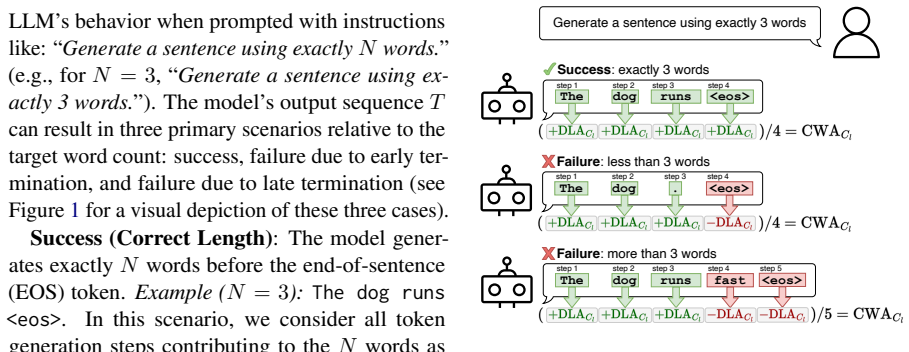
Cumulative Weighted Attribution (CWA), a signed aggregate of Direct Logit Attribution (DLA) over all generation steps of an output. At each step, DLA projects a component's residual-stream output onto the unembedding to measure its push on the winning token; CWA averages these pushes after signing each step +1 if the running word count is at most the target N and −1 otherwise. The sign rule is what turns raw logit attribution into a 'helps or hinders length control' score, and the per-layer aggregation is what allows the paper to localize the effect in deeper layers.
What would settle it
Re-run the CWA computation with the too-short stop (premature end-of-sentence) scored as a failure step rather than a success; if the late-layer attention attribution for instruction-tuned models no longer exceeds the base model's, the claimed deep-layer specialization is an artifact of the sign rule.
Extended reading notes
Core claim
Comparing the base and instruction-tuned versions of Llama 3.1 8B on 'write a sentence with exactly N words' prompts, the paper finds that instruction tuning reduces mean absolute error from tens of words to near zero. Using CWA, the paper traces this to the deep layers: components at layers 24–31 that show negative (constraint-hindering) attribution in the base model flip to positive attribution after tuning, especially attention heads in English. In Italian, attention contributions stay weaker and the final-layer MLP instead shows a strong positive CWA, which the authors propose is a compensatory mechanism for less effective attention-based length tracking. The paper also reports that the
Load-bearing premise
The central measurement assumption is that a generation step counts as correct whenever the running word count is at or below the target, so a too-short finish is scored as a success and the positive deep-layer signal may just be the model's habit of generating short text.
Editorial extensions
If this is right
- The base model's failure is mostly a stopping problem (it runs ~35 words long in English, ~27 in Italian), not a counting problem, since the tuned model with the same architecture is near-zero-error.
- If CWA is correct, length control in Llama 3.1 8B sits in late layers (roughly 24–31), so targeted interventions such as activation steering, pruning, or fine-tuning of those heads should have outsized effects on the capability.
- The English/Italian split—late attention heads vs final MLP—implies instruction-following strategies are language-conditional, so cross-lingual transfer of control improvements is not automatic.
- The deep-layer specializations appear only after instruction tuning, suggesting tuning adds a task-adherence circuit rather than strengthening a pre-existing one.
- Because the base model's deep MLPs are strongly negative for the constraint, instruction tuning must override rather than reuse those computations.
Reading between the lines
- The sign rule in Eq. 5 labels a premature end-of-sentence as a success step (running count still below N), yet the paper's own failure definition counts too-short outputs as failures; with English tuned errors mostly −1, the positive deep-layer attention CWA may substantially reflect the model's ordinary tendency to generate short texts, not length adherence.
- A direct test of the mechanism: score the same outputs with a sign rule that marks premature EOS as failure, and with a rule that marks all non-EOS word tokens after the count equals N as failure; the claimed layer-24+ specialization should survive only if it tracks true constraint-following.
- The compensatory-MLP reading for Italian could be checked by putting Italian lexical content into English prompts (or vice versa): if the final-layer MLP remains the strong component, the effect is tied to the language of content, not the language of instruction.
- The paper's attribution is correlational; a causal probe that zeroes or amplifies the late-layer heads (already flagged as future work) would convert the localization claim into a verified circuit claim.
Editorial analysis
A structured set of objections, weighed in public.
Referee Report
Summary. The paper studies how instruction tuning changes the internal mechanisms that let Llama 3.1 8B follow explicit word-count constraints. It compares the base and instruction-tuned (IT) models on English and Italian prompts with target lengths N = 3–9, scoring outputs as success, too short, or too long. The authors introduce Cumulative Weighted Attribution (CWA), derived from Direct Logit Attribution (DLA), which aggregates per-step DLA scores with signs determined by whether the running word count is within the target. The main claims are that instruction tuning substantially improves length control, that this improvement is implemented mainly in deeper model layers, that later-layer attention heads are especially important in English, and that final-layer MLPs play a compensatory role in Italian. Performance results show the IT model is far more accurate than the base model, which overgenerates. The mechanistic claims rest on CWA patterns in Figures 4 and 5.
Significance. If valid, the paper would be a useful step toward understanding where length-control behavior lives in an open-weight model and how it differs across languages. The task is important, the comparison between base and instruct versions is natural, and the cross-lingual design is a genuine addition over prior work. The performance findings are plausible and supported by Table 1. However, the central mechanistic contribution is undermined by a fundamental problem in the CWA sign rule, which contradicts the paper's own definition of too-short failures and makes the main figures uninterpretable as evidence about length-control specialization. The paper also leaves a key methodological detail unspecified: how a vector-valued DLA is reduced to the scalar used in CWA. For these reasons, the mechanistic claims are not currently supported.
major comments (2)
- [§4, Eq. (5)] The sign function in Eq. (5) is inconsistent with the failure definitions given earlier in §4. The text defines a premature EOS as a failure step when fewer than N words have been generated, but Eq. (5) assigns sign = +1 whenever the running word count m ≤ N. In the paper's own too-short example, 'The dog . <eos>' for N=3, all four steps satisfy m ≤ 3, so every step is scored +1 and the sequence is indistinguishable from a successful one. Since Table 1 shows that ENG-IT and ITA-IT errors are mostly non-positive (mean −0.07 and −0.08, with ITA-IT 25th percentile −1), the CWA contains almost no negative signal for the dominant IT error mode. The positive deep-layer CWA in Figures 4–5 therefore reflects only that IT outputs stay within the requested bound, and the IT-versus-BASE contrast is confounded with output length distribution. This undermines the central mechanistic claim that later-
- [§4, Eqs. (2)–(4)] CWA is not fully defined. In Eqs. (2) and (3), DLA_Cl is a vector over the vocabulary: it is the component output projected by the unembedding matrix W_U. Eq. (4), however, appears to treat DLA_Cl as a scalar when computing CWA_Cl. The paper does not state whether the scalar is the logit of the sampled token, the logit of the gold token, an average over tokens, or some other reduction. Without this specification, the numerical CWA values reported in Figures 4 and 5 are not reproducible. In addition, the sign function uses 'the sentence generated from tokens (t1,...,ti) collectively constituting m words,' but the paper does not define how word counts are computed from token sequences—e.g., how punctuation, subword tokens, or the EOS token are handled. These details are load-bearing for the proposed metric and must be clarified before the results can be accepted.
minor comments (3)
- [§6, Figures 4–5] The figures show layer-level CWA values without error bars or confidence intervals, even though §5 states each configuration was repeated 20 times. It is also unclear whether each curve is an average over attention heads within a layer, over prompt templates, over repetitions, or over all of these. Adding this information would make the visual language differences (e.g., ITA-IT final-layer MLP) more interpretable.
- [§5, prompt construction] The text says prompts were built with integers from 0 to 9, but the reported experiments cover N ∈ [3, 9]. Please clarify what was done with N = 0, 1, 2, or state that they were excluded from analysis.
- [§7, Limitations] The limitations paragraph mentions single-digit N, the Llama 3.1 architecture, and the two languages, but it does not mention the metric's sign inconsistency or the confound between CWA and output length. Adding this would improve the paper's transparency.
Circularity Check
No significant circularity: CWA is a post-hoc diagnostic, but its Eq. (5) sign rule creates a construct-validity problem that borders on self-definitional.
full rationale
Section 4 defines CWA (Eq. 4) with the sign rule (Eq. 5): sign(t_i|t_<i) = +1 whenever the running word count m <= N, and -1 otherwise. The paper also labels a premature EOS as a 'failure step' (Section 4, 'Failure (Too Short)', example 'The dog . <eos>'). At that step m=2 < N=3, so Eq. (5) assigns +1, contradicting the paper's own failure definition. As a result, positive CWA cannot distinguish exact-length success from too-short failure. Since Table 1 shows ENG-IT and ITA-IT errors are centered near 0 with negative tails, much of the positive deep-layer CWA observed for IT models may simply reflect that IT outputs do not exceed N, rather than deliberate length adherence. This is a serious measurement/construct-validity issue for the paper's mechanistic interpretation: the sign rule effectively defines 'good' as 'not overlong', which is not the same as 'exactly N'. However, this is not circularity in the strict sense used here. CWA is a post-hoc aggregation of DLA values computed from actual generation traces; no parameter is fitted to the later-layer specialization conclusion, and the observed layer/component patterns are not tautologically forced by the definition. There is also no load-bearing self-citation, no imported uniqueness theorem, and no known result merely renamed. The central derivation chain therefore does not reduce to its own inputs by construction, but the Eq. (5) inconsistency is a definitional flaw that weakens the central claim. Score 1 reflects that this is a minor, circularity-adjacent issue rather than a genuine circular derivation.
Assumptions & free parameters
assumptions (3)
- standard math Residual stream linearity: component outputs add directly and unembedding W_U gives a valid per-component logit attribution.
- domain assumption Word count m at each step is known and unambiguously defined.
- domain assumption DLA in Eq. (4) refers to the scalar logit value for the generated token t_i, although Eq. (2) defines a vector over the vocabulary.
Cite this review
Pith. "Pith review of How Instruction-Tuning Imparts Length Control: A Cross-Lingual Mechanistic Analysis." pith.science (2026). https://pith.science/paper/QQPP63TU
@misc{pith2026250902075,
  author       = {Pith},
  title        = {Pith review of: How Instruction-Tuning Imparts Length Control: A Cross-Lingual Mechanistic Analysis},
  year         = {2026},
  howpublished = {\url{https://pith.science/paper/QQPP63TU}},
  note         = {Machine review of arXiv:2509.02075}
}
read the original abstract
Adhering to explicit length constraints, such as generating text with a precise word count, remains a significant challenge for Large Language Models (LLMs). This study aims at investigating the differences between foundation models and their instruction-tuned counterparts, on length-controlled text generation in English and Italian. We analyze both performance and internal component contributions using Cumulative Weighted Attribution, a metric derived from Direct Logit Attribution. Our findings reveal that instruction-tuning substantially improves length control, primarily by specializing components in deeper model layers. Specifically, attention heads in later layers of IT models show increasingly positive contributions, particularly in English. In Italian, while attention contributions are more attenuated, final-layer MLPs exhibit a stronger positive role, suggesting a compensatory mechanism. These results indicate that instruction-tuning reconfigures later layers for task adherence, with component-level strategies potentially adapting to linguistic context.
Figures


Figures from the paper (1 more)

Reference graph
Works this paper leans on
-
[2]
Benchmarking large language models on controllable generation under diversified instructions. In Thirty-Eighth AAAI Conference on Artificial Intelligence, AAAI 2024, Thirty-Sixth Con- ference on Innovative Applications of Artificial Intel- ligence, IAAI 2024, Fourteenth Symposium on Educa- tional Advances in Artificial Intelligence, EAAI 2014, February 20...
work page 2024
-
[3]
On the similarity of circuits across languages: a case study on the subject-verb agreement task. In Find- ings of the Association for Computational Linguis- tics: EMNLP 2024, Miami, Florida, USA, November 12-16, 2024, pages 10115–10125. Association for Computational Linguistics. Changjiang Gao, Shujian Huang, Jixing Li, and Jiajun Chen
work page 2024
-
[5]
Mistral 7b. Preprint, arXiv:2310.06825. Po-Nien Kung and Nanyun Peng
-
[6]
Do models really learn to follow instructions? an empirical study of instruction tuning. In Proceedings of the 61st Annual Meeting of the Association for Computational Linguistics (Volume 2: Short Papers), ACL 2023, Toronto, Canada, July 9-14, 2023, pages 1317–1328. Association for Computational Linguistics. Xun Liang, Hanyu Wang, Yezhaohui Wang, Shichao ...
work page 2023
-
[7]
Con- trollable text generation for large language models: A survey. Preprint, arXiv:2408.12599. Llama Team, AI Meta
-
[8]
The llama 3 herd of models. Preprint, arXiv:2407.21783. Albert Lu, Hongxin Zhang, Yanzhe Zhang, Xuezhi Wang, and Diyi Yang
-
[9]
Bounding the capabili- ties of large language models in open text generation with prompt constraints. In Findings of the Asso- ciation for Computational Linguistics: EACL 2023, pages 1982–2008, Dubrovnik, Croatia. Association for Computational Linguistics. Chris Olah
work page 2023
-
[10]
Gpt-4 technical report. Preprint, arXiv:2303.08774. Tilman Räuker, Anson Ho, Stephen Casper, and Dylan Hadfield-Menell
Show all 18 references
-
[11]
Preprint, arXiv:2207.13243
Toward transparent ai: A survey on interpreting the inner structures of deep neural networks. Preprint, arXiv:2207.13243. Jiao Sun, Yufei Tian, Wangchunshu Zhou, Nan Xu, Qian Hu, Rahul Gupta, John Wieting, Nanyun Peng, and Xuezhe Ma
-
[12]
In Proceedings of the 2023 Conference on Empirical Methods in Natural Language Processing, pages 3155–3168, Singapore
Evaluating large language models on controlled generation tasks. In Proceedings of the 2023 Conference on Empirical Methods in Natural Language Processing, pages 3155–3168, Singapore. Association for Computational Linguistics. Gemma Team
2023
-
[13]
Preprint, arXiv:2403.08295
Gemma: Open models based on gemini research and technology. Preprint, arXiv:2403.08295. Hugo Touvron, Louis Martin, Kevin Stone, Peter Albert, and Amjad Almahairi et al
-
[14]
Preprint, arXiv:2307.09288
Llama 2: Open foundation and fine-tuned chat models. Preprint, arXiv:2307.09288. Xuansheng Wu, Wenlin Yao, Jianshu Chen, Xiaoman Pan, Xiaoyang Wang, Ninghao Liu, and Dong Yu
-
[15]
From language modeling to instruction fol- lowing: Understanding the behavior shift in LLMs after instruction tuning. In Proceedings of the 2024 Conference of the North American Chapter of the Association for Computational Linguistics: Human Language Technologies (Volume 1: Lo...
2024
-
[16]
In The Twelfth International Conference on Learning Representations, ICLR 2024, Vienna, Austria, May 7-11,
COLLIE: systematic construction of constrained text genera- tion tasks. In The Twelfth International Conference on Learning Representations, ICLR 2024, Vienna, Austria, May 7-11,
2024
-
[18]
Preprint, arXiv:2311.07911
Instruction-following evaluation for large language models. Preprint, arXiv:2311.07911. 10
-
[2022]
In Pro- ceedings of the 2022 Conference on Empirical Meth- ods in Natural Language Processing, pages 184–198, Abu Dhabi, United Arab Emirates
Interpreting lan- guage models with contrastive explanations. In Pro- ceedings of the 2022 Conference on Empirical Meth- ods in Natural Language Processing, pages 184–198, Abu Dhabi, United Arab Emirates. Association for Computational Linguistics. Jeffrey Zhou, Tianjian Lu, Sw...
2022
-
[2023]
human attention
Roles of scaling and instruction tuning in language perception: Model vs. human attention. In Findings of the Association for Computational Linguistics: EMNLP 2023, pages 13042–13055, Sin- gapore. Association for Computational Linguistics. Albert Q. Jiang, Alexandre Sablayroll...
2023
-
[2024]
Preprint, arXiv:2310.16343
Evaluat- ing, understanding, and improving constrained text generation for large language models. Preprint, arXiv:2310.16343. Yihan Chen, Benfeng Xu, Quan Wang, Yi Liu, and Zhendong Mao
Reviewed August 5, 2026 · model on record in the stance chip above.
Discussion (0). Sign in to comment.