REVIEW 3 major objections 4 minor 75 references
Defect states in compressible active polar fluids with turnover
T0 review · 3 major / 4 minor · reviewed 2026-08-07 · deepseek-v4-flash
Pith's one-line read Turnover stabilizes topological defects in compressible active polar fluids.
desk verdict A genuinely new turnover-based mechanism for stabilizing defects in active polar fluids, well-supported by numerics but conditional on the density-polarity coupling chi; deserves referee time. read the letter →
The pith
A machine-rendered reading of the paper's core claim, the machinery that carries it, and where it could break.
The reading
What carries the argument
The load-bearing object is the density-polarity coupling $\chi>0$ in the free energy $f = \frac{a}{4}\rho^4 + \rho^2\left[-\frac{\chi}{2}\frac{\rho}{\rho_0}|p|^2 + \frac{\chi}{4}|p|^4 + \frac{\kappa}{2}(\nabla p)^2\right]$, which sets $|p|^2 = \rho/\rho_0$ in equilibrium so that defect cores ($p=0$) are density-depleted. Around such a core, mass conservation with turnover (source term $-\tau^{-1}(\rho-\rho_0)$) produces a radial outflow; the two-domain core model gives the radial velocity $v(R^-)=\tau^{-1}R\varepsilon/2$ with $\varepsilon = \frac{3\chi\rho_0^2}{3\chi\rho_0^2+12\rho_0^3(a\rho_0-\zeta_\rho)+2\xi\tau^{-1}R\ell}$. This outflow enters the defect-pair force balance $\dot{d}=2v(r=d)-\kappa/(d\bar{\gamma})$, the equation that determines when defects repel rather than annihilate.
What would settle it
A numerical experiment with the same equations but $\chi=0$ should show no defect stabilization: opposite-charge pairs should annihilate for all turnover rates. Equivalently, in a simulation with $\chi>0$, measure the density profile and velocity field around an isolated $+1$ defect: if the claim is correct, the density should dip at the core and the radial velocity should grow with turnover rate roughly as $\tau^{-1}R\varepsilon$, while a defect pair should settle at a finite separation that shrinks as $\chi\to0$.
Extended reading notes
Core claim
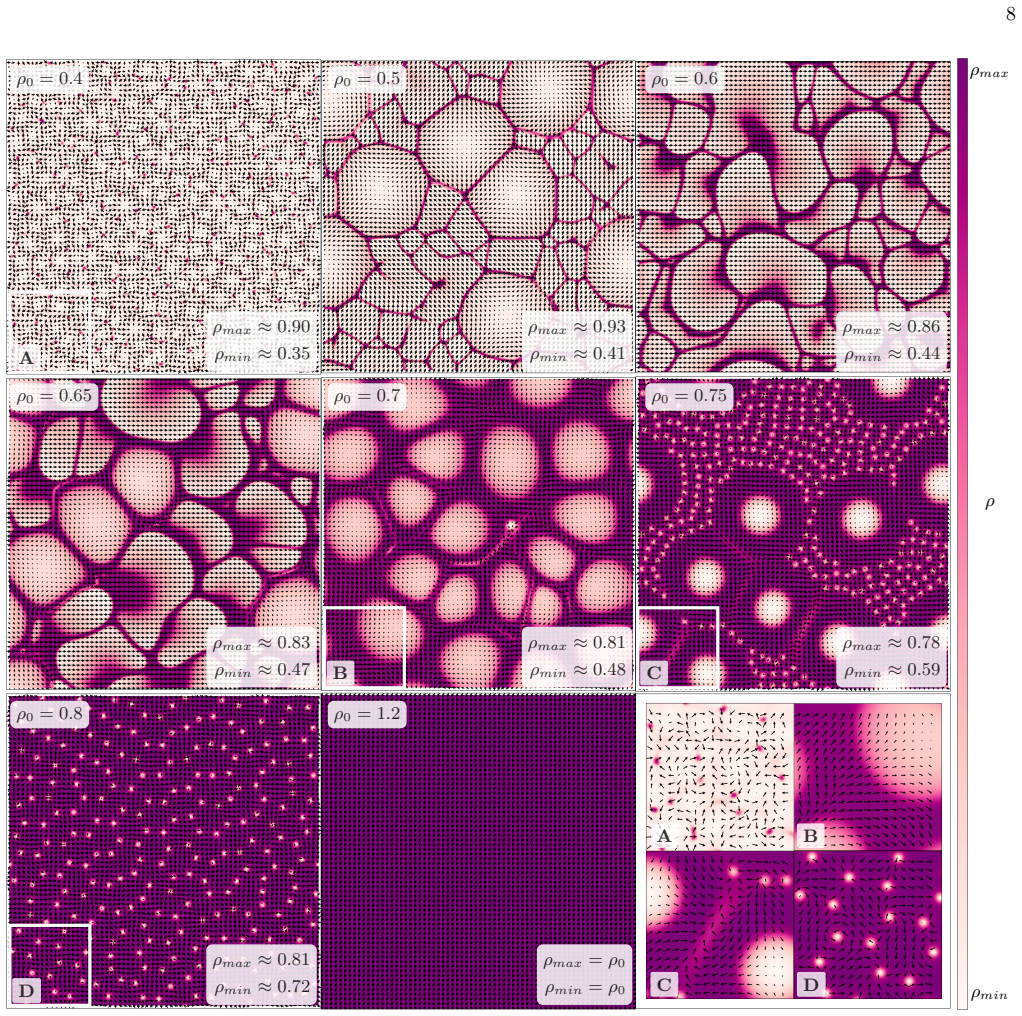
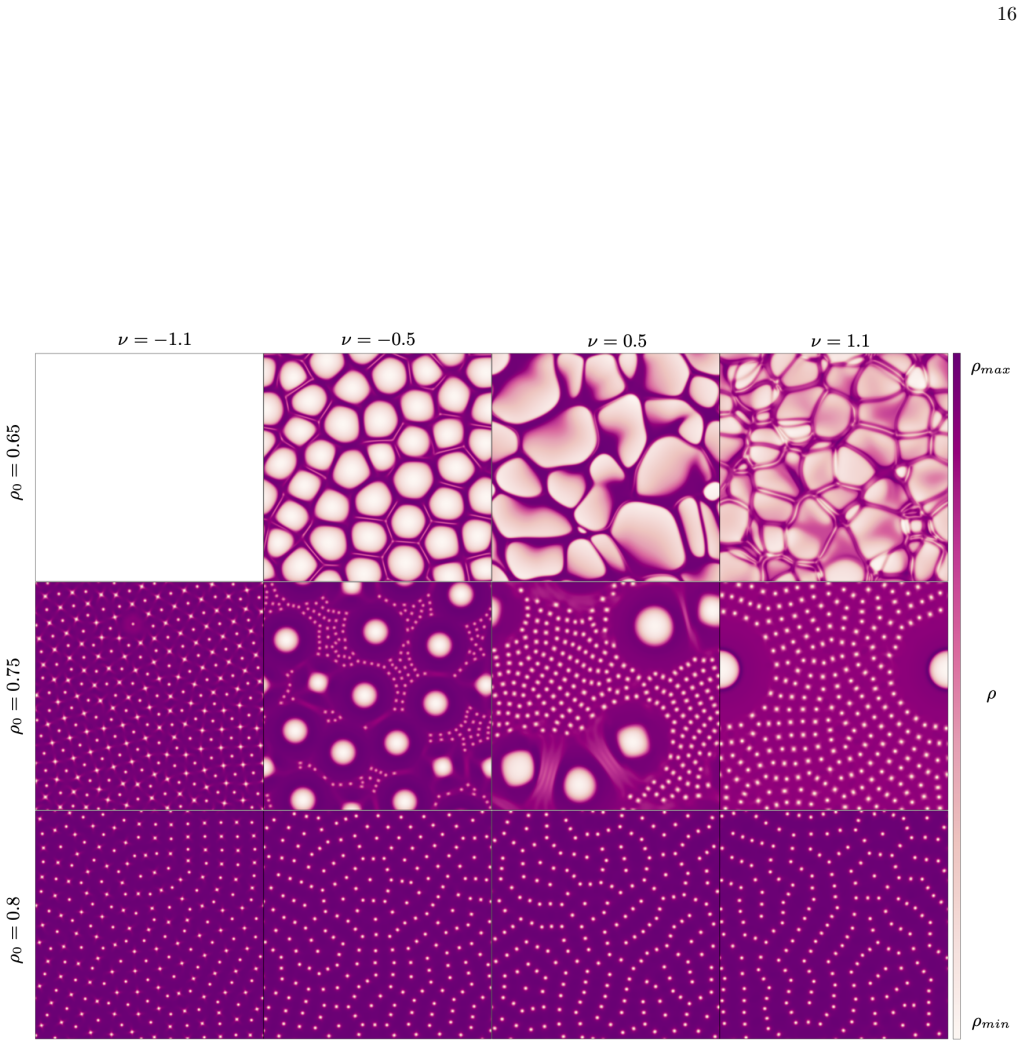
The central claim is that turnover stabilizes topological defect pairs in a compressible polar active fluid, with or without anisotropic active stress. In equilibrium the fluid's polarity magnitude obeys $|p|^2 = \rho/\rho_0$ for $\chi>0$, so a defect core, where $p=0$, is depleted of active fluid. Turnover, modeled by the source term $-\tau^{-1}(\rho-\rho_0)$, then sustains a radial Darcy-like outflow from the core with velocity $v(R^-)=\tau^{-1}R\varepsilon/2$ (Eq. 13), where $\varepsilon$ is the density contrast set by stress balance and mass conservation (Eq. 14). For two opposite-charge defects the separation obeys $\dot{d}=2v(r=d)-\kappa/(d\bar{\gamma})$ (Eq. 18), so the outflow advects each defect away from the other while elastic interactions ($\sim\kappa/d$) pull them together; at intermediate distances the outflow wins, giving a stable nonzero separation. Long-time numerical solutions show that this stabilization organizes defects into active foams, density waves, vortex glasses, and spontaneously forming square or hexagonal defect lattices, with the phase selected by the turnover rate and target density, rationalized by a linear stability analysis of homogeneous states that turns the instability from type II to type I.
Load-bearing premise
The whole stabilization mechanism requires that polarity order grows with density (the coupling $\chi>0$), so that a vanishing polarity at a defect core leaves the fluid locally depleted; without that density contrast, turnover produces no outward flow and nothing stops the defects from annihilating.
Editorial extensions
If this is right
- If turnover stabilizes defects without requiring anisotropic active stress, experimental systems with tunable turnover (reconstituted actomyosin, cell monolayers) should exhibit sustained defect populations controlled by assembly and disassembly rates.
- Defect lattices in this model move at constant velocity without defect rearrangements, implying a genuinely self-propelled crystalline state of singularities.
- The linear stability result predicts that turnover changes the onset of pattern formation from a type II to a type I instability, so the characteristic wavelength of the emerging pattern should be set by $\tau$ and by the density diffusion coefficient.
- Because the mechanism is independent of active stress anisotropy, it applies to both contractile and extensile situations as long as the density-polarity coupling is positive; anisotropic stress and flow alignment then only select defect subtypes or modify the pattern.
- The phase sequence with increasing target density—foams, waves, vortex glass, lattices, uniform—can serve as a phase diagram for experiments mapping turnover rates.
Reading between the lines
- The short-range repulsion between defects could be viewed as an effective defect gas with a repulsive core set by the outflow zone; this suggests that collective defect statistics might follow from an effective interacting-particle model with a single length scale $R$.
- Since defects are not spontaneously created in the noiseless theory, the model predicts that turnover regulates the fate of pre-existing defect populations; adding noise or defect-pair nucleation could turn it into a full theory of defect number selection.
- The same density-polarity coupling could stabilize defects in active nematics with turnover if the nematic order parameter is density-dependent, so the mechanism may generalize beyond polar systems.
- A concrete testable extension: in systems where turnover can be inhibited (e.g., by drug treatment), defect density should drop and pairs should annihilate, while increasing turnover should restore finite defect separations.
Editorial analysis
A structured set of objections, weighed in public.
Referee Report
Summary. The paper develops a hydrodynamic theory of compressible active polar fluids that includes turnover (assembly/disassembly of the active component), density-dependent active stress, and a density-polarity coupling in the free energy. The central claim is that turnover stabilizes topological defects in the polar order field: density depletion at defect cores, combined with turnover-driven radial outflow, repels oppositely charged defects and prevents annihilation. The authors support this claim with long-time numerical solutions in two dimensions, identifying several asymptotic states (active foams, density waves, vortex glasses, and defect lattices) as functions of target density, turnover rate, and activity. They also present a simplified two-domain analytic model of an isolated defect and a defect-pair force balance, along with linear stability analyses of homogeneous polarized and isotropic states. The paper argues that turnover, rather than chaotic active turbulence or suppressed hydrodynamic interactions, is a generic mechanism for organizing defects in biological active matter.
Significance. If the central claim holds, the paper identifies a plausible and previously underappreciated mechanism by which topological defects can be stabilized in biological active matter, with potential relevance to actin-cortex organization and tissue morphogenesis. The strengths of the paper are its extensive numerical parameter sweeps, the explicit derivation of the hydrodynamic model, the transparent stability analysis of homogeneous states, and falsifiable predictions such as the critical activity threshold in Eq. (21) and the dependence of defect density on rho_0, zeta_rho, and tau. However, the significance is moderated by the fact that the stabilization mechanism is conditional on a positive density-polarity coupling chi and by the acknowledged free parameters (defect core radius R and interface thickness l) in the analytic defect-core model. The paper is a solid contribution to active-matter theory if these caveats are made explicit and the analytic model is presented as a scaling argument rather than a closed quantitative theory.
major comments (3)
- [Abstract and Sec. III.A, Eqs. (13)-(14)] The radial outflow v(R-) = tau^{-1} R epsilon / 2 and the density contrast epsilon both vanish identically when the density-polarity coupling chi = 0, because epsilon in Eq. (14) is proportional to chi. Therefore the stabilization mechanism is not produced by turnover alone but by turnover acting on a density profile that is depleted at defect cores only because the equilibrium relation |p|^2 = rho/rho_0 is imposed by Eq. (1). The abstract's statement that 'turnover readily leads to a stabilization of defects' and the claim in Sec. III that turnover stabilizes defect pairs 'both in the presence or absence of active stress' should be qualified to state explicitly that positive chi is required. The paper would also benefit from a brief discussion of the physical evidence or modeling precedent for the sign and magnitude of chi, since the simulations use only chi = 0.1 (Table I) and the entire mechanism disappears for chi = 0.
- [Sec. III.A and Fig. 3] The analytic defect-core calculation neglects the Frank free energy (kappa = 0), leaves the core radius R and the interface thickness l as free parameters, and the authors state that chemical and mechanical balance cannot be enforced simultaneously. As a consequence, Eq. (18) and the stabilization criterion tau^{-1} R^2 epsilon > kappa / bar{gamma} are scaling relations rather than closed quantitative predictions. This becomes load-bearing when Fig. 3 compares the numerical phase boundary to Eq. (21) using the relation a = 4 zeta_c_rho / 3 from Table I; this relation is an ad hoc modeling choice, not a derived or measured parameter. Please state clearly that R, l, and the a-zeta_c_rho relation are adjustable within the analytic model, and provide a sensitivity check showing how the predicted boundary in Fig. 3 changes under reasonable variations of R and l.
- [Sec. III.B, Eq. (18)] The defect-pair balance uses the single-defect outflow v(r=d) as if it were the core-boundary value v(R-) = tau^{-1} R epsilon / 2. For the argument to work, the radial outflow must decay over a length comparable to R so that it is significant at d ~ R and negligible at d >> R, but the paper does not provide the radial decay profile or a derivation of v(r) outside the core. Without this profile, the statement that elastic attraction dominates at large d because radial flows are 'localized near the defect center' is only qualitative. A measurement of v(r) from the simulations, or a matched asymptotic solution, would substantially strengthen the analytic mechanism.
minor comments (4)
- [Sec. IV.B and Ref. [51]] The text says 'The code can be found at [51]', but Ref. [51] states 'Code will be made available upon publication.' Please provide a working repository link or change the wording to reflect the intended availability.
- [Sec. V] There is a typo, 'perfromed', in the first paragraph of Sec. V; it should be 'performed'.
- [Sec. IV.A and Eq. (21)] The discussion of the critical activity zeta_c_rho and the comparison in Fig. 3 would be easier to follow if the text explicitly stated that Eq. (21) is solved self-consistently when a = 4 zeta_c_rho / 3, and how this affects the shape of the predicted boundary.
- [Fig. 3 caption] The caption states that each data point comes from a single numerical solution; given the known variability of defect counts, a brief note on the expected statistical error or a representative error bar would help the reader judge the phase boundaries.
Circularity Check
No circularity: the turnover-driven defect stabilization is derived from the stated hydrodynamic model, not from its conclusion.
full rationale
The derivation chain is self-contained. The defect-core model in Sec. III starts from the declared free energy and constitutive equations, posits an inner core with depleted density, and derives the radial outflow from Eq. (12) mass balance together with the stress difference (10)-(11), yielding Eqs. (13)-(14). These are not fit to the simulation defect densities; the core radius R and interface thickness ℓ are left as free parameters, and the ratio check (17) uses parameter values from Table I rather than adjusting them to match the numerics. The pair stabilization balance, Eq. (18), combines this computed outflow with the standard elastic attraction κ/(dγbar), and the resulting condition τ^{-1}R^2ε > κ/γbar is a substantive inequality, not an identity. The linear-stability results (Eqs. (19)-(21), (C6)-(C8), (C11)-(C12)) are derived from the same equations and are used to rationalize, not to fit, the phase diagram. The relation a=4/3ζc_rho is a self-consistently chosen modeling convention, not a fitted parameter renamed as a prediction. Dependence of the mechanism on the density-polarity coupling χ>0 in Eq. (1) is a stated physical input and a limitation on generality, but it does not make the derivation circular because the conclusion is not equivalent to that input by construction. Self-citations (e.g., Refs. [37], [44], [55]) appear only as background modeling context and are not load-bearing for the stabilization claim. No circular step meeting the evidentiary standard was found.
Assumptions & free parameters
free parameters (3)
- Defect core radius R =
undetermined
- Quartic density stiffness a relative to activity zeta_rho =
a = 4/3 zeta_rho (Table I)
- Interface thickness l =
assumed proportional to R
assumptions (5)
- domain assumption The free energy density has the form f = a*rho^4/4 + rho^2*(-(chi/2)(rho/rho_0)|p|^2 + (chi/4)|p|^4 + (kappa/2)(nabla p)^2), Eq. (1).
- domain assumption Turnover enters as a linear relaxation of density to rho_0, d_t rho + ... = -tau^{-1}(rho-rho_0), Eq. (4).
- domain assumption Momentum balance reduces to a Darcy friction law d_beta sigma_tot = xi v, Eq. (5), with inertia and permeation neglected.
- ad hoc to paper The analytic defect-core calculation neglects the Frank free energy (kappa=0) and does not enforce chemical and mechanical balance simultaneously.
- domain assumption The dynamics are deterministic (no noise), so topological defects are only present through initial conditions.
Cite this review
Pith. "Pith review of Defect states in compressible active polar fluids with turnover." pith.science (2026). https://pith.science/paper/QRGS5OJO
@misc{pith2026250603795,
  author       = {Pith},
  title        = {Pith review of: Defect states in compressible active polar fluids with turnover},
  year         = {2026},
  howpublished = {\url{https://pith.science/paper/QRGS5OJO}},
  note         = {Machine review of arXiv:2506.03795}
}
read the original abstract
Biological active matter like the cytoskeleton or tissues are characterized by their ability to transform chemical energy into mechanical stress. In addition, it often exhibits orientational order, which is essential for many cellular and morphogenetic processes. Experimental evidence suggests that defects in the orientational order field play an important role in organizing active stress. However, defects tend to annihilate unless the material is in a chaotic state or hydrodynamic interactions are suppressed. Using a hydrodynamic description of compressible active polar fluids, we show that turnover readily leads to a stabilization of defects. Depending on the turnover rate, topological defects arrange in a multitude of different phases, including lattices, active foams, and vortex glasses. Our work suggests that turnover plays a crucial role for organizing biological active matter.
Figures


Figures from the paper (9 more)



Reference graph
Works this paper leans on
-
[1]
Puncta and networks For small target densitiesρ 0,ρ 0 = 0.4 in Fig. 5 and Movie 6, the system spontaneously forms puncta of ele- vated density within a background with a density around ρ0. The majority of these puncta are connected to other puncta by lines of intermediate density that formed the edges of a network with puncta at its vertices. We denote th...
-
[2]
Active foams With increasing target densityρ 0, the density along the edges increases,ρ 0 = 0.5 in Fig. 5 and Movie 7. The system forms two sorts of cells: One kind contains a single integer topological defect of the polar order field, whereas cells of the other kind do not contain defects. In the latter, the polarity is typically aligned throughout the w...
-
[3]
Density waves Asρ 0 is increased further, traveling density waves ap- pear,ρ 0 = 0.6 andρ 0 = 0.65 in Fig. 5 and Movies 2 and 8. At the same time, uniform polar order emerges through- out the whole system. In contrast to lower densities, the cell shapes are elongated in one direction. The direction of elongation is on average perpendicular to the directio...
-
[4]
Vortex glass For a target density ofρ 0 = 0.75, topological defects with cores of two different sizes emerge, Fig. 5 and Movie
-
[5]
small” defects flowing between “large
The state is dynamic with “small” defects flowing between “large” ones. Due to the similarity of this state with states observed in the complex Ginzburg-Landau equation, we denote this state as a vortex glass state [52]. Note, however, that the disclination points with charge +1 can also be asters and spirals in addition to vortices, Fig. 5C
-
[6]
For densities around ρ0 = 0.8, locally, regular defect lattices appear sponta- neously, Fig
Defect lattices As the target density is increased further, the size of defect cores is again monodisperse. For densities around ρ0 = 0.8, locally, regular defect lattices appear sponta- neously, Fig. 5D and Movie 10. The topological defects have charges of±1 and the lattices are either square or hexagonal. We discuss the lattice phase in more detail in S...
-
[7]
Indeed, the critical valueζ c ρ, Eq
Homogenous uniformly polarized state For target densitiesρ 0 beyond a critical value, the system asymptotically settles into the homogenous state with uniform polarity, Movie 11. Indeed, the critical valueζ c ρ, Eq. (21), increases with the densityρ 0. By increasingρ 0 and keeping all other parameter values con- stant, the homogenous uniformly polarized s...
-
[8]
Polarized homogeneous state To study the linear stability of the polarized state, we consider without limiting generality that the polar field is aligned along thex-axis,p 0.ey = 0. We setρ=ρ 0 +δρ, p=p 0 +δpwith|p 0|= 1, andv=δv, and derive the dynamic equations to first order in the perturbationsδρ, δp, andδv. By settingδρ= ˆρ(q x, qy)ei(qxx+qyy) and si...
Show all 75 references
-
[9]
Isotropic homogeneous state In our numerical integration of the equations (1)- (9), we initialize the system in the isotropic state with a small random perturbation. In Sect. IV C, to interpret the states observed in numerics, we use a linear stabil- ity analysis of the isotro...
-
[10]
Substituting the expressions above for ˆvx and ˆvy into the linearized equa- tions (1)-(9), we obtain the following dynamical equa- tions for the density and the polarization d dt ˆρ=− 1 τ + 3q2 aρ2 0γ−ρ 0 E 2q2 + 1 ˆρ.(C11) d dt ˆp= ρ2 0 Γ χ−κq 2 ˆp.(C12) As long asχ >0, the ...
-
[11]
Prost, F
J. Prost, F. J¨ ulicher, and J. F. Joanny, Active gel physics, Nature Physics11, 111 (2015)
2015
-
[12]
A. B. Verkhovsky, T. M. Svitkina, and G. G. Borisy, Self- polarization and directional motility of cytoplasm., Curr. Biol.9, 11 (1999)
1999
-
[13]
A. C. Martin, M. Kaschube, and E. F. Wieschaus, Pulsed contractions of an actin-myosin network drive apical con- striction, Nature457, 495 (2009)
2009
-
[14]
Mayer, M
M. Mayer, M. Depken, J. S. Bois, F. J¨ ulicher, and S. W. Grill, Anisotropies in cortical tension reveal the physical basis of polarizing cortical flows, Nature467, 617 (2010)
2010
-
[15]
Sanchez, D
T. Sanchez, D. T. N. Chen, S. J. DeCamp, M. Heymann, and Z. Dogic, Spontaneous motion in hierarchically as- sembled active matter, Nature491, 431 (2012)
2012
-
[16]
Duclos, S
G. Duclos, S. Garcia, H. G. Yevick, and P. Silberzan, Perfect nematic order in confined monolayers of spindle- shaped cells, Soft Matter10, 2346 (2014)
2014
-
[17]
N´ ed´ elec, T
F. N´ ed´ elec, T. Surrey, A. C. Maggs, and S. Leibler, Self- organization of microtubules and motors, Nature389, 305 (1997)
1997
-
[18]
Delarue, J.-F
M. Delarue, J.-F. Joanny, F. J¨ ulicher, and J. Prost, Stress distributions and cell flows in a growing cell aggregate, Interface focus4, 20140033 (2014)
2014
-
[19]
S. Jain, V. M. Cachoux, G. H. Narayana, S. de Beco, J. D’alessandro, V. Cellerin, T. Chen, M. L. Heuz´ e, P. Marcq, R.-M. M` ege,et al., The role of single-cell me- chanical behaviour and polarity in driving collective cell migration, Nature Physics16, 802 (2020)
2020
-
[20]
Armengol-Collado, L
J.-M. Armengol-Collado, L. N. Carenza, J. Eckert, D. Krommydas, and L. Giomi, Epithelia are multiscale active liquid crystals, Nature Physics19, 1773–1779 (2023)
2023
-
[21]
Dedenon and K
M. Dedenon and K. Kruse, Noise-induced transitions from contractile to extensile active stress in isotropic flu- ids, Physical Review E111, 015426 (2025)
2025
-
[22]
T. B. Saw, A. Doostmohammadi, V. Nier, L. Kocgozlu, 18 S. Thampi, Y. Toyama, P. Marcq, C. T. Lim, J. M. Yeo- mans, and B. Ladoux, Topological defects in epithelia govern cell death and extrusion, Nature544, 212 (2017)
2017
-
[23]
Kawaguchi, R
K. Kawaguchi, R. Kageyama, and M. Sano, Topological defects control collective dynamics in neural progenitor cell cultures, Nature545, 327 (2017)
2017
-
[24]
Maroudas-Sacks, L
Y. Maroudas-Sacks, L. Garion, L. Shani-Zerbib, A. Livshits, E. Braun, and K. Keren, Topological de- fects in the nematic order of actin fibres as organization centres of Hydra morphogenesis, Nature Physics17, 251 (2021)
2021
-
[25]
Guillamat, C
P. Guillamat, C. Blanch-Mercader, G. Pernollet, K. Kruse, and A. Roux, Integer topological defects or- ganize stresses driving tissue morphogenesis, Nature Ma- terials21, 588 (2022)
2022
-
[26]
P. G. de Gennes and J. Prost,The Physics of Liquid Crystals, 2nd ed., Oxford University Press (Oxford Uni- versity Press, 2002)
2002
-
[27]
A. J. Vromans and L. Giomi, Orientational properties of nematic disclinations, Soft Matter12, 6490 (2016), 1507.05588
2016 arXiv
-
[28]
Tang and J
X. Tang and J. V. Selinger, Orientation of topological defects in 2D nematic liquid crystals, Soft Matter13, 5481 (2017), 1706.05065
2017 arXiv
-
[29]
D. J. G. Pearce and K. Kruse, Properties of twisted topo- logical defects in 2D nematic liquid crystals†, Soft Matter 17, 7408 (2021), 2104.11293
2021 arXiv
-
[30]
Blanch-Mercader, P
C. Blanch-Mercader, P. Guillamat, A. Roux, and K. Kruse, Quantifying Material Properties of Cell Mono- layers by Analyzing Integer Topological Defects, Physical Review Letters126, 028101 (2021)
2021
-
[31]
Maroudas-Sacks, L
Y. Maroudas-Sacks, L. Garion, S. Suganthan, M. Popovi´ c, and K. Keren, Confinement Modulates Axial Patterning in Regenerating Hydra, PRX Life2, 043007 (2024)
2024
-
[32]
Ravichandran, M
Y. Ravichandran, M. Vogg, K. Kruse, D. J. G. Pearce, and A. Roux, Topology changes of Hydra define actin ori- entation defects as organizers of morphogenesis, Science Advances11, eadr9855 (2025)
2025
-
[33]
S. P. Thampi, R. Golestanian, and J. M. Yeomans, Veloc- ity Correlations in an Active Nematic, Phys. Rev. Lett. 111, 118101 (2013)
2013
-
[34]
Giomi, Geometry and Topology of Turbulence in Ac- tive Nematics, Physical Review X5, 031003 (2015)
L. Giomi, Geometry and Topology of Turbulence in Ac- tive Nematics, Physical Review X5, 031003 (2015)
2015
-
[35]
Alert, J
R. Alert, J. Casademunt, and J.-F. Joanny, Active Tur- bulence, Annual Review of Condensed Matter Physics 13, 143 (2022), 2104.02122
2022 arXiv
-
[36]
D. J. G. Pearce, Activity Driven Orientational Order in Active Nematic Liquid Crystals on an Anisotropic Substrate, Physical Review Letters122, 227801 (2019), 1810.04549
2019 arXiv
-
[37]
D. J. G. Pearce, Defect order in active nematics on a curved surface, New Journal of Physics22, 063051 (2020), 2002.06364
2020 arXiv
-
[38]
Thijssen and A
K. Thijssen and A. Doostmohammadi, Binding self- propelled topological defects in active turbulence, Phys- ical Review Research2, 042008 (2020), 2007.13443
2020 arXiv
-
[39]
A. U. Oza and J. Dunkel, Antipolar ordering of topo- logical defects in active liquid crystals, New Journal of Physics18, 093006 (2016), 1507.01055
2016 arXiv
-
[40]
Doostmohammadi, M
A. Doostmohammadi, M. F. Adamer, S. P. Thampi, and J. M. Yeomans, Stabilization of active matter by flow- vortex lattices and defect ordering., Nature Communica- tions7, 10557 (2016)
2016
-
[41]
Thijssen, M
K. Thijssen, M. R. Nejad, and J. M. Yeomans, Role of Friction in Multidefect Ordering, Physical Review Letters 125, 218004 (2020), 2005.01164
2020 arXiv
-
[42]
Shankar, A
S. Shankar, A. Souslov, M. J. Bowick, M. C. Marchetti, and V. Vitelli, Topological active matter, Nature Reviews Physics4, 380 (2022)
2022
-
[43]
T. B. Saw, W. Xi, B. Ladoux, and C. T. Lim, Biolog- ical tissues as active nematic liquid crystals, Advanced materials30, 1802579 (2018)
2018
-
[44]
Maroudas-Sacks and K
Y. Maroudas-Sacks and K. Keren, Mechanical pattern- ing in animal morphogenesis, Annual Review of Cell and Developmental Biology37, 469 (2021)
2021
-
[45]
J. F. Joanny, F. J¨ ulicher, K. Kruse, and J. Prost, Hydro- dynamic theory for multi-component active polar gels, New Journal of Physics9, 422 (2007)
2007
-
[46]
A. C. Callan-Jones and F. J¨ ulicher, Hydrodynamics of ac- tive permeating gels, New Journal of Physics13, 093027 (2011)
2011
-
[47]
J. F. Joanny, K. Kruse, J. Prost, and S. Ramaswamy, The actin cortex as an active wetting layer, The Euro- pean Physical Journal E36, 10.1140/epje/i2013-13052-9 (2013)
2013 doi
-
[48]
R. M. Adar and J.-F. Joanny, Active-gel theory for mul- ticellular migration of polar cells in the extra-cellular ma- trix, New Journal of Physics24, 073001 (2022)
2022
-
[49]
de Gennes and J
P. de Gennes and J. Prost,The Physics of Liquid Crystals, International Series of Monographs on Physics (Clarendon Press, 1993)
1993
-
[50]
Kruse, J.-F
K. Kruse, J.-F. Joanny, F. J¨ ulicher, J. Prost, and K. Seki- moto, Asters, vortices, and rotating spirals in active gels of polar filaments., Phys. Rev. Lett.92, 078101 (2004)
2004
-
[51]
B. I. Shraiman, Mechanical feedback as a possible reg- ulator of tissue growth, Proceedings of the National Academy of Sciences102, 3318 (2005)
2005
-
[52]
Basan, T
M. Basan, T. Risler, J.-F. Joanny, X. Sastre-Garau, and J. Prost, Homeostatic competition drives tumor growth and metastasis nucleation, HFSP journal3, 265 (2009)
2009
-
[53]
S. R. d. Groot and P. Mazur,Non-Equilibrium Ther- modynamics, Dover Publications Inc (Dover Publications Inc, 1985)
1985
-
[54]
Kruse, J.-F
K. Kruse, J.-F. Joanny, F. J¨ ulicher, J. Prost, and K. Seki- moto, Generic theory of active polar gels: a paradigm for cytoskeletal dynamics, The European Physical Journal E 16, 5 (2005)
2005
-
[55]
Levernier and K
N. Levernier and K. Kruse, Spontaneous formation of chaotic protrusions in a polymerizing active gel layer, New Journal of Physics22, 013003 (2020)
2020
-
[56]
Giomi, M
L. Giomi, M. J. Bowick, X. Ma, and M. C. Marchetti, De- fect Annihilation and Proliferation in Active Nematics, Phys. Rev. Lett.110, 228101 (2013)
2013
-
[57]
Giomi, M
L. Giomi, M. J. Bowick, P. Mishra, R. Sknepnek, and M. C. Marchetti, Defect dynamics in active nemat- ics, Philosophical Transactions of the Royal Society a- Mathematical Physical and Engineering Sciences372, 10.1098/rsta.2013.0365 (2014)
2014
-
[58]
Shankar, S
S. Shankar, S. Ramaswamy, M. C. Marchetti, and M. J. Bowick, Defect unbinding in active nematics, Physical review letters121, 108002 (2018)
2018
-
[59]
M. C. Cross and P. C. Hohenberg, Pattern formation outside of equilibrium, Rev Mod Phys65, 851 (1993)
1993
-
[60]
Bezanson, A
J. Bezanson, A. Edelman, S. Karpinski, and V. B. Shah, Julia: A fresh approach to numerical computing, SIAM review59, 65 (2017)
2017
-
[61]
Code will be made available upon publication. 19
-
[62]
Brito, I
C. Brito, I. S. Aranson, and H. Chat´ e, Vortex glass and vortex liquid in oscillatory media, Phys. Rev. Lett.90, 068301 (2003)
2003
-
[63]
Voituriez, J
R. Voituriez, J. F. Joanny, and J. Prost, Spontaneous flow transition in active polar gels, EPL (Europhysics Letters) 70, 10.1209/epl/i2004-10501-2 (2007), q-bio/0503022
2007 arXiv
-
[64]
Duclos, C
G. Duclos, C. Blanch-Mercader, V. Yashunsky, G. Sal- breux, J. F. Joanny, J. Prost, and P. Silberzan, Spon- taneous shear flow in confined cellular nematics, Nature Physics14, 728 (2018)
2018
-
[65]
Dedenon, C
M. Dedenon, C. A. Dessalles, P. Guillamat, A. Roux, K. Kruse, and C. Blanch-Mercader, Density-Polarity Coupling in Confined Active Polar Films: Asters, Spi- rals, and Biphasic Orientational Phases, Physical Review Letters131, 268301 (2023)
2023
-
[66]
Chandragiri, A
S. Chandragiri, A. Doostmohammadi, J. M. Yeomans, and S. P. Thampi, Flow States and Transitions of an Ac- tive Nematic in a Three-Dimensional Channel, Physical Review Letters125, 148002 (2020)
2020
-
[67]
I. Lavi, R. Alert, J.-F. Joanny, and J. Casademunt, Dynamical arrest in active nematic turbulence, arXiv 10.48550/arxiv.2407.15149 (2024), 2407.15149
2024 doi
-
[68]
M. F. Staddon, E. M. Munro, and S. Banerjee, Pul- satile contractions and pattern formation in excitable actomyosin cortex, PLoS Computational Biology18, e1009981 (2022)
2022
-
[69]
Besse, H
M. Besse, H. Chat´ e, and A. Solon, Metastability of Constant-Density Flocks, Physical Review Letters129, 268003 (2022)
2022
-
[70]
Lemma, N
B. Lemma, N. P. Mitchell, R. Subramanian, D. J. Needle- man, and Z. Dogic, Active Microphase Separation in Mix- tures of Microtubules and Tip-Accumulating Molecular Motors, Physical Review X12, 031006 (2022)
2022
-
[71]
Rinaldin, A
M. Rinaldin, A. Kickuth, B. Dalton, Y. Xu, S. D. Talia, and J. Brugu´ es, Robust cytoplasmic partitioning by solving an intrinsic cytoskeletal instability, bioRxiv , 2024.03.12.584684 (2024)
2024
-
[72]
James, D
M. James, D. A. Suchla, J. Dunkel, and M. Wilczek, Emergence and melting of active vortex crystals, Nature Communications12, 5630 (2021)
2021
-
[73]
D. J. G. Pearce, J. Nambisan, P. W. Ellis, A. Fernandez- Nieves, and L. Giomi, Orientational Correlations in Ac- tive and Passive Nematic Defects, Physical Review Let- ters127, 197801 (2021)
2021
-
[74]
R. R. Keogh, S. Chandragiri, B. Loewe, T. Ala-Nissila, S. P. Thampi, and T. N. Shendruk, Helical flow states in active nematics, Physical Review E106, L012602 (2022)
2022
-
[75]
Caballero, Z
F. Caballero, Z. You, and M. C. Marchetti, Vorticity phase separation and defect lattices in the isotropic phase of active liquid crystals, Soft Matter19, 7828 (2023)
2023
Reviewed August 7, 2026 · model on record in the stance chip above.
Discussion (0). Sign in to comment.