REVIEW 5 major objections 6 minor 2 cited by
AgreeMate: Teaching LLMs to Haggle
T0 review · 5 major / 6 minor · reviewed 2026-08-11 · deepseek-v4-flash
Pith's one-line read Larger Llama models negotiate more agreeably and fairly, while chain-of-thought makes them explore more, according to a 21-model study of prompt engineering, fine-tuning, and personality prompts in buyer-seller bargaining.
desk verdict A clearly written course project with a genuine empirical bug: the Fairness metric divides by zero in every run, so the headline fairness results are undefined. read the letter →
The pith
A machine-rendered reading of the paper's core claim, the machinery that carries it, and where it could break.
The reading
What carries the argument
The load-bearing object is the AgreeMate framework itself: a decoupled bargaining architecture with no parser, in which the LLM serves as both manager (selecting from eleven coarse actions) and generator (producing the utterance), with outputs formatted as action-utterance pairs. A negotiation runner orchestrates buyer and seller agents over at most 15 turns on 30 fixed scenarios, and a tester records prices and actions for metric calculation. The metrics that carry the evaluation are agreement rate, a midpoint-deviation fairness score, a seller-target bias score, aggressiveness, concession rate, relative efficiency, and probing ratio. Role specialization is produced by LoRA fine-tuning (rank 32, alpha 16) with 4-bit nf4 quantization, gradient checkpointing, cyclic learning-rate scheduling, EMA loss tracking, and layerwise learning-rate decay, keeping memory around 3.56GB. Attention probing of specific heads then serves as the internal-evidence component.
What would settle it
Recompute every metric in Tables 2 and 3 from raw conversation histories using a defined fairness denominator (for example, seller target minus buyer target), and independently verify that the parsed accepted prices and action labels match the raw model text; the scale and CoT conclusions stand only if the corrected fairness rankings still show larger models as fairer and CoT as more exploratory.
Extended reading notes
Core claim
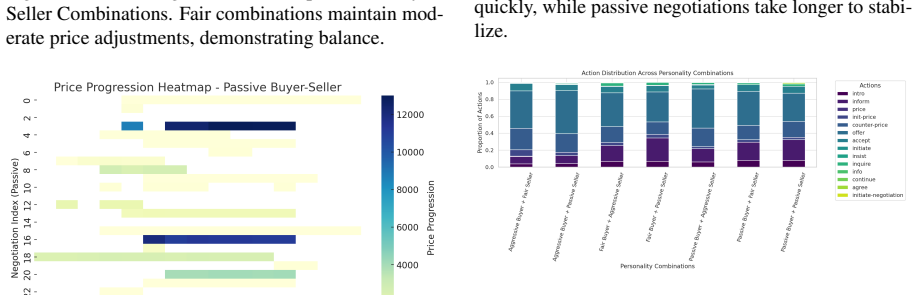
On its own terms, the paper's discovery is that an LLM can replace both the manager and generator of a modular negotiation system, choosing coarse actions (offer, counter-price, insist, accept, inform, inquire) and producing utterances, and that this design exposes clear, regular effects. Larger Llama models show higher agreement rates, lower aggressiveness, and fairer outcomes, while the 8B models are an outlier with low agreement and long dialogues. Chain-of-thought prompting produces exploratory behavior—higher probing ratios, more aggressive initial offers, and smaller average concessions—that improves agreement rates and relative efficiency but makes small models much more buyer-biased and unfair. Personality prompts act as another control: aggressive buyers paired with fair sellers reach the highest agreement rate, and passive sellers exhibit the highest buyer bias. Attention probing finds a layer-1 head that attends to negotiation verbs regardless of fine-tuning, plus a layer-2 head that attends to 'sell' differently between buyer and seller specialists, which the paper reads as evidence that models track negotiation-relevant semantics.
Load-bearing premise
All conclusions rest on the assumption that the fairness metric is well-defined (its printed formula divides by seller target minus seller target, which is zero for every run) and that the prices and action labels parsed from model outputs accurately reflect what the agents said.
Editorial extensions
If this is right
- Larger Llama models (70B over 3B) can be expected to produce higher agreement rates, fairer outcomes, less aggressiveness, and shorter dialogues in the same bargaining setup.
- Chain-of-thought prompting shifts negotiation style toward exploration: more inquiry acts, more aggressive price moves, and smaller concessions, with agreement rates and relative efficiency improving even as small-model bias and fairness degrade.
- Personality prompting works as a control on the whole conversation: aggressive buyers dominate and shorten dialogues, passive sellers concede most, and aggressive-plus-fair pairings give the highest agreement rate.
- Role-specialized negotiation agents (buyer, seller, generalist) can be fine-tuned at 3B scale under tight memory constraints, suggesting specialized bargaining can run on modest hardware.
- Attention-head patterns tied to negotiation verbs indicate that even without a dedicated parser, the models track negotiation-relevant semantics in their input.
Reading between the lines
- One untested extension is to raise the 15-turn cap for CoT agents; the paper's own relative-efficiency result suggests longer horizons could convert exploratory inquiry into fairer agreements, but the paper does not run this comparison.
- The fine-tuning study only covers the 3B scale, leaving open whether role specialization at 8B or 70B would reproduce the same buyer/seller asymmetries or interact with the scale effects the paper reports.
- The attention-head finding suggests a direct control experiment the paper does not attempt: steering or masking the layer-1 negotiation-verb head should measurably alter concession behavior if the semantic-attention claim is causal.
- Because personality prompts were applied to base 3B models rather than the fine-tuned specialists, a natural follow-up is to cross personality prompts with fine-tuned weights to separate prompt-driven from weight-driven strategy.
Signed reviews
Editorial analysis
A structured set of objections, weighed in public.
Referee Report
Summary. AgreeMate introduces a framework in which an LLM acts as both negotiation manager and generator, producing action-utterance pairs under a turn limit. The paper evaluates Llama 3.2 3B/8B/70B models with and without chain-of-thought prompting, personality-prompted 3B models, and three fine-tuned 3B specialists (buyer, seller, generalist) on 30 scenarios from the Craigslist Bargaining Dataset. It defines several custom metrics, including fairness, bias, aggressiveness, concession rate, relative efficiency, and probing ratio, and reports that larger models are more agreeable and fairer, that chain-of-thought prompting induces exploratory bargaining behavior, that personality prompts shift negotiation outcomes, and that certain attention heads track negotiation-related verbs. The central quantitative claims rest on the custom metrics and on automatic extraction of prices and actions from model outputs; as written, the fairness metric is undefined and the extraction is not validated.
Significance. If the empirical results were valid, the paper would provide a useful comparison of model scale, prompting, and fine-tuning in a strategic dialogue setting, and the release of code on GitHub together with the use of public datasets would aid reproducibility. Strengths include the breadth of the model zoo tested, the clear separation of the evaluation set (Craigslist) from the fine-tuning set (Deal or No Deal), and the transparency about the course-project context. However, the headline claims are not currently supported: the fairness formula in Section 6.2 divides by zero as printed, the fine-tuning claim in the abstract is never tested against a baseline, and all metric-based comparisons depend on an unvalidated parser. These are load-bearing issues rather than presentation slips, although they are identifiable and, in principle, correctable.
major comments (5)
- [Section 6.2] The Fairness formula is written as Fairness = 1 - 2*|accepted - (seller_target + buyer_target)/2| / (seller_target - seller_target). The denominator is identically zero for every negotiation, so every Fairness value in Tables 2 and 3, Figures 7 and 18, and all fairness-based conclusions in Sections 6.3.3, 6.4.3, and 6.4.6 are undefined as printed. Please correct the denominator (presumably to seller_target - buyer_target) and recompute all affected results; the abstract's 'fairer' claims depend directly on this metric.
- [Section 6.1] The paper states that 'relevant information like prices and actions are recorded' from model outputs, but it reports no validation of this extraction. Because Agreement Rate, Bias, Aggressiveness, Concession Rate, and Probing Ratio are all computed from these extracted prices and action labels, any parsing error corrupts every metric reported. Please provide parsing accuracy on a labeled sample, or compare the extracted actions with the Craigslist dataset's provided intents, so that the main measurements are trustworthy.
- [Section 5.4 and Section 6.1] The three fine-tuned agents (buyer specialist, seller specialist, generalist) are listed in Section 6.1, but no subsequent table or figure reports their negotiation metrics, and there is no comparison with the base Llama 3.2 3B model. Section 5.4 reports only training loss convergence. Therefore the abstract's claim that 'fine-tuning ... enhances model performance' is not demonstrated by the experiments. Please add a direct comparison of the fine-tuned specialists against the corresponding baseline on the Section 6.2 metrics.
- [Section 6.1] All results are based on 30 randomly selected scenarios, and the paper reports no confidence intervals or significance tests. Differences such as Table 3's With-CoT versus Without-CoT Bias (1.0813 vs 0.1671) or Fairness (-0.4385 vs 0.3021), as well as the agreement rates in Table 1, could plausibly reflect noise at n=30. Please add bootstrap confidence intervals or a suitable statistical test for each headline comparison.
- [Section 6.2] Several metrics, including Aggressiveness, Bias, Fairness, Relative Efficiency, and Concession Rate, are defined in terms of an accepted price, but agreement rates in Table 1 and Figure 16 are below 1. The paper does not state whether rejected or turn-limit-truncated negotiations are excluded from the metric averages or assigned a specific value. This decision affects every reported mean and should be made explicit.
minor comments (6)
- [Throughout] The dataset name is consistently misspelled as 'Craiglist'; it should be 'Craigslist'.
- [Section 6.2] The heading 'Aggreement Rate' contains a typo; it should be 'Agreement Rate'.
- [Section 6.1] The phrase 'aggressive, fair, and passive passive personalities' duplicates 'passive'; one instance should be removed.
- [Section 3] The sentence 'To goal being, to see if LLMs can infer common negotiation strategies...' is ungrammatical and should be rewritten.
- [References] The Llama 3.2 models are cited to Touvron et al. (2023), which describes Llama 1; please cite the correct Llama 3.2 release or model card.
- [Section 6.5] The probing analysis draws conclusions such as 'this specific attention head was not impacted by fine-tuning' from visual inspection of a single conversation; this claim should be labeled as anecdotal or supported by quantitative comparisons across multiple inputs.
Circularity Check
No circularity found; the empirical chain is independent of its own conclusions, though §6.2's Fairness formula and unvalidated parsing are serious validity problems, not circularity.
full rationale
I examined the derivation chain from the abstract's claims through Sections 5–6.5. The main claims are (1) model scale, CoT prompting, personality prompts, and fine-tuning affect negotiation behavior, and (2) certain attention heads track negotiation semantics. The evaluation uses the Craigslist Negotiation Dataset, while fine-tuning uses the separate Deal or No Deal dataset; no metric or parameter is fitted to the evaluation outcomes. The custom metrics in §6.2 are computed directly from recorded prices, targets, and action counts, and they are not used as training objectives, so they do not make the conclusions true by construction. The attention probing is a post-hoc observation of attention weights on a single conversation, not a metric derived from the conclusion. The paper contains no self-citations that carry a load-bearing premise; its architecture is inherited from He et al. (2018) and the base model from Touvron et al. (2023), both external and independently available. Therefore no circular step can be exhibited. For completeness, §6.2's Fairness formula has a zero denominator (seller_target - seller_target) and §6.1 reports no validation of the price/action parser; these are serious validity and reproducibility problems, but they are not circularity, because the metrics are not defined in terms of the conclusions and are not fitted to them.
Assumptions & free parameters
free parameters (3)
- Negotiation turn limit =
15
- Test scenario count =
30
- Fine-tuning hyperparameters =
rank 32, alpha 16, batch 32, seq 512, 4k steps
assumptions (5)
- domain assumption LLM-generated action labels and extracted prices accurately reflect the true negotiation state
- ad hoc to paper The fairness formula is meaningful and its denominator is nonzero
- domain assumption 30 randomly chosen scenarios from the Craigslist test set are representative for model comparisons
- domain assumption Personality prompt labels correspond to distinct agent strategies
- domain assumption Visual inspection of attention weights from one conversation is sufficient evidence of semantic negotiation processing
Cite this review
Pith. "Pith review of AgreeMate: Teaching LLMs to Haggle." pith.science (2026). https://pith.science/paper/QRVGZ7GW
@misc{pith2026241218690,
  author       = {Pith},
  title        = {Pith review of: AgreeMate: Teaching LLMs to Haggle},
  year         = {2026},
  howpublished = {\url{https://pith.science/paper/QRVGZ7GW}},
  note         = {Machine review of arXiv:2412.18690}
}
read the original abstract
We introduce AgreeMate, a framework for training Large Language Models (LLMs) to perform strategic price negotiations through natural language. We apply recent advances to a negotiation setting where two agents (i.e. buyer or seller) use natural language to bargain on goods using coarse actions. Specifically, we present the performance of Large Language Models when used as agents within a decoupled (modular) bargaining architecture. We demonstrate that using prompt engineering, fine-tuning, and chain-of-thought prompting enhances model performance, as defined by novel metrics. We use attention probing to show model attention to semantic relationships between tokens during negotiations.
Figures


Figures from the paper (15 more)




Forward citations
Cited by 2 Pith papers
-
EvoEmo: Towards Evolved Emotional Policies for Adversarial LLM Agents in Multi-Turn Price Negotiation
EvoEmo evolves emotion-transition policies for buyer LLM agents and reports higher savings, success rates, and efficiency than vanilla or fixed-emotion baselines in simulated price negotiations.
-
State-Inference-Based Prompting for Natural Language Trading with Game NPCs
A prompt framework that makes LLM game merchants follow a six-state trading flow achieves over 97% state compliance, over 95% item accuracy, and 99.7% price accuracy in simulated dialogues.
Reference graph
Works this paper leans on
-
[1]
online" 'onlinestring :=
ENTRY address archivePrefix author booktitle chapter edition editor eid eprint eprinttype howpublished institution journal key month note number organization pages publisher school series title type volume year doi pubmed url lastchecked label extra.label sort.label short.list INTEGERS output.state before.all mid.sentence after.sentence after.block STRING...
-
[2]
write newline
" write newline "" before.all 'output.state := FUNCTION n.dashify 't := "" t empty not t #1 #1 substring "-" = t #1 #2 substring "--" = not "--" * t #2 global.max substring 't := t #1 #1 substring "-" = "-" * t #2 global.max substring 't := while if t #1 #1 substring * t #2 global.max substring 't := if while FUNCTION word.in bbl.in capitalize " " * FUNCT...
-
[3]
Simon Martin Breum, Daniel V dele Egdal, Victor Gram Mortensen, Anders Giovanni M ller, and Luca Maria Aiello. 2023. https://arxiv.org/abs/2312.15523 The persuasive power of large language models . Computing Research Repository, arXiv:2312.15523
arXiv 2023
-
[4]
He He, Derek Chen, Anusha Balakrishnan, and Percy Liang. 2018. https://doi.org/10.18653/v1/D18-1256 Decoupling strategy and generation in negotiation dialogues . In Proceedings of the 2018 Conference on Empirical Methods in Natural Language Processing, pages 2333--2343, Brussels, Belgium. Association for Computational Linguistics
-
[5]
Mike Lewis, Denis Yarats, Yann N Dauphin, Devi Parikh, and Dhruv Batra. 2017. https://arxiv.org/abs/1706.05125 Deal or no deal? end-to-end learning for negotiation dialogues . Proceedings of the Conference on Empirical Methods in Natural Language Processing (EMNLP). Published by Meta AI, focusing on negotiation tasks that combine reasoning and linguistic ...
arXiv 2017
-
[6]
Deepa Seetharaman. 2024. https://www.wsj.com/tech/ai/open-ai-division-for-profit-da26c24b Turning OpenAI into a real business is tearing it apart . The Wall Street Journal
work page 2024
-
[7]
Hugo Touvron, Thibaut Lavril, Gautier Izacard, Xavier Martinet, Marie-Anne Lachaux, Timothée Lacroix, Baptiste Rozière, Naman Goyal, Eric Hambro, Faisal Azhar, Aurelien Rodriguez, Armand Joulin, Edouard Grave, and Guillaume Lample. 2023. https://arxiv.org/abs/2302.13971 Llama: Open and efficient foundation language models . arXiv preprint arXiv:2302.13971...
arXiv 2023
Reviewed August 11, 2026 · model on record in the stance chip above.
Discussion (0). Continue with ORCID to comment.