EP251023a: A fast X-ray transient featuring a magnetar-powered optical internal plateau followed by a steep decay
Pith reviewed 2026-06-25 23:35 UTC · model grok-4.3
The pith
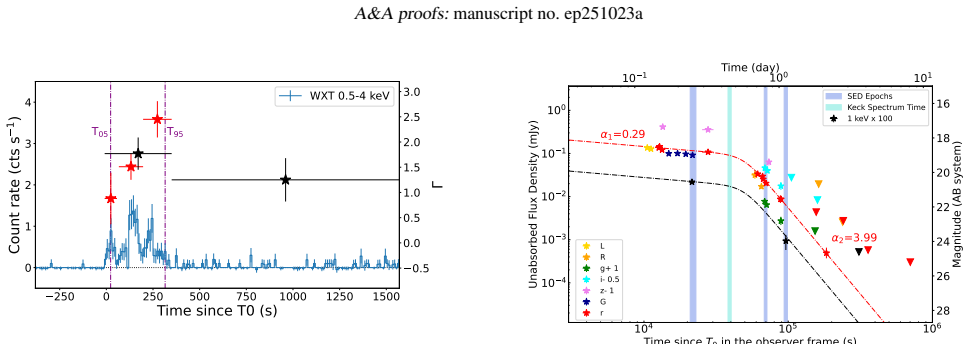
EP251023a shows an achromatic optical plateau then a slope-3.99 decay after 49 ks, matching a magnetar engine with little external-shock input.
A machine-rendered reading of the paper's core claim, the machinery that carries it, and where it could break.
Core claim
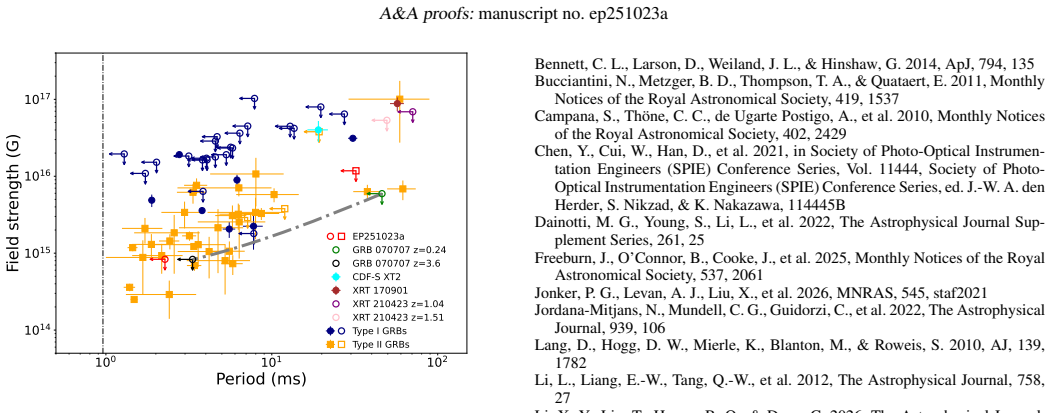
The late-time light curves of EP251023a show an achromatic plateau, followed by an extremely steep decay with a slope of 3.99 after a break at about 49 ks, which is consistent with a rapidly spinning millisecond magnetar engine. Under the isotropic wind scenario the initial period satisfies P0 < 2.27 ms and the magnetic field Bp < 8.33 × 10^14 G; a typical jet opening angle of 0.1 rad relaxes the bounds to P0 < 32.15 ms and Bp < 1.18 × 10^16 G.
What carries the argument
The magnetar-powered internal plateau, in which spin-down energy is released internally and produces the observed achromatic plateau and subsequent steep decay with minimal external-shock contribution.
If this is right
- The magnetar initial spin period and magnetic field are bounded by the observed break time and decay slope under both isotropic and collimated geometries.
- EP251023a and GRB 070707 form a rare subclass of events whose plateaus are visible in the optical band and show little external-shock contamination.
- The absence of a bright gamma-ray counterpart is compatible with a magnetar central engine that powers the plateau internally.
- Similar events detected in the future will clarify how optical magnetar plateaus relate to those seen only in X-rays.
Where Pith is reading between the lines
- Detection of the plateau in optical bands implies that some magnetar-driven transients may be missed when only X-ray monitors are used.
- The low host-galaxy HI column density reported from the Keck spectrum may reduce extinction and thereby allow the internal emission to be seen at optical wavelengths.
- If the same engine operates without strong external shocks, the event may link fast X-ray transients to other magnetar-powered phenomena such as certain superluminous supernovae.
Load-bearing premise
The observed optical plateau and steep decay are dominated by internal magnetar-powered emission with little external-shock contamination.
What would settle it
A measurement showing that the optical-to-X-ray spectral index changes across the 49 ks break or that the decay index deviates from the value predicted by the derived magnetar parameters would falsify the internal-emission interpretation.
Figures
read the original abstract
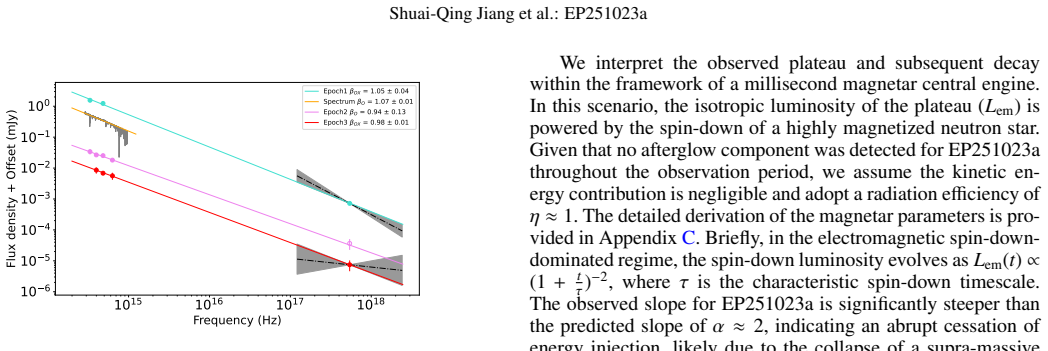
EP251023a is an extragalactic fast X-ray transient (eFXT) detected solely by EP without a gamma-ray counterpart. The prompt emission consists of a main emission with a duration $T_{90}=292\pm19$ s, followed by a long-lasting tail emission that persists until the observation ends at $T_0+1571$ s. With the upper limit of Konus--Wind, we derived a conservative upper limit on the isotropic gamma-ray energy $E_{\gamma,\rm{iso}}$ of $5.7 \times 10^{52}$ erg for the main emission phase. A redshift of $z = 2.232\pm0.001$ is identified from strong absorption features in the Keck spectrum, which also indicate a relatively low host-galaxy HI column density. Based on the broadband spectral energy distribution, the late-time light curves show an achromatic plateau, followed by an extremely steep decay with a slope of 3.99 after a break at about 49 ks, which is consistent with a rapidly spinning millisecond magnetar engine. Under the isotropic wind scenario, we obtain the initial period $P_0<2.27$~ms and the magnetic field strength $B_p<8.33\times10^{14}$~G for the magnetar; whereas considering a jet collimation with a typical opening angle of 0.1 rad relaxes these constraints to $P_0<32.15$~ms and $B_p<1.18\times10^{16}$~G. Together with GRB\,070707, EP251023a may represent a rare class of optical magnetar-powered internal plateaus with little external-shock contamination, unlike previous examples detected primarily in X-rays. Future discoveries of similar events will help clarify the relationship between magnetar-powered internal emission observed in the optical band and that detected only in X-rays.
Editorial analysis
A structured set of objections, weighed in public.
Referee Report
Summary. The paper reports the detection of EP251023a, an extragalactic fast X-ray transient at z=2.232 with no gamma-ray counterpart. Prompt emission lasts T90=292 s plus a tail to 1571 s, with Eγ,iso upper limit 5.7e52 erg. Late-time optical light curves exhibit an achromatic plateau (from broadband SED) breaking at ~49 ks to a steep decay with index 3.99. This is interpreted as a magnetar-powered internal plateau with negligible external-shock contamination. Upper limits are derived: P0<2.27 ms and Bp<8.33e14 G (isotropic wind) or relaxed to P0<32.15 ms and Bp<1.18e16 G (jet with 0.1 rad opening angle). The event is proposed as a rare optical analog to GRB 070707.
Significance. If the magnetar interpretation with minimal external-shock contribution holds after quantitative testing, the result would be significant for identifying a new subclass of optical magnetar-powered plateaus in fast X-ray transients, distinct from X-ray-only cases, and for providing direct constraints on millisecond magnetar parameters. The broadband SED argument for achromaticity is a methodological strength that supports the internal-emission claim.
major comments (2)
- [Late-time light-curve and SED section] Late-time light-curve and SED section: The central claim that the achromatic plateau and post-break decay (α=3.99 at ~49 ks) are dominated by internal magnetar emission with little external-shock contamination is load-bearing for the derived P0 and Bp limits, yet the manuscript provides no quantitative decomposition, upper limits on external forward-shock flux, or comparison showing that standard afterglow models (which predict α≲2 once injection ceases) are sub-dominant.
- [Magnetar parameter estimation (isotropic and jet scenarios)] Magnetar parameter estimation (isotropic and jet scenarios): The reported upper limits on P0 and Bp are obtained by direct substitution of the observed plateau duration, break time, and decay index into the standard spin-down equations without reported fit statistics (e.g., χ²/dof), parameter uncertainties, or explicit tests of alternative models, rendering the consistency circular by construction.
minor comments (1)
- [Abstract] The abstract states the decay slope as 3.99 without quoting uncertainties or the functional form of the broken power-law fit used to obtain the break time.
Simulated Author's Rebuttal
We thank the referee for their thorough review and valuable comments on our manuscript. We address each of the major comments below, providing clarifications and indicating where revisions will be made.
read point-by-point responses
-
Referee: [Late-time light-curve and SED section] The central claim that the achromatic plateau and post-break decay (α=3.99 at ~49 ks) are dominated by internal magnetar emission with little external-shock contamination is load-bearing for the derived P0 and Bp limits, yet the manuscript provides no quantitative decomposition, upper limits on external forward-shock flux, or comparison showing that standard afterglow models (which predict α≲2 once injection ceases) are sub-dominant.
Authors: We agree that a more quantitative assessment would strengthen the manuscript. The observed decay slope of 3.99 is substantially steeper than the α ≲ 2 expected for external forward shocks post-injection, and the achromatic nature from the broadband SED supports an internal origin. However, to address this directly, we will add a section providing upper limits on the external shock contribution by comparing to standard afterglow models scaled to the available X-ray constraints and optical data. This will include estimates showing the external component is sub-dominant. revision: yes
-
Referee: [Magnetar parameter estimation (isotropic and jet scenarios)] The reported upper limits on P0 and Bp are obtained by direct substitution of the observed plateau duration, break time, and decay index into the standard spin-down equations without reported fit statistics (e.g., χ²/dof), parameter uncertainties, or explicit tests of alternative models, rendering the consistency circular by construction.
Authors: The P0 and Bp values are not obtained from a statistical fit but are calculated as upper limits using the analytic expressions for magnetar spin-down (plateau luminosity and duration). The decay index is used to confirm consistency with the end of the internal plateau phase rather than ongoing injection. The approach is not circular as the model naturally predicts a shallower decay during spin-down; the steep observed decay indicates the cessation of the magnetar-powered emission. We will include the explicit formulas used and discuss the assumptions in the revised manuscript. No χ² is applicable as this is not a fit. revision: partial
Circularity Check
No significant circularity; standard model fitting to observed light-curve features.
full rationale
The paper extracts the plateau duration (~49 ks) and post-break decay index (α=3.99) directly from the observed optical light curves and broadband SED. It then invokes the standard isotropic magnetar wind spin-down formulae to place upper bounds on P0 and Bp. This is ordinary parameter estimation under an assumed emission mechanism; the derived limits are not presented as independent predictions, nor do they reduce to the inputs by algebraic identity. No load-bearing self-citations appear in the derivation chain, and the central consistency statement rests on the mismatch between the observed steep slope and typical external-shock expectations rather than on any redefinition or fitted-input renaming.
Axiom & Free-Parameter Ledger
free parameters (1)
- jet opening angle =
0.1 rad
axioms (2)
- domain assumption Magnetar spin-down luminosity and timescale relations connect plateau duration and decay slope to initial spin period and magnetic field
- domain assumption Achromatic plateau indicates a single internal emission component with negligible external shock contribution
Reference graph
Works this paper leans on
-
[1]
GRB Coordinates Network , year = 2025, month = oct, volume =
EP251023a: Einstein Probe detection of an X-ray transient. GRB Coordinates Network , year = 2025, month = oct, volume =
2025
-
[2]
Astronomical Data Analysis Software and Systems V , year = 1996, editor =
XSPEC: The First Ten Years. Astronomical Data Analysis Software and Systems V , year = 1996, editor =
1996
-
[3]
On the Absorption of X-rays in the Interstellar Medium
Wilms, J. and Allen, A. and McCray, R. , title =. The Astrophysical Journal , abstract =. 2000 , month =. doi:10.1086/317016 , url =
work page internal anchor Pith review doi:10.1086/317016 2000
-
[4]
Calibration of X-ray absorption in our Galaxy
Calibration of X-ray absorption in our Galaxy. , keywords =. doi:10.1093/mnras/stt175 , archivePrefix =. 1303.0843 , primaryClass =
work page internal anchor Pith review Pith/arXiv arXiv doi:10.1093/mnras/stt175
-
[5]
Measuring Reddening with SDSS Stellar Spectra and Recalibrating SFD
Schlafly, Edward F. and Finkbeiner, Douglas P. , title =. The Astrophysical Journal , abstract =. 2011 , month =. doi:10.1088/0004-637X/737/2/103 , url =
work page internal anchor Pith review doi:10.1088/0004-637x/737/2/103 2011
-
[6]
Society of Photo-Optical Instrumentation Engineers (SPIE) Conference Series , year = 2021, editor =
Status of the follow-up x-ray telescope onboard the Einstein Probe satellite. Society of Photo-Optical Instrumentation Engineers (SPIE) Conference Series , year = 2021, editor =. doi:10.1117/12.2562311 , adsurl =
-
[7]
Science China Physics, Mechanics, and Astronomy , keywords =
Yuan, Weimin and Dai, Lixin and Feng, Hua and Jin, Chichuan and Jonker, Peter and Kuulkers, Erik and Liu, Yuan and Nandra, Kirpal and O'Brien, Paul and Piro, Luigi and Rau, Arne and Rea, Nanda and Sanders, Jeremy and Tao, Lian and Wang, Junfeng and Wu, Xuefeng and Zhang, Bing and Zhang, Shuangnan and Ai, Shunke and Buchner, Johannes and Bulbul, Esra and C...
-
[8]
The Einstein Probe Mission , ISBN=
Yuan, Weimin and Zhang, Chen and Chen, Yong and Ling, Zhixing. The Einstein Probe Mission. Handbook of X-ray and Gamma-ray Astrophysics. 2022. doi:10.1007/978-981-16-4544-0_151-1
-
[9]
GRB Coordinates Network , year = 2025, month = oct, volume =
EP/WXT 01709247295: GOTO optical afterglow candidate. GRB Coordinates Network , year = 2025, month = oct, volume =
2025
-
[10]
GRB Coordinates Network , year = 2025, month = oct, volume =
EP251023a: Keck/LRIS spectroscopic redshift z=2.232. GRB Coordinates Network , year = 2025, month = oct, volume =
2025
-
[11]
The Keck Low-Resolution Imaging Spectrometer. , keywords =. doi:10.1086/133562 , adsurl =
-
[12]
The fraction of ionizing radiation from massive stars that escapes to the intergalactic medium
The fraction of ionizing radiation from massive stars that escapes to the intergalactic medium. , keywords =. doi:10.1093/mnras/sty3460 , archivePrefix =. 1805.07318 , primaryClass =
work page internal anchor Pith review Pith/arXiv arXiv doi:10.1093/mnras/sty3460
-
[13]
The Dynamics and Light Curves of Beamed Gamma Ray Burst Afterglows
The Dynamics and Light Curves of Beamed Gamma-Ray Burst Afterglows. , keywords =. doi:10.1086/307907 , archivePrefix =. astro-ph/9903399 , primaryClass =
work page internal anchor Pith review Pith/arXiv arXiv doi:10.1086/307907
-
[14]
doi:10.1086/320255 , keywords =
Zhang, Bing and Mészáros, Peter , title =. The Astrophysical Journal , abstract =. 2001 , month =. doi:10.1086/320255 , url =
-
[15]
Secondary standard stars for absolute spectrophotometry. , keywords =. doi:10.1086/160817 , adsurl =
-
[16]
Aptekar, R. L. and Frederiks, D. D. and Golenetskii, S. V. and Ilynskii, V. N. and Mazets, E. P. and Panov, V. N. and Sokolova, Z. J. and Terekhov, M. M. and Sheshin, L. O. and Cline, T. L. and Stilwell, D. E. , title=. Space Science Reviews , year=. doi:10.1007/BF00751332 , url=
-
[17]
Spectral Hardening Reveals Afterglow Emergence in Long-duration Fast X-Ray Transients: A Case Study of GRB 250404A/EP250404a. , keywords =. doi:10.3847/2041-8213/adf552 , archivePrefix =. 2506.00435 , primaryClass =
-
[18]
Experimental Astronomy , keywords =
Ground calibration result of the wide-field X-ray telescope (WXT) onboard the Einstein probe. Experimental Astronomy , keywords =. doi:10.1007/s10686-025-10025-9 , archivePrefix =. 2505.18939 , primaryClass =
-
[19]
Gamma-Ray Urgent Archiver for Novel Opportunities (GUANO): Swift/BAT Event Data Dumps on Demand to Enable Sensitive Subthreshold GRB Searches. , keywords =. doi:10.3847/1538-4357/aba94f , archivePrefix =. 2005.01751 , primaryClass =
-
[20]
Harvesting BAT-GUANO with NITRATES (Non-Imaging Transient Reconstruction and Temporal Search): Detecting and Localizing the Faintest Gamma-Ray Bursts with a Likelihood Framework. , keywords =. doi:10.3847/1538-4357/ac9d38 , archivePrefix =. 2111.01769 , primaryClass =
-
[21]
The Burst Alert Telescope (BAT) on the SWIFT Midex Mission. , keywords =. doi:10.1007/s11214-005-5096-3 , archivePrefix =. astro-ph/0507410 , primaryClass =
work page internal anchor Pith review Pith/arXiv arXiv doi:10.1007/s11214-005-5096-3
-
[22]
The Fermi Gamma-Ray Burst Monitor
The Fermi Gamma-ray Burst Monitor. , keywords =. doi:10.1088/0004-637X/702/1/791 , archivePrefix =. 0908.0450 , primaryClass =
work page internal anchor Pith review Pith/arXiv arXiv doi:10.1088/0004-637x/702/1/791
-
[23]
The 1% Concordance Hubble Constant
The 1\. , keywords =. doi:10.1088/0004-637X/794/2/135 , archivePrefix =. 1406.1718 , primaryClass =
work page internal anchor Pith review Pith/arXiv arXiv doi:10.1088/0004-637x/794/2/135
-
[24]
A Complete Reference of the Analytical Synchrotron External Shock Models of Gamma-Ray Bursts
A complete reference of the analytical synchrotron external shock models of gamma-ray bursts. , keywords =. doi:10.1016/j.newar.2013.10.001 , archivePrefix =. 1310.2181 , primaryClass =
work page internal anchor Pith review Pith/arXiv arXiv doi:10.1016/j.newar.2013.10.001 2013
-
[25]
Smooth light curves from a bumpy ride: relativistic blast wave encounters a density jump. , keywords =. doi:10.1111/j.1365-2966.2007.12245.x , archivePrefix =. astro-ph/0606011 , primaryClass =
-
[26]
The short GRB070707 afterglow and its very faint host galaxy
The short GRB 070707 afterglow and its very faint host galaxy. , keywords =. doi:10.1051/0004-6361:200810547 , archivePrefix =. 0807.1348 , primaryClass =
work page internal anchor Pith review Pith/arXiv arXiv doi:10.1051/0004-6361:200810547
-
[27]
GRB -0.5ex 250704B/EP250704a a Short Gamma-Ray Burst Powered by a Magnetar. arXiv e-prints , keywords =. doi:10.48550/arXiv.2601.15732 , archivePrefix =. 2601.15732 , primaryClass =
-
[28]
A magnetar-powered X-ray transient as the aftermath of a binary neutron-star merger
A magnetar-powered X-ray transient as the aftermath of a binary neutron-star merger. , keywords =. doi:10.1038/s41586-019-1079-5 , archivePrefix =. 1904.05368 , primaryClass =
work page internal anchor Pith review Pith/arXiv arXiv doi:10.1038/s41586-019-1079-5 1904
-
[29]
Triggering the Untriggered: The First Einstein Probe-detected Gamma-Ray Burst 240219A and Its Implications. , keywords =. doi:10.3847/2041-8213/ad8652 , archivePrefix =. 2407.10156 , primaryClass =
-
[30]
EP240801a/XRF 240801B: An X-Ray Flash Detected by the Einstein Probe and the Implications of Its Multiband Afterglow. , keywords =. doi:10.3847/2041-8213/addebf , archivePrefix =. 2503.04306 , primaryClass =
-
[31]
Soft X-ray prompt emission from the high-redshift gamma-ray burst EP240315a. Nature Astronomy , keywords =. doi:10.1038/s41550-024-02449-8 , archivePrefix =. 2404.16425 , primaryClass =
-
[32]
Nature Astronomy , year = 2025, month = sep, volume =
Fast X-ray transient EP240315A from a Lyman-continuum-leaking galaxy at z 5. Nature Astronomy , year = 2025, month = sep, volume =. doi:10.1038/s41550-025-02612-9 , adsurl =
-
[33]
JWST and HST Observations of the Host Galaxy and Supernova SN 2024aihh in EP240801a at z = 1.67. , keywords =. doi:10.3847/2041-8213/ae28db , archivePrefix =. 2512.11572 , primaryClass =
-
[34]
RapidGBM: An Efficient Tool for Fermi-GBM Visibility Checking and Data Analysis with a Case Study of EP240617a. , keywords =. doi:10.3847/1538-4357/ae04e8 , archivePrefix =. 2506.20532 , primaryClass =
-
[35]
GRB 250704B: An Off-axis Short GRB with a Long-lived Afterglow Plateau. , keywords =. doi:10.3847/2041-8213/ae2a20 , archivePrefix =. 2509.02769 , primaryClass =
-
[36]
Minutes-long soft X-ray prompt emission from a compact object merger. arXiv e-prints , keywords =. doi:10.48550/arXiv.2601.14137 , archivePrefix =. 2601.14137 , primaryClass =
-
[37]
Identification of the Optical Counterpart of the Fast X-Ray Transient EP240414a. , keywords =. doi:10.3847/2041-8213/ad9c75 , archivePrefix =. 2409.19070 , primaryClass =
-
[38]
The Radio Counterpart to the Fast X-Ray Transient EP240414a. , keywords =. doi:10.3847/1538-4357/adaaef , archivePrefix =. 2409.19055 , primaryClass =
-
[39]
The Einstein Probe Transient EP240414a: Linking Fast X-Ray Transients, Gamma-Ray Bursts, and Luminous Fast Blue Optical Transients. , keywords =. doi:10.3847/2041-8213/adbc7e , archivePrefix =. 2409.19056 , primaryClass =
-
[40]
EP240414a: Off-axis View of a Jet-cocoon System from an Expanded Progenitor Star. , keywords =. doi:10.3847/1538-4357/adc993 , archivePrefix =. 2503.24266 , primaryClass =
-
[41]
EP240414a: A Gamma-Ray Burst Jet Weakened by an Extended Circumstellar Material. , keywords =. doi:10.3847/2041-8213/add99d , archivePrefix =. 2503.16243 , primaryClass =
-
[42]
A fast X-ray transient from a weak relativistic jet associated with a type Ic-BL supernova. Nature Astronomy , keywords =. doi:10.1038/s41550-025-02571-1 , archivePrefix =. 2410.02315 , primaryClass =
-
[43]
An extremely soft and weak fast X-ray transient associated with a luminous supernova. arXiv e-prints , keywords =. doi:10.48550/arXiv.2504.17034 , archivePrefix =. 2504.17034 , primaryClass =
-
[44]
The Kangaroo's First Hop: The Early Fast Cooling Phase of EP250108a/SN 2025kg. , keywords =. doi:10.3847/2041-8213/ade1d9 , archivePrefix =. 2504.08886 , primaryClass =
-
[45]
EP250108a/SN 2025kg: A Jet-driven Stellar Explosion Interacting with Circumstellar Material. , keywords =. doi:10.3847/2041-8213/ade870 , archivePrefix =. 2504.17516 , primaryClass =
-
[46]
EP250827b/SN 2025wkm: An X-ray Flash-Supernova Powered by a Central Engine and Circumstellar Interaction. arXiv e-prints , keywords =. doi:10.48550/arXiv.2512.10239 , archivePrefix =. 2512.10239 , primaryClass =
work page internal anchor Pith review Pith/arXiv arXiv doi:10.48550/arxiv.2512.10239
-
[47]
Characterizing EP241107a: multiwavelength observations of an Einstein Probe-detected fast X-ray transient. , keywords =. doi:10.1093/mnras/staf2062 , archivePrefix =. 2511.02562 , primaryClass =
-
[48]
arXiv e-prints , keywords =
EP241217a: a likely Type II GRB with an achromatic bump at z = 4.59. arXiv e-prints , keywords =
-
[49]
Is it due to a binary compact object merger?
EP250207b is not a collapsar fast X-ray transient. Is it due to a binary compact object merger?. , keywords =. doi:10.1093/mnras/staf2021 , archivePrefix =. 2508.13039 , primaryClass =
-
[50]
Science China Physics, Mechanics, and Astronomy , keywords =
Einstein Probe discovery of EP240408a: A peculiar X-ray transient with an intermediate timescale. Science China Physics, Mechanics, and Astronomy , keywords =. doi:10.1007/s11433-024-2524-4 , archivePrefix =. 2410.21617 , primaryClass =
-
[51]
Characterization of a Peculiar Einstein Probe Transient EP240408a: An Exotic Gamma-Ray Burst or an Abnormal Jetted Tidal Disruption Event?. , keywords =. doi:10.3847/2041-8213/ada7f5 , archivePrefix =. 2410.21622 , primaryClass =
-
[52]
EP241021a: A Months-duration X-Ray Transient with Luminous Optical and Radio Emission. , keywords =. doi:10.3847/2041-8213/adf4cd , archivePrefix =. 2505.07665 , primaryClass =
-
[53]
The curious case of EP241021a: Unraveling the mystery of its exceptional rebrightening. , keywords =. doi:10.1051/0004-6361/202554626 , archivePrefix =. 2503.14588 , primaryClass =
-
[54]
EP241021a: A Catastrophic Collapse/Merger of Compact Star Binary Leading to the Formation of a Remnant Millisecond Magnetar?. , keywords =. doi:10.3847/1538-4357/adfbf0 , archivePrefix =. 2505.12491 , primaryClass =
-
[55]
The soft X-ray transient EP241021A: A cosmic explosion with a complex off-axis jet and cocoon from a massive progenitor. , keywords =. doi:10.1051/0004-6361/202555450 , archivePrefix =. 2505.05444 , primaryClass =
-
[56]
Radio Observations Point to a Moderately Relativistic Outflow in the Fast X-Ray Transient EP241021a. , keywords =. doi:10.3847/1538-4357/ae1746 , archivePrefix =. 2505.08781 , primaryClass =
-
[57]
Unveiling the nature of the Einstein Probe transient EP241021a. , keywords =. doi:10.1093/mnras/staf2064 , archivePrefix =. 2511.13314 , primaryClass =
-
[58]
A New, Faint Population of X-ray Transients
A new, faint population of X-ray transients. , keywords =. doi:10.1093/mnras/stx417 , archivePrefix =. 1702.04422 , primaryClass =
work page internal anchor Pith review Pith/arXiv arXiv doi:10.1093/mnras/stx417
-
[59]
Discovery of a new kind of explosive X-ray transient near M86
Discovery of a New Kind of Explosive X-Ray Transient near M86. , keywords =. doi:10.1088/0004-637X/779/1/14 , archivePrefix =. 1310.7238 , primaryClass =
work page internal anchor Pith review Pith/arXiv arXiv doi:10.1088/0004-637x/779/1/14
-
[60]
Blasts from the Past: Supernova Shock Breakouts among X-Ray Transients in the XMM-Newton Archive. , keywords =. doi:10.3847/1538-4357/ab91ba , archivePrefix =. 2004.09519 , primaryClass =
-
[61]
Extragalactic fast X-ray transient candidates discovered by Chandra (2000-2014). , keywords =. doi:10.1051/0004-6361/202243047 , archivePrefix =. 2201.07773 , primaryClass =
-
[62]
Extragalactic fast X-ray transient candidates discovered by Chandra (2014-2022). , keywords =. doi:10.1051/0004-6361/202345912 , archivePrefix =. 2304.13795 , primaryClass =
-
[63]
A test of the millisecond magnetar central engine model of GRBs with Swift data
A Test of the Millisecond Magnetar Central Engine Model of Gamma-Ray Bursts with Swift Data. , keywords =. doi:10.1088/0004-637X/785/1/74 , archivePrefix =. 1401.1562 , primaryClass =
work page internal anchor Pith review Pith/arXiv arXiv doi:10.1088/0004-637x/785/1/74
-
[64]
The Physics of Neutron Stars. Science , keywords =. doi:10.1126/science.1090720 , archivePrefix =. astro-ph/0405262 , primaryClass =
work page internal anchor Pith review Pith/arXiv arXiv doi:10.1126/science.1090720
-
[65]
Magnetic Fields In Relativistic Collisionless Shocks
Magnetic Fields in Relativistic Collisionless Shocks. , keywords =. doi:10.1088/0004-637X/785/1/29 , archivePrefix =. 1309.3277 , primaryClass =
work page internal anchor Pith review Pith/arXiv arXiv doi:10.1088/0004-637x/785/1/29
-
[66]
Troja, E. and Cusumano, G. and O’Brien, P. T. and Zhang, B. and Sbarufatti, B. and Mangano, V. and Willingale, R. and Chincarini, G. and Osborne, J. P. and Marshall, F. E. and Burrows, D. N. and Campana, S. and Gehrels, N. and Guidorzi, C. and Krimm, H. A. and La Parola, V. and Liang, E. W. and Mineo, T. and Moretti, A. and Page, K. L. and Romano, P. and ...
-
[67]
Rowlinson, A. and O'Brien, P. T. and Tanvir, N. R. and Zhang, B. and Evans, P. A. and Lyons, N. and Levan, A. J. and Willingale, R. and Page, K. L. and Onal, O. and Burrows, D. N. and Beardmore, A. P. and Ukwatta, T. N. and Berger, E. and Hjorth, J. and Fruchter, A. S. and Tunnicliffe, R. L. and Fox, D. B. and Cucchiara, A. , title =. Monthly Notices of t...
-
[68]
A possible connection between Fast Radio Bursts and Gamma-Ray Bursts
A Possible Connection between Fast Radio Bursts and Gamma-Ray Bursts. , keywords =. doi:10.1088/2041-8205/780/2/L21 , archivePrefix =. 1310.4893 , primaryClass =
work page internal anchor Pith review Pith/arXiv arXiv doi:10.1088/2041-8205/780/2/l21 2041
-
[69]
Bucciantini, N. and Metzger, B. D. and Thompson, T. A. and Quataert, E. , title =. Monthly Notices of the Royal Astronomical Society , volume =. 2011 , month =. doi:10.1111/j.1365-2966.2011.19810.x , url =
-
[70]
Information criteria for astrophysical model selection
Bucciantini, N. and Quataert, E. and Arons, J. and Metzger, B. D. and Thompson, T. A. , title =. Monthly Notices of the Royal Astronomical Society: Letters , volume =. 2008 , month =. doi:10.1111/j.1745-3933.2007.00403.x , url =
-
[71]
REDBACK: a Bayesian inference software package for electromagnetic transients. , keywords =. doi:10.1093/mnras/stae1238 , archivePrefix =. 2308.12806 , primaryClass =
-
[72]
Bilby: A user-friendly Bayesian inference library for gravitational-wave astronomy
BILBY: A User-friendly Bayesian Inference Library for Gravitational-wave Astronomy. , keywords =. doi:10.3847/1538-4365/ab06fc , archivePrefix =. 1811.02042 , primaryClass =
work page internal anchor Pith review Pith/arXiv arXiv doi:10.3847/1538-4365/ab06fc
-
[73]
dynesty: A Dynamic Nested Sampling Package for Estimating Bayesian Posteriors and Evidences
DYNESTY: a dynamic nested sampling package for estimating Bayesian posteriors and evidences. , keywords =. doi:10.1093/mnras/staa278 , archivePrefix =. 1904.02180 , primaryClass =
work page internal anchor Pith review Pith/arXiv arXiv doi:10.1093/mnras/staa278 1904
-
[74]
New JWST redshifts for the host galaxies of CDF-S XT1 and XT2: Understanding their nature. , keywords =. doi:10.1051/0004-6361/202451825 , archivePrefix =. 2410.10015 , primaryClass =
-
[75]
The Millisecond Magnetar Central Engine in short GRBs
The Millisecond Magnetar Central Engine in Short GRBs. , keywords =. doi:10.1088/0004-637X/805/2/89 , archivePrefix =. 1501.02589 , primaryClass =
work page internal anchor Pith review Pith/arXiv arXiv doi:10.1088/0004-637x/805/2/89
-
[76]
The Pan-STARRS1 Database and Data Products. , keywords =. doi:10.3847/1538-4365/abb82d , archivePrefix =. 1612.05243 , primaryClass =
-
[77]
Instrumentation in astronomy VI , year = 1986, editor =
The IRAF Data Reduction and Analysis System. Instrumentation in astronomy VI , year = 1986, editor =. doi:10.1117/12.968154 , adsurl =
-
[78]
Astrometry.net: Blind astrometric calibration of arbitrary astronomical images
Astrometry.net: Blind Astrometric Calibration of Arbitrary Astronomical Images. , keywords =. doi:10.1088/0004-6256/139/5/1782 , archivePrefix =. 0910.2233 , primaryClass =
work page internal anchor Pith review Pith/arXiv arXiv doi:10.1088/0004-6256/139/5/1782
-
[79]
The importance of atmospheric differential refraction in spectrophotometry. , keywords =. doi:10.1086/131052 , adsurl =
-
[80]
Fully Automated Reduction of Longslit Spectroscopy with the Low Resolution Imaging Spectrometer at the Keck Observatory. , keywords =. doi:10.1088/1538-3873/ab215d , archivePrefix =. 1903.07629 , primaryClass =
work page internal anchor Pith review Pith/arXiv arXiv doi:10.1088/1538-3873/ab215d 1903
discussion (0)
Sign in with ORCID, Apple, or X to comment. Anyone can read and Pith papers without signing in.