REVIEW 4 major objections 6 minor 15 references
Structure-Informed Deep Reinforcement Learning for Inventory Management
T0 review · 4 major / 6 minor · reviewed 2026-08-06 · deepseek-v4-flash
Pith's one-line read A generic deep reinforcement learning implementation, trained with one fixed architecture and nearly no tuning, can match or beat classical inventory-management benchmarks across lost sales, lead times, perishables, dual sourcing, and…
desk verdict A competent, honest extension of DirectBackprop to more inventory settings, with a useful but modest structural penalty; the Favorita example carries a censoring caveat that should be addressed, but the core experiments hold. read the letter →
The pith
A machine-rendered reading of the paper's core claim, the machinery that carries it, and where it could break.
The reading
What carries the argument
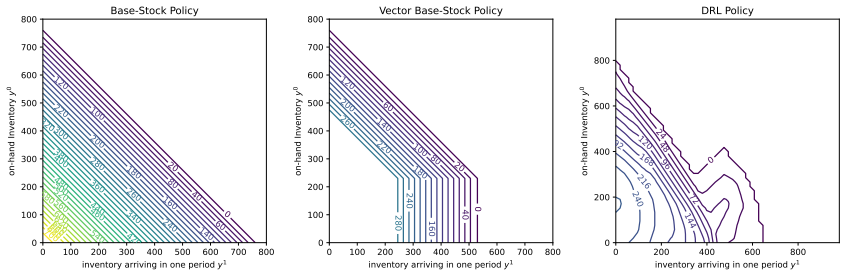
The load-bearing object is the Exo-MDP, an input-driven Markov decision process in which demand and other external inputs evolve independently of the agent's actions, combined with DirectBackprop, which differentiates through a simulator of the inventory transition $y_{t+1} = f(z_t, o_t, a_t)$ to produce gradients of the reward with respect to the policy parameters. The policy itself is a small network: stacked causal dilated convolutions encode the past 32 demand realizations, and a two-layer MLP merges that encoding with product economics and the current inventory state to output order quantities. The Structure-Informed Policy Network is the same architecture trained with an augmented reward $R'_t = R_t - \lambda \sum_{g \in C} \max(0, g(\theta, z_t))^2$, where each $g$ is a partial derivative of the ordering quantity with respect to an inventory-state coordinate, constrained by $-1 \le \partial q/\partial y_{L-1} \le \cdots \le \partial q/\partial y_0 \le 0$ in the lead-time case. Automatic differentiation makes those derivatives available during training, so the penalties are cheap to evaluate and directly shape the policy toward the monotonicity and sensitivity properties that theory says optimal policies have.
What would settle it
Train the same lost-sales-with-lead-time DRL policy on demand histories censored by stockouts, replacing each period's true demand by the number of units actually sold, and evaluate on uncensored demand; if average reward collapses or order-up-to levels drift far from the critical quantile, the claimed practical robustness does not extend to censored environments.
Extended reading notes
Core claim
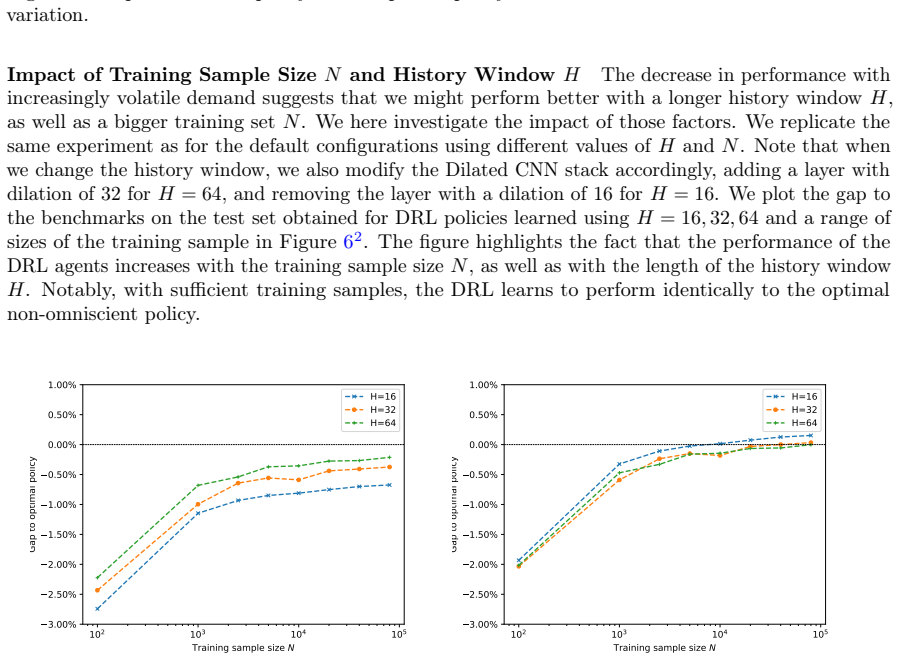
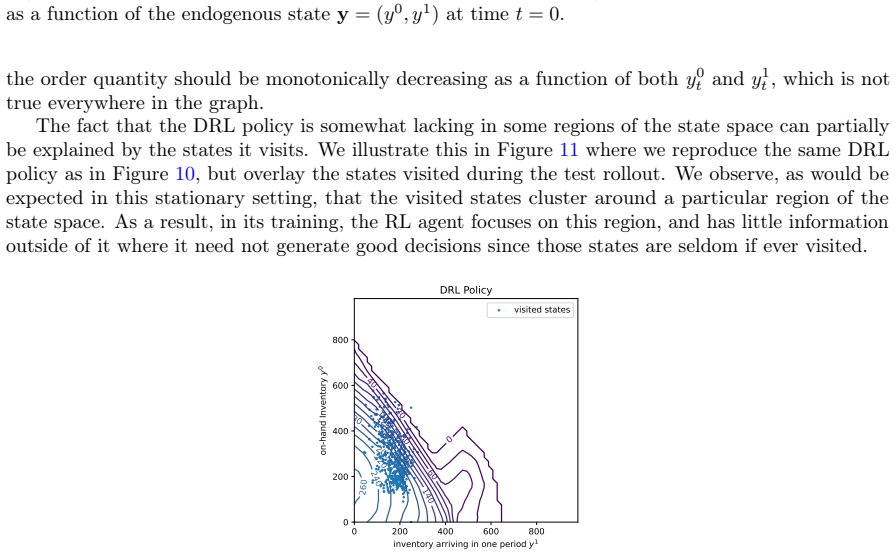
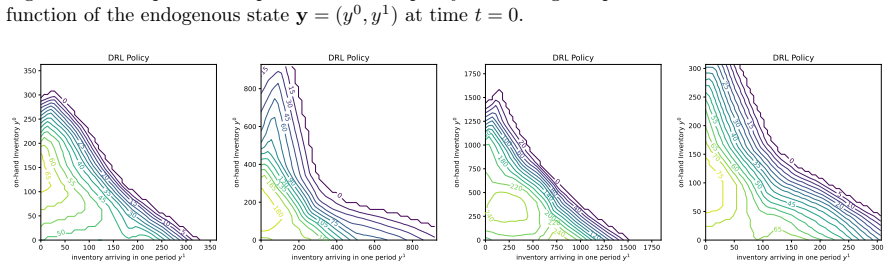
The central claim is that DirectBackprop — a stochastic-gradient algorithm that unrolls a differentiable inventory simulator over historical demand and backpropagates the reward through it — turns inventory policy search into a practical supervised-like learning problem. With a fixed 40,000-product training set, a 32-period demand window, and roughly 1,000 training epochs, the same policy architecture matches the optimal myopic policy in the no-lead-time lost-sales case, outperforms base-stock and vector base-stock heuristics as lead times grow (up to 5.7% and 3.8% respectively at lead time seven), stays within about 0.7% of the best achievable base-stock policy for perishables, and matches the optimal single-index dual base-stock policy for consecutive lead times while beating it once the regular lead time reaches six periods. The learned policies spontaneously reproduce known structural features such as order-up-to levels, interval-stock buy/return thresholds, and separated expedited/regular ordering. The proposed Structure-Informed Policy Network adds quadratic penalties of the form $\lambda \cdot \max(0, g(\theta,z))^2$ to the reward, where $g$ encodes known differential inequalities like $-1 \le \partial q/\partial y_i \le 0$ and the ordering of sensitivities across pipeline coordinates. On realistic grocery demand with a five-period lead time, this regularization sharply reduces catastrophic out-of-sample failures — including an ever-increasing purchasing loop after a demand spike — and improves mean out-of-sample reward for small training sets, while leaving typical performance essentially unchanged. On non-stationary data, the end-to-end DRL agent also beats a predict-then-optimize pipeline, improving average per-period reward by about 0.6% to 0.9%.
Load-bearing premise
The load-bearing premise is that demand is observed as uncensored realizations during training and evaluation: the paper's simulated demand is described as 'single (uncensored) demand realizations,' and the realistic grocery data are only noted as 'albeit at times censored,' so in a real lost-sales deployment where stockouts hide true demand, the policy would consume a systematically distorted demand signal without any correction in the method.
Editorial extensions
If this is right
- A single hyperparameter configuration transfers across problem classes, so a practitioner can deploy the same learning engine on a new inventory setting without per-scenario tuning.
- In lost-sales systems with lead times, the DRL agent beats standard base-stock heuristics, with the gap widening from under 1% to more than 5% as the lead time grows from 2 to 7 periods.
- For perishable products, the same agent is within about 0.7% of the best base-stock policy at every tested shelf life and is far better than a naive base-stock policy when shelf life is short.
- Adding structural penalties leaves steady-state reward essentially unchanged while greatly reducing the worst-case out-of-sample failures that occur under demand shocks, especially when training data are scarce.
- On non-stationary demand, directly optimizing the order quantity with DRL beats the traditional forecast-then-optimize pipeline, with the advantage increasing on the longer evaluation window that includes a demand shock.
Reading between the lines
- Editorial inference: the same partial-derivative penalties could serve as a cheap safety layer for any learned inventory policy, since the monotonicity bound 'order less when already overstocked' is precisely what prevents the self-reinforcing purchasing loops documented here.
- Editorial inference: because the paper trains on uncensored demand while real lost-sales histories are censored by stockouts, a natural extension is to pair the structural penalty with a censoring correction; the two mechanisms target different failure modes and would likely combine.
- Editorial inference: evaluating the calibration penalties on a uniform grid of inventory states rather than only on states visited during training could convert the demonstrated robustness into a formal monotonicity guarantee over a bounded region, a path the paper notes but does not take.
Editorial analysis
A structured set of objections, weighed in public.
Referee Report
Summary. The paper applies DirectBackprop, a differentiable-simulator DRL method, to five classical inventory management problems (lost sales with and without lead times, perishables, dual sourcing, and returns), comparing against analytical benchmarks and classical heuristics. It then proposes a Structure-Informed Policy Network that adds a penalty for violations of analytically known derivative inequalities (e.g., monotonicity of orders in inventory) and evaluates this technique on real grocery data from Corporación Favorita, where it claims improved out-of-sample robustness. The paper also reports a non-stationary comparison showing end-to-end DRL outperforming a predict-then-optimize baseline.
Significance. If the claims hold, the paper is a useful demonstration that a single end-to-end DRL pipeline can match or beat classical inventory heuristics without access to demand distributions, and that structural knowledge from OR can be injected as soft derivative penalties. The synthetic experimental design is carefully thought out: the demand generator and product-economics sampling are fully specified, the benchmarks are given information that the DRL agent is deliberately denied, and the cross-product training setup is more realistic than instance-level RL. The structural penalties are derived from classical results (Morton, Zipkin, Nahmias, Li-Yu) and are cheap to compute with automatic differentiation. However, the realistic-data evidence for extrapolation and robustness is undermined by the use of censored sales as if they were exogenous demand, and the quantitative support in the key tables is weakened by apparent data errors and a lack of statistical error bars. The central synthetic results are credible, but the practical claims need either corrected data handling or substantially qualified wording.
major comments (4)
- [Sections 5.5.1 and 2.2; Tables 10-11, Figure 30] The Exo-MDP formulation in Section 2.2 explicitly defines the exogenous demand process as '(uncensored) customer demand,' and the synthetic training in Section 4.1 uses 'single (uncensored) demand realizations.' The Favorita experiment in Section 5.5.1, by contrast, feeds sales traces that the paper itself describes as 'albeit at times censored' directly into training and evaluation, without any lost-sales imputation or censoring correction. In a lost-sales system, observed sales equal min(D_t, available inventory), a function of previous actions, so the demand trace does not evolve independently of the policy. This violates the exogeneity assumption that underpins the DirectBackprop training objective and biases both the reward computation and the learned policy. Consequently, the extrapolation and robustness claims for the Structure-Informed Policy Network are not established for censored historical data; the same issue affects the non-stationary comparison in Section 6, where Section 6.4.1 refers to feeding 'uncensored' demand realizations to the forecasting agent. Please either use uncensored demand data, apply a censoring correction, or explicitly scope the practical claims to settings where true demand is observable.
- [Tables 10-11 and Section 5.5.2] The p50 result for the unpenalized policy in Table 11 exactly reproduces the mean result for the penalized policy in Table 10 (2,119.28, 2,180.35, 2,198.36, 2,229.50, 2,240.17). As printed, the table therefore does not provide an unpenalized p50 baseline, and the statement that regularization improves the 'typical' performance of learned policies is not supported by the reported numbers. Even after correcting this error, the mean and p50 are point estimates from 200 training subsets with no standard errors or confidence intervals; because the unpenalized mean at N=100 is -4.37e9, the mean comparison is dominated by a small number of catastrophic rollouts. The robustness conclusion would be materially strengthened by reporting the fraction of runs that fail catastrophically, the standard error of the mean, and paired differences between penalized and unpenalized policies on the same 200 training subsets.
- [Section 6.5, Table 12] The end-to-end DRL versus predict-then-optimize comparison is based on a single training run of each agent, and the reported improvements (0.62% over 85 weeks, 0.85% over 156 weeks) are small. Without multiple seeds, paired resampling, or confidence intervals, the claim that 'an end-to-end DRL approach outperforms a predict-then-optimize one' on the Favorita data is not statistically supported. Since this is an advertised contribution, the evidence should be strengthened or the claim should be softened.
- [Section 3.2 and Section 5.4] The policy network is described as using ELU activations 'throughout,' but the paper never states how nonnegative order quantities are enforced during training or evaluation. Purchase quantities enter the transition and reward functions as physical units, and the structural penalties in Section 5 are computed from partial derivatives of the network output with respect to the endogenous state. An unconstrained output, or an unspecified clipping or projection step, affects both the learned policies and the derivative penalties, and the experiments cannot be reproduced without this detail. Please specify the output activation or the action post-processing used in all experiments.
minor comments (6)
- [Sections 5.5.1 and 5.5.2] The lead time is stated as 5 periods in Section 5.5.1 and as 6 periods in Section 5.5.2 ('we recall that the lead time is of 6 periods'); please correct the inconsistency.
- [Table 10] The entry '1,229,83' appears to be a typo for '1,229.83'; please fix the formatting of the table.
- [Section 5.3.3] The definition 'C(g; θ, Y) := E_Y[C(g; θ, Y)]' uses the same symbol for a random variable and its distribution; please introduce a separate notation for the distribution over endogenous states.
- [Sections 5.5.1 and 6.2] The data description says the Favorita data run 'from January 2013 to August 207'; this should be 'August 2017.'
- [Section 5.4.2] The text refers to 'the few examples plotted in Figure 13 and Figure 13 for L = 2 and L = 5'; it should presumably refer to Figure 12 and Figure 13.
- [Sections 4.1, 5.5, and 6.3] The claim of 'minimal parameter tuning' is qualified by the fact that Section 5.5 changes the history window to H=16 and the learning rate to 0.003, while Section 6.3 uses 5,000 epochs; please state these per-case adjustments explicitly and align the wording with the actual procedure.
Circularity Check
No circular derivation found: DirectBackprop is self-cited but reproduced and validated against external benchmarks, and the structural regularization uses external OR results; the censored-data limitation is a correctness issue, not circularity.
full rationale
The paper's central claim is that a generic DirectBackprop implementation performs competitively on several inventory problems. DirectBackprop is attributed to [MTE+22], a paper with overlapping authors (Eisenach and Foster), and this is the main self-citation. It is not load-bearing in a circular sense: the algorithm is reproduced in Appendix A, and the paper's evidence consists of new rollouts against external benchmarks (optimal myopic/base-stock, vector base-stock, best base-stock via golden-section search, and the single-index dual base-stock policy from Fukuda/Whittemore-Saunders), not of a claim taken on faith from [MTE+22]. The structural inequalities used in the Structure-Informed Policy Network (Section 5.2, Eqs. 4-6) are explicitly cited to Morton (1969) and Zipkin (2008) and are checked by automatic differentiation during training; they are not fitted to the test data. The Favorita example uses external sales data made available by [ARK23]/Kaggle, and the paper itself flags a limitation in Section 5.5.1: it uses the realistic Favorita traces 'albeit at times censored.' Censored sales violate the uncensored-demand assumption of the Exo-MDP formulation (Section 2.2 states exogenous demand is '(uncensored) customer demand'), which is a real threat to the practical generalization claim, but this is an exogeneity/correctness concern rather than a circular step; the penalized vs unpenalized comparison is still evaluated on the same external data with the original reward. Accordingly, no prediction in the paper reduces by construction to a fitted input, no self-citation carries a uniqueness or ansatz argument, and the only circularity-relevant observation is minor self-citation for the optimizer. Score 2.
Assumptions & free parameters
free parameters (8)
- Learning rate =
0.001
- Batch size =
2,500; 33k for Favorita
- Training epochs =
1,000; 2,000 for N<5,000; 5,000 for Favorita and non-stationary sections
- History window H =
32 default; 16 and 64 in sweep
- Policy architecture dimensions =
5 dilated CNN layers, 8 channels; 2 MLP layers, 32 neurons; ELU
- Structural penalty coefficient lambda =
1e5 for lead-time experiments; 1e6 for Favorita
- Synthetic product economics and demand parameters =
p~Exp(100), c=p*U1, c_i derived, r=c*U3, k~Exp(10)*U4, h~Exp(5), mu~Exp(100), nu~U(0,1)
- Initial inventory sampling =
y0~U(0,2*mean demand) for lost sales; y0~20*mean*U for returns
assumptions (5)
- domain assumption Transition and reward functions are differentiable enough for end-to-end gradient training.
- domain assumption Known derivative inequalities for optimal policies apply to neural policies and to the states visited during training.
- domain assumption Synthetic demand is Gamma-distributed with stationary parameters per product.
- domain assumption Uncensored demand realizations are available for training and evaluation.
- standard math Classical optimality results for myopic base-stock policies and critical quantile order-up-to levels hold.
Cite this review
Pith. "Pith review of Structure-Informed Deep Reinforcement Learning for Inventory Management." pith.science (2026). https://pith.science/paper/QSMK7UNZ
@misc{pith2026250722040,
  author       = {Pith},
  title        = {Pith review of: Structure-Informed Deep Reinforcement Learning for Inventory Management},
  year         = {2026},
  howpublished = {\url{https://pith.science/paper/QSMK7UNZ}},
  note         = {Machine review of arXiv:2507.22040}
}
read the original abstract
This paper investigates the application of Deep Reinforcement Learning (DRL) to classical inventory management problems, with a focus on practical implementation considerations. We apply a DRL algorithm based on DirectBackprop to several fundamental inventory management scenarios including multi-period systems with lost sales (with and without lead times), perishable inventory management, dual sourcing, and joint inventory procurement and removal. The DRL approach learns policies across products using only historical information that would be available in practice, avoiding unrealistic assumptions about demand distributions or access to distribution parameters. We demonstrate that our generic DRL implementation performs competitively against or outperforms established benchmarks and heuristics across these diverse settings, while requiring minimal parameter tuning. Through examination of the learned policies, we show that the DRL approach naturally captures many known structural properties of optimal policies derived from traditional operations research methods. To further improve policy performance and interpretability, we propose a Structure-Informed Policy Network technique that explicitly incorporates analytically-derived characteristics of optimal policies into the learning process. This approach can help interpretability and add robustness to the policy in out-of-sample performance, as we demonstrate in an example with realistic demand data. Finally, we provide an illustrative application of DRL in a non-stationary setting. Our work bridges the gap between data-driven learning and analytical insights in inventory management while maintaining practical applicability.
Figures


Figures from the paper (37 more)











Reference graph
Works this paper leans on
-
[1]
Learning an inventory control policy with general inventory arrival dynamics
[AEM+23] Sohrab Andaz, Carson Eisenach, Dhruv Madeka, Kari Torkkola, Randy Jia, Dean Foster, and Sham Kakade. Learning an inventory control policy with general inventory arrival dynamics. arXiv preprint arXiv:2310.17168,
-
[10]
[MTE+22] Dhruv Madeka, Kari Torkkola, Carson Eisenach, Anna Luo, Dean P. Foster, and Sham M. Kakade. Deep inventory management.arXiv preprint arXiv:2210.03137,
-
[11]
Variance Reduction for Reinforcement Learning in Input-Driven Environments
[MVSA18] Hongzi Mao, Shaileshh Bojja Venkatakrishnan, Malte Schwarzkopf, and Mohammad Alizadeh. Variance Reduction for Reinforcement Learning in Input-Driven Environments. arXiv preprint arXiv:1807.02264,
-
[14]
Wavenet: A Generative Model for Raw Audio.arXiv preprint arXiv:1609.03499, 12,
[VDODZ+16] Aaron Van Den Oord, Sander Dieleman, Heiga Zen, Karen Simonyan, Oriol Vinyals, Alex Graves, Nal Kalchbrenner, Andrew Senior, Koray Kavukcuoglu, et al. Wavenet: A Generative Model for Raw Audio.arXiv preprint arXiv:1609.03499, 12,
-
[1951]
[ARK23] Matias Alvo, Daniel Russo, and Yash Kanoria. Neural inventory control in networks via hindsight differentiable policy optimization.arXiv preprint arXiv:2306.11246,
-
[1960]
Adam: A method for stochastic optimization
[Kin14] Diederik P Kingma. Adam: A method for stochastic optimization. arXiv preprint arXiv:1412.6980,
-
[2002]
[GSM+19] Akhil Gupta, Naman Shukla, Lavanya Marla, Arinbjörn Kolbeinsson, and Kartik Yellepeddi. How to incorporate monotonicity in deep networks while preserving flexibility? arXiv preprint arXiv:1909.10662,
arXiv 1909
-
[2014]
Effective Dual-Sourcing Through Inventory Projection
[DA22] Melvin Drent and Joachim Arts. Effective dual-sourcing through inventory projection. arXiv preprint arXiv:2207.12182,
Show all 15 references
-
[2016]
Lillicrap, Tim Harley, David Silver, and Koray Kavukcuoglu
[MBM+16] Volodymyr Mnih, Adrià Puigdomènech Badia, Mehdi Mirza, Alex Graves, Timothy P. Lillicrap, Tim Harley, David Silver, and Koray Kavukcuoglu. Asynchronous methods for deep reinforcement learning.CoRR, abs/1602.01783,
-
[2017]
ORL: Reinforcement Learning Benchmarks for Online Stochastic Optimization Problems
[BBMB+19] Bharathan Balaji, Jordan Bell-Masterson, Enes Bilgin, Andreas Damianou, Pablo Moreno Garcia, Arpit Jain, Runfei Luo, Alvaro Maggiar, Balakrishnan Narayanaswamy, and Chun Ye. ORL: Reinforcement Learning Benchmarks for Online Stochastic Optimization Problems. arXiv pre...
1911 arXiv
-
[2018]
On the convergence of physics informed neural networks for linear second-order elliptic and parabolic type pdes
[SDK20] Yeonjong Shin, Jerome Darbon, and George Em Karniadakis. On the convergence of physics informed neural networks for linear second-order elliptic and parabolic type pdes. arXiv preprint arXiv:2004.01806,
2004 arXiv
-
[2019]
Proximal policy optimization algorithms.arXiv preprint arXiv:1707.06347,
[SWD+17] John Schulman, Filip Wolski, Prafulla Dhariwal, Alec Radford, and Oleg Klimov. Proximal policy optimization algorithms.arXiv preprint arXiv:1707.06347,
-
[2021]
VC theory for inventory policies.arXiv preprint arXiv:2404.11509,
[XMX24] Yaqi Xie, Will Ma, and Linwei Xin. VC theory for inventory policies.arXiv preprint arXiv:2404.11509,
-
[2022]
Neural coordination and capacity control for inventory management.arXiv preprint arXiv:2410.02817,
[EGM+24] Carson Eisenach, Udaya Ghai, Dhruv Madeka, Kari Torkkola, Dean Foster, and Sham Kakade. Neural coordination and capacity control for inventory management.arXiv preprint arXiv:2410.02817,
-
[2024]
MQTransformer: Multi-horizon forecasts with context dependent and feedback-aware attention
[EPM20] Carson Eisenach, Yagna Patel, and Dhruv Madeka. MQTransformer: Multi-horizon forecasts with context dependent and feedback-aware attention. arXiv preprint arXiv:2009.14799,
2009 arXiv
Reviewed August 6, 2026 · model on record in the stance chip above.
Discussion (0). Sign in to comment.