REVIEW 26 references
Clustering LLM-generated chain-of-thought trajectories, rather than raw question text, selects coresets that estimate full-benchmark scores with lower error than text-only selection on some benchmarks.
Reviewed by Pith at T0; open to challenge. T0 means a machine referee read the full paper against a public rubric. the ladder, T0–T4 →
T0 review · deepseek-v4-flash
2026-08-04 01:44 UTC pith:QUIUDW2B
load-bearing objection A plausible, well-scoped coreset-selection idea whose 'drastic cost reduction' claim is undercut by missing end-to-end cost accounting; the method itself is honest about where it helps.
CoT-Core: Accelerating LLM Evaluation via CoT-Aware Coreset Selection
The pith
A machine-rendered reading of the paper's core claim, the machinery that carries it, and where it could break.
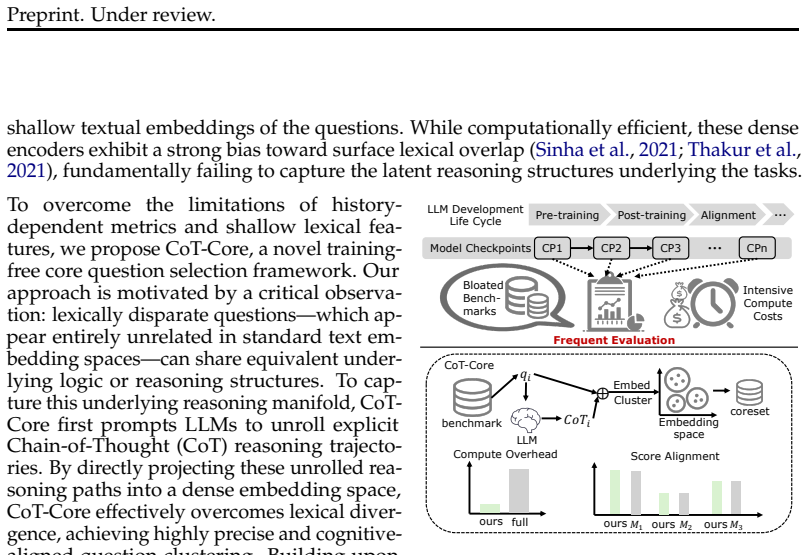
The idea: instead of grouping questions by their wording, ask another LLM to 'think step by step' for each question, producing a chain of thought. Then embed those reasoning traces into a vector space and cluster them. Questions that are worded differently but need the same logic should end up in the same cluster, because their reasoning traces look similar. From each cluster, CoT-Core keeps the question closest to the cluster center.
The paper tests this on GSM8K, MMLU, MMLU-Pro, and GPQA, comparing against random sampling, text-embedding k-means, k-center, and IRT-based methods. The results are mixed: on harder benchmarks like GPQA, CoT-Core often has lower error than text-based selection, but on easier math (GSM8K) it sometimes does worse than a simple text-based baseline. The authors also find that using a smaller LLM to generate the reasoning traces works about as well as a huge one, and that cleaning away conversational filler helps. However, the method requires generating reasoning traces for the whole benchmark once, which is itself a significant compute cost, and the paper's main tables do not show uncertainty bars or provide code.
Core claim
CoT-Core, by clustering CoT trajectories rather than raw text, yields coresets that provide high-fidelity full-dataset score estimation under a strictly training-free pipeline. From the abstract: 'Projecting these paths into a latent space effectively clusters questions by intrinsic logical equivalence rather than superficial text similarity. Extensive experiments on GSM8K, MMLU, MMLU-Pro, and GPQA demonstrate that CoT-Core drastically reduces evaluation costs while maintaining high-fidelity score estimation.'
Load-bearing premise
The method assumes that CoT trajectories generated by a separate generator LLM (Phi-4) expose an 'underlying reasoning manifold' that is stable across arbitrary target models, and that embedding these trajectories with BGE-M3 yields a metric space where k-means clusters correspond to score-prediction equivalence. If the generator's reasoning style is not aligned with the target models' actual reasoning (or if the encoder fails to capture structural equivalence), the selected coreset may not be representative. This enters in Section 3.3 (Stage 1) and Section 3.4 (Stage 2).
Editorial analysis
A structured set of objections, weighed in public.
Axiom & Free-Parameter Ledger
free parameters (3)
- Generator LLM Mgen (Phi-4)
- CoT trigger prompt pcot =
"Let's think step by step"
- Generation hyperparameters (temperature T=0.7, max_tokens=1024)
axioms (4)
- domain assumption CoT trajectories expose underlying logical structure better than raw text.
- domain assumption Embedding concatenated question+CoT with BGE-M3 yields a metric space where k-means clusters correspond to reasoning equivalence classes.
- domain assumption An unweighted mean of scores on centroid-closest instances is a valid proxy for the full-benchmark score.
- domain assumption The generator LLM's trajectories need not be correct for the method to work.
read the original abstract
Evaluating Large Language Models (LLMs) incurs prohibitive computational overhead during continuous development processes. While coreset selection accelerates evaluation, existing methods either suffer from a severe ``cold start'' bottleneck requiring massive historical logs (e.g., Item Response Theory) or exhibit a surface lexical bias that misses the underlying reasoning manifold of tasks. We propose CoT-Core, a novel training-free core question selection framework. Recognizing that lexically disparate questions can share equivalent underlying logic, CoT-Core prompts LLMs to unroll zero-shot Chain-of-Thought (CoT) reasoning trajectories. Projecting these paths into a latent space effectively clusters questions by intrinsic logical equivalence rather than superficial text similarity. Extensive experiments on GSM8K, MMLU, MMLU-Pro, and GPQA demonstrate that CoT-Core drastically reduces evaluation costs while maintaining high-fidelity score estimation, and delineate the boundary conditions of reasoning-aware pruning, revealing that its efficacy is intrinsically gated by task complexity.
Figures


Reference graph
Works this paper leans on
-
[1]
Marah Abdin, Jyoti Aneja, Harkirat Behl, S \'e bastien Bubeck, Ronen Eldan, Suriya Gunasekar, Michael Harrison, Russell J Hewett, Mojan Javaheripi, Piero Kauffmann, et al. Phi-4 technical report. arXiv preprint arXiv:2412.08905, 2024
Pith/arXiv arXiv 2024
-
[2]
Josh Achiam, Steven Adler, Sandhini Agarwal, Lama Ahmad, Ilge Akkaya, Florencia Leoni Aleman, Diogo Almeida, Janko Altenschmidt, Sam Altman, Shyamal Anadkat, et al. Gpt-4 technical report. arXiv preprint arXiv:2303.08774, 2023
Pith/arXiv arXiv 2023
-
[3]
Open llm leaderboard
Edward Beeching, Cl \'e mentine Fourrier, Nathan Habib, Sheon Han, Nathan Lambert, Nazneen Rajani, Omar Sanseviero, Lewis Tunstall, and Thomas Wolf. Open llm leaderboard. https://huggingface.co/spaces/open-llm-leaderboard/open_llm_leaderboard, 2023
2023
-
[4]
Pythia: A suite for analyzing large language models across training and scaling
Stella Biderman, Hailey Schoelkopf, Quentin Gregory Anthony, Herbie Bradley, Kyle O’Brien, Eric Hallahan, Mohammad Aflah Khan, Shivanshu Purohit, USVSN Sai Prashanth, Edward Raff, et al. Pythia: A suite for analyzing large language models across training and scaling. In International conference on machine learning, pp.\ 2397--2430. PMLR, 2023
2023
-
[5]
Jianlv Chen, Shitao Xiao, Peitian Zhang, Kun Luo, Defu Lian, and Zheng Liu. Bge m3-embedding: Multi-lingual, multi-functionality, multi-granularity text embeddings through self-knowledge distillation. arXiv preprint arXiv:2402.03216, 4 0 (5), 2024
Pith/arXiv arXiv 2024
-
[6]
Training verifiers to solve math word problems
Karl Cobbe, Vineet Kosaraju, Mohammad Bavarian, Mark Chen, Heewoo Jun, Lukasz Kaiser, Matthias Plappert, Jerry Tworek, Jacob Hilton, Reiichiro Nakano, et al. Training verifiers to solve math word problems. arXiv preprint arXiv:2110.14168, 2021
Pith/arXiv arXiv 2021
-
[7]
Olmo: Accelerating the science of language models
Dirk Groeneveld, Iz Beltagy, Evan Walsh, Akshita Bhagia, Rodney Kinney, Oyvind Tafjord, Ananya Jha, Hamish Ivison, Ian Magnusson, Yizhong Wang, et al. Olmo: Accelerating the science of language models. In Proceedings of the 62nd Annual Meeting of the Association for Computational Linguistics (Volume 1: Long Papers), pp.\ 15789--15809, 2024
2024
-
[8]
Measuring massive multitask language understanding
Dan Hendrycks, Collin Burns, Steven Basart, Andy Zou, Mantas Mazeika, Dawn Song, and Jacob Steinhardt. Measuring massive multitask language understanding. arXiv preprint arXiv:2009.03300, 2020
Pith/arXiv arXiv 2009
-
[9]
Adaptive testing for llm evaluation: A psychometric alternative to static benchmarks
Peiyu Li, Xiuxiu Tang, Si Chen, Ying Cheng, Ronald Metoyer, Ting Hua, and Nitesh V Chawla. Adaptive testing for llm evaluation: A psychometric alternative to static benchmarks. arXiv preprint arXiv:2511.04689, 2025
Pith/arXiv arXiv 2025
-
[10]
Holistic evaluation of language models
Percy Liang, Rishi Bommasani, Tony Lee, Dimitris Tsipras, Dilara Soylu, Michihiro Yasunaga, Yian Zhang, Deepak Narayanan, Yuhuai Wu, Ananya Kumar, et al. Holistic evaluation of language models. arXiv preprint arXiv:2211.09110, 2022
Pith/arXiv arXiv 2022
-
[11]
Opencompass: A universal evaluation platform for foundation models
OpenCompass Contributors . Opencompass: A universal evaluation platform for foundation models . https://github.com/open-compass/opencompass, 2023
2023
-
[12]
tinybenchmarks: evaluating llms with fewer examples
Felipe Maia Polo, Lucas Weber, Leshem Choshen, Yuekai Sun, Gongjun Xu, and Mikhail Yurochkin. tinybenchmarks: evaluating llms with fewer examples. arXiv preprint arXiv:2402.14992, 2024
Pith/arXiv arXiv 2024
-
[13]
Gpqa: A graduate-level google-proof q&a benchmark
David Rein, Betty Li Hou, Asa Cooper Stickland, Jackson Petty, Richard Yuanzhe Pang, Julien Dirani, Julian Michael, and Samuel R Bowman. Gpqa: A graduate-level google-proof q&a benchmark. In First conference on language modeling, 2024
2024
-
[14]
Active learning for convolutional neural networks: A core-set approach
Ozan Sener and Silvio Savarese. Active learning for convolutional neural networks: A core-set approach. arXiv preprint arXiv:1708.00489, 2017
Pith/arXiv arXiv 2017
-
[15]
Large language models can be easily distracted by irrelevant context
Freda Shi, Xinyun Chen, Kanishka Misra, Nathan Scales, David Dohan, Ed H Chi, Nathanael Sch \"a rli, and Denny Zhou. Large language models can be easily distracted by irrelevant context. In International Conference on Machine Learning, pp.\ 31210--31227. PMLR, 2023
2023
-
[16]
Unnatural language inference
Koustuv Sinha, Prasanna Parthasarathi, Joelle Pineau, and Adina Williams. Unnatural language inference. In Proceedings of the 59th annual meeting of the Association for Computational Linguistics and the 11th international joint conference on natural language processing (Volume 1: Long Papers), pp.\ 7329--7346, 2021
2021
-
[17]
Beyond the imitation game: Quantifying and extrapolating the capabilities of language models
Aarohi Srivastava, Abhinav Rastogi, Abhishek Rao, Abu Awal Md Shoeb, Abubakar Abid, Adam Fisch, Adam R Brown, Adam Santoro, Aditya Gupta, Adri \`a Garriga-Alonso, et al. Beyond the imitation game: Quantifying and extrapolating the capabilities of language models. Transactions on machine learning research, 2023
2023
-
[18]
Dataset cartography: Mapping and diagnosing datasets with training dynamics
Swabha Swayamdipta, Roy Schwartz, Nicholas Lourie, Yizhong Wang, Hannaneh Hajishirzi, Noah A Smith, and Yejin Choi. Dataset cartography: Mapping and diagnosing datasets with training dynamics. In Proceedings of the 2020 Conference on Empirical Methods in Natural Language Processing (EMNLP), pp.\ 9275--9293, 2020
2020
-
[19]
Beir: A heterogenous benchmark for zero-shot evaluation of information retrieval models
Nandan Thakur, Nils Reimers, Andreas R \"u ckl \'e , Abhishek Srivastava, and Iryna Gurevych. Beir: A heterogenous benchmark for zero-shot evaluation of information retrieval models. arXiv preprint arXiv:2104.08663, 2021
Pith/arXiv arXiv 2021
-
[20]
Llama 2: Open foundation and fine-tuned chat models
Hugo Touvron, Louis Martin, Kevin Stone, Peter Albert, Amjad Almahairi, Yasmine Babaei, Nikolay Bashlykov, Soumya Batra, Prajjwal Bhargava, Shruti Bhosale, et al. Llama 2: Open foundation and fine-tuned chat models. arXiv preprint arXiv:2307.09288, 2023
Pith/arXiv arXiv 2023
-
[21]
Shaobo Wang, Cong Wang, Wenjie Fu, Yue Min, Mingquan Feng, Isabel Guan, Xuming Hu, Conghui He, Cunxiang Wang, Kexin Yang, et al. Rethinking llm evaluation: Can we evaluate llms with 200x less data? arXiv preprint arXiv:2510.10457, 2025
arXiv 2025
-
[22]
Mmlu-pro: A more robust and challenging multi-task language understanding benchmark
Yubo Wang, Xueguang Ma, Ge Zhang, Yuansheng Ni, Abhranil Chandra, Shiguang Guo, Weiming Ren, Aaran Arulraj, Xuan He, Ziyan Jiang, et al. Mmlu-pro: A more robust and challenging multi-task language understanding benchmark. Advances in Neural Information Processing Systems, 37: 0 95266--95290, 2024
2024
-
[23]
Chain-of-thought prompting elicits reasoning in large language models
Jason Wei, Xuezhi Wang, Dale Schuurmans, Maarten Bosma, Fei Xia, Ed Chi, Quoc V Le, Denny Zhou, et al. Chain-of-thought prompting elicits reasoning in large language models. Advances in neural information processing systems, 35: 0 24824--24837, 2022
2022
-
[24]
Explainable chain-of-thought reasoning: An empirical analysis on state-aware reasoning dynamics
Sheldon Yu, Yuxin Xiong, Junda Wu, Xintong Li, Tong Yu, Xiang Chen, Ritwik Sinha, Jingbo Shang, and Julian McAuley. Explainable chain-of-thought reasoning: An empirical analysis on state-aware reasoning dynamics. arXiv preprint arXiv:2509.00190, 2025
arXiv 2025
-
[25]
Automatic chain of thought prompting in large language models
Zhuosheng Zhang, Aston Zhang, Mu Li, and Alex Smola. Automatic chain of thought prompting in large language models. arXiv preprint arXiv:2210.03493, 2022
Pith/arXiv arXiv 2022
-
[26]
Redundancy principles for mllms benchmarks
Zicheng Zhang, Xiangyu Zhao, Xinyu Fang, Chunyi Li, Xiaohong Liu, Xiongkuo Min, Haodong Duan, Kai Chen, and Guangtao Zhai. Redundancy principles for mllms benchmarks. In Proceedings of the 63rd Annual Meeting of the Association for Computational Linguistics (Volume 1: Long Papers), pp.\ 12492--12504, 2025
2025
discussion (0)
Sign in with ORCID, Apple, or X to comment. Anyone can read and Pith papers without signing in.