REVIEW 4 major objections 5 minor 1 cited by
Using Gaussian Process Regression to estimate returns for untried actions in root-parallel MCTS outperforms existing aggregation strategies in continuous-action domains.
Reviewed by Pith at T0; open to challenge. T0 means a machine referee read the full paper against a public rubric. the ladder, T0–T4 →
T0 review · deepseek-v4-flash
2026-08-03 17:21 UTC pith:QUJDLXC4
load-bearing objection Genuinely new aggregation idea for root-parallel MCTS, but the headline performance claim is over-sold due to uneven tuning and no significance tests. the 4 major comments →
Gaussian Process Aggregation for Root-Parallel Monte Carlo Tree Search with Continuous Actions
The pith
A machine-rendered reading of the paper's core claim, the machinery that carries it, and where it could break.
Core claim
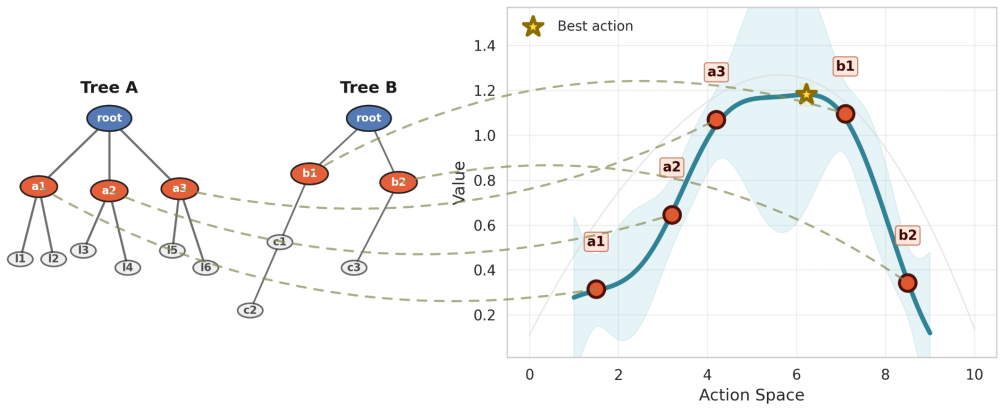
The central discovery is that a Gaussian Process with a radial basis function kernel, trained on the root-action value estimates of sufficiently visited actions across threads, yields a reliable ranking of the entire continuous action space, and that selecting the argmax of the GP posterior mean beats all tested aggregation baselines. The paper evaluates GPR2P against Max, Most Visited, similarity-based voting and merge strategies, and single-thread MCTS in six continuous-action domains (Lunar Lander, Mountain Car, Pendulum, Random Teleporter, Wide Corridor, Narrow Corridor). Using Mean Reciprocal Rank as an overall summary across 24 task/trial-count combinations, GPR2P achieves 0.9167, comp
What carries the argument
The load-bearing object is the Gaussian Process regressor over the root action space. GPR2P first filters actions by a visit-count threshold τ to keep only reliable value estimates, builds an RBF-kernel GP with the Q(s0,a) estimates as training targets, and then returns a* = argmax_a μ(a), where μ(a) is the GP posterior mean at action a. The RBF kernel's lengthscale and signal/noise variances control how far information from sampled actions is extrapolated; the key step is that the GP interpolates values for actions never trialled, turning aggregation into a regression problem over the whole action space.
Load-bearing premise
The method assumes that the expected return varies smoothly with the action, so that a Gaussian-process model with a fixed, tuned lengthscale can reliably estimate values for actions no thread has tried.
What would settle it
Construct a continuous-action control task with a narrow, high-reward 'spike' in the action-value surface (e.g., a sharp Gaussian bump of width far below the GP lengthscale) and run GPR2P with the same hyperparameter tuning protocol. If at low trial counts the posterior mean argmax systematically misses the spike, the smoothness premise is violated. A direct check is to compare the GP posterior mean against ground-truth Q(s0,a) on a toy domain to see whether the ranking over untried actions is actually accurate.
If this is right
- With low per-thread trial budgets, root-parallel MCTS can now return actions that no thread sampled, which is valuable when the good action region is narrow or hard to hit by chance.
- The GP's posterior variance offers a natural confidence measure, and the paper notes that selection criteria such as upper confidence bound are applicable, so the same model can be used for risk-aware action selection.
- The method generalises to environments with stochastic transitions under Double Progressive Widening, so it is not restricted to deterministic simulators.
- Because the inference overhead is small relative to simulation cost, GPR2P's gains are not an artifact of spending extra wall-clock time; the paper shows performance remains better when the overhead is reallocated to extra trials.
Where Pith is reading between the lines
- If the smoothness assumption holds, the same regression-based aggregation could be applied to leaf- or tree-parallel MCTS, since the Q-function over the root action is what is being modelled; the paper only tests root parallelism.
- The GP posterior could be reused across planning episodes to warm-start MCTS, propagating value information between decisions, which the paper does not explore.
- The dependence on the fixed RBF kernel and tuned lengthscale suggests a testable extension: learning a deep or input-dependent kernel could remove the per-environment tuning burden and improve performance on non-smooth Q-surfaces.
- A practical consequence for time-critical control: GPR2P may allow reducing per-thread simulation budgets, since interpolation compensates for sparse sampling, enabling faster decisions at similar quality.
Editorial analysis
A structured set of objections, weighed in public.
Referee Report
Summary. The paper proposes GPR2P, a root-parallel MCTS aggregation method for continuous action spaces. GPR2P first filters sampled root actions by a visit-count threshold, fits a Gaussian Process with an RBF kernel to their Q-value estimates, and selects the action maximizing the GP posterior mean over the full action space, thus allowing selection of actions not sampled by any thread. The paper compares GPR2P with Max, Most Visited, Similarity Vote, Similarity Merge, and Single Thread MCTS across six continuous-action environments (three Gymnasium and three self-designed stochastic tasks). The central empirical claim is that GPR2P outperforms all aggregation baselines, with an overall MRR of 0.9167 versus 0.5972 for the next-best method (Similarity Merge), while incurring modest extra inference time.
Significance. If the empirical claim is substantiated, the paper makes a useful contribution: GPR2P addresses a genuine limitation of existing root-parallel aggregation methods, which can only select among actions sampled in the tree. The evaluation is broader than prior work in this niche, covering six domains including stochastic transitions, and it includes a runtime comparison showing that the GP inference overhead is small relative to total runtime. However, the paper does not provide code or data, reports no confidence intervals or significance tests, and tunes far more parameters for GPR2P than for the baselines. The evidence is therefore suggestive rather than conclusive. The proposed method is simple and clearly described, but the central claim of superiority over existing methods is not yet established at the standard expected for a journal publication.
major comments (4)
- [Experimental Evaluation / Table 2 / Figure 3] The central claim that GPR2P 'outperforms existing aggregation strategies' rests on the MRR values in Table 2 (0.9167 vs 0.5972), but no confidence intervals, standard errors, or significance tests are reported anywhere. The text in the Corridor experiments states that the advantage 'remains statistically significant' without specifying a test. The statement in the Evaluation Procedure that the Lunar Lander success rate 'does not enable calculating a confidence interval' is incorrect: a success proportion over episodes has a binomial confidence interval. Please report per-environment and per-trial-count means with standard errors or 95% confidence intervals, use a paired significance test across the 20-50 seeds (e.g., Wilcoxon signed-rank), and provide bootstrap confidence intervals on the MRR values. Release code and data so the results can be reproduced.
- [Experimental Evaluation / Table 3 and hyperparameter tuning] The model-selection protocol gives GPR2P substantially more freedom than the baselines. Table 3 lists three GP hyperparameters (alpha_f^2, l, alpha_n^2) plus four visit thresholds tau_1..tau_4 tied to trial counts 15/30/60/120, whereas Similarity Vote and Similarity Merge each have only one parameter phi. The paper says that 'for aggregation strategies with parameters, we also perform a grid search,' but no nested procedure separates tuning from evaluation. Since the thresholds are chosen per trial-count block, the reported MRR may be an upper bound on what a user could obtain in deployment, where these values must be set in advance. Please add a nested evaluation (split environments/seeds for tuning vs testing), an ablation with fixed/default thresholds, and a sensitivity analysis over the GP hyperparameters. Also give the baselines an equal model-selection budget.
- [Methods, GPR2P, Eqs. (7)-(9)] There is an internal inconsistency in the GP formulation. Eq. (7) defines k(ai,aj) = sigma_f^2 exp(-||ai-aj||^2/(2l^2)) + sigma_n^2 I_n, so the matrix K already includes the observation noise. Eq. (8) then computes the posterior mean as k(a,X)(K + sigma_n^2 I)^{-1} y, adding the noise term a second time. Standard GP regression uses a noiseless covariance kernel and adds sigma_n^2 I only once. Please correct the equations and state explicitly what is implemented in the experiments; this affects the posterior mean and therefore the selected action.
- [GPR2P method / Assumption of smoothness] The method's core assumption is that the expected return as a function of the root action is smooth enough to be modeled by a stationary RBF-kernel GP with a fixed lengthscale. This is not tested in the paper. If the true Q-surface has sharp discontinuities or the lengthscale is misspecified, interpolating to untried actions will yield biased rankings. Since this is exactly the mechanism by which GPR2P is expected to outperform sampled-action-only baselines in low-trial regimes, please provide evidence for the assumption, e.g., a leave-one-out predictive check on sampled actions, ground-truth Q-surface plots for the self-designed environments, or a sensitivity curve over the lengthscale.
minor comments (5)
- [Background, Eq. (4)] The text says that sigma_f^2 'accounts for observation noise'; this should be sigma_n^2. The signal variance and noise variance are conflated.
- [Algorithm 3, line 4] The pseudocode refers to 'the RBF kernel defined in Eq. (7)', but Eq. (7) is first presented inside the algorithm. It would be clearer to refer to Eq. (4) in the Background, or to introduce Eq. (7) before the algorithm.
- [Results / Table 1] The Min/Mid/Max trial counts are not defined explicitly. The text mentions trial counts 15, 30, 60, 120 (and Pendulum uses 15, 20, 30, 40), but the table does not say which values correspond to Min/Mid/Max. Please state them in the table caption.
- [Results / Figure 4] The comparison in Figure 4 is only against Similarity Merge. If time-equalized comparison is meant to address the inference overhead, also compare with the other strong baselines (e.g., Max and Most Visited with extra trials) to show that the result is not specific to one baseline.
- [Conclusion] The sentence 'If this can be performed offline prior to deploying the system for online planning, the advantage of GPR2P is well justified' is an important caveat; it should appear in the introduction or experimental design section, since the current evaluation assumes offline tuning per environment.
Circularity Check
No significant circularity: GPR2P is an empirical aggregation rule whose GP mean is a fitted smoother over observed MCTS return estimates, not a derivation that reduces to its own inputs.
full rationale
The paper makes no derivational claim that would collapse into its inputs. GPR2P fits an RBF-kernel Gaussian Process to the observed root-action value estimates Q(s0,a) from the parallel MCTS threads (Eqs. 7-9, Algorithm 3) and selects argmax over the action space of the GP posterior mean. This is standard regression-based interpolation: the 'value estimates for actions that were not trialed' are exactly the GP posterior mean, a linear smoother of the observed Q-values, and the paper presents this as an aggregation heuristic rather than as an independent first-principles prediction. There is no equation that is simultaneously input and output, and no fitted parameter is renamed as a predicted quantity. The grid search over GP hyperparameters and thresholds (Table 3) is a model-selection procedure that affects the strength and fairness of the empirical comparison, but it does not make the central comparison circular by construction. No load-bearing self-citations appear: the authors do not cite their own prior work to justify the method, and the cited prior aggregation methods (Kurzer et al. 2020) are external baselines. The absence of confidence intervals and the tuning flexibility are legitimate experimental-validity concerns, not circularity. Therefore the honest finding is no significant circularity: score 0.
Axiom & Free-Parameter Ledger
free parameters (6)
- GP signal variance σ_f^2 =
0.054 (most environments), 0.5 (Pendulum), 0.284 (Teleporter/Corridors)
- GP lengthscale l =
2.71, 2.5, 2.61 per environment
- GP noise variance σ_n^2 =
0.899 (most environments), 0.1 (Pendulum)
- Visit threshold τ (τ1..τ4) =
Lunar Lander: 1,4,6,8; Mountain Car: 1,3,5,7; Pendulum: 1,1,4,5; Teleporter/Corridors: 1,1,1,1
- Similarity scale ϕ (baselines) =
5, 25, or 1 per environment
- MCTS parameters C, c, d, α, β =
Values in Table 3 (e.g., C=7, c=2 for Lunar Lander)
axioms (5)
- domain assumption The root-action value function Q(s0,a) is smooth enough to be captured by an RBF-kernel GP with a single lengthscale.
- domain assumption Each thread's Q(s0,a) estimates are noisy independent observations of the same underlying function, with noise captured by σ_n^2.
- standard math Standard Gaussian Process regression formulas (posterior mean/variance, Eqs. 8-9) are correct under the usual GP assumptions.
- domain assumption Root-parallel threads construct independent trees from the same root state and can be compared directly.
- domain assumption Grid-searched hyperparameters on each environment yield a fair comparison and generalize to the reported seeds and trial counts.
Cite this review
Pith. "Pith review of Gaussian Process Aggregation for Root-Parallel Monte Carlo Tree Search with Continuous Actions." pith.science (2026). https://pith.science/paper/QUJDLXC4
@misc{pith2026251209727,
  author       = {Pith},
  title        = {Pith review of: Gaussian Process Aggregation for Root-Parallel Monte Carlo Tree Search with Continuous Actions},
  year         = {2026},
  howpublished = {\url{https://pith.science/paper/QUJDLXC4}},
  note         = {Machine review of arXiv:2512.09727}
}
read the original abstract
Monte Carlo Tree Search is a cornerstone algorithm for online planning, and its root-parallel variant is widely used when wall clock time is limited but best performance is desired. In environments with continuous action spaces, how to best aggregate statistics from different threads is an important yet underexplored question. In this work, we introduce a method that uses Gaussian Process Regression to obtain value estimates for promising actions that were not trialed in the environment. We perform a systematic evaluation across 6 different domains, demonstrating that our approach outperforms existing aggregation strategies while requiring a modest increase in inference time.
Figures


Forward citations
Cited by 1 Pith paper
-
Online Navigation Planning for Long-term Autonomous Operation of Underwater Gliders
An MCTS-based online planner for underwater gliders, using a real-data-calibrated simulator, enables longer autonomous operations with up to 16.51% shorter paths in 1000 km field deployments.
Reference graph
Works this paper leans on
-
[2008]
InInternational Conference on Computers and Games, 60–71
Parallel monte-carlo tree search. InInternational Conference on Computers and Games, 60–71. Springer. Chaslot, G. M. J.; Winands, M. H.; Herik, H. J. v. d.; Uiter- wijk, J. W.; and Bouzy, B. 2008. Progressive strategies for Monte-Carlo tree search.New Mathematics and Natural Computation, 4(03): 343–357. Cou¨etoux, A.; Hoock, J.-B.; Sokolovska, N.; Teytaud...
Pith/arXiv arXiv 2008
-
[2016]
InIJCAI, 690–697
Monte Carlo Tree Search in Continuous Action Spaces with Execution Uncertainty. InIJCAI, 690–697. Supplementary Material Experiment Parameters The parameters used in the experiments are shown in Ta- ble 3. As noted in the main text, parameters were first tuned via grid search for MCTS and fixed. The parameters of all aggregation methods, including baselin...
discussion (0)
Sign in with ORCID, Apple, or X to comment. Anyone can read and Pith papers without signing in.