REVIEW 4 major objections 5 minor 7 cited by
FluxSpace: Disentangled Semantic Editing in Rectified Flow Transformers
T0 review · 4 major / 5 minor · reviewed 2026-08-11 · deepseek-v4-flash
Pith's one-line read Fine-grained image edits in a flow transformer reduce to one linear move in attention space.
desk verdict FluxSpace deserves a review: the idea is new, the pictures are good, but the evaluation is thin and the linearity assumption is untested. read the letter →
The pith
A machine-rendered reading of the paper's core claim, the machinery that carries it, and where it could break.
The reading
What carries the argument
The machinery is a single linear edit on joint attention outputs, built from three forward passes through the same attention layer: base text $c$, edit text $c_e$, and null text $\varnothing$. The null-text output $l_\theta(x,\varnothing,t)$ acts as an image prior; projecting the edit-conditioned output onto it and subtracting removes image-content components, leaving a semantic direction $l'_\theta(x,c_e,t)$. Adding that direction back to the base output with scale $\lambda_{\mathrm{fine}}$ gives the edited attention output. The same projection-plus-interpolation idea is applied to the pooled CLIP embedding for global appearance. An optional attention mask $\mathbf{M}''_{i,\mathrm{edit}}$, derived from the query-key map between image tokens and the edit text, restricts the fine edit to relevant latent pixels.
What would settle it
A concrete test: fix a noisy latent, compute the residual direction for one attribute, and increase $\lambda_{\mathrm{fine}}$ over a dense range while measuring a paired attribute scorer for unrelated attributes; if moving along 'eyeglasses' shifts age or expression scores nearly as much as it shifts eyeglasses scores, the disentanglement claim fails.
Extended reading notes
Core claim
The paper's central discovery is that the joint attention layers of Flux's MM-DiT blocks encode semantic content in an approximately linear and disentangled way: the difference between the edit-conditioned output $l_\theta(x,c_e,t)$ and its projection onto the null-conditioned output $l_\theta(x,\varnothing,t)$ defines a direction that changes one attribute. Adding that direction to the base attention output, $\hat l_\theta(x,c,c_e,t) = l_\theta(x,c,t) + \lambda_{\mathrm{fine}} l'_\theta(x,c_e,t)$, yields the fine-grained edit, with $\lambda_{\mathrm{fine}}$ as an interpolable strength; a self-supervised mask built from query-key similarity between image tokens and the edit text confines the change to relevant pixels. Coarse edits use the same projection-plus-interpolation recipe on the pooled CLIP embedding, $\hat c_{\mathrm{pool}} = (1-\lambda_{\mathrm{coarse}}) c_{\mathrm{pool}} + \lambda_{\mathrm{coarse}} c'_{e,\mathrm{pool}}$, where the edited embedding modulates text features while image features keep the original modulation. The paper's claim is that these two operations enable disentangled semantic editing in flow-matching transformers at inference time, with no training and no user-provided masks.
Load-bearing premise
The load-bearing premise is that the attention layer's output changes roughly linearly when the text condition changes, so subtracting the no-text output leaves a clean direction for one attribute; if prompt changes act nonlinearly on these activations, the added direction mixes in unrelated changes and the claimed disentanglement collapses.
Editorial extensions
If this is right
- Every attribute that can be expressed as a text prompt becomes an editable direction in FluxSpace, selectable at inference time with no per-edit training.
- Fine and coarse edits compose: $\lambda_{\mathrm{fine}}$ sets attribute strength and $\lambda_{\mathrm{coarse}}$ sets style, so a single generation can interpolate both.
- Because the edit lives in attention outputs, it transfers across domains such as faces, animals, cars, and street scenes, and can edit multiple subjects at once.
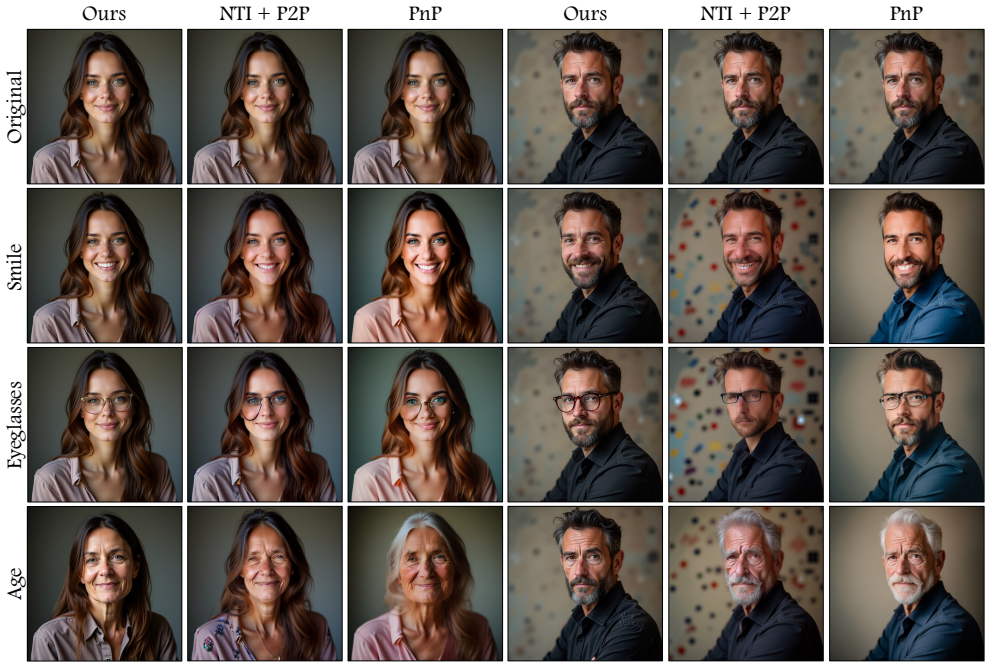
- Coupling the same edit vectors with an inversion routine extends them to real images, although the paper's main experiments use generated images.
- The attention-derived mask emerges from the model's own query-key interaction, so no external segmentation input is required.
Reading between the lines
- Editorial inference: the same recipe should transfer to other flow-matching transformers with joint attention blocks, but the paper does not test that transfer.
- Editorial inference: the linearity assumption could be checked directly by testing whether attention outputs obey approximate additivity over prompt mixtures; if they do, multi-attribute edits should equal sums of single-attribute directions.
- Editorial inference: combining the masks of several edit texts would give a natural multi-attribute editing protocol, a variant the paper does not run.
- Editorial inference: the identity-preservation results point toward controllable portrait generation, though that application is not demonstrated here.
Signed reviews
Editorial analysis
A structured set of objections, weighed in public.
Referee Report
Summary. The paper introduces FluxSpace, an inference-time image editing method for rectified flow transformers such as Flux. It defines a representation space on the outputs of Flux's joint attention layers and proposes two editing mechanisms. Fine-grained edits use a linear direction obtained by subtracting the null-conditioned attention output from the edit-conditioned output after an orthogonal projection, with an optional attention mask for content preservation. Coarse edits modify the pooled CLIP text embedding by adding the component of the edit embedding that is orthogonal to the base generation prompt embedding, and then use this modified embedding for modulation. The method requires no training, supports both generated and real images (the latter through an RF-Inversion integration), and is evaluated qualitatively and quantitatively on eyeglasses and smile edits against LEDITS++, TurboEdit, Sliders-FLUX, and RF-Inversion, with an additional user study.
Significance. If the central claims hold, FluxSpace addresses a genuine gap: training-free, disentangled semantic editing in flow-matching transformer generators, which are not directly amenable to techniques developed for UNet-based diffusion models. The method is simple, interpretable, and reproducible in principle: the editing operations are closed-form vector manipulations, no additional training is required, hyperparameters are clearly listed in the supplementary material, and the authors state that the implementation will be public. The qualitative results across faces, objects, scenes, and styles suggest that the representation space is promising. However, the significance is contingent on two assumptions that are not yet quantitatively validated: the linearity of attention outputs in the text condition, and the suitability of the pooled-embedding projection for content-preserving coarse edits. The current quantitative evaluation is too narrow to support the strong disentanglement claim, and the per-edit hyperparameter tuning weakens the generality of the reported results.
major comments (4)
- [Section 5.4, Table 1] The quantitative evidence does not yet support the central disentanglement claim. The reported CLIP-T, CLIP-I, and DINO scores are global similarities computed over a single set of 60 images with one seed, and the compared methods use different base generators (SDXL for LEDITS++ and TurboEdit, FLUX for Sliders-FLUX and RF-Inversion), so identity-preservation differences are confounded by the base model. Please report means with standard deviations or confidence intervals over multiple seeds and images, add a per-attribute preservation metric (i.e., measure the change in attributes that should not be edited), evaluate additional edit types beyond eyeglasses and smile, and state the statistical significance of the user-study comparison.
- [Section 4.1, Eqs. (3)-(5)] The paper states in Section 4.1 that 'Our framework relies on the linearity assumption of attention outputs,' but it provides no numerical validation of this assumption. Since Eq. (5) treats l_theta(x,c_e,t) - proj_phi l_theta(x,c_e,t) as a clean semantic direction, a nonlinear dependence of attention outputs on the text condition would mix unrelated changes and invalidate the disentanglement claim. Please add a quantitative check, for example measuring how the proposed edit direction varies across timesteps and input contents, or comparing the effect of the linearized edit with a direct conditional generation that uses the edit text; report the deviation and discuss where the linearity assumption breaks down.
- [Section 4.2, Eqs. (9)-(10)] The coarse-editing projection in Eq. (9) uses the base generation prompt embedding c_pool as the reference direction. For real-image editing via the RF-Inversion integration in Section 5.3, c_pool is not an image-content embedding; it is a text prompt embedding. Even for generated images, removing the component of c_e,pool along c_pool can also remove content-bearing information whenever the edit prompt shares components with the base prompt (for example, when the base prompt describes gender or age and the edit changes that attribute). The paper provides no quantitative content-preservation evaluation for coarse edits. Please validate the projection choice, for example by comparing against an image-derived reference embedding or against an unprojected edit direction, and measure content preservation quantitatively for coarse style and attribute edits.
- [Section 5.1 and Supplementary C.2] The hyperparameters lambda_fine, lambda_coarse, tau_m, and the starting timestep are set per edit (e.g., lambda_fine=5 for eyeglasses and 8 for smile) with a fixed seed of 0, and this tuning uses knowledge of the desired outputs. Because only two edits are evaluated quantitatively and no sensitivity analysis is reported, the current results may reflect per-example tuning rather than a generally applicable method. Please provide a sensitivity analysis over lambda_fine, lambda_coarse, tau_m, and starting timestep, or an automatic selection rule, and report quantitative results over multiple seeds to demonstrate that the reported gains are robust.
minor comments (5)
- [Section 4.1, Eq. (5)] The text says the editing scheme is 'in the form of linear interpolation,' but Eq. (5) is an additive update (base output plus lambda times a direction), not an interpolation between two outputs; please correct the wording.
- [Section 3.1, Eq. (2)] Equation (2) has a formatting issue: 'LCF M' should be 'L_CFM' with the subscript on the loss, and the notation lambda'_t should be defined explicitly before its first use.
- [Figure 2] In the fine-grained editing panel, the labels 'Projection' and '-1' are not self-explanatory; please clarify in the caption that the projection is onto the null-conditioned attention output and that the subtraction yields the orthogonal residual.
- [Section 5.3] The paper honestly notes that the RF-Inversion correction term does not fully map the input image into the generator's latent distribution, but it provides no quantitative reconstruction or content-preservation measure for real-image edits; please either add such a measure or explicitly scope the real-image claim to qualitative demonstration.
- [References] Reference [37] lists only abbreviated author names ('L Rout, Y Chen, N Ruiz, C Caramanis, S Shakkottai, and W Chu') and no publication venue; please complete the entry for consistency with the other references.
Circularity Check
No circularity found: the edit directions are constructed from prompt-conditioned attention and pooled embeddings, not fitted to the evaluation metrics, and the paper's self-citations are not load-bearing.
full rationale
I examined the derivation chain in Eqs. 1-10 and the experimental protocol in Secs. 4-5. The fine-grained edit direction in Eqs. 3-5 is built as the null-conditioned residual of the edit-conditioned attention output, and the coarse edit direction in Eqs. 9-10 is built as a projection residual between edit and base pooled CLIP embeddings. Neither direction is inverted from the evaluation metrics (CLIP-T, CLIP-I, DINO) or from the reported output images; the scalar hyperparameters (lambda_fine, lambda_coarse, tau_m, starting timestep) are chosen per edit, ablated, and not fitted to the scores. The CLIP-T evaluation uses the same prompt as the edit condition, but that is the standard definition of the text-guided editing task, not a mechanism that makes the metric equal the construction. The paper explicitly acknowledges that its framework relies on a linearity assumption for attention outputs (Sec. 4.1); an unvalidated premise is a correctness risk, not circularity. The self-citations (refs 8, 9, 10, 43, 44) appear in related-work context and do not carry the load-bearing argument, and no uniqueness theorem or ansatz is imported from the authors' prior work. The real-image editing limitation in Sec. 5.3 is honestly stated and does not create a circular step. I therefore find no exhibited reduction of any prediction to its own inputs.
Assumptions & free parameters
free parameters (5)
- Fine-grained editing scale λ_fine =
5 (eyeglasses), 8 (smile)
- Coarse editing scale λ_coarse =
0.5 default, 0.8 for eyeglasses
- Mask threshold τ_m =
0.5
- Starting timestep for edit =
3 (eyeglasses), 5 (smile)
- Boundary coefficient d =
10
assumptions (5)
- domain assumption Attention outputs are linear in the text condition such that the orthogonal residual of the edit-conditioned output with respect to the null-conditioned output is a valid edit direction.
- domain assumption The null-text attention output l(x,∅,t) is a neutral image prior whose removal isolates the edit semantics.
- domain assumption The linear representation hypothesis (that semantic directions are linear in embedding space) applies to Flux's pooled CLIP embedding.
- domain assumption The query-key attention map between image features and edit text tokens localizes the region to edit.
- domain assumption RF-Inversion's inversion maps real images closely enough into Flux's latent that edits computed on generated latents transfer.
invented entities (1)
-
FluxSpace
Cite this review
Pith. "Pith review of FluxSpace: Disentangled Semantic Editing in Rectified Flow Transformers." pith.science (2026). https://pith.science/paper/QULGJFIO
@misc{pith2026241209611,
  author       = {Pith},
  title        = {Pith review of: FluxSpace: Disentangled Semantic Editing in Rectified Flow Transformers},
  year         = {2026},
  howpublished = {\url{https://pith.science/paper/QULGJFIO}},
  note         = {Machine review of arXiv:2412.09611}
}
read the original abstract
Rectified flow models have emerged as a dominant approach in image generation, showcasing impressive capabilities in high-quality image synthesis. However, despite their effectiveness in visual generation, rectified flow models often struggle with disentangled editing of images. This limitation prevents the ability to perform precise, attribute-specific modifications without affecting unrelated aspects of the image. In this paper, we introduce FluxSpace, a domain-agnostic image editing method leveraging a representation space with the ability to control the semantics of images generated by rectified flow transformers, such as Flux. By leveraging the representations learned by the transformer blocks within the rectified flow models, we propose a set of semantically interpretable representations that enable a wide range of image editing tasks, from fine-grained image editing to artistic creation. This work offers a scalable and effective image editing approach, along with its disentanglement capabilities.
Figures


Figures from the paper (9 more)




Forward citations
Cited by 7 Pith papers
-
Flow Straight and Fast in Hilbert Space: Functional Rectified Flow
Functional rectified flow is defined and proved to preserve marginals in separable Hilbert spaces, with functional flow matching and probability-flow ODEs as special cases.
-
ConceptAttention: Diffusion Transformers Learn Highly Interpretable Features
ConceptAttention shows that linear projections in the output space of DiT attention layers yield sharper concept-localizing saliency maps than cross-attention maps, reaching state-of-the-art zero-shot segmentation.
-
SEED: A Benchmark Dataset for Sequential Facial Attribute Editing with Diffusion Models
SEED is a 91,526-image benchmark of diffusion-generated sequential facial edits with sequence, mask, and prompt annotations, and FAITH adds DWT high-frequency cues to a transformer for edit-sequence detection.
-
Multi-turn Consistent Image Editing
The authors propose a FLUX-based multi-turn editing pipeline combining dual-objective LQR guidance and adaptive attention masking that maintains image identity over successive text edits, with the best FID score in fo...
-
WordCon: Word-level Typography Control in Scene Text Rendering
WordCon uses grounding-model masks and two extra losses to fine-tune Flux so that typography can be controlled word by word.
-
PairEdit: Learning Semantic Variations for Exemplar-based Image Editing
PairEdit trains two LoRA adapters on a pretrained diffusion model to capture the semantic direction between paired source-target images, enabling text-free, controllable image editing from as few as one pair.
-
DFVEdit: Conditional Delta Flow Vector for Zero-shot Video Editing
DFVEdit edits videos by iteratively subtracting a conditional delta flow vector, the difference between the model's predictions under the target and source prompts, from the latent representation of the source video.
Reference graph
Works this paper leans on
-
[1]
A latent variable model approach to pmi- based word embeddings
Sanjeev Arora, Yuanzhi Li, Yingyu Liang, Tengyu Ma, and Andrej Risteski. A latent variable model approach to pmi- based word embeddings. Transactions of the Association for Computational Linguistics, 4:385–399, 2016. 6
work page 2016
-
[2]
Linear algebraic structure of word senses, with applications to polysemy
Sanjeev Arora, Yuanzhi Li, Yingyu Liang, Tengyu Ma, and Andrej Risteski. Linear algebraic structure of word senses, with applications to polysemy. Transactions of the Associa- tion for Computational Linguistics, 6:483–495, 2018. 6
work page 2018
-
[3]
Continu- ous, subject-specific attribute control in t2i models by identi- fying semantic directions
Stefan Andreas Baumann, Felix Krause, Michael Neumayr, Nick Stracke, Vincent Tao Hu, and Bj¨orn Ommer. Continu- ous, subject-specific attribute control in t2i models by identi- fying semantic directions. arXiv preprint arXiv:2403.17064,
-
[4]
Interpreting CLIP with sparse linear concept embeddings (spliCE)
Usha Bhalla, Alex Oesterling, Suraj Srinivas, Flavio Cal- mon, and Himabindu Lakkaraju. Interpreting CLIP with sparse linear concept embeddings (spliCE). In The Thirty- eighth Annual Conference on Neural Information Processing Systems, 2024. 6
work page 2024
-
[5]
Sega: Instructing diffusion using semantic dimensions
Manuel Brack, Felix Friedrich, Dominik Hintersdorf, Lukas Struppek, Patrick Schramowski, and Kristian Kersting. Sega: Instructing diffusion using semantic dimensions. arXiv preprint arXiv:2301.12247, 2023. 3
arXiv 2023
-
[6]
Ledits++: Limitless image editing using text-to-image models
Manuel Brack, Felix Friedrich, Katharia Kornmeier, Linoy Tsaban, Patrick Schramowski, Kristian Kersting, and Apolin´ario Passos. Ledits++: Limitless image editing using text-to-image models. In Proceedings of the IEEE/CVF Con- ference on Computer Vision and Pattern Recognition, pages 8861–8870, 2024. 3, 6, 7, 12, 13
work page 2024
-
[7]
Emerg- ing properties in self-supervised vision transformers
Mathilde Caron, Hugo Touvron, Ishan Misra, Herv ´e J´egou, Julien Mairal, Piotr Bojanowski, and Armand Joulin. Emerg- ing properties in self-supervised vision transformers. In Pro- ceedings of the IEEE/CVF international conference on com- puter vision, pages 9650–9660, 2021. 7
2021
-
[8]
Yusuf Dalva and Pinar Yanardag. Noiseclr: A con- trastive learning approach for unsupervised discovery of in- terpretable directions in diffusion models. arXiv preprint arXiv:2312.05390, 2023. 2, 3
arXiv 2023
Show all 46 references
-
[9]
Image-to-image transla- tion with disentangled latent vectors for face editing
Yusuf Dalva, Hamza Pehlivan, Oyku Irmak Hatipoglu, Cansu Moran, and Aysegul Dundar. Image-to-image transla- tion with disentangled latent vectors for face editing. IEEE Transactions on Pattern Analysis and Machine Intelligence,
-
[10]
Gantastic: Gan-based transfer of interpretable directions for disentan- gled image editing in text-to-image diffusion models
Yusuf Dalva, Hidir Yesiltepe, and Pinar Yanardag. Gantastic: Gan-based transfer of interpretable directions for disentan- gled image editing in text-to-image diffusion models. arXiv preprint arXiv:2403.19645, 2024. 3
2024 arXiv
-
[11]
Turboedit: Text-based image editing using few-step diffusion models, 2024
Gilad Deutch, Rinon Gal, Daniel Garibi, Or Patashnik, and Daniel Cohen-Or. Turboedit: Text-based image editing using few-step diffusion models, 2024. 6, 7, 12, 13
2024
-
[12]
Interpreting the weight space of customized dif- fusion models
Amil Dravid, Yossi Gandelsman, Kuan-Chieh Wang, Rameen Abdal, Gordon Wetzstein, Alexei A Efros, and Kfir Aberman. Interpreting the weight space of customized dif- fusion models. arXiv preprint arXiv:2406.09413, 2024. 2, 3
2024 arXiv
-
[13]
Efros, and Aleksander Holynski
Dave Epstein, Allan Jabri, Ben Poole, Alexei A. Efros, and Aleksander Holynski. Diffusion self-guidance for control- lable image generation. 2023. 5
2023
-
[14]
Scaling recti- fied flow transformers for high-resolution image synthesis
Patrick Esser, Sumith Kulal, Andreas Blattmann, Rahim Entezari, Jonas M ¨uller, Harry Saini, Yam Levi, Dominik Lorenz, Axel Sauer, Frederic Boesel, et al. Scaling recti- fied flow transformers for high-resolution image synthesis. In Forty-first International Conference on Mach...
2024
-
[15]
Sparse overcomplete word vector representations
Manaal Faruqui, Yulia Tsvetkov, Dani Yogatama, Chris Dyer, and Noah Smith. Sparse overcomplete word vector representations. arXiv preprint arXiv:1506.02004, 2015. 6
2015 arXiv
-
[16]
Concept sliders: Lora adap- tors for precise control in diffusion models
Rohit Gandikota, Joanna Materzynska, Tingrui Zhou, Anto- nio Torralba, and David Bau. Concept sliders: Lora adap- tors for precise control in diffusion models. arXiv preprint arXiv:2311.12092, 2023. 2, 3, 6, 7, 12
2023 arXiv
-
[17]
Generative adversarial networks
Ian Goodfellow, Jean Pouget-Abadie, Mehdi Mirza, Bing Xu, David Warde-Farley, Sherjil Ozair, Aaron Courville, and Yoshua Bengio. Generative adversarial networks. Commu- nications of the ACM, 63(11):139–144, 2020. 2
2020
-
[18]
Prompt-to-prompt im- age editing with cross attention control
Amir Hertz, Ron Mokady, Jay Tenenbaum, Kfir Aberman, Yael Pritch, and Daniel Cohen-Or. Prompt-to-prompt im- age editing with cross attention control. arXiv preprint arXiv:2208.01626, 2022. 3, 14, 15
2022 arXiv
-
[19]
Denoising dif- fusion probabilistic models
Jonathan Ho, Ajay Jain, and Pieter Abbeel. Denoising dif- fusion probabilistic models. Advances in neural information processing systems, 33:6840–6851, 2020. 3
2020
-
[20]
A style-based generator architecture for generative adversarial networks
Tero Karras, Samuli Laine, and Timo Aila. A style-based generator architecture for generative adversarial networks. In Proceedings of the IEEE/CVF conference on computer vi- sion and pattern recognition, pages 4401–4410, 2019. 2
2019
-
[21]
Stylemc: multi-channel based fast text-guided im- age generation and manipulation
Umut Kocasari, Alara Dirik, Mert Tiftikci, and Pinar Ya- nardag. Stylemc: multi-channel based fast text-guided im- age generation and manipulation. In Proceedings of the IEEE/CVF Winter Conference on Applications of Computer Vision, pages 895–904, 2022. 3
2022
-
[22]
Deepfakes: a new threat to face recognition? assessment and detection
Pavel Korshunov and S ´ebastien Marcel. Deepfakes: a new threat to face recognition? assessment and detection. arXiv preprint arXiv:1812.08685, 2018. 9
2018 arXiv
-
[23]
Diffusion models already have a semantic latent space
Mingi Kwon, Jaeseok Jeong, and Youngjung Uh. Diffusion models already have a semantic latent space. arXiv preprint arXiv:2210.10960, 2022. 2
2022 arXiv
-
[24]
Yaron Lipman, Ricky T. Q. Chen, Heli Ben-Hamu, Maxim- ilian Nickel, and Matthew Le. Flow matching for genera- tive modeling. In The Eleventh International Conference on Learning Representations, 2023. 3
2023
-
[25]
Flow straight and fast: Learning to generate and transfer data with rectified flow
Xingchao Liu, Chengyue Gong, and qiang liu. Flow straight and fast: Learning to generate and transfer data with rectified flow. In The Eleventh International Conference on Learning Representations, 2023. 3
2023
-
[26]
Linguis- tic regularities in continuous space word representations
Tom ´aˇs Mikolov, Wen-tau Yih, and Geoffrey Zweig. Linguis- tic regularities in continuous space word representations. In Proceedings of the 2013 conference of the north american chapter of the association for computational linguistics: Hu- man language technologies, pages 746...
2013
-
[27]
Null-text inversion for editing real images using guided diffusion models
Ron Mokady, Amir Hertz, Kfir Aberman, Yael Pritch, and Daniel Cohen-Or. Null-text inversion for editing real images using guided diffusion models. arXiv preprint arXiv:2211.09794, 2022. 14, 15 10
2022 arXiv
-
[28]
Sentence- t5: Scalable sentence encoders from pre-trained text-to-text models
Jianmo Ni, Gustavo Hernandez Abrego, Noah Constant, Ji Ma, Keith B Hall, Daniel Cer, and Yinfei Yang. Sentence- t5: Scalable sentence encoders from pre-trained text-to-text models. arXiv preprint arXiv:2108.08877, 2021. 5
2021 arXiv
-
[29]
The linear rep- resentation hypothesis and the geometry of large language models
Kiho Park, Yo Joong Choe, and Victor Veitch. The linear rep- resentation hypothesis and the geometry of large language models. In Causal Representation Learning Workshop at NeurIPS 2023, 2023. 6
2023
-
[30]
Understanding the latent space of diffusion models through the lens of riemannian geometry
Yong-Hyun Park, Mingi Kwon, Jaewoong Choi, Junghyo Jo, and Youngjung Uh. Understanding the latent space of diffusion models through the lens of riemannian geometry. Advances in Neural Information Processing Systems , 36: 24129–24142, 2023. 2
2023
-
[31]
Styleclip: Text-driven manipulation of stylegan imagery
Or Patashnik, Zongze Wu, Eli Shechtman, Daniel Cohen-Or, and Dani Lischinski. Styleclip: Text-driven manipulation of stylegan imagery. arXiv preprint arXiv:2103.17249, 2021. 3
2021 arXiv
-
[32]
Scalable diffusion models with transformers
William Peebles and Saining Xie. Scalable diffusion models with transformers. In Proceedings of the IEEE/CVF Inter- national Conference on Computer Vision, pages 4195–4205,
-
[33]
Sdxl: Improving latent diffusion mod- els for high-resolution image synthesis
Dustin Podell, Zion English, Kyle Lacey, Andreas Blattmann, Tim Dockhorn, Jonas M ¨uller, Joe Penna, and Robin Rombach. Sdxl: Improving latent diffusion mod- els for high-resolution image synthesis. arXiv preprint arXiv:2307.01952, 2023. 3, 4, 5, 7, 12
2023 arXiv
-
[34]
Learning transferable visual models from natural language supervi- sion
Alec Radford, Jong Wook Kim, Chris Hallacy, Aditya Ramesh, Gabriel Goh, Sandhini Agarwal, Girish Sastry, Amanda Askell, Pamela Mishkin, Jack Clark, et al. Learning transferable visual models from natural language supervi- sion. In International conference on machine learning, ...
2021
-
[35]
Exploring the limits of transfer learning with a unified text-to-text transformer
Colin Raffel, Noam Shazeer, Adam Roberts, Katherine Lee, Sharan Narang, Michael Matena, Yanqi Zhou, Wei Li, and Peter J Liu. Exploring the limits of transfer learning with a unified text-to-text transformer. The Journal of Machine Learning Research, 21(1):5485–5551, 2020. 3
2020
-
[36]
High-resolution image synthesis with latent diffusion models
Robin Rombach, Andreas Blattmann, Dominik Lorenz, Patrick Esser, and Bj ¨orn Ommer. High-resolution image synthesis with latent diffusion models. In Proceedings of the IEEE/CVF conference on computer vision and pattern recognition, pages 10684–10695, 2022. 3, 12
2022
-
[37]
Semantic image inversion and editing using rectified stochastic differential equations
L Rout, Y Chen, N Ruiz, C Caramanis, S Shakkottai, and W Chu. Semantic image inversion and editing using rectified stochastic differential equations. 2024. 3, 6, 7, 8, 12
2024
-
[38]
Adversarial diffusion distillation
Axel Sauer, Dominik Lorenz, Andreas Blattmann, and Robin Rombach. Adversarial diffusion distillation. In European Conference on Computer Vision , pages 87–103. Springer,
-
[39]
Plug-and-play diffusion features for text-driven image-to-image translation
Narek Tumanyan, Michal Geyer, Shai Bagon, and Tali Dekel. Plug-and-play diffusion features for text-driven image-to-image translation. InProceedings of the IEEE/CVF Conference on Computer Vision and Pattern Recognition , pages 1921–1930, 2023. 3, 14, 15
1921
-
[40]
Unitune: Text-driven image editing by fine tuning a diffusion model on a single image
Dani Valevski, Matan Kalman, Eyal Molad, Eyal Segalis, Yossi Matias, and Yaniv Leviathan. Unitune: Text-driven image editing by fine tuning a diffusion model on a single image. ACM Transactions on Graphics (TOG), 42(4):1–10,
-
[41]
A latent space of stochastic diffusion models for zero-shot image editing and guidance
Chen Henry Wu and Fernando De la Torre. A latent space of stochastic diffusion models for zero-shot image editing and guidance. In Proceedings of the IEEE/CVF International Conference on Computer Vision, pages 7378–7387, 2023. 2
2023
-
[42]
Stylespace analysis: Disentangled controls for stylegan image genera- tion
Zongze Wu, Dani Lischinski, and Eli Shechtman. Stylespace analysis: Disentangled controls for stylegan image genera- tion. In Proceedings of the IEEE/CVF conference on com- puter vision and pattern recognition , pages 12863–12872,
-
[43]
The curi- ous case of end token: A zero-shot disentangled image edit- ing using clip
Hidir Yesiltepe, Yusuf Dalva, and Pinar Yanardag. The curi- ous case of end token: A zero-shot disentangled image edit- ing using clip. arXiv preprint arXiv:2406.00457, 2024. 3
2024 arXiv
-
[44]
Latentclr: A contrastive learning approach for un- supervised discovery of interpretable directions
O ˘guz Kaan Y¨uksel, Enis Simsar, Ezgi G¨ulperi Er, and Pinar Yanardag. Latentclr: A contrastive learning approach for un- supervised discovery of interpretable directions. In Proceed- ings of the IEEE/CVF International Conference on Com- puter Vision (ICCV), pages 14263–14272...
2021
-
[45]
age” and “eyeglasses
Lvmin Zhang, Anyi Rao, and Maneesh Agrawala. Adding conditional control to text-to-image diffusion models. In Proceedings of the IEEE/CVF International Conference on Computer Vision, pages 3836–3847, 2023. 3 11 FluxSpace: Disentangled Semantic Editing in Rectified Flow Transfo...
2023
-
[46]
eyeglasses
In our experiments, we use a fixed set of hyperparame- ters for each edit evaluated, which are coarse editing scale λcoarse, fine-grained editing scale λf ine, mask threshold 4https://github.com/ml-research/ledits_pp/tree/ main 13 τm, and starting iteration for edit i. The hyp...
Reviewed August 11, 2026 · model on record in the stance chip above.
Discussion (0). Continue with ORCID to comment.