REVIEW 3 major objections 5 minor 79 references
Van Hove singularities in twisted double bilayer graphene generate a giant, universally positive Nernst signal.
Reviewed by Pith at T0; open to challenge. T0 means a machine referee read the full paper against a public rubric. the ladder, T0–T4 →
Van Hove singularities in twisted double bilayer graphene produce large, tunable, positive Nernst peaks at about 1 K, reproduced by semiclassical Boltzmann theory and a minimal two-band model.
T0 review reviewed 2026-08-01 challenge →
load-bearing objection First equilibrium Nernst data at a van Hove singularity in a twisted platform — real result, but the 'quantitative' theory agreement is a Mott-relation consistency check with an unmeasured DOS-broadening knob. the 3 major comments →
Van Hove singularity-driven giant Nernst signal in twisted double bilayer graphene
The pith
A machine-rendered reading of the paper's core claim, the machinery that carries it, and where it could break.
The reading
Core claim
The paper's central claim is that van Hove singularities in twisted double bilayer graphene produce an unusually large, universally positive Nernst signal that tracks Lifshitz transitions. The sign and magnitude are explained by the effective-mass sign reversal at the saddle point: carriers on either side of the chemical potential deflect in the same transverse direction, so the Nernst response does not cancel. The measured Nernst signal can be computed from the conductivity tensor and theoretical density of states via a semiclassical Mott relation, giving positive peaks at both conduction- and valence-band vHS. This mechanism is distinct from conventional metals, where the Nernst sign depen
What carries the argument
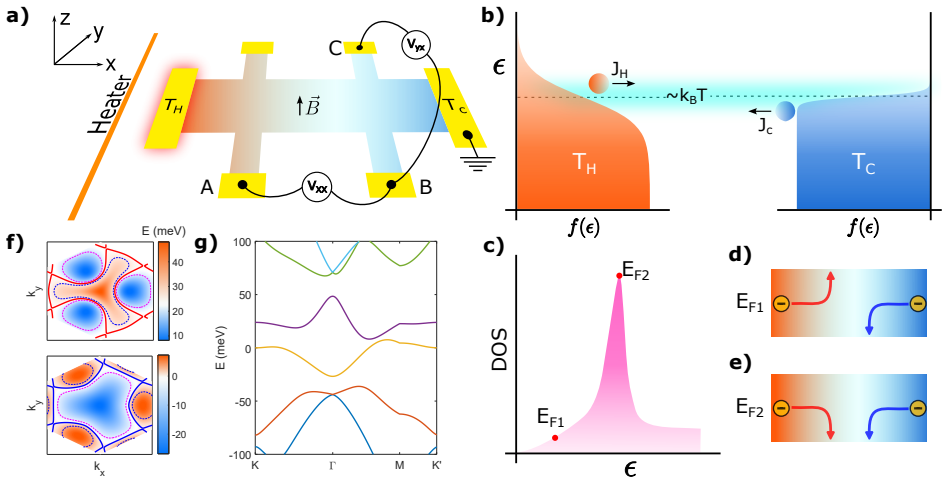
The central identity is the semiclassical generalization of the Mott relation, Eq. (1) in the paper: Syx = (π²/3)(k_B²T/e) cos²Θ_H ∂tanΘ_H/∂n ρ(n)|εF, where Θ_H is the Hall angle, ρ(n) is the density of states, and εF is the Fermi energy. This formula converts the measured Hall angle and theoretical DOS into a Nernst signal. Near a vHS, ∂tanΘ_H/∂n is large and the DOS diverges logarithmically, while the large Hall angle (µB > 1) prevents the small-angle cancellation that suppresses the Nernst response in ordinary metals. A supporting two-band tight-binding model demonstrates the same positive Nernst peak from the vHS.
Load-bearing premise
The central claim rests on treating the mobility as a single, energy-independent, Drude value across the entire n–D plane; if mobility actually varies strongly across the vHS in a way not captured by the σxx(B) fit, the quantitative identification of the Nernst peak with the Lifshitz transition collapses.
What would settle it
A decisive check would be to measure the energy-dependent mobility near the vHS directly—for instance, via quantum oscillations that resolve mobility per Landau level—and recompute Eq. (1) with that mobility. If the predicted peak is absent, or if its sign flips at a vHS where the band structure is independently known, the semiclassical attribution to Lifshitz transitions would fail.
If this is right
- In tDBLG, the Nernst signal can be tuned by displacement field, reaching about 40 µV/K/T at ~1 K for a 1.20° twist, placing it among the strongest known Nernst materials.
- The positive sign of the Nernst signal around a vHS is argued to be universal, independent of carrier type, unlike the sign behavior in metals and semimetals.
- Semiclassical Boltzmann transport quantitatively reproduces the measured thermoelectric coefficients from the measured conductivity and theoretical DOS, including the temperature dependence and B-field linearity.
- A minimal two-band tight-binding model with a vHS and Lifshitz transition reproduces the large positive Nernst peak, supporting the mechanism as a generic band-structure effect.
Where Pith is reading between the lines
- If the mechanism is generic, other moiré or flat-band materials with saddle-point singularities should show similar Nernst peaks, making the effect a rapid screening tool for detecting vHS without requiring high-resolution spectroscopy.
- The paper's sign argument suggests that a negative Nernst peak around a vHS would signal a different origin (e.g., interactions or fluctuations), providing a discriminator in correlated regimes.
- The semiclassical framework predicts a specific temperature dependence of the peak height; deviations from the Mott prediction at higher temperatures would indicate the onset of inelastic or multi-band transport.
- One testable extension would be to measure the Nernst signal in a strained or tilted moiré system where the saddle-point topology is altered, checking whether the positive sign is indeed universal.
Editorial analysis
A structured set of objections, weighed in public.
Referee Report
Summary. The paper reports Nernst-effect measurements in twisted double bilayer graphene (tDBLG) devices at twist angles 1.66° and 1.20°, finding sharp positive peaks in the transverse thermoelectric coefficient Syx at carrier densities that coincide with van Hove singularities (vHSs) identified independently via Hall-density divergences and continuum-model DOS. The peak position is tunable by displacement field and the magnitude reaches ~40 µV K⁻¹ T⁻¹ at ~1 K (D2). The authors explain the enhancement using the semiclassical Mott relation [Eq. (1)] fed with the measured conductivity tensor and a theoretical DOS, and they support the mechanism with a minimal two-band triangular-lattice model that reproduces a positive Nernst peak at the vHS. They further claim that the positive sign of Syx around a vHS is universal, making the Nernst effect a probe of Fermi-surface topology in moiré materials.
Significance. If the quantitative claim held, this would be the first equilibrium Nernst study of a twisted moiré system at a vHS and would establish a new experimental probe of Lifshitz transitions. The paper's strengths include: two devices with different twist angles; an independent identification of the vHS trajectory from the Hall-density divergence (Fig. 2c); a BLG control sample (SI S9); comparison of the full thermoelectric tensor α with the Mott prediction (SI S13); and a transparent minimal model that captures the trend. These elements make the central qualitative mechanism (vHS-driven enhancement, positive peak at the Lifshitz transition) plausible. However, the quantitative agreement is not settled: the calculated Syx systematically exceeds the measured value, and the paper's own text attributes the discrepancy to unquantified DOS broadening from twist-angle inhomogeneity. The 'universal sign' claim also goes beyond the evidence presented.
major comments (3)
- [Fig. 4d and Conclusion] The comparison in Fig. 4d uses Eq. (1) with the measured conductivity tensor and a theoretical DOS. The calculated Syx (orange) is systematically larger than the measured peak, and the main text states this 'could be due to uncertainty in DOS, since the real device with angle inhomogeneity can broaden the DOS.' No independent measurement or even a fitted value of this broadening is provided, and the SI minimal-model section explicitly says that model magnitudes 'should not be compared with the experimental results.' The Conclusion's claim that the semiclassical analysis 'reproduces this response quantitatively' is therefore not supported; the comparison is a consistency check with an unconstrained broadening parameter. Please either remove 'quantitatively' and describe the agreement as qualitative in peak position and sign, or include a quantitative fit over a plausible DOS-broadening ra
- [Abstract, Conclusion, SI S12] The claim that the positive sign of Syx is 'universal around a vHS' goes beyond the evidence. The experiments cover one material (tDBLG at two twist angles), and the minimal model in SI S12 uses a symmetric two-band triangular lattice with equal hoppings (te=th) and a fixed Gaussian broadening. The sign in Eq. (S14) depends on a combination of σxx and σxy derivatives; SI Fig. S22 shows that varying the mass ratio changes peak heights and can introduce negative Nernst regions at high temperature, although the near-vHS peak remains positive in the cases shown. A universality claim requires either a proof from the Boltzmann expression or a systematic scan over representative band parameters and scattering conditions. Otherwise, please soften to 'positive in the systems studied here.'
- [Introduction and SI S10] The sign convention for the Nernst coefficient is inconsistent as presented. The introduction defines N = -Syx = -Ey/∇xT (so Syx = Ey/∇xT), and later the paper refers to positive Syx as a positive Nernst signal. In SI S10, Syx is defined as E_y^th/∇xT under the 'vortex convention,' and the sign argument yielding a positive peak is based on that definition. Since the universality claim concerns the sign of Syx, the reader cannot tell whether the reported positive peaks correspond to a positive or negative conventional Nernst coefficient. Please state the convention used for all reported Syx values, define N consistently, and verify that the comparison with Bi and PrFe4P12 uses the same sign convention.
minor comments (5)
- [Eq. (1) and Fig. 4e] The notation ∂tanΘ_H/∂n ρ(n) is redundant/ambiguous; since d/dn = (1/ρ) d/dε, the expression equals ∂tanΘ_H/∂ε but the placement of ρ(n) is confusing. In Fig. 4e, 'without the DOS contribution' is unclear. Please define the derivative variable and state whether ρ(n) is the total DOS per unit area.
- [Fig. 2 and SI S4] For D2, the theoretical DOS at D=0 is shown but no comparison like the middle panel of Fig. 2c is given; please add the corresponding nH cut and state the twist-angle uncertainty for both devices.
- [Throughout] Several typos: 'postive' in SI S7 title; 'the the' in the text around Fig. 1; 'moire band' should be 'moiré band'; missing comma after 'CNP' in Fig. 3a. A careful proofread is needed.
- [References to SI] The text refers to 'section 10 of the SI' and 'SI section 11' but the supplementary file does not consistently number sections; ensure cross-references match.
- [Methods / Mobility extraction] The Hall mobility extraction uses σxx(B)=σ0/(1+µ²B²); please state whether µ extracted this way is consistent with tanΘ_H = σxy/σxx at the same densities, since the large-Hall-angle regime is important for Eq. (1).
Circularity Check
No significant circularity: the semiclassical Nernst calculation is an explicit consistency check using measured conductivity and an independently computed DOS, not a parameter-free prediction; the admitted DOS-broadening discrepancy is a quantitative limitation, not a circular step.
full rationale
The central derivation chain is not circular. The measured Nernst signal Syx is an independent observable, while the calculated curve in Fig. 4d is obtained from the standard Mott/Oganesyan–Ussishkin relation, Eq. (1), using the measured electrical conductivity tensor and a continuum-model DOS. The paper states this explicitly: "Utilizing σ and theoretically calculated DOS, we calculate the Syx using Eq. (1)" (Fig. 4d). This is a consistency check of the Mott relation, not a prediction forced by construction: the input conductivity is measured, not derived from Syx, and the target Syx is separately measured. The vHS positions are established from two independent sets of data—Hall-density divergences and the computed DOS—and the paper says "the divergence of Hall density, followed by a sign change along the n−D trajectory, indicate the position of the vHS... matches well with the position of density at which nH diverges." The admitted magnitude mismatch is also not circular: the paper states "the magnitude of the measured signal is on the smaller side, which could be due to uncertainty in DOS, since the real device with angle inhomogeneity can broaden the DOS, which is not taken into account in the theoretical calculation." This is an unconstrained correction that weakens the quantitative magnitude claim, but no parameter is fitted to the Nernst data and the peak positions and sign are robust. The minimal tight-binding model in SI S12 is explicitly illustrative ("the model used here has the vHSs but does not represent the tDBLG band structure"), so it is not a self-validating ansatz. Self-citations, including refs. 39 and 41, are not load-bearing for the central result: the continuum model is also anchored to independent work (Koshino, ref. 4), and ref. 41 concerns fabrication/measurement methodology. Thus no step reduces, by construction or by self-citation, to its own output.
Axiom & Free-Parameter Ledger
free parameters (5)
- Twist angle θ =
1.66° (D1); 1.20° (D2)
- Hall mobility µ(n,D) =
e.g., 5.12 ± 0.34 T⁻¹ at n/ns=0.41 (D1); 0.89 T⁻¹ (D2)
- Minimal-model hopping/offset scale te=th=1, ε0_e=1, ε0_h=-1 =
1 (arbitrary units)
- Gaussian DOS broadening σ in the minimal model =
not stated
- Relaxation time τ0 in the minimal model =
τ0 = 1 (arbitrary)
axioms (5)
- domain assumption Continuum model of tDBLG (refs 3,4,39) gives the correct single-particle band structure, DOS, and vHS positions.
- domain assumption Semiclassical Boltzmann transport with Mott relation α = -(π² k_B² T / 3e) ∂σ/∂ε applies at T ~ 1 K.
- standard math Nernst sign follows the vortex convention and Sondheimer cancellation holds for energy-independent mobility.
- domain assumption Non-interacting single-particle picture is sufficient away from half-filling.
- domain assumption Twist-angle inhomogeneity only broadens the DOS rather than shifting vHS positions or altering the transport tensors.
Cite this review
Pith. "Pith review of Van Hove singularity-driven giant Nernst signal in twisted double bilayer graphene." pith.science (2026). https://pith.science/paper/QV773JFQ
@misc{pith2026260725359,
  author       = {Pith},
  title        = {Pith review of: Van Hove singularity-driven giant Nernst signal in twisted double bilayer graphene},
  year         = {2026},
  howpublished = {\url{https://pith.science/paper/QV773JFQ}},
  note         = {Machine review of arXiv:2607.25359}
}
read the original abstract
Twisted graphene layers host van Hove singularities (vHSs), peaks in the electronic density of states, thought to drive exotic phases in moir\'e materials, but their effect on thermal transport has remained unclear. Here we show that vHSs in twisted double bilayer graphene (tDBLG) generate an unusually large Nernst signal-the transverse voltage produced by a longitudinal temperature gradient in a magnetic field. The pronounced Nernst peaks at the vHSs of the conduction and valence bands of tDBLG are tunable by an electric field with a maximum value of $\sim 40$ $\mu V K^{-1} T^{-1}$ at $\sim 1$ $K$, which is comparable to the best-known Nernst materials. Our theoretical calculations show that the large enhancement of the Nernst signal arises from the Lifshitz transitions around the vHSs. These findings establish the Nernst effect as a sensitive probe of Fermi-surface topology in moir\'e materials, and identify a universal thermoelectric signature of van Hove singularities.
Figures


Reference graph
Works this paper leans on
-
[1]
title Band structure and topological properties of twisted double bilayer graphene
author Koshino, M. title Band structure and topological properties of twisted double bilayer graphene . journal Phys. Rev. B. volume 99 ( year 2019 )
2019
-
[3]
title The nernst effect and the boundaries of the fermi liquid picture
author Behnia, K. title The nernst effect and the boundaries of the fermi liquid picture . journal J. Phys. Condens. Matter volume 21 , pages 113101 ( year 2009 )
2009
-
[4]
author Andrei, E. Y. et al. title The marvels of moir \'e materials . journal Nat. Rev. Mater. volume 6 , pages 201--206 ( year 2021 )
2021
-
[5]
author Andrei, E. Y. & author MacDonald, A. H. title Graphene bilayers with a twist . journal Nat. Mater. volume 19 , pages 1265--1275 ( year 2020 )
2020
-
[6]
author Chebrolu, N. R. , author Chittari, B. L. & author Jung, J. title Flat bands in twisted double bilayer graphene . journal Phys. Rev. B. volume 99 ( year 2019 )
2019
-
[7]
author Cao, Y. et al. title Tunable correlated states and spin-polarized phases in twisted bilayer-bilayer graphene . journal Nature volume 583 , pages 215--220 ( year 2020 )
2020
-
[8]
author Liu, X. et al. title Tunable spin-polarized correlated states in twisted double bilayer graphene . journal Nature volume 583 , pages 221--225 ( year 2020 )
2020
-
[9]
author Shen, C. et al. title Correlated states in twisted double bilayer graphene . journal Nat. Phys. volume 16 , pages 520--525 ( year 2020 )
2020
-
[10]
author He, M. et al. title Symmetry breaking in twisted double bilayer graphene . journal Nat. Phys. volume 17 , pages 26--30 ( year 2021 )
2021
-
[11]
, author Kuiri, M
author Su, R. , author Kuiri, M. , author Watanabe, K. , author Taniguchi, T. & author Folk, J. title Superconductivity in twisted double bilayer graphene stabilized by WSe2 . journal Nat. Mater. volume 22 , pages 1332--1337 ( year 2023 )
2023
-
[12]
author Lee, J. Y. et al. title Theory of correlated insulating behaviour and spin-triplet superconductivity in twisted double bilayer graphene . journal Nat. Commun. volume 10 , pages 5333 ( year 2019 )
2019
-
[13]
author Wong, D. et al. title Cascade of electronic transitions in magic-angle twisted bilayer graphene . journal Nature volume 582 , pages 198--202 ( year 2020 )
2020
-
[14]
author Zondiner, U. et al. title Cascade of phase transitions and dirac revivals in magic-angle graphene . journal Nature volume 582 , pages 203--208 ( year 2020 )
2020
-
[15]
& author Luttinger, J
author Kohn, W. & author Luttinger, J. M. title New mechanism for superconductivity . journal Phys. Rev. Lett. volume 15 , pages 524--526 ( year 1965 )
1965
-
[16]
title Kohn-Luttinger superconductivity in graphene
author Gonz \'a lez, J. title Kohn-Luttinger superconductivity in graphene . journal Phys. Rev. B Condens. Matter Mater. Phys. volume 78 ( year 2008 )
2008
-
[17]
, author Levitov, L
author Nandkishore, R. , author Levitov, L. S. & author Chubukov, A. V. title Chiral superconductivity from repulsive interactions in doped graphene . journal Nat. Phys. volume 8 , pages 158--163 ( year 2012 )
2012
-
[18]
, author Ole \'s , A
author Fleck, M. , author Ole \'s , A. M. & author Hedin, L. title Magnetic phases near the van hove singularity ins- andd-band hubbard models . journal Phys. Rev. B Condens. Matter volume 56 , pages 3159--3166 ( year 1997 )
1997
-
[21]
author Li, G. et al. title Observation of van hove singularities in twisted graphene layers . journal Nat. Phys. volume 6 , pages 109--113 ( year 2010 )
2010
-
[22]
author Kerelsky, A. et al. title Maximized electron interactions at the magic angle in twisted bilayer graphene . journal Nature volume 572 , pages 95--100 ( year 2019 )
2019
-
[23]
author Choi, Y. et al. title Electronic correlations in twisted bilayer graphene near the magic angle . journal Nat. Phys. volume 15 , pages 1174--1180 ( year 2019 )
2019
-
[24]
, author Zhang, Z
author Wu, S. , author Zhang, Z. , author Watanabe, K. , author Taniguchi, T. & author Andrei, E. Y. title Chern insulators, van hove singularities and topological flat bands in magic-angle twisted bilayer graphene . journal Nat. Mater. volume 20 , pages 488--494 ( year 2021 )
2021
-
[25]
author Kn \"u ppel, P. et al. title Correlated states controlled by a tunable van hove singularity in moir \'e WSe2 bilayers . journal Nat. Commun. volume 16 , pages 1959 ( year 2025 )
1959
-
[26]
& author Aubin, H
author Behnia, K. & author Aubin, H. title Nernst effect in metals and superconductors: a review of concepts and experiments . journal Rep. Prog. Phys. volume 79 , pages 046502 ( year 2016 )
2016
-
[27]
author Sondheimer, E. H. title The theory of the galvanomagnetic and thermomagnetic effects in metals . journal Proc. R. Soc. Lond. volume 193 , pages 484--512 ( year 1948 ). ://royalsocietypublishing.org/rspa/article/193/1035/484/6698/The-theory-of-the-galvanomagnetic-and
1948
-
[29]
author Xu, Z. A. , author Ong, N. P. , author Wang, Y. , author Kakeshita, T. & author Uchida, S. title Vortex-like excitations and the onset of superconducting phase fluctuation in underdoped La(2-x)Sr(x)CuO4 . journal Nature volume 406 , pages 486--488 ( year 2000 ). ://www.nature.com/articles/35020016
arXiv 2000
-
[31]
author Pourret, A. et al. title Observation of the nernst signal generated by fluctuating cooper pairs . journal Nat. Phys. volume 2 , pages 683--686 ( year 2006 ). ://www.nature.com/articles/nphys413
2006
-
[33]
, author Yang, H
author Zhu, Z. , author Yang, H. , author Fauqu \'e , B. , author Kopelevich, Y. & author Behnia, K. title Nernst effect and dimensionality in the quantum limit . journal Nat. Phys. volume 6 , pages 26--29 ( year 2010 ). ://www.nature.com/articles/nphys1437
2010
-
[35]
author Liang, T. et al. title Evidence for massive bulk dirac fermions in pb1−xsnxse from nernst and thermopower experiments . journal Nat. Commun. volume 4 , pages 2696 ( year 2013 ). ://www.nature.com/articles/ncomms3696
2013
-
[39]
author Wu, S. et al. title Multiple hot-carrier collection in photo-excited graphene moir \'e superlattices . journal Sci. Adv. volume 2 , pages e1600002 ( year 2016 ). ://www.science.org/doi/10.1126/sciadv.1600002
-
[41]
author Paul, A. K. et al. title Interaction-driven giant thermopower in magic-angle twisted bilayer graphene . journal Nat. Phys. volume 18 , pages 691--698 ( year 2022 ). ://www.nature.com/articles/s41567-022-01574-3
2022
-
[42]
author Mott, N. F. & author Davis, E. A. title Electronic processes in non-crystalline materials . Oxford Classic Texts in the Physical Sciences ( publisher Oxford University Press , address London, England , year 2012 )
2012
-
[44]
The Nernst effect and the boundaries of the Fermi liquid picture
Behnia, Kamran. The Nernst effect and the boundaries of the Fermi liquid picture. J. Phys. Condens. Matter
-
[45]
Band structure and topological properties of twisted double bilayer graphene
Koshino, Mikito. Band structure and topological properties of twisted double bilayer graphene. Phys. Rev. B
-
[46]
Trigonal warping, satellite Dirac points, and multiple field tuned topological transitions in twisted double bilayer graphene , author =. Phys. Rev. B , volume =. 2021 , month =. doi:10.1103/PhysRevB.103.155149 , url =
-
[47]
Flat bands in twisted double bilayer graphene , author =. Phys. Rev. B , volume =. 2019 , month =. doi:10.1103/PhysRevB.99.235417 , url =
-
[48]
Graphene bilayers with a twist
Andrei, Eva Y and MacDonald, Allan H. Graphene bilayers with a twist. Nat. Mater
-
[49]
Flat bands in twisted double bilayer graphene
Chebrolu, Narasimha Raju and Chittari, Bheema Lingam and Jung, Jeil. Flat bands in twisted double bilayer graphene. Phys. Rev. B
-
[50]
Theory of correlated insulating behaviour and spin-triplet superconductivity in twisted double bilayer graphene
Lee, Jong Yeon and Khalaf, Eslam and Liu, Shang and Liu, Xiaomeng and Hao, Zeyu and Kim, Philip and Vishwanath, Ashvin. Theory of correlated insulating behaviour and spin-triplet superconductivity in twisted double bilayer graphene. Nat. Commun
-
[51]
Quantum valley hall effect, orbital magnetism, and anomalous hall effect in twisted multilayer graphene systems
Liu, Jianpeng and Ma, Zhen and Gao, Jinhua and Dai, Xi. Quantum valley hall effect, orbital magnetism, and anomalous hall effect in twisted multilayer graphene systems. Phys. Rev. X
-
[52]
Tunable spin-polarized correlated states in twisted double bilayer graphene
Liu, Xiaomeng and Hao, Zeyu and Khalaf, Eslam and Lee, Jong Yeon and Ronen, Yuval and Yoo, Hyobin and Haei Najafabadi, Danial and Watanabe, Kenji and Taniguchi, Takashi and Vishwanath, Ashvin and Kim, Philip. Tunable spin-polarized correlated states in twisted double bilayer graphene. Nature
-
[53]
Tunable correlated states and spin-polarized phases in twisted bilayer-bilayer graphene
Cao, Yuan and Rodan-Legrain, Daniel and Rubies-Bigorda, Oriol and Park, Jeong Min and Watanabe, Kenji and Taniguchi, Takashi and Jarillo-Herrero, Pablo. Tunable correlated states and spin-polarized phases in twisted bilayer-bilayer graphene. Nature
-
[54]
Isospin competitions and valley polarized correlated insulators in twisted double bilayer graphene
Liu, Le and Zhang, Shihao and Chu, Yanbang and Shen, Cheng and Huang, Yuan and Yuan, Yalong and Tian, Jinpeng and Tang, Jian and Ji, Yiru and Yang, Rong and Watanabe, Kenji and Taniguchi, Takashi and Shi, Dongxia and Liu, Jianpeng and Yang, Wei and Zhang, Guangyu. Isospin competitions and valley polarized correlated insulators in twisted double bilayer gr...
-
[55]
Correlated states in twisted double bilayer graphene
Shen, Cheng and Chu, Yanbang and Wu, Quansheng and Li, Na and Wang, Shuopei and Zhao, Yanchong and Tang, Jian and Liu, Jieying and Tian, Jinpeng and Watanabe, Kenji and Taniguchi, Takashi and Yang, Rong and Meng, Zi Yang and Shi, Dongxia and Yazyev, Oleg V and Zhang, Guangyu. Correlated states in twisted double bilayer graphene. Nat. Phys
-
[56]
Superconductivity in twisted double bilayer graphene stabilized by WSe2
Su, Ruiheng and Kuiri, Manabendra and Watanabe, Kenji and Taniguchi, Takashi and Folk, Joshua. Superconductivity in twisted double bilayer graphene stabilized by WSe2. Nat. Mater
-
[57]
Symmetry breaking in twisted double bilayer graphene
He, Minhao and Li, Yuhao and Cai, Jiaqi and Liu, Yang and Watanabe, K and Taniguchi, T and Xu, Xiaodong and Yankowitz, Matthew. Symmetry breaking in twisted double bilayer graphene. Nat. Phys
-
[58]
The marvels of moir \'e materials
Andrei, Eva Y and Efetov, Dmitri K and Jarillo-Herrero, Pablo and MacDonald, Allan H and Mak, Kin Fai and Senthil, T and Tutuc, Emanuel and Yazdani, Ali and Young, Andrea F. The marvels of moir \'e materials. Nat. Rev. Mater
-
[59]
New mechanism for superconductivity
Kohn, W and Luttinger, J M. New mechanism for superconductivity. Phys. Rev. Lett
-
[60]
Kohn-Luttinger superconductivity in graphene
Gonz \'a lez, J. Kohn-Luttinger superconductivity in graphene. Phys. Rev. B Condens. Matter Mater. Phys
-
[61]
Magnetic phases near the Van Hove singularity ins- andd-band Hubbard models
Fleck, Marcus and Ole \'s , Andrzej M and Hedin, Lars. Magnetic phases near the Van Hove singularity ins- andd-band Hubbard models. Phys. Rev. B Condens. Matter
-
[62]
Cascade of electronic transitions in magic-angle twisted bilayer graphene
Wong, Dillon and Nuckolls, Kevin P and Oh, Myungchul and Lian, Biao and Xie, Yonglong and Jeon, Sangjun and Watanabe, Kenji and Taniguchi, Takashi and Bernevig, B Andrei and Yazdani, Ali. Cascade of electronic transitions in magic-angle twisted bilayer graphene. Nature
-
[63]
Cascade of phase transitions and Dirac revivals in magic-angle graphene
Zondiner, U and Rozen, A and Rodan-Legrain, D and Cao, Y and Queiroz, R and Taniguchi, T and Watanabe, K and Oreg, Y and von Oppen, F and Stern, Ady and Berg, E and Jarillo-Herrero, P and Ilani, S. Cascade of phase transitions and Dirac revivals in magic-angle graphene. Nature
-
[64]
Observation of Van Hove singularities in twisted graphene layers
Li, Guohong and Luican, A and Lopes dos Santos, J M B and Castro Neto, A H and Reina, A and Kong, J and Andrei, E Y. Observation of Van Hove singularities in twisted graphene layers. Nat. Phys
-
[65]
Chern insulators, van Hove singularities and topological flat bands in magic-angle twisted bilayer graphene
Wu, Shuang and Zhang, Zhenyuan and Watanabe, K and Taniguchi, T and Andrei, Eva Y. Chern insulators, van Hove singularities and topological flat bands in magic-angle twisted bilayer graphene. Nat. Mater
-
[66]
Correlated states controlled by a tunable van Hove singularity in moir \'e WSe2 bilayers
Kn \"u ppel, Patrick and Zhu, Jiacheng and Xia, Yiyu and Xia, Zhengchao and Han, Zhongdong and Zeng, Yihang and Watanabe, Kenji and Taniguchi, Takashi and Shan, Jie and Mak, Kin Fai. Correlated states controlled by a tunable van Hove singularity in moir \'e WSe2 bilayers. Nat. Commun
-
[67]
Maximized electron interactions at the magic angle in twisted bilayer graphene
Kerelsky, Alexander and McGilly, Leo J and Kennes, Dante M and Xian, Lede and Yankowitz, Matthew and Chen, Shaowen and Watanabe, K and Taniguchi, T and Hone, James and Dean, Cory and Rubio, Angel and Pasupathy, Abhay N. Maximized electron interactions at the magic angle in twisted bilayer graphene. Nature
-
[68]
Electronic correlations in twisted bilayer graphene near the magic angle
Choi, Youngjoon and Kemmer, Jeannette and Peng, Yang and Thomson, Alex and Arora, Harpreet and Polski, Robert and Zhang, Yiran and Ren, Hechen and Alicea, Jason and Refael, Gil and von Oppen, Felix and Watanabe, Kenji and Taniguchi, Takashi and Nadj-Perge, Stevan. Electronic correlations in twisted bilayer graphene near the magic angle. Nat. Phys
-
[69]
Chiral superconductivity from repulsive interactions in doped graphene
Nandkishore, Rahul and Levitov, L S and Chubukov, A V. Chiral superconductivity from repulsive interactions in doped graphene. Nat. Phys
-
[70]
Electronic phases in twisted bilayer graphene at magic angles as a result of Van Hove singularities and interactions , author =. Phys. Rev. B , volume =. 2018 , month =. doi:10.1103/PhysRevB.98.205151 , url =
-
[71]
Magnetism near half-filling of a Van Hove singularity in twisted graphene bilayer , author =. Phys. Rev. B , volume =. 2019 , month =. doi:10.1103/PhysRevB.99.201408 , url =
-
[72]
Tunable moir \'e bands and strong correlations in small-twist-angle bilayer graphene
Kim, Kyounghwan and DaSilva, Ashley and Huang, Shengqiang and Fallahazad, Babak and Larentis, Stefano and Taniguchi, Takashi and Watanabe, Kenji and LeRoy, Brian J and MacDonald, Allan H and Tutuc, Emanuel. Tunable moir \'e bands and strong correlations in small-twist-angle bilayer graphene. Proc. Natl. Acad. Sci. U. S. A
-
[73]
Nernst effect in metals and superconductors: a review of concepts and experiments
Behnia, Kamran and Aubin, Herv \'e. Nernst effect in metals and superconductors: a review of concepts and experiments. Rep. Prog. Phys
-
[74]
The theory of the galvanomagnetic and thermomagnetic effects in metals
Sondheimer, E H. The theory of the galvanomagnetic and thermomagnetic effects in metals. Proc. R. Soc. Lond
-
[75]
Nernst effect, quasiparticles, and d -density waves in cuprates , author =. Phys. Rev. B , volume =. 2004 , month =. doi:10.1103/PhysRevB.70.054503 , url =
-
[76]
Nernst Effect in Semimetals: The Effective Mass and the Figure of Merit , author =. Phys. Rev. Lett. , volume =. 2007 , month =. doi:10.1103/PhysRevLett.98.076603 , url =
-
[77]
Vortex-like excitations and the onset of superconducting phase fluctuation in underdoped La(2-x)Sr(x)CuO4
Xu, Z A and Ong, N P and Wang, Y and Kakeshita, T and Uchida, S. Vortex-like excitations and the onset of superconducting phase fluctuation in underdoped La(2-x)Sr(x)CuO4. Nature
-
[78]
Wang, Yayu and Li, Lu and Ong, N. P. , journal =. Nernst effect in high-. 2006 , month =. doi:10.1103/PhysRevB.73.024510 , url =
-
[79]
Nernst effect and dimensionality in the quantum limit
Zhu, Zengwei and Yang, Huan and Fauqu \'e , Beno \^ t and Kopelevich, Yakov and Behnia, Kamran. Nernst effect and dimensionality in the quantum limit. Nat. Phys
-
[80]
Quantum Oscillations, Thermoelectric Coefficients, and the Fermi Surface of Semimetallic
Zhu, Zengwei and Lin, Xiao and Liu, Juan and Fauqu\'e, Beno\^. Quantum Oscillations, Thermoelectric Coefficients, and the Fermi Surface of Semimetallic. Phys. Rev. Lett. , volume =. 2015 , month =. doi:10.1103/PhysRevLett.114.176601 , url =
-
[81]
Magnetothermoelectric properties of Bi
Fauqu\'e, Beno\^. Magnetothermoelectric properties of Bi. Phys. Rev. B , volume =. 2013 , month =. doi:10.1103/PhysRevB.87.035133 , url =
-
[82]
Evidence for massive bulk Dirac fermions in Pb1−xSnxSe from Nernst and thermopower experiments
Liang, Tian and Gibson, Quinn and Xiong, Jun and Hirschberger, Max and Koduvayur, Sunanda P and Cava, R J and Ong, N P. Evidence for massive bulk Dirac fermions in Pb1−xSnxSe from Nernst and thermopower experiments. Nat. Commun
-
[83]
Bel, Romain and Behnia, Kamran and Berger, Helmuth , journal =. Ambipolar Nernst Effect in. 2003 , month =. doi:10.1103/PhysRevLett.91.066602 , url =
-
[84]
Observation of the Nernst signal generated by fluctuating Cooper pairs
Pourret, A and Aubin, H and Lesueur, J and Marrache-Kikuchi, C A and Berg \'e , L and Dumoulin, L and Behnia, K. Observation of the Nernst signal generated by fluctuating Cooper pairs. Nat. Phys
-
[85]
Gaussian Superconducting Fluctuations, Thermal Transport, and the Nernst Effect , author =. Phys. Rev. Lett. , volume =. 2002 , month =. doi:10.1103/PhysRevLett.89.287001 , url =
-
[86]
Elesin, L and Shilov, A L and Jana, S and Mazurenko, I and Pantaleon, P A and Kashchenko, M and Krivovichev, N and Dremov, V and Gayduchenko, I and Goltsman, G and Taniguchi, T and Watanabe, K and Wang, Y and Titova, E I and Svintsov, D A and Novoselov, K S and Bandurin, D A. Enhanced terahertz thermoelectricity via engineered van Hove singularities and N...
-
[87]
Thermoelectric probe for Fermi surface topology in the three-dimensional Rashba semiconductor BiTeI , author =. Phys. Rev. B , volume =. 2015 , month =. doi:10.1103/PhysRevB.92.115144 , url =
-
[88]
Multiple hot-carrier collection in photo-excited graphene Moir \'e superlattices
Wu, Sanfeng and Wang, Lei and Lai, You and Shan, Wen-Yu and Aivazian, Grant and Zhang, Xian and Taniguchi, Takashi and Watanabe, Kenji and Xiao, Di and Dean, Cory and Hone, James and Li, Zhiqiang and Xu, Xiaodong. Multiple hot-carrier collection in photo-excited graphene Moir \'e superlattices. Sci. Adv
-
[89]
Interaction-driven giant thermopower in magic-angle twisted bilayer graphene
Paul, Arup Kumar and Ghosh, Ayan and Chakraborty, Souvik and Roy, Ujjal and Dutta, Ranit and Watanabe, K and Taniguchi, T and Panda, Animesh and Agarwala, Adhip and Mukerjee, Subroto and Banerjee, Sumilan and Das, Anindya. Interaction-driven giant thermopower in magic-angle twisted bilayer graphene. Nat. Phys
-
[90]
Thermoelectric and Magnetothermoelectric Transport Measurements of Graphene , author =. Phys. Rev. Lett. , volume =. 2009 , month =. doi:10.1103/PhysRevLett.102.096807 , url =
-
[91]
Electronic processes in non-crystalline materials
Mott, Nevill Francis and Davis, Edward Arthur. Electronic processes in non-crystalline materials
This paper was first reviewed by deepseek-v4-flash on August 1, 2026.
discussion (0)
Sign in with ORCID, Apple, or X to comment. Anyone can read and Pith papers without signing in.