SUNRISE-3D: Sharp UNveiling of AGN feedback Regulation and its Impact on Star-formation at the cosmic noon Epoch
Pith reviewed 2026-07-01 01:28 UTC · model grok-4.3
The pith
ELT 3D spectroscopy produces spatially resolved AGN outflow maps that can be compared directly to star-formation rate maps at sub-kpc scales without assuming outflow geometry.
A machine-rendered reading of the paper's core claim, the machinery that carries it, and where it could break.
Core claim
The central claim is that the availability of adaptive-optics-assisted 3D spectroscopy with the ELT multi-IFU instrument SHARP/VESPER enables the construction of spatially resolved outflow property maps, providing instantaneous outflow rates across the entire field of view without assuming outflow geometry, and thus significantly reducing the uncertainties compared to methods based on longslit spectroscopy; furthermore, combining these maps with resolved star formation rate maps allows a direct comparison between outflow properties and star-formation activity across the galaxy, providing key insights into how AGN feedback regulates star formation down to sub-kpc scales when applied to a repr
What carries the argument
Spatially resolved outflow property maps from adaptive-optics-assisted multi-IFU spectroscopy that supply instantaneous outflow rates without assuming outflow geometry.
If this is right
- Derivation of mass and energy carried by outflows across entire galaxies becomes possible without geometry assumptions.
- Correlations between outflow quantities and both AGN and host-galaxy properties can be measured on a statistical sample.
- Effects of AGN feedback on the overall galaxy population at cosmic noon can be revealed.
- Physical mechanisms driving the outflows can be constrained by the sub-kpc comparisons.
- The interplay between AGN activity, outflows, and star formation can be investigated systematically across low- to high-mass systems.
Where Pith is reading between the lines
- The same mapping technique could be extended to other redshift ranges once similar IFU capabilities exist at different facilities.
- Local suppression or enhancement of star formation by outflows might be detectable as spatial anti-correlations in the maps.
- If the method works, existing long-slit studies could be re-interpreted with quantified geometry uncertainties.
- Galaxy evolution simulations could be tested against the observed distribution of outflow rates versus local SFR.
Load-bearing premise
The assumption that adaptive-optics-assisted 3D spectroscopy with the ELT multi-IFU instrument SHARP/VESPER will enable construction of spatially resolved outflow property maps providing instantaneous outflow rates across the entire field of view without assuming outflow geometry.
What would settle it
If the first SHARP/VESPER observations still require an assumed outflow geometry to derive mass and energy rates, or if the resulting maps show no spatial correlation with resolved SFR maps at sub-kpc scales.
Figures
read the original abstract
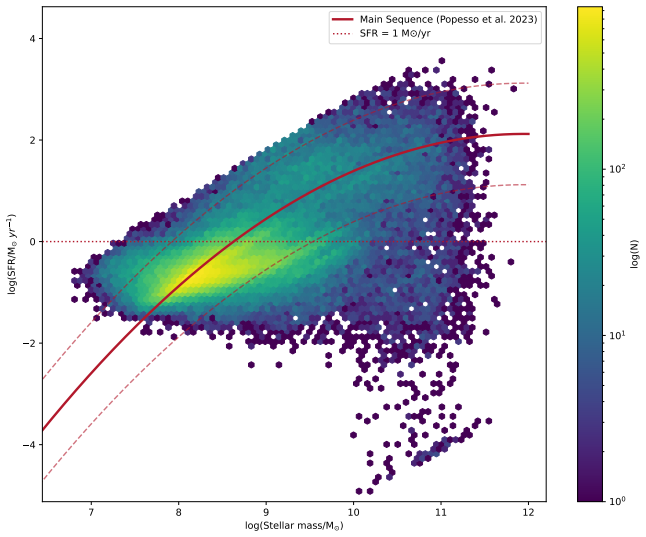
To better understand the role of AGN-driven outflows as a mechanism for heating or sweeping up gas over distances comparable to the size of the galaxy in its evolution, and to explore their physical characteristics as a function of AGN and host galaxy properties, it is necessary to have a statistical sample of AGNs selected from a uniform sample of galaxies with spectroscopic coverage of key restframe optical emission lines. To assess the impact of AGN-driven outflows on their host galaxies, we need to derive the mass and energy carried by the outflows, as well as correlations of these quantities with both AGN and host galaxy properties, in order to reveal their effects on the galaxy population and constrain the physical mechanisms driving the outflows. The availability of adaptive-optics-assisted 3D spectroscopy with the ELT multi-IFU instrument SHARP/VESPER enables the construction of spatially resolved outflow property maps, providing instantaneous outflow rates across the entire field of view without assuming outflow geometry, and thus significantly reducing the uncertainties compared to methods based on longslit spectroscopy. Furthermore, combining these maps with resolved star formation rate (SFR) maps allows a direct comparison between outflow properties and star-formation activity across the galaxy, providing key insights into how AGN feedback regulates star formation down to sub-kpc scales. By applying this approach to a representative sample of galaxies at cosmic noon ($1.5 < z < 2.5$), spanning a wide range of stellar masses from low-mass systems ($M_\star = 10^{8-10}\,M_\odot$) to the massive end ($M_\star > 10^{10}\,M_\odot$), we aim to systematically investigate the interplay between AGN activity, outflows, and star formation in the galaxy population as a whole.
Editorial analysis
A structured set of objections, weighed in public.
Referee Report
Summary. The manuscript outlines a proposed observing program using adaptive-optics-assisted 3D spectroscopy with the ELT multi-IFU instrument SHARP/VESPER to map AGN-driven outflows and resolved star-formation rates in galaxies at 1.5 < z < 2.5 across a stellar-mass range from 10^8 to >10^10 M_⊙, with the goal of studying AGN feedback regulation of star formation at sub-kpc scales without assuming outflow geometry.
Significance. If executed, the proposed observations could in principle yield spatially resolved outflow-rate maps that enable direct comparison with SFR maps and reduce geometric uncertainties relative to long-slit methods. However, the manuscript contains no data, derivations, sample selection criteria, observing strategy, or analysis, so its contribution is limited to a high-level science case rather than a completed scientific result.
major comments (2)
- [Abstract] Abstract: the central claim that SHARP/VESPER will deliver instantaneous outflow rates across the entire field of view without assuming outflow geometry is presented as an established capability, yet no instrument performance metrics, data-reduction approach, or validation against existing IFU data or simulations are supplied to support this assertion.
- [Abstract] Abstract: the stated requirement for a 'statistical sample of AGNs selected from a uniform sample of galaxies with spectroscopic coverage of key restframe optical emission lines' is not accompanied by any concrete selection criteria, parent catalog, or redshift-dependent completeness estimates, leaving the feasibility of the claimed population-level conclusions unassessable.
minor comments (1)
- The abstract is written as a single extended paragraph containing multiple compound claims; breaking it into shorter paragraphs would improve readability.
Simulated Author's Rebuttal
We thank the referee for their review. Our manuscript presents a science case for the proposed SUNRISE-3D program rather than an analysis of existing observations. We address the two major comments below and indicate where revisions will be made to improve clarity and support for the claims.
read point-by-point responses
-
Referee: [Abstract] Abstract: the central claim that SHARP/VESPER will deliver instantaneous outflow rates across the entire field of view without assuming outflow geometry is presented as an established capability, yet no instrument performance metrics, data-reduction approach, or validation against existing IFU data or simulations are supplied to support this assertion.
Authors: The referee correctly notes that the manuscript does not supply instrument performance metrics, data-reduction details, or validation studies. These claims derive from the published design specifications and performance expectations for the SHARP/VESPER multi-IFU instrument on the ELT. In revision we will add citations to the relevant instrument papers and include a short paragraph summarizing how the simultaneous multi-IFU coverage enables geometry-independent outflow mapping. We will also moderate the abstract wording to reflect that this is an expected capability based on instrument design rather than a demonstrated result. revision: yes
-
Referee: [Abstract] Abstract: the stated requirement for a 'statistical sample of AGNs selected from a uniform sample of galaxies with spectroscopic coverage of key restframe optical emission lines' is not accompanied by any concrete selection criteria, parent catalog, or redshift-dependent completeness estimates, leaving the feasibility of the claimed population-level conclusions unassessable.
Authors: We agree that the absence of explicit selection criteria and completeness estimates makes the statistical feasibility difficult to evaluate from the current text. The manuscript intentionally keeps the description at a high level to emphasize the scientific motivation. In the revised version we will add a dedicated subsection outlining example selection criteria drawn from existing parent catalogs (e.g., CANDELS, 3D-HST), approximate number densities at 1.5 < z < 2.5, and a brief discussion of redshift-dependent completeness for the key emission lines. This will allow readers to assess the practicality of assembling the sample. revision: yes
Circularity Check
Proposal abstract contains no derivations or self-referential claims
full rationale
This manuscript is a forward-looking proposal for an ELT/SHARP-VESPER observing program at 1.5<z<2.5. It contains no data, no equations, no fitted parameters, no modeling, and no completed analysis. The text describes instrument capabilities and survey goals without any derivation chain, self-citation load-bearing steps, or quantities that reduce to inputs by construction. The central claims about outflow maps and SFR comparisons are statements of intended future work, not derived results.
Axiom & Free-Parameter Ledger
Reference graph
Works this paper leans on
-
[1]
The WISSH quasars project. I. Powerful ionised outflows in hyper-luminous quasars. , keywords =. doi:10.1051/0004-6361/201629301 , archivePrefix =. 1612.03728 , primaryClass =
work page internal anchor Pith review Pith/arXiv arXiv doi:10.1051/0004-6361/201629301
-
[2]
Active Galactic Nucleus Feedback in Quiescent Galaxies at Cosmic Noon Traced by Ionized Gas Emission. , keywords =. doi:10.3847/1538-4357/adaeaf , archivePrefix =. 2406.08547 , primaryClass =
-
[3]
Peculiar emission line spectra of core extremely red BOSS quasars at z 2-3: orientation and/or evolution?. , keywords =. doi:10.1051/0004-6361/201937086 , archivePrefix =. 2001.03379 , primaryClass =
-
[4]
The diversity of quasars unified by accretion and orientation
The diversity of quasars unified by accretion and orientation. , keywords =. doi:10.1038/nature13712 , archivePrefix =. 1409.2887 , primaryClass =
work page internal anchor Pith review Pith/arXiv arXiv doi:10.1038/nature13712
-
[5]
Observational evidence of quasar feedback quenching star formation at high redshift
Observational evidence of quasar feedback quenching star formation at high redshift. , keywords =. doi:10.1051/0004-6361/201118358 , archivePrefix =. 1112.3071 , primaryClass =
work page internal anchor Pith review Pith/arXiv arXiv doi:10.1051/0004-6361/201118358
-
[6]
A massive quiescent galaxy at redshift 4.658. , keywords =. doi:10.1038/s41586-023-06158-6 , archivePrefix =. 2301.11413 , primaryClass =
-
[7]
JADES: The incidence rate and properties of galactic outflows in low-mass galaxies across 3 < z < 9. , keywords =. doi:10.1051/0004-6361/202347230 , archivePrefix =. 2306.11801 , primaryClass =
-
[8]
and Mainieri, V
Cresci, G. and Mainieri, V. and Brusa, M. and others , title =. ApJ , volume =
-
[9]
SUPER. I. Toward an unbiased study of ionized outflows in z 2 active galactic nuclei: survey overview and sample characterization. , keywords =. doi:10.1051/0004-6361/201833520 , archivePrefix =. 1809.04858 , primaryClass =
work page internal anchor Pith review Pith/arXiv arXiv doi:10.1051/0004-6361/201833520
-
[10]
SUPER. IV. CO(J = 3-2) properties of active galactic nucleus hosts at cosmic noon revealed by ALMA. , keywords =. doi:10.1051/0004-6361/202039270 , archivePrefix =. 2012.07965 , primaryClass =
-
[11]
and Sijacki, D
Costa, T. and Sijacki, D. and Trenti, M. and others , title =. MNRAS , volume =
-
[12]
Energy input from quasars regulates the growth and activity of black holes and their host galaxies. , keywords =. doi:10.1038/nature03335 , archivePrefix =. astro-ph/0502199 , primaryClass =
work page internal anchor Pith review Pith/arXiv arXiv doi:10.1038/nature03335
-
[13]
Observational Evidence of AGN Feedback
Observational Evidence of Active Galactic Nuclei Feedback. , keywords =. doi:10.1146/annurev-astro-081811-125521 , archivePrefix =. 1204.4114 , primaryClass =
work page internal anchor Pith review Pith/arXiv arXiv doi:10.1146/annurev-astro-081811-125521
-
[14]
AGN wind scaling relations and the co-evolution of black holes and galaxies
AGN wind scaling relations and the co-evolution of black holes and galaxies. , keywords =. doi:10.1051/0004-6361/201629478 , archivePrefix =. 1702.04507 , primaryClass =
work page internal anchor Pith review Pith/arXiv arXiv doi:10.1051/0004-6361/201629478
-
[15]
The KMOS^3D Survey: Demographics and Properties of Galactic Outflows at z = 0.6 - 2.7
The KMOS ^ 3D Survey: Demographics and Properties of Galactic Outflows at z = 0.6-2.7. , keywords =. doi:10.3847/1538-4357/ab0ca2 , archivePrefix =. 1807.04738 , primaryClass =
work page internal anchor Pith review Pith/arXiv arXiv doi:10.3847/1538-4357/ab0ca2
-
[16]
How do galaxies populate dark matter haloes?. , keywords =. doi:10.1111/j.1365-2966.2010.16341.x , archivePrefix =. 0909.4305 , primaryClass =
-
[17]
Galaxies on FIRE (Feedback In Realistic Environments): stellar feedback explains cosmologically inefficient star formation. , keywords =. doi:10.1093/mnras/stu1738 , archivePrefix =. 1311.2073 , primaryClass =
work page internal anchor Pith review Pith/arXiv arXiv doi:10.1093/mnras/stu1738 2073
-
[18]
and Ho, L
Kormendy, J. and Ho, L. C. , title =. ARA&A , volume =
-
[19]
The MOSDEF survey: the prevalence and properties of galaxy-wide AGN-driven outflows at $z\sim 2$
The MOSDEF Survey: The Prevalence and Properties of Galaxy-wide AGN-driven Outflows at z 2. , keywords =. doi:10.3847/1538-4357/aa9024 , archivePrefix =. 1703.10255 , primaryClass =
work page internal anchor Pith review Pith/arXiv arXiv doi:10.3847/1538-4357/aa9024
-
[20]
The MOSDEF Survey: A Census of AGN-driven Ionized Outflows at z = 1.4-3.8. , keywords =. doi:10.3847/1538-4357/ab4a7c , archivePrefix =. 1905.13338 , primaryClass =
-
[21]
and Ferguson, H
Madau, P. and Ferguson, H. C. and Dickinson, M. E. and others , title =. MNRAS , volume =
-
[22]
and others , title =
Mezcua, M. and others , title =. MNRAS , volume =
-
[23]
Penny, S. J. and Masters, K. L. and Smethurst, R. J. and others , title =. MNRAS , volume =
-
[24]
Mass and Environment as Drivers of Galaxy Evolution in SDSS and zCOSMOS and the Origin of the Schechter Function. , keywords =. doi:10.1088/0004-637X/721/1/193 , archivePrefix =. 1003.4747 , primaryClass =
work page internal anchor Pith review Pith/arXiv arXiv doi:10.1088/0004-637x/721/1/193
-
[25]
2018, MNRAS, 473, 4077, doi: 10.1093/mnras/stx2656
Simulating galaxy formation with the IllustrisTNG model. , keywords =. doi:10.1093/mnras/stx2656 , archivePrefix =. 1703.02970 , primaryClass =
work page internal anchor Pith review Pith/arXiv arXiv doi:10.1093/mnras/stx2656
-
[26]
Reines, A. E. and others , title =. ApJ , volume =
-
[27]
The WISSH quasars project. XI. The mean spectral energy distribution and bolometric corrections of the most luminous quasars. , keywords =. doi:10.1051/0004-6361/202244296 , archivePrefix =. 2211.07677 , primaryClass =
-
[28]
Sartori, L. F. and Schawinski, K. and Treister, E. and others , title =. MNRAS , volume =
-
[29]
An FMOS Survey of moderate-luminosity broad-line AGN in COSMOS, SXDS and E-CDF-S
An FMOS Survey of Moderate-luminosity, Broad-line AGNs in COSMOS, SXDS, and E-CDF-S. , keywords =. doi:10.3847/1538-4365/aae82f , archivePrefix =. 1810.07445 , primaryClass =
work page internal anchor Pith review Pith/arXiv arXiv doi:10.3847/1538-4365/aae82f
-
[30]
The WISSH quasars project. IV. Broad line region versus kiloparsec-scale winds. , keywords =. doi:10.1051/0004-6361/201732335 , archivePrefix =. 1802.03423 , primaryClass =
work page internal anchor Pith review Pith/arXiv arXiv doi:10.1051/0004-6361/201732335
-
[31]
Star formation shut down by multiphase gas outflow in a galaxy at a redshift of 2.45. , keywords =. doi:10.1038/s41586-024-07412-1 , archivePrefix =. 2308.05795 , primaryClass =
-
[32]
A fast-rotator post-starburst galaxy quenched by supermassive black-hole feedback at z = 3. Nature Astronomy , keywords =. doi:10.1038/s41550-024-02345-1 , archivePrefix =. 2308.06317 , primaryClass =
-
[33]
Fast and furious at z 2: Obscured type-2 active nuclei host faster ionised winds than type-1 systems
SUPER: VIII. Fast and furious at z 2: Obscured type-2 active nuclei host faster ionised winds than type-1 systems. , keywords =. doi:10.1051/0004-6361/202450162 , archivePrefix =. 2407.04099 , primaryClass =
-
[34]
The Global Schmidt Law in Star-forming Galaxies. , keywords =. doi:10.1086/305588 , archivePrefix =. astro-ph/9712213 , primaryClass =
work page internal anchor Pith review Pith/arXiv arXiv doi:10.1086/305588
-
[35]
3D-HST+CANDELS: The Evolution of the Galaxy Size-Mass Distribution since $z=3$
3D-HST+CANDELS: The Evolution of the Galaxy Size-Mass Distribution since z = 3. , keywords =. doi:10.1088/0004-637X/788/1/28 , archivePrefix =. 1404.2844 , primaryClass =
work page internal anchor Pith review Pith/arXiv arXiv doi:10.1088/0004-637x/788/1/28
-
[36]
Integral Field Spectroscopy of Massive, Kiloparsec-scale Outflows in the Infrared-luminous QSO Mrk 231. , keywords =. doi:10.1088/2041-8205/729/2/L27 , archivePrefix =. 1102.4349 , primaryClass =
work page internal anchor Pith review Pith/arXiv arXiv doi:10.1088/2041-8205/729/2/l27 2041
-
[37]
JWST reveals widespread AGN-driven neutral gas outflows in massive z 2 galaxies. , keywords =. doi:10.1093/mnras/stae327 , archivePrefix =. 2310.17939 , primaryClass =
-
[38]
Massive Molecular Outflows and Evidence for AGN Feedback from CO Observations
Massive molecular outflows and evidence for AGN feedback from CO observations. , keywords =. doi:10.1051/0004-6361/201322464 , archivePrefix =. 1311.2595 , primaryClass =
work page internal anchor Pith review Pith/arXiv arXiv doi:10.1051/0004-6361/201322464
-
[39]
The KMOS AGN Survey at High redshift (KASHz): the prevalence and drivers of ionized outflows in the host galaxies of X-ray AGN. , keywords =. doi:10.1093/mnras/stv2727 , archivePrefix =. 1511.00008 , primaryClass =
work page internal anchor Pith review Pith/arXiv arXiv doi:10.1093/mnras/stv2727
-
[40]
SUPER. II. Spatially resolved ionised gas kinematics and scaling relations in z 2 AGN host galaxies. , keywords =. doi:10.1051/0004-6361/202038551 , archivePrefix =. 2008.01728 , primaryClass =
-
[41]
Delayed or No Feedback? Gas Outflows in Type 2 AGNs. III. , keywords =. doi:10.3847/1538-4357/aa6894 , archivePrefix =. 1702.06681 , primaryClass =
work page internal anchor Pith review Pith/arXiv arXiv doi:10.3847/1538-4357/aa6894
-
[42]
The mass of quasars. Bulletin of the Astronomical Society of India , keywords =. doi:10.48550/arXiv.1302.2643 , archivePrefix =. 1302.2643 , primaryClass =
work page internal anchor Pith review Pith/arXiv arXiv doi:10.48550/arxiv.1302.2643
-
[43]
Black hole mass estimation for Active Galactic Nuclei from a new angle
Black hole mass estimation for active galactic nuclei from a new angle. , keywords =. doi:10.1093/mnras/stz1546 , archivePrefix =. 1903.01996 , primaryClass =
work page internal anchor Pith review Pith/arXiv arXiv doi:10.1093/mnras/stz1546 1903
-
[44]
On the quenching of star formation in observed and simulated central galaxies: evidence for the role of integrated AGN feedback. , keywords =. doi:10.1093/mnras/stab3673 , archivePrefix =. 2112.07672 , primaryClass =
-
[45]
The Chandra COSMOS-Legacy survey: Source X-ray spectral properties
The Chandra COSMOS-Legacy Survey: Source X-Ray Spectral Properties. , keywords =. doi:10.3847/0004-637X/830/2/100 , archivePrefix =. 1608.05149 , primaryClass =
work page internal anchor Pith review Pith/arXiv arXiv doi:10.3847/0004-637x/830/2/100
-
[46]
COSMOS2020: A Panchromatic View of the Universe to z 10 from Two Complementary Catalogs. , keywords =. doi:10.3847/1538-4365/ac3078 , archivePrefix =. 2110.13923 , primaryClass =
-
[47]
COSMOS2025: The COSMOS-Web galaxy catalog of photometry, morphology, redshifts, and physical parameters from JWST, HST, and ground-based imaging. , keywords =. doi:10.1051/0004-6361/202555799 , archivePrefix =. 2506.03243 , primaryClass =
-
[48]
The main sequence of star-forming galaxies across cosmic times. , keywords =. doi:10.1093/mnras/stac3214 , archivePrefix =. 2203.10487 , primaryClass =
-
[49]
Cool outflows in galaxies and their implications. , keywords =. doi:10.1007/s00159-019-0121-9 , archivePrefix =. 2002.07765 , primaryClass =
-
[50]
Classification parameters for the emission-line spectra of extragalactic objects. , keywords =. doi:10.1086/130766 , adsurl =
-
[51]
Discovering AGN-driven winds through their infrared emission: II. Mass outflow rate and energetics
Discovering AGN-driven winds through their infrared emission - II. Mass outflow rate and energetics. , keywords =. doi:10.1093/mnras/stz1070 , archivePrefix =. 1903.11076 , primaryClass =
work page internal anchor Pith review Pith/arXiv arXiv doi:10.1093/mnras/stz1070 1903
-
[52]
AGN outflows and feedback twenty years on
AGN outflows and feedback twenty years on. Nature Astronomy , keywords =. doi:10.1038/s41550-018-0403-6 , archivePrefix =. 1802.10306 , primaryClass =
work page internal anchor Pith review Pith/arXiv arXiv doi:10.1038/s41550-018-0403-6
-
[53]
Ionized outflows in local luminous AGN: what are the real densities and outflow rates?. , keywords =. doi:10.1093/mnras/staa2413 , archivePrefix =. 2003.06153 , primaryClass =
-
[54]
BASS XXXI: Outflow scaling relations in low redshift X-ray AGN host galaxies with MUSE. , keywords =. doi:10.1093/mnras/stac103 , archivePrefix =. 2201.04149 , primaryClass =
-
[55]
Observing positive and negative AGN feedback
Observing positive and negative AGN feedback. Nature Astronomy , keywords =. doi:10.1038/s41550-018-0404-5 , archivePrefix =. 1802.10305 , primaryClass =
work page internal anchor Pith review Pith/arXiv arXiv doi:10.1038/s41550-018-0404-5
-
[56]
SUPER. III. Broad line region properties of AGNs at z 2. , keywords =. doi:10.1051/0004-6361/202039136 , archivePrefix =. 2010.07443 , primaryClass =
-
[57]
An extremely high-velocity outflow in SMSS J2157-3602, the most luminous quasar in the first 1.3 Gyr. , keywords =. doi:10.1051/0004-6361/202555673 , archivePrefix =. 2509.08891 , primaryClass =
discussion (0)
Sign in with ORCID, Apple, or X to comment. Anyone can read and Pith papers without signing in.