REVIEW 4 major objections 5 minor 47 references
Where Did Your Model Learn That? Label-free Influence for Self-supervised Learning
T0 review · 4 major / 5 minor · reviewed 2026-08-11 · deepseek-v4-flash
Pith's one-line read This paper introduces Influence-SSL, a label-free influence score for self-supervised visual models that measures each training image's contribution to its own augmented-view consistency, and reports that removing the highest-scoring…
desk verdict Useful label-free influence score for SSL, but Theorem 1 is proven for a single-example Hessian, not the dataset Hessian the method actually uses, so the theory needs rework before the empirical claims are supported. read the letter →
The pith
A machine-rendered reading of the paper's core claim, the machinery that carries it, and where it could break.
The reading
What carries the argument
The load-bearing object is the SSL self-influence score $I(f,i) = -\nabla_\theta L(f_\theta(x_i), f_\theta(\hat{x}_i))^\top H_\theta^{-1} \nabla_\theta L(f_\theta(x_i), f_\theta(\hat{x}_i))$, where $L$ is the cosine distance between a training image and an augmented view and $H_\theta$ is the Hessian of the model's loss over the dataset. The paper's theoretical engine is the reduction of this score in a two-layer linear network with $x_{\mathrm{aug}} = x + \varepsilon\delta(x)$, $|\delta|=1$, $\varepsilon\ll1$: there the score collapses to $-2\varepsilon^2|W\delta|^2$, making influence exactly proportional to the per-sample SSL loss. In practice the Hessian inverse is approximated with a low-rank inverse-Hessian-vector-product method, and the augmentation is implemented as Gaussian noise, which the appendix shows is the perturbation choice that best preserves score rankings.
What would settle it
Retrain a small SSL model after removing each of the top-1000 Influence-SSL points and compare the actual leave-one-out change in downstream accuracy with the score's predictions; if removing high-influence points does not consistently improve accuracy across seed runs, the central removal claim fails. A second check is to compute Equation 6 in the exact two-layer linear network of Theorem 1 with $\varepsilon\ll1$ and verify that the score equals $-2\varepsilon^2|W\delta|^2$ within numerical precision.
Extended reading notes
Core claim
The central claim is that a training example's influence in self-supervised learning can be measured without any labels by looking at how much the learned representation changes when that example is augmented, and that this score is informative about what the model learned. In the simplified two-layer linear setting the score has the closed form $I_{\mathrm{ssl}}(x) = -2\varepsilon^2 |W\delta(x)|^2$, so influence is proportional to the per-sample augmentation loss and measures how far the model's representation moves under that input's perturbation. Empirically, high-influence CIFAR images are dominated by examples with uniform backgrounds, low-influence images include near-duplicates, and deleting the highest-influence examples improves downstream accuracy for SimCLR, BYOL, and Barlow Twins on CIFAR-10 and CIFAR-100, the opposite of the supervised baseline. On FairFace, the top-100 influential faces over-represent Black and Middle Eastern groups, which the paper presents as evidence that the score can surface biases hidden from conventional metrics.
Load-bearing premise
The whole argument assumes that what is true for a two-layer linear network with tiny perturbations is still true for deep nonlinear SSL models; if the inverse-Hessian term stops behaving like the constant it becomes in the linear proof, the theoretical foundation no longer covers the experiments.
Editorial extensions
If this is right
- Removing the highest-influence training points improves downstream top-1 accuracy for SimCLR, BYOL, and Barlow Twins on CIFAR-10 and CIFAR-100, while the same removal degrades a supervised baseline.
- Influence-SSL scores are reproducible: Pearson rank correlations exceed 0.96 across independent training runs for all three SSL frameworks.
- Low-influence examples tend to be semantic duplicates and high-influence examples tend to have uniform backgrounds, so the score can serve as a label-free signal for deduplication and outlier detection.
- On FairFace, the top-100 influential faces are disproportionately Black and Middle Eastern, indicating the score can reveal demographic skew in SSL representation learning.
- In the linear model, influence decomposes into a perturbation scale factor and a representation-sensitivity term, so the score directly measures how strongly augmentations move a point in representation space.
Reading between the lines
- A testable corollary of the linear theory is that in deep networks the score's ranking may be dominated by the per-sample augmentation loss; comparing Influence-SSL rankings against that loss alone would show whether the inverse-Hessian term adds signal.
- The uniform-background result suggests SSL pretraining can encode background as a shortcut; influence scores could be used as a pre-deployment audit to find images whose backgrounds, not objects, drive their representations.
- Because low-influence examples are near-duplicates, Influence-SSL could double as a label-free deduplication filter before pretraining; one extension would test whether dropping low-influence images reduces pretraining cost without hurting downstream accuracy.
- The paper deliberately leaves cross-point influence (a training point's effect on a held-out query's representation) for future work; defining query-conditional influence would let practitioners ask which training images best explain a specific test prediction.
Editorial analysis
A structured set of objections, weighed in public.
Referee Report
Summary. The paper introduces Influence-SSL, a label-free influence score for self-supervised learning defined in Eq. (6) as I(f,i) = -∇L(fθ(xi), fθ(x̂i))^T Hθ^{-1} ∇L(fθ(xi), fθ(x̂i)), where L is cosine distance and Hθ is described as the Hessian of the model's loss over the dataset. The authors provide a linear-network analysis (Theorem 1) claiming the score reduces to -2ε²|Wδ|², prove structural properties such as rotation invariance and scaling, and present experiments on CIFAR-10/100 and FairFace showing score stability across runs, detection of duplicates and uniform-background images, improved downstream accuracy after removing high-influence points, and uneven demographic representation among high-influence faces.
Significance. If the proposed score were a valid influence function, it would fill a real gap: supervised influence functions require labels and cannot be applied directly to SSL embeddings, and existing label-free attribution tools are mostly heuristic. The paper is commendable for releasing code, using three SSL frameworks (SimCLR, BYOL, Barlow Twins), reporting training configurations, and for the clean algebraic properties of the linearized score (Propositions 1-2, Appendix C). However, the theoretical bridge from Eq. (6) to the closed form in Theorem 1 is broken by the Hessian mismatch, and the simplified closed form is a scalar multiple of the per-sample SSL loss. The empirical removal results therefore currently read as augmentation-loss pruning rather than as downstream effects of causal example influence. These issues affect the central claim, so the paper in its present form is not ready for acceptance.
major comments (4)
- [§3.1 / Appendix C.1, Theorem 1] The proof applies Sherman-Morrison to H_ssl^λ = 2ε²δδᵀ + λI, the regularized Hessian of a single training example, but Eq. (6) and the classical influence definition require the Hessian of the full training objective over the dataset. For a dataset with Hessian H = 2Σ_i ε_i² δ_i δ_iᵀ + λI, the self-influence of point j is I_j = -4ε_j⁴ |Wδ_j|² δ_jᵀ H^{-1} δ_j, not -2ε²|Wδ_j|². The factor δ_jᵀH^{-1}δ_j is a leverage score and is not generally 1/(2ε_j²); even in the scalar case d=1, n=2, with ε_1=ε_2=ε and δ_1=δ_2=1, Eq. (6) gives -ε² while Theorem 1 predicts -2ε². Since the experiments use the full training-set Hessian via LoGra/LogIX, the theorem does not characterize the quantity actually computed.
- [§3.1, Theorem 1 and Lemma 3] In the simplified setting, the derived influence I_ssl(x) = -2ε²|Wδ|² is exactly -2 times the per-sample SSL loss L_ssl(x)=ε²|Wδ|². Thus the proposed 'influence' reduces, by the paper's own equations, to a deterministic monotone transform of the loss of one augmented pair. The score therefore measures augmentation sensitivity of the current representation, not the effect of the example on the learned parameters; a point can be 'high-influence' without causing any change in θ. This is a conceptual issue, not just a presentational one: it means the theoretical argument does not establish that Eq. (6) is an influence function in the Koh-Liang sense.
- [§4.3, Figure 6] The main empirical claim is that removing high-Influence-SSL points improves downstream accuracy, but the experiments do not compare against random removal or against removal by the per-sample SSL/consistency loss. Given Major Comment 2, the observed improvement may be exactly the effect of removing the largest per-sample augmentation losses; such hard-example pruning is a known phenomenon and would not validate the proposed attribution method. Please add baselines (random, highest raw SSL loss, highest gradient norm) and report the rank correlation between Influence-SSL and raw SSL loss on the actual ResNet18 models.
- [§4 and Theorem 1] The theory is stated for a two-layer linear network with small perturbations δ satisfying δᵀx = 0 and Euclidean loss, yet the experiments use ResNet18, Gaussian noise with σ=0.2, cosine distance, and nonlinear SSL objectives. No argument or diagnostic is given that the Hessian inverse in Eq. (6) is approximately constant across examples or that the linear closed form is predictive of deep-network scores. The paper's own caveat that influence functions can deviate from leave-one-out effects in neural networks (Section 3.1, citing [5,2]) makes this gap load-bearing for the claim that the experiments validate the theory. Please provide, at minimum, a rank-correlation check between Eq. (6) with full Hessian and the linearized score, or explicitly reframe the theory as intuition only.
minor comments (5)
- [Eq. (6) and experimental ranking] Eq. (6) defines I(f,i) as a negative quadratic form, so scores are non-positive, but the paper reports positive 'log influence scores' and ranks 'top influential' without saying whether it uses |I| or -I; please clarify this for all figures and tables.
- [Appendix B.4, Figure 12] Duplicate identification is based on visual inspection; provide a quantitative duplicate-detection measure (e.g., fraction of nearest-neighbor pairs among lowest-influence images) and a threshold for declaring duplicates.
- [Figure 6] Appendix A lists seeds and says error bars are used, but the figure appears without visible error bars; add them or state explicitly that they are omitted.
- [§4.5, Figure 8] The racial imbalance claim needs a statistical test against the FairFace base rates and a control using the lowest-influence examples; currently it is a histogram without error bars or a significance statement.
- [Appendix A and C.2] There are several typos, including 'validation ses' in Appendix A, 'eac' in Appendix C.2, and 'Inluence' in the Figure 9 caption; also, reference [21] is the authors' own workshop paper and its relation to this submission should be clarified.
Circularity Check
Theorem 1's closed-form influence is -2 times the per-sample SSL loss, obtained by swapping in the single-example Hessian; the theoretical derivation restates its own input.
-
self definitional
[Theorem 1 and Appendix C.1 (Lemma 3, Lemma 4, final influence formula)]
"Lssl(W ; x) = |W x− W xaug|2 ... = ε2|W δ|2 ... Hssl = 2ε2δδ T ... I λ ssl(x) = −4ε4∥W δ∥2 1 λ + 2ε2"
Eq. (6) defines I = −∇L^T H^{-1}∇L. In the proof H is taken to be Hssl = 2ε²δδᵀ, the Hessian of the same single-example loss whose value Lemma 3 gives as Lssl = ε²|Wδ|². For this homogeneous quadratic, −∇L^T(∇²L)^{-1}∇L = −2Lssl, so Theorem 1's Issl = −2ε²|Wδ|² is −2 times the loss already fed into the formula. This is an algebraic identity of the proposed quadratic form, not an independent characterization. Moreover, Eq. (6) defines Hθ as the dataset Hessian; with H = 2Σᵢ εᵢ²δᵢδᵢᵀ the self-influence of point j is −4εⱼ⁴|Wδⱼ|²δⱼᵀH^{-1}δⱼ, which equals the theorem only for n=1. The theorem therefore holds by replacing the dataset Hessian with the per-example Hessian, making the result equivalent to its input.
full rationale
The central theoretical step is circular: Theorem 1's closed form is just −2×Lssl(x) under a single-example Hessian, so the claimed 'characterization' restates the definition. The empirical studies (Figures 2, 4, 6; FairFace) are benchmark-based and would stand or fall independently; no load-bearing self-citation is used, and [21] is a prior workshop paper cited only for the unsurprising point that label-based influence is not directly applicable. I score 6 rather than 8-10 because the implemented score uses a LoGra/LogIX full-data Hessian, so the practical ranking is not literally the n=1 identity; however, the theoretical bridge claimed in Theorem 1 reduces by construction, and the paper offers no argument that the deep-network Hessian makes the score differ from a monotone transform of the per-sample augmentation loss.
Assumptions & free parameters
free parameters (3)
- Gaussian perturbation parameters (mu, sigma) =
mu=0.05, sigma=0.2
- Perturbation magnitude epsilon =
implicit small; set by sigma=0.2
- Hessian low-rank approximation rank =
not specified
assumptions (5)
- domain assumption The influence of a training point on its own representation can be measured by the cosine distance between the point and an augmented view, with the Hessian of the dataset loss.
- domain assumption The Hessian in Equation 6 is invertible or regularized.
- domain assumption Small perturbation assumption: x_aug = x + epsilon delta with epsilon << 1.
- ad hoc to paper Gaussian noise is representative of SSL augmentations.
- ad hoc to paper The linear network analysis transfers to deep nonlinear SSL models.
Cite this review
Pith. "Pith review of Where Did Your Model Learn That? Label-free Influence for Self-supervised Learning." pith.science (2026). https://pith.science/paper/QWDOHCJH
@misc{pith2026241217170,
  author       = {Pith},
  title        = {Pith review of: Where Did Your Model Learn That? Label-free Influence for Self-supervised Learning},
  year         = {2026},
  howpublished = {\url{https://pith.science/paper/QWDOHCJH}},
  note         = {Machine review of arXiv:2412.17170}
}
read the original abstract
Self-supervised learning (SSL) has revolutionized learning from large-scale unlabeled datasets, yet the intrinsic relationship between pretraining data and the learned representations remains poorly understood. Traditional supervised learning benefits from gradient-based data attribution tools like influence functions that measure the contribution of an individual data point to model predictions. However, existing definitions of influence rely on labels, making them unsuitable for SSL settings. We address this gap by introducing Influence-SSL, a novel and label-free approach for defining influence functions tailored to SSL. Our method harnesses the stability of learned representations against data augmentations to identify training examples that help explain model predictions. We provide both theoretical foundations and empirical evidence to show the utility of Influence-SSL in analyzing pre-trained SSL models. Our analysis reveals notable differences in how SSL models respond to influential data compared to supervised models. Finally, we validate the effectiveness of Influence-SSL through applications in duplicate detection, outlier identification and fairness analysis. Code is available at: \url{https://github.com/cryptonymous9/Influence-SSL}.
Figures
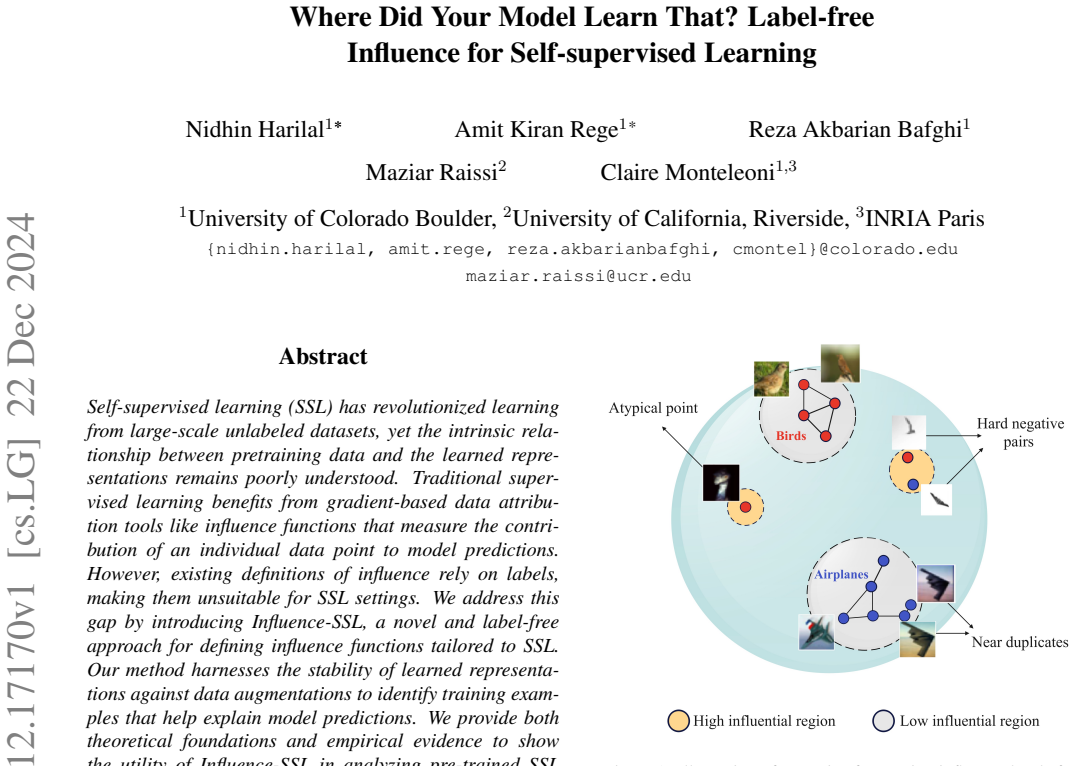


Figures from the paper (12 more)


Reference graph
Works this paper leans on
-
[1]
A closer look at memorization in deep networks
Devansh Arpit, Stanisław Jastrz˛ ebski, Nicolas Ballas, David Krueger, Emmanuel Bengio, Maxinder S Kanwal, Tegan Maharaj, Asja Fischer, Aaron Courville, Yoshua Bengio, et al. A closer look at memorization in deep networks. In International conference on machine learning , pages 233–
-
[2]
Juhan Bae, Nathan Ng, Alston Lo, Marzyeh Ghassemi, and Roger B Grosse. If influence functions are the answer, then what is the question? Advances in Neural Information Pro- cessing Systems, 35:17953–17967, 2022. 1, 2, 4
work page 2022
-
[3]
Relatif: Identifying explanatory training samples via relative influence
Elnaz Barshan, Marc-Etienne Brunet, and Gintare Karolina Dziugaite. Relatif: Identifying explanatory training samples via relative influence. In Proceedings of the Twenty Third In- ternational Conference on Artificial Intelligence and Statis- tics, pages 1899–1909. PMLR, 2020. 3
work page 1909
-
[4]
On second- order group influence functions for black-box predictions
Samyadeep Basu, Xuchen You, and Soheil Feizi. On second- order group influence functions for black-box predictions. In Proceedings of the 37th International Conference on Ma- chine Learning. JMLR.org, 2020. 3
work page 2020
-
[5]
Influence functions in deep learning are fragile
Samyadeep Basu, Phillip Pope, and Soheil Feizi. Influence functions in deep learning are fragile. In ICLR. OpenRe- view.net, 2021. 4
work page 2021
-
[6]
Gender shades: Inter- sectional accuracy disparities in commercial gender classifi- cation
Joy Buolamwini and Timnit Gebru. Gender shades: Inter- sectional accuracy disparities in commercial gender classifi- cation. In Conference on fairness, accountability and trans- parency, pages 77–91. PMLR, 2018. 1
work page 2018
-
[7]
The secret sharer: Evaluating and test- ing unintended memorization in neural networks
Nicholas Carlini, Chang Liu, Úlfar Erlingsson, Jernej Kos, and Dawn Song. The secret sharer: Evaluating and test- ing unintended memorization in neural networks. In 28th USENIX security symposium (USENIX security 19) , pages 267–284, 2019. 3
work page 2019
-
[8]
Ting Chen, Simon Kornblith, Mohammad Norouzi, and Ge- offrey E. Hinton. A simple framework for contrastive learn- ing of visual representations. ArXiv, abs/2002.05709, 2020. 5
arXiv 2002
Show all 47 references
-
[9]
What is your data worth to gpt? llm-scale data valuation with influ- ence functions, 2024
Sang Keun Choe, Hwijeen Ahn, Juhan Bae, Kewen Zhao, Minsoo Kang, Youngseog Chung, Adithya Pratapa, Willie Neiswanger, Emma Strubell, Teruko Mitamura, Jeff Schnei- der, Eduard Hovy, Roger Grosse, and Eric Xing. What is your data worth to gpt? llm-scale data valuation with influ...
2024
-
[10]
Sang Keun Choe, Hwijeen Ahn, Juhan Bae, Kewen Zhao, Minsoo Kang, Youngseog Chung, Adithya Pratapa, Willie Neiswanger, Emma Strubell, Teruko Mitamura, Jeff Schnei- der, Eduard Hovy, Roger Grosse, and Eric P. Xing. What is your data worth to gpt? llm-scale data valuation with in...
2024 arXiv
-
[11]
R. Dennis. Cook and Sanford Weisberg. Residuals and influ- ence in regression / R. Dennis Cook and Sanford Weisberg. Chapman and Hall, New York, 1982. 3
1982
-
[12]
Does learning require memorization? a short tale about a long tail
Vitaly Feldman. Does learning require memorization? a short tale about a long tail. In Proceedings of the 52nd Annual ACM SIGACT Symposium on Theory of Computing , pages 954–959, 2020. 1, 3, 6
2020
-
[13]
What neural networks memorize and why: Discovering the long tail via influence estimation
Vitaly Feldman and Chiyuan Zhang. What neural networks memorize and why: Discovering the long tail via influence estimation. In Advances in Neural Information Processing Systems, pages 2881–2891. Curran Associates, Inc., 2020. 2, 3, 6
2020
-
[14]
Data shapley: Equitable valuation of data for machine learning
Amirata Ghorbani and James Zou. Data shapley: Equitable valuation of data for machine learning. InProceedings of the 36th International Conference on Machine Learning , pages 2242–2251. PMLR, 2019. 3
2019
-
[15]
Bootstrap your own latent-a new approach to self-supervised learning
Jean-Bastien Grill, Florian Strub, Florent Altché, Corentin Tallec, Pierre Richemond, Elena Buchatskaya, Carl Doersch, Bernardo Avila Pires, Zhaohan Guo, Mohammad Ghesh- laghi Azar, et al. Bootstrap your own latent-a new approach to self-supervised learning. Advances in neural...
2020
-
[16]
Richemond, Elena Buchatskaya, Carl Do- ersch, Bernardo Ávila Pires, Zhaohan Daniel Guo, Mo- hammad Gheshlaghi Azar, Bilal Piot, Koray Kavukcuoglu, Rémi Munos, and Michal Valko
Jean-Bastien Grill, Florian Strub, Florent Altch’e, Corentin Tallec, Pierre H. Richemond, Elena Buchatskaya, Carl Do- ersch, Bernardo Ávila Pires, Zhaohan Daniel Guo, Mo- hammad Gheshlaghi Azar, Bilal Piot, Koray Kavukcuoglu, Rémi Munos, and Michal Valko. Bootstrap your own la...
2006 arXiv
-
[17]
Studying large lan- guage model generalization with influence functions
Roger Grosse, Juhan Bae, Cem Anil, Nelson Elhage, Alex Tamkin, Amirhossein Tajdini, Benoit Steiner, Dustin Li, Esin Durmus, Ethan Perez, et al. Studying large lan- guage model generalization with influence functions. arXiv preprint arXiv:2308.03296, 2023. 1, 3
2023 arXiv
-
[18]
Simfluence: Modeling the in- fluence of individual training examples by simulating train- ing runs
Kelvin Guu, Albert Webson, Ellie Pavlick, Lucas Dixon, Ian Tenney, and Tolga Bolukbasi. Simfluence: Modeling the in- fluence of individual training examples by simulating train- ing runs. arXiv preprint arXiv:2303.08114, 2023. 1
2023 arXiv
-
[19]
Training data influence analysis and estimation: a survey
Zayd Hammoudeh and Daniel Lowd. Training data influence analysis and estimation: a survey. Mach. Learn. , 113(5): 2351–2403, 2024. 3, 6
2024
-
[20]
Frank R. Hampel. The influence curve and its role in robust estimation. Journal of The American Statistical Association, 69(346):383–393, 1974. 2, 4
1974
-
[21]
Influence estima- tion in self-supervised learning
Nidhin Harilal, Reza Akbarian Bafghi, Amit Kiran Rege, Maziar Raissi, and Claire Monteleoni. Influence estima- tion in self-supervised learning. In NeurIPS 2024 Workshop: Self-Supervised Learning-Theory and Practice, 2024. 2
2024
-
[22]
Towards the generalization of contrastive self- supervised learning
Weiran Huang, Mingyang Yi, Xuyang Zhao, and Zihao Jiang. Towards the generalization of contrastive self- supervised learning. arXiv preprint arXiv:2111.00743, 2021. 3
2021 arXiv
-
[23]
Datamodels: Understand- ing predictions with data and data with predictions
Andrew Ilyas, Sung Min Park, Logan Engstrom, Guillaume Leclerc, and Aleksander Madry. Datamodels: Understand- ing predictions with data and data with predictions. In Pro- ceedings of the 39th International Conference on Machine Learning, pages 9525–9587. PMLR, 2022. 3
2022
-
[24]
Fairface: Face attribute dataset for balanced race, gender, and age for bias measurement and mitigation
Kimmo Karkkainen and Jungseock Joo. Fairface: Face attribute dataset for balanced race, gender, and age for bias measurement and mitigation. In Proceedings of the IEEE/CVF Winter Conference on Applications of Computer Vision, pages 1548–1558, 2021. 8, 1
2021
-
[25]
Understanding black-box predictions via influence functions
Pang Wei Koh and Percy Liang. Understanding black-box predictions via influence functions. In International confer- ence on machine learning, pages 1885–1894. PMLR, 2017. 1, 2, 3
2017
-
[26]
On the accuracy of influence functions for measuring group effects
Pang Wei W Koh, Kai-Siang Ang, Hubert Teo, and Percy S Liang. On the accuracy of influence functions for measuring group effects. Advances in neural information processing systems, 32, 2019. 3
2019
-
[27]
Learning multiple layers of features from tiny images
Alex Krizhevsky. Learning multiple layers of features from tiny images. In . Toronto, ON, Canada, 2009. 5
2009
-
[28]
Six lectures on linearized neural networks, 2023
Theodor Misiakiewicz and Andrea Montanari. Six lectures on linearized neural networks, 2023. 3, 4
2023
-
[29]
Estimating training data influence by trac- ing gradient descent
Garima Pruthi, Frederick Liu, Satyen Kale, and Mukund Sundararajan. Estimating training data influence by trac- ing gradient descent. In Advances in Neural Information Processing Systems, pages 19920–19930. Curran Associates, Inc., 2020. 3
2020
-
[30]
Actionable au- diting: Investigating the impact of publicly naming biased performance results of commercial ai products
Inioluwa Deborah Raji and Joy Buolamwini. Actionable au- diting: Investigating the impact of publicly naming biased performance results of commercial ai products. In Proceed- ings of the 2019 AAAI/ACM Conference on AI, Ethics, and Society, pages 429–435, 2019. 1
2019
-
[31]
A value for n-person games
Lloyd S Shapley. A value for n-person games. In Contribu- tions to the Theory of Games II , pages 307–317. Princeton University Press, Princeton, 1953. 3
1953
-
[32]
Chaos is a ladder: A new theoretical under- standing of contrastive learning via augmentation overlap
Yifei Wang, Qi Zhang, Yisen Wang, Jiansheng Yang, and Zhouchen Lin. Chaos is a ladder: A new theoretical under- standing of contrastive learning via augmentation overlap. arXiv preprint arXiv:2203.13457, 2022. 3
2022 arXiv
-
[33]
Representer point selection for explaining deep neural networks
Chih-Kuan Yeh, Joon Kim, Ian En-Hsu Yen, and Pradeep K Ravikumar. Representer point selection for explaining deep neural networks. In Advances in Neural Information Pro- cessing Systems. Curran Associates, Inc., 2018. 3
2018
-
[34]
Barlow twins: Self-supervised learning via redundancy reduction
Jure Zbontar, Li Jing, Ishan Misra, Yann LeCun, and Stéphane Deny. Barlow twins: Self-supervised learning via redundancy reduction. ArXiv, abs/2103.03230, 2021. 5
2021 arXiv
-
[35]
Barlow twins: Self-supervised learning via redundancy reduction
Jure Zbontar, Li Jing, Ishan Misra, Yann LeCun, and Stéphane Deny. Barlow twins: Self-supervised learning via redundancy reduction. In International conference on ma- chine learning, pages 12310–12320. PMLR, 2021. 3
2021
-
[36]
Understanding deep learning (still) requires rethinking generalization
Chiyuan Zhang, Samy Bengio, Moritz Hardt, Benjamin Recht, and Oriol Vinyals. Understanding deep learning (still) requires rethinking generalization. Communications of the ACM, 64(3):107–115, 2021. 3
2021
-
[37]
How mask mat- ters: Towards theoretical understandings of masked autoen- coders
Qi Zhang, Yifei Wang, and Yisen Wang. How mask mat- ters: Towards theoretical understandings of masked autoen- coders. Advances in Neural Information Processing Systems, 35:27127–27139, 2022. 3
2022
-
[38]
Rethinking influence func- tions of neural networks in the over-parameterized regime
Rui Zhang and Shihua Zhang. Rethinking influence func- tions of neural networks in the over-parameterized regime. In Proceedings of the AAAI Conference on Artificial Intelli- gence, pages 9082–9090, 2022. 1 Where Did Your Model Learn That? Label-free Influence for Self-supervi...
2022
-
[39]
The gradient is: ∇W Lssl = 2ε2W δδT
-
[40]
The Hessian is: Hssl = 2ε2δδ T Proof. For the gradient: Lssl = ε2tr(W δδT W T ) ∇W Lssl = ε2∇W tr(W δδT W T ) = 2ε2W δδT For the Hessian: Hssl = ∇W (2ε2W δδT ) = 2ε2δδ T Throughout the following derivations, for notational simplicity, we focus on the case k = 1, i.e. W ∈ R1×d....
-
[41]
Claim 1 (Decomposition of SSL Influence, Part (A) of Prop
We split the proposition into several parts, eac corre- sponding to a property of the influence functions. Claim 1 (Decomposition of SSL Influence, Part (A) of Prop. 1) . The SSL influence function admits a canonical decomposition: Issl(x) = −2ε2∥W δ∥2 = −2ε2tr(W δδT W T ) whi...
-
[42]
A scale factor ε2 depending only on perturbation mag- nitude
-
[43]
Starting from Issl(x) = −2ε2∥W δ∥2: ∥W δ∥2 = (W δ)T (W δ) = tr((W δ)(W δ)T ) = tr(W δδT W T ) where we used the cyclic property of trace
A geometric term tr (W δδT W T ) measuring representa- tion sensitivity Proof. Starting from Issl(x) = −2ε2∥W δ∥2: ∥W δ∥2 = (W δ)T (W δ) = tr((W δ)(W δ)T ) = tr(W δδT W T ) where we used the cyclic property of trace. The decompo- sition follows directly. This decomposition lea...
-
[44]
Perturbation magnitude: Issl(x; ε) = ε2Issl(x; 1)
-
[45]
This provides theoretical justification for their use in analyzing self-supervised learning systems
Parameter magnitude: Issl(x; αW ) = α2Issl(x; W ) These properties establish that our definition of influence functions in a SSL setting measure an intrinsic geometric quantity: the sensitivity of learned representations to pertur- bations, independent of the specific paramete...
-
[46]
The influence admits a geometric decomposition: Issl(x) = −2ε2 Tr(W δ(x, ξ)δ(x, ξ)T W T ) = −2ε2⟨W T W, δ(x, ξ)δ(x, ξ)T
-
[47]
The deviation from expected influence is: Issl(x)−Eξ∼P (ξ)[Issl(x)] = −2ε2 Tr(W T W (δ(x, ξ)δ(x, ξ)T − Σx)) where Σx = Eξ[δ(x, ξ)δ(x, ξ)T ] represents the expected augmentation behavior for input x. Proof. For the geometric decomposition: Issl(x) = −2ε2|W δ(x, ξ)|2 = −2ε2(W δ(...
Reviewed August 11, 2026 · model on record in the stance chip above.
Discussion (0). Continue with ORCID to comment.