REVIEW 3 major objections 4 minor 53 references
A two-stage model converts relative depth into metric 3D geometry by calibrating every pixel's scale and ray direction, and reports the strongest average zero-shot depth accuracy across seven benchmarks.
Reviewed by Pith at T0; open to challenge. T0 means a machine referee read the full paper against a public rubric. the ladder, T0–T4 →
T0 review · deepseek-v4-flash
2026-08-02 06:50 UTC pith:QWPLM7OX
load-bearing objection Strong monocular metric-depth paper with a real ablation gap — the pixel-wise-fields-vs-global-scale claim is only tested on 5% data, so the headline margin may owe more to backbone/data than to the fields. the 3 major comments →
FoundationGeo: Learning Spatial Pixel-Wise Fields for Monocular Metric Geometry
The pith
A machine-rendered reading of the paper's core claim, the machinery that carries it, and where it could break.
Core claim
The paper's central claim is that relative-to-metric transfer for monocular geometry can be made substantially more accurate and robust by replacing a single global scale with two pixel-wise spatial calibration fields: a scale field that performs spatially varying metric alignment and a ray-direction correction field that compensates directional bias in the predicted point map. Trained in a two-stage scheme where a DINOv3-initialized relative base model is first learned on a curated 10.2M-image corpus and then fine-tuned jointly with the fields, the model produces metrically consistent 3D point maps. The authors further claim that the remaining zero-shot gap is largely caused by camera-intri
What carries the argument
The load-bearing mechanisms are (1) a pixel-wise scale field S and a ray-direction correction field Δ that are applied to the relative point map P to produce metric points via p_i = s_i · (normalize(ray + bounded tangent offsets) · range); (2) a two-stage training recipe that initializes from a strong relative model and keeps relative-geometry losses as structural regularizers during metric calibration; (3) a closed-form target scale that decouples scale learning from point-map prediction; and (4) a controlled Blender-based data engine that renders matched scenes with diverse focal lengths to repair intrinsic coverage. The ray correction is parameterized by bounded tanh offsets in a local ta
Load-bearing premise
The load-bearing premise is that the residual zero-shot gap is caused primarily by test intrinsics falling outside the training focal-length distribution, and that the 23,700 Blender renders improve real benchmarks by repairing that coverage rather than by generic data volume; if this premise fails, the data contribution reduces to 'more synthetic data helps.'
What would settle it
Replace the 23,700 Blender renders with an equal number of real images whose focal lengths fall inside the previously under-covered band (e.g., from diverse cameras). If the improvement on DDAD and DIODE disappears, focal-length coverage is not the operative cause; if it persists, coverage is confirmed.
If this is right
- Spatially varying calibration outperforms a single global scale for relative-to-metric conversion, implying that pixel-wise fields should replace global scale heads in future metric-depth models.
- Focal-length coverage is a first-order determinant of zero-shot metric accuracy; models trained with diverse intrinsics generalize to unseen cameras more reliably.
- Two-stage training—first a relative foundation model, then a lightweight metric calibration—yields better metric accuracy than direct single-stage metric training.
- The ray-direction correction field improves angular accuracy of predicted point maps, reducing 3D inconsistency even when depth scale is well calibrated.
- The stage-one relative model also achieves the best overall relative-depth performance and competitive boundary sharpness, indicating the approach benefits both scale-free and metric geometry.
Where Pith is reading between the lines
- If focal-length coverage is the dominant factor, then evaluating any metric-depth model on focal-length-shifted versions of the same scenes should reproduce the same sharp degradation when intrinsics leave the training band; if it does not, other factors such as scene priors or data volume are the real bottleneck.
- Since the scale field is learned implicitly from image cues, it may subsume explicit focal-length prediction and lead to camera-agnostic metric models that do not need an intrinsic-estimation branch.
- The effectiveness of 23,700 targeted renders suggests that data engines guided by intrinsic-coverage diagnostics can rival much larger indiscriminate datasets, pointing to a more economical recipe for metric-generalization research.
- Extending the same coverage argument to principal point, distortion, and sensor size is a natural next step; if focal length is truly the dominant intrinsic factor, correcting the others may yield only marginal gains.
Editorial analysis
A structured set of objections, weighed in public.
Referee Report
Summary. The paper proposes FoundationGeo, a two-stage monocular metric depth estimator. Stage 1 trains a DINOv3-initialized ViT-L backbone on a curated 10.2M-image corpus to predict affine-invariant point maps, relative depth, and masks. Stage 2 adds a pixel-wise scale field and a ray-direction correction field, together with coupled metric regression and decoupled field-specific losses, to convert relative geometry into metric 3D point maps. The paper further diagnoses focal-length coverage mismatch between training and test data, and introduces a Blender-based synthetic render set (23,700 images) designed to cover under-represented focal regimes. Zero-shot evaluations on seven metric-depth benchmarks report the best average AbsRel (14.8) and δ1 (80.8), outperforming MoGe-2 (15.7/76.8) without requiring ground-truth intrinsics at inference.
Significance. If fully supported, this is a valuable empirical contribution to monocular metric depth estimation: it demonstrates a practical route from a high-quality affine-invariant base model to metric geometry using lightweight pixel-wise calibration, and it provides a concrete data-side diagnosis with a controlled synthetic intervention. The paper's strengths include the use of a unified, widely used evaluation protocol (MoGe's protocol), the controlled Fixed-Focal vs Diverse-Focal comparison in Table 5, and the internally consistent component ablations. The main missing piece is a full-scale ablation that isolates the proposed spatial fields from the upgraded backbone and larger training corpus; without it, the title-level claim is not yet validated at the scale where the paper claims state-of-the-art performance.
major comments (3)
- [§4.2, Tables 4 and 5] The central claim that pixel-wise spatial fields outperform a global scale in relative-to-metric transfer is only tested on ~5% stratified subsets (Table 4, rows 3 vs 4: AbsRel 20.1→19.3, δ1 66.8→68.0). The full-data ablations in Table 5 compare two-stage training with/without FGD and with scratch training, but never replace the spatial fields with an image-level global scale while keeping the 10.2M corpus, DINOv3 initialization, Stage-1 relative model, and Stage-2 hyperparameters identical. The reported full-model advantage over MoGe-2 (14.8/80.8 vs 15.7/76.8, Table 2) is of the same order as the 5%-scale advantage, so the headline result could be driven by the stronger relative backbone and larger training corpus rather than by the proposed fields. This is load-bearing for the title-level contribution; a full-data spatial-fields-vs-global-scale ablation is required.
- [Tables 2–6] All reported results are single-run without seeds or variance estimates. The headline margin over MoGe-2 in Table 2 is 0.9 AbsRel (14.8 vs 15.7) and 4.0 δ1 (80.8 vs 76.8), but per-dataset margins are smaller on several benchmarks (e.g., DDAD AbsRel 17.6 vs 15.8, where FoundationGeo is worse) and the average depends on a few datasets. Given the small margins and the absence of multiple runs, the 'best overall' ranking is not robustly supported. At least three seeds, or an explicit statement that run-to-run variance is negligible, should be reported for the main comparisons and the key ablations.
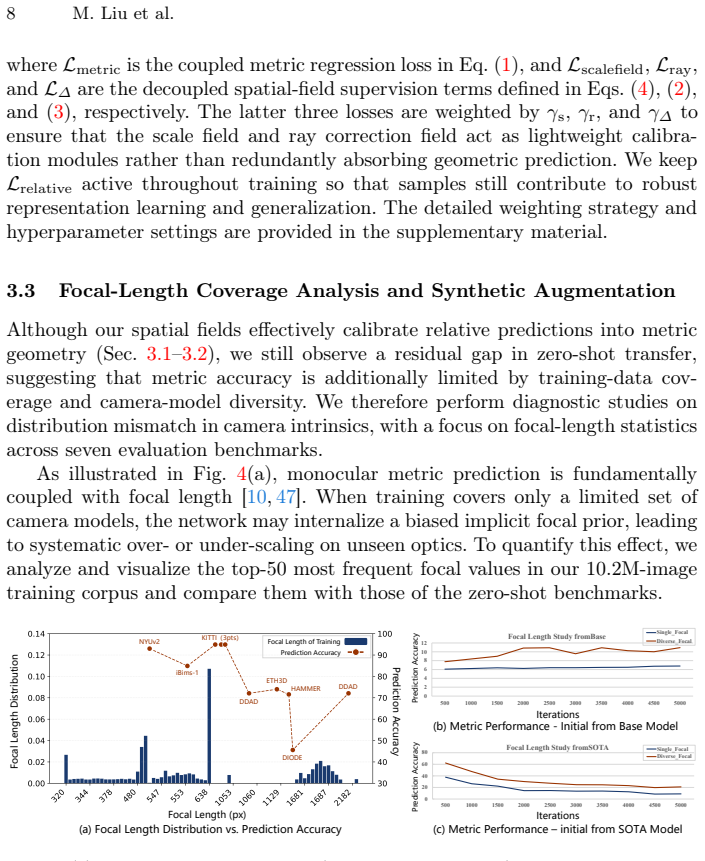
- [§3.3, Fig. 4, Table 5] The claim that the residual zero-shot gap is primarily caused by focal-length coverage is supported only qualitatively by the visual focal-length histograms in Fig. 4(a). The controlled Fixed-Focal vs Diverse-Focal comparison in Table 5 is a good step, but it does not fully separate focal diversity from synthetic-data effects: both FGD variants improve DDAD and DIODE substantially over 'w/o FGD' (e.g., DDAD AbsRel 20.0→19.2 for fixed, →17.6 for diverse), so generic synthetic volume/domain also contributes. Please add a quantitative per-focal-band error analysis and report the actual coverage overlap between training and each benchmark to make the 'primarily' claim precise.
minor comments (4)
- [Table 2] The metric-depth average is said to be over seven benchmarks, but the table lists eight datasets with Sintel blank. Clarify that Sintel is excluded from metric-depth averaging because metric scale is unavailable.
- [Table 5] Row labels are ambiguous: 'MoGe-2 +FGD' vs '+FGD(Ours)' vs 'w/o FGD' do not make it clear which rows correspond to the proposed pipeline and which to MoGe-2 under the same evaluation protocol. Use explicit labels such as 'Ours (w/o FGD)', 'Ours + FGD', 'MoGe-2 + FGD'.
- [Fig. 2] The x-axis tick labels of Fig. 2(a) appear garbled ('256 141664'); please fix the font/formatting.
- [Supplementary Sec. E] The limitations listed in Sec. E (camera-model coverage beyond focal length, capacity of the lightweight fields, synthetic data diversity) are sensible and should be at least summarized in the main paper's conclusion so readers see them without consulting the supplementary material.
Circularity Check
No significant circularity: the single overlapping-author citation is peripheral, and the scale/ray-field calibration is trained against ground-truth targets and tested on external benchmarks.
full rationale
The derivation chain is self-contained. Stage-1 relative geometry is trained with affine-invariant alignment losses (Eqs. 6-15) against ground-truth point maps; Stage-2 spatial fields are supervised by a coupled metric l1 loss (Eq. 1), a closed-form least-squares scale target (Eq. 4), and ray-angle/regularization losses (Eqs. 2-3), all derived from ground-truth metric points, and the final model is evaluated on seven external benchmarks (Table 2). No equation equates a reported 'prediction' to a fitted parameter by construction; the scale target s_i is a per-pixel least-squares projection used only as supervision, not as the claimed result. The focal-length diagnosis (Sec. 3.3) is an empirical correlation plus controlled Single-Focal vs. Diverse-Focal experiments (Fig. 4, Table 5), not a definitional identity. The only overlapping-author citation is [22] in Related Work ('Recent progress in relative depth estimation [7,9,22,38]'), used as a pointer, and it does not carry any load-bearing assumption. The skeptic's concern that the full-data ablation never isolates spatial fields from the upgraded backbone/data is an experimental-design limitation, not circularity; it does not reduce a claimed result to an input. The appended limitations (Sec. E) likewise identify scope constraints (focal-only coverage, limited synthetic diversity) rather than circular reasoning.
Axiom & Free-Parameter Ledger
free parameters (6)
- δ_max (ray correction bound) =
not reported in main text; described only as 'a small bound'
- Stage-II loss weights γ_s, γ_r, γ_Δ =
0.2, 0.1, 0.05
- Huber thresholds β_scale and β_ray =
β_scale = log(1.25), β_ray = 3°
- Scale target clamp range =
[0.05, 20.0]
- Focal-length band for synthetic renders =
approx. 1000–1373 px (under-covered band)
- Stage-I/II iterations and learning rates =
55K + 20K iterations; LRs 1e-5/1e-4 and 1e-6/1e-5
axioms (6)
- domain assumption Pixel-wise scale field and ray-direction correction can absorb spatially varying scale drift and directional bias without damaging the relative geometry prior.
- domain assumption Monocular metric accuracy is strongly controlled by focal-length coverage; under-covered intrinsics cause systematic scale errors.
- domain assumption Rendered synthetic data from seven Blender scenes transfers to real benchmarks well enough to improve metric calibration.
- domain assumption The MoGe-2 evaluation protocol, including dataset preprocessing and masking, is a fair comparison for all baselines.
- standard math The closed-form per-pixel scale s_i = (p'_i)^T p_i / ||p'_i||^2 minimizes ||p'_i s - p_i||^2.
- standard math The tangent-basis construction via reference-axis selection yields a stable orthonormal basis orthogonal to the predicted ray.
read the original abstract
We present FoundationGeo, a two-stage framework that explicitly bridges relative and metric prediction via spatial calibration and principled data design. Stage 1 learns a high-fidelity, affine-invariant geometry model by initializing with DINOv3 and training on a curated 10.2M-sample multi-domain corpus with complementary local-detail supervision, yielding sharp boundaries and strong cross-domain generalization. Stage 2 moves beyond global scaling by introducing lightweight pixel-wise calibration fields for metric estimation: a scale field for spatially varying metric alignment and a ray-direction correction field that mitigates directional bias in point-map geometry, together producing metrically consistent 3D point maps. Beyond model design, we identify camera intrinsic coverage, especially focal length distribution mismatch between training and test data, as a key bottleneck for zero-shot metric generalization: performance drops sharply when test intrinsics fall outside the training distribution. To address this, we synthesize additional training data across diverse focal lengths using a Blender-based data engine, repairing under-covered focal regimes and improving robustness under intrinsic shift. Extensive zero-shot evaluations across seven benchmarks show that FoundationGeo significantly strengthens cross-domain robustness, staying near the top across diverse domains while avoiding the sharp cross-domain performance drops observed in other methods. This consistency translates into the best overall performance, surpassing heavier baselines by over 5.2% on average.
Figures




Reference graph
Works this paper leans on
-
[1]
In: Thirty-fifth Con- ference on Neural Information Processing Systems Datasets and Benchmarks Track (Round 1) (2021) 10
Baruch,G.,Chen,Z.,Dehghan,A.,Dimry,T.,Feigin,Y.,Fu,P.,Gebauer,T.,Joffe, B., Kurz, D., Schwartz, A., Shulman, E.: ARKitscenes - a diverse real-world dataset for 3d indoor scene understanding using mobile RGB-d data. In: Thirty-fifth Con- ference on Neural Information Processing Systems Datasets and Benchmarks Track (Round 1) (2021) 10
2021
-
[2]
arXiv preprint arXiv:2302.12288 (2023) 2, 4, 11, 12
Bhat,S.F.,Birkl,R.,Wofk,D.,Wonka,P.,Müller,M.:Zoedepth:Zero-shottransfer by combining relative and metric depth. arXiv preprint arXiv:2302.12288 (2023) 2, 4, 11, 12
Pith/arXiv arXiv 2023
-
[3]
In: International Conference on Learning Representations (2025) 2, 4, 9, 10, 11, 12
Bochkovskii, A., Delaunoy, A., Germain, H., Santos, M., Zhou, Y., Richter, S., Koltun, V.: Depth pro: Sharp monocular metric depth in less than a second. In: International Conference on Learning Representations (2025) 2, 4, 9, 10, 11, 12
2025
-
[4]
In: European conference on computer vision
Butler, D.J., Wulff, J., Stanley, G.B., Black, M.J.: A naturalistic open source movie for optical flow evaluation. In: European conference on computer vision. pp. 611–
-
[5]
In: International Conference on Learning Representations (2021) 9
Dosovitskiy, A., Beyer, L., Kolesnikov, A., Weissenborn, D., Zhai, X., Unterthiner, T., Dehghani, M., Minderer, M., Heigold, G., Gelly, S., Uszkoreit, J., Houlsby, N.: An image is worth 16x16 words: Transformers for image recognition at scale. In: International Conference on Learning Representations (2021) 9
2021
-
[6]
Advances in neural information processing systems27 (2014) 2
Eigen, D., Puhrsch, C., Fergus, R.: Depth map prediction from a single image using a multi-scale deep network. Advances in neural information processing systems27 (2014) 2
2014
-
[7]
arXiv preprint arXiv:2507.16290 (2025) 4
Fang, X., Gao, J., Wang, Z., Chen, Z., Ren, X., Lyu, J., Ren, Q., Yang, Z., Yang, X., Yan, Y., Lyu, C.: Dens3r: A foundation model for 3d geometry prediction. arXiv preprint arXiv:2507.16290 (2025) 4
Pith/arXiv arXiv 2025
-
[8]
In: Proceedings of the IEEE/CVF conference on com- puter vision and pattern recognition workshops (2019) 10
Fonder, M., Van Droogenbroeck, M.: Mid-air: A multi-modal dataset for extremely low altitude drone flights. In: Proceedings of the IEEE/CVF conference on com- puter vision and pattern recognition workshops (2019) 10
2019
-
[9]
arXiv preprint arXiv:2510.27234 (2025) 4
Gao, J., Wang, Z., Fang, X., Ren, X., Chen, Z., Liu, S., Cheng, Y., Lyu, J., Yang, X., Yan, Y.: More: 3d visual geometry reconstruction meets mixture-of-experts. arXiv preprint arXiv:2510.27234 (2025) 4
arXiv 2025
-
[10]
Neurocomputing637, 130038 (2025) 10
Gómez, J.L., Silva, M., Seoane, A., Borrás, A., Noriega, M., Ros, G., Iglesias- Guitian, J.A., López, A.M.: All for one, and one for all: Urbansyn dataset, the third musketeer of synthetic driving scenes. Neurocomputing637, 130038 (2025) 10
2025
-
[11]
In: Proceedings of the IEEE/CVF conference on computer vision and pattern recognition
Guizilini, V., Ambrus, R., Pillai, S., Raventos, A., Gaidon, A.: 3d packing for self-supervised monocular depth estimation. In: Proceedings of the IEEE/CVF conference on computer vision and pattern recognition. pp. 2485–2494 (2020) 10, 6
2020
-
[12]
IEEE Transactions on Pattern Analysis and Machine Intelligence46(12), 10579–10596 (2024) 2, 4, 8, 10, 11, 12
Hu, M., Yin, W., Zhang, C., Cai, Z., Long, X., Chen, H., Wang, K., Yu, G., Shen, C., Shen, S.: Metric3d v2: A versatile monocular geometric foundation model for zero-shot metric depth and surface normal estimation. IEEE Transactions on Pattern Analysis and Machine Intelligence46(12), 10579–10596 (2024) 2, 4, 8, 10, 11, 12
2024
-
[13]
In: Proceedings of the IEEE conference on computer vision and pattern recognition
Huang, P.H., Matzen, K., Kopf, J., Ahuja, N., Huang, J.B.: Deepmvs: Learning multi-view stereopsis. In: Proceedings of the IEEE conference on computer vision and pattern recognition. pp. 2821–2830 (2018) 10
2018
-
[14]
In: Proceedings of the IEEE/CVF Conference on Computer Vision and Pattern Recognition
Jung, H., Ruhkamp, P., Zhai, G., Brasch, N., Li, Y., Verdie, Y., Song, J., Zhou, Y., Armagan, A., Ilic, S., et al.: On the importance of accurate geometry data for FoundationGeo 17 dense 3d vision tasks. In: Proceedings of the IEEE/CVF Conference on Computer Vision and Pattern Recognition. pp. 780–791 (2023) 10, 12, 6
2023
-
[15]
In: Proceedings of the IEEE/CVF Conference on Computer Vision and Pattern Recognition
Karaev, N., Rocco, I., Graham, B., Neverova, N., Vedaldi, A., Rupprecht, C.: Dy- namicstereo: Consistent dynamic depth from stereo videos. In: Proceedings of the IEEE/CVF Conference on Computer Vision and Pattern Recognition. pp. 13229– 13239 (2023) 10
2023
-
[16]
IEEE Transactions on Pattern Analysis and Machine Intelligence (2025) 2, 4
Ke, B., Qu, K., Wang, T., Metzger, N., Huang, S., Li, B., Obukhov, A., Schindler, K.: Marigold: Affordable adaptation of diffusion-based image generators for image analysis. IEEE Transactions on Pattern Analysis and Machine Intelligence (2025) 2, 4
2025
-
[17]
In: Proceedings of the European Conference on Computer Vision (ECCV) Workshops (2018) 10, 12, 6
Koch, T., Liebel, L., Fraundorfer, F., Korner, M.: Evaluation of cnn-based single- image depth estimation methods. In: Proceedings of the European Conference on Computer Vision (ECCV) Workshops (2018) 10, 12, 6
2018
-
[18]
Computer Vision and Image Understanding191, 102877 (2020) 10, 12, 6
Koch, T., Liebel, L., Körner, M., Fraundorfer, F.: Comparison of monocular depth estimation methods using geometrically relevant metrics on the ibims-1 dataset. Computer Vision and Image Understanding191, 102877 (2020) 10, 12, 6
2020
-
[19]
In: European Conference on Computer Vision
Leroy, V., Cabon, Y., Revaud, J.: Grounding image matching in 3d with mast3r. In: European Conference on Computer Vision. pp. 71–91. Springer (2024) 11, 12
2024
-
[20]
In: Proceedings of the IEEE/CVF International Conference on Computer Vision
Li, Y., Jiang, L., Xu, L., Xiangli, Y., Wang, Z., Lin, D., Dai, B.: Matrixcity: A large-scale city dataset for city-scale neural rendering and beyond. In: Proceedings of the IEEE/CVF International Conference on Computer Vision. pp. 3205–3215 (2023) 10
2023
-
[21]
In: International Conference on Learning Representations (2026) 10, 11
Lin, H., Chen, S., Liew, J.H., Chen, D.Y., Li, Z., Zhao, Y., Peng, S., Guo, H., Zhou, X., Shi, G., Feng, J., Kang, B.: Depth anything 3: Recovering the visual space from any views. In: International Conference on Learning Representations (2026) 10, 11
2026
-
[22]
Lyu, X., Liu, M., Wu, X., Wang, R., Huang, Y.H., Sun, Y.T., Shi, S., Qi, X.: Stabi- lizingstreamingvideogeometryviadynamicfeaturenormalization.In:Proceedings of the IEEE/CVF Conference on Computer Vision and Pattern Recognition. pp. 7577–7587 (2026) 4
2026
-
[23]
In: Proceedings of the IEEE/CVF Conference on Computer Vision and Pattern Recognition
Mehl, L., Schmalfuss, J., Jahedi, A., Nalivayko, Y., Bruhn, A.: Spring: A high- resolutionhigh-detaildatasetandbenchmarkforsceneflow,opticalflowandstereo. In: Proceedings of the IEEE/CVF Conference on Computer Vision and Pattern Recognition. pp. 4981–4991 (2023) 10, 6
2023
-
[24]
ACM Transactions on Graphics (ToG)38(6), 1–15 (2019) 10
Niklaus, S., Mai, L., Yang, J., Liu, F.: 3d ken burns effect from a single image. ACM Transactions on Graphics (ToG)38(6), 1–15 (2019) 10
2019
-
[25]
IEEE Transactions on Pattern Analysis and Machine Intelligence (2025) 2, 4, 9, 11, 12
Piccinelli, L., Sakaridis, C., Yang, Y.H., Segu, M., Li, S., Abbeloos, W., Van Gool, L.: Unidepthv2: Universal monocular metric depth estimation made simpler. IEEE Transactions on Pattern Analysis and Machine Intelligence (2025) 2, 4, 9, 11, 12
2025
-
[26]
In: Proceedings of the IEEE/CVF Conference on Computer Vision and Pattern Recognition
Piccinelli, L., Yang, Y.H., Sakaridis, C., Segu, M., Li, S., Van Gool, L., Yu, F.: Unidepth: Universal monocular metric depth estimation. In: Proceedings of the IEEE/CVF Conference on Computer Vision and Pattern Recognition. pp. 10106– 10116 (2024) 2, 4, 9, 11, 12
2024
-
[27]
In: Proceedings of the IEEE Conference on Computer Vision and Pattern Recognition
Qi, X., Liao, R., Liu, Z., Urtasun, R., Jia, J.: Geonet: Geometric neural network for joint depth and surface normal estimation. In: Proceedings of the IEEE Conference on Computer Vision and Pattern Recognition. pp. 283–291 (2018) 6
2018
-
[28]
IEEE Transactions on Pattern Analysis and Machine Intelli- gence44(2), 969–984 (2020) 6 18 M
Qi, X., Liu, Z., Liao, R., Torr, P.H., Urtasun, R., Jia, J.: Geonet++: Iterative geometric neural network with edge-aware refinement for joint depth and surface normal estimation. IEEE Transactions on Pattern Analysis and Machine Intelli- gence44(2), 969–984 (2020) 6 18 M. Liu et al
2020
-
[29]
In: Proceedings of the IEEE/CVF international conference on computer vision
Ranftl, R., Bochkovskiy, A., Koltun, V.: Vision transformers for dense prediction. In: Proceedings of the IEEE/CVF international conference on computer vision. pp. 12179–12188 (2021) 4
2021
-
[30]
In: Proceedings of the IEEE/CVF international conference on computer vision
Roberts, M., Ramapuram, J., Ranjan, A., Kumar, A., Bautista, M.A., Paczan, N., Webb, R., Susskind, J.M.: Hypersim: A photorealistic synthetic dataset for holis- tic indoor scene understanding. In: Proceedings of the IEEE/CVF international conference on computer vision. pp. 10912–10922 (2021) 10
2021
-
[31]
In: Aaai
Saxena, A., Sun, M., Ng, A.Y.: Make3d: Depth perception from a single still image. In: Aaai. vol. 3, pp. 1571–1576 (2008) 2
2008
-
[32]
In: Proceedings of the IEEE/CVF Conference on Computer Vision and Pattern Recognition
Schops, T., Sattler, T., Pollefeys, M.: Bad slam: Bundle adjusted direct rgb-d slam. In: Proceedings of the IEEE/CVF Conference on Computer Vision and Pattern Recognition. pp. 134–144 (2019) 10, 6
2019
-
[33]
In: European conference on computer vision
Silberman, N., Hoiem, D., Kohli, P., Fergus, R.: Indoor segmentation and support inference from rgbd images. In: European conference on computer vision. pp. 746–
-
[34]
arXiv preprint arXiv:2508.10104 (2025) 3, 5, 9
Siméoni, O., Vo, H.V., Seitzer, M., Baldassarre, F., Oquab, M., Jose, C., Khali- dov, V., Szafraniec, M., Yi, S., Ramamonjisoa, M., et al.: Dinov3. arXiv preprint arXiv:2508.10104 (2025) 3, 5, 9
Pith/arXiv arXiv 2025
-
[35]
In: Proceedings of the IEEE/CVF conference on computer vision and pattern recognition
Sun, P., Kretzschmar, H., Dotiwalla, X., Chouard, A., Patnaik, V., Tsui, P., Guo, J., Zhou, Y., Chai, Y., Caine, B., et al.: Scalability in perception for autonomous driving: Waymo open dataset. In: Proceedings of the IEEE/CVF conference on computer vision and pattern recognition. pp. 2446–2454 (2020) 10
2020
-
[36]
In: 2017 international conference on 3D Vision (3DV)
Uhrig, J., Schneider, N., Schneider, L., Franke, U., Brox, T., Geiger, A.: Sparsity invariant cnns. In: 2017 international conference on 3D Vision (3DV). pp. 11–20. IEEE (2017) 10, 6
2017
-
[37]
arXiv preprint arXiv:1908.00463 (2019) 10, 6
Vasiljevic, I., Kolkin, N., Zhang, S., Luo, R., Wang, H., Dai, F.Z., Daniele, A.F., Mostajabi, M., Basart, S., Walter, M.R., et al.: Diode: A dense indoor and outdoor depth dataset. arXiv preprint arXiv:1908.00463 (2019) 10, 6
Pith/arXiv arXiv 1908
-
[38]
In: Proceedings of the Computer Vision and Pattern Recognition Conference
Wang, J., Chen, M., Karaev, N., Vedaldi, A., Rupprecht, C., Novotny, D.: Vggt: Visual geometry grounded transformer. In: Proceedings of the Computer Vision and Pattern Recognition Conference. pp. 5294–5306 (2025) 4, 10, 11
2025
-
[39]
In: 2021 IEEE International Conference on Multimedia and Expo (ICME)
Wang, Q., Zheng, S., Yan, Q., Deng, F., Zhao, K., Chu, X.: Irs: A large naturalistic indoor robotics stereo dataset to train deep models for disparity and surface nor- mal estimation. In: 2021 IEEE International Conference on Multimedia and Expo (ICME). pp. 1–6. IEEE (2021) 10
2021
-
[40]
In: Proceedings of the Computer Vision and Pattern Recog- nition Conference
Wang, R., Xu, S., Dai, C., Xiang, J., Deng, Y., Tong, X., Yang, J.: Moge: Unlock- ing accurate monocular geometry estimation for open-domain images with optimal training supervision. In: Proceedings of the Computer Vision and Pattern Recog- nition Conference. pp. 5261–5271 (2025) 2, 4, 5, 6, 11, 12, 8
2025
-
[41]
Advances in Neural Information Processing Systems38, 35928–35959 (2025) 2, 4, 6, 10, 11, 12, 13
Wang, R., Xu, S., Dong, Y., Deng, Y., Xiang, J., Lv, Z., Sun, G., Tong, X., Yang, J.: Moge-2: Accurate monocular geometry with metric scale and sharp details. Advances in Neural Information Processing Systems38, 35928–35959 (2025) 2, 4, 6, 10, 11, 12, 13
2025
-
[42]
In: 2020 IEEE/RSJ International Conference on Intelligent Robots and Systems (IROS)
Wang, W., Zhu, D., Wang, X., Hu, Y., Qiu, Y., Wang, C., Hu, Y., Kapoor, A., Scherer, S.: Tartanair: A dataset to push the limits of visual slam. In: 2020 IEEE/RSJ International Conference on Intelligent Robots and Systems (IROS). pp. 4909–4916. IEEE (2020) 10
2020
-
[43]
In: Proceedings of the IEEE/CVF conference on computer vision and pattern recognition
Wen, B., Trepte, M., Aribido, J., Kautz, J., Gallo, O., Birchfield, S.: Foundation- stereo: Zero-shot stereo matching. In: Proceedings of the IEEE/CVF conference on computer vision and pattern recognition. pp. 5249–5260 (2025) 10 FoundationGeo 19
2025
-
[44]
In: Proceedings of the Neural Information Processing Systems Track on Datasets and Benchmarks (NeurIPS Datasets and Benchmarks 2021) (2021) 10
Wilson, B., Qi, W., Agarwal, T., Lambert, J., Singh, J., Khandelwal, S., Pan, B., Kumar, R., Hartnett, A., Pontes, J.K., Ramanan, D., Carr, P., Hays, J.: Argo- verse 2: Next generation datasets for self-driving perception and forecasting. In: Proceedings of the Neural Information Processing Systems Track on Datasets and Benchmarks (NeurIPS Datasets and Be...
2021
-
[45]
Advances in Neural Information Processing Systems38, 174731–174755 (2025) 11
Xu, G., Lin, H., Luo, H., Wang, X., Yao, J., Zhu, L., Pu, Y., Chi, C., Sun, H., Wang, B., et al.: Pixel-perfect depth with semantics-prompted diffusion transform- ers. Advances in Neural Information Processing Systems38, 174731–174755 (2025) 11
2025
-
[46]
In: Proceedings of the IEEE/CVF conference on computer vision and pattern recognition
Yang, L., Kang, B., Huang, Z., Xu, X., Feng, J., Zhao, H.: Depth anything: Un- leashing the power of large-scale unlabeled data. In: Proceedings of the IEEE/CVF conference on computer vision and pattern recognition. pp. 10371–10381 (2024) 2, 4, 10, 11, 12
2024
-
[47]
Advances in Neural Information Processing Systems37, 21875–21911 (2024) 2, 4, 10, 11, 12
Yang, L., Kang, B., Huang, Z., Zhao, Z., Xu, X., Feng, J., Zhao, H.: Depth anything v2. Advances in Neural Information Processing Systems37, 21875–21911 (2024) 2, 4, 10, 11, 12
2024
-
[48]
In: Proceed- ings of the IEEE/CVF conference on computer vision and pattern recognition
Yao, Y., Luo, Z., Li, S., Zhang, J., Ren, Y., Zhou, L., Fang, T., Quan, L.: Blended- mvs: A large-scale dataset for generalized multi-view stereo networks. In: Proceed- ings of the IEEE/CVF conference on computer vision and pattern recognition. pp. 1790–1799 (2020) 10
2020
-
[49]
In: Proceed- ings of the IEEE/CVF international conference on computer vision
Yin, W., Zhang, C., Chen, H., Cai, Z., Yu, G., Wang, K., Chen, X., Shen, C.: Metric3d: Towards zero-shot metric 3d prediction from a single image. In: Proceed- ings of the IEEE/CVF international conference on computer vision. pp. 9043–9053 (2023) 2, 4, 8
2023
-
[50]
In: Proceedings of the IEEE conference on computer vision and pattern recognition
Zamir, A.R., Sax, A., Shen, W., Guibas, L.J., Malik, J., Savarese, S.: Taskonomy: Disentangling task transfer learning. In: Proceedings of the IEEE conference on computer vision and pattern recognition. pp. 3712–3722 (2018) 10
2018
-
[51]
In: European Conference on Computer Vision
Zheng, J., Zhang, J., Li, J., Tang, R., Gao, S., Zhou, Z.: Structured3d: A large photo-realistic dataset for structured 3d modeling. In: European Conference on Computer Vision. pp. 519–535. Springer (2020) 10 FoundationGeo 1 Supplementary Material This supplementary material provides additional implementation details, algo- rithmic explanations, and datas...
2020
-
[625]
Springer (2012) 10, 12, 6
2012
-
[760]
Springer (2012) 10, 6
2012
discussion (0)
Sign in with ORCID, Apple, or X to comment. Anyone can read and Pith papers without signing in.