REVIEW 6 major objections 4 minor 58 references
MambaGlue: Fast and Robust Local Feature Matching With Mamba
T0 review · 6 major / 4 minor · reviewed 2026-08-09 · deepseek-v4-flash
Pith's one-line read MambaGlue, a hybrid of Mamba's selective scan and self-attention, reports matching accuracy above LightGlue's on three benchmarks at comparable speed.
desk verdict A solid but incremental LightGlue variant with a real confound around Mamba scan ordering and missing training details; the benchmark gains are mostly small and the 'fast' claim is undercut by its own timing. read the letter →
The pith
A machine-rendered reading of the paper's core claim, the machinery that carries it, and where it could break.
The reading
What carries the argument
The load-bearing object is the MambaAttention mixer, the block that replaces self-attention inside each matching layer: it concatenates three parallel branches — self-attention with rotary positional encoding, a Mamba branch built from a gated convolution feeding a selective scan, and a direct connection that preserves the original state — into the message $m_q = [s_q \mid y_q \mid z_q]$ that updates the feature state $x_q$. The selective scan is a linear-time state-space operation that focuses on the most relevant segments of an input sequence; the self-attention branch encodes geometry through relative positions $R(p_k - p_q)$. The second mechanism is the deep confidence score regressor, an MLP $d \to d/2 \to d/4 \to 1$ with a sigmoid that outputs each point's matchability score $c_q$, feeding an exit test that halts the layer stack when the proportion of confident points exceeds a threshold $\alpha$. Together the two mechanisms make each layer more accurate and make the stopping decision more precise, which is how the paper accounts for higher accuracy at comparable speed.
What would settle it
Take the image pairs where MambaGlue reports its largest gains over LightGlue, hold all weights fixed, and rerun inference with the keypoint indices randomly permuted before they enter the MambaAttention mixer; if match precision, inlier ratio, or exit behavior varies across permutations, the selective scan is consuming order information the keypoint set does not carry, and the reported gains must be re-evaluated against ordering effects. A complementary check is to train the same architecture under randomized input order and see whether the gap over LightGlue persists.
Extended reading notes
Core claim
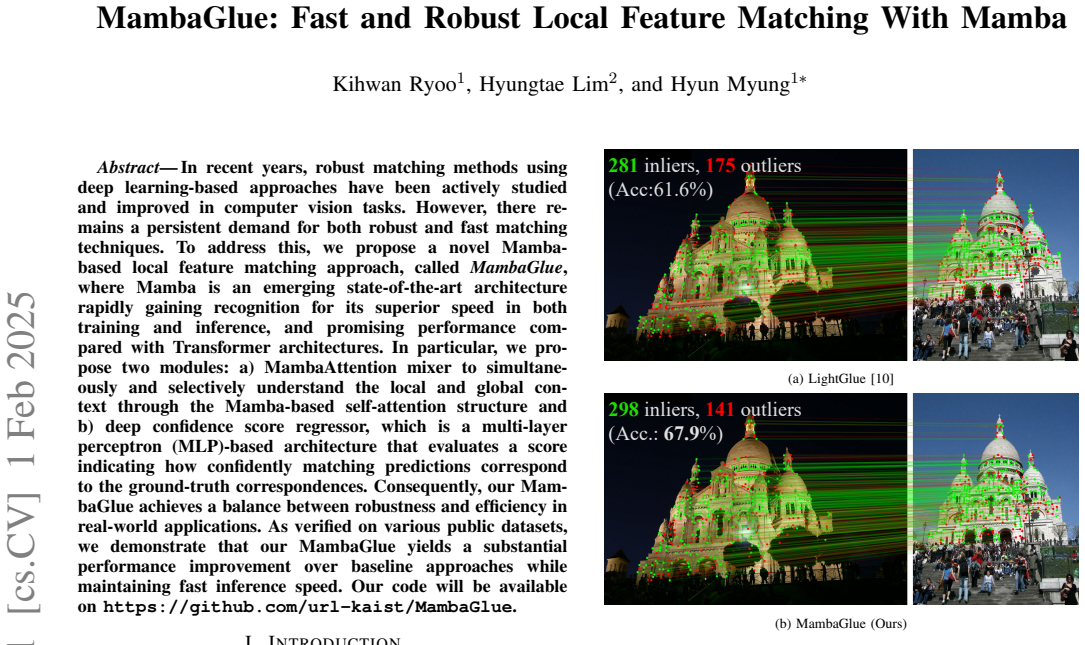
The central claim, stated on the paper's own terms, is that a layer in which a Mamba-based selective scan and a self-attention branch run in parallel — with the raw input carried through by a direct connection and the three outputs concatenated — is more accurate than the self-attention-only layer of LightGlue, at every layer depth. The MambaAttention mixer augments each feature state with both the global context captured by attention and the selectively scanned context captured by Mamba, and the ablation shows the gain compounding as layers are stacked. The second contribution is the deep confidence score regressor, an MLP that maps each state to a per-point probability that its current match is correct; because it is deeper than LightGlue's single linear classifier, the exit test stops at a more precise moment, and the accuracy drop that LightGlue suffers when the exit test is enabled shrinks. The paper verifies the claim on homography estimation (HPatches), relative pose estimation (MegaDepth-1500), and outdoor visual localization (Aachen Day-Night), feeding identical SuperPoint keypoints and descriptors to every sparse matcher. It also reports a training advantage: after 5 million image pairs, roughly two GPU-days, the final loss is 26.7% lower and match recall 0.3% higher than LightGlue.
Load-bearing premise
The Mamba branch treats the arbitrary order in which keypoints are listed as a meaningful sequence for its selective scan, without positional encoding, and the paper does not test whether the scan's output depends on that order — if it does, the learned context is not order-invariant and some of the reported accuracy gain could come from exploiting a fixed input ordering.
Editorial extensions
If this is right
- Each MambaGlue layer is more accurate than the corresponding LightGlue layer, so the same accuracy is reachable with fewer layers: the ablation shows MambaGlue ahead at every layer count from one to nine.
- With the exit test enabled, MambaGlue stops near the fifth iteration and loses less accuracy than LightGlue while saving compute, so early exit becomes a cheaper way to trade speed for reliability.
- On HPatches, MambaGlue's matches reach 94.6% precision at 3 px versus LightGlue's 88.9%, and at a 5 px threshold its homography estimate is more accurate than the dense matcher LoFTR despite using only sparse keypoints.
- On Aachen Day-Night, night-time localization recall at the strictest threshold rises from 85.7% to 86.7% while matching throughput stays at LightGlue's level.
- Training is cheaper: after 5 million image pairs (about two GPU-days) the model reports a 26.7% lower final loss and 0.3% higher match recall than LightGlue.
Reading between the lines
- Because the Mamba branch consumes keypoints in their arbitrary detection order, the reported gains may partly reflect order exploitation rather than geometric understanding; permuting keypoint indices at inference and measuring accuracy changes would settle this, an experiment the paper does not run.
- The per-layer gains suggest the hybrid block could be inserted as a cheap refinement head in dense matchers or global localization pipelines, not just in LightGlue-style sparse matchers.
- The exit test relies on a single aggregate threshold over pointwise confidences; a per-image adaptive threshold, which the paper does not explore, could tighten the accuracy–speed trade-off further.
- If the order sensitivity is controlled, the result indicates the selective scan and self-attention capture complementary context, so a permutation-invariant Mamba-only matcher might approach the same accuracy at lower cost — the paper itself names a Mamba-only model as future work.
Editorial analysis
A structured set of objections, weighed in public.
Referee Report
Summary. The paper proposes MambaGlue, a sparse local feature matcher that combines a Mamba-based selective-scan branch with a Transformer self-attention branch in a new MambaAttention mixer block, plus a deep confidence score regressor for early exit. The method is evaluated on homography estimation (HPatches), relative pose estimation (MegaDepth-1500), and outdoor visual localization (Aachen Day-Night), with comparisons against LightGlue, SuperGlue, SGMNet, and dense matchers. The authors report improved accuracy on several metrics and claim fast inference, with code to be released.
Significance. If the claims are substantiated, the paper makes a useful contribution: it shows a simple parallel combination of Mamba and Transformer can improve per-layer matching accuracy over a strong baseline, and the deep confidence regressor appears to improve the early-exit trade-off. The evaluation spans three standard public benchmarks and includes ablations over the exit threshold, layer count, and regressor design. However, the paper does not currently provide enough experimental detail to verify the claims: training settings are omitted, one central metric is undefined, variance is not reported, and the speed claim is contradicted by the reported tables. The architecture itself is plausible, but the comparison with permutation-invariant Transformer baselines is complicated by the order-sensitive Mamba branch.
major comments (6)
- [Sec. III-A, Eq. (5)] The selective-scan branch is applied to the set of keypoint states without specifying a sequence order or adding positional encoding. Scan is causal and order-dependent, so the resulting representation depends on the order in which keypoints are enumerated; keypoints are an unordered set. The paper neither provides a canonical ordering nor an invariance analysis, nor an ablation over random permutations. Since the Transformer branches and the LightGlue baseline are permutation-invariant with respect to keypoint indexing, the comparison is not apples-to-apples unless this ordering is controlled. Please specify the exact ordering used, justify it, and report a permutation-sensitivity experiment (e.g., random shuffles at inference) to establish that the reported gains are not an artifact of a particular indexing.
- [Tables II and III] The speed claim is not supported by the reported numbers. In Table II, MambaGlue is slower than LightGlue both without exit test (46.3 ms vs 44.2 ms) and with exit test (33.1 ms vs 31.4 ms); in Table III, MambaGlue processes 16.7 pairs/s vs LightGlue's 17.2 pairs/s. Please reconcile the statement of 'fast inference speed' with these results, report the hardware and timing methodology, and clarify whether the claimed advantage is accuracy at comparable speed rather than speed itself.
- [Sec. IV-B, Table I] The PR metric is undefined. The table header says 'precision with error threshold at 3 px' but no formula, reference, or explanation is given for how precision is computed. Since the paper's headline result of 'highest precision' rests on this column, please define the metric precisely and state how the threshold is applied. Also clarify the exact definitions of the DLT and RANSAC AUC metrics.
- [Sec. III-D, Eq. (9)] The matching probability in the loss appears to have a subscript error: the second softmax is written as Softmax_{k in A}(S_ik)_j, which indexes within image A rather than over image B. If this is not a typo, the loss uses within-image scores for a cross-image matching probability; if it is a typo, please correct it. As written, Eq. (9) is not reproducible.
- [Sec. IV-A] No training details are reported: the number of layers N, hidden dimensions, number of heads, SSM state size, optimizer, learning-rate schedule, batch size, number of training images, data augmentation, and hardware are all missing. The statement in Fig. 4 that training uses '5M image pairs' and '2 GPU-days' is not sufficient for reproducibility. Please add a complete training configuration.
- [Sec. IV] All results appear to be from a single training run without variance estimates or significance tests. Several reported differences are small (e.g., Table II RANSAC AUC 5 degrees: 50.1 vs 49.8; Table III Day 0.25 m/2 degrees: 89.0 vs 88.8), so it is important to show that the improvements are stable across seeds or to provide error bars. At minimum, report multiple runs or confidence intervals for the main comparisons.
minor comments (4)
- [Fig. 4] The x-axis labels '0 1M 2M 3M 4M 5M' are formatted inconsistently and the y-axis of panel (a) has nonuniform tick labels; also, the claim of '26.7% lower loss' should state whether this is relative or absolute loss reduction.
- [Sec. I] The abstract and introduction state that code will be available, but no repository URL is included in the manuscript; please provide the link.
- [Sec. III-E] The claim that MambaGlue 'converges faster than LightGlue' is supported only by the single training curve in Fig. 4; please clarify how the two models were matched in parameter count and compute for this comparison.
- [Sec. II-C] The statement that SSM-only architectures 'are neither as efficient nor as effective as Transformer-only models' is a broad claim without a citation or supporting evidence; consider softening or citing relevant comparisons.
Circularity Check
No significant circularity: the paper is an empirical architecture comparison validated on held-out benchmarks, with no fitted quantity renamed as a prediction.
full rationale
MambaGlue is an empirical deep-learning architecture paper. Its central claims are comparative accuracy and speed results on HPatches, MegaDepth-1500, and Aachen Day-Night, obtained by training the proposed matcher with ground-truth correspondences and evaluating on standard benchmarks. No step in the paper derives a predicted quantity from the same measurement used to fit it: the matching loss in Eq. (9) supervises match probabilities with ground-truth correspondences, and the deep confidence score regressor in Eq. (7) is trained with binary cross-entropy against ground-truth matches, then evaluated through downstream homography, pose, and localization tasks against held-out data. The regressor is not a fitted parameter that is later renamed as the main result; it is an architectural component compared with LightGlue's linear classifier in the ablation. The paper's self-citations, e.g., [36] and [37], appear only in related-work context and are not load-bearing for the central claim. The Mamba branch's sensitivity to keypoint ordering, raised as a possible robustness concern, is a correctness or reproducibility issue about unspecified sequence order and missing positional encoding, not a circularity in the derivation. Overall, no reduction of the paper's claims to its own inputs or to author-only citations is present.
Assumptions & free parameters
free parameters (5)
- Number of layers N =
not stated
- Mamba and attention dimensions, number of heads, SSM state size =
not stated
- Deep confidence regressor MLP widths =
d to d/2 to d/4 to 1, per Eq. (7)
- Exit test thresholds alpha and lambda_n =
alpha varies from 0.7 to 1.0 in Fig. 5; lambda_n not specified
- Training hyperparameters =
not reported
assumptions (4)
- domain assumption Selective scan treats keypoints as a sequence.
- domain assumption Ground truth labels from pose and depth are reliable.
- standard math Attention and Mamba operations are differentiable and trainable.
- domain assumption Dense matcher results from LightGlue are comparable.
invented entities (2)
-
MambaAttention mixer block
independent evidence
-
Deep confidence score regressor
independent evidence
Cite this review
Pith. "Pith review of MambaGlue: Fast and Robust Local Feature Matching With Mamba." pith.science (2026). https://pith.science/paper/QWR5PLWB
@misc{pith2026250200462,
  author       = {Pith},
  title        = {Pith review of: MambaGlue: Fast and Robust Local Feature Matching With Mamba},
  year         = {2026},
  howpublished = {\url{https://pith.science/paper/QWR5PLWB}},
  note         = {Machine review of arXiv:2502.00462}
}
read the original abstract
In recent years, robust matching methods using deep learning-based approaches have been actively studied and improved in computer vision tasks. However, there remains a persistent demand for both robust and fast matching techniques. To address this, we propose a novel Mamba-based local feature matching approach, called MambaGlue, where Mamba is an emerging state-of-the-art architecture rapidly gaining recognition for its superior speed in both training and inference, and promising performance compared with Transformer architectures. In particular, we propose two modules: a) MambaAttention mixer to simultaneously and selectively understand the local and global context through the Mamba-based self-attention structure and b) deep confidence score regressor, which is a multi-layer perceptron (MLP)-based architecture that evaluates a score indicating how confidently matching predictions correspond to the ground-truth correspondences. Consequently, our MambaGlue achieves a balance between robustness and efficiency in real-world applications. As verified on various public datasets, we demonstrate that our MambaGlue yields a substantial performance improvement over baseline approaches while maintaining fast inference speed. Our code will be available on https://github.com/url-kaist/MambaGlue
Figures


Figures from the paper (3 more)


Reference graph
Works this paper leans on
-
[1]
From coarse to fine: Robust hierarchical localization at large scale,
P.-E. Sarlin, C. Cadena, R. Siegwart, and M. Dymczyk, “From coarse to fine: Robust hierarchical localization at large scale,” in Proc. IEEE/CVF Conf. Comput. Vis. Pattern Recognit. , 2019, pp. 12 716– 12 725
work page 2019
-
[2]
Back to the feature: Learning robust camera localization from pixels to pose,
P.-E. Sarlin, A. Unagar, M. Larsson, H. Germain, C. Toft, V . Larsson, M. Pollefeys, V . Lepetit, L. Hammarstrand, F. Kahl, et al. , “Back to the feature: Learning robust camera localization from pixels to pose,” in Proc. IEEE/CVF Conf. Comput. Vis. Pattern Recognit. , 2021, pp. 3247–3257
work page 2021
-
[3]
VINS-Mono: A robust and versatile monocular visual-inertial state estimator,
T. Qin, P. Li, and S. Shen, “VINS-Mono: A robust and versatile monocular visual-inertial state estimator,” IEEE Trans. Robot., vol. 34, no. 4, pp. 1004–1020, 2018
2018
-
[4]
ORB-SLAM: A versatile and accurate monocular SLAM system,
R. Mur-Artal, J. M. M. Montiel, and J. D. Tardos, “ORB-SLAM: A versatile and accurate monocular SLAM system,” IEEE Trans. Robot., vol. 31, no. 5, pp. 1147–1163, 2015
work page 2015
-
[5]
UV-SLAM: Unconstrained line-based SLAM using vanishing points for structural mapping,
H. Lim, J. Jeon, and H. Myung, “UV-SLAM: Unconstrained line-based SLAM using vanishing points for structural mapping,” IEEE Robot. Automat. Lett., vol. 7, no. 2, pp. 1518–1525, 2022
work page 2022
-
[6]
S. Agarwal, Y . Furukawa, N. Snavely, I. Simon, B. Curless, S. M. Seitz, and R. Szeliski, “Building rome in a day,” Communications of the ACM, vol. 54, no. 10, pp. 105–112, 2011
work page 2011
-
[7]
Structure-from-Motion revisited,
J. L. Schonberger and J.-M. Frahm, “Structure-from-Motion revisited,” in Proc. IEEE/CVF Conf. Comput. Vis. Pattern Recognit. , 2016, pp. 4104–4113
work page 2016
-
[8]
R2D2: Reliable and repeatable detector and descriptor,
J. Revaud, C. De Souza, M. Humenberger, and P. Weinzaepfel, “R2D2: Reliable and repeatable detector and descriptor,” Adv. Neural Inf. Process. Syst., vol. 32, 2019
work page 2019
Show all 58 references
-
[9]
A local image descriptor robust to illumination changes,
S. Zambanini and M. Kampel, “A local image descriptor robust to illumination changes,” in Proc. 18th Scandinavian Conference on Image Analysis, 2013, pp. 11–21
2013
-
[10]
LightGlue: Local feature matching at light speed,
P. Lindenberger, P.-E. Sarlin, and M. Pollefeys, “LightGlue: Local feature matching at light speed,” in Proc. IEEE Int. Conf. Comput. Vis., 2023, pp. 17 627–17 638
2023
-
[11]
SuperPoint: Self-supervised interest point detection and description,
D. DeTone, T. Malisiewicz, and A. Rabinovich, “SuperPoint: Self-supervised interest point detection and description,” in Proc. IEEE/CVF Conf. Comput. Vis. Pattern Recognit. Workshops , 2018, pp. 224–236
2018
-
[12]
Attention is all you need,
A. Vaswani, N. Shazeer, N. Parmar, J. Uszkoreit, L. Jones, A. N. Gomez, Ł. Kaiser, and I. Polosukhin, “Attention is all you need,” Adv. Neural Inf. Process. Syst. , vol. 30, 2017
2017
-
[13]
Emerging properties in self-supervised vision trans- formers,
M. Caron, H. Touvron, I. Misra, H. Jégou, J. Mairal, P. Bojanowski, and A. Joulin, “Emerging properties in self-supervised vision trans- formers,” in Proc. IEEE Int. Conf. Comput. Vis., 2021, pp. 9650–9660
2021
-
[14]
An image is worth 16x16 words: Transformers for image recognition at scale,
A. Dosovitskiy, L. Beyer, A. Kolesnikov, D. Weissenborn, X. Zhai, T. Unterthiner, M. Dehghani, M. Minderer, G. Heigold, S. Gelly,et al., “An image is worth 16x16 words: Transformers for image recognition at scale,” arXiv preprint arXiv:2010.11929 , 2020
2010 arXiv
-
[15]
Perceiver IO: A general architecture for structured inputs & outputs,
A. Jaegle, S. Borgeaud, J.-B. Alayrac, C. Doersch, C. Ionescu, D. Ding, S. Koppula, D. Zoran, A. Brock, E. Shelhamer, et al. , “Perceiver IO: A general architecture for structured inputs & outputs,” arXiv preprint arXiv:2107.14795 , 2021
2021 arXiv
-
[16]
LoFTR: Detector- free local feature matching with transformers,
J. Sun, Z. Shen, Y . Wang, H. Bao, and X. Zhou, “LoFTR: Detector- free local feature matching with transformers,” in Proc. IEEE/CVF Conf. Comput. Vis. Pattern Recognit. , 2021, pp. 8922–8931
2021
-
[17]
Efficient neighbourhood consensus networks via submanifold sparse convolutions,
I. Rocco, R. Arandjelovi ´c, and J. Sivic, “Efficient neighbourhood consensus networks via submanifold sparse convolutions,” in Proc. Eur. Conf. Comput. Vis., 2020, pp. 605–621
2020
-
[18]
Dual-resolution correspon- dence networks,
X. Li, K. Han, S. Li, and V . Prisacariu, “Dual-resolution correspon- dence networks,” Adv. Neural Inf. Process. Syst. , vol. 33, pp. 17 346– 17 357, 2020
2020
-
[19]
Super- Glue: Learning feature matching with graph neural networks,
P.-E. Sarlin, D. DeTone, T. Malisiewicz, and A. Rabinovich, “Super- Glue: Learning feature matching with graph neural networks,” in Proc. IEEE/CVF Conf. Comput. Vis. Pattern Recognit. , 2020, pp. 4938– 4947
2020
-
[20]
LaMAR: Benchmarking localization and mapping for augmented reality,
P.-E. Sarlin, M. Dusmanu, J. L. Schönberger, P. Speciale, L. Gruber, V . Larsson, O. Miksik, and M. Pollefeys, “LaMAR: Benchmarking localization and mapping for augmented reality,” in Proc. Eur. Conf. Comput. Vis., 2022, pp. 686–704
2022
-
[21]
Bench- marking 6DOF outdoor visual localization in changing conditions,
T. Sattler, W. Maddern, C. Toft, A. Torii, L. Hammarstrand, E. Sten- borg, D. Safari, M. Okutomi, M. Pollefeys, J. Sivic, et al. , “Bench- marking 6DOF outdoor visual localization in changing conditions,” in Proc. IEEE/CVF Conf. Comput. Vis. Pattern Recognit. , 2018, pp. 8601–8610
2018
-
[22]
Mamba: Linear-time sequence modeling with selective state spaces,
A. Gu and T. Dao, “Mamba: Linear-time sequence modeling with selective state spaces,” arXiv preprint arXiv:2312.00752 , 2023
2023 arXiv
-
[23]
Jamba: A hybrid transformer-mamba language model,
O. Lieber, B. Lenz, H. Bata, G. Cohen, J. Osin, I. Dalmedi- gos, E. Safahi, S. Meirom, Y . Belinkov, S. Shalev-Shwartz, et al. , “Jamba: A hybrid transformer-mamba language model,”arXiv preprint arXiv:2403.19887, 2024
2024 arXiv
-
[24]
MambaVision: A hybrid mamba- transformer vision backbone,
A. Hatamizadeh and J. Kautz, “MambaVision: A hybrid mamba- transformer vision backbone,” arXiv preprint arXiv:2407.08083, 2024
2024 arXiv
-
[25]
Vision Mamba: Efficient visual representation learning with bidirectional state space model,
L. Zhu, B. Liao, Q. Zhang, X. Wang, W. Liu, and X. Wang, “Vision Mamba: Efficient visual representation learning with bidirectional state space model,” arXiv preprint arXiv:2401.09417 , 2024
2024 arXiv
-
[26]
Multi-scale VMamba: Hierarchy in hierarchy visual state space model,
Y . Shi, M. Dong, and C. Xu, “Multi-scale VMamba: Hierarchy in hierarchy visual state space model,” arXiv preprint arXiv:2405.14174, 2024
2024 arXiv
-
[27]
Object retrieval with large vocabularies and fast spatial matching,
J. Philbin, O. Chum, M. Isard, J. Sivic, and A. Zisserman, “Object retrieval with large vocabularies and fast spatial matching,” in Proc. IEEE/CVF Conf. Comput. Vis. Pattern Recognit. , 2007, pp. 1–8
2007
-
[28]
Video Google: A text retrieval approach to object matching in videos,
Sivic and Zisserman, “Video Google: A text retrieval approach to object matching in videos,” in Proc. IEEE Int. Conf. Comput. Vis. , 2003, pp. 1470–1477
2003
-
[29]
Gluestick: Robust image matching by sticking points and lines together,
R. Pautrat, I. Suárez, Y . Yu, M. Pollefeys, and V . Larsson, “Gluestick: Robust image matching by sticking points and lines together,” in Proc. IEEE Int. Conf. Comput. Vis. , 2023, pp. 9706–9716
2023
-
[30]
RoMa: Robust dense feature matching,
J. Edstedt, Q. Sun, G. Bökman, M. Wadenbäck, and M. Felsberg, “RoMa: Robust dense feature matching,” in Proc. IEEE/CVF Conf. Comput. Vis. Pattern Recognit. , 2024, pp. 19 790–19 800
2024
-
[31]
Distinctive image features from scale-invariant key- points,
D. G. Lowe, “Distinctive image features from scale-invariant key- points,” Int. J. Comput. Vis. , vol. 60, pp. 91–110, 2004
2004
-
[32]
SURF: Speeded up robust features,
H. Bay, T. Tuytelaars, and L. Van Gool, “SURF: Speeded up robust features,” in Proc. Eur. Conf. Comput. Vis. , 2006, pp. 404–417
2006
-
[33]
ORB: An efficient alternative to SIFT or SURF,
E. Rublee, V . Rabaud, K. Konolige, and G. Bradski, “ORB: An efficient alternative to SIFT or SURF,” in Proc. IEEE Int. Conf. Comput. Vis., 2011, pp. 2564–2571
2011
-
[34]
D2-Net: A trainable CNN for joint description and detection of local features,
M. Dusmanu, I. Rocco, T. Pajdla, M. Pollefeys, J. Sivic, A. Torii, and T. Sattler, “D2-Net: A trainable CNN for joint description and detection of local features,” in Proc. IEEE/CVF Conf. Comput. Vis. Pattern Recognit., 2019, pp. 8092–8101
2019
-
[35]
LIFT: Learned invariant feature transform,
K. M. Yi, E. Trulls, V . Lepetit, and P. Fua, “LIFT: Learned invariant feature transform,” in Proc. Eur. Conf. Comput. Vis. , 2016, pp. 467– 483
2016
-
[36]
A single correspondence is enough: Robust global registration to avoid degeneracy in urban environments,
H. Lim, S. Yeon, S. Ryu, Y . Lee, Y . Kim, J. Yun, E. Jung, D. Lee, and H. Myung, “A single correspondence is enough: Robust global registration to avoid degeneracy in urban environments,” inProc. IEEE Int. Conf. Robot. Automat. , 2022, pp. 8010–8017
2022
-
[37]
Quatro++: Robust global registration exploiting ground segmentation for loop closing in LiDAR SLAM,
H. Lim, B. Kim, D. Kim, E. Mason Lee, and H. Myung, “Quatro++: Robust global registration exploiting ground segmentation for loop closing in LiDAR SLAM,” Int. J. Robot. Res. , pp. 685–715, 2024
2024
-
[38]
Fast approximate nearest neighbors with automatic algorithm configuration
M. Muja and D. G. Lowe, “Fast approximate nearest neighbors with automatic algorithm configuration.” in Proc. Int. Conf. Comput. Vis. Theory Appl., 2009, pp. 331–340
2009
-
[39]
Learning to find good correspondences,
K. M. Yi, E. Trulls, Y . Ono, V . Lepetit, M. Salzmann, and P. Fua, “Learning to find good correspondences,” in Proc. IEEE/CVF Conf. Comput. Vis. Pattern Recognit. , 2018, pp. 2666–2674
2018
-
[40]
Learning two-view correspondences and geometry using order-aware network,
J. Zhang, D. Sun, Z. Luo, A. Yao, L. Zhou, T. Shen, Y . Chen, L. Quan, and H. Liao, “Learning two-view correspondences and geometry using order-aware network,” in Proc. IEEE Int. Conf. Comput. Vis. , 2019, pp. 5845–5854
2019
-
[41]
Handcrafted outlier detection revisited,
L. Cavalli, V . Larsson, M. R. Oswald, T. Sattler, and M. Pollefeys, “Handcrafted outlier detection revisited,” in Proc. Eur. Conf. Comput. Vis., 2020, pp. 770–787
2020
-
[42]
Random sample consensus: a paradigm for model fitting with applications to image analysis and automated cartography,
M. A. Fischler and R. C. Bolles, “Random sample consensus: a paradigm for model fitting with applications to image analysis and automated cartography,” Communications of the ACM , vol. 24, no. 6, pp. 381–395, 1981
1981
-
[43]
Computational optimal transport,
G. Peyré and M. Cuturi, “Computational optimal transport,” Founda- tions and Trends® in Machine Learning, vol. 11, no. 5-6, pp. 355–607, 2019
2019
-
[44]
Longformer: The long- document transformer,
I. Beltagy, M. E. Peters, and A. Cohan, “Longformer: The long- document transformer,” arXiv preprint arXiv:2004.05150 , 2020
2004 arXiv
-
[45]
On the computational complexity of self-attention,
F. D. Keles, P. M. Wijewardena, and C. Hegde, “On the computational complexity of self-attention,” in Proc. International Conference on Algorithmic Learning Theory , 2023, pp. 597–619
2023
-
[46]
Learning to match features with seeded graph matching network,
H. Chen, Z. Luo, J. Zhang, L. Zhou, X. Bai, Z. Hu, C.-L. Tai, and L. Quan, “Learning to match features with seeded graph matching network,” in Proc. IEEE Int. Conf. Comput. Vis. , 2021, pp. 6301– 6310
2021
-
[47]
ClusterGNN: Cluster-based coarse-to-fine graph neural network for efficient feature matching,
Y . Shi, J.-X. Cai, Y . Shavit, T.-J. Mu, W. Feng, and K. Zhang, “ClusterGNN: Cluster-based coarse-to-fine graph neural network for efficient feature matching,” in Proc. IEEE/CVF Conf. Comput. Vis. Pattern Recognit., 2022, pp. 12 517–12 526
2022
-
[48]
Vivim: a video vision mamba for medical video object segmentation,
Y . Yang, Z. Xing, and L. Zhu, “Vivim: a video vision mamba for medical video object segmentation,” arXiv preprint arXiv:2401.14168, 2024
2024 arXiv
-
[49]
RoFormer: En- hanced transformer with rotary position embedding,
J. Su, M. Ahmed, Y . Lu, S. Pan, W. Bo, and Y . Liu, “RoFormer: En- hanced transformer with rotary position embedding,” Neurocomputing, vol. 568, p. 127063, 2024
2024
-
[50]
Sigmoid-weighted linear units for neural network function approximation in reinforcement learning,
S. Elfwing, E. Uchibe, and K. Doya, “Sigmoid-weighted linear units for neural network function approximation in reinforcement learning,” Neural networks, vol. 107, pp. 3–11, 2018
2018
-
[51]
Perceiving longer sequences with bi-directional cross-attention transformers,
M. Hiller, K. A. Ehinger, and T. Drummond, “Perceiving longer sequences with bi-directional cross-attention transformers,” arXiv preprint arXiv:2402.12138, 2024
2024 arXiv
-
[52]
A mathematical theory of communication,
C. E. Shannon, “A mathematical theory of communication,” The Bell System Technical Journal, vol. 27, no. 3, pp. 379–423, 1948
1948
-
[53]
HPatches: A benchmark and evaluation of handcrafted and learned local descrip- tors,
V . Balntas, K. Lenc, A. Vedaldi, and K. Mikolajczyk, “HPatches: A benchmark and evaluation of handcrafted and learned local descrip- tors,” in Proc. IEEE/CVF Conf. Comput. Vis. Pattern Recognit. , 2017, pp. 5173–5182
2017
-
[54]
Match- former: Interleaving attention in transformers for feature matching,
Q. Wang, J. Zhang, K. Yang, K. Peng, and R. Stiefelhagen, “Match- former: Interleaving attention in transformers for feature matching,” in Proc. Asian Conf. Pattern Recognit. , 2022, pp. 2746–2762
2022
-
[55]
ASpanFormer: Detector-free image matching with adaptive span transformer,
H. Chen, Z. Luo, L. Zhou, Y . Tian, M. Zhen, T. Fang, D. Mckinnon, Y . Tsin, and L. Quan, “ASpanFormer: Detector-free image matching with adaptive span transformer,” in Proc. Eur. Conf. Comput. Vis. , 2022, pp. 20–36
2022
-
[56]
MegaDepth: Learning single-view depth prediction from internet photos,
Z. Li and N. Snavely, “MegaDepth: Learning single-view depth prediction from internet photos,” in Proc. IEEE/CVF Conf. Comput. Vis. Pattern Recognit., 2018, pp. 2041–2050
2018
-
[57]
Poselib - minimal solvers for camera pose estimation,
V . Larsson and contributors, “Poselib - minimal solvers for camera pose estimation,” Accessed: Aug. 1, 2024. [Online]. Available: https://github.com/vlarsson/PoseLib
2024
-
[58]
Hartley and A
R. Hartley and A. Zisserman, Multiple View Geometry in Computer Vision. Cambridge University Press, 2003
2003
Reviewed August 9, 2026 · model on record in the stance chip above.
Discussion (0). Continue with ORCID to comment.