REVIEW 3 major objections 4 minor 23 references
Interior instability of naked singularities of a scalar field
T0 review · 3 major / 4 minor · reviewed 2026-08-05 · deepseek-v4-flash
Pith's one-line read This paper claims that the self-similar naked singularity solutions of the spherically symmetric Einstein–scalar field system are unstable to black hole formation under perturbations supported entirely in the interior region, at every regul
desk verdict The family-of-cones idea is new and worth attention, but the proof of the main interior-instability theorem has a self-contradiction: (3.11) forces u1,s to be constant when t_s is small, while (3.19) claims it decays. read the letter →
The pith
A machine-rendered reading of the paper's core claim, the machinery that carries it, and where it could break.
The reading
What carries the argument
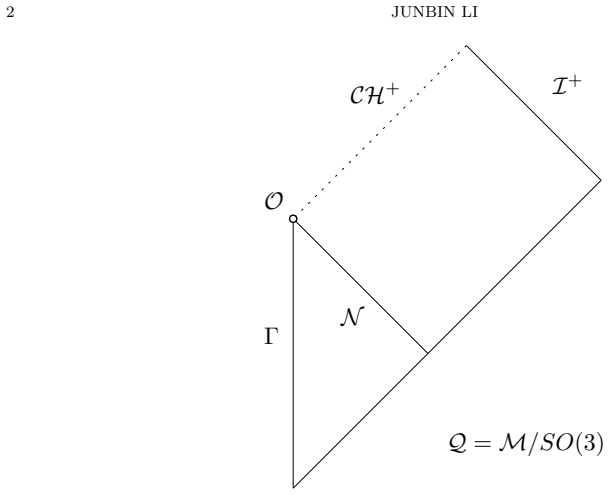
The new mechanism is a family of incoming null cones $C^-_s$ approaching the past null cone $N$ of the singularity, rather than a single cone. On each such cone one uses the a priori estimates of Theorem 2.1 under the uniform lapse bound $\Omega_{0,s}^2(u_s)\le |u_s|^{(1-\gamma)k^2}$, which follows from the lower bound $\psi_s(u_s)^2\ge (1-\gamma)k^2$ on the background solution. The trapped-surface criterion of Theorem 3.2 then applies: with perturbations of the form $\partial_v(r\phi)(v;s)=t_s(v-v_s)^{p/(1-p)}$ on each cone, the amplitude $t_s$ can be chosen to tend to zero as $s\to s_*$, while still forcing the surface $S_{u_{1,s},u_{1,s}}$ to be trapped near the original interior region.
What would settle it
Compute the lapse integral in (2.8) along incoming cones $C^-_s$ of a $k$-self-similar solution with fixed $k^2\in(0,1/3)$ as $s\to s_*$. If some sequence of cones violates $\psi_s^2\ge(1-\gamma)k^2$ on $[u_{0,s},u_{1,s}]$, the bound (3.17) used to make $t_s$ small collapses. Conversely, if (3.17) holds, numerically evolve the perturbed data (3.20) with amplitude below the threshold in (3.13): Theorem 3.2 predicts a closed trapped surface must appear, so its absence would falsify the claim.
Extended reading notes
Core claim
The central claim is that interior perturbations of $k$-self-similar naked singularities are unstable to black hole formation in every regularity strictly below the threshold. Given any $k^2\in(0,1/3)$ and any $p\in(0,k^2)$, there exists a family of initial data $\alpha_{0,t}$ on an outgoing null cone such that: $\alpha_{0,t}$ agrees with the original data $\alpha_0$ in the exterior region; $\alpha_{0,t}\to\alpha_0$ in $C^{p/(1-p)}$ as $t\to0$; and the maximal development of $\alpha_{0,t}$ for $t\neq0$ contains a closed trapped surface and a complete future null infinity. The same proof yields a trapped-surface formation theorem valid in both interior and exterior regions, giving exterior in
Load-bearing premise
The argument requires that, on the unperturbed $k$-self-similar solution, every incoming null cone sufficiently close to the singularity's past null cone satisfies the uniform lower bound $\psi_s(u_s)^2\ge(1-\gamma)k^2$ on the relevant interval; if this bound fails, the lapse estimate (3.17) fails and the perturbation amplitude cannot be made arbitrarily small while still triggering a trapped surface.
Editorial extensions
If this is right
- For every regularity below the threshold, arbitrarily small interior perturbations force black hole formation: the resulting spacetime has a closed trapped surface in the original interior region and a complete future null infinity.
- The same method proves exterior instability in all sub-threshold regularities, sharpening earlier BV-level exterior instability to the full Hölder scale below the threshold.
- For general naked singularity solutions, the paper shows that whenever a family of incoming null cones approaching the singular cone has unbounded blue-shift integral, interior BV perturbations lead to black hole formation.
- Together with Cauchy stability, this makes the set of data leading to complete developments or black holes a dense $G_\delta$ (Baire-generic) subset of all BV data, which is a concrete form of the genericity in the weak cosmic censorship conjecture.
- The threshold $p=k^2$ is the dividing line: linear analysis had indicated stability at or above the threshold, and the paper shows instability at every lower regularity, leaving only the threshold case potentially stable.
Reading between the lines
- A natural testable extension is to discretely self-similar critical-collapse solutions: the continuously self-similar structure is what makes the cone-family rate explicit here, so the same black-hole instability may hold for critical collapse but would require a different rate argument.
- Since the constructed perturbations are shrinking bumps, they suggest that dispersive perturbations which would erase the singularity, if they exist, must live at or above the threshold regularity; this is a constraint on numerical searches for such behavior.
- The paper's BV instability is built from discrete families; an open question is whether interior perturbations can be arranged in non-intersecting one-parameter lines, which would upgrade the Baire-genericity statement to higher-codimension genericity in the spirit of earlier exterior results.
Editorial analysis
A structured set of objections, weighed in public.
Referee Report
Summary. The paper claims to prove interior instability of k-self-similar naked singularity solutions of the spherically symmetric Einstein–scalar field system under Hölder perturbations of regularity below the threshold, as well as exterior instability below the threshold and BV instability for general naked singularities. The proof strategy is to establish an a priori estimate (Theorem 2.1), derive a trapped-surface formation criterion (Theorems 3.1 and 3.2), and then apply it to a family of incoming null cones C^-_s approaching the past null cone of the singularity. The paper also contains a more general BV instability theorem (Theorem 1.3) based on blueshift integrals along a sequence of incoming cones.
Significance. If the central construction can be made rigorous, the result would be a significant advance: it would establish nonlinear interior instability below the threshold regularity for the k-self-similar naked singularities, complementing the linear analysis and previous exterior instability results, and give a BV instability theorem for general naked singularities. The method of analyzing a family of incoming null cones that become more singular is novel and potentially useful beyond this model. The paper also provides a sharp trapped-surface criterion (Theorem 3.1) that may have independent value. However, the proof of the key smallness statement in Theorem 1.1 is not valid as written, and several sign and interval inconsistencies obscure the verification of the main estimates.
major comments (3)
- [Section 3.4, Eqs. (3.11)-(3.14), (3.19)] The proof that t_s→0 is internally inconsistent. For u1,s<0, (3.11) has a sign error; up to sign, |u1,s|^p a_s = ε |u1,s|^{(ep-p)/2}. With a_s=max{|t_s|,K} and t_s≤K for s near s* (first branch of (3.14)), a_s=K and |u1,s|=(ε/K)^{2/(ep-3p)} (if ep>3p), independent of s, contradicting |u1,s|→0 from (3.19). On the second branch a_s=|t_s|, combining (3.14) with (3.11) again fixes |u1,s| at O(1). Since ε is fixed and a≥1 by (2.12), t_s→0 is not established, so the C^{p/(1-p)} convergence in Theorem 1.1 is unsupported.
- [Section 3.3 vs. Theorem 3.2] The logical status of u1 is inconsistent. Theorem 3.2 states that u1 is defined through (3.11), yet Section 3.3 chooses u1 arbitrarily and views t as a function of u1. These are incompatible. The theorem must specify which of u1, t, or ε is free; otherwise the applications in Sections 3.3 and 3.4 are ambiguous.
- [Section 2.2 and Eq. (3.10)] The interval conventions are self-contradictory. Theorem 2.1 requires u1>0 and u0≤u1<0 simultaneously, and integrals such as ∫_0^{u1} in (3.10) and (3.12) have negative upper limits. This makes the magnitudes in (3.13)–(3.14) unverifiable. Use |u| or a nonnegative coordinate consistently throughout.
minor comments (4)
- [Section 3.1] The definitions of α and β are inconsistent: α=β−1 and later β=1/α cannot both hold. Also β∼−(1−k)^2(s∗−s) should presumably be −(1−k^2)(s∗−s).
- [Theorem 2.1] The assumption '0≤h0≤1 on C_0^1' uses an undefined symbol C_0^1; likely a typo for C_0 or a normalization condition.
- [Section 3.4] The notation u for the Bondi coordinate and u_s for the optical function is confusing; the relation between them should be defined explicitly when the perturbations are transferred to the fixed coordinate system.
- [Remark 1.4 and Section 3.4] The claimed convergence in AC and BV and the C^1 cut-off construction are asserted but not proved in detail; a reference to [18] is given, but the adaptation to the present setting should be spelled out.
Circularity Check
The smallness claim t_s→0 in the interior instability proof is contradicted by the defining equation for u_{1,s}.
-
self definitional
[Section 3.4, equations (3.11), (3.14), (3.19)]
"where u_{1,s} is defined through (3.11) and t_s is defined by (3.14). Then a trapped surface from s at S_{u_{1,s},u_{1,s}}. In order to show that t_s → 0 as s → s_*, we need to show that |u_{1,s}| → 0. ... This proves |u_{1,s}| → 0 at a precise rate. Equation (3.11): u_1 |u_1|^{p-1} a = ε |u_1|^{(ep-p)/2}, with a = max{|t|, K}."
Once t_s→0, a_s=max{|t_s|,K}=K for s close to s_*. Equation (3.11) then becomes an s-independent algebraic equation for |u_{1,s}| (up to the sign error in the text), fixing |u_{1,s}| as a positive constant rather than allowing it to tend to 0. The proof nevertheless uses the geometric computation (3.19) to assert |u_{1,s}|→0 and hence t_s→0. Thus the claimed C^{p/(1-p)} convergence in Theorem 1.1 is not a consequence of the construction; it is excluded by the defining relation (3.11). The parameter u_{1,s} is not free to be sent to zero while (3.11) holds with fixed ε and K.
full rationale
The paper is mostly a genuine construction, not a fit: the trapped-surface theorems are proved from the Einstein-scalar-field equations and prior a priori estimates. Citations to [17] (co-authored by the author) and to Christodoulou [8] are external anchors: [17] contains an independent proof of the a priori estimates that are here refined, and [8] constructs the background k-self-similar solutions. Those are not circular in themselves. However, the interior instability proof contains a self-definitional obstruction. Theorem 3.2 defines u_{1,s} through (3.11), with a_s=max{|t_s|,K}. The goal is t_s→0, which requires |u_{1,s}|→0. But once t_s→0, a_s=K eventually, and (3.11) becomes an s-independent algebraic equation for |u_{1,s}|, so |u_{1,s}| is pinned as a fixed positive constant, not a vanishing quantity. The geometric computation (3.19) is then used to assert |u_{1,s}|→0, treating u_{1,s} as if it were the free geometric parameter r_s, but (3.11) has already fixed it. Therefore the C^{p/(1-p)} convergence in Theorem 1.1, which is exactly t_s→0, is not derived; it is excluded by the defining relation. This is the only circular step found; the remaining self-citations are not load-bearing in a circular way.
Assumptions & free parameters
free parameters (2)
- p (regularity exponent)
- gamma (threshold margin)
assumptions (4)
- domain assumption Existence and asymptotic structure of k-self-similar naked singularity solutions from Christodoulou: for 0<k^2<1/3, solutions exist with theta -> 1/k, alpha ~ -1/((1-k^2)(s*-s)), zeta -> -k, and finite Holder regularity k^2/(1-k^2) along the past null cone.
- domain assumption Christodoulou BV development framework: BV initial data yields unique BV solutions, and small BV variation gives global solutions.
- domain assumption Dafermos trapped-surface theorem: in spherically symmetric Einstein-scalar field, presence of a closed trapped surface implies the maximal development has a complete future null infinity and an event horizon.
- domain assumption Regularity of the center and the lapse upper bound Omega_0(u) <= |u|^p along incoming cones, verified for the k-self-similar background with p=k^2.
Cite this review
Pith. "Pith review of Interior instability of naked singularities of a scalar field." pith.science (2026). https://pith.science/paper/QXBZ5UDS
@misc{pith2026250807655,
  author       = {Pith},
  title        = {Pith review of: Interior instability of naked singularities of a scalar field},
  year         = {2026},
  howpublished = {\url{https://pith.science/paper/QXBZ5UDS}},
  note         = {Machine review of arXiv:2508.07655}
}
abstract
We show that the $k$-self-similar naked singularity solutions of the spherically symmetric Einstein--Scalar field system are unstable to black hole formation under perturbations that are totally supported in the interior region, in all regularities strictly below the threshold. The instability below the threshold is also established for exterior perturbations. We also show that general naked singularity solutions are unstable under interior BV perturbations, which provides a new insight into understanding the weak cosmic censorship conjecture for this model. In contrast to all previous results on the exterior instability of naked singularities (and even trapped surface formation), where only a single incoming null cone is considered, the novel approach to proving the interior instability is analyzing a family of incoming null cones becoming more and more singular.
Figures


Figures from the paper (2 more)


Reference graph
Works this paper leans on
-
[1]
Naked Singularity Censoring with Anisotropic Apparent Horizon
X. An,Naked Singularity Censoring with Anisotropic Apparent Horizon, arXiv:2401.02003
- [2]
-
[3]
X. An, H. K. Tan,A Proof of Weak Cosmic Censorship Conjecture for the Spherically Symmetric Einstein-Maxwell-Charged Scalar Field System, arXiv:2402.16250
-
[4]
Choptuik,Universality and scaling in gravitational collapse of a massless scalar field, Phys
M.W. Choptuik,Universality and scaling in gravitational collapse of a massless scalar field, Phys. Rev. Lett., 70, 9–12, (1993)
work page 1993
-
[5]
Christodoulou,A Mathematical Theory of Gravitational Collapse, Comm
D. Christodoulou,A Mathematical Theory of Gravitational Collapse, Comm. Math. Phys. 109, (1987), 613–647
work page 1987
-
[6]
D. Christodoulou,The formation of black holes and singularities in spherically symmetric gravitational collapse, Communications on Pure and Applied Mathematics 44, no. 3 (1991): 339-373
work page 1991
-
[7]
D. Christodoulou,Bounded variation solutions of the spherically symmetric einstein-scalar field equa- tions, Communications on Pure and Applied Mathematics 46, no. 8 (1993): 1131-1220
work page 1993
-
[8]
D. Christodoulou,Examples of Naked Singularity Formation in the Gravitational Collapse of a Scalar Field, Annals of Mathematics, (1994) 140(3), 607–653
work page 1994
Show all 23 references
-
[9]
Christodoulou,The instability of naked singularities in the gravitational collapse of a scalar field, Ann
D. Christodoulou,The instability of naked singularities in the gravitational collapse of a scalar field, Ann. of Math. 149, 183-217 (1999)
1999
-
[10]
Christodoulou,On the global initial value problem and the issue of singularities, Class
D. Christodoulou,On the global initial value problem and the issue of singularities, Class. Quantum Grav. (1999) 16 A23
1999
-
[11]
Cicortas, C
S. Cicortas, C. Kehle,Discretely self-similar exterior-naked singularities for the Einstein-scalar field system, aXiv:2412.09540
-
[12]
Dafermos,Spherically symmetric spacetimes with a trapped surface, Class
M. Dafermos,Spherically symmetric spacetimes with a trapped surface, Class. Quantum Grav. 22 2221, 2005
2005
-
[13]
Gundlach, D
C. Gundlach, D. Hilditch, J. M. Mart ´ ın-Garc ´ ıa,Critical Phenomena in Gravitational Collapse, arXiv: 2507.07636
-
[14]
Y. Guo, M. Hadzic, M., J. Jang,Naked Singularities in the Einstein-Euler System, Ann. PDE 9, 4 (2023)
2023
-
[15]
Le,Spacetime inextensibility criteria by volume-distance-ratio asymptote and applications to naked singularities and FLR W spacetimes, arXiv:2507.23097
P. Le,Spacetime inextensibility criteria by volume-distance-ratio asymptote and applications to naked singularities and FLR W spacetimes, arXiv:2507.23097
-
[16]
Li, and J
J. Li, and J. LiuInstability of spherical naked singularities of a scalar field under gravitational pertur- bations, Journal of Differential Geometry, 120(1): 97-197, 2022
2022
-
[17]
Liu and J
J. Liu and J. Li,A robust proof of the instability of naked singularities of a scalar field in spherical symmetry, Comm. Math. Phys. 363 (2018), no. 2, 561–578
2018
-
[18]
Li and X
J. Li and X. P. Zhu, Scalar perturbations to naked singularities of perfect fluid, arXiv: 2505.20766
-
[19]
A. Ori, T. Piran,Naked singularities and other features of self-similar general-relativistic gravitational collapse, Phys. Rev. D 42, 1068, 1990
1990
-
[20]
Penrose,Gravitational collapse: the role of general relativity, Noovo Cimento 1, 252 - 276 (1969)
R. Penrose,Gravitational collapse: the role of general relativity, Noovo Cimento 1, 252 - 276 (1969)
1969
-
[21]
Rodnianski, Y
I. Rodnianski, Y. Shlapentokh-Rothman,Naked singularities for the Einstein vacuum equations: The exterior solution, Ann. Math., 198 (2023), 1, 231-391
2023
-
[22]
Singh,A construction of approximately self-similar naked singularities for the spherically symmetric Einstein-scalar field system, arXiv: 2210.11325
J. Singh,A construction of approximately self-similar naked singularities for the spherically symmetric Einstein-scalar field system, arXiv: 2210.11325
-
[23]
J. Singh,High regularity waves on self-similar naked singularity interiors: decay and the role of blue- shift, arXiv: 2402.00062 Department of Mathematics, Sun Yat-sen University, Guangzhou, China Email address:lijunbin@mail.sysu.edu.cn
Reviewed August 5, 2026 · model on record in the stance chip above.
Discussion (0). Sign in to comment.