ENC-ODE: Event-level Neurodegenerative Modeling in Continuous Time with Neural ODEs
Pith reviewed 2026-06-30 06:07 UTC · model grok-4.3
The pith
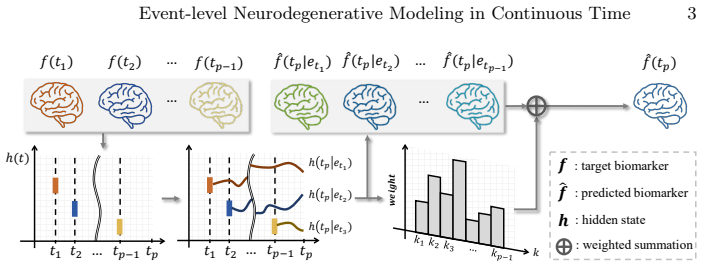
ENC-ODE models clinical events with diagnosis-conditioned neural ODEs and target-specific attention to predict future biomarker evolution without compressing patient history.
A machine-rendered reading of the paper's core claim, the machinery that carries it, and where it could break.
Core claim
ENC-ODE predicts future biomarker evolution by modeling clinical events through diagnosis-conditioned continuous dynamics. A target-conditioned attention mechanism weights and aggregates event-level predictions for the target time and modality without history compression.
What carries the argument
Diagnosis-conditioned continuous dynamics via neural ODEs paired with a target-conditioned attention mechanism that weights and sums event-level predictions.
If this is right
- Predictions become possible at any chosen future time point rather than only at observed visit times.
- Multiple biomarker modalities can be handled jointly without forcing data onto a fixed time grid.
- Full event sequences remain available for aggregation instead of being summarized into fixed-length vectors.
- The framework supplies a continuous-time alternative for clinical decision support in Alzheimer's monitoring.
Where Pith is reading between the lines
- The same event-level continuous modeling could apply to other chronic conditions that produce irregular follow-up records.
- Adding patient-level covariates such as genetics or lifestyle factors into the conditioning could be tested as a direct extension.
- The attention weights over past events offer a route to inspect which clinical observations most influence a given forecast.
- Validation on datasets with higher missingness rates would check whether the continuous dynamics remain stable under greater sparsity.
Load-bearing premise
The ADNI dataset supplies enough representative longitudinal samples for training and for fair performance comparisons against sequence models.
What would settle it
An independent test on a separate Alzheimer's cohort with different visit sparsity patterns showing no consistent advantage over recurrent or transformer baselines would disprove the performance claim.
Figures
read the original abstract
Accurately predicting the temporal evolution of clinical biomarkers is crucial for the early diagnosis and management of neurodegenerative diseases such as Alzheimer's disease. However, this relies on longitudinal data to capture biomarker changes over time, which is often sparse and irregular due to the high cost, labor-intensive nature, and patient burden. To address these challenges, we propose ENC-ODE, an Event-level Neurodegenerative modeling in Continuous time with neural Ordinary Differential Equations. ENC-ODE predicts future biomarker evolution by modeling clinical events through diagnosis-conditioned continuous dynamics. A target-conditioned attention mechanism weights and aggregates event-level predictions for the target time and modality without history compression. Extensive experiments on Alzheimer's Disease Neuroimaging Initiative (ADNI) dataset demonstrate that ENC-ODE outperforms representative sequence models while offering a scalable and neuroscientifically grounded solution for clinical support. The code is available at https://github.com/JardinDelSol/enc-ode.
Editorial analysis
A structured set of objections, weighed in public.
Referee Report
Summary. The paper introduces ENC-ODE, a continuous-time model for predicting biomarker evolution in neurodegenerative diseases. It uses diagnosis-conditioned Neural ODEs to model clinical events and a target-conditioned attention mechanism to aggregate event-level predictions without history compression. Experiments on the ADNI dataset claim that ENC-ODE outperforms representative sequence models, with code released at a GitHub link.
Significance. If the performance claims hold under rigorous temporal splits and statistical controls, the work would offer a neuroscientifically motivated approach to irregular longitudinal data that avoids explicit history compression. The combination of Neural ODEs with event-level attention and diagnosis conditioning addresses a genuine gap in handling sparse clinical time series; code availability further strengthens potential impact for reproducibility in Alzheimer's modeling.
major comments (3)
- [Experiments] Experiments section: the manuscript provides only high-level ADNI dataset statistics and no explicit description of train/test split construction, temporal ordering constraints, or leakage controls for irregular visit times. This is load-bearing for the central outperformance claim over sequence models.
- [Results] Results: reported gains lack patient-level variance estimates, per-modality error distributions, or statistical significance tests against baselines. Without these, it is impossible to assess whether observed improvements are robust or attributable to favorable partitioning.
- [Model] Model section: while the architecture is described at a high level, the precise functional form of the diagnosis-conditioned dynamics (e.g., how diagnosis enters the Neural ODE vector field) and the target-conditioned attention weighting are not given as equations, impeding verification that the continuous-event formulation is the source of gains.
minor comments (2)
- [Model] Notation for event times and modalities is introduced without a consolidated table, making cross-references between text and figures harder to follow.
- [Abstract] The abstract states an outperformance claim but the results section should explicitly restate the exact baselines, metrics, and number of runs used for the comparison.
Simulated Author's Rebuttal
We thank the referee for the constructive and detailed comments, which highlight important areas for improving the clarity and rigor of our work. We address each major comment point by point below.
read point-by-point responses
-
Referee: [Experiments] Experiments section: the manuscript provides only high-level ADNI dataset statistics and no explicit description of train/test split construction, temporal ordering constraints, or leakage controls for irregular visit times. This is load-bearing for the central outperformance claim over sequence models.
Authors: We agree that explicit details on the data partitioning are essential to substantiate the performance claims. In the revised manuscript, we will add a dedicated subsection in Experiments describing the train/test split construction, including the use of strict temporal ordering (training on visits up to a fixed cutoff date per patient and testing on subsequent visits), the handling of irregular visit times, and specific leakage prevention measures such as ensuring no future information leaks into training features. revision: yes
-
Referee: [Results] Results: reported gains lack patient-level variance estimates, per-modality error distributions, or statistical significance tests against baselines. Without these, it is impossible to assess whether observed improvements are robust or attributable to favorable partitioning.
Authors: We acknowledge this limitation in the current reporting. The revised Results section will incorporate patient-level variance estimates (e.g., mean and standard deviation across patients), per-modality error distributions, and statistical significance testing (such as paired t-tests or Wilcoxon signed-rank tests with reported p-values) against all baselines to allow assessment of robustness independent of any particular split. revision: yes
-
Referee: [Model] Model section: while the architecture is described at a high level, the precise functional form of the diagnosis-conditioned dynamics (e.g., how diagnosis enters the Neural ODE vector field) and the target-conditioned attention weighting are not given as equations, impeding verification that the continuous-event formulation is the source of gains.
Authors: We agree that the absence of explicit equations limits verifiability. We will revise the Model section to include the precise mathematical formulations: the diagnosis-conditioned vector field of the Neural ODE (specifying the functional dependence on the diagnosis embedding) and the target-conditioned attention weighting (including the scoring function that incorporates target time and modality without history compression). revision: yes
Circularity Check
No circularity: model architecture and empirical claims are independent of inputs
full rationale
The paper proposes ENC-ODE as a Neural ODE architecture with diagnosis-conditioned dynamics and target-conditioned attention for irregular longitudinal biomarker data. No equations, loss functions, or parameter-fitting procedures are shown that would allow any claimed prediction to reduce by construction to its own inputs or to a self-citation. Performance is asserted on the external ADNI dataset without visible data splits or ablations that collapse into the training procedure itself. The derivation chain therefore remains self-contained and does not exhibit any of the enumerated circular patterns.
Axiom & Free-Parameter Ledger
Reference graph
Works this paper leans on
-
[1]
Journal of Alzheimer’s Disease88(3), 1127–1135 (2022)
Ali, D.G., Bahrani, A.A., et al.: Amyloid-pet levels in the precuneus and poste- rior cingulate cortices are associated with executive function scores in preclinical alzheimer’s disease prior to overt global amyloid positivity. Journal of Alzheimer’s Disease88(3), 1127–1135 (2022)
2022
-
[2]
In: ISBI
Baek, S., Choi, I., et al.: Learning covariance-based multi-scale representation of neuroimaging measures for alzheimer classification. In: ISBI. pp. 1–5. IEEE (2023)
2023
-
[3]
In: ISBI
Baek, S., Sim, J., et al.: Modality-agnostic style transfer for holistic feature impu- tation. In: ISBI. pp. 1–5. IEEE (2024)
2024
-
[4]
In: MICCAI
Baek, S., Sim, J., et al.: Ocl: Ordinal contrastive learning for imputating features with progressive labels. In: MICCAI. pp. 334–344. Springer (2024)
2024
-
[5]
NeurIPS34, 21325–21337 (2021)
Biloš, M., Sommer, J., Rangapuram, S.S., Januschowski, T., Günnemann, S.: Neu- ral flows: Efficient alternative to neural odes. NeurIPS34, 21325–21337 (2021)
2021
-
[6]
Electronic Journal of Mathematical Analysis and Applications1(2), 2090–2792 (2013)
Biswas, B.N., Chatterjee, S., Mukherjee, S., Pal, S.: A discussion on euler method: A review. Electronic Journal of Mathematical Analysis and Applications1(2), 2090–2792 (2013)
2090
-
[7]
Journal of internal medicine284(6), 643–663 (2018)
Blennow, K., Zetterberg, H.: Biomarkers for alzheimer’s disease: current status and prospects for the future. Journal of internal medicine284(6), 643–663 (2018)
2018
-
[8]
NeurIPS31(2018)
Chen, R.T., Rubanova, Y., Bettencourt, J., et al.: Neural ordinary differential equations. NeurIPS31(2018)
2018
-
[9]
Journal of Alzheimer’s Disease35(4), 813–821 (2013)
Cho, H., Seo, S.W., Kim, J.H., et al.: Amyloid deposition in early onset versus late onset alzheimer’s disease. Journal of Alzheimer’s Disease35(4), 813–821 (2013)
2013
-
[10]
Neurobiology of disease72, 117–122 (2014)
Cohen, A.D., Klunk, W.E.: Early detection of alzheimer’s disease using pib and fdg pet. Neurobiology of disease72, 117–122 (2014)
2014
-
[11]
Neuroimage53(1), 1–15 (2010)
Destrieux, C., Fischl, B., Dale, A., Halgren, E.: Automatic parcellation of human cortical gyri and sulci using standard anatomical nomenclature. Neuroimage53(1), 1–15 (2010)
2010
-
[12]
Artificial Intelligence Review54(7), 4827–4871 (2021)
Goenka, N., Tiwari, S.: Deep learning for alzheimer prediction using brain biomark- ers. Artificial Intelligence Review54(7), 4827–4871 (2021)
2021
-
[13]
In: COLM (2024)
Gu, A., Dao, T.: Mamba: Linear-time sequence modeling with selective state spaces. In: COLM (2024)
2024
-
[14]
Brain Communications 2(1), fcaa007 (2020)
Insel, P.S., Mormino, E.C., et al.: Neuroanatomical spread of amyloidβand tau in alzheimer’s disease: implications for primary prevention. Brain Communications 2(1), fcaa007 (2020)
2020
-
[15]
Ageing research reviews30, 73–84 (2016) 10 Y
Kato, T., Inui, Y., Nakamura, A., et al.: Brain fluorodeoxyglucose (fdg) pet in dementia. Ageing research reviews30, 73–84 (2016) 10 Y. Song & S. Baek et al
2016
-
[16]
Adam: A Method for Stochastic Optimization
Kingma, D.P., Ba, J.: Adam: A method for stochastic optimization. arXiv preprint arXiv:1412.6980 (2014)
work page internal anchor Pith review Pith/arXiv arXiv 2014
-
[17]
NeurIPS33, 13539–13550 (2020)
Liu, H., Brock, A., Simonyan, K., Le, Q.: Evolving normalization-activation layers. NeurIPS33, 13539–13550 (2020)
2020
-
[18]
Neurology64(11), 1860–1867 (2005)
Mosconi, L., Tsui, W.H., De Santi, S., et al.: Reduced hippocampal metabolism in mci and ad: automated fdg-pet image analysis. Neurology64(11), 1860–1867 (2005)
2005
-
[19]
European journal of nuclear medicine and molecular imaging36, 811–822 (2009)
Mosconi, L., Mistur, R., Switalski, R., et al.: Fdg-pet changes in brain glucose metabolism from normal cognition to pathologically verified alzheimer’s disease. European journal of nuclear medicine and molecular imaging36, 811–822 (2009)
2009
-
[20]
Neuroimaging Clinics15(4), 869–877 (2005)
Mueller, S.G., Weiner, M.W., Thal, L.J., et al.: The alzheimer’s disease neuroimag- ing initiative. Neuroimaging Clinics15(4), 869–877 (2005)
2005
-
[21]
Applied Mathematics and Computa- tion105(1), 21–68 (1999)
Nedialkov, N.S., Jackson, K.R., Corliss, G.F.: Validated solutions of initial value problems for ordinary differential equations. Applied Mathematics and Computa- tion105(1), 21–68 (1999)
1999
-
[22]
European journal of radiology94, 16–24 (2017)
Rice, L., Bisdas, S.: The diagnostic value of fdg and amyloid pet in alzheimer’s disease—a systematic review. European journal of radiology94, 16–24 (2017)
2017
-
[23]
NeurIPS32(2019)
Rubanova, Y., Chen, R.T., Duvenaud, D.K.: Latent ordinary differential equations for irregularly-sampled time series. NeurIPS32(2019)
2019
-
[24]
na- ture323(6088), 533–536 (1986)
Rumelhart, D.E., et al.: Learning representations by back-propagating errors. na- ture323(6088), 533–536 (1986)
1986
-
[25]
In: ICML
Schirmer, M., Eltayeb, M., Lessmann, S., Rudolph, M.: Modeling irregular time series with continuous recurrent units. In: ICML. pp. 19388–19405. PMLR (2022)
2022
-
[26]
Journal of Nuclear Medicine45(9), 1431–1434 (2004)
Thie, J.A.: Understanding the standardized uptake value, its methods, and impli- cations for usage. Journal of Nuclear Medicine45(9), 1431–1434 (2004)
2004
-
[27]
NeurIPS 30(2017)
Vaswani, A., Shazeer, N., Parmar, N., et al.: Attention is all you need. NeurIPS 30(2017)
2017
-
[28]
In: ICLR (2022)
Yang, C., Mei, H., Eisner, J.: Transformer embeddings of irregularly spaced events and their participants. In: ICLR (2022)
2022
discussion (0)
Sign in with ORCID, Apple, or X to comment. Anyone can read and Pith papers without signing in.