REVIEW 3 major objections 5 minor 30 references
Entropy of each layer update tells you how much rank you need to send, so multimodal edge federated learning can cut traffic by tens of times and still raise accuracy.
Reviewed by Pith at T0; open to challenge. T0 means a machine referee read the full paper against a public rubric. the ladder, T0–T4 →
T0 review · grok-4.5
2026-07-11 00:14 UTC pith:QXRVQVU7
load-bearing objection Solid edge-FL systems package: entropy-ordered MPS ranks under real payload budgets work; the +2% accuracy claim is an empirical bonus, not a theory consequence. the 3 major comments →
Entropy-Guided Tensor Compression for Multimodal Federated Learning on Edge Devices
The pith
A machine-rendered reading of the paper's core claim, the machinery that carries it, and where it could break.
Core claim
Spectral entropy of a layer-wise model update is a reliable, locally computable proxy for how compressible that update is. Allocating matrix-product-state ranks in proportion to entropy under each client's exact payload budget therefore solves a natural communication-accuracy tradeoff, yields a monotone convex allocation, preserves non-convex FL convergence, and, on modality-heterogeneous edge hardware, simultaneously reduces transmitted data and raises final accuracy relative to the uncompressed baseline.
What carries the argument
Entropy-guided MPS rank allocation: truncated spectral entropy Ĥ of each layer update drives the continuous rule r̄ ∝ exp(Ĥ/2), which is then scaled by bisection and integer projection so that the quadratic MPS payload exactly meets the client's budget C_k. This rule is the closed-form solution of a convex entropy-weighted surrogate whose optimality and monotonicity are proved under both linearized and exact quadratic payload models.
Load-bearing premise
The clean 1/r error bound that justifies the entropy-weighted surrogate assumes the singular-value tails of the MPS unfoldings decay exponentially; the paper notes this has not been checked for every layer and round.
What would settle it
Measure the actual singular-value tails of layer-wise updates on the AV-MNIST Raspberry Pi runs (or a similar multimodal edge task). If the tails are consistently heavier than exponential and the entropy-proportional ranks stop outperforming uniform-rank MPS under the same budgets, the central allocation claim fails.
Editorial analysis
A structured set of objections, weighed in public.
Referee Report
Summary. The paper proposes MESH-FL, an entropy-guided matrix product state (MPS) compression framework for multimodal federated learning under joint modality and device heterogeneity. Clients estimate layer-wise spectral entropy of updates via truncated SVD, allocate MPS ranks under per-client payload budgets C_k, and transmit compressed cores; the server reconstructs and aggregates layer-wise over modality-eligible clients. The theory shows that higher spectral entropy implies weakly larger reconstruction rank under majorization (Theorem V.1), derives an entropy-weighted MPS error bound under exponential tail decay (Proposition V.1, Assumption V.1), proves that the entropy-guided allocation solves a convex surrogate with monotone KKT structure (Theorem V.3), and gives a standard nonconvex FL convergence bound with an explicit compression-error term (Theorem V.2). On a 15-node Raspberry Pi 4/5 cluster with AV-MNIST (Dirichlet α=0.1) and modality-heterogeneous clients, MESH-FL reports up to 56.8× compression, up to +2.01% accuracy over uncompressed FedAvg, and up to 66× less total data to reach 95% accuracy, with ablations against uniform-rank MPS and standard compression baselines.
Significance. If the empirical claims hold more broadly, the work is a useful systems-and-theory contribution for communication-efficient multimodal FL on heterogeneous edge hardware. Strengths include a clean majorization argument for entropy–rank ordering, a correctly posed convex surrogate with KKT monotonicity under the stated payload model, an explicit compression term in the convergence bound, a real Raspberry Pi testbed rather than simulation-only evaluation, and an ablation isolating entropy-guided allocation from uniform-rank MPS under identical budgets. The combination of modality-aware layer-wise aggregation, device-specific budgets, and adaptive MPS ranks is a coherent package that goes beyond uniform sparsification/quantization/low-rank baselines. The main significance caveat is that the headline accuracy superiority over dense FedAvg is an empirical observation on one strongly non-IID multimodal benchmark, not a prediction of the entropy-rank theory.
major comments (3)
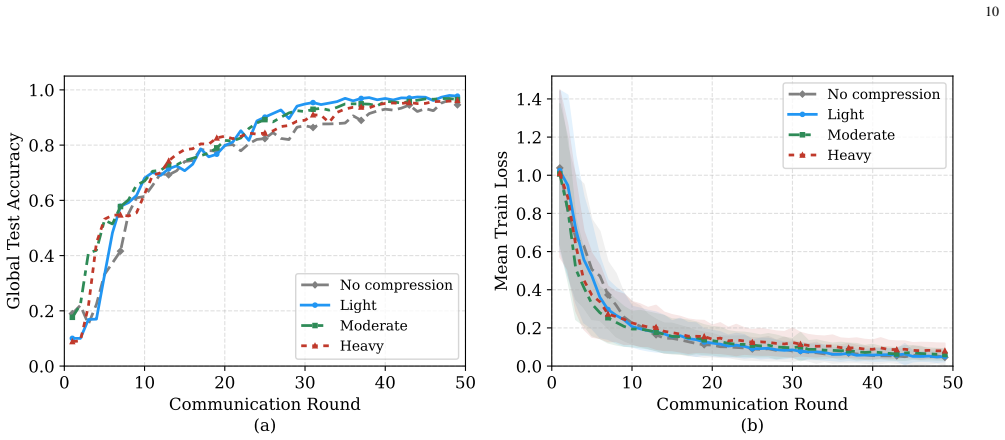
- The abstract and §VI package three results as co-equal: 56.8× compression, +2.01% accuracy over uncompressed FedAvg, and 66× less data to convergence. Theorems V.1–V.3 and Proposition V.1 only justify monotone rank allocation that controls reconstruction error under payload budgets; they do not predict higher final accuracy than dense FedAvg. §VI-B attributes the gain to “implicit gradient regularization” that filters high-frequency non-IID components, but this mechanism is neither formalized nor tested outside AV-MNIST with α=0.1. The paper itself lists the missing explanation as a limitation (§VII). The accuracy claim should be scoped as a single-regime empirical observation, or supported by additional regimes (milder α, other multimodal tasks) and a clearer separation from the compression/data-volume claims that the theory actually supports.
- Assumption V.1 (exponential tail decay of MPS unfolding spectra) is used to obtain the entropy-weighted bound ε² ≤ Ψ/r in Proposition V.1, which motivates the convex surrogate whose solution justifies the practical r ∝ e^{Ĥ/2} rule. The manuscript states that this assumption “has not been verified across all layers and training regimes” (§V-A, §VII). Without spectral diagnostics (e.g., empirical tail plots or measured Ψ vs. reconstruction error), the theory-to-algorithm link is only partially grounded when tails are slower than exponential. Either provide such evidence for the AV-MNIST runs, or clearly demote Proposition V.1 to a sufficient condition and rest the allocation rule primarily on the majorization ordering (Theorem V.1) and the convex program (Theorem V.3), which do not require exponential tails.
- Evaluation is confined to one multimodal dataset (AV-MNIST), one non-IID setting (α=0.1), full participation, and a single model architecture (CNN+MLP+fusion). Tables I–II and Figs. 1–5 therefore leave open whether the compression–accuracy tradeoff and the entropy-vs-uniform ablation generalize. At least one additional multimodal task or milder heterogeneity setting would substantially strengthen the central empirical claim; without it, the strongest claim should be stated more narrowly as results on this testbed.
minor comments (5)
- Notation for the truncated entropy estimator mixes Ĥ, bH, and H inconsistently across §IV-A, Remark 1, and Theorem V.3; unify the symbols.
- Eq. (6) and Eq. (18) both define the MPS payload φ; one can be referenced rather than restated.
- Fig. 4 is described in the text but the caption/layout in the manuscript is sparse; ensure device-type breakdown and units are readable in the final figure.
- Clarify how m1, m2 are chosen when m1 m2 > mℓ (zero-padding) and whether padding affects entropy estimation before or after reshape.
- Related work on multimodal FL and tensor-train gradient compression is adequate but could briefly note concurrent partial-modality FL work beyond [26] for completeness.
Circularity Check
No significant circularity: entropy-rank monotonicity, convex surrogate optimality, and convergence bound are derived from majorization/KKT under stated assumptions, independent of the empirical accuracy lift.
full rationale
The paper's load-bearing derivation chain is self-contained and non-circular. Theorem V.1 follows directly from Schur-concavity of Shannon entropy plus the majorization implication on tail sums, with no fitted parameters or self-referential definitions. Proposition V.1 converts discarded spectral energy under Assumption V.1 into the entropy-weighted bound ε^{2} ≤ Ψ/r via Eckart-Young and a standard e^{-αr} o 1/r relaxation; the assumption is explicitly flagged as technical and unverified in all regimes, but the bound is not used to force experimental outcomes. Theorem V.3 solves the convex surrogate min ∑ Ψ_ℓ/r_ℓ s.t. quadratic payload by KKT stationarity, yielding monotonicity in Ψ and the closed-form r ∝ √(Ψ/a) under linearization; the practical rule r ∝ e^{Ĥ/2} is an online proxy for that ordering followed by bisection, not a fit to accuracy or payload data. Convergence (Theorem V.2) inserts the reconstruction error as an additive term under standard non-IID FL assumptions. Compression budgets C_k, truncation q=10, and target ratios are free design choices. The +2.01% accuracy gain over dense FedAvg is reported purely as an empirical observation on AV-MNIST (α=0.1) and attributed post-hoc to spectral regularization; it is neither derived from nor used to justify the allocation theory. No self-citation is load-bearing for uniqueness or the core claims, and no known result is merely renamed. Empty steps list is therefore appropriate.
Axiom & Free-Parameter Ledger
free parameters (5)
- truncated SVD rank q =
10
- per-client payload budgets C_k and device rank caps r_max^(k) =
tiered targets by Pi 4 vs Pi 5
- global r_min
- Dirichlet concentration α =
0.1
- local steps E, lr, rounds T =
E=5, lr=0.01, T=50
axioms (5)
- domain assumption Local objectives are L-smooth; local deltas have bounded variance after E SGD steps; client gradient dissimilarity bounded by δ².
- ad hoc to paper Assumption V.1: normalized singular-value tails of MPS unfoldings decay exponentially (Σ_{j>r} q_j ≤ A_s e^{-α_s r}).
- standard math Shannon entropy is Schur-concave; majorization of energy distributions implies entropy and ε-rank ordering (Theorem V.1).
- standard math Eckart–Young optimality of truncated SVD for Frobenius error on each unfolding.
- domain assumption Truncated entropy Ĥ from top-q singular values is a stable ordering proxy for full spectral entropy when tail energy τ is small (Remark 1).
invented entities (2)
-
MESH-FL protocol (entropy estimation + device-aware MPS rank allocation + modality layer-wise aggregation)
no independent evidence
-
Entropy-weighted spectral-complexity coefficient Ψ_{k,ℓ} = C1 e^{H^{(1)}} + C2 e^{H^{(2)}}
no independent evidence
read the original abstract
Federated learning (FL) over mobile and edge devices increasingly involves multimodal models in which clients differ in both sensing capability and computational capacity. Existing update compression schemes typically apply uniform policies across layers and devices, without accounting for modality-specific differences in spectral structure and compressibility. We propose MESH-FL, an entropy-guided matrix product state (MPS) update-compression framework for modality-heterogeneous FL on resource-constrained devices. MESH-FL estimates the spectral entropy of each layer-wise update via truncated singular value decomposition and allocates MPS compression ranks adaptively across layers, modalities, and devices under per-client payload budgets. We show that higher spectral entropy necessitates a higher reconstruction rank under the majorization order on singular-value energy distributions. Building on this result, we prove that the proposed entropy-guided allocation solves a convex surrogate rank-allocation problem, preserves monotonicity under the exact payload model, and achieves convergence with an explicit compression-dependent error term. Experiments on a 15-node heterogeneous Raspberry Pi~4/5 cluster with modality-heterogeneous clients show that MESH-FL achieves up to $56.8\times$ compression while surpassing the uncompressed FedAvg baseline in final accuracy by up to 2.01%, and reduces total transmitted data to reach convergence by up to $66\times$.
Figures


Reference graph
Works this paper leans on
-
[1]
A secure multi-modal federated transfer learning system for ECG classification,
Q. B. Phan and T. T. Nguyen, “A secure multi-modal federated transfer learning system for ECG classification,”Neurocomputing, vol. 681, p. 133402, Jun. 2026
work page 2026
-
[2]
FedGSE: Gradient- based submodel extraction for resource-constrained federated learning,
G. Chen, Y . Jia, H. Wang, C. Pang, and W. Xu, “FedGSE: Gradient- based submodel extraction for resource-constrained federated learning,” IEEE Transactions on Mobile Computing, vol. 25, no. 6, pp. 7735–7747, Jun. 2026
work page 2026
-
[3]
Energy and memory-efficient federated learning with ordered layer freezing,
Z. Niu, H. Dong, A. K. Qin, T. Gu, and P. Zhang, “Energy and memory-efficient federated learning with ordered layer freezing,”IEEE Transactions on Mobile Computing, vol. 25, no. 6, pp. 7657–7671, Jun. 2026
work page 2026
-
[4]
M. Adam, A. Albaseer, U. Baroudi, and M. Abdallah, “Survey of multimodal federated learning: Exploring data integration, challenges, and future directions,”IEEE Open Journal of the Communications Society, vol. 6, pp. 2510–2538, 2025
work page 2025
-
[5]
G. Gad, A. Farrag, A. Aboulfotouh, K. Bedda, Z. M. Fadlullah, and M. M. Fouda, “Joint self-organizing maps and knowledge- distillation-based communication-efficient federated learning for resource-constrained UA V-IoT systems,”IEEE Internet of Things Journal, vol. 11, no. 9, pp. 15 504–15 522, May 2024
work page 2024
-
[6]
A comprehensive survey on communication-efficient federated learning in mobile edge environments,
N. Jia, Z. Qu, B. Ye, Y . Wang, S. Hu, and S. Guo, “A comprehensive survey on communication-efficient federated learning in mobile edge environments,”IEEE Communications Surveys & Tutorials, vol. 27, no. 6, pp. 3710–3741, Dec. 2025
work page 2025
-
[7]
Distributed deep learning with gradient compression for big remote sensing image interpretation,
W. Xie, J. Ma, T. Lu, Y . Li, J. Lei, L. Fang, and Q. Du, “Distributed deep learning with gradient compression for big remote sensing image interpretation,”IEEE Transactions on Neural Networks and Learning Systems, vol. 36, no. 8, pp. 14 328–14 342, 2025
work page 2025
-
[8]
Communication-efficient distributed learning: An overview,
X. Cao, T. Ba¸ sar, S. Diggavi, Y . C. Eldar, K. B. Letaief, H. V . Poor, and J. Zhang, “Communication-efficient distributed learning: An overview,” IEEE Journal on Selected Areas in Communications, vol. 41, no. 4, pp. 851–873, Apr. 2023
work page 2023
-
[9]
Multimodal federated learning: A survey,
L. Che, J. Wang, Y . Zhou, and F. Ma, “Multimodal federated learning: A survey,”Sensors, vol. 23, no. 15, 2023
work page 2023
-
[10]
Deep gradient compression: Reducing the communication bandwidth for distributed training,
Y . Lin, S. Han, H. Mao, Y . Wang, and W. J. Dally, “Deep gradient compression: Reducing the communication bandwidth for distributed training,” inProceedings of the International Conference on Learning Representations (ICLR), Vancouver, BC, Canada, Apr. 30–May 3, 2018
work page 2018
-
[11]
S. U. Stich, J.-B. Cordonnier, and M. Jaggi, “Sparsified SGD with memory,”Advances in neural information processing systems, vol. 31, 2018
work page 2018
-
[12]
QSGD: Communication-efficient SGD via gradient quantization and encoding,
D. Alistarh, D. Grubic, J. Li, R. Tomioka, and M. V ojnovic, “QSGD: Communication-efficient SGD via gradient quantization and encoding,” Advances in neural information processing systems, vol. 30, 2017
work page 2017
-
[13]
TernGrad: Ternary gradients to reduce communication in distributed deep learning,
W. Wen, C. Xu, F. Yan, C. Wu, Y . Wang, Y . Chen, and H. Li, “TernGrad: Ternary gradients to reduce communication in distributed deep learning,” Advances in neural information processing systems, vol. 30, 2017
work page 2017
-
[14]
PowerSGD: Practical low- rank gradient compression for distributed optimization,
T. V ogels, S. P. Karimireddy, and M. Jaggi, “PowerSGD: Practical low- rank gradient compression for distributed optimization,”Advances in Neural Information Processing Systems, vol. 32, 2019
work page 2019
-
[15]
A. Reisizadeh, A. Mokhtari, H. Hassani, A. Jadbabaie, and R. Pedarsani, “FedPAQ: A communication-efficient federated learning method with periodic averaging and quantization,” inProceedings of the 23rd Inter- national Conference on Artificial Intelligence and Statistics, Aug. 26–28 2020, pp. 2021–2031
work page 2020
-
[16]
A. Novikov, D. Podoprikhin, A. Osokin, and D. P. Vetrov, “Tensorizing neural networks,”Advances in neural information processing systems, vol. 28, 2015
work page 2015
-
[17]
Speeding-up Convolutional Neural Networks Using Fine-tuned CP-Decomposition
V . Lebedev, Y . Ganin, M. Rakhuba, I. Oseledets, and V . Lempit- sky, “Speeding-up convolutional neural networks using fine-tuned CP- decomposition,”arXiv preprint arXiv:1412.6553, 2014
work page internal anchor Pith review Pith/arXiv arXiv 2014
-
[18]
I. V . Oseledets, “Tensor-train decomposition,”SIAM Journal on Scien- tific Computing, vol. 33, no. 5, pp. 2295–2317, 2011
work page 2011
-
[19]
Compressing recurrent neural network with tensor train,
A. Tjandra, S. Sakti, and S. Nakamura, “Compressing recurrent neural network with tensor train,” inProceedings of the 2017 International Joint Conference on Neural Networks (IJCNN), Anchorage, AK, USA, May 14–19 2017, pp. 4451–4458
work page 2017
-
[20]
Tensor-train recurrent neural networks for video classification,
Y . Yang, D. Krompass, and V . Tresp, “Tensor-train recurrent neural networks for video classification,” inProceedings of the 34th Interna- tional Conference on Machine Learning (PMLR), vol. 70, Sydney, NSW, Australia, Aug. 6–11, 2017, pp. 3891–3900
work page 2017
-
[21]
Asynchronous federated optimization,
C. Xie, S. Koyejo, and I. Gupta, “Asynchronous federated optimization,” inProceedings of the 12th Annual Workshop on Optimization for Machine Learning at NeurIPS, Dec. 11–12, 2020
work page 2020
-
[22]
HeteroFL: Computation and communi- cation efficient federated learning for heterogeneous clients,
E. Diao, J. Ding, and V . Tarokh, “HeteroFL: Computation and communi- cation efficient federated learning for heterogeneous clients,” inProceed- ings of the 9th International Conference on Learning Representations (ICLR), May 3–7, 2021
work page 2021
-
[23]
Federated optimization in heterogeneous networks,
T. Li, A. K. Sahu, M. Zaheer, M. Sanjabi, A. Talwalkar, and V . Smith, “Federated optimization in heterogeneous networks,” inProceedings of Machine Learning and Systems (MLSys), vol. 2, Austin, TX, USA, Mar. 2–4, 2020, pp. 429–450
work page 2020
-
[24]
SCAFFOLD: Stochastic controlled averaging for federated learning,
S. P. Karimireddy, S. Kale, M. Mohri, S. Reddi, S. Stich, and A. T. Suresh, “SCAFFOLD: Stochastic controlled averaging for federated learning,” inProceedings of the International Conference on Machine Learning (ICML), Jul. 13–18, 2020, pp. 5132–5143
work page 2020
-
[25]
Federated Learning with Non-IID Data
Y . Zhao, M. Li, L. Lai, N. Suda, D. Civin, and V . Chandra, “Federated learning with non-IID data,”arXiv preprint arXiv:1806.00582, 2018
work page internal anchor Pith review Pith/arXiv arXiv 2018
-
[26]
Towards multi- modal transformers in federated learning,
G. Sun, M. Mendieta, A. Dutta, X. Li, and C. Chen, “Towards multi- modal transformers in federated learning,” inProceedings of the 18th European Conference on Computer Vision (ECCV), Milan, Italy, Sep. 29–Oct. 4, 2024, pp. 229–246
work page 2024
-
[27]
Gradient-based learning applied to document recognition,
Y . LeCun, L. Bottou, Y . Bengio, and P. Haffner, “Gradient-based learning applied to document recognition,”Proceedings of the IEEE, vol. 86, no. 11, pp. 2278–2324, 1998
work page 1998
-
[28]
Free spoken digit dataset (FSDD),
Z. Jackson, C. Souza, J. Flaks, Y . Nicholas, H. Kaiser, and A. Thite, “Free spoken digit dataset (FSDD),” GitHub repository, 2018, available: https://github.com/Jakobovski/free-spoken-digit-dataset
work page 2018
-
[29]
Measuring the Effects of Non-Identical Data Distribution for Federated Visual Classification
T.-M. H. Hsu, H. Qi, and M. Brown, “Measuring the effects of non- identical data distribution for federated visual classification,”arXiv preprint arXiv:1909.06335, 2019
work page internal anchor Pith review Pith/arXiv arXiv 1909
-
[30]
Communication-efficient learning of deep networks from decentralized data,
B. McMahan, E. Moore, D. Ramage, S. Hampson, and B. A. y. Arcas, “Communication-efficient learning of deep networks from decentralized data,” inProceedings of the 20th International Conference on Artificial Intelligence and Statistics (AISTATS), vol. 54, Fort Lauderdale, FL, USA, Apr. 20–22, 2017, pp. 1273–1282
work page 2017
discussion (0)
Sign in with ORCID, Apple, or X to comment. Anyone can read and Pith papers without signing in.