The swallowed spike: the formation of light primordial black hole structures around heavy seeds
Pith reviewed 2026-06-25 22:53 UTC · model grok-4.3
The pith
Light primordial black holes are captured by heavy seeds because no torque mechanism supplies sufficient angular momentum in the inner region.
A machine-rendered reading of the paper's core claim, the machinery that carries it, and where it could break.
Core claim
When both the central object and the bulk dark matter are primordial black holes, lighter PBHs have negligible angular momentum at formation with respect to the massive central object and are captured unless external torque is supplied by small-scale or large-scale matter fluctuations. A comprehensive assessment of torque mechanisms and angular momentum evolution shows that in the innermost region no mechanism studied here is capable of providing enough torque, so the resulting inner core is expected to be significantly less dense than in particle scenarios.
What carries the argument
Angular momentum evolution of light PBHs under torques from small-scale and large-scale matter fluctuations, which determines whether capture by the heavy seed occurs.
If this is right
- The inner core around the heavy seed is significantly less dense than the corresponding structure formed with particle dark matter.
- Spike formation is highly non-trivial when the dark matter consists of lighter primordial black holes.
- Capture of light PBHs occurs in the innermost region under all torque mechanisms examined.
Where Pith is reading between the lines
- Density profiles around heavy PBH seeds would differ from those around particle-dark-matter halos at small radii.
- Observational searches sensitive to the inner density structure near compact seeds may need separate modeling for primordial-black-hole dark matter.
Load-bearing premise
Lighter PBHs have negligible angular momentum at formation with respect to the massive central object, so capture occurs unless external torque is supplied.
What would settle it
A simulation or observation showing that any studied fluctuation source supplies enough torque to maintain the angular momentum of light PBHs against capture in the innermost region around a heavy seed would falsify the claim.
Figures
read the original abstract
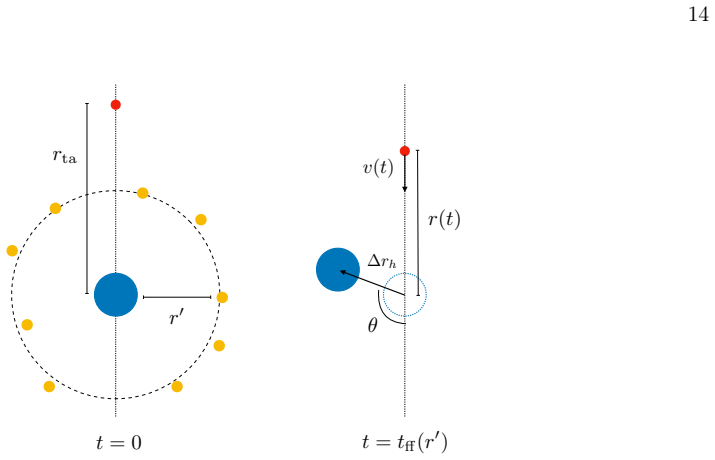
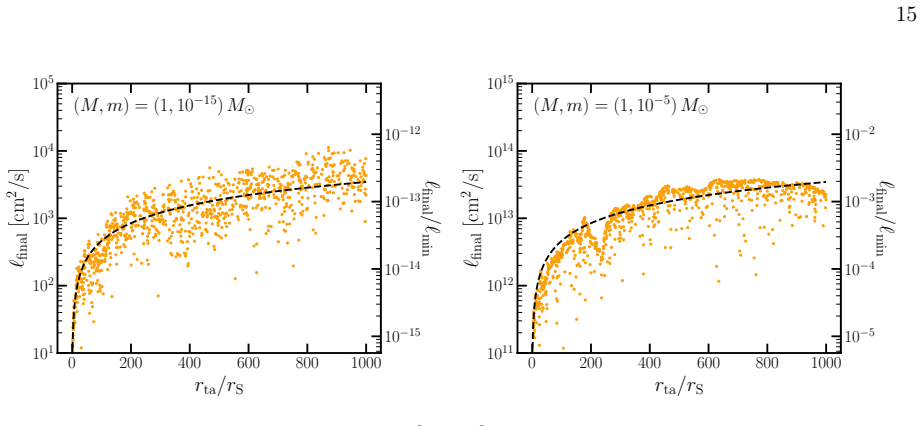
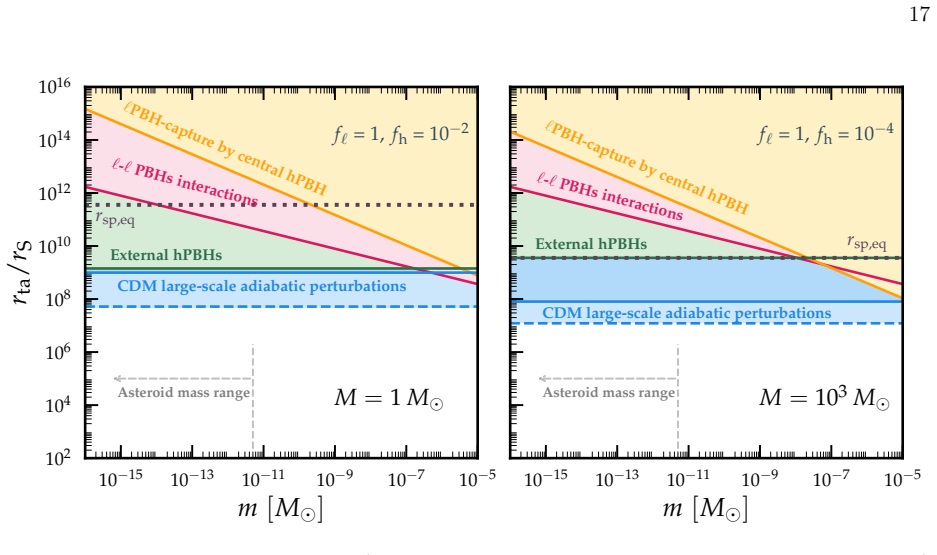
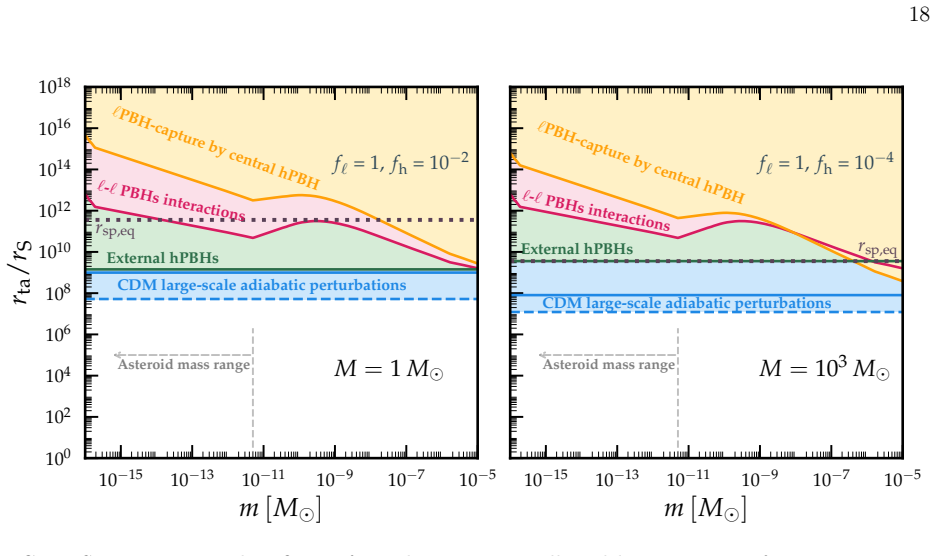
Spikes are steep enhancements in the dark matter (DM) distribution around a heavy compact object. If the compact object is primordial, and the bulk of the DM is also composed of (lighter) primordial compact objects, for instance asteroid-mass primordial black holes (PBHs), the phenomenology of spike formation is highly non-trivial. In fact, lighter PBHs have negligible angular momentum at formation with respect to the massive central object and would therefore be captured unless enough torque is exerted from either small-scale or large-scale matter fluctuations. In this paper, we present the first comprehensive assessment of this scenario. We define the mechanisms and the initial conditions that allow light PBHs to avoid capture. We then quantify the different types of torque and follow the corresponding angular momentum evolution with a combination of analytical prescriptions and numerical simulations. We find that in the innermost region no mechanism studied here is capable of providing enough torque; the resulting inner core is expected to be significantly less dense than in particle scenarios, potentially leading to interesting phenomenology.
Editorial analysis
A structured set of objections, weighed in public.
Referee Report
Summary. The manuscript examines spike formation around heavy primordial black hole (PBH) seeds when dark matter consists of lighter PBHs. It states that lighter PBHs form with negligible angular momentum relative to the central object and are thus captured unless external torques from small- or large-scale fluctuations are supplied. Combining analytic prescriptions with numerical simulations, the authors conclude that no mechanism examined supplies sufficient torque in the innermost region, yielding an inner core significantly less dense than in particle dark-matter scenarios.
Significance. If the result holds, the work identifies a qualitative difference between compact-object and particle dark matter in the structure of spikes around primordial seeds, with possible consequences for dynamical and lensing signatures near galactic centers. The explicit combination of analytic torque calculations and simulations is a methodological strength.
major comments (2)
- [Abstract] Abstract: the central premise that 'lighter PBHs have negligible angular momentum at formation with respect to the massive central object' is asserted without derivation, citation to the formation mechanism (curvature perturbations), or quantitative estimate of specific angular momentum. This initial condition is load-bearing for the torque analysis and the claim that 'no mechanism studied here is capable of providing enough torque'; non-zero L at formation would alter the capture threshold and the depleted-core conclusion.
- [Torque analysis and numerical sections] The quantification of torques (small-scale and large-scale fluctuations) and the angular-momentum evolution must be shown to remain insufficient even if a modest initial specific angular momentum is allowed; the manuscript should provide an explicit test or bound on the formation-time L to establish that the 'insufficient torque' result is robust rather than assumption-dependent.
minor comments (1)
- Clarify the precise radial range corresponding to the 'innermost region' where torque is claimed to be insufficient, and state the numerical resolution or analytic cutoff used there.
Simulated Author's Rebuttal
We thank the referee for the careful reading and constructive comments, which correctly identify the need for stronger justification of the initial angular momentum assumption and explicit robustness tests. We will revise the manuscript to address both points.
read point-by-point responses
-
Referee: [Abstract] Abstract: the central premise that 'lighter PBHs have negligible angular momentum at formation with respect to the massive central object' is asserted without derivation, citation to the formation mechanism (curvature perturbations), or quantitative estimate of specific angular momentum. This initial condition is load-bearing for the torque analysis and the claim that 'no mechanism studied here is capable of providing enough torque'; non-zero L at formation would alter the capture threshold and the depleted-core conclusion.
Authors: We agree that the current manuscript asserts this premise without the requested supporting material. In the revised version we will add a derivation (in the main text or a short appendix) based on the curvature-perturbation formation channel, together with a quantitative estimate of the typical specific angular momentum at formation. The estimate will show that the value lies several orders of magnitude below the capture threshold, thereby justifying the negligible-L assumption used throughout the torque analysis. revision: yes
-
Referee: [Torque analysis and numerical sections] The quantification of torques (small-scale and large-scale fluctuations) and the angular-momentum evolution must be shown to remain insufficient even if a modest initial specific angular momentum is allowed; the manuscript should provide an explicit test or bound on the formation-time L to establish that the 'insufficient torque' result is robust rather than assumption-dependent.
Authors: We accept that an explicit robustness check is required. The revised manuscript will include additional numerical runs in which the light PBHs are initialized with a modest non-zero specific angular momentum (bounded by the formation-time estimate we will supply). These runs will demonstrate that the torques from both small- and large-scale fluctuations remain insufficient to prevent capture in the innermost regions, so that the depleted-core conclusion is unchanged. This test will be presented alongside the original zero-L results. revision: yes
Circularity Check
No circularity; torque analysis independent of stated initial-condition premise
full rationale
The paper explicitly states the negligible angular momentum at formation as an input premise in the abstract and proceeds to quantify torques via analytic prescriptions and simulations. No equation or result is shown to reduce by construction to this premise (no self-definitional loop, no fitted parameter renamed as prediction, no load-bearing self-citation). The central claim of insufficient torque in the inner region is a derived outcome conditional on the premise, not equivalent to it. This matches the default expectation of a self-contained derivation against external benchmarks.
Axiom & Free-Parameter Ledger
Reference graph
Works this paper leans on
-
[1]
The Hypothesis of Cores Retarded during Expansion and the Hot Cosmological Model,
Y. B. Zel’dovich and I. D. Novikov, “The Hypothesis of Cores Retarded during Expansion and the Hot Cosmological Model,”Sov. Astron.10(1967) 602
1967
-
[2]
Gravitationally collapsed objects of very low mass,
S. Hawking, “Gravitationally collapsed objects of very low mass,”Mon. Not. Roy. Astron. Soc.152 (1971) 75
1971
-
[3]
The primordial black hole mass spectrum.,
B. J. Carr, “The primordial black hole mass spectrum.,”Astrophys. J.201(Oct., 1975) 1–19
1975
-
[4]
Primordial Black Holes as a dark matter candidate,
A. M. Green and B. J. Kavanagh, “Primordial Black Holes as a dark matter candidate,”J. Phys. G 48no. 4, (2021) 043001,arXiv:2007.10722 [astro-ph.CO]
Pith/arXiv arXiv 2021
-
[5]
A. Escrivà, F. Kuhnel, and Y. Tada,Primordial Black Holes. 11, 2022.arXiv:2211.05767 [astro-ph.CO]
arXiv 2022
-
[6]
Primordial black holes: constraints, potential evidence and prospects,
B. Carr, A. J. Iovino, G. Perna, V. Vaskonen, and H. Veermäe, “Primordial black holes: constraints, potential evidence and prospects,”La Rivista del Nuovo Cimento(1, 2026) ,arXiv:2601.06024 [astro-ph.CO]
arXiv 2026
-
[7]
Constraints on Earth-mass primordial black holes from OGLE 5-year microlensing events,
H. Niikura, M. Takada, S. Yokoyama, T. Sumi, and S. Masaki, “Constraints on Earth-mass primordial black holes from OGLE 5-year microlensing events,”Phys. Rev. D99no. 8, (2019) 083503, arXiv:1901.07120 [astro-ph.CO]
Pith/arXiv arXiv 2019
-
[8]
Constraining the masses of microlensing black holes and the mass gap with Gaia DR2,
Ł. Wyrzykowski and I. Mandel, “Constraining the masses of microlensing black holes and the mass gap with Gaia DR2,”A&A636(Apr., 2020) A20,arXiv:1904.07789 [astro-ph.SR]
arXiv 2020
-
[9]
AMPM I. A Targeted Search for Asteroid Mass Primordial Black Hole Microlenses,
R. Key, E. N. Taylor, K. C. Freeman, J. Mould, A. Saha, A. Möller, T. M. C. Abbott, and A. R. Duffy, “AMPM I. A Targeted Search for Asteroid Mass Primordial Black Hole Microlenses,” arXiv:2605.19332 [astro-ph.GA]
-
[10]
AMPM II. A Lunar-Mass Primordial Black Hole Microlensing Candidate in the Milky Way Halo,
R. Key, E. N. Taylor, K. C. Freeman, J. Mould, A. Saha, A. Möller, T. M. C. Abbott, and A. R. Duffy, “AMPM II. A Lunar-Mass Primordial Black Hole Microlensing Candidate in the Milky Way Halo,”arXiv:2605.19375 [astro-ph.CO]
-
[11]
Eppur non si trovano Vol. 3: Phoebe – a Mirage of a Primordial Black Hole,
A. Udalski and P. Mróz, “Eppur non si trovano Vol. 3: Phoebe – a Mirage of a Primordial Black Hole,”arXiv:2606.19442 [astro-ph.GA]
-
[12]
Spectroscopic confirmation of two luminous galaxies at a redshift of 14,
S. Carniani, K. Hainline, F. D’Eugenio, D. J. Eisenstein, P. Jakobsen, J. Witstok, B. D. Johnson, J. Chevallard, R. Maiolino, J. M. Helton, C. Willott, B. Robertson, S. Alberts, S. Arribas, W. M. Baker, R. Bhatawdekar, K. Boyett, A. J. Bunker, A. J. Cameron, P. A. Cargile, S. Charlot, M. Curti, E. Curtis-Lake, E. Egami, G. Giardino, K. Isaak, Z. Ji, G. C....
arXiv 2024
-
[13]
P. G. Pérez-Gonzálezet al., “The Rise of the Galactic Empire: Ultraviolet Luminosity Functions at z ∼17 and z∼25 Estimated with the MIDIS+NGDEEP Ultra-deep JWST/NIRCam Data Set,” Astrophys. J.991no. 2, (2025) 179,arXiv:2503.15594 [astro-ph.GA]
arXiv 2025
-
[14]
Beyond the first galaxies primordial black holes shine,
A. Matteri, A. Ferrara, and A. Pallottini, “Beyond the first galaxies primordial black holes shine,” Astron. Astrophys.701(2025) A186,arXiv:2503.18850 [astro-ph.GA]. [15]KAGRA, VIRGO, LIGO ScientificCollaboration, R. Abbottet al., “Population of Merging Compact Binaries Inferred Using Gravitational Waves through GWTC-3,”Phys. Rev. X13no. 1, (2023) 011048,...
arXiv 2025
-
[15]
Primordial black holes as dark matter candidates,
B. Carr and F. Kuhnel, “Primordial black holes as dark matter candidates,”SciPost Phys. Lect. Notes 48(2022) 1,arXiv:2110.02821 [astro-ph.CO]
arXiv 2022
-
[16]
Revisiting constraints on asteroid-mass primordial black holes as dark matter candidates,
P. Montero-Camacho, X. Fang, G. Vasquez, M. Silva, and C. M. Hirata, “Revisiting constraints on asteroid-mass primordial black holes as dark matter candidates,”JCAP08(2019) 031, arXiv:1906.05950 [astro-ph.CO]
arXiv 2019
-
[17]
bradkav/pbhbounds: Release version
B. J. Kavanagh, “bradkav/pbhbounds: Release version.” github.com/bradkav/PBHbounds, Nov., 2019.https://doi.org/10.5281/zenodo.3538999
-
[18]
Primordial Black Holes as Silver Bullets for New Physics at the Weak Scale,
G. Bertone, A. M. Coogan, D. Gaggero, B. J. Kavanagh, and C. Weniger, “Primordial Black Holes as Silver Bullets for New Physics at the Weak Scale,”Phys. Rev. D100no. 12, (2019) 123013, arXiv:1905.01238 [hep-ph]
arXiv 2019
-
[19]
Universality and scaling in gravitational collapse of a massless scalar field,
M. W. Choptuik, “Universality and scaling in gravitational collapse of a massless scalar field,”Phys. Rev. Lett.70(Jan, 1993) 9–12.https://link.aps.org/doi/10.1103/PhysRevLett.70.9
-
[20]
Steepest growth of the power spectrum and primordial black holes,
C. T. Byrnes, P. S. Cole, and S. P. Patil, “Steepest growth of the power spectrum and primordial black holes,”JCAP06(2019) 028,arXiv:1811.11158 [astro-ph.CO]
Pith/arXiv arXiv 2019
-
[21]
Could MACHOS be primordial black holes formed during the QCD epoch?,
K. Jedamzik, “Could MACHOS be primordial black holes formed during the QCD epoch?,”Phys. Rept.307(1998) 155–162,arXiv:astro-ph/9805147
Pith/arXiv arXiv 1998
-
[22]
Primordial black holes with an accurate QCD equation of state,
C. T. Byrnes, M. Hindmarsh, S. Young, and M. R. S. Hawkins, “Primordial black holes with an accurate QCD equation of state,”JCAP08(2018) 041,arXiv:1801.06138 [astro-ph.CO]
Pith/arXiv arXiv 2018
-
[23]
Cosmic conundra explained by thermal history and primordial black holes,
B. Carr, S. Clesse, J. García-Bellido, and F. Kühnel, “Cosmic conundra explained by thermal history and primordial black holes,”Phys. Dark Univ.31(2021) 100755,arXiv:1906.08217 [astro-ph.CO]
arXiv 2021
-
[24]
P. Mrózet al., “Microlensing Optical Depth and Event Rate toward the Large Magellanic Cloud Based on 20 yr of OGLE Observations,”Astrophys. J. Suppl.273no. 1, (2024) 4,arXiv:2403.02398 [astro-ph.GA]
arXiv 2024
-
[25]
Constraints on primordial black holes from the first part of LIGO-Virgo-KAGRA fourth observing run,
M. Andrés-Carcasona, A. J. Iovino, E. Vallejo-Pagès, V. Vaskonen, H. Veermäe, M. Martínez, and L. M. Mir, “Constraints on primordial black holes from the first part of LIGO-Virgo-KAGRA fourth observing run,”arXiv:2605.15749 [astro-ph.CO]
-
[26]
On the stunning abundance of super-early, luminous galaxies revealed by JWST,
A. Ferrara, A. Pallottini, and P. Dayal, “On the stunning abundance of super-early, luminous galaxies revealed by JWST,”Mon. Not. Roy. Astron. Soc.522no. 3, (2023) 3986–3991,arXiv:2208.00720 [astro-ph.GA]
arXiv 2023
-
[27]
F. Pacucci, B. Nguyen, S. Carniani, R. Maiolino, and X. Fan, “JWST CEERS and JADES Active Galaxies at z = 4–7 Violate the LocalM•–M∗ Relation at>3σ: Implications for Low-mass Black Holes and Seeding Models,”Astrophys. J. Lett.957no. 1, (2023) L3,arXiv:2308.12331 [astro-ph.GA]
arXiv 2023
-
[28]
Anatomy of single-field inflationary models for primordial black holes,
A. Karam, N. Koivunen, E. Tomberg, V. Vaskonen, and H. Veermäe, “Anatomy of single-field inflationary models for primordial black holes,”JCAP03(2023) 013,arXiv:2205.13540 [astro-ph.CO]
arXiv 2023
-
[29]
C. T. Byrnes, J. Lesgourgues, and D. Sharma, “Robustµ-distortion constraints on primordial supermassive black holes from non-Gaussian perturbations,”JCAP09(2024) 012,arXiv:2404.18475 [astro-ph.CO]
arXiv 2024
-
[30]
A cosmologist’s take on Little Red Dots,
V. De Luca, L. Del Grosso, G. Franciolini, K. Kritos, E. Berti, D. D’Orazio, and J. Silk, “A cosmologist’s take on Little Red Dots,” 12, 2025
2025
-
[31]
Feedback in the dark: a critical examination of CMB bounds on primordial black holes,
D. Agius, R. Essig, D. Gaggero, F. Scarcella, G. Suczewski, and M. Valli, “Feedback in the dark: a critical examination of CMB bounds on primordial black holes,”JCAP07(2024) 003, arXiv:2403.18895 [hep-ph]
arXiv 2024
-
[32]
Tinyakov,The Asteroid Mass Window
P. Tinyakov,The Asteroid Mass Window. 2025.arXiv:2406.03114 [astro-ph.CO]
arXiv 2025
-
[33]
G. Franciolini, I. Musco, P. Pani, and A. Urbano, “From inflation to black hole mergers and back again: Gravitational-wave data-driven constraints on inflationary scenarios with a first-principle model of primordial black holes across the QCD epoch,”Phys. Rev. D106no. 12, (2022) 123526, arXiv:2209.05959 [astro-ph.CO]
arXiv 2022
-
[34]
Primordial-black-hole mergers in dark-matter spikes,
H. Nishikawa, E. D. Kovetz, M. Kamionkowski, and J. Silk, “Primordial-black-hole mergers in dark-matter spikes,”Phys. Rev. D99no. 4, (2019) 043533,arXiv:1708.08449 [astro-ph.CO]
Pith/arXiv arXiv 2019
-
[35]
Waves from the Centre: Probing PBH and other Macroscopic Dark Matter with LISA,
F. Kuhnel, A. Matas, G. D. Starkman, and K. Freese, “Waves from the Centre: Probing PBH and other Macroscopic Dark Matter with LISA,”Eur. Phys. J. C80no. 7, (2020) 627, 32 arXiv:1811.06387 [gr-qc]
arXiv 2020
-
[36]
Gravitational Waves from Primordial Black Hole Dark Matter Spikes,
W.-X. Feng, S. Bird, and H.-B. Yu, “Gravitational Waves from Primordial Black Hole Dark Matter Spikes,”Astrophys. J.986no. 2, (2025) 151,arXiv:2411.05065 [astro-ph.CO]
arXiv 2025
-
[37]
Growth of structure seeded by primordial black holes,
K. J. Mack, J. P. Ostriker, and M. Ricotti, “Growth of structure seeded by primordial black holes,” Astrophys. J.665(2007) 1277–1287,arXiv:astro-ph/0608642
Pith/arXiv arXiv 2007
-
[38]
Primordial Black Holes as Dark Matter: Almost All or Almost Nothing,
B. C. Lacki and J. F. Beacom, “Primordial Black Holes as Dark Matter: Almost All or Almost Nothing,”Astrophys. J. Lett.720(2010) L67–L71,arXiv:1003.3466 [astro-ph.CO]
Pith/arXiv arXiv 2010
-
[39]
Dark matter density spikes around primordial black holes,
Y. N. Eroshenko, “Dark matter density spikes around primordial black holes,”Astron. Lett.42no. 6, (2016) 347–356,arXiv:1607.00612 [astro-ph.HE]
Pith/arXiv arXiv 2016
-
[40]
WIMPs and stellar-mass primordial black holes are incompatible,
J. Adamek, C. T. Byrnes, M. Gosenca, and S. Hotchkiss, “WIMPs and stellar-mass primordial black holes are incompatible,”Phys. Rev. D100no. 2, (2019) 023506,arXiv:1901.08528 [astro-ph.CO]
arXiv 2019
-
[41]
Black holes and WIMPs: all or nothing or something else,
B. Carr, F. Kuhnel, and L. Visinelli, “Black holes and WIMPs: all or nothing or something else,” Mon. Not. Roy. Astron. Soc.506no. 3, (2021) 3648–3661,arXiv:2011.01930 [astro-ph.CO]
arXiv 2021
-
[42]
Black holes in the early Universe,
B. J. Carr and S. W. Hawking, “Black holes in the early Universe,”Mon. Not. Roy. Astron. Soc.168 (1974) 399–415
1974
-
[43]
Gravitational waves from coalescing black hole macho binaries,
T. Nakamura, M. Sasaki, T. Tanaka, and K. S. Thorne, “Gravitational waves from coalescing black hole macho binaries,”Astrophys.J.487:L139-L142,1997487no. 2, (Oct., 1997) L139–L142, arXiv:astro-ph/9708060 [astro-ph]
Pith/arXiv arXiv 1997
-
[44]
Merger rate of primordial black-hole binaries,
Y. Ali-Haïmoud, E. D. Kovetz, and M. Kamionkowski, “Merger rate of primordial black-hole binaries,”Phys. Rev. D96no. 12, (2017) 123523,arXiv:1709.06576 [astro-ph.CO]
Pith/arXiv arXiv 2017
-
[45]
Gravitational Waves from Primordial Black Hole Mergers,
M. Raidal, V. Vaskonen, and H. Veermäe, “Gravitational Waves from Primordial Black Hole Mergers,”JCAP09(2017) 037,arXiv:1707.01480 [astro-ph.CO]
Pith/arXiv arXiv 2017
-
[46]
Gravitational waves from primordial black holes collisions in binary systems,
Y. N. Eroshenko, “Gravitational waves from primordial black holes collisions in binary systems,”J. Phys. Conf. Ser.1051no. 1, (2018) 012010,arXiv:1604.04932 [astro-ph.CO]
Pith/arXiv arXiv 2018
-
[47]
Formation and Evolution of Primordial Black Hole Binaries in the Early Universe,
M. Raidal, C. Spethmann, V. Vaskonen, and H. Veermäe, “Formation and Evolution of Primordial Black Hole Binaries in the Early Universe,”JCAP02(2019) 018,arXiv:1812.01930 [astro-ph.CO]
Pith/arXiv arXiv 2019
-
[48]
Toward a realistic description of dark matter overdensities around black holes,
G. Bertone, A. R. A. C. Wierda, D. Gaggero, B. J. Kavanagh, M. Volonteri, and N. Yoshida, “Toward a realistic description of dark matter overdensities around black holes,”Phys. Rev. D112no. 4, (2025) 043537,arXiv:2404.08731 [astro-ph.CO]
arXiv 2025
-
[49]
Stochastic problems in physics and astronomy,
S. Chandrasekhar, “Stochastic problems in physics and astronomy,”Rev. Mod. Phys.15(1943) 1–89. [52]PlanckCollaboration, N. Aghanimet al., “Planck 2018 results. VI. Cosmological parameters,” Astron. Astrophys.641(2020) A6,arXiv:1807.06209 [astro-ph.CO]. [Erratum: Astron.Astrophys. 652, C4 (2021)]
Pith/arXiv arXiv 1943
-
[50]
CAMB Notes
A. Lewis, “CAMB Notes.”https://cosmologist.info/notes/CAMB.pdf
-
[51]
Primordial black hole dark matter from inflation: The reverse engineering approach,
G. Franciolini and A. Urbano, “Primordial black hole dark matter from inflation: The reverse engineering approach,”Phys. Rev. D106no. 12, (2022) 123519,arXiv:2207.10056 [astro-ph.CO]
arXiv 2022
-
[52]
Early structure formation in primordial black hole cosmologies,
D. Inman and Y. Ali-Haïmoud, “Early structure formation in primordial black hole cosmologies,” Phys. Rev. D100no. 8, (2019) 083528,arXiv:1907.08129 [astro-ph.CO]
arXiv 2019
-
[53]
Simulating cosmic structure formation with the gadget-4 code,
V. Springel, R. Pakmor, O. Zier, and M. Reinecke, “Simulating cosmic structure formation with the gadget-4 code,”Mon. Not. Roy. Astron. Soc.506no. 2, (2021) 2871–2949,arXiv:2010.03567 [astro-ph.IM]
arXiv 2021
-
[54]
B. J. Kavanagh, “NbodyIMRI [Code, v1.1].”https://github.com/bradkav/NbodyIMRI, DOI:10.5281/zenodo.10641173, Feb., 2024.https://doi.org/10.5281/zenodo.10641173
-
[55]
Sharpening the dark matter signature in gravitational waveforms. II. Numerical simulations,
B. J. Kavanagh, T. K. Karydas, G. Bertone, P. Di Cintio, and M. Pasquato, “Sharpening the dark matter signature in gravitational waveforms. II. Numerical simulations,”Phys. Rev. D111no. 6, (2025) 063071,arXiv:2402.13762 [gr-qc]
arXiv 2025
-
[56]
Measuring the dark matter environments of black hole binaries with gravitational waves,
A. Coogan, G. Bertone, D. Gaggero, B. J. Kavanagh, and D. A. Nichols, “Measuring the dark matter environments of black hole binaries with gravitational waves,”Phys. Rev. D105no. 4, (2022) 043009, arXiv:2108.04154 [gr-qc]
arXiv 2022
-
[57]
Spatial clustering of primordial black holes,
V. Desjacques and A. Riotto, “Spatial clustering of primordial black holes,”Phys. Rev. D98no. 12, (2018) 123533,arXiv:1806.10414 [astro-ph.CO]
Pith/arXiv arXiv 2018
-
[58]
Clustering of primordial black holes with non-Gaussian initial fluctuations,
T. Suyama and S. Yokoyama, “Clustering of primordial black holes with non-Gaussian initial fluctuations,”PTEP2019no. 10, (2019) 103E02,arXiv:1906.04958 [astro-ph.CO]
arXiv 2019
-
[59]
Initial clustering and the primordial black hole merger rate,
S. Young and C. T. Byrnes, “Initial clustering and the primordial black hole merger rate,”JCAP03 (2020) 004,arXiv:1910.06077 [astro-ph.CO]. 33
arXiv 2020
-
[60]
K. Eda, Y. Itoh, S. Kuroyanagi, and J. Silk, “New Probe of Dark-Matter Properties: Gravitational Waves from an Intermediate-Mass Black Hole Embedded in a Dark-Matter Minispike,”Phys. Rev. Lett.110no. 22, (2013) 221101,arXiv:1301.5971 [gr-qc]
Pith/arXiv arXiv 2013
-
[61]
Gravitational waves as a probe of dark matter minispikes,
K. Eda, Y. Itoh, S. Kuroyanagi, and J. Silk, “Gravitational waves as a probe of dark matter minispikes,”Phys. Rev. D91no. 4, (2015) 044045,arXiv:1408.3534 [gr-qc]
Pith/arXiv arXiv 2015
-
[62]
Gravitational wave probes of dark matter: challenges and opportunities,
G. Bertoneet al., “Gravitational wave probes of dark matter: challenges and opportunities,”SciPost Phys. Core3(2020) 007,arXiv:1907.10610 [astro-ph.CO]
arXiv 2020
-
[63]
Constraints on the astrophysical environment of binaries with gravitational-wave observations,
V. Cardoso and A. Maselli, “Constraints on the astrophysical environment of binaries with gravitational-wave observations,”Astron. Astrophys.644(2020) A147,arXiv:1909.05870 [astro-ph.HE]
arXiv 2020
-
[64]
B. J. Kavanagh, D. A. Nichols, G. Bertone, and D. Gaggero, “Detecting dark matter around black holes with gravitational waves: Effects of dark-matter dynamics on the gravitational waveform,” Phys. Rev. D102no. 8, (2020) 083006,arXiv:2002.12811 [gr-qc]
arXiv 2020
-
[65]
P. S. Cole, A. Coogan, B. J. Kavanagh, and G. Bertone, “Measuring dark matter spikes around primordial black holes with Einstein Telescope and Cosmic Explorer,”Phys. Rev. D107no. 8, (2023) 083006,arXiv:2207.07576 [astro-ph.CO]
arXiv 2023
-
[66]
The statistics of the gravitational field arising from an inhomogenous system of particles,
A. Del Popolo and M. Gambera, “The statistics of the gravitational field arising from an inhomogenous system of particles,”Astron. Astrophys.342(1999) 34,arXiv:astro-ph/9810435
Pith/arXiv arXiv 1999
-
[67]
Efficient computation of CMB anisotropies in closed FRW models,
A. Lewis, A. Challinor, and A. Lasenby, “Efficient computation of CMB anisotropies in closed FRW models,”Astrophys. J.538(2000) 473–476,arXiv:astro-ph/9911177
Pith/arXiv arXiv 2000
-
[68]
An Analytical Model for Spherical Galaxies and Bulges,
L. Hernquist, “An Analytical Model for Spherical Galaxies and Bulges,”Astrophys. J.356(1990) 359
1990
-
[69]
The little robot, black holes, and spaghettification,
J. Pinochet, “The little robot, black holes, and spaghettification,”Phys. Educ.57no. 4, (2022) 045008,arXiv:2203.04759 [physics.pop-ph]
arXiv 2022
discussion (0)
Sign in with ORCID, Apple, or X to comment. Anyone can read and Pith papers without signing in.