Eppur non si trovano Vol. 3: Phoebe -- a Mirage of a Primordial Black Hole
Pith reviewed 2026-06-26 20:13 UTC · model grok-4.3
The pith
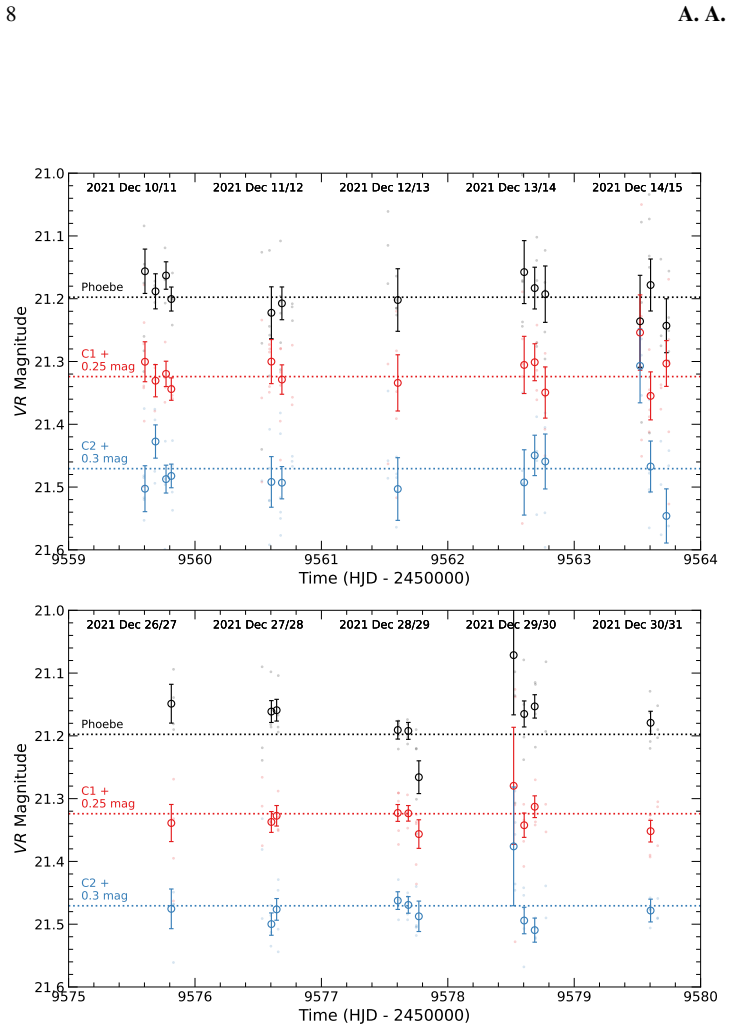
Reanalysis of DECam data shows Phoebe is a variable star with multiple brightenings, not a primordial black hole microlensing event.
A machine-rendered reading of the paper's core claim, the machinery that carries it, and where it could break.
Core claim
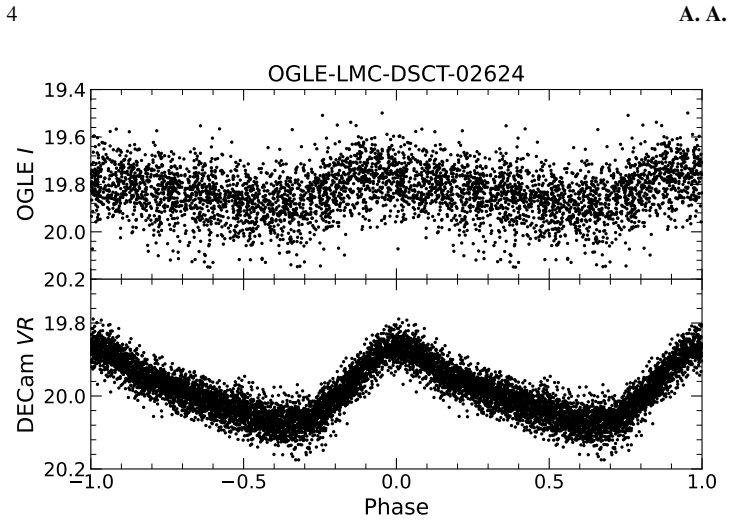
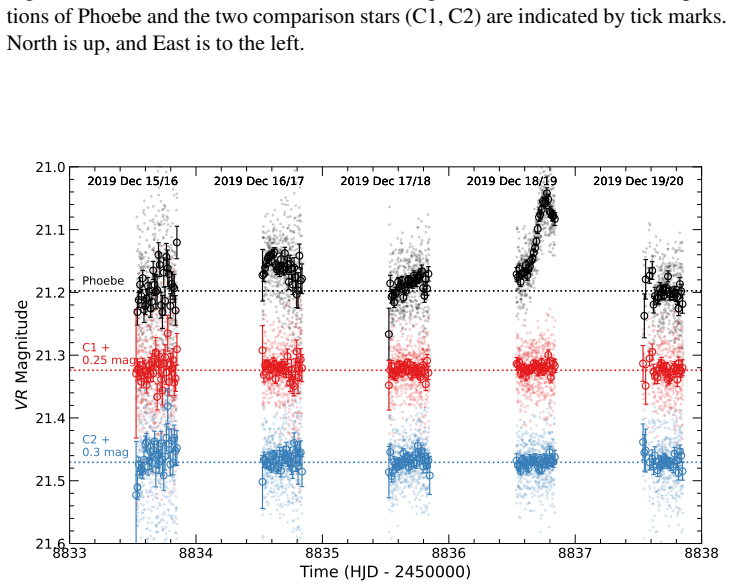
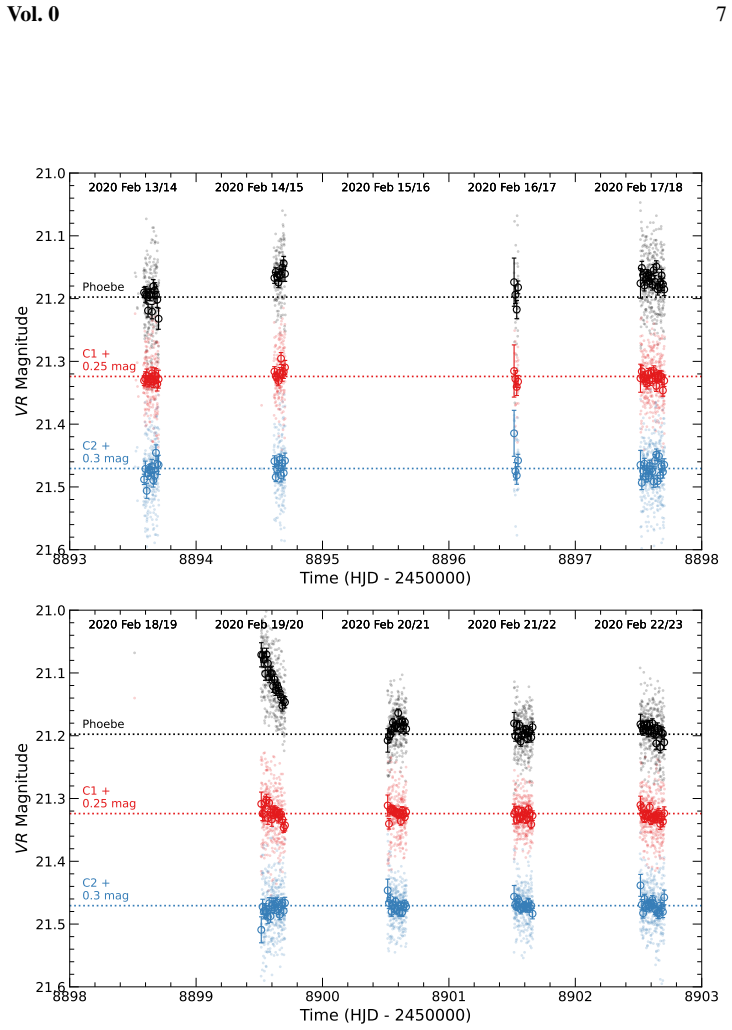
The object underwent at least three distinct, low-amplitude brightenings (one of which was misinterpreted as a short-timescale microlensing event) in addition to long-term variations of its mean magnitude. These characteristics indicate that Phoebe is an ordinary variable star rather than a microlensing event. This finding resolves the apparent tension with the results from earlier microlensing experiments that rule out the hypothesis that a substantial fraction of dark matter is composed of lunar- and planetary-mass PBHs.
What carries the argument
Independent re-analysis of publicly available DECam observations of Phoebe, incorporating extra 2020-2021 epochs to reveal repeated brightenings and mean-magnitude changes.
If this is right
- No evidence remains from Phoebe for lunar-mass primordial black holes as dark matter.
- Earlier surveys that already excluded substantial PBH fractions stay consistent with all data.
- Claims of short-timescale PBH microlensing must be checked against multi-year baselines before acceptance.
- The reported tension between this candidate and prior microlensing limits is eliminated.
Where Pith is reading between the lines
- Similar multi-epoch rechecks could be applied to other short-timescale microlensing candidates to test for hidden variability.
- Long-baseline monitoring of LMC stars may be needed to separate intrinsic variables from true lensing events in future searches.
- This case shows that sparse sampling can turn repeated low-amplitude stellar variations into apparent single transients.
Load-bearing premise
The additional 2020-2021 DECam data points are free of systematic calibration errors or artifacts that could produce or hide multiple brightenings.
What would settle it
A new photometric campaign that measures only one isolated brightening event whose light curve fits a single microlensing model without residuals, or that detects strict periodicity in the variations.
Figures
read the original abstract
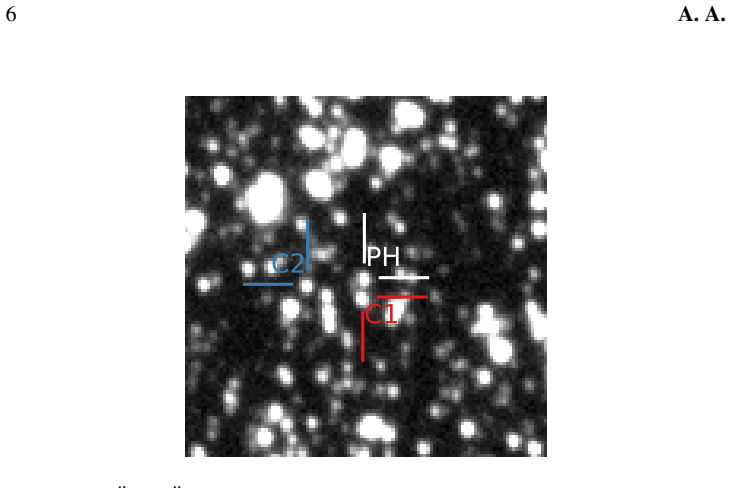
Recent preprints by Key et al. reported the discovery of a short-lived brightening of a star (nicknamed "Phoebe") located in the Large Magellanic Cloud that was interpreted as a short-timescale gravitational microlensing event produced by a lunar-mass primordial black hole (PBH) in the Milky Way dark matter halo. Here, we present an independent re-analysis of the publicly available DECam observations of this object, incorporating additional data from 2020 and 2021. The object underwent at least three distinct, low-amplitude brightenings (one of which was misinterpreted as a short-timescale microlensing event) in addition to long-term variations of its mean magnitude. These characteristics indicate that Phoebe is an ordinary variable star rather than a microlensing event. This finding resolves the apparent tension with the results from earlier microlensing experiments that rule out the hypothesis that a substantial fraction of dark matter is composed of lunar- and planetary-mass PBHs.
Editorial analysis
A structured set of objections, weighed in public.
Referee Report
Summary. The manuscript re-analyzes publicly available DECam photometry of the star Phoebe in the LMC, previously interpreted by Key et al. as a short-timescale microlensing event produced by a lunar-mass primordial black hole. Incorporating additional 2020–2021 epochs, the authors identify at least three distinct low-amplitude brightenings plus long-term changes in mean magnitude and conclude that Phoebe is an ordinary variable star, thereby removing an apparent tension with earlier microlensing surveys that constrain the PBH dark-matter fraction at these masses.
Significance. If the reported brightenings are shown to be astrophysical rather than photometric artifacts, the result would reinforce existing upper limits on lunar- and planetary-mass PBHs as dark matter by demonstrating that at least one claimed event is stellar variability. The work’s use of public data for an independent check is a positive feature for reproducibility.
major comments (1)
- [Section 3] Section 3 (re-reduced light curve): the manuscript presents the 2020–2021 DECam points and the resulting multiple-peak morphology without an independent cross-calibration against overlapping surveys, a covariance analysis of the added epochs, or injection-recovery tests that quantify the false-positive rate for low-amplitude brightenings under the actual observing conditions. Because the central claim that Phoebe is a variable star (rather than a microlensing event) rests on these additional brightenings being real, the absence of these validation steps is load-bearing.
minor comments (2)
- [Abstract / Section 3] The abstract and Section 3 would benefit from an explicit statement of the total number of new epochs, their photometric precision, and the precise time baseline covered by the 2020–2021 data.
- [Figures] Figure captions should include the filter(s) used and any applied zero-point offsets so that the long-term mean-magnitude variations can be assessed quantitatively.
Simulated Author's Rebuttal
We thank the referee for their constructive review and recommendation of major revision. We address the major comment below and will update the manuscript to incorporate additional validation steps.
read point-by-point responses
-
Referee: [Section 3] Section 3 (re-reduced light curve): the manuscript presents the 2020–2021 DECam points and the resulting multiple-peak morphology without an independent cross-calibration against overlapping surveys, a covariance analysis of the added epochs, or injection-recovery tests that quantify the false-positive rate for low-amplitude brightenings under the actual observing conditions. Because the central claim that Phoebe is a variable star (rather than a microlensing event) rests on these additional brightenings being real, the absence of these validation steps is load-bearing.
Authors: We agree that the absence of these specific validation steps weakens the robustness of the claim that the additional brightenings are astrophysical. In the revised manuscript we will add an injection-recovery test using the actual DECam observing conditions and noise properties to quantify the false-positive rate for low-amplitude brightenings. We will also include a covariance analysis of the 2020–2021 epochs. For cross-calibration, we will explicitly demonstrate consistency between our re-reduction and the original Key et al. photometry on the overlapping epochs and note the lack of independent overlapping surveys at the required depth and cadence; this limitation will be stated clearly. These changes directly address the load-bearing concern. revision: yes
Circularity Check
No circularity: direct observational comparison of light-curve morphology
full rationale
The paper's central claim rests on re-reduced DECam photometry showing multiple distinct brightenings plus long-term magnitude changes, which are then compared to standard expectations for microlensing (single symmetric peak) versus stellar variability (multiple asymmetric events). No equations, fitted parameters, or self-citations are invoked to derive the conclusion; the result is the direct morphological evidence itself. The analysis is self-contained against external benchmarks of light-curve classification and does not reduce any prediction to its inputs by construction.
Axiom & Free-Parameter Ledger
axioms (1)
- domain assumption Standard microlensing light-curve models and stellar variability templates are sufficient to distinguish the two phenomena for this object.
Forward citations
Cited by 1 Pith paper
-
The swallowed spike: the formation of light primordial black hole structures around heavy seeds
Light PBHs around heavy primordial seeds form significantly less dense inner cores than particle DM because no studied torque mechanism prevents capture.
Reference graph
Works this paper leans on
-
[1]
2015, , 150, 150
Flaugher , B., et al. 2015, , 150, 150
2015
-
[2]
2026 a , arXiv e-prints, arXiv:2605.19332
Key , R., et al. 2026 a , arXiv e-prints, arXiv:2605.19332
Pith/arXiv arXiv 2026
-
[3]
2026 b , arXiv e-prints, arXiv:2605.19375
Key , R., et al. 2026 b , arXiv e-prints, arXiv:2605.19375
Pith/arXiv arXiv 2026
-
[4]
2023, , 73, 259
Mr \'o z , P. 2023, , 73, 259
2023
-
[5]
2026, , 76, 1
Mr \'o z , P., and Udalski , A. 2026, , 76, 1
2026
-
[6]
2024, , 976, L19
Mr \'o z , P., et al. 2024, , 976, L19
2024
-
[7]
2021, , 161, 74
Nidever , D.L., et al. 2021, , 161, 74
2021
-
[8]
2023, , 73, 105
Soszy \'n ski , I., et al. 2023, , 73, 105
2023
-
[9]
2003, , 53, 291
Udalski , A. 2003, , 53, 291
2003
-
[10]
2015, , 65, 1
Udalski , A., Szyma \'n ski , M.K., and Szyma \'n ski , G. 2015, , 65, 1
2015
-
[11]
485, eds
Valdes , F., Gruendl , R., and DES Project 2014, in Astronomical Data Analysis Software and Systems XXIII, Astronomical Society of the Pacific Conference Series, vol. 485, eds. N. Manset , and P. Forshay , 379
2014
-
[12]
2000, , 50, 421
Wo \'z niak , P.R. 2000, , 50, 421
2000
discussion (0)
Sign in with ORCID, Apple, or X to comment. Anyone can read and Pith papers without signing in.