REVIEW 2 major objections 4 minor 2 cited by
Similarities and differences between infinite-layer nickelates and cuprates and implications for superconductivity
T0 review · 2 major / 4 minor · reviewed 2026-08-14 · deepseek-v4-flash
Pith's one-line read Infinite-layer nickelates are plausible cuprate analogs: their key hopping ratios match, and only the much larger charge-transfer gap stands between them and the cuprate recipe for superconductivity.
desk verdict A careful electronic-structure comparison that delivers new Wannier/tight-binding parameters and a plausible large-t'/t story for nickelates; the La-5d caveat is real but not fatal. read the letter →
The pith
A machine-rendered reading of the paper's core claim, the machinery that carries it, and where it could break.
The reading
What carries the argument
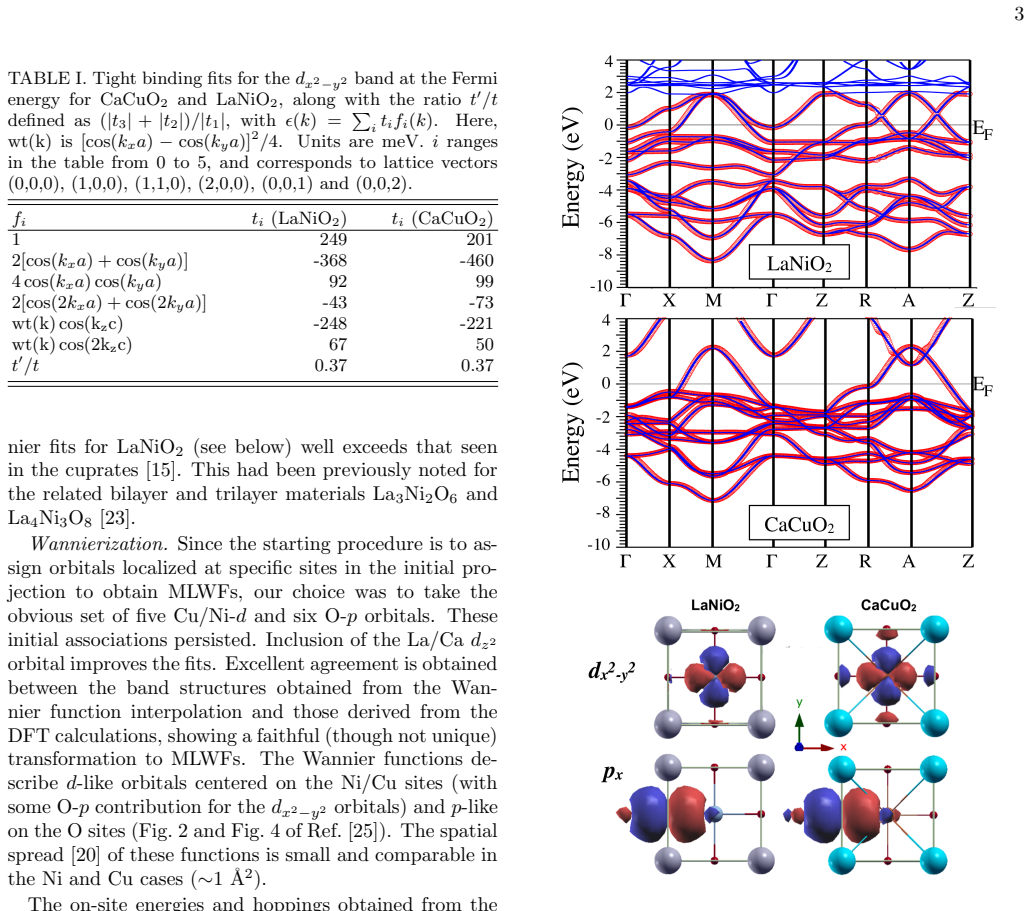
The load-bearing machinery is a three-level tight-binding analysis of the density-functional band structures: a six-parameter fit to the $d_{x^2-y^2}$ band at the Fermi energy, a maximally localized Wannier-function parametrization of the $d$-$p$ manifold, and Slater-Koster fits seeded by the Wannier values. The cuprate comparison is carried by two derived numbers—the ratio $t'/t = (|t_3|+|t_2|)/|t_1|$, which comes out near 0.37 in both materials, and the charge-transfer gap $\Delta$, which comes out at 4.4 eV for the nickelate and 2.7 eV for the cuprate—because these are the quantities previously correlated with $T_c$ in cuprates.
What would settle it
Explicitly include the La-$5d$ orbitals in the Wannier active space and refit the one-band parameters: if $t'/t$ falls well below 0.37 or $\Delta$ moves toward the cuprate value of 2.7 eV, the comparison collapses. A direct spectroscopic determination of the charge-transfer gap in LaNiO$_2$—near 4.4 eV or near 2.7 eV—would also settle which parameter set describes the physics.
Extended reading notes
Core claim
On the paper's own terms, the central discovery is that the electronic-structure parameters that correlate with superconductivity in cuprates split into two sets when carried over to infinite-layer nickelates. The hopping integrals—$pd\sigma$ about 1.4–1.5 eV, $pp\sigma$ about 1.2–1.3 eV, and the one-band $t_1,t_2,t_3$—are nearly the same in LaNiO$_2$ and CaCuO$_2$, yielding $t'/t \approx 0.37$; the $e_g$ splitting is also comparable. But the charge-transfer energy $\Delta = \epsilon_d - \epsilon_p$ is almost twice as large (4.4 eV versus 2.7 eV), and two small La-$5d$ Fermi pockets self-dope the hole-like $d_{x^2-y^2}$ surface. The authors therefore present $R$NiO$_2$ as a cuprate analog in which the parameters that favor superconductivity are present and the main outlier is the large gap, a feature that could account for the reduced $T_c$.
Load-bearing premise
The argument assumes that the low-energy model built from Ni-$d$ and O-$p$ Wannier functions—omitting the La-$5d$ states that cross the Fermi energy—captures the parameters that control superconductivity; the noticeably worse Slater-Koster fit in the nickelate (rms 331 meV versus 174 meV) is a warning that this assumption may be too strong.
Editorial extensions
If this is right
- The large $t'/t$ ratio and comparable $pd$/$pp$ hoppings place $R$NiO$_2$ inside the empirical cuprate window for pairing, so the same descriptors used to rank cuprates by $T_c$ would rank the nickelates as promising superconductors.
- Because the La-$5d$ pockets self-dope the hole-like Fermi surface, optimal doping is likely lower than in the cuprates; the rigid-band estimate is about 12% rather than 16%.
- Electron doping of $R$NiO$_2$ should be as revealing as electron doping of SrCuO$_2$, which gives the highest $T_c$ among electron-doped cuprates.
- If the large charge-transfer gap is what suppresses pairing, the nickelates become a direct testbed for how $\Delta$ controls $T_c$ in a cuprate-like single-band setting.
Reading between the lines
- Editorial inference: because the large gap and the self-doping both originate in the rare-earth spacer states, substituting different $R$ cations or applying epitaxial strain should tune $\Delta$ downward; under this paper's logic, such modified nickelates would be predicted to have higher $T_c$.
- Editorial inference: applying the same Wannier-to-Slater-Koster comparison to other reduced nickelate families, such as the bilayer La$_3$Ni$_2$O$_6$, would test whether the cuprate-like hopping pattern is a general property of Ni$^{1+}$ square planes.
- Editorial inference: the parameter set implies a sharp spectroscopic check—resonant inelastic X-ray scattering should place the Ni charge-transfer excitation near 4.4 eV in LaNiO$_2$, well above the cuprate value, if the paper's $\Delta$ is right.
Signed reviews
Editorial analysis
A structured set of objections, weighed in public.
Referee Report
Summary. The paper revisits the electronic structure of infinite-layer nickelates RNiO2 (R = La, Nd) using DFT (GGA), LDA+U, maximally localized Wannier functions, tight-binding fits, and Slater-Koster fits, comparing them with the cuprate CaCuO2. The central findings are that the pd and pp hopping parameters are similar between the nickelates and cuprates, the t'/t ratio is large (~0.37) for both, the eg splitting is comparable, but the charge-transfer gap Δ is much larger in LaNiO2 (4.4 eV) than in CaCuO2 (2.7 eV). The paper argues that the large t'/t is favorable for superconductivity, the large Δ may account for the reduced Tc, and the La-5d electron pockets self-dope the main Fermi surface. It also presents spin-polarized results, doping studies, and a Hall coefficient analysis.
Significance. If the central electronic-structure comparison is robust, the identification of a cuprate-like t'/t in infinite-layer nickelates is an important step toward understanding superconductivity in these materials. The paper provides a detailed set of fitted parameters in Tables I and II and in the Supplemental Material, allowing direct quantitative comparison, and it interprets these parameters using independent empirical correlations from Pavarini, Sakakibara, and Weber rather than self-referential criteria. The discussion of self-doping, the rigid-band estimate of optimal doping, and the Hall coefficient analysis add value. The principal weakness is that the fits underpinning the central t'/t and Δ claims omit the La-5d states, which the authors themselves acknowledge can affect the fits.
major comments (2)
- [Wannierization] The central claim in the abstract that both materials exhibit a large ratio of longer-range to near-neighbor hopping rests on the six-parameter tight-binding fit to the dx2-y2 band reported in Table I. No rms error or fitting window is reported for this fit. Since the La-5d states cross the Fermi level and the paper states that inclusion of the La/Ca dz2 orbital improves the Wannier fits, the fitted t1, t2, and t3 values could be affected by the omitted La-d degrees of freedom. Please provide the fit error, specify the energy window used, and show how the extracted parameters and the t'/t ratio change when a La dz2 orbital is included in the Wannier basis.
- [Supplemental Material, Table I] The Slater-Koster fit for LaNiO2 has an rms error of 331 meV versus 174 meV for CaCuO2, which the authors attribute to the neglect of the La-d states. This large discrepancy raises a parallel concern about the Wannier-derived charge-transfer gap Δ = 4.4 eV in Table II, because that Wannier basis also omits La-d states. Please report whether including the La dz2 orbital changes the on-site energies and hoppings in Table II, and if so, how the comparison with cuprates is modified. Without this information, the robustness of both the large Δ and the large t'/t conclusions is not fully established.
minor comments (4)
- [Table I] The first row of Table I is the constant term t0, not the nearest-neighbor hopping t1; please clarify in the caption that t1 is the coefficient of 2[cos(kxa)+cos(kya)] so that the definition of t'/t is unambiguous.
- [Conclusions] The phrase "including our own [9,11]" is inaccurate because reference [9] is by Lee and Pickett; only reference [11] is the authors' previous work.
- [Spin-polarized calculations] The sentence "The energy difference obtained with respect to the non magnetic state is 0.70 meV/Ni and 0.69 meV/Ni with respect to an A-type AFM state" is ambiguous; please rewrite to state explicitly which state is the lowest and what the energy differences refer to.
- [Wannierization] The statement that inclusion of the La/Ca dz2 orbital improves the fits is not quantified anywhere in the manuscript; please either provide the resulting changes in the Table II parameters or state explicitly that the reported values are from the basis without La dz2.
Circularity Check
No significant circularity: the paper's central parameters are outputs of fits to first-principles DFT bands, and the superconductivity expectations are judged against independent empirical correlations.
full rationale
The derivation chain is: DFT band structures for LaNiO2 and CaCuO2 are computed from first principles; six-parameter tight-binding fits yield t1, t2, t3 and hence t'/t; Wannier and Slater-Koster fits yield on-site energies and hoppings, including the charge-transfer gap. These fitted parameters are then compared against external empirical correlations from Pavarini, Sakakibara, and Weber. Nothing in this chain defines the predicted quantity in terms of itself. The t'/t ratio is computed from fitted hopping parameters, not imposed as an input. The large charge-transfer gap is read off from Wannier on-site energies. The paper explicitly reports the Slater-Koster rms error (331 meV for Ni versus 174 meV for Cu) and attributes the larger error to the omission of La d states; that is a stated accuracy limitation, not a circular step. Self-citations to Refs. 9 and 11 are prior calculations or earlier negative conclusions, and they are not used as the load-bearing evidence for the new result. The empirical correlations used to interpret t'/t and Delta are external to this paper. Therefore no specific reduction of a claimed result to its own inputs can be exhibited, and the appropriate finding is no significant circularity.
Assumptions & free parameters
free parameters (4)
- t1 (nearest-neighbor dx2-y2 hopping) =
LaNiO2: -368 meV; CaCuO2: -460 meV
- t2 (next-nearest in-plane hopping) =
LaNiO2: 92 meV; CaCuO2: 99 meV
- t3 (third-neighbor in-plane hopping) =
LaNiO2: -43 meV; CaCuO2: -73 meV
- Slater-Koster tight-binding parameters =
19 values listed in Supplemental Table I
assumptions (5)
- domain assumption DFT with GGA and LDA+U accurately captures the low-energy electronic structure of RNiO2 and CaCuO2
- domain assumption Maximally localized Wannier functions with a Ni/Cu-d and O-p basis faithfully represent the DFT band structure
- standard math Slater-Koster two-center tight-binding approximation is adequate for these band structures
- domain assumption Rigid band approximation applies for Sr doping and Hall coefficient estimates
- domain assumption Cuprate empirical correlations (Pavarini t'/t-Tc, Sakakibara eg splitting, Weber charge-transfer gap) transfer to nickelates
Cite this review
Pith. "Pith review of Similarities and differences between infinite-layer nickelates and cuprates and implications for superconductivity." pith.science (2026). https://pith.science/paper/QY2V5K2Z
@misc{pith2026190810946,
  author       = {Pith},
  title        = {Pith review of: Similarities and differences between infinite-layer nickelates and cuprates and implications for superconductivity},
  year         = {2026},
  howpublished = {\url{https://pith.science/paper/QY2V5K2Z}},
  note         = {Machine review of arXiv:1908.10946}
}
abstract
We have revisited the electronic structure of infinite-layer RNiO$_2$ (R= La, Nd) in light of the recent discovery of superconductivity in Sr-doped NdNiO$_2$. From a comparison to their cuprate counterpart CaCuO$_2$, we derive essential facts related to their electronic structures, in particular the values for various hopping parameters and energy splittings, and the influence of the spacer cation. From this detailed comparison, we comment on expectations in regards to superconductivity. In particular, both materials exhibit a large ratio of longer-range hopping to near-neighbor hopping which should be conducive for superconductivity.
Figures


Figures from the paper (6 more)



Forward citations
Cited by 2 Pith papers
-
Model construction and a possibility of cuprate-like pairing in a new d9 nickelate superconductor (Nd,Sr)NiO2
First-principles models plus fluctuation-exchange calculations suggest the infinite-layer nickelate (Nd,Sr)NiO2 pairs electrons with d_x2-y2 symmetry like the cuprates, with a reduced Tc caused by stronger interaction...
-
Hole superconductivity in infinite-layer nickelates
Infinite-layer nickelate superconductivity in Nd0.8Sr0.2NiO2 is attributed to oxygen pπ hole pairing via correlated hopping, with a predicted large Tc increase under compressive epitaxial strain.
Reference graph
Works this paper leans on
-
[1]
M. R. Norman, Rep. Prog. Phys. 79, 074502 (2016)
work page 2016
-
[2]
V. I. Anisimov, D. Bukhvalov and T. M. Rice, Phys. Rev. B 59, 7901 (1999)
work page 1999
-
[3]
M. Crespin, P. Levitz and L. Gatineau, J. Chem. Soc., Faraday Trans. 2, 79, 1181 (1983)
work page 1983
-
[4]
M. A. Hayward, M. A. Green, M. J. Rosseinsky and J. Sloan, J. Amer. Chem. Soc. 121, 8843 (1999)
work page 1999
- [5]
- [6]
- [7]
- [8]
Show all 33 references
-
[9]
For both the AMF and FLL schemes, the value of the magnetic moment at the Ni site increases up to the highest U value used of 6 eV
and we cannot reproduce it either. For both the AMF and FLL schemes, the value of the magnetic moment at the Ni site increases up to the highest U value used of 6 eV. As noted above, there is no experimental evidence for antiferromagnetic order in LaNiO 2. In fact, the suscep-...
-
[10]
Lee and W
K.-W. Lee and W. E. Pickett, Phys. Rev. B 70, 165109 (2004)
2004
-
[11]
T. Liu, H. Wu, T. Jia, X. Zhang, Z. Zeng, H. Q. Lin and X. G. Li, AIP Advances 4, 047132 (2014)
2014
-
[12]
A. S. Botana and M. R. Norman, Phys. Rev. Materials 2, 104803 (2018)
2018
-
[13]
D. Li, K. Lee, B. Y. Wang, M. Osada, S. Crossley, H. R. Lee, Y. Cui, Y. Hikita and H. Y. Hwang, Nature 572, 624 (2019)
2019
-
[14]
Pavarini, I
E. Pavarini, I. Dasgupta, T. Saha-Dasgupta, O. Jepsen and O. K. Andersen, Phys. Rev. Lett. 87, 047003 (2001)
2001
-
[15]
Sakakibara, H
H. Sakakibara, H. Usui, K. Kuroki, R. Arita and H. Aoki, Phys. Rev. B 85, 064501 (2012)
2012
-
[16]
Weber, C
C. Weber, C. Yee, K. Haule and G. Kotliar, EPL 100, 37001 (2012)
2012
-
[17]
Blaha, K
P. Blaha, K. Schwarz, G. K. H. Madsen, D. Kvasnicka and J. Luitz, WIEN2k, An Augmented Plane Wave Plus Local Orbitals Program for Calculating Crystal Proper- ties, Vienna University of Technology, Austria (2001)
2001
-
[18]
J. P. Perdew, K. Burke and M. Ernzerhof, Phys. Rev. Lett. 77, 3865 (1996)
1996
-
[19]
Lichtenstein, V
A. Lichtenstein, V. Anisimov and J. Zaanen, Phys. Rev. B 52, R5467 (1995)
1995
-
[20]
M. T. Czyzyk and G. A. Sawatzky, Phys. Rev. B 49, 14211 (1994)
1994
-
[21]
Marzari, A
N. Marzari, A. A. Mostofi, J. R. Yates, I. Souza and D. Vanderbilt, Rev. Mod. Phys. 84, 1419 (2012)
2012
-
[22]
A. A. Mostofi, J. R. Yates, G. Pizzi, Y. S. Lee, I. Souza, D. Vanderbilt and N. Marzari, Comput. Phys. Commun. 185, 2309 (2014)
2014
-
[23]
Kunes, R
J. Kunes, R. Arita, P. Wissgott, A. Toschi, H. Ikeda and K. Held, Comp. Phys. Commun. 181, 1888 (2010)
2010
-
[24]
C.-H. Yee, T. Birol and G. Kotliar, EPL 111, 17002 (2015)
2015
-
[25]
J. C. Slater and G. F. Koster, Phys. Rev.94, 1498 (1954)
1954
-
[26]
Further details of the band structures, Fermi surfaces, Wannier functions, Slater-Koster fits, and magnetic band structures can be found in the Supplemental Material
-
[27]
S. W. Jang, T. Kotani, H. Kino, K. Kuroki and M. J. Han, Sci. Rep. 5, 12050 (2015)
2015
-
[28]
W. H. Press, B. P. Flannery, S. A. Teukolsky and W. T. Vetterling, Numerical Recipes (Cambridge University Press, 1989)
1989
-
[30]
M. R. Norman, Phys. Rev. B 71, 220405 (2005)
2005
-
[31]
Y. Y. Peng et al. , Nature Phys. 13, 1201 (2017)
2017
-
[32]
Similarities and differences between infinite-layer nickelates and cuprates and implications for superconductivity
M. G. Smith, A. Manthiram, J. Zhou, J. B. Goodenough and J. T. Markert, Nature 351, 549 (1991). 1 Supplemental Material to “Similarities and differences between infinite-layer nickelates and cuprates and implications for superconductivity” FIG. 1. Crystal structure of CaCuO 2 (l...
1991 arXiv
-
[33]
L. F. Mattheiss and D. R. Hamann, Phys. Rev. B 40, 2217 (1989)
1989
-
[34]
J. C. Slater and G. F. Koster, Phys. Rev. 94, 1498 (1954)
1954
Reviewed August 14, 2026 · model on record in the stance chip above.
Discussion (0). Continue with ORCID to comment.