REVIEW 3 major objections 3 minor 64 references
New Spatially Resolved Imaging of the SR 21 Transition Disk and Constraints on the Small-Grain Disk Geometry
T0 review · 3 major / 3 minor · reviewed 2026-08-14 · deepseek-v4-flash
Pith's one-line read Multi-epoch near-infrared interferometric imaging of the SR 21 transition disk shows that its inner small-grain dust disk is truncated at roughly 4–7 AU, exhibits a warp or spiral, and contains grains grown to about 2–5 µm.
desk verdict New NRM data genuinely break the old degeneracy on SR 21's inner small-grain disk and the warp evidence is credible, but the few-AU truncation rests on a single dust mixture and should be framed as model-dependent. read the letter →
The pith
A machine-rendered reading of the paper's core claim, the machinery that carries it, and where it could break.
The reading
What carries the argument
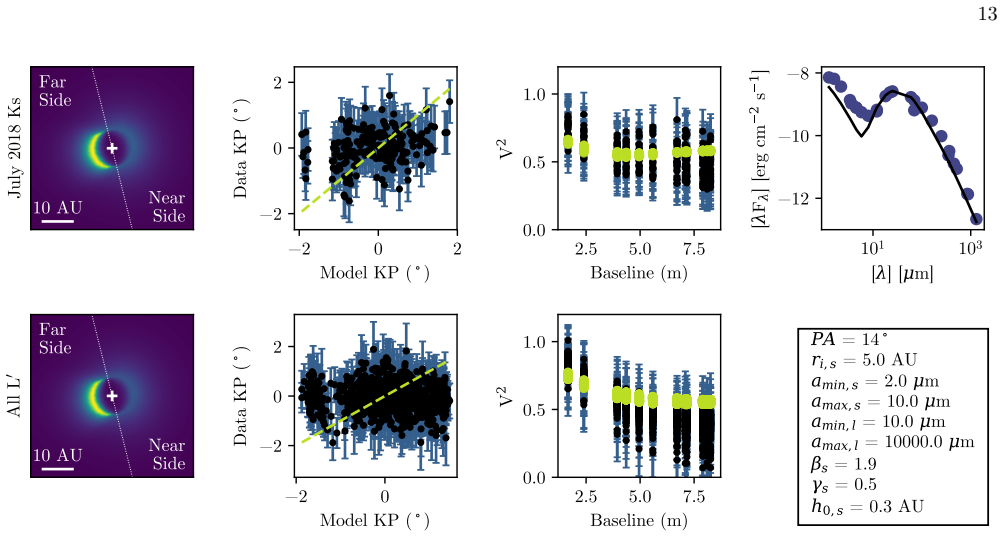
The argument is carried by a parametric radiative transfer model of a two-component flared disk, in which a large-grain outer disk with inner radius 36 AU is joined by a puffy small-grain disk whose density follows $\rho(r,z) = \rho_0 (r/r_0)^{-\alpha} \exp\left(-z^2/2h(r)^2\right)$ with $h(r) = h_0 (r/r_0)^\beta$, and whose inner radius, scale height, flaring index, and minimum grain size are fit against the imaging and SED. In the warped variant, the inner small-grain disk's inclination and position angle change linearly with stellocentric radius from inner values ($i_0$, PA$_0$) to the millimeter-disk orientation ($i = 15°$, PA = 194°) by 7 AU, matching the CO truncation radius. The observables that discriminate among models are the squared visibilities, which penalize too much unresolved hot dust and therefore rule out an inner disk at the sublimation radius, and the kernel phases, which encode the asymmetric scattered-light pattern that requires the warp or spiral. A weighted goodness-of-fit metric combining kernel-phase, visibility, and SED $\chi^2$ values selects the best model, and Bayesian image reconstruction confirms the northeast arc and fainter southwest component seen in the warped model.
What would settle it
Imaging of SR 21 at ~5 mas resolution at L' that places the brightest inner-disk emission inside ~4 AU, or a 10 µm spectrum whose silicate feature requires abundant sub-micron grains, would contradict the claimed few-AU truncation and 2–5 µm grain sizes; likewise, a clear measurement of Keplerian orbital motion of a point-like companion in the outer disk plane would refute the static-warp interpretation.
Extended reading notes
Core claim
On the paper's own terms, the central discovery is that the near-infrared emission from SR 21 is inconsistent both with a single orbiting companion and with an axisymmetric small-grain disk that reaches the sublimation radius. The squared visibilities drop with baseline in a way that demands resolved, roughly centro-symmetric structure, while the kernel phases demand an asymmetry whose position angle is not that of the millimeter disk and shifts between Ks and L'. A parametric radiative transfer model with a puffy, flared small-grain disk whose inner regions are truncated at a few AU and whose orientation twists linearly until it matches the millimeter disk at 7 AU reproduces the visibilities, the kernel phases, and the spectral energy distribution. The same fit requires minimum grain sizes of about 2–5 µm and a large flaring index, so the paper concludes that the small-grain disk is a truncated, warped, puffed-up structure with grown grains, most plausibly shaped by a giant-planet-mass companion.
Load-bearing premise
The derived truncation radius of a few AU and the 2–5 µm minimum grain size rest on assumed dust composition (65% silicates, 35% graphite), a fixed grain-size distribution index $p = 3.5$, and a parametric flared, warped density structure; if the true opacities or inner rim geometry differ, models with small grains reaching the sublimation radius could also fit the images.
Editorial extensions
If this is right
- The inner small-grain disk of SR 21 must be truncated at a few AU, so models that place the inner rim at the dust sublimation radius are excluded by these data.
- The small-grain disk is not an aligned rim: its orientation changes with radius, so any successful model of SR 21 must include a warp or spiral structure in the inner few AU.
- Minimum grain sizes of 2–5 µm inside the millimeter clearing imply that dust has grown in the clearing, consistent with pressure maxima produced by an embedded companion.
- The data do not rule out the previously proposed ~700 K companion; disk-plus-companion models with L' and Ks contrasts of about 3.5 and 6.0 magnitudes fit the observations as well as or better than the disk alone.
- Multi-epoch kernel phases from four epochs are inconsistent with a companion orbiting in the outer disk plane, so the asymmetric signal is more likely static scattered light than an orbiting point source.
Reading between the lines
- If the few-AU truncation holds up, the ratio of the small-grain truncation (~4–7 AU) to the CO truncation (~7 AU) becomes a quantitative probe of the planet mass and gap-opening physics, a comparison the paper discusses only qualitatively.
- The warp-versus-spiral ambiguity could be settled by polarimetric imaging at H band with sub-10 AU resolution: a coherent warp would produce a brightness peak that rotates smoothly with radius, while a spiral would show a fixed azimuthal phase offset that winds inward.
- The inferred 2–5 µm minimum grain size is tied to the assumed 65/35 silicate-graphite mixture and the $p = 3.5$ size distribution; spatially resolved spectroscopy of the 10 µm silicate feature inside the clearing would directly test whether sub-micron grains are truly absent.
- The same multi-epoch kernel-phase strategy used here—rejecting a companion orbit in favor of static disk structure—could be applied to other transition disks with claimed point-source detections, since spurious companion signals from disk scattered light are a known hazard.
Signed reviews
Editorial analysis
A structured set of objections, weighed in public.
Referee Report
Summary. This paper presents new multi-epoch near-infrared interferometric imaging of the transition disk SR 21, using MagAO/Clio2 NRM at L', Keck/NIRC2 NRM at Ks and L', and MagAO/VisAO H-alpha imaging. After calibrating closure/kernel phases and squared visibilities, the authors fit single-companion models, geometric Gaussian disk models, and radiative transfer disk models (RADMC-3D) to the imaging together with a literature SED. They find that single-companion models cannot reproduce the squared visibilities or the multi-epoch position angles, and that aligned small-grain disk models fail to match the kernel phases. A parametric warped small-grain disk model reproduces the data better. The authors conclude that the small-grain disk is truncated at a few AU (4-7 AU), has a large scale height/flaring, and contains grains with minimum sizes of 2-5 microns, and they discuss a giant-planet companion as a possible dynamical origin.
Significance. The data themselves are new and valuable: the Ks/L' NRM observations resolve the inner few AU of a transition disk, a region that previous scattered-light imaging could not distinguish. The paper is carefully executed in several respects: the companion-model false-positive calculations are Monte-Carlo based; the calibrators are vetted; the final radiative transfer models are checked against the H-band radial profile from Follette et al. (2013); and the SQUEEZE reconstructions are compared to simulated observations of the disk models. If the main claims hold, the paper provides one of the first direct NIR constraints on the inner small-grain disk truncation radius in this system, with implications for companion-driven clearing.
major comments (3)
- [§4.3.1, Table 5; §4.3.2] The stated central constraint that the small-grain disk is truncated at a few AU rests on a single adopted dust composition (65% silicates, 35% graphite; Weingartner & Draine 2001) and a fixed grain size index p = 3.5. The only exploration at ri,s = 0.07 AU, described at the end of §4.3.2, uses this same opacity model. Because the near-IR opacity per unit mass of small grains depends strongly on composition and the grain size distribution, a carbon-rich mixture or a different p could reduce the unresolved flux at the sublimation radius enough to bring the 0.07 AU models into agreement with the squared visibilities. I would like to see either a small grid of alternate compositions and p values at ri,s = 0.07 AU, or a quantitative statement (e.g., the factor by which the near-IR opacity would have to change) to justify replacing 'preferred under the adopted opacity model' with 'require' in the abstract.
- [§5.2, Figures 8 and 9] The paper acknowledges that the best-fitting disk models cannot reproduce SR 21's near-infrared excess while simultaneously matching the imaging and without over-predicting the 10 micron silicate feature. This residual SED mismatch weakens the abstract's claim that the images are reconciled with the spectral energy distribution, and it directly affects the inferred minimum grain size of 2-5 microns because that inference comes from the joint imaging+SED fit. The revision should state the best-fit (weighted and unweighted) chi-square values for the models in Figures 8 and 9 and show how amin,s changes when the near-IR excess is excluded from or reweighted in the fit.
- [§4.3, Eq. (4)] The combined goodness-of-fit X^2 in Eq. (4) uses relative weights wKP, wV2, and wSED that the text itself describes as arbitrary. While the paper explores a wide range of weights, it does not report the normalized chi-square components for the specific best-fit aligned and warped models, nor for the 0.07 AU models that are the basis for the truncation claim. As written, the reader cannot judge whether the warp or the truncation is preferred at a statistically meaningful level or by a marginal improvement. Please add a table with chi2_KP, chi2_V2, chi2_SED, and X^2 for the models shown in Figures 8 and 9 and for the 0.07 AU variants, and state the criterion used to pick the final weights.
minor comments (3)
- [§5.1, Table 6] The grid allows h0,rin values as large as 5 AU, while the text quotes typical scale heights of 0.05-0.2 AU at 1 AU; the relation between the two quantities should be stated explicitly to avoid an apparent inconsistency.
- [§3.2, Figure 2] The Gaussian error model is a poor description of the most affected datasets (e.g., the squared visibilities of 2018-06-28 and the closure phases of 2013-04-05). Since these fitted Gaussians set the error bars used in all subsequent fits, the paper should briefly state whether the main conclusions persist when the worst nights are down-weighted by an additional factor or removed.
- [§4.4] The reconstructed images depend more strongly on the choice of model components (delta function plus symmetric disk) than on the regularizer, and the paper does not show the L-curves used to choose the hyperparameters; adding them, or at least a statement of the systematic uncertainty in f*, d, and fd, would make the comparison with the radiative transfer models easier to evaluate.
Circularity Check
No circularity: the disk geometry and grain-size constraints come from fitting new interferometric data plus an external SED; no prediction reduces to its own inputs.
full rationale
The paper's central claims are that SR 21's small-grain disk is truncated at a few AU, has warp- or spiral-like structure, and contains grains grown to roughly 2-5 microns. These claims are supported by comparing new multi-epoch Keck/NIRC2 and Magellan/MagAO kernel phases and squared visibilities, plus a literature SED, against a grid of RADMC-3D radiative transfer models. The parameters such as inner radius, scale height, flaring index, and minimum grain size are model inputs that are varied and then selected by goodness of fit; they are not derived from one another, and the best-fit values are not claimed to be first-principles predictions. The key rejection of the 0.07 AU sublimation-radius models is empirical: 'The disk models with inner radii at the sublimation radius over-predict the squared visibilities; the hot dust close to the star creates too much unresolved flux.' This is a comparison between model predictions and independent measured visibilities, not an identity between input and output. The paper explicitly acknowledges that the X^2 weighting in Eq. (4) is an 'arbitrary choice' and that the near-infrared excess is not fully reproduced, which further shows that the modeling is a fitting exercise with admitted limitations rather than a circular derivation. Self-citations appear (Sallum & Eisner 2017 for the reduction pipeline; Sheehan & Eisner 2017 for the X^2 weighting scheme), but neither is load-bearing for the geometric conclusions, and neither is invoked as a uniqueness theorem or as a substitute for fitting the new data. The dependence of the inferred truncation radius on the assumed dust composition, grain size index p=3.5, and parametric density structure is a real model-dependence and correctness risk, but it is not circularity: alternative opacity laws or density structures could change the conclusion, but the paper's own derivation does not reduce to its own inputs. No step satisfies the required standard of Eq. X = Eq. Y by construction or a fitted parameter renamed as a prediction.
Assumptions & free parameters
free parameters (8)
- Small-grain disk inner radius (ri,s) =
5.0 AU (warped best fit; grid 3 to 6 AU)
- Small-grain disk minimum grain size (amin,s) =
5.0 micrometers (warped) or 2.0 micrometers (aligned)
- Small-grain disk flaring index (beta_s) =
1.35 (warped) or 1.9 (aligned)
- Small-grain disk scale height at inner radius (h0,rin) =
5.0 AU (warped best fit; grid 0.3 to 5.0 AU)
- Small-grain disk mass (Md,s) =
9.0e-6 solar masses (warped)
- Warp initial position angle (PA0) =
330 degrees (fine grid) or 280 degrees (coarse grid)
- Warp initial inclination (i0) =
25 degrees (fine grid) or 20 degrees (coarse grid)
- Relative data weights in X^2 (wKP, wV2, wSED) =
5, 1, 0.5 in the shown best fit
assumptions (7)
- domain assumption RADMC-3D and pdspy correctly model scattered light and thermal emission from the disk with the adopted density profile.
- domain assumption Dust composition is 65% silicates and 35% graphite (Weingartner & Draine 2001).
- domain assumption The grain size distribution is a power law with p = 3.5.
- ad hoc to paper The small-grain disk is forced to align with the millimeter disk by 7 AU.
- domain assumption The large-grain disk inner radius is 36 AU.
- domain assumption Distance to SR 21 is 138 pc (Gaia).
- domain assumption The source does not vary significantly over the multi-epoch datasets except for tested Keplerian companions.
Cite this review
Pith. "Pith review of New Spatially Resolved Imaging of the SR 21 Transition Disk and Constraints on the Small-Grain Disk Geometry." pith.science (2026). https://pith.science/paper/QY77KV6Q
@misc{pith2026190807427,
  author       = {Pith},
  title        = {Pith review of: New Spatially Resolved Imaging of the SR 21 Transition Disk and Constraints on the Small-Grain Disk Geometry},
  year         = {2026},
  howpublished = {\url{https://pith.science/paper/QY77KV6Q}},
  note         = {Machine review of arXiv:1908.07427}
}
abstract
We present new 0.6 - 4 $\mu$m imaging of the SR 21 transition disk from Keck/NIRC2 and Magellan/MagAO. The protoplanetary disk around SR 21 has a large (~ 30 - 40 AU) clearing first inferred from its spectral energy distribution and later detected in sub-millimeter imaging. Both the gas and small dust grains are known to have a different morphology, with an inner truncation in CO at ~7 AU, and micron-sized dust detected within the millimeter clearing. Previous near-infrared imaging could not distinguish between an inner dust disk with a truncation at ~7 AU or one that extended to the sublimation radius. The imaging data presented here require an inner dust disk radius of a few AU, and complex structure such as a warp or spiral. We present a parametric warped disk model that can reproduce the observations. Reconciling the images with the spectral energy distribution gathered from the literature suggests grain growth to ~2 - 5 $\mu$m within the sub-millimeter clearing. The complex disk structure and possible grain growth can be connected to dynamical shaping by a giant-planet mass companion, a scenario supported by previous observational and theoretical studies.
Figures


Figures from the paper (10 more)




Reference graph
Works this paper leans on
-
[1]
M., Wilner, D
Andrews, S. M., Wilner, D. J., Espaillat, C., et al. 2011, ApJ, 732, 42
2011
-
[2]
P., van der Marel, N., et al
Ansdell, M., Williams, J. P., van der Marel, N., et al. 2016, ApJ, 828, 46
2016
-
[3]
Baron, F., Monnier, J. D., & Kloppenborg, B. 2010, in Proc. SPIE, Vol. 7734, Optical and Infrared Interferometry II, 77342I
work page 2010
- [4]
-
[5]
Biller, B., Lacour, S., Juh´ asz, A., et al. 2012, ApJL, 753, L38
work page 2012
-
[6]
Biller, B. A., Close, L. M., Masciadri, E., et al. 2006, in Society of Photo-Optical Instrumentation Engineers (SPIE) Conference Series, Vol. 6272, 62722D
work page 2006
- [7]
-
[8]
Brown, J. M., Blake, G. A., Dullemond, C. P., et al. 2007, ApJL, 664, L107
work page 2007
Show all 64 references
-
[9]
Papaloizou, J. C. B. 1999, ApJ, 514, 344
1999
-
[10]
2018, MNRAS, 477, 5104
Casassus, S., Avenhaus, H., P´ erez, S., et al. 2018, MNRAS, 477, 5104
2018
-
[11]
2015, MNRAS, 450, L1
Gregorio-Monsalvo, I., & Tuthill, P. 2015, MNRAS, 450, L1
2015
-
[12]
2016, A&A, 589, A112
Chelli, A., Duvert, G., Bourg` es, L., et al. 2016, A&A, 589, A112
2016
-
[13]
2012, in Society of Photo-Optical Instrumentation Engineers (SPIE) Conference Series, Vol
Close, L., Males, J., Kopon, D., et al. 2012, in Society of Photo-Optical Instrumentation Engineers (SPIE) Conference Series, Vol. 8447, Society of Photo-Optical Instrumentation Engineers (SPIE) Conference Series, 0X1–0X16
2012
-
[14]
M., Males, J
Close, L. M., Males, J. R., Morzinski, K., et al. 2013, ApJ, 774, 94
2013
-
[15]
M., Males, J
Close, L. M., Males, J. R., Morzinski, K. M., et al. 2018, in Society of Photo-Optical Instrumentation Engineers (SPIE) Conference Series, Vol. 10703, Adaptive Optics Systems VI, 107030L
2018
-
[16]
2004, in SF2A-2004: Semaine de l’Astrophysique Francaise, ed
Delfosse, X., & Bonneau, D. 2004, in SF2A-2004: Semaine de l’Astrophysique Francaise, ed. F. Combes, D. Barret, T. Contini, F. Meynadier, & L. Pagani, 181
2004
-
[17]
2018, ApJ, 866, 110
Dong, R., Li, S., Chiang, E., & Li, H. 2018, ApJ, 866, 110
2018
-
[18]
R., & Stone, J
Dong, R., Zhu, Z., Rafikov, R. R., & Stone, J. M. 2015, ApJL, 809, L5 21
2015
-
[19]
Dullemond, C. P. 2012, RADMC-3D: A multi-purpose radiative transfer tool, Astrophysics Source Code Library, , , ascl:1202.015
2012
-
[20]
Eisner, J. A. 2015, ApJL, 803, L4
2015
-
[21]
A., Monnier, J
Eisner, J. A., Monnier, J. D., Tuthill, P., & Lacour, S. 2009, ApJL, 698, L169
2009
-
[22]
B., Tamura, M., Hashimoto, J., et al
Follette, K. B., Tamura, M., Hashimoto, J., et al. 2013, ApJ, 767, 10
2013
-
[23]
B., Rameau, J., Dong, R., et al
Follette, K. B., Rameau, J., Dong, R., et al. 2017, AJ, 153, 264
2017
-
[24]
J., Marley, M
Fortney, J. J., Marley, M. S., Saumon, D., & Lodders, K. 2008, ApJ, 683, 1104
2008
-
[25]
Frieden, B. R. 1972, Journal of the Optical Society of America (1917-1983), 62, 511 Gaia Collaboration, Prusti, T., de Bruijne, J. H. J., et al. 2016, A&A, 595, A1
1972
-
[26]
2014, ApJ, 780, 171
Martinache, F. 2014, ApJ, 780, 171
2014
-
[27]
A., & Lada, C
Haisch, Karl E., J., Lada, E. A., & Lada, C. J. 2001, ApJ, 553, L153 H¨ ogbom, J. A. 1974, A&AS, 15, 417 Hu´ elamo, N., Lacour, S., Tuthill, P., et al. 2011, A&A, 528, L7
2001
-
[28]
J., & Kraus, A
Ireland, M. J., & Kraus, A. L. 2008, ApJL, 678, L59
2008
-
[29]
M., Carpenter, J
Isella, A., P´ erez, L. M., Carpenter, J. M., et al. 2013, ApJ, 775, 30
2013
-
[30]
2018, A&A, 617, A44
Keppler, M., Benisty, M., M¨ uller, A., et al. 2018, A&A, 617, A44
2018
-
[31]
L., & Ireland, M
Kraus, A. L., & Ireland, M. J. 2012, ApJ, 745, 5
2012
-
[32]
L., Ireland, M
Kraus, A. L., Ireland, M. J., Martinache, F., & Hillenbrand, L. A. 2011, ApJ, 731, 8
2011
-
[33]
F., Testi, L., Natta, A., et al
Manara, C. F., Testi, L., Natta, A., et al. 2014, A&A, 568, A18
2014
-
[34]
2015, ApJ, 798, L44
Marino, S., Perez, S., & Casassus, S. 2015, ApJ, 798, L44
2015
-
[35]
2006, ApJ, 641, 556
Nadeau, D. 2006, ApJ, 641, 556
2006
-
[36]
2010, ApJ, 724, 464
Martinache, F. 2010, ApJ, 724, 464
2010
-
[37]
2014, ApJ, 792, 97
Mawet, D., Milli, J., Wahhaj, Z., et al. 2014, ApJ, 792, 97
2014
-
[38]
Monnier, J. D. 1999, PhD thesis, UNIVERSITY OF
1999
-
[39]
D., Harries, T
Monnier, J. D., Harries, T. J., Bae, J., et al. 2019, ApJ, 872, 122
2019
-
[40]
M., Close, L
Morzinski, K. M., Close, L. M., Males, J. R., et al. 2014, in Proc. SPIE, Vol. 9148, Adaptive Optics Systems IV, 914804
2014
-
[41]
M., Males, J
Morzinski, K. M., Males, J. R., Skemer, A. J., et al. 2015, ApJ, 815, 108 M¨ uller, A., Keppler, M., Henning, T., et al. 2018, A&A, 617, L2
2015
-
[42]
A., Hashimoto, J., et al
Muto, T., Grady, C. A., Hashimoto, J., et al. 2012, ApJL, 748, L22
2012
-
[43]
R., Strom, S
Najita, J. R., Strom, S. E., & Muzerolle, J. 2007, MNRAS, 378, 369 P´ erez, L. M., Isella, A., Carpenter, J. M., & Chandler, C. J. 2014, ApJL, 783, L13
2007
-
[44]
M., Blake, G
Pontoppidan, K. M., Blake, G. A., van Dishoeck, E. F., et al. 2008, ApJ, 684, 1323
2008
-
[45]
P., & Simon, M
Prato, L., Greene, T. P., & Simon, M. 2003, ApJ, 584, 853
2003
-
[46]
A., Connors, A., Kashyap, V
Protassov, R., van Dyk, D. A., Connors, A., Kashyap, V. L., & Siemiginowska, A. 2002, ApJ, 571, 545 Ribas, ´A., Espaillat, C. C., Mac´ ıas, E., et al. 2017, ApJ, 849, 63
2002
-
[47]
2012, A&A, 548, A56
Rigliaco, E., Natta, A., Testi, L., et al. 2012, A&A, 548, A56
2012
-
[48]
2010, AJ, 139, 2440
Roeser, S., Demleitner, M., & Schilbach, E. 2010, AJ, 139, 2440
2010
-
[49]
I., Osher, S., & Fatemi, E
Rudin, L. I., Osher, S., & Fatemi, E. 1992, Physica D Nonlinear Phenomena, 60, 259
1992
-
[50]
2017, The Astrophysical Journal Supplement Series, 233, 9
Sallum, S., & Eisner, J. 2017, The Astrophysical Journal Supplement Series, 233, 9
2017
-
[51]
A., Hinz, P
Sallum, S., Eisner, J. A., Hinz, P. M., et al. 2017, ApJ, 844, 22
2017
-
[52]
M., et al
Sallum, S., Eisner, J., Close, L. M., et al. 2016, in Proc. SPIE, Vol. 9907, Optical and Infrared Interferometry and Imaging V, 99070D
2016
-
[53]
2018, psheehan/pdspy: pdspy: A MCMC Tool for Continuum and Spectral Line Radiative Transfer Modeling, , , doi:10.5281/zenodo.2455079
Sheehan, P. 2018, psheehan/pdspy: pdspy: A MCMC Tool for Continuum and Spectral Line Radiative Transfer Modeling, , , doi:10.5281/zenodo.2455079
2018 doi
-
[54]
D., & Eisner, J
Sheehan, P. D., & Eisner, J. A. 2017, ApJ, 851, 45
2017
-
[55]
D., Wu, Y.-L., Eisner, J
Sheehan, P. D., Wu, Y.-L., Eisner, J. A., & Tobin, J. J. 2019, ApJ, 874, 136
2019
-
[56]
2012, ApJL, 755, L28
Soummer, R., Pueyo, L., & Larkin, J. 2012, ApJL, 755, L28
2012
-
[57]
S., & Burrows, A
Spiegel, D. S., & Burrows, A. 2012, ApJ, 745, 174
2012
-
[58]
Skrutskie, M. F. 1989, AJ, 97, 1451 Thi´ ebaut,´E., & Young, J. 2017, Journal of the Optical Society of America A, 34, 904
1989
-
[59]
M., Loinard, L., Mioduszewski, A
Torres, R. M., Loinard, L., Mioduszewski, A. J., & Rodr´ ıguez, L. F. 2007, ApJ, 671, 1813 22
2007
-
[60]
G., Monnier, J
Tuthill, P. G., Monnier, J. D., Danchi, W. C., Wishnow, E. H., & Haniff, C. A. 2000b, PASP, 112, 555 van der Marel, N., van Dishoeck, E. F., Bruderer, S., et al. 2016, A&A, 585, A58 —. 2013, Science, 340, 1199
2016
-
[61]
B., Close, L
Wagner, K., Follete, K. B., Close, L. M., et al. 2018, ApJ, 863, L8
2018
-
[62]
J., Ruffio, J.-B., De Rosa, R
Wang, J. J., Ruffio, J.-B., De Rosa, R. J., et al. 2015, pyKLIP: PSF Subtraction for Exoplanets and Disks, Astrophysics Source Code Library, , , ascl:1506.001
2015
-
[63]
C., & Draine, B
Weingartner, J. C., & Draine, B. T. 2001, ApJ, 548, 296
2001
-
[64]
2019, A&A, 621, A7
Willson, M., Kraus, S., Kluska, J., et al. 2019, A&A, 621, A7
2019
Reviewed August 14, 2026 · model on record in the stance chip above.
Discussion (0). Continue with ORCID to comment.