REVIEW 2 major objections 5 minor 29 references
Hump-like structure in Hall signal from SrRuO$_3$ ultra-thin films without inhomogeneous anomalous Hall effect
T0 review · 2 major / 5 minor · reviewed 2026-08-14 · deepseek-v4-flash
Pith's one-line read Using magnetization measurements on the same SrRuO3 films that show humps in the Hall signal, this paper argues the humps cannot come from a mixture of magnetic regions, and must have a topological origin.
desk verdict Useful correlated transport plus magnetization data that kills the simple double-AHE explanation, but the "must be topological" conclusion overreaches without a sensitivity analysis. read the letter →
The pith
A machine-rendered reading of the paper's core claim, the machinery that carries it, and where it could break.
The reading
What carries the argument
The load-bearing argument is an elimination test built on the proportionality between anomalous Hall resistivity and magnetization. If the hump came from two or more regions with different AHE, those regions would have to switch at different coercive fields, so the total magnetization would show a double hysteresis loop or distinct steps; a topological Hall contribution, by contrast, arises from non-coplanar spin arrangements with zero net magnetization and leaves the M-H loop single. Magnetization measured by Kerr rotation and SQUID is therefore the discriminating instrument, and a known superlattice system in which humps in $\rho_{xy}$ coexist with a genuine double hysteresis loop (reference 27) serves as the positive control, showing the test can detect inhomogeneous AHE when it is actually present. The second piece of machinery is the residual-resistivity ratio as an index of Ru stoichiometry (reference 29), used to connect growth conditions with the appearance of the hump.
What would settle it
Image the magnetic texture of these 4 u.c. films directly, for example with Lorentz transmission electron microscopy or scanning nitrogen-vacancy magnetometry, in the field and temperature window where the hump appears: the topological claim predicts a chiral or non-coplanar spin texture with zero net magnetization there, while a null result would reopen the inhomogeneous-AHE explanation. A complementary check is to measure magnetization with higher sensitivity inside the $\Delta H$ window of Fig. 3: any resolvable secondary coercive feature accompanying the hump would falsify the single-loop interpretation.
Extended reading notes
Core claim
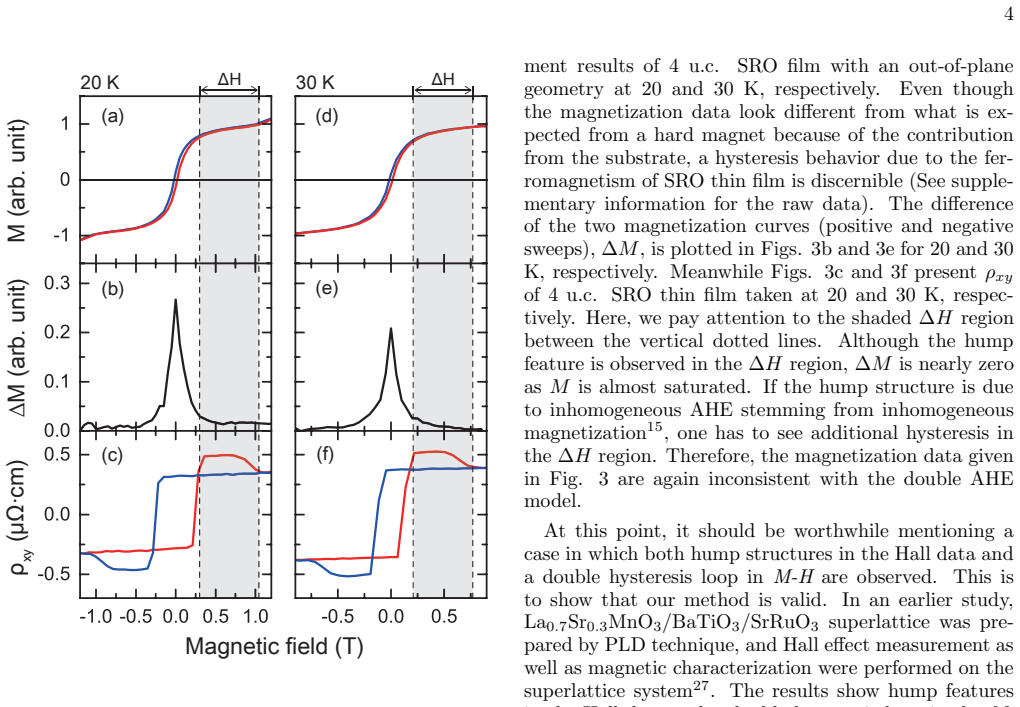
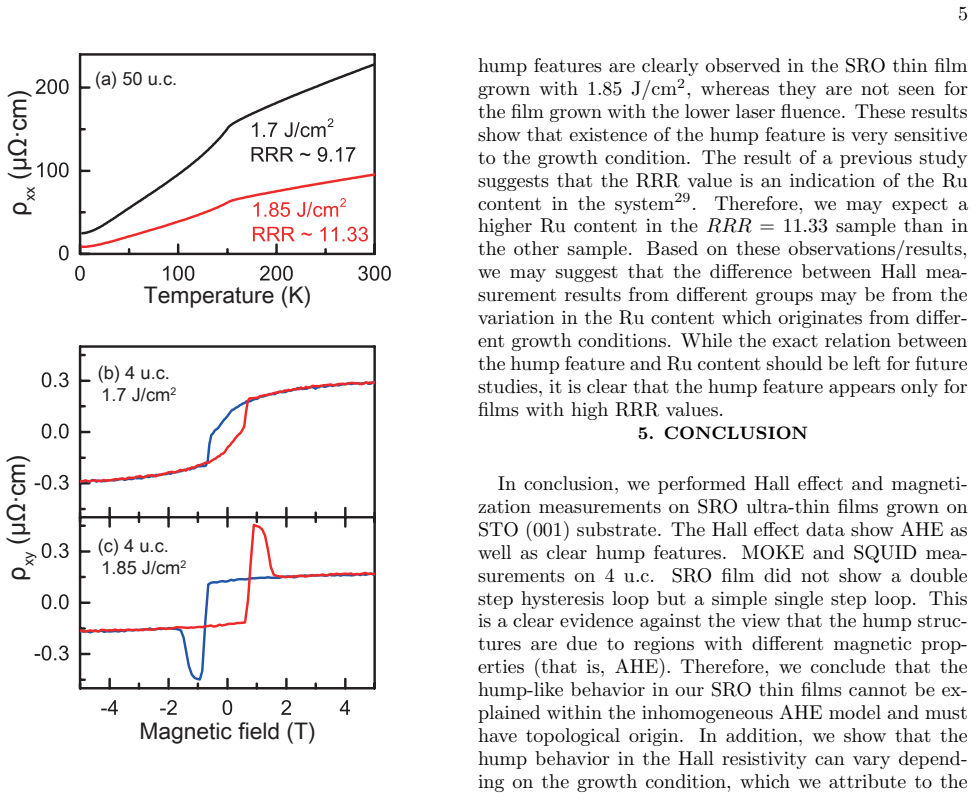
On the paper's own terms, its central claim is that the hump-like structure in $\rho_{xy}$ of 4-unit-cell SrRuO$_3$ films on SrTiO$_3$(001) is not the superposition of two or more anomalous Hall effects with different coercive fields. The evidence is the coexistence of the hump with a single-step magnetization loop: polar magneto-optic Kerr rotation, which is proportional to the film magnetization, shows one rectangular loop with no hump structure, and SQUID magnetization after substrate subtraction shows no multiple coercive fields, with $\Delta M$ essentially zero in exactly the field window where the Hall hump sits ($\Delta H$ in Fig. 3). Because the inhomogeneous-AHE model requires regions switching at different fields, which would appear as steps or a double loop in the total magnetization, the single loop rules that model out for these films. The paper therefore concludes the hump must have a topological origin, and it validates the magnetization test by citing a superlattice system in which humps in $\rho_{xy}$ do coexist with a genuine double hysteresis loop. It further shows the hump's presence tracks film quality: 4 u.c. films grown at higher laser fluence, with a higher residual-resistivity ratio attributed to higher Ru content, develop clear humps, while lower-fluence films do not.
Load-bearing premise
The argument rules out inhomogeneous AHE only on the premise that any such scenario must leave two distinct switching fields visible in the total magnetization; if two magnetic regions switch at nearly the same field, or one region's signal is smaller than the sensitivity of the Kerr or SQUID measurements after substrate subtraction, a single hysteresis loop could still hide an inhomogeneous AHE.
Editorial extensions
If this is right
- A hump in $\rho_{xy}$ should no longer be read as evidence of inhomogeneous AHE when the film's magnetization shows a single loop; magnetization data become the discriminating measurement in the SRO debate.
- If the hump is topological, 4 u.c. SrRuO$_3$ films on SrTiO$_3$(001) host chiral or non-coplanar spin textures on their own, without an SrIrO$_3$ capping layer.
- The conflicting reports among different groups are plausibly explained by growth conditions: only films with a high residual-resistivity ratio (attributed to higher Ru content) show clear humps, so sample quality decides which interpretation a given data set supports.
- The topological signal exists only in a restricted window — it weakens as temperature approaches the Curie temperature and disappears in lower-fluence films — so any model of the spin texture must explain this sensitivity.
Reading between the lines
- The conclusion is an elimination rather than a direct sighting: nothing in the paper images the conjectured chiral spin texture, so real-space imaging of these films in the hump's field-temperature window would be the decisive confirmation.
- The elimination logic has a sensitivity limit: a magnetic minority region whose coercivity nearly coincides with the main switching field, or whose moment is buried in the substrate background, could produce a hump without a visible double loop, and higher-sensitivity magnetometry on the same films would test that boundary.
- If Ru stoichiometry controls the hump, then tuning the laser fluence or oxygen pressure during growth should continuously vary the hump amplitude, effectively mapping the topological signal as a function of composition — a testable extension the paper leaves to future work.
- The same Hall-plus-magnetization discrimination should transfer to other ultra-thin oxide films with THE-like humps, since the argument relies only on the proportionality of AHE to magnetization and on distinct coercive fields leaving a magnetic signature.
Signed reviews
Editorial analysis
A structured set of objections, weighed in public.
Referee Report
Summary. The paper addresses the controversy over hump-like features in the Hall resistivity of ultra-thin SrRuO3 films, which have been attributed either to a topological Hall effect or to the superposition of anomalous Hall effects from regions with different magnetic properties. The authors grow 4 and 5 unit-cell SrRuO3 films on SrTiO3(001), observe clear hump features in ρxy at low temperatures, and then measure the magnetization with polar MOKE and SQUID. They find single hysteresis loops without double steps in both probes and conclude that inhomogeneous AHE alone cannot explain the humps, so the humps must have a topological origin. They also report that the hump features depend sensitively on growth conditions and correlate with the residual resistivity ratio, which they attribute to Ru content variations.
Significance. If the elimination argument were made rigorous, this work would be an important experimental contribution to a live controversy, because it directly confronts a proposed non-topological explanation with magnetization measurements on the same films. The strengths are the use of two independent magnetization probes, the comparison of transport and magnetization on nominally identical films, and the controlled growth-condition series showing that hump features appear only in higher-quality films. The paper is not internally inconsistent and does not rely on fitted parameters. However, the central claim that inhomogeneous AHE is excluded currently rests on an implicit sensitivity assumption that is not quantified, and the final inference to a topological origin is stronger than the data support.
major comments (2)
- [§3 and Figs. 2d, 3b, 3e] The premise that an inhomogeneous AHE scenario requires 'different coercive fields, which should be manifested in the M-H curve as corresponding distinct steps or double hysteresis loops' is only valid if every AHE-active region produces a magnetization step large enough to be resolved. In the two-region model of Ref. 15 invoked by the authors, the Hall resistivity is a conductivity-weighted average of local contributions, so a minority 5 u.c. region with a small magnetic moment could contribute a hump of the observed size while its switching step remains buried in the substrate-dominated SQUID background or below the MOKE sensitivity. The manuscript provides no error bars, noise floor, or detection-threshold estimate for the ΔM curves in Figs. 3b and 3e, and the MOKE measurements cannot reach the 10 K regime where the hump is most pronounced. The data convincingly rule out a large, well-separated double loop, but they do not rule out a second switching event with a small moment or with a coercive field close to that of the main loop. Please add a quantitative estimate of the magnetization step needed to produce the observed hump amplitude and compare it with the actual sensitivity of the SQUID and MOKE measurements.
- [§5 and Conclusion] The conclusion that the hump 'must have topological origin' is stronger than the evidence supports. The measurements exclude one particular class of two-AHE superposition models, namely those with two well-separated coercive fields and comparable magnetization steps, but the absence of a double hysteresis loop is not sufficient to identify topology. Other non-topological mechanisms, such as domain-wall scattering, anisotropic magnetoresistance contributions to ρxy, or interface-related effects, could in principle produce hump-like features with a single M-H loop. I recommend replacing 'must have topological origin' with a statement such as 'consistent with a topological origin' and, if possible, adding an independent test of the topological interpretation (for example, a scaling relation of the hump amplitude with the THE component).
minor comments (5)
- [Methods] The text says 'superconducting quantum interface device'; this should be 'superconducting quantum interference device' (SQUID).
- [Fig. 2d] The Kerr rotation is given in arbitrary units with no scale bar; please provide the absolute Kerr angle scale or state the noise floor so that the absence of a double step can be evaluated quantitatively.
- [Figs. 3b and 3e] The ΔM curves would be much more informative if representative error bars or the noise level after substrate subtraction were shown; without this, the statement that ΔM is 'nearly zero' in the ΔH region is difficult to assess.
- [Fig. 3 caption] The caption uses 'THE disappears' to describe the vertical dashed lines, but the topological interpretation is exactly what is being tested; consider using 'hump feature' instead to avoid presupposing the conclusion.
- [References] Several references (11, 14, 15, 16) are arXiv preprints; please update to published versions where available, since the controversy has evolved.
Circularity Check
No significant circularity: the paper's central claim is an empirical elimination argument comparing independent Hall, MOKE, and SQUID measurements, with no fitted parameter renamed as a prediction.
full rationale
The paper's derivation chain is not circular. The authors measure Hall resistivity humps in 4 u.c. SrRuO3 films, then independently measure magnetization via MOKE and SQUID. The logical step is the stated premise that an inhomogeneous-AHE explanation requires distinct coercive fields that should appear as steps or a double loop in the magnetization. This premise is a physical assumption about the competing model, not a quantity fitted to the Hall data and then reused to predict the same Hall data. No parameter is extracted from rho_xy and then 'predicted' from magnetization, nor is any magnetization feature constructed from the Hall hump. The reliance on the authors' prior work (Ref. 11) is contextual: it supplies the initial THE interpretation and the Hall data schematics, but the elimination argument rests on the new MOKE and SQUID data presented in this paper, not on the self-citation. The paper also acknowledges its own limitation that 10 K MOKE could not access the coercive field, and therefore uses elevated-temperature MOKE plus low-temperature SQUID; this is a stated experimental constraint, not a circular step. A skeptic could question whether the magnetization measurements have enough sensitivity to resolve a small minority-phase switching event, but that is a correctness or evidence-strength concern, not circularity. The conclusion that the hump 'must have topological origin' is an inference to the best remaining explanation; it is not derived by definition from the inputs. Therefore the circularity score is 0.
Assumptions & free parameters
assumptions (3)
- domain assumption Kerr rotation is proportional to the magnetization of the SRO film.
- domain assumption Two regions with different AHE must have different coercive fields that appear as distinct steps or a double loop in M-H.
- domain assumption SQUID signal after diamagnetic subtraction isolates the film's ferromagnetic hysteresis.
Cite this review
Pith. "Pith review of Hump-like structure in Hall signal from SrRuO$_3$ ultra-thin films without inhomogeneous anomalous Hall effect." pith.science (2026). https://pith.science/paper/QYESHUKX
@misc{pith2026190802083,
  author       = {Pith},
  title        = {Pith review of: Hump-like structure in Hall signal from SrRuO$_3$ ultra-thin films without inhomogeneous anomalous Hall effect},
  year         = {2026},
  howpublished = {\url{https://pith.science/paper/QYESHUKX}},
  note         = {Machine review of arXiv:1908.02083}
}
abstract
A controversy arose over the interpretation of the recently observed hump features in Hall resistivity $\rho_{xy}$ from ultra-thin SrRuO$_3$ (SRO) film; it was initially interpreted to be due to topological Hall effect but was later proposed to be from existence of regions with different anomalous Hall effect (AHE). In order to settle down the issue, we performed Hall effect as well as magneto-optic Kerr-effect measurements on 4 unit cell SRO films grown on SrTiO$_3$ (001) substrates. Clear hump features are observed in the measured $\rho_{xy}$, whereas neither hump feature nor double hysteresis loop is seen in the Kerr rotation which should be proportional to the magnetization. In addition, magnetization measurement by superconducting quantum interference device shows no sign of multiple coercive fields. These results show that inhomogeneous AHE alone cannot explain the observed hump behavior in $\rho_{xy}$ data from our SRO ultra-thin films. We found that emergence of the hump structure in $\rho_{xy}$ is closely related to the growth condition, high quality films having clear sign of humps.
Figures


Figures from the paper (1 more)
Reference graph
Works this paper leans on
- [1]
-
[2]
P. K. Rout, P. V. Madduri, S. K. Manna, A. K. Nayak, Phys. Rev. B 2019 , 99 , 094430
work page 2019
-
[3]
A. Neubauer, C. Pfleiderer, B. Binz, A. Rosch, R. Ritz, P. G. Niklowitz, P. B\" o ni, Phys. Rev. Lett. 2009 , 102 , 186602
work page 2009
-
[4]
Y. Li, N. Kanazawa, X. Z. Yu, A. Tsukazaki, M. Kawasaki, M. Ichikawa, X. F. Jin, F. Kagawa, Y. Tokura, Phys. Rev. Lett. 2013 , 110 , 117202
work page 2013
-
[5]
N. Kanazawa, Y. Onose, T. Arima, D. Okuyama, K. Ohoyama, S. Wakimoto, K. Kakurai, S. Ishiwata, Y. Tokura, Phys. Rev. Lett. 2011 , 106 , 156603
work page 2011
-
[6]
T. Yokouchi, N. Kanazawa, A. Tsukazaki, Y. Kozuka, M. Kawasaki, M. Ichikawa, F. Kagawa, Y. Tokura, Phys. Rev. B 2014 , 89 , 064416
work page 2014
-
[7]
A. Soumyanarayanan, M. Raju, A. L. G. Oyarce, A. K. C. Tan, M. Y. Im, A. P. Petrovic, P. Ho, K. H. Khoo, M. Tran, C. K. Gan, F. Ernult, C. Panagopoulos, Nat. Mater. 2017 , 16 , 898-904
work page 2017
-
[8]
B. M. Ludbrook, G. Dubuis , A.-H. Puichaud, B. J. Ruck, S. Granville, Sci. Rep. 2017 , 7 , 13620
work page 2017
Show all 29 references
-
[9]
Matsuno, N
J. Matsuno, N. Ogawa, K. Yasuda, F. Kagawa, W. Koshibae, N. Nagaosa, Sci. Adv. 2016 , 2 , e1600304
2016
-
[10]
Ohuchi, Y
Y. Ohuchi, Y. Kozuka, M. Uchida, K. Ueno, A. Tsukazaki, M. Kawasaki, Phys. Rev. B 2015 , 91 , 245115
2015
-
[11]
B. Sohn, B. Kim, S. Y. Park, H. Y. Choi, J. Y. Moon, T. Choi, Y. J. Choi, T. W. Noh, H. Zhou, S. H. Chang, J. H. Han, C. Kim, arXiv:1810.01615 [cond-mat.str-el]
-
[12]
D. Kan, T. Moriyama, K. Kobayashi, Y. Shimakawa, Phys. Rev. B 2018 , 98 , 180408(R)
2018
-
[13]
L. Wang, Q. Feng, Y. Kim, R. Kim, K. H. Lee, S. D. Pollard, Y. J. Shin, H. Zhou, W. Peng, D. Lee, W. Meng, H. Yang, J. H. Han, M. Kim, Q. Lu, T. W. Noh, Nat. Mater. 2018 , 17 , 1087
2018
-
[14]
Gu, Y.-W
Y. Gu, Y.-W. Wei, K. Xu, H. Zhang, F. Wang, F. Li, M. S. Saleem, C.-Z. Chang, J. Sun, C. Song, J. Feng, X. Zhong, W. Liu, Z. Zhang, J. Zhu, F. Pan, arXiv:1811.09075 [cond-mat.mtrl-sci]
-
[15]
L. Wu, Y. Zhang, arXiv:1812.09847 [cond-mat.mtrl-sci]
-
[16]
D. J. Groenendijk, C. Autieri, T. C. van Thiel, W. Brzezicki, N. Gauquelin, P. Barone, K. H. W. van den Bos, S. van Aert, J. Verbeeck, A. Filippetti, S. Picozzi, M. Cuoco, A. D. Caviglia, arXiv:1810.05619 [cond-mat.str-el]
-
[17]
J. Choi, C. B. Eom, G. Rijnders, H. Rogalla, D. H. A. Blank, Appl. Phys. Lett. 2001 , 79 , 1447
2001
-
[18]
P. N. Argyres, Phys. Rev. 1955 , 97 , 334
1955
-
[19]
S. D. Bader, J. Magn. Magn. Mater. 1991 , 100 , 440-454
1991
-
[20]
J. Xia, W. Siemons, G. Koster, M. R. Beasley, A. Kapitulnik, Phys. Rev. B 2009 , 79 , 140407(R)
2009
-
[21]
Klein, J
L. Klein, J. S. Dodge, C. H. Ahn, J. W. Reiner, L. Mieville, T. H. Geballe, M. R. Beasley, A. Kapitulnik, J. Phys.: Condens. Matter 1996 , 8 , 10111-10126
1996
-
[22]
Schultz, S
M. Schultz, S. Levy, J. W. Reiner, L. Klein, Phys. Rev. B 2009 , 79 , 125444
2009
-
[23]
Nagaosa, Y
N. Nagaosa, Y. Tokura, Nat. Nanotechnol. 2013 , 8 , 899-911
2013
-
[24]
Z. Fang, N. Nagaosa, K. S. Takahashi, A. Asamitsu, R. Mathieu, T. Ogasawara, H. Yamada, M. Kawasaki, Y. Tokura, Science 2003 , 302 , 5642
2003
-
[25]
Mathieu, A
R. Mathieu, A. Asamitsu, H. Yamada, K. S. Takahashi, M. Kawasaki, Z. Fang, N. Nagaosa, Y. Tokura, Phys. Rev. Lett. 2004 , 93 , 016602
2004
-
[26]
Khalifah, I
P. Khalifah, I. Ohkubo, B. C. Sales, H. M. Christen, D. Mandrus, J. Cerne, Phys. Rev. B 2007 , 76 , 054404
2007
-
[27]
Ziese, I
M. Ziese, I. Lindfors-Vrejoiu, J. Appl. Phys. 2018 , 124 , 163905
2018
-
[28]
Wysocski, R
L. Wysocski, R. Mirzaaghayev, M. Ziese, L. Yang, J. Sch\" o pf, R. B. Versteeg, A. Bliesener, J. Engelmayer, A. Kov\' a cs, L. Jin, F. Gunkel, R. Dittmann, P. H. M. van Loosdrecht, I. Lindfors-Vrejoiu, Appl. Phys. Lett. 2018 , 113 , 192402
2018
-
[29]
Siemons, G
W. Siemons, G. Koster, A. Vailionis, H. Yamamoto, D. H. A. Blank, and M. R. Beasley, Phys. Rev. B 2007 , 76 , 075126
2007
Reviewed August 14, 2026 · model on record in the stance chip above.
Discussion (0). Continue with ORCID to comment.