Preparing two-mode magnonic Schr\"odinger cat states in a cavity-magnon-qubit system
Pith reviewed 2026-06-25 21:30 UTC · model grok-4.3
The pith
A cavity-magnon-qubit system generates two-mode magnonic Schrödinger cat states with non-Gaussian entanglement by preparing a bright hybridized mode and measuring the qubit.
A machine-rendered reading of the paper's core claim, the machinery that carries it, and where it could break.
Core claim
Working in the magnon-magnon strong-coupling regime with two identical magnon frequencies and identical couplings to the cavity produces bright and dark hybridized modes. After the effective magnon-qubit conditional-displacement interaction is established by cavity elimination and qubit driving, a projective measurement on the qubit prepares the bright mode in a cat state while the dark mode remains in vacuum; the corresponding state of the two original magnon modes is therefore a two-mode cat state that carries strong non-Gaussian entanglement.
What carries the argument
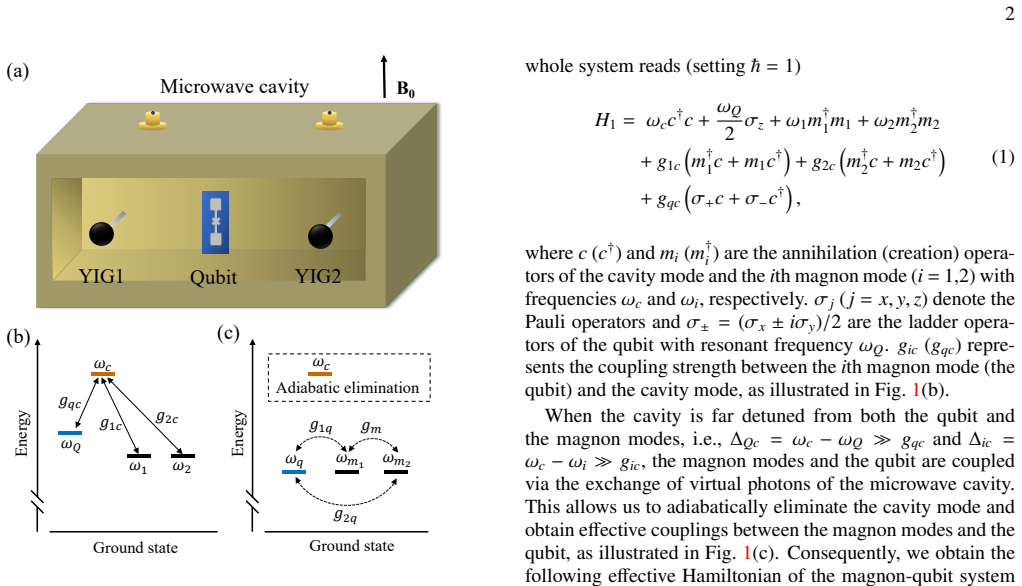
Effective magnon-qubit conditional-displacement interaction obtained by adiabatic cavity elimination and resonant qubit driving, which acts on the bright hybridized magnon mode after the strong-coupling regime splits the modes into bright and dark combinations.
If this is right
- The dark mode remains in vacuum, so all nonclassical features reside in the bright mode and transfer directly to the original magnon pair.
- Strong non-Gaussian entanglement appears between the two magnon modes as a direct consequence of the cat-state preparation.
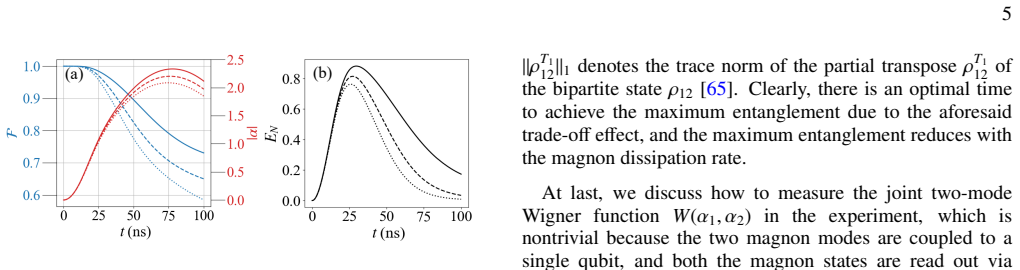
- Dissipation and dephasing reduce but do not eliminate the nonclassicality when realistic device parameters are used.
Where Pith is reading between the lines
- The same bright-dark splitting and conditional-displacement protocol could be applied to three or more magnon modes to produce multi-mode entangled cat states.
- The resulting non-Gaussian magnon entanglement might serve as a resource for continuous-variable quantum information tasks that require non-Gaussian operations.
- Measuring the qubit after the interaction provides a direct experimental signature that can be compared against the predicted cat-state fidelity without requiring full tomography of both magnon modes.
Load-bearing premise
The two magnons must have exactly identical frequencies and identical couplings to the cavity so that the hybridized modes cleanly separate into a bright mode that couples to the qubit and a dark mode that does not.
What would settle it
After the qubit is projectively measured in the computational basis, the reconstructed joint Wigner function of the two magnon modes shows no regions of negativity or no interference fringes between the two coherent-state components.
Figures
read the original abstract
The cavity-magnon-qubit system has recently been demonstrated as a new platform for preparing macroscopic quantum states in magnonic systems. Here, we propose to prepare a two-mode magnonic cat state, which is also a non-Gaussian entangled state, based on this practical system involving two yttrium-iron-garnet (YIG) spheres and a superconducting qubit coupled to a common microwave cavity. By adiabatically eliminating the cavity and resonantly driving the qubit, an effective magnon-qubit conditional-displacement interaction is achieved. Further working in the magnon-magnon strong-coupling regime and considering two identical magnon frequencies and coupling strengths to the cavity, two hybridized magnon modes are formed, of which the bright mode is prepared in a cat state after a projective measurement on the qubit, while the dark mode remains in its initial vacuum state. Such a state corresponds to a two-mode cat state of two original magnon modes, which share strong non-Gaussian entanglement. We also discuss practical dissipation and dephasing effects on the cat state. The results indicate that strong nonclassicality and non-Gaussian entanglement are present in the two-mode cat state using fully feasible parameters.
Editorial analysis
A structured set of objections, weighed in public.
Referee Report
Summary. The paper proposes preparing two-mode magnonic Schrödinger cat states (also non-Gaussian entangled states) in a system of two YIG spheres and a superconducting qubit coupled to a common microwave cavity. After adiabatically eliminating the cavity and applying resonant qubit drive to obtain an effective magnon-qubit conditional-displacement interaction, the scheme operates in the magnon-magnon strong-coupling regime under the assumption of identical magnon frequencies and cavity couplings. This produces hybridized bright and dark modes; a projective qubit measurement prepares a cat state in the bright mode (dark mode stays in vacuum), which maps back to a two-mode cat in the original magnon basis. Dissipation and dephasing effects are discussed, with the claim that strong nonclassicality and entanglement persist for feasible parameters.
Significance. If the protocol is robust, the work extends cavity-magnon platforms to two-mode non-Gaussian entanglement, providing a concrete route to macroscopic quantum states with current technology. Explicit discussion of dissipation and dephasing strengthens the feasibility assessment.
major comments (1)
- [Abstract and hybridized-modes section] Abstract and the section on hybridized modes: the protocol requires exact equality of the two magnon frequencies and their couplings to the cavity to form clean bright/dark modes with the dark mode remaining in vacuum. No quantitative analysis (e.g., tolerance to frequency mismatch δ or coupling mismatch ε) is provided, yet any deviation mixes the modes and populates the dark mode, undermining the purity of the claimed two-mode cat state and its non-Gaussian entanglement.
Simulated Author's Rebuttal
We thank the referee for their careful reading and constructive feedback on our manuscript. We address the major comment below.
read point-by-point responses
-
Referee: [Abstract and hybridized-modes section] Abstract and the section on hybridized modes: the protocol requires exact equality of the two magnon frequencies and their couplings to the cavity to form clean bright/dark modes with the dark mode remaining in vacuum. No quantitative analysis (e.g., tolerance to frequency mismatch δ or coupling mismatch ε) is provided, yet any deviation mixes the modes and populates the dark mode, undermining the purity of the claimed two-mode cat state and its non-Gaussian entanglement.
Authors: We agree that the protocol as presented assumes identical magnon frequencies and cavity couplings to realize ideal bright and dark modes, and that the original manuscript does not include a quantitative analysis of deviations. In the revised manuscript we have added a new subsection in the hybridized-modes section that provides numerical results for small frequency mismatch δ and coupling mismatch ε. These results show that, within the magnon-magnon strong-coupling regime, mismatches up to approximately 5 % of the coupling strength keep the dark-mode population below a few percent and preserve a Wigner-function negativity above 0.2, indicating that substantial non-Gaussian entanglement survives. The abstract has been updated to note this robustness. revision: yes
Circularity Check
No circularity: derivation uses standard quantum-optics steps under explicit assumptions
full rationale
The protocol derives an effective magnon-qubit conditional displacement via adiabatic cavity elimination and resonant qubit drive, then invokes the magnon-magnon strong-coupling regime under the stated assumption of identical frequencies and couplings to obtain clean bright/dark hybridized modes. These steps follow directly from the Hamiltonian and standard approximations without any self-definitional reduction, fitted parameters renamed as predictions, or load-bearing self-citations. The final cat-state claim is conditional on the explicit equality assumption rather than tautological, and the paper remains self-contained against external benchmarks.
Axiom & Free-Parameter Ledger
axioms (2)
- domain assumption Adiabatic elimination of the cavity mode is valid when the cavity is far detuned or strongly coupled
- domain assumption Identical magnon frequencies and couplings allow formation of bright and dark modes
Reference graph
Works this paper leans on
-
[1]
σx ˜ρσx + 1 2 σy ˜ρσy + 1 2 σz ˜ρσz # , ˜σ+ ˜σ− ˜ρ=1 4
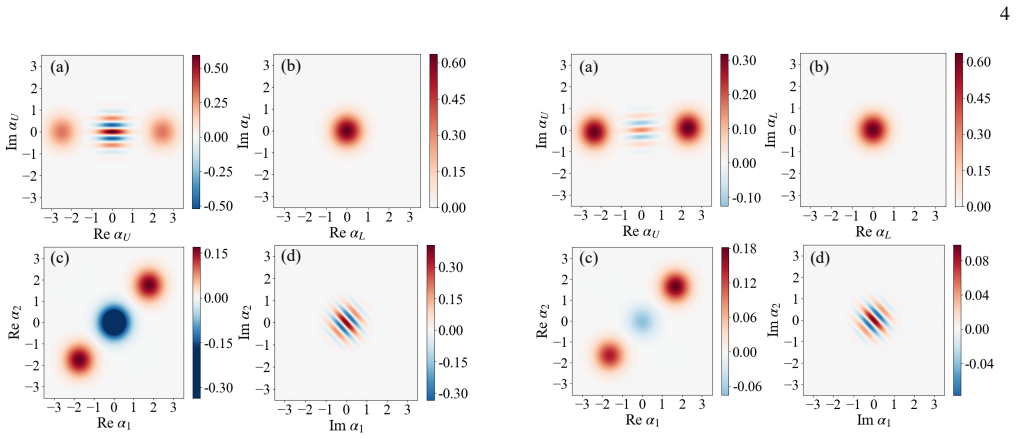
The above states represent a coherent superposition of two macroscopically distinguishable states involving two magnon modes, which are also non-Gaussian entangled states. Without loss of generality, hereafter we con- sider the case where the qubit is projected onto the ground state. In Figs. 2(a)-(b), we plot the Wigner function of the two hy- bridized m...
-
[2]
W. H. Zurek, Decoherence, einselection, and the quantum ori- gins of the classical, Rev. Mod. Phys.75, 715 (2003)
2003
-
[3]
Arndt and K
M. Arndt and K. Hornberger, Testing the limits of quantum me- chanical superpositions, Nat. Phys.10, 271 (2014)
2014
-
[4]
Solano, G
E. Solano, G. S. Agarwal, and H. Walther, Strong-driving- assisted multipartite entanglement in cavity qed, Phys. Rev. Lett.90, 027903 (2003)
2003
-
[5]
Liao and L
J.-Q. Liao and L. Tian, Macroscopic quantum superposition in cavity optomechanics, Phys. Rev. Lett.116, 163602 (2016)
2016
-
[6]
Liao, J.-F
J.-Q. Liao, J.-F. Huang, and L. Tian, Generation of macroscopic Schr¨odinger-cat states in qubit-oscillator systems, Phys. Rev. A 93, 033853 (2016)
2016
-
[7]
Shomroni, L
I. Shomroni, L. Qiu, and T. J. Kippenberg, Optomechanical generation of a mechanical catlike state by phonon subtraction, Phys. Rev. A101, 033812 (2020)
2020
-
[8]
H. Zhan, G. Li, and H. Tan, Preparing macroscopic mechanical quantum superpositions via photon detection, Phys. Rev. A101, 063834 (2020). 8
2020
-
[9]
Li, H.-B
H.-T. Li, H.-B. Wang, Z.-X. Lu, and J. Li, Generation of me- chanical cat-like states via optomagnomechanics, Quantum Re- view Letters2, 35 (2026)
2026
-
[10]
Minganti, N
F. Minganti, N. Bartolo, J. Lolli, W. Casteels, and C. Ciuti, Ex- act results for Schr ¨odinger cats in driven-dissipative systems and their feedback control, Sci. Rep.6, 26987 (2016)
2016
-
[11]
Hou, X.-L
Y .-B. Hou, X.-L. Hei, X.-F. Pan, J.-K. Xie, Y .-L. Ren, S.-L. Ma, F.-L. Li, and P.-B. Li, Robust generation of a magnonic cat state via a superconducting flux qubit, Phys. Rev. A110, 013711 (2024)
2024
-
[12]
G. Liu, G. Li, H. Tan, and J. Li, Magnon cat states in a cavity- magnon-qubit system via two-magnon driving and dissipation, Phys. Rev. A112, 023709 (2025)
2025
-
[13]
C. M. Savage, S. L. Braunstein, and D. F. Walls, Macroscopic quantum superpositions by means of single-atom dispersion, Opt. Lett.15, 628 (1990)
1990
-
[14]
Schr ¨odinger cat
M. Brune, S. Haroche, J. M. Raimond, L. Davidovich, and N. Zagury, Manipulation of photons in a cavity by dispersive atom-field coupling: Quantum-nondemolition measurements and generation of “Schr ¨odinger cat” states, Phys. Rev. A45, 5193 (1992)
1992
-
[15]
Brune, E
M. Brune, E. Hagley, J. Dreyer, X. Ma ˆıtre, A. Maali, C. Wun- derlich, J. M. Raimond, and S. Haroche, Observing the progres- sive decoherence of the “meter” in a quantum measurement, Phys. Rev. Lett.77, 4887 (1996)
1996
-
[16]
Schr¨odinger cat
C. Monroe, D. M. Meekhof, B. E. King, and D. J. Wineland, A “Schr¨odinger cat” superposition state of an atom, Science272, 1131 (1996)
1996
-
[17]
Leibfried, E
D. Leibfried, E. Knill, S. Seidelin, J. Britton, R. B. Blakestad, J. Chiaverini, D. B. Hume, W. M. Itano, J. D. Jost, C. Langer, R. Ozeri, R. Reichle, and D. J. Wineland, Creation of a six-atom ‘Schr¨odinger cat’ state, Nature438, 639 (2005)
2005
-
[18]
Vlastakis, G
B. Vlastakis, G. Kirchmair, Z. Leghtas, S. E. Nigg, L. Frun- zio, S. M. Girvin, M. Mirrahimi, M. H. Devoret, and R. J. Schoelkopf, Deterministically encoding quantum information using 100-photon Schr ¨odinger cat states, Science342, 607 (2013)
2013
-
[19]
Ourjoumtsev, R
A. Ourjoumtsev, R. Tualle-Brouri, J. Laurat, and P. Grangier, Generating optical Schr ¨odinger kittens for quantum informa- tion processing, Science312, 83 (2006)
2006
-
[20]
J. S. Neergaard-Nielsen, B. M. Nielsen, C. Hettich, K. Mølmer, and E. S. Polzik, Generation of a superposition of odd photon number states for quantum information networks, Phys. Rev. Lett.97, 083604 (2006)
2006
-
[21]
Huang, H
K. Huang, H. Le Jeannic, J. Ruaudel, V . B. Verma, M. D. Shaw, F. Marsili, S. W. Nam, E. Wu, H. Zeng, Y .-C. Jeong, R. Filip, O. Morin, and J. Laurat, Optical synthesis of large-amplitude squeezed coherent-state superpositions with minimal resources, Phys. Rev. Lett.115, 023602 (2015)
2015
-
[22]
M. Bild, M. Fadel, Y . Yang, U. von L¨upke, P. Martin, A. Bruno, and Y . Chu, Schr¨odinger cat states of a 16-microgram mechan- ical oscillator, Science380, 274 (2023)
2023
-
[23]
B. C. Sanders, Entangled coherent states, Phys. Rev. A45, 6811 (1992)
1992
-
[24]
C. C. Gerry and R. Grobe, Two-mode su(2) and su(2) Schr¨odinger cat states, J. Mod. Opt.44, 41 (1997)
1997
-
[25]
B. C. Sanders, Review of entangled coherent states, J. Phys. A: Math. Theor.45, 244002 (2012)
2012
-
[26]
C. Wang, Y . Y . Gao, P. Reinhold, R. W. Heeres, N. Ofek, K. Chou, C. Axline, M. Reagor, J. Blumoff, K. M. Sliwa, L. Frunzio, S. M. Girvin, L. Jiang, M. Mirrahimi, M. H. De- voret, and R. J. Schoelkopf, A Schr ¨odinger cat living in two boxes, Science352, 1087 (2016)
2016
-
[27]
Ourjoumtsev, F
A. Ourjoumtsev, F. Ferreyrol, R. Tualle-Brouri, and P. Grangier, Preparation of non-local superpositions of quasi-classical light states, Nat. Phys.5, 189 (2009)
2009
-
[28]
J. B. Brask, I. Rigas, E. S. Polzik, U. L. Andersen, and A. S. Sørensen, Hybrid long-distance entanglement distribution pro- tocol, Phys. Rev. Lett.105, 160501 (2010)
2010
-
[29]
J. Joo, W. J. Munro, and T. P. Spiller, Quantum metrology with entangled coherent states, Phys. Rev. Lett.107, 083601 (2011)
2011
-
[30]
Zheng, Y
P. Zheng, Y . Cai, B. Xu, S. Wen, L. Zhang, Z. Ni, J. Mai, Y . Zeng, L. Lin, L. Hu, X. Deng, S. Liu, J. Shu, Y . Xu, and D. Yu, Quantum-enhanced dark matter search using cat states, Phys. Rev. Lett. , (2026)
2026
-
[31]
Lachance-Quirion, Y
D. Lachance-Quirion, Y . Tabuchi, A. Gloppe, K. Usami, and Y . Nakamura, Hybrid quantum systems based on magnonics, Appl. Phys. Express12, 070101 (2019)
2019
-
[32]
H. Yuan, Y . Cao, A. Kamra, R. A. Duine, and P. Yan, Quantum magnonics: When magnon spintronics meets quantum informa- tion science, Phys. Rep.965, 1 (2022)
2022
-
[33]
Zare Rameshti, S
B. Zare Rameshti, S. Viola Kusminskiy, J. A. Haigh, K. Usami, D. Lachance-Quirion, Y . Nakamura, C.-M. Hu, H. X. Tang, G. E. Bauer, and Y . M. Blanter, Cavity magnonics, Phys. Rep. 979, 1 (2022)
2022
-
[34]
Zuo, Z.-Y
X. Zuo, Z.-Y . Fan, H. Qian, M.-S. Ding, H. Tan, H. Xiong, and J. Li, Cavity magnomechanics: from classical to quantum, New J. Phys.26, 031201 (2024)
2024
-
[35]
Huebl, C
H. Huebl, C. W. Zollitsch, J. Lotze, F. Hocke, M. Greifenstein, A. Marx, R. Gross, and S. T. B. Goennenwein, High cooper- ativity in coupled microwave resonator ferrimagnetic insulator hybrids, Phys. Rev. Lett.111, 127003 (2013)
2013
-
[36]
Tabuchi, S
Y . Tabuchi, S. Ishino, T. Ishikawa, R. Yamazaki, K. Usami, and Y . Nakamura, Hybridizing ferromagnetic magnons and mi- crowave photons in the quantum limit, Phys. Rev. Lett.113, 083603 (2014)
2014
-
[37]
Zhang, C.-L
X. Zhang, C.-L. Zou, L. Jiang, and H. X. Tang, Strongly cou- pled magnons and cavity microwave photons, Phys. Rev. Lett. 113, 156401 (2014)
2014
-
[38]
Hisatomi, A
R. Hisatomi, A. Osada, Y . Tabuchi, T. Ishikawa, A. Noguchi, R. Yamazaki, K. Usami, and Y . Nakamura, Bidirectional conversion between microwave and light via ferromagnetic magnons, Phys. Rev. B93, 174427 (2016)
2016
-
[39]
Osada, R
A. Osada, R. Hisatomi, A. Noguchi, Y . Tabuchi, R. Yamazaki, K. Usami, M. Sadgrove, R. Yalla, M. Nomura, and Y . Naka- mura, Cavity optomagnonics with spin-orbit coupled photons, Phys. Rev. Lett.116, 223601 (2016)
2016
-
[40]
Zhang, N
X. Zhang, N. Zhu, C.-L. Zou, and H. X. Tang, Optomagnonic whispering gallery microresonators, Phys. Rev. Lett.117, 123605 (2016)
2016
-
[41]
J. A. Haigh, A. Nunnenkamp, A. J. Ramsay, and A. J. Fer- guson, Triple-resonant brillouin light scattering in magneto- optical cavities, Phys. Rev. Lett.117, 133602 (2016)
2016
-
[42]
Li, S.-Y
J. Li, S.-Y . Zhu, and G. S. Agarwal, Magnon-photon-phonon entanglement in cavity magnomechanics, Phys. Rev. Lett.121, 203601 (2018)
2018
-
[43]
Zhang, C.-L
X. Zhang, C.-L. Zou, L. Jiang, and H. X. Tang, Cavity mag- nomechanics, Sci. Adv.2, e1501286 (2016)
2016
-
[44]
C. A. Potts, E. Varga, V . A. S. V . Bittencourt, S. V . Kusminskiy, and J. P. Davis, Dynamical backaction magnomechanics, Phys. Rev. X11, 031053 (2021)
2021
-
[45]
R.-C. Shen, J. Li, Z.-Y . Fan, Y .-P. Wang, and J. Q. You, Mechan- ical bistability in kerr-modified cavity magnomechanics, Phys. Rev. Lett.129, 123601 (2022)
2022
-
[46]
Shen, G.-T
Z. Shen, G.-T. Xu, M. Zhang, Y .-L. Zhang, Y . Wang, C.-Z. Chai, C.-L. Zou, G.-C. Guo, and C.-H. Dong, Coherent cou- pling between phonons, magnons, and photons, Phys. Rev. Lett. 9 129, 243601 (2022)
2022
-
[47]
Tabuchi, S
Y . Tabuchi, S. Ishino, A. Noguchi, T. Ishikawa, R. Yamazaki, K. Usami, and Y . Nakamura, Coherent coupling between a fer- romagnetic magnon and a superconducting qubit, Science349, 405 (2015)
2015
-
[48]
Lachance-Quirion, Y
D. Lachance-Quirion, Y . Tabuchi, S. Ishino, A. Noguchi, T. Ishikawa, R. Yamazaki, and Y . Nakamura, Resolving quanta of collective spin excitations in a millimeter-sized ferromagnet, Sci. Adv.3, e1603150 (2017)
2017
-
[49]
Lachance-Quirion, S
D. Lachance-Quirion, S. P. Wolski, Y . Tabuchi, S. Kono, K. Us- ami, and Y . Nakamura, Entanglement-based single-shot detec- tion of a single magnon with a superconducting qubit, Science 367, 425 (2020)
2020
-
[50]
Xu, X.-K
D. Xu, X.-K. Gu, H.-K. Li, Y .-C. Weng, Y .-P. Wang, J. Li, H. Wang, S.-Y . Zhu, and J. Q. You, Quantum control of a sin- gle magnon in a macroscopic spin system, Phys. Rev. Lett.130, 193603 (2023)
2023
-
[51]
Y .-C. Weng, D. Xu, Z. Chen, L.-Z. Tan, X.-K. Gu, J. Li, H.-F. Yu, S.-Y . Zhu, X. Hu, F. Nori, and J. Q. You, Magnon squeezing in the quantum regime, Nat. Commun.17, 2679 (2026)
2026
-
[52]
R.-C. Shen, J. Li, Y .-M. Sun, W.-J. Wu, X. Zuo, Y .-P. Wang, S.-Y . Zhu, and J. Q. You, Cavity-magnon polaritons strongly coupled to phonons, Nat. Commun.16, 5652 (2025)
2025
-
[53]
Li, Y .-P
J. Li, Y .-P. Wang, W.-J. Wu, S.-Y . Zhu, and J. You, Quantum network with magnonic and mechanical nodes, PRX Quantum 2, 040344 (2021)
2021
-
[54]
Z.-X. Lu, G. Liu, M. Fadel, and J. Li, Magnonic gottesman- kitaev-preskill states (2026), arXiv:2604.27565 [quant-ph]
Pith/arXiv arXiv 2026
-
[55]
Crescini, D
N. Crescini, D. Alesini, C. Braggio, G. Carugno, D. D’Agostino, D. Di Gioacchino, P. Falferi, U. Gambardella, C. Gatti, G. Iannone, C. Ligi, A. Lombardi, A. Ortolan, R. Pengo, G. Ruoso, and L. Taffarello (QUAX Collaboration), Axion search with a quantum-limited ferromagnetic haloscope, Phys. Rev. Lett.124, 171801 (2020)
2020
-
[56]
Q. Guo, J. Cheng, H. Tan, and J. Li, Magnon squeezing by two- tone driving of a qubit in cavity-magnon-qubit systems, Phys. Rev. A108, 063703 (2023)
2023
-
[57]
G. Liu, G. Li, R.-C. Yang, W. Xiong, and J. Li, Magnon squeez- ing near a quantum critical point in a cavity-magnon-qubit sys- tem, Phys. Rev. A113, 033707 (2026)
2026
-
[58]
Kounalakis, G
M. Kounalakis, G. E. W. Bauer, and Y . M. Blanter, Analog quantum control of magnonic cat states on a chip by a super- conducting qubit, Phys. Rev. Lett.129, 037205 (2022)
2022
-
[59]
S. He, X. Xin, F.-Y . Zhang, and C. Li, Generation of a Schr¨odinger cat state in a hybrid ferromagnet-superconductor system, Phys. Rev. A107, 023709 (2023)
2023
-
[60]
Huang, Y
W. Huang, Y . Wu, and X.-Y . L ¨u, Superradiant phase transi- tion induced by the indirect rabi interaction, Phys. Rev. A107, 033702 (2023)
2023
-
[61]
S. He, X. Xin, Z. Wang, F.-Y . Zhang, and C. Li, Generation of a squeezed Schr ¨odinger cat state in an anisotropic ferromagnet- superconductor coupled system, Phys. Rev. A110, 053710 (2024)
2024
-
[62]
He, Z.-L
S. He, Z.-L. Yang, S. Jin, F.-Y . Zhang, and C. Li, Generation of four-component magnonic Schr¨odinger cat states via floquet engineering, Phys. Rev. A113, 013739 (2026)
2026
-
[63]
Qi and J
S.-f. Qi and J. Jing, Generation of bell and greenberger-horne- zeilinger states from a hybrid qubit-photon-magnon system, Phys. Rev. A105, 022624 (2022)
2022
-
[64]
Qi and J
S.-f. Qi and J. Jing, Floquet generation of a magnonic noon state, Phys. Rev. A107, 013702 (2023)
2023
-
[65]
Yurke and D
B. Yurke and D. Stoler, Generating quantum mechanical super- positions of macroscopically distinguishable states via ampli- tude dispersion, Phys. Rev. Lett.57, 13 (1986)
1986
-
[66]
Vidal and R
G. Vidal and R. F. Werner, Computable measure of entangle- ment, Phys. Rev. A65, 032314 (2002)
2002
-
[67]
E. A. Wollack, A. Y . Cleland, R. G. Gruenke, Z. Wang, P. Arrangoiz-Arriola, and A. H. Safavi-Naeini, Quantum state preparation and tomography of entangled mechanical res- onators, Nature604, 463 (2022)
2022
-
[68]
H. Jeon, J. Kang, W. Choi, K. Kim, J. You, and T. Kim, Two- mode bosonic state tomography with single-shot joint-parity measurement of a trapped ion, PRX Quantum6, 040352 (2025)
2025
-
[69]
Fr ¨ohlich, Theory of the superconducting state
H. Fr ¨ohlich, Theory of the superconducting state. i. the ground state at the absolute zero of temperature, Phys. Rev.79, 845 (1950)
1950
-
[70]
Nakajima, Perturbation theory in statistical mechanics, Adv
S. Nakajima, Perturbation theory in statistical mechanics, Adv. Phys.4, 363 (1955)
1955
discussion (0)
Sign in with ORCID, Apple, or X to comment. Anyone can read and Pith papers without signing in.