REVIEW 4 major objections 5 minor 39 references
Lightweight Chunk Selection for Mobile Retrieval-Augmented Generation
T0 review · 4 major / 5 minor · reviewed 2026-08-06 · deepseek-v4-flash
Pith's one-line read A 7M-parameter chunk selector predicts an evidence prototype in embedding space and lifts rank-1 RAG evidence selection by 2.49 points.
desk verdict A sensible, incremental method for one-chunk RAG selection, but the headline numbers rest entirely on GPT-5.1 labels that have not been checked against humans. read the letter →
The pith
A machine-rendered reading of the paper's core claim, the machinery that carries it, and where it could break.
The reading
What carries the argument
The load-bearing object is the predicted evidence prototype $\tilde{y}$: one 384-dimensional vector in the retriever's embedding space that represents where the answer evidence should be, learned by a compact MLP from three feature blocks. The hidden state $h$ and the routing-weighted expert response $r$ come from the LLM warmup pass, so they add no extra forward pass; the flattened chunk-embedding block $E$ preserves the geometry of the candidates returned by the retriever. This formulation turns chunk selection into a nearest-neighbor problem in embedding space rather than a query-chunk pair scoring problem, and the multi-target contrastive loss lets all positive chunks, not just the top-r
What would settle it
Re-annotate a random sample (e.g., 500 instances per dataset) of the evaluated question-chunk sets with human annotators using the same evidence-sufficiency instruction, recompute rank-1 accuracy and the 2.49-point gap against human labels; separately, retrain or re-score with the five chunk positions randomly permuted and check whether rank-1 accuracy stays stable. If accuracy drops sharply when positions are shuffled, the selector is reading retrieval order rather than evidence.
Extended reading notes
Core claim
The paper's central claim is that single-chunk evidence selection for RAG can be cast as an evidence-alignment problem: learn a function that maps generator-side and retriever-side features to a point in the chunk-embedding space, then pick the retrieved chunk whose embedding is closest to that point. The input is $x = h \parallel r \parallel E \in \mathbb{R}^{4992}$, where $h \in \mathbb{R}^{2048}$ is the final-token question hidden state from a frozen MoE language model, $r \in \mathbb{R}^{1024}$ is the routing-weighted expert-response score aggregated over all 16 layers and 64 experts, and $E$ stacks the $\ell^2$-normalized embeddings of the top-5 chunks ($5 \times 384$). A 7M-parameter M
Load-bearing premise
The headline gain depends on GPT-5.1's semantic support labels being correct ground truth for both training and evaluation (only 78% agreement with lexical containment is reported, with no human validation), and on the flattened top-5 embedding input not letting the MLP exploit retrieval-order position rather than evidence quality.
Editorial extensions
If this is right
- Keeping only the single best evidence chunk before generation can recover accuracy lost by naively using the top retrieval result; the selector adds 4.60, 9.13, and 4.61 points over the retrieval-rank baseline on TriviaQA, PopQA, and MS MARCO PR.
- The selector's marginal online cost is small because the question-only warmup pass is already required for generation; the extra trainable module is a 7M-parameter MLP plus cosine scoring.
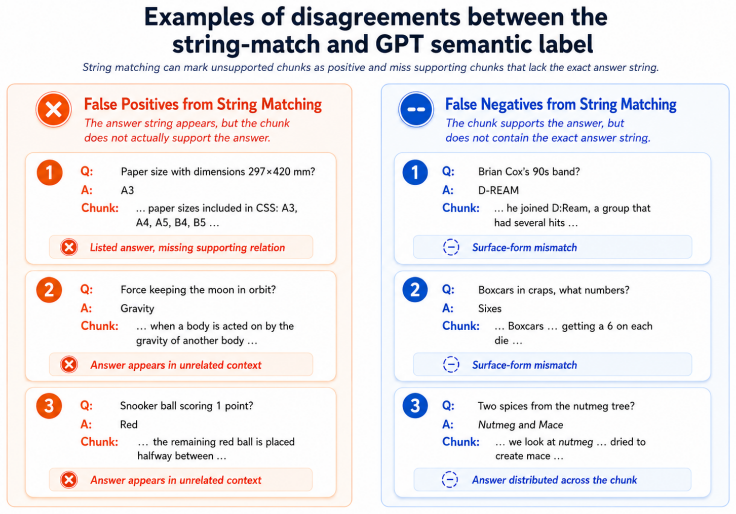
- Supervision based on evidence sufficiency rather than answer-string containment changes which chunk counts as correct, and lexical containment agrees with the semantic labels on only 78% of chunks, so label quality is a first-order factor in measured selection accuracy.
- The budget-aware feature mask provides a smooth accuracy-efficiency curve: even 10% of input dimensions beats the retrieval-rank baseline, and a 20%-dimension selector already matches KNRM's average accuracy.
- PopQA shows the largest improvement (70.87 vs. 66.76 for KNRM), consistent with cases where multiple retrieved chunks share the same entity but only one carries the relation needed to answer.
Reading between the lines
- A direct test of whether the selector learns evidence rather than position would be to shuffle the order of the five chunk embeddings at inference or retrain on permuted orders. If rank-1 accuracy collapses, the flattened $E$ in Eq. (3) has let the MLP exploit retrieval-order position as a shortcut.
- If the evidence-prototype idea holds, it could generalize beyond text chunks to other selection settings, such as multi-vector or cross-modal retrieval, where one predicted prototype can rank candidates without pairwise scoring.
- The 2.49-point margin is measured against labels produced by one automated annotator; human re-annotation of a sample would likely shift absolute accuracies and could change the margin, even if the relative ordering of methods persists.
- If the approach is sound, future mobile RAG designs could train the selector jointly with the generator or reuse the warmup KV cache more aggressively, since the query-side computation is already amortized across selection and generation.
Editorial analysis
A structured set of objections, weighed in public.
Referee Report
Summary. The paper proposes a lightweight, 7M-parameter chunk selector for mobile retrieval-augmented generation. The selector combines three feature sources—the generator's final-token hidden state, MoE routing-weighted expert responses, and the embeddings of the top-5 retrieved chunks—and uses a compact MLP to predict an evidence prototype in chunk-embedding space; the chunk with highest cosine similarity to this prototype is selected. To obtain chunk-level supervision, the authors construct semantic support labels using GPT-5.1 as an automated annotator, and they also introduce a gradient-based feature-budget reduction. Experiments on TriviaQA, PopQA, and MS MARCO Passage Ranking report rank-1 chunk-selection accuracy, with an average improvement of 2.49 percentage points over the strongest mobile-applicable baseline (KNRM).
Significance. If the empirical results are robust, the paper demonstrates a parameter-efficient strategy for single-chunk context reduction that reuses generator warmup features and avoids large cross-encoder rerankers, which is relevant for mobile/edge RAG. The paper also contributes a chunk-level supervision formulation based on evidential sufficiency and a feature-budget analysis. However, the headline claim rests on unvalidated GPT-5.1-generated labels, and the reported accuracy margins are small and lack statistical grounding. The contribution is therefore promising but currently conditional on the reliability of the annotation procedure and on ruling out positional shortcuts in the input representation.
major comments (4)
- [§4.1] The semantic support labels produced by GPT-5.1 serve as ground truth for both training (Eq. 8) and evaluation (Tables 1-3). The only validation reported is a preliminary 78% agreement with lexical answer-containment; no human annotation, inter-annotator agreement, or label-quality statistics are provided. Since the label definition is the task definition, the 2.49 pp advantage may reflect reproducing GPT-5.1's annotation biases rather than selecting genuinely sufficient evidence. Please add a human-annotated sample per dataset, report agreement and prevalence, and evaluate robustness by training/evaluating on lexical labels or a separate human-labeled set.
- [§3.3, Eq. (3)] The input E is formed by flattening top-K chunk embeddings in retrieval order, so the MLP input encodes position. The model can learn a rank prior or copy the embedding at a position that is often positive; the statement that 'retrieval rank is not used as the supervision target' does not rule out position as an input feature. To support the evidence-prototype interpretation, add an ablation that shuffles the K chunk embeddings at train/inference or removes positional identities. If accuracy degrades substantially, the method is exploiting rank rather than evidence alignment.
- [§5.2, Table 1] No train/validation/test split, dataset sizes, number of runs, or significance tests are reported. Gains over KNRM are small (0.85 pp on MS MARCO PR, 2.52 pp on TriviaQA), and the headline 2.49 pp average has no error bars or confidence intervals. Report bootstrap confidence intervals or multiple-seed results, and state explicitly whether rank-1 accuracy is computed only on instances with at least one positive label; §4.2 leaves this ambiguous.
- [§3.2, Table 3] The gradient-based feature mask is selected using the training set (Eq. 4) and then the reduced model is retrained on the same data. There is no held-out safeguard for the mask, so the feature-budget curve in Table 3 could reflect overfitting to training importance estimates. Specify whether mask selection uses a validation set and report variance across random initializations.
minor comments (5)
- [§4.1] The annotation is described only as 'GPT-5.1'; please include the exact model version, decoding parameters, number of annotation calls per chunk, and consistency checks. Also clarify what 'preliminary comparison' means and on what subset the 78% agreement was computed.
- [§5.1] The retrieval protocol is fixed across datasets, but retrieval quality is not reported. Adding recall@5 or similar would help contextualize the rank-1 selection ceiling.
- [§6.1] Tables 1 and 2 report single runs. Even if raw numbers are standard for this benchmark, a statement about the number of seeds or variance would improve interpretability.
- [§2.4] Some baselines (RankSVM, LambdaMART, DUET, DRMM) have no training details or hyperparameter settings. Please specify how they were trained/tuned to ensure fair comparison.
- [§6.1] 'RAG baseline' and 'rank baseline' are used interchangeably across sections; pick one term and use it consistently.
Circularity Check
No significant circularity: the selector's prototype is a learned function, evaluation is against independent (if automated) labels, and self-citations are motivational only.
full rationale
The paper's derivation chain is not circular. The input vector in Eq. (1) is a concatenation of the question hidden state h, routing feature r, and flattened top-5 chunk embeddings E (Eq. 3). Eq. (6) defines the evidence prototype as an MLP output ŷ = f_θ(x′), Eq. (7) scores each candidate by cosine similarity between the normalized prototype and each chunk embedding, Eq. (8) is a standard multi-target contrastive loss supervised by GPT-5.1 semantic-support labels, and Eq. (9) selects the argmax. No equation is defined in terms of the quantity it is used to predict; the prototype is a learned representation, not a fitted parameter, and rank-1 accuracy is measured against chunk labels that are external to the model even though they are generated by an automated annotator. The possible weaknesses are data-quality issues rather than circularity: the GPT-5.1 labels are used for both training and evaluation and only 78% agreement with answer-string containment is reported with no human validation, so the headline gains could partly reflect agreement with one annotator's bias. That is a validity concern, not an equation-level reduction. Some motivating citations for using MoE routing features are self-citations (references [15]–[18]), but the claim that routing weights are embedding-like is supported by independent work [14] and, more importantly, is evaluated directly in the ablation study (Table 2), so the central result does not rest on those self-citations. No load-bearing self-citation, imported uniqueness theorem, or ansatz smuggled in via citation is present. The comparison against KNRM and other baselines is an independent empirical measurement on the same labeled data, so the 2.49-point average improvement is not forced by construction.
Assumptions & free parameters
free parameters (5)
- Evidence prototype mapping (MLP weights) =
trained, 7M parameters
- Contrastive temperature tau =
not reported
- Number of retrieved candidates K =
5
- MLP architecture =
three 1024-width hidden layers
- Feature retention budget X =
10% to 100% in 10% steps
assumptions (5)
- domain assumption Retrieval similarity does not imply evidential sufficiency
- domain assumption Question-only warmup hidden state and MoE routing features from the generator are reusable and informative for evidence selection
- domain assumption Cosine similarity between a predicted prototype and chunk embeddings is a valid scoring function for evidence selection
- ad hoc to paper GPT-5.1 semantic support labels are a reliable ground truth for evidence sufficiency
- domain assumption The top-5 retrieved chunks contain the answer evidence for answerable instances
invented entities (1)
-
Evidence prototype (y-hat)
Cite this review
Pith. "Pith review of Lightweight Chunk Selection for Mobile Retrieval-Augmented Generation." pith.science (2026). https://pith.science/paper/QZ6PGDT3
@misc{pith2026260803148,
  author       = {Pith},
  title        = {Pith review of: Lightweight Chunk Selection for Mobile Retrieval-Augmented Generation},
  year         = {2026},
  howpublished = {\url{https://pith.science/paper/QZ6PGDT3}},
  note         = {Machine review of arXiv:2608.03148}
}
read the original abstract
RAG improves the factual grounding of LLM by incorporating external knowledge, but deploying RAG on mobile and edge devices remains challenging because retrieved context increases computation and memory. A direct way to reduce this cost is to retain only one retrieved chunk before generation, but the top-ranked retrieved chunk is not always the most evidence-supporting one, since retrieval similarity does not necessarily imply evidential sufficiency. Existing context-reduction methods can improve context quality, but often require additional LLMs or compressors that are costly under a strict mobile budget. In this paper, we study lightweight RAG chunk selection as an evidence-alignment problem. Our selector combines three complementary feature sources: question hidden states that represent LLM-side query intent, MoE routing-derived expert signals that capture the generator's internal routing structure, and retrieved chunk embeddings that preserve candidate-side evidence geometry. A compact multilayer perceptron maps these features to an evidence prototype in the chunk embedding space, and the candidate most aligned with this prototype is selected by cosine similarity. For stricter deployment budgets, we further introduce an optional task-aware feature selection strategy to reduce the selector input dimension. To support supervised evaluation, we construct semantic chunk-correctness labels based on evidence sufficiency rather than answer-string containment. Experiments show that the proposed selector consistently improves rank-1 evidence selection over mobile-applicable baselines by an average of 2.5%. These results suggest that using LLM-side query representations and MoE routing information and aligning them with retrieval-side candidate embedding is an effective and parameter-efficient strategy for mobile-applicable RAG chunk selection.
Figures


Figures from the paper (1 more)
Reference graph
Works this paper leans on
-
[1]
P. Lewis, E. Perez, A. Piktus, F. Petroni, V. Karpukhin, N. Goyal, H. Küttler, M. Lewis, W.-t. Yih, T. Rocktäschel, S. Riedel, D. Kiela, Retrieval-augmented generation for knowledge-intensive nlp tasks, in: Advances in Neural Information Processing Systems, Vol. 33, 2020, pp. 9459–9474. URLhttps://arxiv.org/abs/2005.11401
arXiv 2020
-
[2]
A. Q. Jiang, A. Sablayrolles, A. Roux, A. Mensch, B. Savary, C. Bam- ford, D. S. Chaplot, D. de las Casas, E. Bou Hanna, F. Bressand, et al., Mixtral of experts, arXiv preprint arXiv:2401.04088 (2024). doi:10.48550/arXiv.2401.04088. URLhttps://arxiv.org/abs/2401.04088
-
[3]
DeepSeek-AI, DeepSeek-V3 technical report, arXiv preprint arXiv:2412.19437 (2024). doi:10.48550/arXiv.2412.19437. URLhttps://arxiv.org/abs/2412.19437
-
[4]
A. Yang, A. Li, B. Yang, B. Zhang, B. Hui, B. Zheng, B. Yu, C. Gao, C. Huang, C. Lv, et al., Qwen3 technical report, arXiv preprint arXiv:2505.09388 (2025). doi:10.48550/arXiv.2505.09388. URLhttps://arxiv.org/abs/2505.09388
-
[5]
D. H. Kang, H. Lee, H. Cha, On device RAG for first aid guidance in offline mobile environment, arXiv preprint arXiv:2602.13229 (2026). 22
arXiv 2026
-
[6]
V. Karpukhin, B. Oguz, S. Min, P. Lewis, L. Wu, S. Edunov, D. Chen, W.-t. Yih, Dense passage retrieval for open-domain question answering, in: Proceedings of the 2020 Conference on Empirical Methods in Natural Language Processing, Association for Computational Linguistics, 2020, pp. 6769–6781. doi:10.18653/v1/2020.emnlp-main.550. URLhttps://aclanthology.o...
-
[8]
Z. Pan, Q. Wu, H. Jiang, M. Xia, X. Luo, J. Zhang, Q. Lin, V. Rühle, Y. Yang, C.-Y. Lin, H. V. Zhao, L. Qiu, D. Zhang, LLMLingua-2: Data distillation for efficient and faithful task-agnostic prompt compression (2024). arXiv:2403.12968, doi:10.48550/arXiv.2403.12968. URLhttps://arxiv.org/abs/2403.12968
-
[9]
F. Xu, W. Shi, E. Choi, RECOMP: Improving retrieval-augmented lms with compression and selective augmentation, arXiv preprint arXiv:2310.04408 (2023). URLhttps://arxiv.org/abs/2310.04408
arXiv 2023
Show all 39 references
-
[10]
Chirkova, T
N. Chirkova, T. Formal, V. Nikoulina, S. Clinchant, Provence: Efficient and robust context pruning for retrieval-augmented generation, arXiv preprint arXiv:2501.16214 (2025). URLhttps://arxiv.org/abs/2501.16214
2025 arXiv
-
[11]
Nogueira, K
R. Nogueira, K. Cho, Passage re-ranking with BERT, arXiv preprint arXiv:1901.04085 (2019). URLhttps://arxiv.org/abs/1901.04085
1901 arXiv
-
[12]
BAAI, BGE-Reranker-v2: Bge reranker documentation,https:// bge-model.com/bge/bge\_reranker\_v2.html, accessed 2026-07-09 (2024)
2026
-
[13]
Jiang, One model is enough: Native retrieval embeddings from LLM agent hidden states, arXiv preprint arXiv:2603.08429 (2026)
B. Jiang, One model is enough: Native retrieval embeddings from LLM agent hidden states, arXiv preprint arXiv:2603.08429 (2026). 23 doi:10.48550/arXiv.2603.08429. URLhttps://arxiv.org/abs/2603.08429
2026 doi
-
[14]
Z. Li, T. Zhou, Your mixture-of-experts LLM is secretly an embedding model for free, in: The Thirteenth International Conference on Learning Representations, 2025. URLhttps://openreview.net/forum?id=eFGQ97z5Cd
2025
-
[15]
W. H. Raza, Y. Wen, A. B. Shah, Y. Shen, J. Martinez-Lemus, M. C. Schiess, T. M. Ellmore, R. Hu, X. Fu, Neuromoe++: Patient-adaptive multi-level multimodal fusion with mixture-of-experts for neurological disorder classification, IEEE Transactions on Biomedical Engineering (202...
2026
-
[16]
W. H. Raza, A. B. Shah, Y. Wen, Y. Shen, J. D. M. Lemus, M. C. Schiess, T. M. Ellmore, R. Hu, X. Fu, Neuromoe: A transformer- based mixture-of-experts framework for multi-modal neurological dis- order classification (2025). arXiv:2506.14970. URLhttps://arxiv.org/abs/2506.14970
2025 arXiv
-
[17]
A. B. Shah, Y. Wen, R. Hu, J. Chen, J. L. Contreras-Vidal, X. Wu, X. Fu, Cogmoe: Signal-quality–guided multimodal moe for cognitive load prediction (2026)
2026
-
[18]
W. H. Raza, M. Schiess, J. M. Lemus, T. M. Ellmore, C. Green, C.Soto, X.Fu, R.Hu, R2moe: Representationandexpertselectiondual- regularized mixture-of-experts for multimodal clinical data, in: Proceed- ings of the IEEE/CVF Conference on Computer Vision and Pattern Recognition (...
2026
-
[19]
Muennighoff, L
N. Muennighoff, L. Soldaini, D. Groeneveld, K. Lo, J. Morrison, S. Min, W. Shi, P. Walsh, O. Tafjord, N. Lambert, et al., OLMoE: Open mixture-of-experts language models, arXiv preprint arXiv:2409.02060 (2024). doi:10.48550/arXiv.2409.02060. URLhttps://arxiv.org/abs/2409.02060
-
[20]
Bandarkar, C
L. Bandarkar, C. Yang, M. Fayyaz, J. Hu, N. Peng, Multilingual routing in mixture-of-experts, in: The Fourteenth International Conference on Learning Representations, 2026. URLhttps://openreview.net/forum?id=ZoZR0x7tTD 24
2026
-
[21]
Fedus, B
W. Fedus, B. Zoph, N. Shazeer, Switch transformers: Scaling to trillion parameter models with simple and efficient sparsity, Journal of Machine Learning Research 23 (120) (2022) 1–39. URLhttps://jmlr.org/papers/v23/21-0998.html
2022
-
[22]
Y. Li, B. Dong, F. Guerin, C. Lin, Compressing context to enhance inference efficiency of large language models, in: Proceedings of the 2023 Conference on Empirical Methods in Natural Language Processing, Association for Computational Linguistics, Singapore, 2023, pp. 6342–
2023
-
[23]
Jiang, Q
H. Jiang, Q. Wu, C.-Y. Lin, Y. Yang, L. Qiu, LLMLingua: Compressing prompts for accelerated inference of large language models, in: Proceed- ings of the 2023 Conference on Empirical Methods in Natural Language Processing, Association for Computational Linguistics, Singapore, 2...
2023 doi
- [24]
-
[25]
Z. Wang, J. Araki, Z. Jiang, M. R. Parvez, G. Neubig, Learning to filter context for retrieval-augmented generation (2023). arXiv:2311.08377. URLhttps://arxiv.org/abs/2311.08377
2023 arXiv
-
[26]
Sentenceembeddingoptimizer — llamaindex documentation, accessed: 2026-02-26 (2026)
2026
-
[27]
deepset.ai/docs/rankers, accessed: 2026-02-26 (2026)
Rankers — haystack documentation,https://docs.haystack. deepset.ai/docs/rankers, accessed: 2026-02-26 (2026)
2026
-
[28]
C. Yoon, T. Lee, H. Hwang, M. Jeong, J. Kang, Compact: Compress- ing retrieved documents actively for question answering, in: Proceed- ings of the 2024 Conference on Empirical Methods in Natural Language Processing, Association for Computational Linguistics, Miami, Florida, US...
2024 doi
- [29]
-
[30]
LLMChainExtractor — langchain documentation (v0.3), accessed: 2026-02-26 (2026)
2026
-
[31]
Robertson, H
S. Robertson, H. Zaragoza, The probabilistic relevance framework: Bm25 and beyond, Foundations and Trends in Information Retrieval 3 (4) (2009) 333–389. doi:10.1561/1500000019. URLhttps://doi.org/10.1561/1500000019
2009 doi
-
[32]
Joachims, Optimizing search engines using clickthrough data, in: Proceedings of the Eighth ACM SIGKDD International Conference on Knowledge Discovery and Data Mining, ACM, 2002, pp
T. Joachims, Optimizing search engines using clickthrough data, in: Proceedings of the Eighth ACM SIGKDD International Conference on Knowledge Discovery and Data Mining, ACM, 2002, pp. 133–142. doi:10.1145/775047.775067. URLhttps://doi.org/10.1145/775047.775067
2002
-
[33]
C. J. C. Burges, From ranknet to lambdarank to lambdamart: An overview, Tech. Rep. MSR-TR-2010-82, Microsoft Research (2010)
2010
-
[34]
Mitra, F
B. Mitra, F. Diaz, N. Craswell, Learning to match using local and dis- tributed representations of text for web search, in: Proceedings of the 26th International Conference on World Wide Web, WWW ’17, Inter- national World Wide Web Conferences Steering Committee, 2017, pp. 129...
2017
-
[35]
J. Guo, Y. Fan, Q. Ai, W. B. Croft, A deep relevance matching model for ad-hoc retrieval, in: Proceedings of the 25th ACM Inter- national on Conference on Information and Knowledge Management, CIKM ’16, Association for Computing Machinery, 2016, pp. 55–64. doi:10.1145/2983323....
2016
-
[36]
Xiong, Z
C. Xiong, Z. Dai, J. Callan, Z. Liu, R. Power, End-to-end neural ad-hoc ranking with kernel pooling, in: Proceedings of the 40th International ACM SIGIR Conference on Research and Development in Information Retrieval, SIGIR ’17, Association for Computing Machinery, 2017, pp. 2...
2017
-
[37]
Reimers, I
N. Reimers, I. Gurevych, Sentence-bert: Sentence embeddings using siamese bert-networks, in: Proceedings of the 2019 Conference on Em- pirical Methods in Natural Language Processing and the 9th Interna- tional Joint Conference on Natural Language Processing, Association for Co...
2019 doi
-
[38]
co/sentence-transformers/all-MiniLM-L6-v2, accessed: 2026-07- 11 (2021)
Sentence Transformers,all-MiniLM-L6-v2,https://huggingface. co/sentence-transformers/all-MiniLM-L6-v2, accessed: 2026-07- 11 (2021)
2026
- [39]
-
[6353]
URLhttps://aclanthology.org/2023.emnlp-main.391/
doi:10.18653/v1/2023.emnlp-main.391. URLhttps://aclanthology.org/2023.emnlp-main.391/
2023 doi
Reviewed August 6, 2026 · model on record in the stance chip above.
Discussion (0). Continue with ORCID to comment.