Susceptibility-kinetic uncertainty relations for quantum systems
Pith reviewed 2026-07-02 11:55 UTC · model grok-4.3
The pith
A susceptibility-kinetic uncertainty relation bounds current precision in any open quantum system using partial dynamical activity.
A machine-rendered reading of the paper's core claim, the machinery that carries it, and where it could break.
Core claim
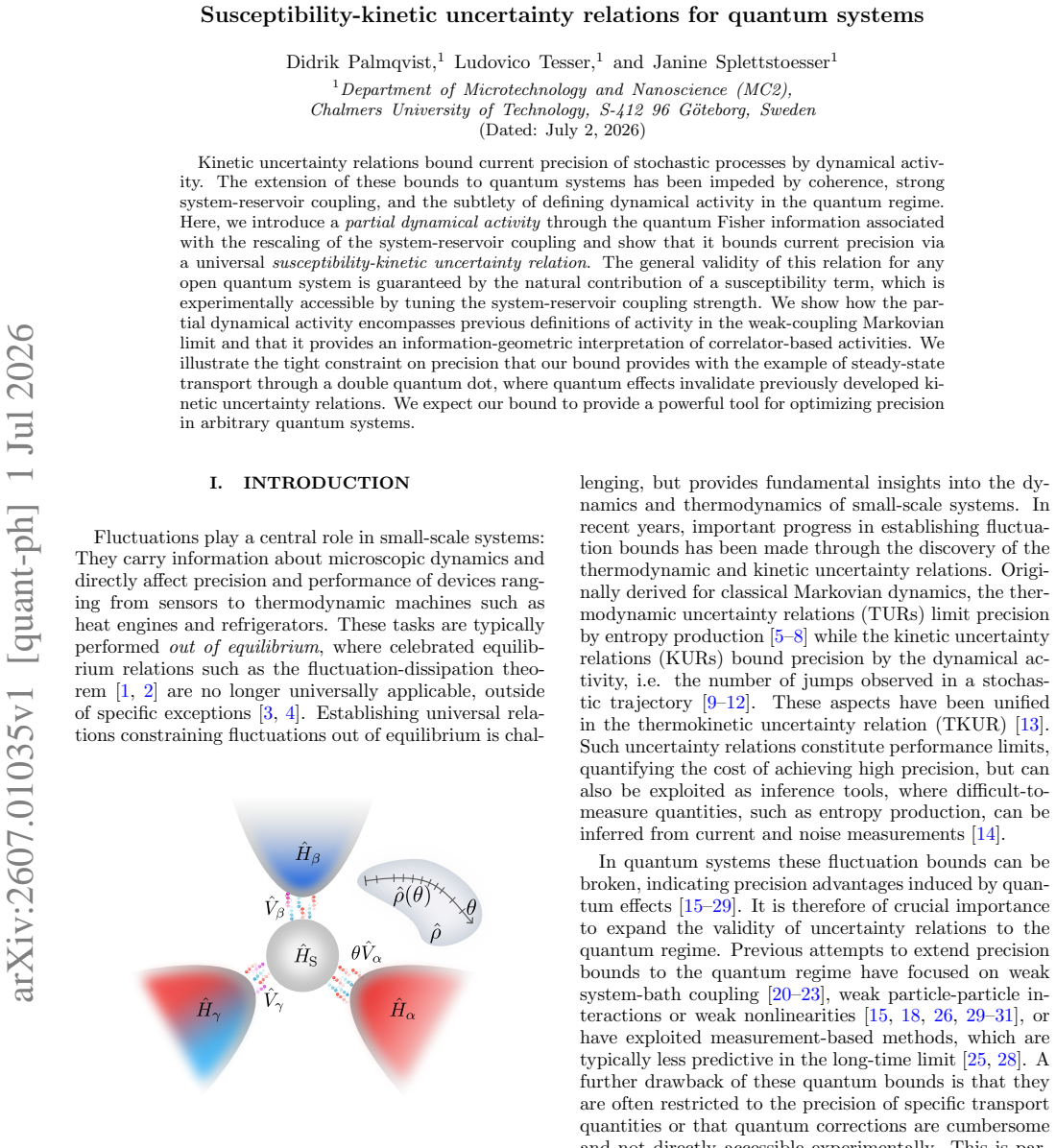
We introduce a partial dynamical activity through the quantum Fisher information associated with the rescaling of the system-reservoir coupling and show that it bounds current precision via a universal susceptibility-kinetic uncertainty relation. The general validity of this relation for any open quantum system is guaranteed by the natural contribution of a susceptibility term, which is experimentally accessible by tuning the system-reservoir coupling strength. We show how the partial dynamical activity encompasses previous definitions of activity in the weak-coupling Markovian limit and that it provides an information-geometric interpretation of correlator-based activities. We illustrate th
What carries the argument
Partial dynamical activity defined via the quantum Fisher information for rescaling the system-reservoir coupling strength, which together with a susceptibility term yields the susceptibility-kinetic uncertainty relation bounding current precision.
If this is right
- The bound applies in non-Markovian and strong-coupling regimes.
- It recovers earlier kinetic uncertainty relations in the weak-coupling Markovian limit.
- It supplies an information-geometric interpretation for correlator-based activities.
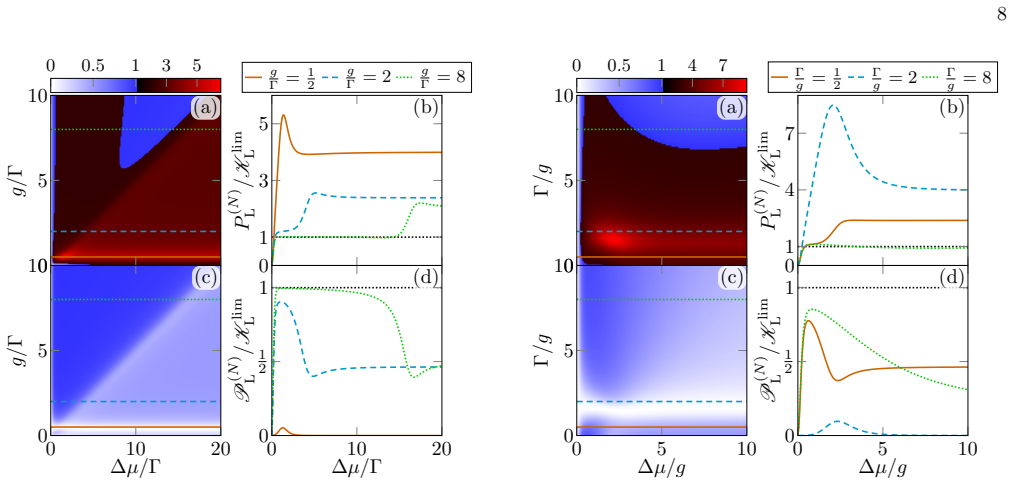
- The bound tightly constrains precision for steady-state transport in a double quantum dot where prior relations fail.
Where Pith is reading between the lines
- The relation could be checked by varying coupling strength in a quantum-dot experiment and isolating the susceptibility contribution.
- Similar Fisher-information constructions might bound precision for other observables such as heat currents.
- The approach suggests a route to precision optimization in quantum devices by direct measurement of the activity term.
Load-bearing premise
That the quantum Fisher information with respect to rescaling the system-reservoir coupling strength defines a partial dynamical activity that, together with the susceptibility term, universally bounds current precision in arbitrary open quantum systems.
What would settle it
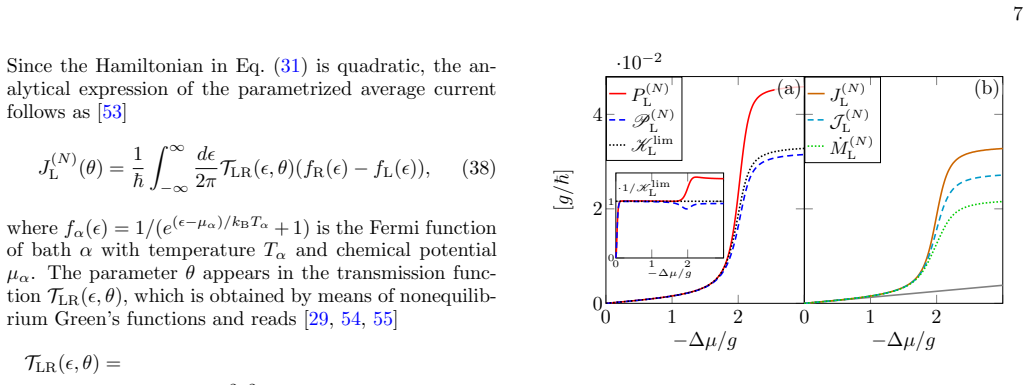
Measure current precision, the quantum Fisher information for coupling rescaling, and the susceptibility term in steady-state transport through a double quantum dot, then test whether the proposed uncertainty relation holds.
Figures
read the original abstract
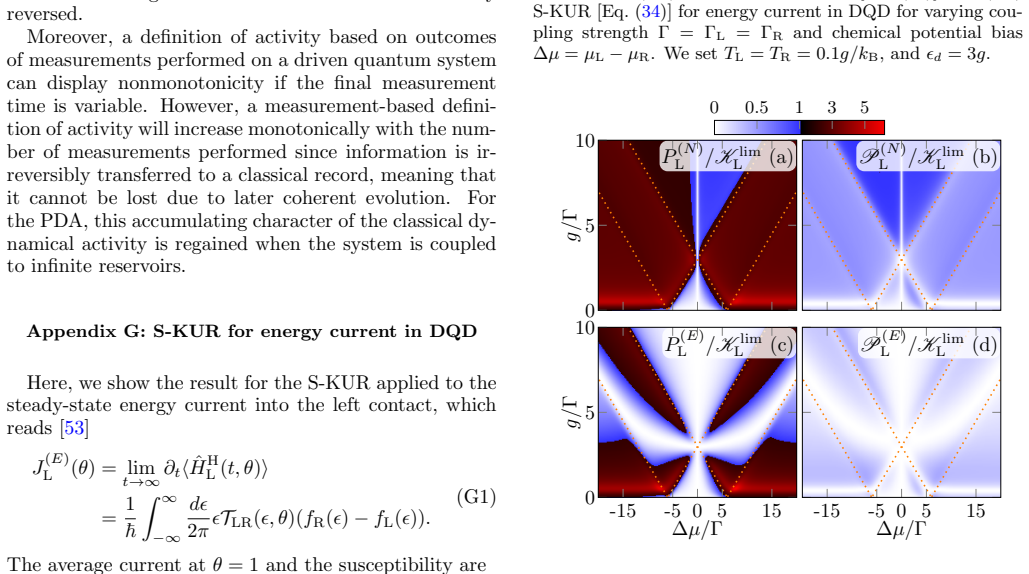
Kinetic uncertainty relations bound current precision of stochastic processes by dynamical activity. The extension of these bounds to quantum systems has been impeded by coherence, strong system-reservoir coupling, and the subtlety of defining dynamical activity in the quantum regime. Here, we introduce a partial dynamical activity through the quantum Fisher information associated with the rescaling of the system-reservoir coupling and show that it bounds current precision via a universal susceptibility-kinetic uncertainty relation. The general validity of this relation for any open quantum system is guaranteed by the natural contribution of a susceptibility term, which is experimentally accessible by tuning the system-reservoir coupling strength. We show how the partial dynamical activity encompasses previous definitions of activity in the weak-coupling Markovian limit and that it provides an information-geometric interpretation of correlator-based activities. We illustrate the tight constraint on precision that our bound provides with the example of steady-state transport through a double quantum dot, where quantum effects invalidate previously developed kinetic uncertainty relations. We expect our bound to provide a powerful tool for optimizing precision in arbitrary quantum systems.
Editorial analysis
A structured set of objections, weighed in public.
Referee Report
Summary. The manuscript introduces a partial dynamical activity defined via the quantum Fisher information associated with rescaling the system-reservoir coupling strength. It claims this quantity, together with a susceptibility term, yields a universal susceptibility-kinetic uncertainty relation bounding current precision in arbitrary open quantum systems (including non-Markovian and strong-coupling regimes). The relation is asserted to hold generally due to the natural contribution of the susceptibility term, to reduce to prior activity definitions in the weak-coupling Markovian limit, to admit an information-geometric interpretation of correlator-based activities, and to be illustrated by a double quantum dot steady-state transport example where quantum effects violate earlier KURs.
Significance. If the central derivation is sound, the result would meaningfully extend kinetic uncertainty relations beyond the Markovian weak-coupling regime where prior bounds fail due to coherence and strong coupling. The experimental accessibility of the susceptibility term via coupling tuning and the information-geometric framing are concrete strengths. The double quantum dot illustration supplies a falsifiable test case.
major comments (3)
- [Section 3] The derivation establishing the susceptibility-kinetic uncertainty relation (Section 3, around the statement that validity is 'guaranteed by the natural contribution of a susceptibility term'): the steps connecting the QFI-based partial activity to the final inequality must be shown explicitly, including the precise inequality (Cauchy-Schwarz, quantum Cramér-Rao, or other) and how the susceptibility term compensates for arbitrary memory kernels without additional restrictions on the coupling form or non-Markovianity.
- [Introduction and Section 3] The claim of universality for any open quantum system (Introduction and Section 3): the argument that the susceptibility term closes the bound in strong-coupling and non-Markovian regimes requires a concrete counter-example check or proof that no further assumptions on the Liouvillian or memory kernel are needed; the abstract assertion alone is insufficient for a load-bearing universality statement.
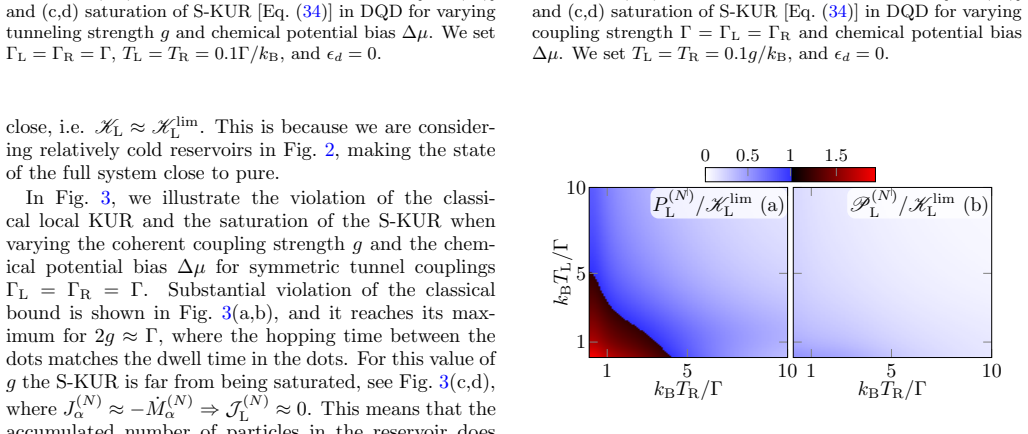
- [Section 5] Double quantum dot example (Section 5): the numerical comparison showing that the new bound remains tight while prior KURs are violated must include the explicit parameter values, the computed partial activity and susceptibility, and the resulting precision ratios so that the claimed improvement can be reproduced.
minor comments (2)
- [Section 2] Notation for the partial dynamical activity should be introduced with a clear symbol (e.g., A_partial) and kept consistent between the general definition and the weak-coupling reduction.
- [Section 5] Figure captions for the double quantum dot plots should state the precise values of the coupling strength and bias used so that the tightness of the bound is immediately verifiable.
Simulated Author's Rebuttal
We thank the referee for the positive evaluation and detailed comments on our manuscript. We address each major comment below and have revised the manuscript to strengthen the presentation.
read point-by-point responses
-
Referee: [Section 3] The derivation establishing the susceptibility-kinetic uncertainty relation (Section 3, around the statement that validity is 'guaranteed by the natural contribution of a susceptibility term'): the steps connecting the QFI-based partial activity to the final inequality must be shown explicitly, including the precise inequality (Cauchy-Schwarz, quantum Cramér-Rao, or other) and how the susceptibility term compensates for arbitrary memory kernels without additional restrictions on the coupling form or non-Markovianity.
Authors: We agree that the intermediate steps require explicit expansion for clarity. In the revised manuscript we have added a detailed derivation in Section 3 that applies the Cauchy-Schwarz inequality directly to the covariance between the current and the QFI-based activity operator, followed by the quantum Cramér-Rao bound on the susceptibility. We explicitly show that the susceptibility term, obtained by differentiating the steady-state current with respect to the coupling strength, cancels the contributions from arbitrary memory kernels without imposing restrictions on the Liouvillian or coupling form. revision: yes
-
Referee: [Introduction and Section 3] The claim of universality for any open quantum system (Introduction and Section 3): the argument that the susceptibility term closes the bound in strong-coupling and non-Markovian regimes requires a concrete counter-example check or proof that no further assumptions on the Liouvillian or memory kernel are needed; the abstract assertion alone is insufficient for a load-bearing universality statement.
Authors: We acknowledge that the universality statement benefits from a more explicit justification. The revised Section 3 now contains a general argument demonstrating that the susceptibility term compensates for any memory kernel by construction, as it arises from the same parameter derivative that defines the partial activity; no additional assumptions on the Liouvillian are required. We also include a brief analytic check confirming the bound remains valid in a simple non-Markovian strong-coupling limit. revision: yes
-
Referee: [Section 5] Double quantum dot example (Section 5): the numerical comparison showing that the new bound remains tight while prior KURs are violated must include the explicit parameter values, the computed partial activity and susceptibility, and the resulting precision ratios so that the claimed improvement can be reproduced.
Authors: We agree that explicit numerical values are necessary for reproducibility. The revised Section 5 now reports the precise Hamiltonian parameters, coupling strengths, and decoherence rates used for the double quantum dot; it tabulates the computed partial dynamical activity, susceptibility, and the resulting precision ratios for both the new bound and the earlier KURs, allowing direct verification of the claimed tightness. revision: yes
Circularity Check
No significant circularity detected
full rationale
The provided abstract and summary introduce a partial dynamical activity defined via quantum Fisher information for rescaling the system-reservoir coupling, then assert a bound on current precision through a susceptibility-kinetic uncertainty relation whose validity is guaranteed by the susceptibility term. No equations, self-citations, or derivation steps are quoted that reduce the claimed universal bound to a fitted input, self-definition, or prior author result by construction. The paper states it recovers prior activity definitions in the weak-coupling Markovian limit and offers an information-geometric view, but these are presented as extensions rather than tautological renamings or load-bearing self-citations. The derivation chain is therefore self-contained against external benchmarks with no exhibited reduction of outputs to inputs.
Axiom & Free-Parameter Ledger
axioms (1)
- standard math Standard framework of open quantum systems, including quantum Fisher information and master equation descriptions of system-reservoir coupling.
invented entities (1)
-
partial dynamical activity
no independent evidence
Reference graph
Works this paper leans on
-
[1]
Thermal Agitation of Electricity in Con- ductors,
J. B. Johnson, “Thermal Agitation of Electricity in Con- ductors,” Nature119, 50–51 (1927)
1927
-
[2]
Thermal Agitation of Electric Charge in Conductors,
H. Nyquist, “Thermal Agitation of Electric Charge in Conductors,” Phys. Rev.32, 110–113 (1928)
1928
-
[3]
Fluctuation-Dissipation Relations Far from Equilibrium,
Bernhard Altaner, Matteo Polettini, and Massimiliano Esposito, “Fluctuation-Dissipation Relations Far from Equilibrium,” Phys. Rev. Lett.117, 180601 (2016)
2016
-
[4]
Fluctua- tion–response inequality out of equilibrium,
Andreas Dechant and Shin-ichi Sasa, “Fluctua- tion–response inequality out of equilibrium,” Proc. Natl. Acad. Sci. U.S.A.117, 6430–6436 (2020)
2020
-
[5]
Thermodynamic Un- certainty Relation for Biomolecular Processes,
Andre C. Barato and Udo Seifert, “Thermodynamic Un- certainty Relation for Biomolecular Processes,” Phys. Rev. Lett.114, 158101 (2015)
2015
-
[6]
Dissipation Bounds All Steady-State Current Fluctuations,
Todd R. Gingrich, Jordan M. Horowitz, Nikolay Pe- runov, and Jeremy L. England, “Dissipation Bounds All Steady-State Current Fluctuations,” Phys. Rev. Lett. 116, 120601 (2016)
2016
-
[7]
Thermo- dynamic uncertainty relations constrain non-equilibrium fluctuations,
Jordan M. Horowitz and Todd R. Gingrich, “Thermo- dynamic uncertainty relations constrain non-equilibrium fluctuations,” Nat. Phys.16, 15–20 (2020)
2020
-
[8]
Thermodynamic Uncer- tainty Relation for Time-Dependent Driving,
Timur Koyuk and Udo Seifert, “Thermodynamic Uncer- tainty Relation for Time-Dependent Driving,” Phys. Rev. Lett.125, 260604 (2020)
2020
-
[9]
Kinetic uncertainty relation,
Ivan Di Terlizzi and Marco Baiesi, “Kinetic uncertainty relation,” J. Phys. A: Math. Theor.52, 02LT03 (2018)
2018
-
[10]
Kinetic Uncertainty Relations for the Control of Stochastic Reaction Networks,
Jiawei Yan, Andreas Hilfinger, Glenn Vinnicombe, and Johan Paulsson, “Kinetic Uncertainty Relations for the Control of Stochastic Reaction Networks,” Phys. Rev. Lett.123, 108101 (2019)
2019
-
[11]
Kinetic uncertainty re- lation on first-passage time for accumulated current,
Ken Hiura and Shin-ichi Sasa, “Kinetic uncertainty re- lation on first-passage time for accumulated current,” Phys. Rev. E103, L050103 (2021)
2021
-
[12]
Dynamical activity univer- sally bounds precision of response in Markovian nonequi- librium systems,
Kangqiao Liu and Jie Gu, “Dynamical activity univer- sally bounds precision of response in Markovian nonequi- librium systems,” Commun. Phys.8, 1–9 (2025)
2025
-
[13]
Unified thermodynamic–kinetic uncertainty relation,
Van Tuan Vo, Tan Van Vu, and Yoshihiko Hasegawa, “Unified thermodynamic–kinetic uncertainty relation,” J. Phys. A: Math. Theor.55, 405004 (2022)
2022
-
[14]
From Stochastic Thermodynamics to Ther- modynamic Inference,
Udo Seifert, “From Stochastic Thermodynamics to Ther- modynamic Inference,” Annu. Rev. Condens. Matter Phys. , 171–192 (2019)
2019
-
[15]
Ther- modynamic Bounds on Precision in Ballistic Multiter- minal Transport,
Kay Brandner, Taro Hanazato, and Keiji Saito, “Ther- modynamic Bounds on Precision in Ballistic Multiter- minal Transport,” Physical Review Letters120, 090601 (2018)
2018
-
[16]
Assessing the validity of the thermodynamic uncertainty relation in quantum systems,
Bijay Kumar Agarwalla and Dvira Segal, “Assessing the validity of the thermodynamic uncertainty relation in quantum systems,” Phys. Rev. B98, 155438 (2018)
2018
-
[17]
Thermodynamic uncertainty relation in thermal transport,
Sushant Saryal, Hava Meira Friedman, Dvira Segal, and Bijay Kumar Agarwalla, “Thermodynamic uncertainty relation in thermal transport,” Phys. Rev. E100, 042101 (2019)
2019
-
[18]
Thermodynamic bounds on coher- ent transport in periodically driven conductors,
Elina Potanina, Christian Flindt, Michael Moskalets, and Kay Brandner, “Thermodynamic bounds on coher- ent transport in periodically driven conductors,” Physical Review X11, 021013 (2021)
2021
-
[19]
Entanglement and thermokinetic uncertainty relations in coherent mesoscopic transport,
Kacper Prech, Philip Johansson, Elias Nyholm, Gabriel T. Landi, Claudio Verdozzi, Peter Samuelsson, and Patrick P. Potts, “Entanglement and thermokinetic uncertainty relations in coherent mesoscopic transport,” Phys. Rev. Res.5, 023155 (2023)
2023
-
[20]
Quantum Thermodynamic Un- certainty Relation for Continuous Measurement,
Yoshihiko Hasegawa, “Quantum Thermodynamic Un- certainty Relation for Continuous Measurement,” Phys. Rev. Lett.125, 050601 (2020)
2020
-
[21]
Unifying speed limit, thermody- namic uncertainty relation and Heisenberg principle via bulk-boundary correspondence,
Yoshihiko Hasegawa, “Unifying speed limit, thermody- namic uncertainty relation and Heisenberg principle via bulk-boundary correspondence,” Nat. Commun.14, 2828 (2023)
2023
-
[22]
Role of Quantum Coherence in Kinetic Uncertainty Re- lations,
Kacper Prech, Patrick P. Potts, and Gabriel T. Landi, “Role of Quantum Coherence in Kinetic Uncertainty Re- lations,” Phys. Rev. Lett.134, 020401 (2025)
2025
-
[23]
Fundamental Bounds on Precision and Response for Quantum Trajectory Observables,
Tan Van Vu, “Fundamental Bounds on Precision and Response for Quantum Trajectory Observables,” PRX Quantum6, 010343 (2025)
2025
-
[24]
Precision is not limited by the sec- ond law of thermodynamics,
Florian Meier, Yuri Minoguchi, Simon Sundelin, Tony J. G. Apollaro, Paul Erker, Simone Gasparinetti, and Marcus Huber, “Precision is not limited by the sec- ond law of thermodynamics,” Nat. Phys.21, 1147–1152 (2025)
2025
-
[25]
Univer- sal Precision Limits in General Open Quantum Systems,
Tan Van Vu, Ryotaro Honma, and Keiji Saito, “Univer- sal Precision Limits in General Open Quantum Systems,” Phys. Rev. Lett.136, 190401 (2026)
2026
-
[26]
Thermodynamic Un- certainty Relations for Coherent Transport,
Kay Brandner and Keiji Saito, “Thermodynamic Un- certainty Relations for Coherent Transport,” Phys. Rev. Lett.135, 046302 (2025)
2025
-
[27]
Thermodynamic bound on current fluctuations in coherent conductors,
Kay Brandner and Keiji Saito, “Thermodynamic bound on current fluctuations in coherent conductors,” J. Phys. A: Math. Theor.58, 435002 (2025)
2025
-
[28]
Fundamental Precision Limits in Finite-Dimensional Quantum Thermal Machines,
Yoshihiko Hasegawa, “Fundamental Precision Limits in Finite-Dimensional Quantum Thermal Machines,” Phys. Rev. Lett.135, 200404 (2025)
2025
-
[29]
Quan- tum kinetic uncertainty relations in mesoscopic conduc- tors at strong coupling,
Gianmichele Blasi, Ricard Ravell Rodr´ ıguez, Mykhailo Moskalets, Rosa L´ opez, and G´ eraldine Haack, “Quan- tum kinetic uncertainty relations in mesoscopic conduc- tors at strong coupling,” arXiv (2025), arXiv:2505.13200
-
[30]
Kinetic Uncertainty Relations for Quan- tum Transport,
Didrik Palmqvist, Ludovico Tesser, and Janine Splettstoesser, “Kinetic Uncertainty Relations for Quan- tum Transport,” Phys. Rev. Lett.135, 166302 (2025)
2025
-
[31]
Combining kinetic and thermodynamic uncertainty relations in quantum transport,
Didrik Palmqvist, Ludovico Tesser, and Janine Splettstoesser, “Combining kinetic and thermodynamic uncertainty relations in quantum transport,” Quantum Sci. Technol.10, 035059 (2025)
2025
-
[32]
Quantum detection and estimation theory,
Carl W. Helstrom, “Quantum detection and estimation theory,” J. Stat. Phys.1, 231–252 (1969)
1969
-
[33]
Exact solution to quantum dynamical activity,
Tomohiro Nishiyama and Yoshihiko Hasegawa, “Exact solution to quantum dynamical activity,” Phys. Rev. E 109, 044114 (2024)
2024
-
[34]
Uni- 15 fied speed limits in classical and quantum dynam- ics via temporal Fisher information,
Tomohiro Nishiyama and Yoshihiko Hasegawa, “Uni- 15 fied speed limits in classical and quantum dynam- ics via temporal Fisher information,” arXiv (2025), 10.48550/arXiv.2504.04790, 2504.04790
-
[35]
Elec- tron transport through double quantum dots,
W. G. van der Wiel, S. De Franceschi, J. M. Elzerman, T. Fujisawa, S. Tarucha, and L. P. Kouwenhoven, “Elec- tron transport through double quantum dots,” Rev. Mod. Phys.75, 1–22 (2002)
2002
-
[36]
Fast sensing of double-dot charge arrangement and spin state with a radio-frequency sensor quantum dot,
C. Barthel, M. Kjærgaard, J. Medford, M. Stopa, C. M. Marcus, M. P. Hanson, and A. C. Gossard, “Fast sensing of double-dot charge arrangement and spin state with a radio-frequency sensor quantum dot,” Phys. Rev. B81, 161308 (2010)
2010
-
[37]
Quantum Fisher information matrix and mul- tiparameter estimation,
Jing Liu, Haidong Yuan, Xiao-Ming Lu, and Xiaoguang Wang, “Quantum Fisher information matrix and mul- tiparameter estimation,” J. Phys. A: Math. Theor.53, 023001 (2019)
2019
-
[38]
Thermokinetic Uncertainty Relations and Dynamical Activities in Quantum Systems,
Didrik Palmqvist, “Thermokinetic Uncertainty Relations and Dynamical Activities in Quantum Systems,” (2026), 551724
2026
-
[39]
Clock-Controlled Emission of Single-Electron Wave Packets in a Solid- State Circuit,
J. D. Fletcher, P. See, H. Howe, M. Pepper, S. P. Giblin, J. P. Griffiths, G. A. C. Jones, I. Farrer, D. A. Ritchie, T. J. B. M. Janssen, and M. Kataoka, “Clock-Controlled Emission of Single-Electron Wave Packets in a Solid- State Circuit,” Phys. Rev. Lett.111, 216807 (2013)
2013
-
[40]
Thermo- dynamic Concentration Inequalities and Trade-Off Rela- tions,
Yoshihiko Hasegawa and Tomohiro Nishiyama, “Thermo- dynamic Concentration Inequalities and Trade-Off Rela- tions,” Phys. Rev. Lett.133, 247101 (2024)
2024
-
[41]
Kinetic Uncertainty Relation in Collective Dissipative Quantum Many-Body Systems
Hayato Yunoki and Yoshihiko Hasegawa, “Ki- netic Uncertainty Relation in Collective Dissipa- tive Quantum Many-Body Systems,” arXiv (2026), 10.48550/arXiv.2604.05747, 2604.05747
work page internal anchor Pith review Pith/arXiv arXiv doi:10.48550/arxiv.2604.05747 2026
-
[42]
Thermodynamic Uncertainty Re- lation for General Open Quantum Systems,
Yoshihiko Hasegawa, “Thermodynamic Uncertainty Re- lation for General Open Quantum Systems,” Phys. Rev. Lett.126, 010602 (2021)
2021
-
[43]
thesis, Chalmers University of Technology, Sweden (2025), 544208
Ludovico Tesser,Thermodynamic constraints on noise, Ph.D. thesis, Chalmers University of Technology, Sweden (2025), 544208
2025
-
[44]
Tightening the thermodynamic uncertainty re- lations with null-entropy events: What we learn when nothing happens,
Abhaya S. Hegde, Andr´ e M. Timpanaro, and Gabriel T. Landi, “Tightening the thermodynamic uncertainty re- lations with null-entropy events: What we learn when nothing happens,” Phys. Rev. E113, 034111 (2026)
2026
-
[45]
Heinz-Peter Breuer and Francesco Petruccione,The The- ory of Open Quantum Systems(Oxford University Pres- sOxford, 2007)
2007
-
[46]
Fisher Informa- tion and the Quantum Cram\’er-Rao Sensitivity Limit of Continuous Measurements,
Søren Gammelmark and Klaus Mølmer, “Fisher Informa- tion and the Quantum Cram\’er-Rao Sensitivity Limit of Continuous Measurements,” Phys. Rev. Lett.112, 170401 (2014)
2014
-
[47]
Unified thermodynamic-kinetic uncertainty relation,
Van Tuan Vo, Tan Van Vu, and Yoshihiko Hasegawa, “Unified thermodynamic-kinetic uncertainty relation,” Journal of Physics A: Mathematical and Theoreti- cal55, 405004 (2022), arXiv:2203.11501 [cond-mat, physics:quant-ph]
-
[48]
The uncertainty relation between energy and time in nonrelativistic quantum me- chanics,
L. Mandelstam and Tamm I., “The uncertainty relation between energy and time in nonrelativistic quantum me- chanics,” J. Phys. (USSR)9, 249 (1945)
1945
-
[49]
Quantum speed limits: from Heisenberg’s uncertainty principle to opti- mal quantum control,
Sebastian Deffner and Steve Campbell, “Quantum speed limits: from Heisenberg’s uncertainty principle to opti- mal quantum control,” J. Phys. A: Math. Theor.50, 453001 (2017)
2017
-
[50]
Fluctuation Theorem Uncertainty Relation,
Yoshihiko Hasegawa and Tan Van Vu, “Fluctuation Theorem Uncertainty Relation,” Phys. Rev. Lett.123, 110602 (2019)
2019
-
[51]
Thermodynamic Uncertainty Re- lations from Exchange Fluctuation Theorems,
Andr´ e M. Timpanaro, Giacomo Guarnieri, John Goold, and Gabriel T. Landi, “Thermodynamic Uncertainty Re- lations from Exchange Fluctuation Theorems,” Phys. Rev. Lett.123, 090604 (2019)
2019
-
[52]
Thermodynamic uncertainty relations including measurement and feed- back,
Patrick P. Potts and Peter Samuelsson, “Thermodynamic uncertainty relations including measurement and feed- back,” Phys. Rev. E100, 052137 (2019)
2019
-
[53]
Landauer formula for the current through an interacting electron region,
Yigal Meir and Ned S. Wingreen, “Landauer formula for the current through an interacting electron region,” Phys. Rev. Lett.68, 2512–2515 (1992)
1992
-
[54]
Direct calculation of the tunneling current,
C. Caroli, R. Combescot, P. Nozieres, and D. Saint- James, “Direct calculation of the tunneling current,” J. Phys. C: Solid State Phys.4, 916 (1971)
1971
-
[55]
Transient Charge and Energy Flow in the Wide-Band Limit,
F. Covito, F. G. Eich, R. Tuovinen, M. A. Sentef, and A. Rubio, “Transient Charge and Energy Flow in the Wide-Band Limit,” J. Chem. Theory Comput.14, 2495– 2504 (2018)
2018
-
[56]
Shot noise in meso- scopic conductors,
Ya. M. Blanter and M. B¨ uttiker, “Shot noise in meso- scopic conductors,” Physics Reports336, 1–166 (2000)
2000
-
[57]
Precision of an autonomous demon ex- ploiting nonthermal resources and information,
Juliette Monsel, Matteo Acciai, Didrik Palmqvist, Nicolas Chiabrando, Rafael S´ anchez, and Janine Splettstoesser, “Precision of an autonomous demon ex- ploiting nonthermal resources and information,” Phys. Rev. B113, 195442 (2026)
2026
-
[58]
Alexander Holevo,Probabilistic and Statistical Aspects of Quantum Theory(Scuola Normale Superiore, Italy, 1982)
1982
-
[59]
Current Fluctuations in Open Quantum Systems: Bridging the Gap Between Quantum Continuous Measurements and Full Counting Statistics,
Gabriel T. Landi, Michael J. Kewming, Mark T. Mitchi- son, and Patrick P. Potts, “Current Fluctuations in Open Quantum Systems: Bridging the Gap Between Quantum Continuous Measurements and Full Counting Statistics,” PRX Quantum5, 020201 (2024)
2024
discussion (0)
Sign in with ORCID, Apple, or X to comment. Anyone can read and Pith papers without signing in.