REVIEW 1 major objections 30 references
LPH-VTON hands control from a structure-biased model to a texture-biased model inside one continuous denoising process to resolve the structure-texture trade-off in virtual try-on.
Reviewed by Pith at T0; open to challenge. T0 means a machine referee read the full paper against a public rubric. the ladder, T0–T4 →
T0 review · grok-4.3
2026-06-30 21:25 UTC pith:R23FWCEH
load-bearing objection The staged handover inside one diffusion trajectory is the clear new piece, but the abstract gives no numbers so the benchmark claims stay unverified. the 1 major comments →
LPH-VTON: Resolving the Structure-Texture Dilemma of Virtual Try-On via Latent Process Handover
The pith
A machine-rendered reading of the paper's core claim, the machinery that carries it, and where it could break.
Core claim
By decomposing the denoising trajectory so that a structure-biased model builds a geometrically consistent latent scaffold in the initial stages and then cedes control to a texture-biased model for high-fidelity rendering, LPH-VTON eliminates the need to choose between alignment and detail within a single continuous process, yielding improved perceptual faithfulness while preserving structural alignment on VITON-HD.
What carries the argument
Latent Process Handover (LPH), a temporal control switch inside one denoising trajectory that assigns early steps to a structure-biased model and later steps to a texture-biased model.
Load-bearing premise
The structure-texture dilemma is produced by complementary inductive biases in existing architectures, and a clean temporal handover inside one denoising run can remove the tension without creating fresh alignment or texture problems.
What would settle it
A side-by-side comparison showing that the handover version produces either worse garment misalignment or more visible texture artifacts than the better of the two separate models on the same VITON-HD test cases would falsify the central claim.
If this is right
- Virtual try-on outputs can simultaneously satisfy body-pose alignment and garment texture realism without post-processing fusion steps.
- The same staged-control idea extends to any diffusion task where early geometry and late detail generation pull in opposite directions.
- Benchmarking shifts from single-metric leaderboards toward explicit Pareto curves that trade structural and perceptual scores.
- Training pipelines no longer require separate structure-only and texture-only networks that must be reconciled after the fact.
Where Pith is reading between the lines
- If the handover timing proves robust across datasets, the method could reduce the need for heavy spatial-conditioning modules in future garment or pose-conditioned generators.
- The approach suggests a broader design pattern: insert a single control switch rather than redesigning the entire backbone when two objectives conflict.
- A natural next test is whether the same principle improves other conditional synthesis problems such as face reenactment or scene editing that also pit layout against appearance.
Editorial analysis
A structured set of objections, weighed in public.
Referee Report
Summary. The paper formalizes the structure-texture dilemma in diffusion-based virtual try-on as arising from complementary inductive biases (spatial constraints vs. unconstrained generative priors) and proposes LPH-VTON, which resolves it via a single continuous denoising process: a structure-biased model first builds a geometrically consistent latent scaffold, after which control is handed over to a texture-biased model for high-fidelity rendering. It claims this yields a superior Pareto-optimal balance and new benchmarks on perceptual faithfulness with competitive structural alignment on VITON-HD.
Significance. If the empirical claims hold, the temporal architectural decoupling within one diffusion trajectory offers a clean, artifact-free way to balance inductive biases in VTON and related synthesis tasks; the diagnosis of the dilemma is internally coherent and the mitigation strategy is falsifiable in principle.
major comments (1)
- Abstract: the central claim that the method 'establishes new benchmarks in perceptual faithfulness while maintaining highly competitive structural alignment' is presented without any quantitative metrics, ablation tables, error analysis, or baseline comparisons, rendering the validation of the Pareto-optimal balance impossible to assess from the provided material.
Simulated Author's Rebuttal
We thank the referee for the constructive feedback and positive assessment of the paper's diagnosis and proposed mitigation strategy. We address the single major comment below.
read point-by-point responses
-
Referee: Abstract: the central claim that the method 'establishes new benchmarks in perceptual faithfulness while maintaining highly competitive structural alignment' is presented without any quantitative metrics, ablation tables, error analysis, or baseline comparisons, rendering the validation of the Pareto-optimal balance impossible to assess from the provided material.
Authors: We agree that the abstract, as currently written, states the performance claims without supporting numbers. The full manuscript contains the requested quantitative results, ablation studies, error analysis, and baseline comparisons in Sections 4 and 5 (including tables reporting LPIPS, FID, SSIM, and pose-alignment metrics on VITON-HD). To make the abstract self-contained and allow immediate assessment of the Pareto-optimal balance, we will revise it to include the key numerical improvements relative to the strongest baselines. revision: yes
Circularity Check
No significant circularity
full rationale
The paper's central claim is a methodological proposal: formalizing the structure-texture trade-off as arising from complementary inductive biases, then introducing a staged handover of control between structure-biased and texture-biased models inside one continuous diffusion trajectory. No equations, parameter fits, self-citations, or uniqueness theorems are presented that would reduce the claimed Pareto improvement or benchmark results to a redefinition of inputs. The derivation chain is therefore self-contained; the improvement is asserted via experimental validation on VITON-HD rather than by algebraic or definitional equivalence.
Axiom & Free-Parameter Ledger
axioms (1)
- domain assumption The observed structure-texture trade-off is a direct consequence of complementary inductive biases in current diffusion architectures.
read the original abstract
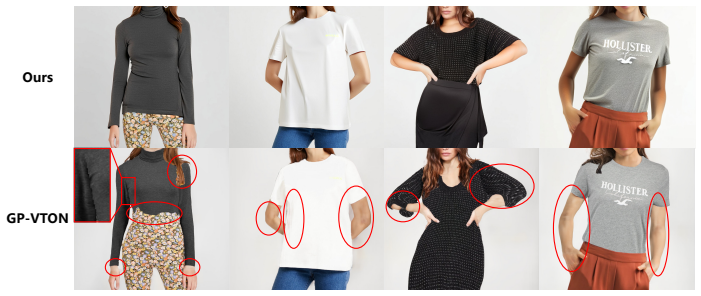
Virtual Try-On (VTON) aims to synthesize photorealistic images of garments precisely aligned with a person's body and pose. Current diffusion-based methods, however, face a fundamental trade-off between structural integrity and textural fidelity. In this paper, we formalize this challenge as a consequence of complementary inductive biases inherent in prevailing architectures: models heavily reliant on spatial constraints naturally favor geometric alignment but often suppress textures, whereas models dominated by unconstrained generative priors excel at vibrant detail rendering but are prone to structural drift. Based on this diagnosis, we propose LPH-VTON, a new synergistic framework that resolves this tension within a single, continuous denoising process. LPH-VTON strategically decomposes the generation, leveraging a structure-biased model to establish a geometrically consistent latent scaffold in the early stages, before handing over control to a texture-biased model for high-fidelity detail rendering. Extensive experiments validate our approach. Our model achieves a superior Pareto-optimal balance, establishing new benchmarks in perceptual faithfulness while maintaining highly competitive structural alignment across the standard dataset VITON-HD, proving the efficacy of temporal architectural decoupling.
Figures




Reference graph
Works this paper leans on
-
[1]
ACM transactions on graphics (TOG)42(4), 1–11 (2023)
Avrahami, O., Fried, O., Lischinski, D.: Blended latent diffusion. ACM transactions on graphics (TOG)42(4), 1–11 (2023)
work page 2023
-
[2]
In: Proceedings of the IEEE/CVF conference on computer vision and pattern recognition
Choi, S., Park, S., Lee, M., Choo, J.: Viton-hd: High-resolution virtual try-on via misalignment-aware normalization. In: Proceedings of the IEEE/CVF conference on computer vision and pattern recognition. pp. 14131–14140 (2021)
work page 2021
-
[3]
arXiv preprint arXiv:2403.05139 , year=
Choi, Y., Kwak, S., Lee, K., Choi, H., Shin, J.: Improving diffusion models for authentic virtual try-on in the wild. arXiv preprint arXiv:2403.05139 (2024)
-
[4]
Chong, Z., Dong, X., Li, H., Zhang, S., Zhang, W., Zhang, X., Zhao, H., Jiang, D., Liang, X.: Catvton: Concatenation is all you need for virtual try-on with diffusion models. arXiv preprint arXiv:2407.15886 (2024)
-
[5]
Advances in neural information processing systems34, 8780–8794 (2021)
Dhariwal, P., Nichol, A.: Diffusion models beat gans on image synthesis. Advances in neural information processing systems34, 8780–8794 (2021)
work page 2021
-
[6]
Douc, R., Moulines, E., Priouret, P., Soulier, P.: Markov chains, vol. 4. Springer (2018)
work page 2018
-
[7]
Advances in neural information processing systems36, 12665–12702 (2023)
Garipov, T., De Peuter, S., Yang, G., Garg, V., Kaski, S., Jaakkola, T.: Composi- tional sculpting of iterative generative processes. Advances in neural information processing systems36, 12665–12702 (2023)
work page 2023
-
[8]
In: Proceedings of the IEEE/CVF conference on computer vision and pattern recognition
Ge, Y., Song, Y., Zhang, R., Ge, C., Liu, W., Luo, P.: Parser-free virtual try-on via distilling appearance flows. In: Proceedings of the IEEE/CVF conference on computer vision and pattern recognition. pp. 8485–8493 (2021)
work page 2021
-
[9]
Advances in neural in- formation processing systems27(2014)
Goodfellow, I.J., Pouget-Abadie, J., Mirza, M., Xu, B., Warde-Farley, D., Ozair, S., Courville, A., Bengio, Y.: Generative adversarial nets. Advances in neural in- formation processing systems27(2014)
work page 2014
-
[10]
In: Proceedings of the 31st ACM international conference on multimedia
Gou,J.,Sun,S.,Zhang,J.,Si,J.,Qian,C.,Zhang,L.:Tamingthepowerofdiffusion models for high-quality virtual try-on with appearance flow. In: Proceedings of the 31st ACM international conference on multimedia. pp. 7599–7607 (2023)
work page 2023
-
[11]
In: Proceedings of the IEEE conference on computer vision and pattern recognition
Han, X., Wu, Z., Wu, Z., Yu, R., Davis, L.S.: Viton: An image-based virtual try-on network. In: Proceedings of the IEEE conference on computer vision and pattern recognition. pp. 7543–7552 (2018)
work page 2018
-
[12]
ACM Transactions on Graph- ics (TOG)43(4), 1–13 (2024)
He, K., Yao, K., Zhang, Q., Yu, J., Liu, L., Xu, L.: Dresscode: Autoregressively sewing and generating garments from text guidance. ACM Transactions on Graph- ics (TOG)43(4), 1–13 (2024)
work page 2024
-
[13]
Advances in neural information processing systems33, 6840–6851 (2020)
Ho, J., Jain, A., Abbeel, P.: Denoising diffusion probabilistic models. Advances in neural information processing systems33, 6840–6851 (2020)
work page 2020
-
[14]
Journal of Machine Learning Research23(47), 1–33 (2022)
Ho, J., Saharia, C., Chan, W., Fleet, D.J., Norouzi, M., Salimans, T.: Cascaded diffusion models for high fidelity image generation. Journal of Machine Learning Research23(47), 1–33 (2022)
work page 2022
-
[15]
In: European Conference on Computer Vision (ECCV) (2020)
Jia, M., Shi, M., Sirotenko, M., Cui, Y., Cardie, C., Hariharan, B., Adam, H., Belongie, S.: Fashionpedia: Ontology, segmentation, and an attribute localization dataset. In: European Conference on Computer Vision (ECCV) (2020)
work page 2020
-
[16]
In: Proceedings of the IEEE/CVF conference on computer vision and pattern recognition
Kim, J., Gu, G., Park, M., Park, S., Choo, J.: Stableviton: Learning semantic correspondence with latent diffusion model for virtual try-on. In: Proceedings of the IEEE/CVF conference on computer vision and pattern recognition. pp. 8176– 8185 (2024)
work page 2024
-
[17]
arXiv preprint arXiv:2312.01725 (2023)
Kim, J., Gu, G., Park, M., Park, S., Choo, J.: Stableviton: Learning seman- tic correspondence with latent diffusion model for virtual try-on. arXiv preprint arXiv:2312.01725 (2023)
-
[18]
In: European Conference on Com- puter Vision
Lee, S., Gu, G., Park, S., Choi, S., Choo, J.: High-resolution virtual try-on with misalignment and occlusion-handled conditions. In: European Conference on Com- puter Vision. pp. 204–219. Springer (2022)
work page 2022
-
[19]
In: Proceedings of the 31st ACM international conference on multimedia
Morelli, D., Baldrati, A., Cartella, G., Cornia, M., Bertini, M., Cucchiara, R.: Ladi- vton: Latent diffusion textual-inversion enhanced virtual try-on. In: Proceedings of the 31st ACM international conference on multimedia. pp. 8580–8589 (2023)
work page 2023
-
[20]
SDXL: Improving Latent Diffusion Models for High-Resolution Image Synthesis
Podell, D., English, Z., Lacey, K., Blattmann, A., Dockhorn, T., Müller, J., Penna, J., Rombach, R.: Sdxl: Improving latent diffusion models for high-resolution image synthesis. arXiv preprint arXiv:2307.01952 (2023)
work page internal anchor Pith review Pith/arXiv arXiv 2023
-
[21]
In: Proceedings of the IEEE/CVF conference on computer vision and pattern recognition
Rombach, R., Blattmann, A., Lorenz, D., Esser, P., Ommer, B.: High-resolution image synthesis with latent diffusion models. In: Proceedings of the IEEE/CVF conference on computer vision and pattern recognition. pp. 10684–10695 (2022)
work page 2022
-
[22]
International Journal of Computer Vision 133(5), 2692–2720 (2025)
Song, D., Zhang, X., Zhou, J., Nie, W., Tong, R., Kankanhalli, M., Liu, A.A.: Image-based virtual try-on: A survey. International Journal of Computer Vision 133(5), 2692–2720 (2025)
work page 2025
-
[23]
In: Proceedings of the European conference on computer vision (ECCV)
Wang, B., Zheng, H., Liang, X., Chen, Y., Lin, L., Yang, M.: Toward characteristic- preserving image-based virtual try-on network. In: Proceedings of the European conference on computer vision (ECCV). pp. 589–604 (2018)
work page 2018
-
[24]
In: International conference on machine learning
Wortsman, M., Ilharco, G., Gadre, S.Y., Roelofs, R., Gontijo-Lopes, R., Morcos, A.S., Namkoong, H., Farhadi, A., Carmon, Y., Kornblith, S., et al.: Model soups: averagingweightsofmultiplefine-tunedmodelsimprovesaccuracywithoutincreas- ing inference time. In: International conference on machine learning. pp. 23965– 23998. PMLR (2022)
work page 2022
-
[25]
In: Proceedings of the IEEE CVF conference on computer vision and pattern recognition
Xie, Z., Huang, Z., Dong, X., Zhao, F., Dong, H., Zhang, X., Zhu, F., Liang, X.: Gp-vton: Towards general purpose virtual try-on via collaborative local-flow global-parsing learning. In: Proceedings of the IEEE CVF conference on computer vision and pattern recognition. pp. 23550–23559 (2023)
work page 2023
-
[26]
In: Proceedings of the AAAI Conference on Artificial Intelligence
Xu, Y., Gu, T., Chen, W., Chen, A.: Ootdiffusion: Outfitting fusion based latent diffusion for controllable virtual try-on. In: Proceedings of the AAAI Conference on Artificial Intelligence. vol. 39, pp. 8996–9004 (2025)
work page 2025
-
[27]
Advances in Neural Information Processing Systems36, 7093–7115 (2023)
Yadav, P., Tam, D., Choshen, L., Raffel, C.A., Bansal, M.: Ties-merging: Resolving interference when merging models. Advances in Neural Information Processing Systems36, 7093–7115 (2023)
work page 2023
-
[28]
ACM computing surveys56(4), 1–39 (2023)
Yang,L.,Zhang,Z.,Song,Y.,Hong,S.,Xu,R.,Zhao,Y.,Zhang,W.,Cui,B.,Yang, M.H.: Diffusion models: A comprehensive survey of methods and applications. ACM computing surveys56(4), 1–39 (2023)
work page 2023
-
[29]
In: Proceedings of the IEEE/CVF International Conference on Computer Vision
Zhang, L., Rao, A., Agrawala, M.: Adding conditional control to text-to-image diffusion models. In: Proceedings of the IEEE/CVF International Conference on Computer Vision. pp. 3836–3847 (2023)
work page 2023
-
[30]
Zhu, L., Yang, D., Zhu, T., Reda, F., Chan, W., Saharia, C., Norouzi, M., Kemelmacher-Shlizerman, I.: Tryondiffusion: A tale of two unets. In: Proceed- ings of the IEEE/CVF conference on computer vision and pattern recognition. pp. 4606–4615 (2023) This supplementary document provides a comprehensive analysis extending the main paper’s findings. We first ...
work page 2023
discussion (0)
Sign in with ORCID, Apple, or X to comment. Anyone can read and Pith papers without signing in.