REVIEW 4 major objections 6 minor 95 references
Robust quantum reservoir computers for forecasting chaotic dynamics: generalized synchronization and stability
T0 review · 4 major / 6 minor · reviewed 2026-08-06 · deepseek-v4-flash
Pith's one-line read The paper claims that recurrence-free quantum reservoir computers satisfy the echo state property by design, because their conditional Jacobian is a constant contraction, making them stable machines for forecasting chaotic time series.
desk verdict A useful, honestly imperfect paper: the RF-QRC contraction result is correct, but the closed-loop design rule rests on an unproved bridge. read the letter →
The pith
A machine-rendered reading of the paper's core claim, the machinery that carries it, and where it could break.
The reading
What carries the argument
The load-bearing object is the conditional Jacobian of the reservoir update, Eq. (25), which is the derivative of the response map with the driving signal held fixed. For a recurrence-free reservoir this Jacobian collapses to Eq. (27), $J_{\mathrm{CLE}} = (1-\epsilon)\mathbb{I}$, a constant, perfectly conditioned, isotropic contraction: every conditional Lyapunov exponent equals $\ln(1-\epsilon)/\Delta t < 0$ for $0<\epsilon<1$. This identity carries the argument because it converts the abstract conditions of generalized-synchronization theory into a concrete design guarantee, and it makes the leak rate the central tuning knob: the reservoir's contraction speed is set entirely by $\epsilon$, independent of the unitary, the input encoding, and the number of qubits.
What would settle it
Measure the conditional Lyapunov exponents of a physical or simulated RF-QRC with the input held fixed and compare them with $\ln(1-\epsilon)/\Delta t$; any systematic deviation would contradict the constant-Jacobian identity. A second check is to find a recurrence-free encoding and random unitary, with $0<\epsilon<1$, for which the reservoir fails to infer a known negative Lyapunov exponent; such a counterexample would falsify the claim that contractivity by design suffices for correct invariant inference.
Extended reading notes
Core claim
The paper's central claim is that a quantum reservoir computer is a generalized-synchronization system, with the input time series as the driving state, the reservoir as the response state, and the trained readout $W_{\mathrm{out}}$ acting as the local inverse of the synchronization map $\varphi$. Because unitary quantum maps are non-expansive, the raw reservoir update cannot contract; the authors show that leaky integration (and, alternatively, noise) makes the channel strictly contractive. The decisive identity is Eq. (27): for an RF-QRC the conditional Jacobian is $J_{\mathrm{CLE}} = (1-\epsilon)\mathbb{I}$, a constant isotropic contraction whose conditional Lyapunov exponents are all negative. The paper states that this proves the RF-QRC fulfills, by design, the GS = ESP criterion, so such reservoirs are asymptotically stable and their forecasts are independent of initial conditions. Numerically, the same reservoirs reproduce the invariant properties of chaotic attractors, and the paper concludes that noise-induced dissipation enlarges the range of hyperparameters over which the machines remain robust.
Load-bearing premise
The load-bearing premise is that the classical generalized-synchronization theorem, which holds for classical drive-response systems, applies to quantum reservoirs: guaranteeing a contractive reservoir update is taken to be sufficient for the trained readout to reproduce the driving system's negative Lyapunov exponents, but the paper does not prove that the trained synchronization map for a quantum reservoir is continuously differentiable.
Editorial extensions
If this is right
- Any recurrence-free quantum reservoir with $0<\epsilon<1$ satisfies the echo state property, so forecasts are asymptotically independent of the initial reservoir state.
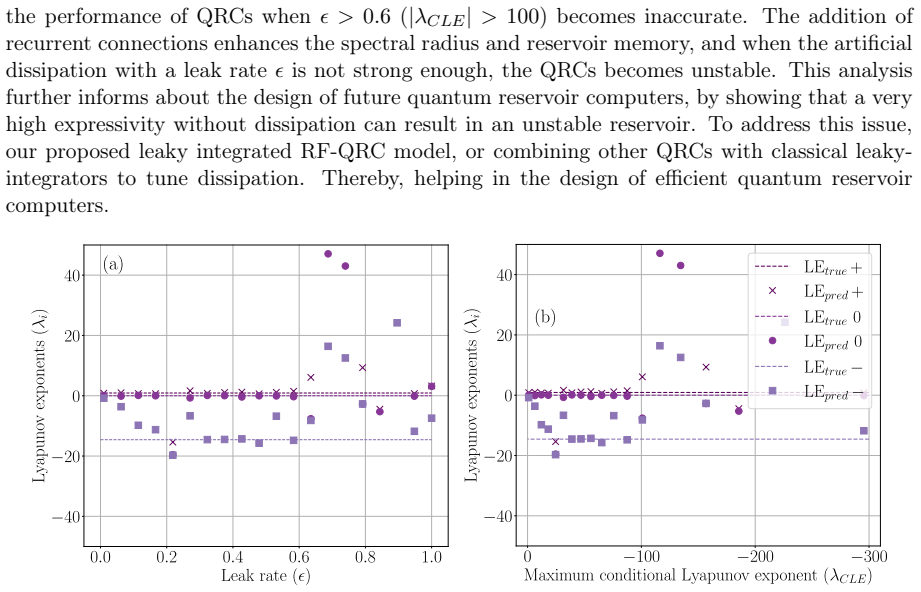
- The design rule is to choose the leak rate so that the maximum conditional Lyapunov exponent falls below the most negative Lyapunov exponent of the driving system, which is needed to infer the full spectrum.
- Recurrence-free reservoirs remain conditionally stable over a far wider range of leak rates than recurrent quantum reservoirs, which become unstable for large $\epsilon$.
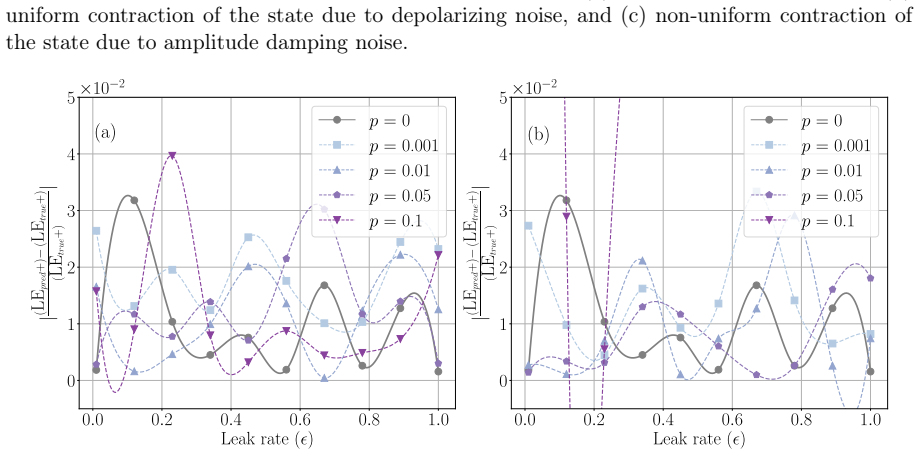
- Incoherent noise and finite sampling add dissipation that strengthens contraction, so noisy RF-QRCs can outperform their noise-free counterparts in low-leak regimes.
- The derived Jacobians allow the Lyapunov spectrum, attractor dimension, and covariant Lyapunov vectors of the physical system to be computed from the autonomous reservoir state.
Reading between the lines
- A direct extension of the paper's identity is a hardware acceptance test: measure the conditional Lyapunov exponents of a fabricated RF-QRC; if they deviate from $\ln(1-\epsilon)/\Delta t$, the device is not behaving as assumed.
- Because the conditional Jacobian carries no input dependence, all task-relevant nonlinear memory in an RF-QRC must come from leaky integration and the input encoding; this suggests a quantitative ceiling on what recurrence-free machines can represent, a consequence the paper does not draw.
- The paper applies a classical theorem about differentiable synchronization to quantum reservoirs without proving that the trained synchronization map is continuously differentiable; the numerical successes suggest a proof, or a counterexample, should be sought.
- Noise scheduling could be treated as a design variable: choose the strength of depolarizing or amplitude-damping channels jointly with $\epsilon$ to place the composite channel in the differentiable-GS region, which the paper hints at but does not formulate as an optimization.
Editorial analysis
A structured set of objections, weighed in public.
Referee Report
Summary. The paper proposes a generalized-synchronization (GS) framework for quantum reservoir computers, derives the Jacobian of both recurrent QRCs and recurrence-free RF-QRCs, and uses the conditional Jacobian to formulate a design rule (GS=ESP). The central analytical result is Eq. (27), which shows that the open-loop conditional Jacobian of an RF-QRC is (1-epsilon)I, a constant isotropic contraction. The authors then use this result to argue that RF-QRCs satisfy the echo state property by design, to guide leak-rate selection, and to justify inference of Lyapunov spectra, Kaplan-Yorke dimension, and covariant Lyapunov vectors. Numerical tests on Lorenz-63 and Lorenz-96 systems, including noisy settings, are reported.
Significance. If the closed-loop robustness claim held, the paper would provide a clean and practically useful stability guarantee for recurrence-free quantum reservoir computers, together with a measurable tuning criterion (the maximum conditional Lyapunov exponent). The derivation of Eq. (27) is self-contained and correct, and the numerical demonstrations against independent ground-truth Lyapunov spectra and dimensions are a strength: no free parameters are fitted to the target invariants. However, the paper's central 'by design' claim is broader than what Eq. (27) proves. The open-loop contraction result does not by itself certify the closed-loop autonomous system's Lyapunov spectrum, and the GS=ESP equivalence is asserted more generally than it is proved. The numerical evidence also lacks error bars and uses very few random seeds in the noise study. These gaps are load-bearing for the main claims of robustness and invariant inference, so the paper needs revision before its conclusions can be accepted at the advertised level.
major comments (4)
- [Section 5, Eqs. (24) and (27)] The claim that RF-QRCs fulfill GS=ESP 'by design' is based on the open-loop conditional Jacobian Eq. (27), J_CLE=(1-epsilon)I. In closed-loop autonomous forecasting, however, the relevant Jacobian is Eq. (24), which contains the additional term epsilon * (d/d u) <...> W_out^T. Eq. (27) has no dependence on W_out or on the training error, so it cannot certify that W_out is a sufficiently accurate local inverse of the synchronization map, that the closed-loop trajectory remains on the synchronization manifold, or that the closed-loop Lyapunov exponents reproduce the driver's. The Hunt-Ott-Yorke differentiability theorem cited in Section 2.2 gives sufficient conditions for differentiability of phi, but the paper does not verify those hypotheses for the trained RF-QRC (e.g., continuous differentiability of phi and the required invertibility conditions), nor does it show that differentiability of phi alone implies that ridge regression yields a W_out with the desired closed-loop properties. This is load-bearing because Section 5 uses Eq. (27) as a design rule for closed-loop forecasting and spectrum inference. Concretely, the authors should compute the closed-loop Jacobian Eq. (24) for the trained reservoirs and compare its Lyapunov spectrum with the driver's spectrum across the ensemble, or provide a separate argument that the closed-loop system inherits the driver's spectrum.
- [Section 3.0.2 and Section 3.2] The paper states that GS and ESP are 'the same conditions' and defines GS=ESP to mean both implications. What is proved is only the direction that a contractive open-loop update implies ESP and GS for RF-QRCs; the converse, ESP implies GS, is not derived. For general reservoir maps, ESP is a fading-memory property that does not by itself guarantee generalized synchronization to the driver on the attractor. Since the criterion GS=ESP appears in the title and abstract, the scope of the equivalence should be stated precisely and, if only one direction is claimed for RF-QRCs, the wording should be corrected accordingly.
- [Tables 4-5 and Figures 6-12] The numerical evidence lacks error bars and confidence intervals. Table 4 reports point estimates for the Lyapunov exponents, Figure 6 shows no uncertainty around the curves, Figure 7 reports only ensemble means, and Figures 8-12 state that averages are taken over only 5, 3, or 10 random seeds. Because the paper's central claims concern robustness across hyperparameters and under noise, ensemble means without a measure of spread (e.g., min-max ranges, quartiles, or standard errors) are insufficient. For example, Figure 10 reports a maximum relative error near 0.2 for depolarizing noise p=0.1 based on only three seeds; this could be dominated by seed variability. Please add error bars or per-seed distributions for at least the Lyapunov-exponent estimates and the valid-prediction-time values support the claimed robustness.
- [Section 5.1 and Eq. (27)] The analytical framework underlying the design rule is derived for the noiseless RF-QRC update. When finite sampling noise or incoherent noise channels are added, the reservoir state evolution is no longer the deterministic map G in Eq. (9), and the conditional Jacobian Eq. (27) does not directly apply. The paper asserts that noise 'promotes GS' and 'ensures a contractive map' by referring to Eq. (21), but no derivation is given for the effective contraction rate or the conditional Lyapunov exponents of the noisy channel. The empirical results are suggestive, but the claim that noise strengthens GS would be on firmer ground if the authors derived the effective contraction for the noisy update or at least stated explicitly that the CLE criterion in Section 5 is computed in the noiseless limit and used only as a heuristic in the noisy case.
minor comments (6)
- [Section 3.0.2 and text after Eq. (27)] The text refers to 'condition (ii) in Table 2' when the relevant table is Table 1; please correct the cross-reference.
- [Figure 7 caption] The color scale is described only in the body text as the averaged valid prediction time; the caption should state the colorbar range and that the values are ensemble means, to make the figure self-contained.
- [Section 5, Figure 6] The notation 'epsilon in the range {0,1}' is ambiguous; it should be written as the interval [0,1] to avoid confusion with a set of two values.
- [Appendix C] The text and Figure 11 caption state a reservoir of 10 qubits for the 10-dimensional Lorenz-96 system, while Section 4.2 and Table 3 specify 9 qubits; please resolve the inconsistency.
- [Table 3] The row 'Resevoir density D' contains the typo 'Resevoir' and the entry 'Fully connected' is vague; please define what is meant by reservoir density for the RF-QRC architecture.
- [Section 3, Eq. (16)] The phrase 'W(k) form a 2^n-dimensional vector' is imprecise; W(k) is a rank-one projector-weighted operator, and the reservoir state is the resulting 2^n-component vector. Please rephrase for clarity.
Circularity Check
The derivation is self-contained: Eq. (27) follows from the reservoir update, and the inferred invariants are validated against independent ground-truth values, so no circularity is found.
full rationale
The paper's central analytical result, Eq. (27), is derived in-paper from the RF-QRC update (Eq. 14) with P = I: differentiating r(t+1) = (1-epsilon) r(t) + epsilon |<...>|^2 with respect to r gives (1-epsilon) I. This is a straightforward calculation, not an assumed conclusion. The Lyapunov exponents, Kaplan-Yorke dimensions, and covariant Lyapunov vector angles are computed from the trained autonomous reservoir and compared against ground-truth values obtained from the original Lorenz-63 and Lorenz-96 systems. The only trained parameters, W_out, are obtained by ridge regression (Eq. 19) against the time-series data; the leak rate and regularization are selected by grid search for forecast quality, not by fitting the reported invariant properties. Thus the invariant predictions are not fits in disguise. The differentiability condition is taken from Hunt, Ott, and Yorke (1997), an external classical result, not from a self-citation. Self-citations [39, 50] provide the RF-QRC architecture, but the architecture is also restated in Eqs. (12)-(16), so the cited prior work is not load-bearing in the derivation. The GS = ESP shorthand is an identification supported by the contraction property and known synchronization theory, not a claim that reduces to its own input. No circular step of any of the enumerated kinds is exhibited.
Assumptions & free parameters
free parameters (5)
- Leak rate epsilon =
0.21 (Lorenz-63), 0.15 (Lorenz-96 10D), 0.12 (Lorenz-96 20D)
- Tikhonov regularization beta =
1e-9 or 1e-12
- Number of qubits n =
7, 8, 9, 10, 13 in different experiments
- Random unitary parameters alpha =
Sampled uniformly in [0, 4pi]
- Input scaling sigma =
Range [0,1] (Table 3)
assumptions (5)
- standard math Oseledets multiplicative ergodic theorem guarantees the existence of Lyapunov exponents and their computation via QR decomposition of the tangent map.
- domain assumption Hunt-Ott-Yorke theorem on differentiable generalized synchronization (condition (iii) in Table 1) is sufficient for accurate inference of invariant properties of the driving system.
- domain assumption The reservoir state update in Eq. 14, including the leaky integration and the measurement probabilities, exactly models the physical quantum reservoir computer.
- standard math Completely positive trace-preserving (CPTP) quantum maps are non-expansive in trace norm (i.e., unitary maps have contraction factor 1).
- domain assumption The feature map e(u) = |<k| V Xi(u) |0>|^2 is differentiable with respect to the input u so that the Jacobian can be evaluated, e.g., by the parameter-shift rule.
Cite this review
Pith. "Pith review of Robust quantum reservoir computers for forecasting chaotic dynamics: generalized synchronization and stability." pith.science (2026). https://pith.science/paper/R2HLH3UP
@misc{pith2026250622335,
  author       = {Pith},
  title        = {Pith review of: Robust quantum reservoir computers for forecasting chaotic dynamics: generalized synchronization and stability},
  year         = {2026},
  howpublished = {\url{https://pith.science/paper/R2HLH3UP}},
  note         = {Machine review of arXiv:2506.22335}
}
abstract
We show that recurrent quantum reservoir computers (QRCs) and their recurrence-free architectures (RF-QRCs) are robust tools for learning and forecasting chaotic dynamics from time-series data. First, we formulate and interpret quantum reservoir computers as coupled dynamical systems, where the reservoir acts as a response system driven by training data; in other words, quantum reservoir computers are generalized-synchronization (GS) systems. Second, we show that quantum reservoir computers can learn chaotic dynamics and their invariant properties, such as Lyapunov spectra, attractor dimensions, and geometric properties such as the covariant Lyapunov vectors. This analysis is enabled by deriving the Jacobian of the quantum reservoir update. Third, by leveraging tools from generalized synchronization, we provide a method for designing robust quantum reservoir computers. We propose the criterion $GS=ESP$: GS implies the echo state property (ESP), and vice versa. We analytically show that RF-QRCs, by design, fulfill $GS=ESP$. Finally, we analyze the effect of simulated noise. We find that dissipation from noise enhances the robustness of quantum reservoir computers. Numerical verifications on systems of different dimensions support our conclusions. This work opens opportunities for designing robust quantum machines for chaotic time series forecasting on near-term quantum hardware.
Figures


Figures from the paper (9 more)



Reference graph
Works this paper leans on
-
[1]
Deterministic Nonperiodic Flow,
E. N. Lorenz, “Deterministic Nonperiodic Flow,” Journal of the Atmospheric Sciences, vol. 20, no. 2, pp. 130–141, Mar. 1963, publisher: American Meteorological Society Section: Journal of the Atmospheric Sciences. [Online]. Available: https://journals.ametsoc.org/ view/journals/atsc/20/2/1520-0469_1963_020_0130_dnf_2_0_co_2.xml
1963
-
[2]
Extended-range atmospheric prediction and the lorenz model,
T. N. Palmer, “Extended-range atmospheric prediction and the lorenz model,” Bulletin 18 of the American Meteorological Society, vol. 74, no. 1, pp. 49 – 66, 1993. [Online]. Available: https://journals.ametsoc.org/view/journals/bams/74/1/1520-0477_1993_074_ 0049_erapat_2_0_co_2.xml
1993
-
[3]
J. R. Buchler, J. M. Perdang, and E. A. Spiegel,Chaos in astrophysics. Springer Science & Business Media, 2012, vol. 161
2012
-
[4]
Nonlinear dynamics and chaos: applications in meteorol- ogy and atmospheric physics,
A. M. Selvam and A. M. Selvam, “Nonlinear dynamics and chaos: applications in meteorol- ogy and atmospheric physics,”Self-organized Criticality and Predictability in Atmospheric Flows: The Quantum World of Clouds and Rain, pp. 1–40, 2017
2017
-
[5]
R. J. Fieldet al., Chaos in chemistry and biochemistry. World Scientific, 1993
1993
-
[6]
Manneville,Instabilities, chaos and turbulence
P. Manneville,Instabilities, chaos and turbulence. World Scientific, 2010, vol. 1
2010
-
[7]
Learning ergodic averages in chaotic systems,
F. Huhn and L. Magri, “Learning ergodic averages in chaotic systems,” inInternational Conference on Computational Science. Springer, 2020, pp. 124–132
2020
-
[8]
Predictability: a way to characterize complexity,
G. Boffetta, M. Cencini, M. Falcioni, and A. Vulpiani, “Predictability: a way to characterize complexity,” Physics Reports, vol. 356, no. 6, pp. 367–474, 2002. [Online]. Available: https://www.sciencedirect.com/science/article/pii/S0370157301000254
2002
Show all 95 references
-
[9]
A numerical approach to ergodic problem of dissipative dynamical systems,
I. Shimada and T. Nagashima, “A numerical approach to ergodic problem of dissipative dynamical systems,” Progress of theoretical physics, vol. 61, no. 6, pp. 1605–1616, 1979
1979
-
[10]
Lyapunovcharacteristicexponents for smooth dynamical systems and for hamiltonian systems; a method for computing all of them. part 1: Theory,
G.Benettin, L.Galgani, A.Giorgilli, andJ.-M.Strelcyn, “Lyapunovcharacteristicexponents for smooth dynamical systems and for hamiltonian systems; a method for computing all of them. part 1: Theory,”Meccanica, vol. 15, pp. 9–20, 1980
1980
-
[11]
The liapunov dimension of strange attractors,
P. Frederickson, J. L. Kaplan, E. D. Yorke, and J. A. Yorke, “The liapunov dimension of strange attractors,” Journal of differential equations, vol. 49, no. 2, pp. 185–207, 1983
1983
-
[12]
Covariant lyapunov vectors,
F. Ginelli, H. Chaté, R. Livi, and A. Politi, “Covariant lyapunov vectors,”Journal of Physics A: Mathematical and Theoretical, vol. 46, no. 25, p. 254005, 2013
2013
-
[13]
Stability analysis of chaotic systems from data,
G. Margazoglou and L. Magri, “Stability analysis of chaotic systems from data,” Nonlinear Dynamics, vol. 111, no. 9, pp. 8799–8819, May 2023. [Online]. Available: https://link.springer.com/10.1007/s11071-023-08285-1
2023 doi
-
[14]
Magri, A
L. Magri, A. Novoa, and E. Özalp,Machine Learning for Fluid Dynamics. von Karman Institute for Fluid Dynamics, 2024, ch. Prediction of chaotic dynamics from data: An introduction
2024
-
[15]
Reconstruction, forecasting, and stability of chaotic dynamics from partial data,
E. Özalp, G. Margazoglou, and L. Magri, “Reconstruction, forecasting, and stability of chaotic dynamics from partial data,” Chaos: An Interdisciplinary Journal of Nonlinear Science, vol. 33, no. 9, 2023
2023
-
[16]
Stability analysis of chaotic systems in latent spaces,
E. Özalp and L. Magri, “Stability analysis of chaotic systems in latent spaces,”Nonlinear Dynamics, pp. 1–16, 2025
2025
-
[17]
Synchronization in chaotic systems,
L. M. Pecora and T. L. Carroll, “Synchronization in chaotic systems,”Physical review letters, vol. 64, no. 8, p. 821, 1990
1990
-
[18]
Synchronization of chaotic systems,
——, “Synchronization of chaotic systems,”Chaos: An Interdisciplinary Journal of Nonlin- ear Science, vol. 25, no. 9, 2015
2015
-
[19]
Driving systems with chaotic signals,
——, “Driving systems with chaotic signals,”Physical review A, vol. 44, no. 4, p. 2374, 1991. 19
1991
-
[20]
Driving systems with chaotic signals,
P. Badola, S. Tambe, and B. Kulkarni, “Driving systems with chaotic signals,”Physical Review A, vol. 46, no. 10, p. 6735, 1992
1992
-
[21]
Generalized synchro- nization of chaos in directionally coupled chaotic systems,
N. F. Rulkov, M. M. Sushchik, L. S. Tsimring, and H. D. Abarbanel, “Generalized synchro- nization of chaos in directionally coupled chaotic systems,”Physical Review E, vol. 51, no. 2, p. 980, 1995
1995
-
[22]
Generalized synchronization, predictability, and equivalence of unidirectionally coupled dynamical systems,
L. Kocarev and U. Parlitz, “Generalized synchronization, predictability, and equivalence of unidirectionally coupled dynamical systems,”Physical review letters, vol. 76, no. 11, p. 1816, 1996
1996
-
[23]
Generalized synchronization in chaotic systems,
S. Yang and C. Duan, “Generalized synchronization in chaotic systems,”Chaos, Solitons & Fractals, vol. 9, no. 10, pp. 1703–1707, 1998
1998
-
[24]
Generalized synchronization of chaos: The auxiliary system approach,
H. D. Abarbanel, N. F. Rulkov, and M. M. Sushchik, “Generalized synchronization of chaos: The auxiliary system approach,”Physical review E, vol. 53, no. 5, p. 4528, 1996
1996
-
[25]
Attractor reconstruction by machine learning,
Z. Lu, B. R. Hunt, and E. Ott, “Attractor reconstruction by machine learning,”Chaos: An Interdisciplinary Journal of Nonlinear Science, vol. 28, no. 6, 2018
2018
-
[26]
The reservoir’s perspective on generalized synchronization,
T. Lymburn, D. M. Walker, M. Small, and T. Jüngling, “The reservoir’s perspective on generalized synchronization,” Chaos: An Interdisciplinary Journal of Nonlinear Science, vol. 29, no. 9, 2019
2019
-
[27]
Robust forecasting using predictive generalized synchronization in reservoir computing,
J. A. Platt, A. Wong, R. Clark, S. G. Penny, and H. D. Abarbanel, “Robust forecasting using predictive generalized synchronization in reservoir computing,”Chaos: An Interdisciplinary Journal of Nonlinear Science, vol. 31, no. 12, 2021
2021
-
[28]
Using machine learning to replicate chaoticattractorsandcalculatelyapunovexponentsfromdata,
J. Pathak, Z. Lu, B. R. Hunt, M. Girvan, and E. Ott, “Using machine learning to replicate chaoticattractorsandcalculatelyapunovexponentsfromdata,” Chaos: An Interdisciplinary Journal of Nonlinear Science, vol. 27, no. 12, 2017
2017
-
[29]
Data-driven forecasting of high-dimensional chaotic systems with long short-term memory networks,
P. R. Vlachas, W. Byeon, Z. Y. Wan, T. P. Sapsis, and P. Koumoutsakos, “Data-driven forecasting of high-dimensional chaotic systems with long short-term memory networks,” Proceedings of the Royal Society A: Mathematical, Physical and Engineering Sciences, vol. 474, no. 2213, p...
2018
-
[30]
Backpropagation algorithms and Reservoir Computing in Recurrent Neural Networks for the forecasting of complex spatiotemporal dynamics,
P. R. Vlachas, J. Pathak, B. R. Hunt, T. P. Sapsis, M. Girvan, E. Ott, and P. Koumoutsakos, “Backpropagation algorithms and Reservoir Computing in Recurrent Neural Networks for the forecasting of complex spatiotemporal dynamics,” Neural Networks , vol. 126, pp. 191–217, Jun. 2...
2020
-
[31]
The" echo state
H. Jaeger, “The" echo state" approach to analysing and training recurrent neural networks- withanerratumnote’,” Bonn, Germany: German National Research Center for Information Technology GMD Technical Report, vol. 148, Jan. 2001
2001
-
[32]
Optimization and applications of echo state networks with leaky- integrator neurons,
H. Jaeger, Mantas, D. Popovici, and U. Siewert, “Optimization and applications of echo state networks with leaky- integrator neurons,” Neural Networks, vol. 20, no. 3, pp. 335–352, 2007, echo State Networks and Liquid State Machines. [Online]. Available: https://www.sciencedir...
2007
-
[33]
Data-driven computation of adjoint sensitivities without adjoint solvers: Anapplicationtothermoacoustics,
D. E. Ozan and L. Magri, “Data-driven computation of adjoint sensitivities without adjoint solvers: Anapplicationtothermoacoustics,” Physical Review Fluids, vol.9, no.10, p.103902, 2024. 20
2024
-
[34]
Physics-Informed Quantum Machine Learning: Solving nonlinear differential equations in latent spaces without costly grid evaluations,
A. E. Paine, V. E. Elfving, and O. Kyriienko, “Physics-Informed Quantum Machine Learning: Solving nonlinear differential equations in latent spaces without costly grid evaluations,” Aug. 2023, arXiv:2308.01827 [cond-mat, physics:quant-ph]. [Online]. Available: http://arxiv.org...
2023 arXiv
-
[35]
Harnessing Disordered-Ensemble Quantum Dynamics for Machine Learning,
K. Fujii and K. Nakajima, “Harnessing Disordered-Ensemble Quantum Dynamics for Machine Learning,” Physical Review Applied, vol. 8, no. 2, p. 024030, Aug. 2017, publisher: American Physical Society. [Online]. Available: https://link.aps.org/doi/10. 1103/PhysRevApplied.8.024030
2017
-
[36]
Quantum reservoir computing: a reservoir approach toward quantum machine learn- ing on near-term quantum devices,
——, “Quantum reservoir computing: a reservoir approach toward quantum machine learn- ing on near-term quantum devices,”Reservoir Computing: Theory, Physical Implementa- tions, and Applications, pp. 423–450, 2021
2021
-
[37]
Time Series Quantum Reservoir Computing with Weak and Projective Measurements,
P. Mujal, R. Martínez-Peña, G. L. Giorgi, M. C. Soriano, and R. Zambrini, “Time Series Quantum Reservoir Computing with Weak and Projective Measurements,”npj Quantum Information, vol. 9, no. 1, p. 16, Feb. 2023, arXiv:2205.06809 [cond-mat, physics:quant-ph]. [Online]. Availabl...
2023 arXiv
-
[38]
Hybrid quantum-classical reservoir computing of thermal convection flow,
P. Pfeffer, F. Heyder, and J. Schumacher, “Hybrid quantum-classical reservoir computing of thermal convection flow,”Physical Review Research, vol. 4, no. 3, p. 033176, Sep. 2022. [Online]. Available: https://link.aps.org/doi/10.1103/PhysRevResearch.4.033176
2022 doi
-
[39]
Prediction of chaotic dynamics and extreme events: A recurrence-free quantum reservoir computing approach,
O. Ahmed, F. Tennie, and L. Magri, “Prediction of chaotic dynamics and extreme events: A recurrence-free quantum reservoir computing approach,”Physical Review Research, vol. 6, no. 4, p. 043082, 2024
2024
-
[40]
Quantum Next Generation Reservoir Computing: An Efficient Quantum Algorithm for Forecasting Quantum Dynamics,
A. Sornsaeng, N. Dangniam, and T. Chotibut, “Quantum Next Generation Reservoir Computing: An Efficient Quantum Algorithm for Forecasting Quantum Dynamics,” Aug. 2023, arXiv:2308.14239 [cond-mat, physics:physics, physics:quant-ph]. [Online]. Available: http://arxiv.org/abs/2308.14239
2023 arXiv
-
[41]
Optimizing Quantum Noise-induced Reservoir Computing for Nonlinear and Chaotic Time Series Prediction,
D. Fry, A. Deshmukh, S. Y.-C. Chen, V. Rastunkov, and V. Markov, “Optimizing Quantum Noise-induced Reservoir Computing for Nonlinear and Chaotic Time Series Prediction,” Mar. 2023, arXiv:2303.05488 [quant-ph]. [Online]. Available: http: //arxiv.org/abs/2303.05488
2023 arXiv
-
[42]
Taking advantage of noise in quantum reservoir computing,
L. Domingo, G. Carlo, and F. Borondo, “Taking advantage of noise in quantum reservoir computing,” Scientific Reports , vol. 13, no. 1, p. 8790, May 2023, number: 1 Publisher: Nature Publishing Group. [Online]. Available: https: //www.nature.com/articles/s41598-023-35461-5
2023
-
[43]
A practical guide to applying echo state networks,
M. Lukoševičius, “A practical guide to applying echo state networks,” inNeural Networks: Tricks of the Trade: Second Edition. Springer, 2012, pp. 659–686
2012
-
[44]
Data-driven prediction and control of extreme events in a chaotic flow,
A. Racca and L. Magri, “Data-driven prediction and control of extreme events in a chaotic flow,” Physical Review Fluids, vol. 7, no. 10, p. 104402, Oct. 2022. [Online]. Available: https://link.aps.org/doi/10.1103/PhysRevFluids.7.104402
2022 doi
-
[45]
Large-scale quantum reservoir learning with an analog quantum computer,
M. Kornjača, H.-Y. Hu, C. Zhao, J. Wurtz, P. Weinberg, M. Hamdan, A. Zhdanov, S. H. Cantu, H. Zhou, R. A. Bravoet al., “Large-scale quantum reservoir learning with an analog quantum computer,”arXiv preprint arXiv:2407.02553, 2024
2024 arXiv
-
[46]
Quantum reservoir computing implementation on coherently coupled quantum oscillators,
J. Dudas, B. Carles, E. Plouet, F. A. Mizrahi, J. Grollier, and D. Marković, “Quantum reservoir computing implementation on coherently coupled quantum oscillators,” npj Quantum Information , vol. 9, no. 1, pp. 1–7, Jul. 2023, number: 1 21 Publisher: Nature Publishing Group. [O...
2023
-
[47]
Variational quantum algorithms,
M. Cerezo, A. Arrasmith, R. Babbush, S. C. Benjamin, S. Endo, K. Fujii, J. R. McClean, K. Mitarai, X. Yuan, L. Cincio, and P. J. Coles, “Variational quantum algorithms,” Nature Reviews Physics , vol. 3, no. 9, pp. 625–644, Sep. 2021, number: 9 Publisher: Nature Publishing Grou...
2021
-
[48]
Barren plateaus in quantum neural network training landscapes,
J. R. McClean, S. Boixo, V. N. Smelyanskiy, R. Babbush, and H. Neven, “Barren plateaus in quantum neural network training landscapes,”Nature communications, vol. 9, no. 1, p. 4812, 2018
2018
-
[49]
A review of barren plateaus in variational quantum computing,
M. Larocca, S. Thanasilp, S. Wang, K. Sharma, J. Biamonte, P. J. Coles, L. Cincio, J. R. McClean, Z. Holmes, and M. Cerezo, “A review of barren plateaus in variational quantum computing,” arXiv preprint arXiv:2405.00781, 2024
2024 arXiv
-
[50]
Optimal training of finitely sampled quantum reservoir computers for forecasting of chaotic dynamics,
O. Ahmed, F. Tennie, and L. Magri, “Optimal training of finitely sampled quantum reservoir computers for forecasting of chaotic dynamics,”Quantum Machine Intelligence, vol. 7, no. 1, pp. 1–16, 2025
2025
-
[51]
On fundamental aspects of quantum extreme learning machines,
W. Xiong, G. Facelli, M. Sahebi, O. Agnel, T. Chotibut, S. Thanasilp, and Z. Holmes, “On fundamental aspects of quantum extreme learning machines,” arXiv preprint arXiv:2312.15124, 2023
2023 arXiv
-
[52]
Extending echo state property for quantum reservoir computing,
S. Kobayashi, Q. H. Tran, and K. Nakajima, “Extending echo state property for quantum reservoir computing,”Physical Review E, vol. 110, no. 2, p. 024207, 2024
2024
-
[53]
Coherence influx is indispensable for quantum reservoir computing,
——, “Coherence influx is indispensable for quantum reservoir computing,”arXiv preprint arXiv:2409.12693, 2024
2024 arXiv
-
[54]
Quantum reservoir computing in finite dimensions,
R. Martínez-Peña and J.-P. Ortega, “Quantum reservoir computing in finite dimensions,” Physical Review E, vol. 107, no. 3, p. 035306, 2023
2023
-
[55]
M. A. Nielsen and I. L. Chuang,Quantum Computation and Quantum Information: 10th Anniversary Edition. Cambridge University Press, 2011
2011
-
[56]
Dissipation as a resource for Quantum Reservoir Computing,
A. Sannia, R. Martínez-Peña, M. C. Soriano, G. L. Giorgi, and R. Zambrini, “Dissipation as a resource for Quantum Reservoir Computing,” Dec. 2022, arXiv:2212.12078 [quant-ph]. [Online]. Available: http://arxiv.org/abs/2212.12078
2022 arXiv
-
[57]
Engineered dissipation to mitigate barren plateaus,
A. Sannia, F. Tacchino, I. Tavernelli, G. L. Giorgi, and R. Zambrini, “Engineered dissipation to mitigate barren plateaus,”npj Quantum Information, vol. 10, no. 1, p. 81, 2024
2024
-
[58]
Optimizing quantum noise-induced reservoir computing for nonlinear and chaotic time series prediction,
D. Fry, A. Deshmukh, S. Y.-C. Chen, V. Rastunkov, and V. Markov, “Optimizing quantum noise-induced reservoir computing for nonlinear and chaotic time series prediction,” 2023
2023
-
[59]
Cf vanloan, matrix computations,
G. H. Golubet al., “Cf vanloan, matrix computations,”The Johns Hopkins, vol. 113, no. 10, pp. 23–36, 1996
1996
-
[60]
Stability, sensitivity and optimisation of chaotic acoustic oscillations,
F. Huhn and L. Magri, “Stability, sensitivity and optimisation of chaotic acoustic oscillations,” Journal of Fluid Mechanics , vol. 882, p. A24, jan 2020. [Online]. Available: https://www.cambridge.org/core/product/identifier/S0022112019008280/type/ journal_article
2020
-
[61]
Reconstruction, forecasting, and stability of chaotic dynamics from partial data,
E. Özalp, G. Margazoglou, and L. Magri, “Reconstruction, forecasting, and stability of chaotic dynamics from partial data,” Chaos: An Interdisciplinary Journal of Nonlinear Science, vol. 33, no. 9, 2023. 22
2023
-
[62]
A multiplicative ergodic theorem, lyapunov characteristic numbers for dy- namical systems,
V. I. Oseledec, “A multiplicative ergodic theorem, lyapunov characteristic numbers for dy- namical systems,” Transactions of the Moscow Mathematical Society, vol. 19, pp. 197–231, 1968
1968
-
[63]
Theory and computation of covariant lyapunov vectors,
P. V. Kuptsov and U. Parlitz, “Theory and computation of covariant lyapunov vectors,” Journal of nonlinear science, vol. 22, pp. 727–762, 2012
2012
-
[64]
Characterizing dynamics with covariant lyapunov vectors,
F. Ginelli, P. Poggi, A. Turchi, H. Chaté, R. Livi, and A. Politi, “Characterizing dynamics with covariant lyapunov vectors,”Physical review letters, vol. 99, no. 13, p. 130601, 2007
2007
-
[65]
Generalized synchronization of chaos in directionally coupled chaotic systems,
N. F. Rulkov, M. M. Sushchik, L. S. Tsimring, and H. D. I. Abarbanel, “Generalized synchronization of chaos in directionally coupled chaotic systems,” Physical Review E, vol. 51, no. 2, pp. 980–994, Feb. 1995, publisher: American Physical Society. [Online]. Available: https://...
1995 doi
-
[66]
Differentiable generalized synchronization of chaos,
B. R. Hunt, E. Ott, and J. A. Yorke, “Differentiable generalized synchronization of chaos,” Physical Review E, vol. 55, no. 4, p. 4029, 1997
1997
-
[67]
Observation of generalized syn- chronization of chaos in a driven chaotic system,
D. Tang, R. Dykstra, M. Hamilton, and N. Heckenberg, “Observation of generalized syn- chronization of chaos in a driven chaotic system,”Physical Review E, vol. 57, no. 5, p. 5247, 1998
1998
-
[68]
Learn to synchronize, synchronize to learn,
P. Verzelli, C. Alippi, and L. Livi, “Learn to synchronize, synchronize to learn,”Chaos: An Interdisciplinary Journal of Nonlinear Science, vol. 31, no. 8, 2021
2021
-
[69]
A systematic exploration of reservoir computing for forecasting complex spatiotemporal dynamics,
J. A. Platt, S. G. Penny, T. A. Smith, T.-C. Chen, and H. D. I. Abarbanel, “A systematic exploration of reservoir computing for forecasting complex spatiotemporal dynamics,” Neural Networks, vol. 153, pp. 530–552, Sep. 2022. [Online]. Available: https://www.sciencedirect.com/s...
2022
-
[70]
Driving systems with chaotic signals,
L. M. Pecora and T. L. Carroll, “Driving systems with chaotic signals,”Physical Review A, vol. 44, no. 4, pp. 2374–2383, Aug. 1991, publisher: American Physical Society. [Online]. Available: https://link.aps.org/doi/10.1103/PhysRevA.44.2374
1991 doi
-
[71]
Conditional lyapunov exponents from time series,
K. Pyragas, “Conditional lyapunov exponents from time series,”Physical Review E, vol. 56, no. 5, p. 5183, 1997
1997
-
[72]
Informa- tion processing capacity of spin-based quantum reservoir computing systems,
R. Martínez-Peña, J. Nokkala, G. L. Giorgi, R. Zambrini, and M. C. Soriano, “Informa- tion processing capacity of spin-based quantum reservoir computing systems,” Cognitive Computation, pp. 1–12, 2023
2023
-
[73]
Naturalquantumreservoir computing for temporal information processing,
Y.Suzuki, Q.Gao, K.C.Pradel, K.Yasuoka, andN.Yamamoto, “Naturalquantumreservoir computing for temporal information processing,”Scientific Reports, vol. 12, no. 1, p. 1353, Jan. 2022. [Online]. Available: https://www.nature.com/articles/s41598-022-05061-w
2022
-
[74]
Reduced-order modeling of two- dimensional turbulent Rayleigh-B\’enard flow by hybrid quantum-classical reservoir computing,
P. Pfeffer, F. Heyder, and J. Schumacher, “Reduced-order modeling of two- dimensional turbulent Rayleigh-B\’enard flow by hybrid quantum-classical reservoir computing,” Jul. 2023, arXiv:2307.03053 [physics, physics:quant-ph]. [Online]. Available: http://arxiv.org/abs/2307.03053
2023 arXiv
-
[75]
Opportunities in Quantum Reservoir Computing and Extreme Learning Machines,
P. Mujal, R. Martínez-Peña, J. Nokkala, J. García-Beni, G. L. Giorgi, M. C. Soriano, and R. Zambrini, “Opportunities in Quantum Reservoir Computing and Extreme Learning Machines,” Feb. 2021, publication Title: arXiv e-prints ADS Bibcode: 2021arXiv210211831M. [Online]. Availabl...
2021
-
[76]
Information processing in echo state networks at the edge of chaos,
J. Boedecker, O. Obst, J. T. Lizier, N. M. Mayer, and M. Asada, “Information processing in echo state networks at the edge of chaos,”Theory in Biosciences, vol. 131, no. 3, pp. 205–213, Sep. 2012. [Online]. Available: https://doi.org/10.1007/s12064-011-0146-8
2012 doi
-
[77]
Constraints on parameter choices for successful time-series prediction with echo-state networks,
L. Storm, K. Gustavsson, and B. Mehlig, “Constraints on parameter choices for successful time-series prediction with echo-state networks,”Machine Learning: Science and Technology, vol. 3, no. 4, p. 045021, Dec. 2022, publisher: IOP Publishing. [Online]. Available: https://dx.d...
2022 doi
-
[78]
Attractor Reconstruction by Machine Learning,
Z. Lu, B. R. Hunt, and E. Ott, “Attractor Reconstruction by Machine Learning,”Chaos: An Interdisciplinary Journal of Nonlinear Science, vol. 28, no. 6, p. 061104, Jun. 2018, arXiv:1805.03362 [nlin]. [Online]. Available: http://arxiv.org/abs/1805.03362
2018 arXiv
-
[79]
Attractor reconstruction with reservoir computers: The effect of the reservoir’s conditional lyapunov exponents on faithful attractor reconstruction,
J. D. Hart, “Attractor reconstruction with reservoir computers: The effect of the reservoir’s conditional lyapunov exponents on faithful attractor reconstruction,”Chaos: An Interdisci- plinary Journal of Nonlinear Science, vol. 34, no. 4, 2024
2024
-
[80]
Computational analysis of memory capacity in echo state networks,
I. Farkaš, R. Bosák, and P. Gergeľ, “Computational analysis of memory capacity in echo state networks,” Neural Networks, vol. 83, pp. 109–120, Nov. 2016. [Online]. Available: https://www.sciencedirect.com/science/article/pii/S0893608016300946
2016
-
[81]
Predicting turbulent dynamics with the con- volutional autoencoder echo state network,
A. Racca, N. A. K. Doan, and L. Magri, “Predicting turbulent dynamics with the con- volutional autoencoder echo state network,”Journal of Fluid Mechanics, vol. 975, p. A2, 2023
2023
-
[82]
Chaos on compact manifolds: Differentiable synchronizations beyond the takens theorem,
L. Grigoryeva, A. Hart, and J.-P. Ortega, “Chaos on compact manifolds: Differentiable synchronizations beyond the takens theorem,”Physical Review E, vol. 103, no. 6, p. 062204, 2021
2021
-
[83]
Gradient-free optimization of chaotic acoustics with reservoir com- puting,
F. Huhn and L. Magri, “Gradient-free optimization of chaotic acoustics with reservoir com- puting,” Physical Review Fluids, vol. 7, no. 1, p. 014402, 2022
2022
-
[84]
Statistical prediction of extreme events from small datasets,
A. Racca and L. Magri, “Statistical prediction of extreme events from small datasets,” in Computational Science – ICCS 2022, D. Groen, C. de Mulatier, M. Paszynski, V. V. Krzhizhanovskaya, J. J. Dongarra, and P. M. A. Sloot, Eds. Cham: Springer International Publishing, 2022, ...
2022
-
[85]
Input-dependence in quantum reservoir computing,
R. Martínez-Peña and J.-P. Ortega, “Input-dependence in quantum reservoir computing,” arXiv preprint arXiv:2412.08322, 2024
2024 arXiv
-
[86]
Evaluating analytic gradi- ents on quantum hardware,
M. Schuld, V. Bergholm, C. Gogolin, J. Izaac, and N. Killoran, “Evaluating analytic gradi- ents on quantum hardware,”Physical Review A, vol. 99, no. 3, p. 032331, 2019
2019
-
[87]
Predictability: A problem partly solved,
E. N. Lorenz, “Predictability: A problem partly solved,” inProc. Seminar on predictability, vol. 1, no. 1. Reading, 1996, pp. 1–18
1996
-
[88]
S. L. Brunton and J. N. Kutz, Data-driven science and engineering: Machine learning, dynamical systems, and control. Cambridge University Press, 2022
2022
-
[89]
Mathematical and physical ideas for climate science,
V. Lucarini, R. Blender, C. Herbert, F. Ragone, S. Pascale, and J. Wouters, “Mathematical and physical ideas for climate science,”Reviews of Geophysics, vol. 52, no. 4, pp. 809–859, 2014
2014
-
[90]
Pennylane: Automatic differentiation of hybrid quantum-classical computations,
V. Bergholm, J. Izaac, M. Schuld, C. Gogolin, S. Ahmed, V. Ajith, M. S. Alam, G. Alonso- Linaje, B. AkashNarayanan, A. Asadiet al., “Pennylane: Automatic differentiation of hybrid quantum-classical computations,”arXiv preprint arXiv:1811.04968, 2018. 24
2018 arXiv
-
[91]
Fault-tolerant quantum computation,
J. Preskill, “Fault-tolerant quantum computation,” inIntroduction to quantum computation and information. World Scientific, 1998, pp. 213–269
1998
-
[92]
Feedback-driven quantum reservoir computing for time-series analysis,
K. Kobayashi, K. Fujii, and N. Yamamoto, “Feedback-driven quantum reservoir computing for time-series analysis,”arXiv preprint arXiv:2406.15783, 2024
2024 arXiv
-
[93]
Tackling sampling noise in physical systems for machine learning applications: Fundamental limits and eigentasks,
F. Hu, G. Angelatos, S. A. Khan, M. Vives, E. Türeci, L. Bello, G. E. Rowlands, G. J. Ribeill, and H. E. Türeci, “Tackling sampling noise in physical systems for machine learning applications: Fundamental limits and eigentasks,” Physical Review X, vol. 13, no. 4, p. 041020, 2023
2023
-
[94]
Temporal information processing induced by quantum noise,
T. Kubota, Y. Suzuki, S. Kobayashi, Q. H. Tran, N. Yamamoto, and K. Nakajima, “Temporal information processing induced by quantum noise,” Physical Review Research, vol. 5, no. 2, p. 023057, Apr. 2023. [Online]. Available: https: //link.aps.org/doi/10.1103/PhysRevResearch.5.023057
2023 doi
-
[95]
Lecture notes for physics 229: Quantum information and computation,
J. Preskill, “Lecture notes for physics 229: Quantum information and computation,”Cali- fornia institute of technology, vol. 16, no. 1, pp. 1–8, 1998. A The computation of LEs and CL Vs We use the procedure to compute LEs and CLVs as described in [13]. Here, we outline the alg...
1998
Reviewed August 6, 2026 · model on record in the stance chip above.
Discussion (0). Sign in to comment.