Continuous Aggregative LQG Games with Delayed Discrete Observations
Pith reviewed 2026-05-20 08:24 UTC · model grok-4.3
The pith
Agents in aggregative LQG games reach Nash equilibrium even when they observe the population mean state only at delayed discrete instants.
A machine-rendered reading of the paper's core claim, the machinery that carries it, and where it could break.
Core claim
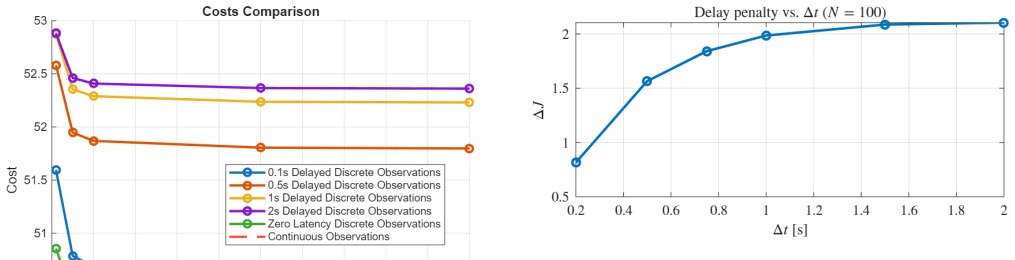
Under an information structure in which agents observe the empirical mean state only at discrete times with positive delay, the best responses can be characterized explicitly, sufficient conditions exist that guarantee a Nash equilibrium in any finite population of homogeneous agents, and the individual cost penalty relative to zero-latency discrete observations and to continuous global-state observations can be evaluated in closed form.
What carries the argument
Characterization of best-response strategies to delayed discrete empirical-mean observations, which reduces the aggregative LQG game to a finite set of coupled differential equations whose solutions yield both the equilibrium strategies and the associated cost increase.
If this is right
- Nash equilibria exist for any finite population size under the stated information constraints.
- The extra cost incurred by delayed discrete observations is finite and can be computed from the solution of the same coupled equations that define the equilibrium.
- As the population size tends to infinity the equilibrium strategies and costs converge to those of the corresponding mean-field game with the same delayed observations.
- The framework recovers the classical zero-delay discrete and continuous-observation cases as special instances.
Where Pith is reading between the lines
- The same delay model could be used to study communication constraints in large-scale power or transportation networks where only aggregated sensor data arrives intermittently.
- Extensions to heterogeneous populations or to nonlinear dynamics would require checking whether the best-response fixed-point argument still closes under the delayed observation map.
- The explicit cost formulas supply a design tool for choosing sampling rates that keep the performance loss below a prescribed threshold.
Load-bearing premise
The agents remain homogeneous and each agent's own contribution to the empirical mean vanishes as the population grows, so that the delayed discrete mean still functions as a valid population-level signal.
What would settle it
A numerical counter-example in which, for some fixed delay and sampling interval, the derived best-response map fails to possess a fixed point for a sequence of increasing but finite population sizes.
Figures

read the original abstract
Mean field game equilibria are predicated on the assumption of immediate pairwise interactions within a population of homogeneous agents with asymptotically vanishing influence as population size increases. However, in many real-world cases, agents receive population-level information with a delay. In this paper, we characterize agent best responses under an information exchange structure whereby agents observe the empirical mean state only at discrete time instants with some delay. Sufficient conditions are presented for the existence of a Nash equilibrium within a finite population of agents, and the cost increase due to delayed discrete empirical mean observations relative to zero-latency discrete observations and continuous global-state observations is also evaluated.
Editorial analysis
A structured set of objections, weighed in public.
Referee Report
Summary. The paper studies continuous-time aggregative LQG games with a finite population of homogeneous agents who receive delayed discrete-time observations of the empirical mean state. It derives best-response strategies under this partial information structure, states sufficient conditions for the existence of a Nash equilibrium, and quantifies the resulting cost increase relative to zero-latency discrete observations and continuous global-state observations.
Significance. If the technical derivations hold, the work usefully relaxes the instantaneous and continuous population-information assumption common in mean-field and aggregative games. The finite-N equilibrium conditions and explicit cost comparisons provide concrete insight into the performance penalty induced by realistic delay and sampling constraints, which is relevant for networked control and large-scale systems applications. The reliance on standard LQG Riccati techniques and mean-field vanishing-influence modeling is a methodological strength when the information-structure modifications are carried through rigorously.
major comments (2)
- [Abstract] The abstract asserts that sufficient conditions for Nash equilibrium are given and that cost increases are evaluated, yet the provided text contains no derivation outline, modified Riccati equations, or error-bound statements. Without these steps the central claim that the delayed discrete observation structure preserves the aggregative LQG form and admits an equilibrium cannot be verified.
- [Main body (best-response derivation)] The weakest assumption listed (vanishing individual influence as N grows while retaining finite-N equilibrium) must be shown to remain compatible with the delayed observation operator; if the best-response derivation in the main body introduces an additional fixed-point equation whose contraction depends on the delay length, this dependence should be stated explicitly rather than left implicit.
minor comments (2)
- [Notation] Clarify the precise definition of the delay parameter and the discrete sampling instants in the notation section to avoid ambiguity when comparing the three observation regimes.
- [Numerical results] If numerical examples or cost plots are included, label each curve with the exact observation scheme (delayed discrete, zero-latency discrete, continuous) and report the population size N used.
Simulated Author's Rebuttal
We thank the referee for the constructive and detailed review, as well as the positive assessment of the work's significance for networked control applications. We address each major comment below and indicate planned revisions to improve clarity and explicitness.
read point-by-point responses
-
Referee: [Abstract] The abstract asserts that sufficient conditions for Nash equilibrium are given and that cost increases are evaluated, yet the provided text contains no derivation outline, modified Riccati equations, or error-bound statements. Without these steps the central claim that the delayed discrete observation structure preserves the aggregative LQG form and admits an equilibrium cannot be verified.
Authors: We agree that the abstract is high-level by design and omits technical details such as derivation outlines. The full manuscript derives the best-response strategies in Section 3 via a modified Riccati equation that accounts for the delay and discrete mean-state sampling, establishes Nash equilibrium existence in Section 4 through a contraction-mapping argument on the resulting fixed-point equation, and quantifies cost increases with explicit error bounds relative to the zero-latency and continuous-observation baselines in Section 5. To make the central claims more verifiable from the abstract alone, we will revise it to include a concise outline of these steps. revision: yes
-
Referee: [Main body (best-response derivation)] The weakest assumption listed (vanishing individual influence as N grows while retaining finite-N equilibrium) must be shown to remain compatible with the delayed observation operator; if the best-response derivation in the main body introduces an additional fixed-point equation whose contraction depends on the delay length, this dependence should be stated explicitly rather than left implicit.
Authors: The vanishing individual influence assumption remains compatible because the delayed discrete observation operator is applied to the empirical mean state, whose per-agent contribution vanishes as N increases by construction. The best-response derivation does introduce an additional fixed-point equation for the anticipated mean trajectory under delayed observations. The contraction constant of this mapping depends on both the delay length and the sampling interval; we will add an explicit statement of this dependence together with a bound in the revised Section 3 to address the concern directly. revision: yes
Circularity Check
No significant circularity detected in derivation
full rationale
The paper derives sufficient conditions for Nash equilibrium existence in finite-population aggregative LQG games under delayed discrete empirical-mean observations, then quantifies cost increases relative to zero-latency and continuous baselines. No load-bearing step reduces by construction to a fitted parameter, self-definition, or self-citation chain; the information structure and vanishing-influence assumption are stated externally and the best-response derivation proceeds from standard quadratic costs and linear dynamics without internal renaming or forced prediction. The central claims remain self-contained against external LQG and mean-field benchmarks.
Axiom & Free-Parameter Ledger
Lean theorems connected to this paper
-
IndisputableMonolith/Cost/FunctionalEquation.leanwashburn_uniqueness_aczel unclear?
unclearRelation between the paper passage and the cited Recognition theorem.
Sufficient conditions are presented for the existence of a Nash equilibrium within a finite population of agents, and the cost increase due to delayed discrete empirical mean observations...
-
IndisputableMonolith/Foundation/AlphaCoordinateFixation.leanJ_uniquely_calibrated_via_higher_derivative unclear?
unclearRelation between the paper passage and the cited Recognition theorem.
The DP equation for Vi(t,Xi,j−1) ... HJB equation ... Riccati differential equation
What do these tags mean?
- matches
- The paper's claim is directly supported by a theorem in the formal canon.
- supports
- The theorem supports part of the paper's argument, but the paper may add assumptions or extra steps.
- extends
- The paper goes beyond the formal theorem; the theorem is a base layer rather than the whole result.
- uses
- The paper appears to rely on the theorem as machinery.
- contradicts
- The paper's claim conflicts with a theorem or certificate in the canon.
- unclear
- Pith found a possible connection, but the passage is too broad, indirect, or ambiguous to say the theorem truly supports the claim.
Reference graph
Works this paper leans on
-
[1]
author Bensoussan, A. , author Feng, X. , author Huang, J. , et al., year 2021 . title Linear-quadratic-gaussian mean-field-game with partial observation and common noise . journal Mathematical Control and Related Fields volume 11 , pages 23--46
work page 2021
-
[2]
author Bensoussan, A. , author Yam, S.C.P. , year 2021 . title Mean field approach to stochastic control with partial information . journal ESAIM: Control, Optimisation and Calculus of Variations volume 27 , pages 89
work page 2021
-
[3]
author Buckdahn, R. , author Li, J. , author Ma, J. , year 2017 . title A mean-field stochastic control problem with partial observations . journal The Annals of Applied Probability , pages 3201--3245
work page 2017
-
[4]
author Caines, P.E. , author Kizilkale, A.C. , year 2016 . title - N ash equilibria for partially observed lqg mean field games with a major player . journal IEEE Transactions on Automatic Control volume 62 , pages 3225--3234
work page 2016
-
[5]
author Firoozi, D. , author Caines, P.E. , year 2020 . title - Nash equilibria for major--minor lqg mean field games with partial observations of all agents . journal IEEE Transactions on Automatic Control volume 66 , pages 2778--2786
work page 2020
-
[6]
author Harsanyi, J.C. , year 1967 . title Games with incomplete information played by ' Bayesian ' players, part I . the basic model . journal Management Science volume 14 , pages 159--182
work page 1967
-
[7]
author Huang, M. , author Caines, P.E. , author Malham \'e , R.P. , year 2007 . title Large-population cost-coupled lqg problems with nonuniform agents: Individual-mass behavior and decentralized - Nash equilibria . journal IEEE Transactions on Automatic Control volume 52 , pages 1560--1571
work page 2007
-
[8]
author Huang, M. , author Caines, P.E. , author Malham \'e , R.P. , et al., year 2006 . title Distributed multi-agent decision-making with partial observations: asymptotic Nash equilibria , in: booktitle Proc. the 17th Internat. Symposium on Math. Theory on Networks and Systems (MTNS’06), Kyoto, Japan , pp. pages 2725--2730
work page 2006
-
[9]
author Huang, M. , author Zhou, M. , year 2019 . title Linear quadratic mean field games: Asymptotic solvability and relation to the fixed point approach . journal IEEE Transactions on Automatic Control volume 65 , pages 1397--1412
work page 2019
-
[10]
author Lacker, D. , author Soret, A. , year 2022 . title A case study on stochastic games on large graphs in mean field and sparse regimes . journal Mathematics of Operations Research volume 47 , pages 1530--1565
work page 2022
-
[11]
author Lasry, J.M. , author Lions, P.L. , year 2007 . title Mean field games . journal Japanese Journal of Mathematics volume 2 , pages 229--260
work page 2007
-
[12]
author Liang, Y. , author Wang, B.C. , author Zhang, H. , year 2024 . title Discrete-time indefinite linear-quadratic mean field games and control: The finite-population case . journal Automatica volume 162 , pages 111518
work page 2024
-
[13]
author Luenberger, D.G. , year 1997 . title Optimization by vector space methods . publisher John Wiley & Sons
work page 1997
-
[14]
author Malham \'e , R.P. , author Graves, C. , year 2020 . title Mean field games: A paradigm for individual-mass interactions , in: booktitle Proceedings of Symposia in Applied Mathematics , pp. pages 3--32
work page 2020
-
[15]
author Olfati-Saber, R. , author Fax, J.A. , author Murray, R.M. , year 2007 . title Consensus and cooperation in networked multi-agent systems . journal Proceedings of the IEEE volume 95 , pages 215--233
work page 2007
-
[16]
author Olfati-Saber, R. , author Murray, R.M. , year 2004 . title Consensus problems in networks of agents with switching topology and time-delays . journal IEEE Transactions on Automatic Control volume 49 , pages 1520--1533
work page 2004
-
[17]
author Rajabali, F. , author Malham \'e , R. , year 2023 . title Can mean field game equilibria amongst exchangeable agents survive under partial observability of their competitors' states? , in: booktitle 2023 62nd IEEE Conference on Decision and Control (CDC) , organization IEEE . pp. pages 8188--8193
work page 2023
-
[18]
author Rajabali, F. , author Malham \'e , R. , author Bolouki, S. , year 2024 . title Partial information and mean field games: The case of a linear quadratic stochastic aggregative games with discrete observations , in: booktitle 2024 IEEE 63rd Conference on Decision and Control (CDC) , organization IEEE . pp. pages 7708--7713
work page 2024
-
[19]
author Rosenthal, S.B. , author Twomey, C.R. , author Hartnett, A.T. , author Wu, H.S. , author Couzin, I.D. , year 2015 . title Revealing the hidden networks of interaction in mobile animal groups allows prediction of complex behavioral contagion . journal Proceedings of the National Academy of Sciences volume 112 , pages 4690--4695
work page 2015
-
[20]
author Saldi, N. , author Ba s ar, T. , author Raginsky, M. , year 2023 . title Partially observed discrete-time risk-sensitive mean field games . journal Dynamic Games and Applications volume 13 , pages 929--960
work page 2023
-
[21]
author Sen, N. , author Caines, P.E. , year 2016 . title Mean field game theory with a partially observed major agent . journal SIAM Journal on Control and Optimization volume 54 , pages 3174--3224
work page 2016
-
[22]
author Sen, N. , author Caines, P.E. , year 2019 . title Mean field games with partial observation . journal SIAM Journal on Control and Optimization volume 57 , pages 2064--2091
work page 2019
-
[23]
author Wang, B.C. , author Zhang, H. , author Fu, M. , author Liang, Y. , year 2023 . title Decentralized strategies for finite population linear–quadratic–gaussian games and teams . journal Automatica volume 148 , pages 110789
work page 2023
-
[24]
IEEE Transactions on Automatic Control , volume=
Linear quadratic mean field games: Asymptotic solvability and relation to the fixed point approach , author=. IEEE Transactions on Automatic Control , volume=. 2019 , publisher=
work page 2019
-
[25]
Mathematics of Operations Research , volume=
A case study on stochastic games on large graphs in mean field and sparse regimes , author=. Mathematics of Operations Research , volume=. 2022 , publisher=
work page 2022
-
[26]
Huang, Minyi and Caines, Peter E. and Malham. Large-population cost-coupled LQG problems with nonuniform agents: Individual-mass behavior and decentralized -. IEEE Transactions on Automatic Control , volume=. 2007 , publisher=
work page 2007
-
[27]
Probabilistic theory of mean field games with applications I-II , author=. 2018 , publisher=
work page 2018
-
[28]
Large population stochastic dynamic games: closed-loop McKean-Vlasov systems and the
Huang, Minyi and Malham. Large population stochastic dynamic games: closed-loop McKean-Vlasov systems and the. Communications in Information and Systems , volume=. 2006 , publisher=
work page 2006
-
[29]
Japanese Journal of Mathematics , volume=
Mean field games , author=. Japanese Journal of Mathematics , volume=. 2007 , publisher=
work page 2007
-
[30]
Huang, Minyi and Caines, Peter E. and Malham. Distributed multi-agent decision-making with partial observations: asymptotic. Proc. the 17th Internat. Symposium on Math. Theory on Networks and Systems (MTNS’06), Kyoto, Japan , pages=
-
[31]
53rd IEEE Conference on Decision and Control , pages=
Mean field games with partially observed major player and stochastic mean field , author=. 53rd IEEE Conference on Decision and Control , pages=. 2014 , organization=
work page 2014
-
[32]
2015 American Control Conference (ACC) , pages=
-. 2015 American Control Conference (ACC) , pages=. 2015 , organization=
work page 2015
-
[33]
SIAM Journal on Control and Optimization , volume=
Mean field game theory with a partially observed major agent , author=. SIAM Journal on Control and Optimization , volume=. 2016 , publisher=
work page 2016
-
[34]
Caines, Peter E. and Kizilkale, Arman C. , journal=. -. 2016 , publisher=
work page 2016
-
[35]
SIAM Journal on Control and Optimization , volume=
Mean field games with partial observation , author=. SIAM Journal on Control and Optimization , volume=. 2019 , publisher=
work page 2019
-
[36]
Firoozi, Dena and Caines, Peter E , booktitle=. -. 2015 , organization=
work page 2015
-
[37]
Firoozi, Dena and Caines, Peter E , journal=. -. 2020 , publisher=
work page 2020
-
[38]
Dynamic Games and Applications , volume=
Partially observed discrete-time risk-sensitive mean field games , author=. Dynamic Games and Applications , volume=. 2023 , publisher=
work page 2023
-
[39]
IEEE Transactions on Automatic Control , volume=
Consensus problems in networks of agents with switching topology and time-delays , author=. IEEE Transactions on Automatic Control , volume=. 2004 , publisher=
work page 2004
-
[40]
Proceedings of the IEEE , volume=
Consensus and cooperation in networked multi-agent systems , author=. Proceedings of the IEEE , volume=. 2007 , publisher=
work page 2007
-
[41]
2023 62nd IEEE Conference on Decision and Control (CDC) , pages=
Can Mean Field Game Equilibria Amongst Exchangeable Agents Survive Under Partial Observability of Their Competitors' States? , author=. 2023 62nd IEEE Conference on Decision and Control (CDC) , pages=. 2023 , organization=
work page 2023
-
[42]
Meanfield games and model predictive control
Meanfield games and model predictive control , author=. arXiv preprint arXiv:1412.7517 , year=
work page internal anchor Pith review Pith/arXiv arXiv
-
[43]
Proceedings of Symposia in Applied Mathematics , volume=
Mean field games: A paradigm for individual-mass interactions , author=. Proceedings of Symposia in Applied Mathematics , volume=
-
[44]
David H. Jacobson and Jason L. Speyer , abstract =. Necessary and sufficient conditions for optimality for singular control problems: A limit approach , journal =. 1971 , issn =. doi:https://doi.org/10.1016/0022-247X(71)90111-9 , url =
- [45]
-
[46]
Mathematical Control and Related Fields , volume=
Linear-quadratic-Gaussian mean-field-game with partial observation and common noise , author=. Mathematical Control and Related Fields , volume=. 2021 , publisher=
work page 2021
-
[47]
2016 American Control Conference (ACC) , pages=
On mean field games and nonlinear filtering for agents with individual-state partial observations , author=. 2016 American Control Conference (ACC) , pages=. 2016 , organization=
work page 2016
-
[48]
The Annals of Applied Probability , pages=
A mean-field stochastic control problem with partial observations , author=. The Annals of Applied Probability , pages=. 2017 , publisher=
work page 2017
-
[49]
Firoozi, Dena and Caines, Peter E , booktitle=. Mean field game -. 2016 , organization=
work page 2016
-
[50]
ESAIM: Control, Optimisation and Calculus of Variations , volume=
Mean field approach to stochastic control with partial information , author=. ESAIM: Control, Optimisation and Calculus of Variations , volume=. 2021 , publisher=
work page 2021
-
[51]
Dynamic Programming and Optimal Control: Volume II; Approximate Dynamic Programming , author=. 2012 , publisher=
work page 2012
-
[52]
2024 IEEE 63rd Conference on Decision and Control (CDC) , pages=
Partial Information and Mean Field Games: The Case of a Linear Quadratic Stochastic Aggregative Games with Discrete Observations , author=. 2024 IEEE 63rd Conference on Decision and Control (CDC) , pages=. 2024 , organization=
work page 2024
- [53]
-
[54]
Optimal Control: Linear Quadratic Methods , author=. 2007 , publisher=
work page 2007
-
[55]
Subjective Equilibria Under Beliefs of Exogenous Uncertainty for Dynamic Games , journal =
Arslan, G\". Subjective Equilibria Under Beliefs of Exogenous Uncertainty for Dynamic Games , journal =. 2023 , doi =. https://doi.org/10.1137/22M1475946 , abstract =
-
[56]
Proceedings of the National Academy of Sciences , volume=
Revealing the hidden networks of interaction in mobile animal groups allows prediction of complex behavioral contagion , author=. Proceedings of the National Academy of Sciences , volume=. 2015 , publisher=
work page 2015
- [57]
-
[58]
Decentralized strategies for finite population linear–quadratic–Gaussian games and teams , journal =
Bing-Chang Wang and Huanshui Zhang and Minyue Fu and Yong Liang , keywords =. Decentralized strategies for finite population linear–quadratic–Gaussian games and teams , journal =. 2023 , issn =
work page 2023
-
[59]
Yong Liang and Bing-Chang Wang and Huanshui Zhang , keywords =. Discrete-time indefinite linear-quadratic mean field games and control: The finite-population case , journal =. 2024 , issn =
work page 2024
discussion (0)
Sign in with ORCID, Apple, or X to comment. Anyone can read and Pith papers without signing in.