REVIEW 3 major objections 4 minor 39 references
Beyond Static Anchors: Bounded Prototype Conditioning for Language-Free Medical Anomaly Detection
T0 review · 3 major / 4 minor · reviewed 2026-08-05 · deepseek-v4-flash
Pith's one-line read ReCAP replaces static normal/abnormal references with per-image bounded visual prototypes, reporting best zero-shot image-level AUROC on all six medical benchmarks and over 70% lower inference latency than the fastest baseline.
desk verdict Genuinely new conditioning mechanism with strong results, but the 'bounded' claim isn't actually bounded and the closest baseline is missing; referee it. read the letter →
The pith
A machine-rendered reading of the paper's core claim, the machinery that carries it, and where it could break.
The reading
What carries the argument
Bounded gated prototype modulation (Eq. 2): each normal/abnormal prototype q is re-centered by σ(β) η tanh(W c(x)), where c(x) is the average-pooled, normalized patch-token descriptor of the query and η=0.05 caps the shift. The sigmoid gate and tanh bound are the load-bearing design: they let the anchor drift toward the current domain while preventing the lesion in the pooled descriptor from dragging the normal anchor onto pathological content. Around it sit the prototype separation regularizer (keeping base prototypes discriminative before adaptation), the non-parametric normal-reference memory for few-shot instance-level normality, and learnable multi-layer fusion combining prototype logit
What would settle it
Take an abnormal image from BrainMRI or LiverCT, compute ReCAP's anomaly score, then re-run the same image after removing or heavily masking the annotated lesion region; if the score decreases (the image with the lesion looks more normal than the image without it), the conditioning is being driven by lesion content rather than domain context, falsifying the bounded-modulation premise. Repeating this across lesions of increasing size should show whether η=0.05 keeps the normal anchor clean.
Extended reading notes
Core claim
ReCAP's central claim is that an anomaly boundary expressed as a pair of visual prototypes—one normal, one abnormal—can and should be made query-adaptive, and that the adaptation must be deliberately bounded. The paper derives this from three limitations of static anchors: text prompts are coarse and wording-sensitive; learned visual tokens can still define a boundary misplaced for an unseen target; and a compact global anchor cannot preserve instance-level normal variation needed for localization. ReCAP computes a context descriptor by average-pooling the query's patch tokens, then shifts each prototype by a gated residual σ(β)η tanh(W c(x)), with η=0.05, so the conditioned prototypes stay
Load-bearing premise
Equation (2) presumes that the average-pooled context descriptor carries domain information without being so dominated by a large lesion that the bounded gate shifts the normal prototype toward the anomaly; the paper does not analyze this contamination failure mode.
Editorial extensions
If this is right
- If ReCAP's central claim holds, language-free, gradient-free per-image anchoring becomes a competitive alternative to text-prompt CLIP adaptation for medical anomaly detection.
- The bounded conditioning design implies that a single source-trained prototype pair can be shipped to unseen target domains and adapted in one forward pass at test time.
- The normal-reference memory makes few-shot detection benefit from instance-level normal variation rather than only a compact prototype; ablations attribute gains to memory, conditioning, and layer fusion jointly.
- The reported ~3.8x latency reduction over VisualAD on the same ViT-L/14@336px backbone suggests the method is suitable for time-sensitive screening if the accuracy results replicate.
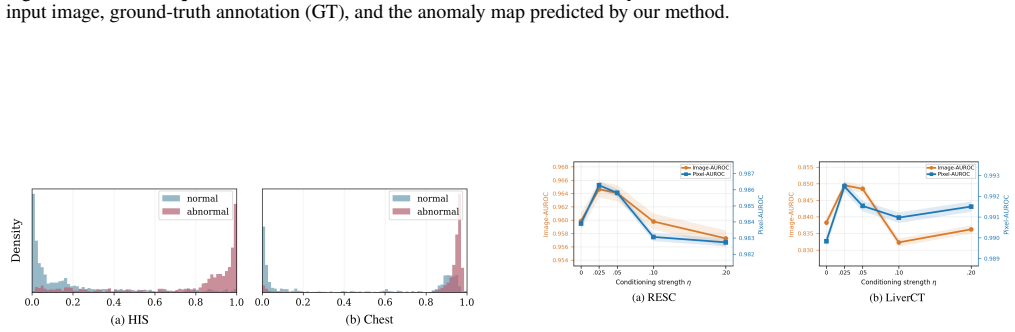
- The sensitivity analyses (η around 0.025–0.05, top-k ratio 5–20%, fusion weight λ around 0.5) indicate the method's gains do not hinge on a narrow hyperparameter setting.
Reading between the lines
- Editorial inference: the bounded-gate premise implies a testable monotonicity property: for a fixed image, removing or shrinking the lesion should not lower the anomaly score; if it does, the conditioning is absorbing lesion signal rather than domain signal.
- Editorial inference: the method could be extended to volumetric data by treating 3D patches or slices as tokens; the context descriptor would then pool over a volume, increasing the chance of lesion contamination and requiring a smaller η or a localization-aware gate.
- Editorial inference: because the approach is language-free and CLIP-based, it may transfer to industrial anomaly detection where textual prompts are also awkward, though the medical cross-domain setup (six datasets) is the paper's actual evidence.
- Editorial inference: the paper's zero-shot leave-one-out protocol trains on five medical domains; a stronger test would be holding out a modality never seen at all (e.g., ultrasound), which the paper lists as future direction.
Editorial analysis
A structured set of objections, weighed in public.
Referee Report
Summary. This paper proposes ReCAP, a language-free medical anomaly detection framework built on a frozen CLIP visual encoder. Instead of static text prompts or fixed visual anchors, ReCAP maintains normal/abnormal visual prototypes that are re-centered for each input using an average-pooled context descriptor under a bounded gated residual (Eq. 2). In the few-shot setting, a non-parametric normal-reference memory is added, and multi-layer fusion combines prototype and memory evidence. The method is evaluated with leave-one-domain-out zero-shot and K-shot protocols on six medical benchmarks, reporting best image-level AUROC on all zero-shot and 23/24 few-shot settings, best zero-shot pixel-level AUROC on all three segmentation datasets, and a >70% inference latency reduction relative to VisualAD.
Significance. The core idea—amortized, input-conditioned prototype re-centering without text prompts or test-time gradients—is timely and clearly relevant for cross-domain medical anomaly detection. The paper has real strengths: the method is specified precisely, the leave-one-domain-out protocol is appropriate, baselines use identical support indices, few-shot results are supplemented with mean±std over five seeds in Appendix E, and the efficiency comparison is concrete. If the bounded-modulation safety claim holds, this is a practical and competitive alternative to prompt-based and test-time adaptation methods. However, the central 'bounded drift' guarantee is not established as stated: the per-coordinate tanh bound does not by itself control the L2 norm of the residual in the 1024-dimensional feature space. In addition, hyperparameter defaults are selected from sensitivity curves computed on the same evaluation benchmarks, and zero-shot results are reported without variance. These issues do not invalidate the empirical findings, but they need to be addressed before the safety and SOTA claims can be fully accepted.
major comments (3)
- [§3.3, Eq. (2)] The claim that the residual is 'small' and that the conditioned anchor 'stays close to the learned base prototype' is not a consequence of the per-coordinate tanh bound. With η=0.05 and C=1024, each component of r = σ(β)η tanh(Wc) lies in [-0.05, 0.05], so the L2 norm can be as large as η√C ≈ 1.6, which exceeds the unit norm of the prototype. After renormalization, the anchor can rotate by tens of degrees. Nothing in the formulation regularizes W or σ(β) to prevent such large per-image shifts. The paper correctly acknowledges that the pooled context descriptor is contaminated by the lesion on abnormal inputs, but Table 5 reports only average AUROC on two datasets and does not measure angular drift on lesion-dominated examples. To support the central safety mechanism, the authors should either add a norm/spectral constraint that actually bounds the drift, or provide an empirical analysis
- [Appendix G, Figs. 6–8] The default hyperparameters η=0.05, top-k=10%, and λ=0.5 are selected from sensitivity curves computed on the same benchmark evaluation sets used to report the main results in Tables 1 and 2. The reported AUROC values are therefore not fully blind to these choices. This is especially relevant because some improvements over baselines are small (e.g., zero-shot BrainMRI 80.24 vs. 79.80 for MVFA, Table 2). I ask the authors to either tune hyperparameters on held-out source-domain data, or explicitly disclose the selection procedure and quantify its effect on the reported numbers (e.g., by reporting performance over a reasonable range of each hyperparameter for all datasets). This is not fatal to the method, but it is load-bearing for the SOTA claim.
- [Table 2 (§4.2)] Zero-shot results are reported as single AUROC values without variance or number of seeds, even though training is stochastic and the improvements over the second-best method are sometimes below one percentage point (e.g., HIS 79.32 vs. 77.32 for MadCLIP; BrainMRI 80.24 vs. 79.80 for MVFA). Appendix E provides mean±std over five seeds for few-shot settings, but no analogous information is provided for the zero-shot setting that supports the headline 'best on all six datasets' claim. Please add mean±std over multiple seeds (or an explicit statement of determinism) for Table 2.
minor comments (4)
- [Tables 1–2 captions] The header row 'N/A ✗ ✗ ✗ ✗ ✓ ✓' is cryptic. Define the symbols in the caption or main text, including what N/A denotes for DRA.
- [Figure 2 caption] The caption text 'OurMVFA GTMadCLIPApril-GAN VisualAD' appears to have missing spacing/formatting. Please fix the caption formatting.
- [Appendix D, Support Sampling] The text says the fixed support set is 'selected from the validation split,' but it is not clear whether this is the same as the labeled pool described in Appendix C and whether the test set is completely disjoint. Clarify the split terminology to avoid leakage ambiguity.
- [Eq. (6)] The normalized memory distance is mapped to [0,1] via division by 2. Since nearest-neighbor cosine distance on ℓ2-normalized features is theoretically in [0,2], this is fine, but a brief justification for using the maximum possible distance (rather than the observed maximum) would help readers.
Circularity Check
No significant circularity: ReCAP's evaluations are held-out and its conditioning mechanism is not defined in terms of the quantities it predicts.
full rationale
Walking the derivation chain, ReCAP's core module is the bounded gated modulation in Eq. (2), which re-centers learned normal/abnormal prototypes from the query's average-pooled patch tokens (Eq. (1)). This is a trainable transformation with a fixed bound; the prototypes, adapters, gate parameters and fusion weights are optimized on source domains or target support sets via Eqs. (10)-(13), and all reported AUROC numbers are computed on target test splits that are not used for training or support selection. The few-shot memory (Eqs. (5)-(6)) is a nearest-neighbor distance to normal support patches, so a query's score is not a fitted value of that query's label. No equation defines the predicted anomaly score as the fitted parameter or as a function of test labels. The only self-citation, Cai et al. (2025) in Sec. 1, is a general reference to prior medical AD work and is not load-bearing. The sensitivity analyses of eta, top-k, and lambda are model-selection procedures on validation/test curves; they are selection bias at most, not a reduction of the prediction to the fit. Therefore no circular step is exhibited, and the central claims rest on held-out empirical evaluation rather than on definitional equivalence or self-citation.
Assumptions & free parameters
free parameters (5)
- conditioning strength eta =
0.05
- logit scale alpha =
100
- top-k aggregation ratio =
10%
- prototype-memory fusion weight lambda =
0.5
- separation margin delta =
not reported
assumptions (3)
- domain assumption Frozen CLIP ViT-L/14@336px visual features transfer across brain MRI, liver CT, retinal OCT, chest X-ray, and histopathology after lightweight adapter training
- domain assumption The leave-one-out protocol and fixed support sets yield unbiased estimates without patient-level leakage
- ad hoc to paper The average-pooled context descriptor is not dominated by lesion content when the input is abnormal, and the bounded gate prevents the normal prototype from drifting toward the anomaly
Cite this review
Pith. "Pith review of Beyond Static Anchors: Bounded Prototype Conditioning for Language-Free Medical Anomaly Detection." pith.science (2026). https://pith.science/paper/R2U33S3L
@misc{pith2026260800442,
  author       = {Pith},
  title        = {Pith review of: Beyond Static Anchors: Bounded Prototype Conditioning for Language-Free Medical Anomaly Detection},
  year         = {2026},
  howpublished = {\url{https://pith.science/paper/R2U33S3L}},
  note         = {Machine review of arXiv:2608.00442}
}
read the original abstract
Medical anomaly detection identifies abnormal images and localizes lesions under scarce supervision while generalizing across organs and modalities. Existing CLIP-based methods reduce annotation requirements through vision--language alignment, but their normal and abnormal references, whether text prompts or learned visual tokens, remain fixed across test images. Such static references may not transfer reliably to unseen targets in a cross-domain medical imaging scenario. To address this, we propose ReCAP, a language-free framework that replaces static anchors with input-conditioned visual prototypes. ReCAP re-centers separated normal and abnormal prototypes for each image through a bounded gated modulation, enabling query-adaptive anomaly scoring while constraining context-induced prototype drift. For the few-shot setting, we introduce a non-parametric normal-reference memory to preserve instance-level target-domain variation and complement the conditional prototype branch. Across six medical benchmarks, ReCAP achieves the best image-level AUROC on all zero-shot and 23 of 24 few-shot settings, and the best zero-shot pixel-level AUROC on all three segmentation datasets. Particularly, it reduces inference latency by over 70% compared to the fastest baseline, without text prompts or test-time gradient updates.
Figures


Figures from the paper (4 more)



Reference graph
Works this paper leans on
-
[1]
Baid, Ujjwal and Ghodasara, Satyam and Mohan, Suyash and Bilello, Michel and Calabrese, Evan and Colak, Errol and Farahani, Keyvan and Kalpathy-Cramer, Jayashree and Kitamura, Felipe C and Pati, Sarthak , title =. ArXiv:2107.02314 , year =
-
[2]
Medical Image Analysis , volume=
The liver tumor segmentation benchmark (lits) , author=. Medical Image Analysis , volume=. 2023 , publisher=
2023
-
[3]
Cell , volume=
Identifying medical diagnoses and treatable diseases by image-based deep learning , author=. Cell , volume=. 2018 , publisher=
2018
-
[4]
Proceedings of the IEEE/CVF Conference on Computer Vision and Pattern Recognition , pages=
Distribution prototype diffusion learning for open-set supervised anomaly detection , author=. Proceedings of the IEEE/CVF Conference on Computer Vision and Pattern Recognition , pages=
-
[5]
Proceedings of the Computer Vision and Pattern Recognition Conference , pages=
One-for-more: Continual diffusion model for anomaly detection , author=. Proceedings of the Computer Vision and Pattern Recognition Conference , pages=
-
[6]
Anomalyclip: Object-agnostic prompt learning for zero-shot anomaly detection , author=. ArXiv:2310.18961 , year=
-
[7]
VisualAD: Language-Free Zero-Shot Anomaly Detection via Vision Transformer , author=. ArXiv:2603.07952 , year=
-
[8]
European Conference on Computer Vision , pages=
Anomalouspatchcore: exploring the use of anomalous samples in industrial anomaly detection , author=. European Conference on Computer Vision , pages=. 2024 , organization=
work page 2024
Show all 39 references
-
[9]
International Conference on Pattern Recognition , pages=
Supersimplenet: Unifying unsupervised and supervised learning for fast and reliable surface defect detection , author=. International Conference on Pattern Recognition , pages=. 2024 , organization=
2024
-
[10]
Proceedings of MICCAI Multi-atlas Labeling Beyond Cranial Vault---Workshop Challenge , volume=
Miccai multi-atlas labeling beyond the cranial vault--workshop and challenge , author=. Proceedings of MICCAI Multi-atlas Labeling Beyond Cranial Vault---Workshop Challenge , volume=. 2015 , organization=
2015
-
[11]
Medical Image Analysis , volume=
Automated segmentation of macular edema in OCT using deep neural networks , author=. Medical Image Analysis , volume=. 2019 , publisher=
2019
-
[12]
Proceedings of the IEEE/CVF Conference on Computer Vision and Pattern Recognition , pages=
Catching both gray and black swans: Open-set supervised anomaly detection , author=. Proceedings of the IEEE/CVF Conference on Computer Vision and Pattern Recognition , pages=
-
[13]
1st Place on Zero-shot AD and 4th Place on Few-shot AD , volume=
A zero-/few-shot anomaly classification and segmentation method for CVPR 2023 (VAND) workshop challenge tracks 1 &2 , author=. 1st Place on Zero-shot AD and 4th Place on Few-shot AD , volume=
2023
-
[14]
International Conference on Medical Image Computing and Computer-Assisted Intervention , pages=
Mediclip: Adapting clip for few-shot medical image anomaly detection , author=. International Conference on Medical Image Computing and Computer-Assisted Intervention , pages=. 2024 , organization=
2024
-
[15]
JAMA , volume=
Diagnostic assessment of deep learning algorithms for detection of lymph node metastases in women with breast cancer , author=. JAMA , volume=
-
[16]
Proceedings of the IEEE Conference on Computer Vision and Pattern Recognition , pages=
Chestx-ray8: Hospital-scale chest x-ray database and benchmarks on weakly-supervised classification and localization of common thorax diseases , author=. Proceedings of the IEEE Conference on Computer Vision and Pattern Recognition , pages=
-
[17]
IEEE Transactions on Medical Imaging , volume=
The multimodal brain tumor image segmentation benchmark (BRATS) , author=. IEEE Transactions on Medical Imaging , volume=. 2014 , publisher=
2014
-
[18]
Scientific data , volume=
Advancing the cancer genome atlas glioma MRI collections with expert segmentation labels and radiomic features , author=. Scientific data , volume=. 2017 , publisher=
2017
-
[19]
Medical Image Analysis , volume=
MedIAnomaly: A comparative study of anomaly detection in medical images , author=. Medical Image Analysis , volume=. 2025 , publisher=
2025
-
[20]
International Conference on Medical Image Computing and Computer-Assisted Intervention , publisher =
Wolleb, Julia and Bieder, Florentin and Sandkühler, Robin and Cattin, Philippe C , title =. International Conference on Medical Image Computing and Computer-Assisted Intervention , publisher =. 2022 , type =
2022
-
[21]
2017 , eprint=
Unsupervised Anomaly Detection with Generative Adversarial Networks to Guide Marker Discovery , author=. 2017 , eprint=
2017
-
[22]
Proceedings of the International Conference on Learning Representations , year=
Deep autoencoding gaussian mixture model for unsupervised anomaly detection , author=. Proceedings of the International Conference on Learning Representations , year=
-
[23]
Proceedings of the IEEE/CVF Conference on Computer Vision and Pattern Recognition , pages=
Anomaly detection via reverse distillation from one-class embedding , author=. Proceedings of the IEEE/CVF Conference on Computer Vision and Pattern Recognition , pages=
-
[24]
Proceedings of the AAAI Conference on Artificial Intelligence , volume=
A diffusion-based framework for multi-class anomaly detection , author=. Proceedings of the AAAI Conference on Artificial Intelligence , volume=
-
[25]
Proceedings of the IEEE/CVF Conference on Computer Vision and Pattern Recognition , pages=
Towards total recall in industrial anomaly detection , author=. Proceedings of the IEEE/CVF Conference on Computer Vision and Pattern Recognition , pages=
-
[26]
Proceedings of the IEEE/CVF Conference on Computer Vision and Pattern Recognition , pages=
Simplenet: A simple network for image anomaly detection and localization , author=. Proceedings of the IEEE/CVF Conference on Computer Vision and Pattern Recognition , pages=
-
[27]
Proceedings of the IEEE/CVF International Conference on Computer Vision , pages=
Memorizing normality to detect anomaly: Memory-augmented deep autoencoder for unsupervised anomaly detection , author=. Proceedings of the IEEE/CVF International Conference on Computer Vision , pages=
-
[28]
Radiology: Artificial Intelligence , volume=
Augmenting the national institutes of health chest radiograph dataset with expert annotations of possible pneumonia , author=. Radiology: Artificial Intelligence , volume=. 2019 , publisher=
2019
-
[29]
Proceedings of the IEEE Conference on Computer Vision and Pattern Recognition , pages=
Adversarially learned one-class classifier for novelty detection , author=. Proceedings of the IEEE Conference on Computer Vision and Pattern Recognition , pages=
-
[30]
Proceedings of the IEEE/CVF Winter Conference on Applications of Computer Vision , pages=
Cflow-ad: Real-time unsupervised anomaly detection with localization via conditional normalizing flows , author=. Proceedings of the IEEE/CVF Winter Conference on Applications of Computer Vision , pages=
-
[31]
International Conference on Machine Learning , pages=
Learning transferable visual models from natural language supervision , author=. International Conference on Machine Learning , pages=. 2021 , organization=
2021
-
[32]
Proceedings of the IEEE/CVF Conference on Computer Vision and Pattern Recognition , pages=
Adapting visual-language models for generalizable anomaly detection in medical images , author=. Proceedings of the IEEE/CVF Conference on Computer Vision and Pattern Recognition , pages=
-
[33]
International Conference on Medical Image Computing and Computer-Assisted Intervention , pages=
MadCLIP: few-shot medical anomaly detection with CLIP , author=. International Conference on Medical Image Computing and Computer-Assisted Intervention , pages=. 2025 , organization=
2025
-
[34]
ArXiv:2506.10730 , year=
IQE-CLIP: Instance-aware Query Embedding for Zero-/Few-shot Anomaly Detection in Medical Domain , author=. ArXiv:2506.10730 , year=
-
[35]
International Conference on Medical Image Computing and Computer-Assisted Intervention , pages=
Ultraad: Fine-grained ultrasound anomaly classification via few-shot clip adaptation , author=. International Conference on Medical Image Computing and Computer-Assisted Intervention , pages=. 2025 , organization=
2025
-
[36]
Proceedings of the Computer Vision and Pattern Recognition Conference , pages=
Aa-clip: Enhancing zero-shot anomaly detection via anomaly-aware clip , author=. Proceedings of the Computer Vision and Pattern Recognition Conference , pages=
-
[37]
European Conference on Computer Vision , pages=
Adaclip: Adapting clip with hybrid learnable prompts for zero-shot anomaly detection , author=. European Conference on Computer Vision , pages=. 2024 , organization=
2024
-
[38]
Proceedings of the 2022 Conference on Empirical Methods in Natural Language Processing , pages=
Medclip: Contrastive learning from unpaired medical images and text , author=. Proceedings of the 2022 Conference on Empirical Methods in Natural Language Processing , pages=
2022
-
[39]
ArXiv:2601.05552 , year=
One Language-Free Foundation Model Is Enough for Universal Vision Anomaly Detection , author=. ArXiv:2601.05552 , year=
Reviewed August 5, 2026 · model on record in the stance chip above.
Discussion (0). Sign in to comment.