REVIEW 5 major objections 6 minor 17 references
Parallel simulation of two--dimensional Ising models using Probabilistic Cellular Automata
T0 review · 5 major / 6 minor · reviewed 2026-08-14 · deepseek-v4-flash
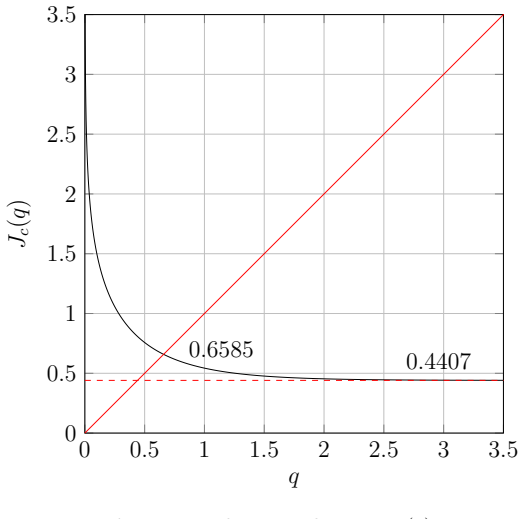
Pith's one-line read The shaken dynamics, a fully parallel probabilistic cellular automaton, reproduces the Ising critical curve $J_c(q)=\tanh^{-1}(\sqrt{\tanh^2 q+1}-\tanh q)$ and, for $q\ge2.5$, samples close to the square-lattice Gibbs measure.
desk verdict Useful numerical companion to the shaken-dynamics papers, with a real soft spot in the equilibration check for the critical-curve estimate; the exact-sampling parts hold up. read the letter →
The pith
A machine-rendered reading of the paper's core claim, the machinery that carries it, and where it could break.
The reading
What carries the argument
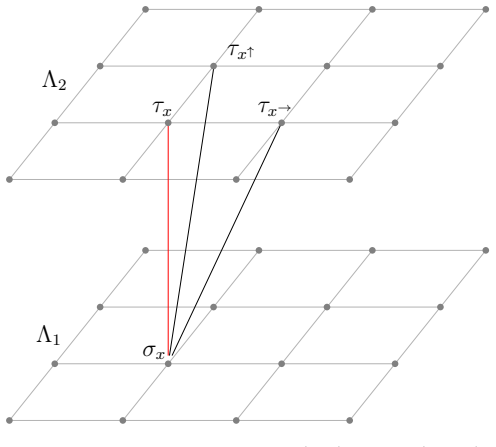
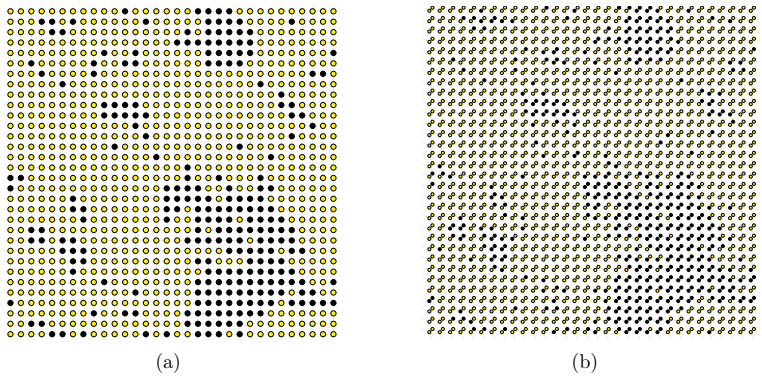
The central object is the shaken dynamics, a probabilistic cellular automaton defined as the marginal on one sublattice of an alternate parallel heat-bath dynamics on a bipartite graph. Each half-step updates all spins simultaneously with probabilities derived from a two-parameter Hamiltonian $H(\sigma,\tau) = -\sum_x [J\sigma_x(\tau_{x^\uparrow}+\tau_{x^\to})+q\sigma_x\tau_x]$, where $q$ is a self-interaction that tunes the effective lattice geometry. The load-bearing identity is the critical-curve equation $1 = 2\tanh J\tanh q + \tanh^2 J$, whose solution is $J_c(q)$; it comes from the even-subgraph expansion for the honeycomb-lattice Ising partition function. The paper uses this identity to predict where the magnetization variance should peak, and uses the partial-order-preserving update to estimate mixing via coalescence of two extremal chains.
What would settle it
Directly estimate the total-variation distance $\|\pi_s - \pi_G\|_{TV}$ from Propp-Wilson samples for $q=2.5$ on increasing lattice sizes; if the distance does not tend to zero as $|\Lambda|\to\infty$, or if the magnetization variance peaks away from $J_c(q)$ on lattices larger than $200\times200$, the central claims would be refuted.
Extended reading notes
Core claim
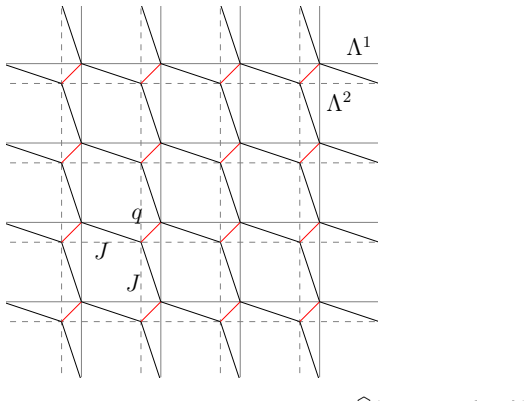
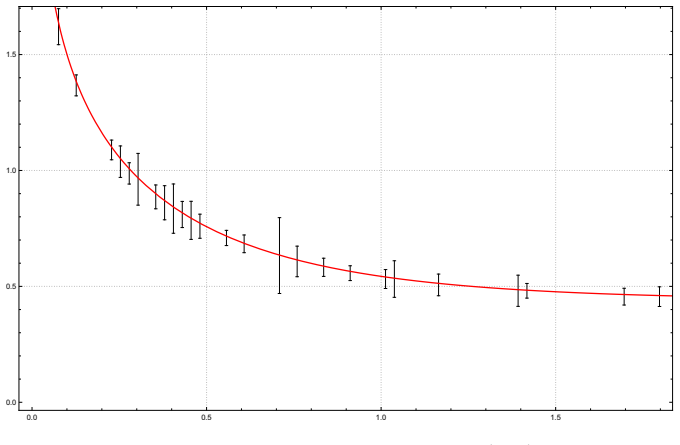
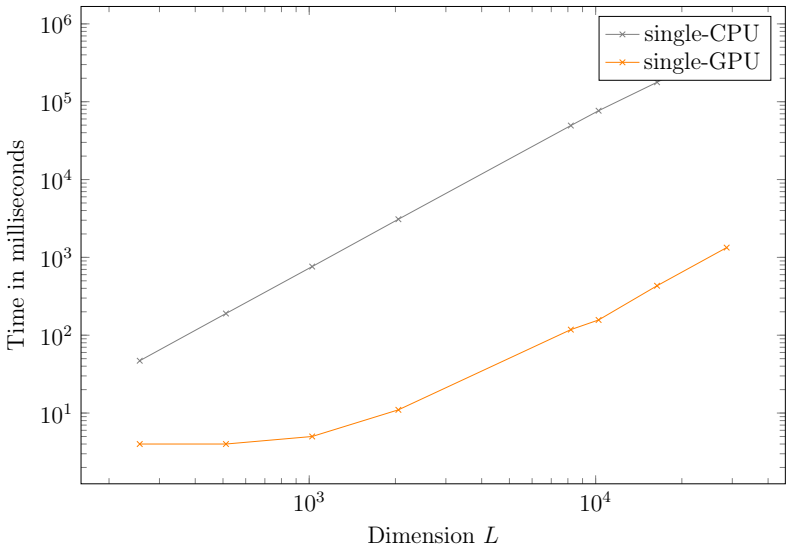
The paper claims that the shaken dynamics—a factorized, fully parallel update rule on a bipartite lattice—undergoes an order-disorder phase transition along the explicit curve $J_c(q) = \tanh^{-1}(\sqrt{\tanh^2 q + 1} - \tanh q)$, which limits to the square-lattice critical value $\tanh^{-1}(\sqrt{2}-1)\approx 0.4407$ as $q\to\infty$ and passes through the honeycomb critical point $J=q\approx 0.6585$. Using the variance of the magnetization as a phase indicator on a $200\times200$ torus, the authors locate the transition points over a grid in $(q,J)$ and find they fall on the theoretical curve. They also measure coalescence times to estimate mixing, and compare the shaken dynamics' equilibrium samples against the square-lattice Gibbs measure for magnetization and energy, concluding that for $q\ge 2.5$ the approximation is good. Two parallel implementations (multicore CPU and GPU) are benchmarked, with the GPU version running roughly 500 times faster than a single CPU core for large lattices.
Load-bearing premise
The paper assumes the companion-paper theorems are correct—the critical-curve equation and the large-$q$ convergence of the shaken equilibrium measure to the square-lattice Gibbs measure—and assumes that 300,000 warm-up steps bring the chain to equilibrium.
Editorial extensions
If this is right
- The shaken dynamics serves as one parallel MCMC algorithm that can simulate the whole family of Ising models across lattice geometries by tuning only $q$ and $J$.
- The critical curve is confirmed numerically, so the phase diagram of the two-parameter Hamiltonian is established by both theory and simulation.
- For $q\ge2.5$, shaken-dynamics samples approximate square-lattice Gibbs samples well enough to estimate magnetization and energy at the accuracies shown.
- Coalescence-time comparisons indicate the parallel alternate dynamics mixes faster per attempted spin flip than the single-spin-flip heat bath, even after volume renormalization.
- The GPU implementation is roughly 500 times faster than a single CPU core for large lattices, making large-scale Monte Carlo runs practical.
Reading between the lines
- If the $q\ge2.5$ approximation holds in total variation and not just for the observables tested, the shaken dynamics could be a drop-in parallel replacement for single-spin-flip samplers wherever the exact Gibbs measure is not essential.
- The pattern of coalescence times suggests tuning $q$ could trade bias against mixing speed; testing intermediate $q$ values (e.g., $q\in[1.5,2.5]$) by direct total-variation estimates would map that trade-off.
- The even-subgraph critical-curve method might extend to other doubly periodic planar lattices, potentially producing a family of tunable parallel samplers for anisotropic Ising-type models.
- A natural follow-up is to measure autocorrelation times rather than coalescence times, since the latter may be pessimistic for the variance of estimators in practice.
Signed reviews
Editorial analysis
A structured set of objections, weighed in public.
Referee Report
Summary. The manuscript presents numerical simulations of the 'shaken dynamics', a parallel probabilistic cellular automaton for the 2D Ising model on a bipartite lattice with parameters J and q. The authors estimate the critical curve Jc(q) in the (q,J) plane via magnetization-variance measurements, study coalescence times and mixing behavior, compute spin-spin correlations, compare the shaken dynamics' equilibrium measure with the Gibbs measure of the square-lattice Ising model for large q, and report CPU/GPU implementations with a benchmark. The paper is positioned as numerical support for the companion theoretical papers [1] and [2], whose predictions it aims to verify.
Significance. If the numerical evidence is quantitatively sound, the paper would provide useful independent validation of the analytical critical curve and of the claim that the shaken dynamics approximates the square-lattice Ising Gibbs measure for q≥2.5. Its strengths include the use of Propp-Wilson exact sampling for the equilibrium comparisons in Figs. 10-13, which avoids warm-up bias in those comparisons, and the concrete algorithmic description with a GPU benchmark. The central limitation is that the critical-curve identification rests on an unchecked equilibration assumption for a single lattice size, and several key quantities are reported without error bars or quantitative comparisons to the analytic predictions.
major comments (5)
- [§3.1, Eq. (11)/(12), Fig. 7] The only numerical evidence for the critical curve is the variance ridge of the magnetization on a single 200×200 torus after a fixed 300,000-step warm-up from the all-minus state. This does not establish equilibration: the paper's own coalescence measurements in Fig. 9 for L=32 reach 10^5-10^6 steps near criticality, and mixing on L=200 should be slower. Provide a mixing diagnostic (e.g., agreement between all-plus and all-minus starts, or a plot of the variance peak versus warm-up length) and a quantitative measure of the distance between the observed ridge and Jc(q). Without these, the validation of Eq. (12) is weaker than Fig. 7 suggests.
- [§3.1, Fig. 7] The threshold variance ≥0.03 used to center the bars in Fig. 7 is arbitrary, and no justification is given for why this threshold identifies the transition rather than merely a fixed fluctuation level. Since the height and width of the variance peak depend on lattice size, run length, and correlation time, the threshold should be justified or replaced by a more robust estimator (for example, a Binder-cumulant or finite-size-scaling analysis).
- [§3.2, Figs. 8-9 and 14] Coalescence times are central to the mixing-time comparisons, yet they are reported as sample averages with no standard errors, no number of independent repetitions, and no indication of how many chains were coupled. This makes it impossible to judge whether the apparent speedups of the shaken or alternate dynamics over single-spin-flip dynamics are statistically meaningful, especially near criticality where coalescence times fluctuate strongly.
- [§3.2, Figs. 10-13] The statement that 'for q≥2.5 the approximation provided by the shaken dynamics is quite good' is not backed by a quantitative distance between the shaken-dynamics observables and the Gibbs-reference values. Several panels, e.g. the energy standard deviation panels in Fig. 13, show discrepancies that appear larger than the between-algorithm scatter, and no error bars are given. Report a quantitative measure (e.g., the maximum observable bias or an estimated total-variation distance) over the plotted J values.
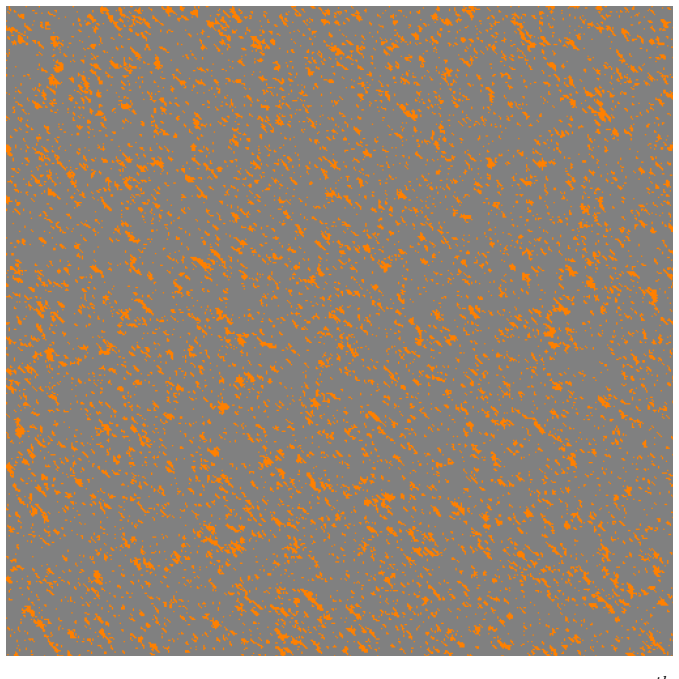
- [§3.3, Table 1] The spin-spin correlation table is presented without error bars or a statement of the number of independent samples used, so the directional asymmetry conclusion and the claim that correlations decay rapidly below Jc rest on uncharacterized single-run estimates. For example, the q=0.05 supercritical row shows the SW-NE correlation at l=16 (0.739) exceeding the NW-SE value at the same distance (0.726), which is not discussed and may indicate large statistical uncertainty.
minor comments (6)
- [Section 1] The paragraph beginning 'In this framework, a new PCA parameterized by J and q...' is duplicated verbatim within the Introduction.
- [Section 2, after Eq. (6)] The sentence 'The critical value of βc separates the ordered phase where all the spin have the same probability... from the ordered phase where the measure is polarized' should read 'disordered phase' in the first instance.
- [Section 3.1] The text says the simulations are run 'for (J,q)∈{(0,2)×(0,2)} on a 80×80 grid', while Section 4 says 80 couples of (q,J) values were simulated; please clarify whether the parameter grid has 80 points or 6400 points.
- [Section 3.2, Fig. 8] Figure 8 lacks a color scale label; the reader has to infer that the color encodes the logarithm of the average coalescence time, and no units or error information are provided.
- [Section 4.0.1] The phrase 'we can not go beyond105 for this GPU' appears to have a missing exponent or line break; it should read something like '10^5'.
- [Section 4.0.2, Fig. 20] The benchmark plot shows single timings with no error bars or repeated measurements; since the text claims a speed-up factor of approximately 500, a statement of measurement variability would strengthen the claim.
Circularity Check
No circular derivation: the numerical experiments independently test the companion-paper theorems [1,2] rather than fitting or renaming them.
full rationale
The paper's central theoretical inputs are the critical curve (eq. 12), the equilibrium measure of the shaken dynamics, and the large-q approach to the square-lattice Gibbs measure. All of these are cited to the companion papers [1] and [2], which are self-citations from the same research group, and the paper explicitly describes itself as numerical support for those papers. That dependence is real: eq. (11) and eq. (12) are not re-derived here. However, the numerical program is an independent, externally falsifiable test of those theorems rather than a construction that re-imports them. Section 3.1 estimates the phase-transition location from the variance of the magnetization computed by direct simulation and compares the resulting ridge to the analytic curve; no parameter is fitted to make the ridge match eq. (12). The mixing-time and coalescence measurements are independent observables, and the Gibbs-comparison section uses Propp-Wilson exact sampling with two reference dynamics, including the standard single-spin-flip heat bath, so the shaken dynamics is compared against an external Gibbs benchmark. The warm-up time of 300,000 steps is asserted rather than quantitatively justified, and the 200x200 runs lack mixing diagnostics near criticality, but that is a correctness or statistical-risk concern, not a circularity. No equation in the paper reduces to the quantity it is claimed to predict, and no fitted constant is relabeled as a prediction. The self-citations are load-bearing for the theoretical framework, yet the numerical content gives them independent support, so the circularity burden is low. The overall score reflects the heavy reliance on companion-paper theorems while acknowledging the absence of any by-construction equivalence between inputs and outputs.
Assumptions & free parameters
assumptions (4)
- domain assumption The critical curve for the Hamiltonian (5) is given by eq. (12), from Theorem in [1].
- domain assumption The equilibrium measure of the shaken dynamics is pi_s(sigma) = Z_sigma / Z, proved in [2].
- domain assumption For large q, pi_s approaches the Gibbs measure of the square-lattice Ising model, i.e., Theorem 2.3 in [2].
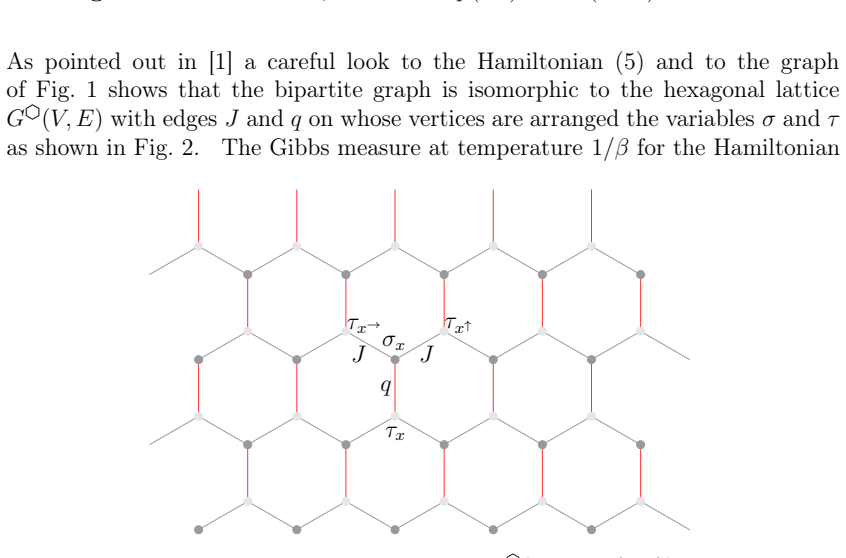
- domain assumption The bipartite graph with q and J edges is isomorphic to the hexagonal lattice.
Cite this review
Pith. "Pith review of Parallel simulation of two--dimensional Ising models using Probabilistic Cellular Automata." pith.science (2026). https://pith.science/paper/R3VGSXXF
@misc{pith2026190807341,
  author       = {Pith},
  title        = {Pith review of: Parallel simulation of two--dimensional Ising models using Probabilistic Cellular Automata},
  year         = {2026},
  howpublished = {\url{https://pith.science/paper/R3VGSXXF}},
  note         = {Machine review of arXiv:1908.07341}
}
abstract
We perform a numerical investigation of the \emph{shaken dynamics}, a parallel Markovian dynamics for spin systems with local interaction and whose transition probabilities depend on two parameters, $q$ and $J$, that tune the geometry of the underlying lattice. We determine a phase transition curve, in the $(q, J)$ plane, separating the disordered phase from the ordered one, study the mixing time of the Markov chain and evaluate the spin-spin correlations as $q$ and $J$ vary. Further, we investigate the relation between the equilibrium measure of the shaken dynamics and the Gibbs measure for the Ising model. Two different approaches are considered for the implementation of the dynamics: a multicore CPU approach, with code written in Julia and a GPU approach with code written in CUDA.
Figures
Figures from the paper (17 more)






Reference graph
Works this paper leans on
-
[1]
Criticality of measures on 2-d Ising configurations: from square to hexagonal graphs
ValentinaApollonioetal.“Criticalityofmeasureson2-dIsingconfigurations: from square to hexagonal graphs”. In: (2019). eprint:arXiv:1906.02546
work page Pith review arXiv 2019
-
[2]
Shaken dynamics: an easy way to parallel Markov Chain Monte Carlo
Valentina Apollonio et al. “Shaken dynamics for the 2d Ising model”. In: (2019). doi: https://arxiv.org/abs/1904.06257
work page Pith review arXiv 2019
-
[3]
The critical temperature for the Ising model on planar doubly periodic graphs
David Cimasoni and Hugo Duminil-Copin. “The critical temperature for the Ising model on planar doubly periodic graphs”. eng. In:Electronic Journal in Probability 18.44 (2013). ID: unige:30547, pp. 1–18.url: https://archive- ouverte.unige.ch/unige:30547
work page 2013
-
[4]
Sampling from a Gibbs Measure with Pair Interaction by Means of PCA
Paolo Dai Pra, Benedetto Scoppola, and Elisabetta Scoppola. “Sampling from a Gibbs Measure with Pair Interaction by Means of PCA”. In:Journal of Statistical Physics 149.4 (2012), pp. 722–737.issn: 1572-9613. doi: 10. 1007/s10955-012-0612-9 . url: http://dx.doi.org/10.1007/s10955- 012-0612-9
doi:10.1007/s10955- 2012
-
[5]
Instabilities and Phase Transitions in the Ising Model. A Review
G. Gallavotti. “Instabilities and Phase Transitions in the Ising Model. A Review”. In:RIVISTA DEL NUOVO CIMENTO 2 (1972), pp. 133–169
work page 1972
-
[6]
Time-Dependent Statistics of the Ising Model
Roy J. Glauber. “Time-Dependent Statistics of the Ising Model”. In:j-J- MATH-PHYS 4.2 (Feb. 1963), pp. 294–307.issn: 0022-2488 (print), 1089- 7658 (electronic), 1527-2427.doi: https://doi.org/10.1063/1.1703954 . url: http://jmp.aip.org/resource/1/jmapaq/v4/i2/p294_s1
-
[7]
From PCA’s to equilibrium systems and back
Sheldon Goldstein et al. “From PCA’s to equilibrium systems and back”. In: Communications in Mathematical Physics 125.1 (Mar. 1989), pp. 71–79. issn: 1432-0916. doi: 10.1007/BF01217769. url: https://doi.org/10. 1007/BF01217769
-
[8]
O. Häggström and O.H.G. M.Finite Markov Chains and Algorithmic Appli- cations. London Mathematical Society Student Texts. Cambridge University Press, 2002.isbn: 9780521890014.url: https://books.google.it/books? id=hpLxIJ9LwRgC. 26
work page 2002
Show all 17 references
-
[9]
Julia: A Fresh Approach to Numerical Computing
Stefan Karpinski et al. “Julia: A Fresh Approach to Numerical Computing”. In: SIAM Review 59 (2017), pp. 65–98.doi: http://dx.doi.org/10.1137/ 141000671
2017
-
[10]
Equilibrium and Non-equilibrium Ising Mod- els by Means of PCA
C. Lancia and B. Scoppola. “Equilibrium and Non-equilibrium Ising Mod- els by Means of PCA”. In:Journal of Statistical Physics 153 (Nov. 2013), pp. 641–653.doi: 10 . 1007 / s10955 - 013 - 0847 - 0. arXiv: 1307 . 2148 [math-ph]
2013
-
[11]
Markov Chains and Mixing Times: Second Edition
D.A.LevinandY.Peres. Markov Chains and Mixing Times: Second Edition . American Mathematical Society, 2017.isbn: 9781470429621
2017
-
[12]
Lindvall
T. Lindvall. Lectures on the Coupling Method . Dover Books on Mathemat- ics. Dover Publications, 2012.isbn: 9780486153247. url: https://books. google.it/books?id=gWK8AQAAQBAJ
2012
-
[13]
Exact Sampling with Cou- pled Markov Chains and Applications to Statistical Mechanics
James Gary Propp and David Bruce Wilson. “Exact Sampling with Cou- pled Markov Chains and Applications to Statistical Mechanics”. In:Random Struct. Algorithms 9.1-2 (Aug. 1996), pp. 223–252.issn: 1042-9832. doi: 10.1002/(SICI)1098-2418(199608/09)9:1/2<223::AID-RSA14>3.0.CO; 2-...
1996 doi
-
[14]
D. Ruelle. Statistical Mechanics: Rigorous Results . World Scientific, 1999. isbn:9789810238629. url: https://books.google.it/books?id=mNtWfcj% 5C_xhwC
1999
-
[15]
Nonuniversal critical dynamics in Monte Carlo simulations
Robert H. Swendsen and Jian-Sheng Wang. “Nonuniversal critical dynamics in Monte Carlo simulations”. In:Phys. Rev. Lett. 58 (2 Jan. 1987), pp. 86–88. doi: 10.1103/PhysRevLett.58.86. url: https://link.aps.org/doi/10. 1103/PhysRevLett.58.86
1987 doi
-
[16]
Collective Monte Carlo Updating for Spin Systems
Ulli Wolff. “Collective Monte Carlo Updating for Spin Systems”. In:Phys. Rev. Lett. 62 (4 Jan. 1989), pp. 361–364.doi: 10.1103/PhysRevLett.62
1989 doi
-
[361]
url: https://link.aps.org/doi/10.1103/PhysRevLett.62.361. 27
Reviewed August 14, 2026 · model on record in the stance chip above.
Discussion (0). Continue with ORCID to comment.