Multi-Armed Bandits with Arriving Arms: Sequential Screening, Dynamic Regret, and Sublinear Guarantees
Pith reviewed 2026-06-27 15:03 UTC · model grok-4.3
The pith
UCB-AA uses preliminary screening of new arms to achieve arrival-dependent regret bounds and sublinear dynamic regret in expanding bandit problems.
A machine-rendered reading of the paper's core claim, the machinery that carries it, and where it could break.
Core claim
UCB-AA is an elimination-based algorithm that adds a preliminary screening phase for each newly arrived arm before it enters full competition with incumbent arms. Under this procedure the algorithm attains regret bounds that depend explicitly on the arrival process, achieves sublinear dynamic regret when the gaps between arms satisfy stated regularity conditions on their evolution, and extends to an online version that does not require knowledge of the horizon in advance.
What carries the argument
UCB for Arriving Arms (UCB-AA): an elimination-based procedure that performs an aiding preliminary screening step on each newly arrived arm before full competition with incumbent arms.
If this is right
- Regret bounds scale explicitly with the number and timing of arm arrivals rather than only with total time horizon.
- Dynamic regret remains sublinear whenever the gap process between arms obeys the stated regularity conditions.
- An online version of the algorithm continues to function without prior knowledge of the total horizon.
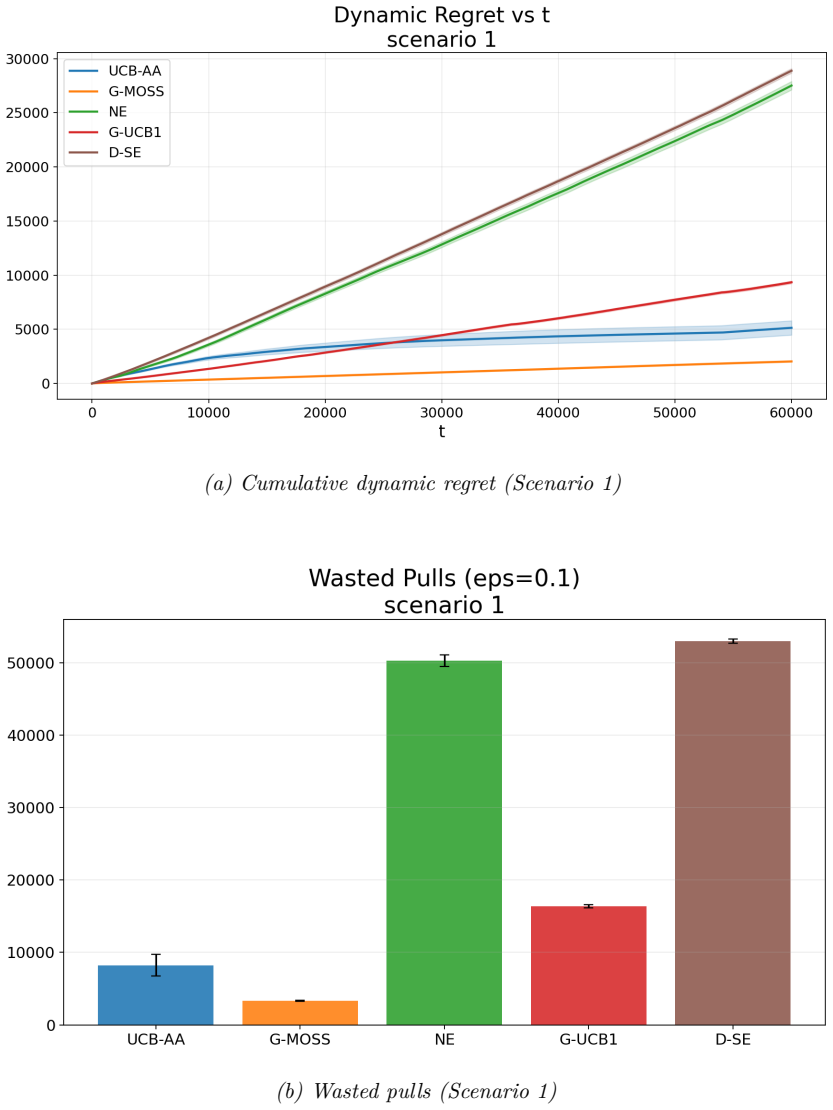
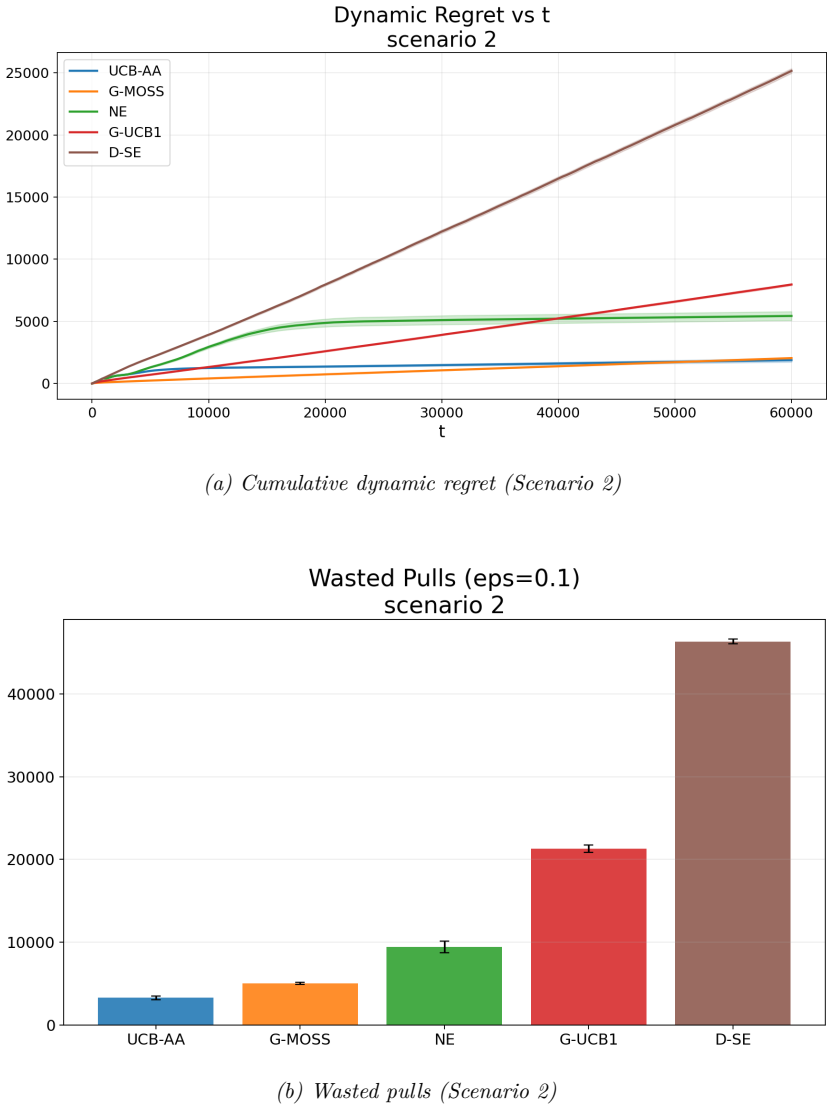
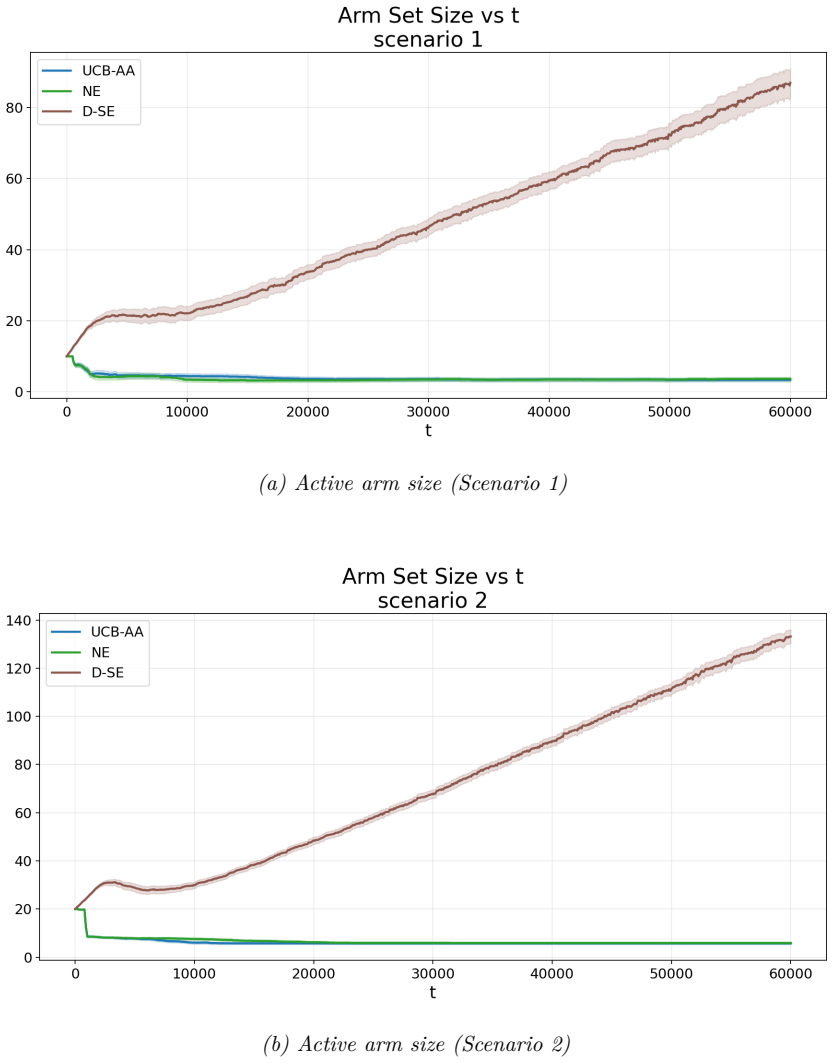
- The screening step reduces the number of wasted pulls on suboptimal new arms and keeps the active arm set smaller than without screening.
Where Pith is reading between the lines
- The same screening idea could be tested in non-stochastic arrival models where arrival times are chosen adversarially.
- If the regularity conditions on gap evolution are violated, the method may need an adaptive screening threshold that depends on observed gap estimates.
- The explicit dependence on the arrival process suggests that knowing or estimating the arrival rate in advance could further tighten bounds.
Load-bearing premise
Sublinear dynamic regret holds only when the gaps between arms satisfy regularity conditions on how those gaps evolve over time.
What would settle it
A simulation in which arm gaps evolve irregularly (for example, widening gaps after each new arrival) that produces linear rather than sublinear dynamic regret would falsify the sublinear guarantee.
Figures
read the original abstract
We study a stochastic multi-armed bandit problem in which the set of available arms expands over time. This setting arises in sequential experimentation when new actions or treatments become available during an ongoing study, making regret against a single best arm in hindsight inappropriate. We instead evaluate performance relative to the best arm currently available, leading to a dynamic-regret criterion for arriving-arm environments. To address the resulting challenges of arrival information discrepancy (AID) and a drifting benchmark (DB), we propose UCB for Arriving Arms (UCB-AA), an elimination-based procedure with an aiding preliminary screening step for newly arrived arms before full competition with incumbent arms. We show that UCB-AA attains regret bounds that depend explicitly on the arrival process, achieves sublinear dynamic regret under regularity conditions on gap evolution, and admits an online extension for unknown horizons. Simulation results show that UCB-AA reduces wasted pulls and maintains a smaller active arm set while preserving competitive regret performance.
Editorial analysis
A structured set of objections, weighed in public.
Referee Report
Summary. The paper studies stochastic multi-armed bandits where the arm set expands over time due to new arrivals. It proposes UCB-AA, an elimination-based algorithm that includes a preliminary screening step for newly arrived arms to handle arrival information discrepancy and a drifting benchmark. The main results claim that UCB-AA achieves regret bounds explicitly depending on the arrival process, sublinear dynamic regret under regularity conditions on gap evolution, and an online extension for unknown horizons, supported by simulations showing reduced wasted pulls and smaller active sets.
Significance. If the claims hold, the work provides a principled approach to dynamic regret in expanding-arm environments relevant to sequential experimentation. The explicit dependence of bounds on the arrival process and the screening mechanism are strengths. However, the sublinear dynamic regret result is conditional on regularity conditions whose necessity and form are central to whether the algorithm truly improves over standard UCB or merely recovers it under strong assumptions.
major comments (1)
- [Abstract] Abstract: the claim of sublinear dynamic regret under 'regularity conditions on gap evolution' is load-bearing for the central contribution, yet the abstract provides no statement of these conditions (e.g., bounds on total variation, number of significant changes, or stabilization rate). Without this, it is impossible to verify whether the elimination + screening procedure actually prevents linear regret against the drifting benchmark or simply assumes away the hardest cases.
Simulated Author's Rebuttal
We thank the referee for the careful reading and constructive feedback. We address the single major comment below.
read point-by-point responses
-
Referee: [Abstract] Abstract: the claim of sublinear dynamic regret under 'regularity conditions on gap evolution' is load-bearing for the central contribution, yet the abstract provides no statement of these conditions (e.g., bounds on total variation, number of significant changes, or stabilization rate). Without this, it is impossible to verify whether the elimination + screening procedure actually prevents linear regret against the drifting benchmark or simply assumes away the hardest cases.
Authors: We agree that the abstract would be improved by briefly indicating the nature of the regularity conditions. The full manuscript states these conditions explicitly in the statements of Theorems 4 and 5 (sublinear total variation of the per-arm gaps, or equivalently a finite number of significant gap changes). In the revision we will append a short clause to the abstract, e.g., “under regularity conditions ensuring sublinear total variation of the gaps.” This makes clear that the sublinear dynamic-regret guarantee is obtained under verifiable, non-trivial assumptions on the drifting benchmark rather than by restricting to trivial instances. revision: yes
Circularity Check
No significant circularity in derivation chain
full rationale
The paper proposes UCB-AA as an elimination-based algorithm with screening for arriving arms, then derives regret bounds that explicitly depend on the arrival process and sublinear dynamic regret under stated regularity conditions on gap evolution. These results follow from standard algorithmic analysis of the procedure rather than any reduction to fitted parameters, self-definitions, or self-citation chains by the paper's own equations. No steps match the enumerated circularity patterns; the central claims retain independent content from the algorithm design and bound derivations, making the analysis self-contained against external benchmarks.
Axiom & Free-Parameter Ledger
Reference graph
Works this paper leans on
-
[1]
Asymptotically efficient adaptive allocation rules , journal =. 1985 , issn =. doi:https://doi.org/10.1016/0196-8858(85)90002-8 , url =
-
[2]
Proceedings of the Fortieth Conference on Uncertainty in Artificial Intelligence , series =
Qi, Han and Fei, Guo and Zhu, Li , title =. Proceedings of the Fortieth Conference on Uncertainty in Artificial Intelligence , series =. 2024 , editor =
2024
-
[3]
Graph Feedback Bandits on Similar Arms: With and Without Graph Structures , author=. 2025 , journal =. 2501.14314 , archivePrefix=
arXiv 2025
-
[4]
Finite-time Analysis of the Multiarmed Bandit Problem , journal =
Auer, Peter and Cesa-Bianchi, Nicol. Finite-time Analysis of the Multiarmed Bandit Problem , journal =. 2002 , doi =
2002
-
[5]
Periodica Mathematica Hungarica , year =
Peter Auer and Ronald Ortner , title =. Periodica Mathematica Hungarica , year =. doi:10.1007/s10998-010-3055-6 , pages=
-
[6]
Berry and Robert W
Donald A. Berry and Robert W. Chen and Alan Zame and David C. Heath and Larry A. Shepp , title =. The Annals of Statistics ,. 1997 , doi =
1997
-
[7]
Proceedings of the 22nd International Conference on Neural Information Processing Systems , pages =
Chakrabarti, Deepayan and Kumar, Ravi and Radlinski, Filip and Upfal, Eli , title =. Proceedings of the 22nd International Conference on Neural Information Processing Systems , pages =. 2008 , isbn =
2008
-
[8]
Kleinberg, Robert and Niculescu-Mizil, Alexandru and Sharma, Yogeshwer , title =. Machine Learning , pages =. 2010 , issue_date =. doi:10.1007/s10994-010-5178-7 , abstract =
-
[9]
In: Proceedings of the 19th international conference on World Wide Web
Li, Lihong and Chu, Wei and Langford, John and Schapire, Robert E. , title =. 2010 , isbn =. doi:10.1145/1772690.1772758 , booktitle =
-
[10]
The Epoch-Greedy Algorithm for Contextual Multi-armed Bandits , url =
Langford, John and Zhang, Tong , booktitle =. The Epoch-Greedy Algorithm for Contextual Multi-armed Bandits , url =
-
[11]
Proceedings of the Fourteenth International Conference on Artificial Intelligence and Statistics , pages =
Contextual Bandits with Linear Payoff Functions , author =. Proceedings of the Fourteenth International Conference on Artificial Intelligence and Statistics , pages =. 2011 , editor =
2011
-
[12]
Neural Contextual Bandits with
Zhou, Dongruo and Li, Lihong and Gu, Quanquan , booktitle =. Neural Contextual Bandits with. 2020 , editor =
2020
-
[13]
2008 , eprint=
On Upper-Confidence Bound Policies for Non-Stationary Bandit Problems , author=. 2008 , eprint=
2008
-
[14]
Proceedings of the 28th International Conference on Neural Information Processing Systems , volume =
Besbes, Omar and Gur, Yonatan and Zeevi, Assaf , title =. Proceedings of the 28th International Conference on Neural Information Processing Systems , volume =. 2014 ,
2014
-
[15]
Foundations and Trends in Machine Learning , volume =
Regret Analysis of Stochastic and Nonstochastic Multi-armed Bandit Problems , author =. Foundations and Trends in Machine Learning , volume =. 2012 , doi =
2012
-
[16]
2020 , doi =
Bandit Algorithms , author =. 2020 , doi =
2020
-
[17]
The Annals of Statistics , volume =
Batched Bandit Problems , author =. The Annals of Statistics , volume =. 2016 , doi =
2016
-
[18]
Ganesh Ghalme and Swapnil Dhamal and Shweta Jain and Sujit Gujar and Y. Narahari , keywords =. Ballooning multi-armed bandits , journal =. 2021 , issn =. doi:https://doi.org/10.1016/j.artint.2021.103485 , url =
-
[19]
Proceedings of the 22nd Annual Conference on Learning Theory (COLT) , year =
Audibert, Jean-Yves and Bubeck, Sébastien , title =. Proceedings of the 22nd Annual Conference on Learning Theory (COLT) , year =
-
[20]
Journal of Machine Learning Research , year =
Eyal Even-Dar and Shie Mannor and Yishay Mansour , title =. Journal of Machine Learning Research , year =
-
[21]
Apostolos N. Burnetas and Michael N. Katehakis , abstract =. Optimal Adaptive Policies for Sequential Allocation Problems , journal =. 1996 , issn =. doi:https://doi.org/10.1006/aama.1996.0007 , url =
-
[22]
On the complexity of best-arm identification in multi-armed bandit models , year =
Kaufmann, Emilie and Capp\'. On the complexity of best-arm identification in multi-armed bandit models , year =. Journal of Machine Learning Research , pages =
-
[23]
Optimal Best Arm Identification with Fixed Confidence , booktitle =
Garivier, Aur. Optimal Best Arm Identification with Fixed Confidence , booktitle =. 2016 , editor =
2016
-
[24]
Proceedings of the 32nd Conference on Learning Theory , pages =
Adaptively Tracking the Best Bandit Arm with an Unknown Number of Distribution Changes , author =. Proceedings of the 32nd Conference on Learning Theory , pages =. 2019 ,
2019
-
[25]
Drug Approvals and Databases , year =
-
[26]
Robust locally weighted regression and smoothing scatterplots
Michael Woodroofe , title =. Journal of the American Statistical Association , volume =. 1979 , publisher =. doi:10.1080/01621459.1979.10481033 , URL =
-
[27]
The Annals of Statistics ,
Yuhong Yang and Dan Zhu , title =. The Annals of Statistics ,. 2002 , doi =
2002
-
[28]
Nonparametric bandits with covariates
Philippe Rigollet and Assaf Zeevi. Nonparametric bandits with covariates. Proceedings of the 23rd Annual Conference on Learning Theory (COLT) , series =. 2010
2010
-
[29]
The Annals of Statistics ,
Vianney Perchet and Philippe Rigollet , title =. The Annals of Statistics ,. 2013 , doi =
2013
-
[30]
Electronic Journal of Statistics ,
Wei Qian and Yuhong Yang , title =. Electronic Journal of Statistics ,. 2016 , doi =
2016
-
[31]
Villar, Sof. Response-Adaptive Randomization for Multi-arm Clinical Trials Using the Forward Looking Gittins Index Rule , journal =. 2015 ,. doi:10.1111/biom.12337 , url =
-
[32]
Williamson, S. Faye and Villar, Sof. A Response-Adaptive Randomization Procedure for Multi-Armed Clinical Trials with Normally Distributed Outcomes , journal =. 2020 ,. doi:10.1111/biom.13119 , url =
-
[33]
Journal of Machine Learning Research , articleno =
Aziz, Maryam and Kaufmann, Emilie and Riviere, Marie-Karelle , title =. Journal of Machine Learning Research , articleno =. 2021 , issue_date =
2021
-
[34]
Bulletin of the American Mathematical Society ,
Herbert Robbins , title =. Bulletin of the American Mathematical Society ,
-
[35]
and Fristedt, Bert , title =
Berry, Donald A. and Fristedt, Bert , title =
-
[36]
Gittins, J. C. , title =. Journal of the Royal Statistical Society: Series B (Methodological) , volume =. 1979 ,. doi:10.1111/j.2517-6161.1979.tb01068.x , url =
-
[37]
Wei Qian and Ching-Kang Ing and Ji Liu , title =. Journal of the American Statistical Association , volume =. 2024 , publisher =. doi:10.1080/01621459.2022.2152343 , URL =
-
[38]
The Annals of Statistics ,
Tze Leung Lai , title =. The Annals of Statistics ,. 1987 , doi =
1987
-
[39]
M. Zelen , title =. Journal of the American Statistical Association , volume =. 1969 , publisher =. doi:10.1080/01621459.1969.10500959 , URL =
-
[40]
L. J. Wei and S. Durham , title =. Journal of the American Statistical Association , volume =. 1978 , publisher =. doi:10.1080/01621459.1978.10480109 , URL =
-
[41]
Tony Cai and Hongzhe Li , title =
Changxiao Cai and T. Tony Cai and Hongzhe Li , title =. The Annals of Statistics ,. 2024 , doi =
2024
-
[42]
and Thomas, Joy A
Cover, Thomas M. and Thomas, Joy A. , title =
-
[43]
, title =
Tsybakov, Alexandre B. , title =
-
[44]
, title =
Pinsker, Mark S. , title =
-
[45]
Bandit Algorithms , publisher =
Lattimore, Tor and Szepesv. Bandit Algorithms , publisher =
discussion (0)
Sign in with ORCID, Apple, or X to comment. Anyone can read and Pith papers without signing in.