REVIEW 1 major objections 1 minor 18 references
Reviewed by Pith at T0; open to challenge.
T0 means a machine referee read the full paper against a public rubric. The mark states how deep the mechanical check went, never who wrote it. the ladder, T0–T4 →
T0 review · grok-4.3
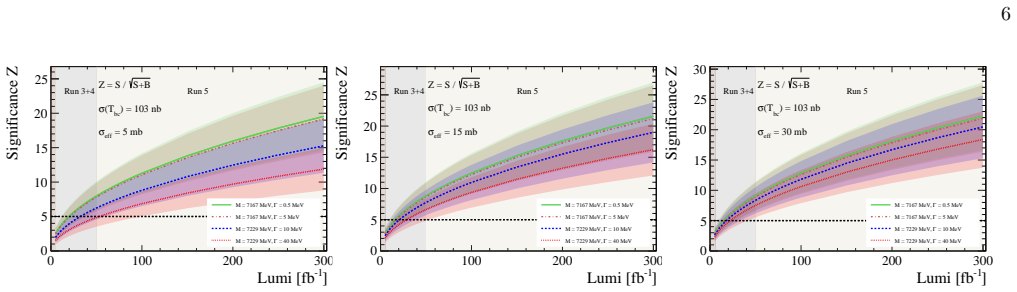
LHCb can observe the T_bc tetraquark in the B- D+ channel during Run 4 or Run 5 if its production cross section reaches 18 nb or higher.
2026-05-21 15:42 UTC pith:R57Z75VJ
load-bearing objection This paper supplies concrete luminosity targets for a T_bc search at LHCb but the targets move in lockstep with three externally chosen production cross sections that are not derived or error-banded inside the work. the 1 major comments →
Prospects for discovering strongly decaying doubly heavy T_(bc) tetraquark states at LHCb
The pith
A machine-rendered reading of the paper's core claim, the machinery that carries it, and where it could break.
Core claim
The authors find that a 5 sigma observation is achievable for a T_bc production cross section of 103 nb during LHCb Run 4, while the scaled estimate of 18 nb from the T_cc+ cross section requires the complete Run 5 dataset of 300 fb^{-1} under the most favorable choices of mass, width and sigma_eff. For the conservative lower bound of 0.3 nb no significant signal appears even with 300 fb^{-1}. The work also supplies the minimum observable product of production cross section times branching ratio to the B- D+ final state that would yield a 5 sigma discovery at various luminosities.
What carries the argument
Phenomenological background model for associated B D production simulated with MadGraph5_aMC@NLO and Pythia 8.3, used to scan signal significance over the four-dimensional parameter space of T_bc mass, width, production cross section and effective double-parton scattering cross section.
Load-bearing premise
The entire discovery reach rests on three externally supplied representative values for the T_bc production cross section rather than values computed from first principles inside the paper.
What would settle it
An experimental upper limit on the T_bc production cross section below roughly 1 nb, or a failure to observe a 5 sigma excess in the B- D+ invariant mass distribution even after collecting the full 300 fb^{-1} Run 5 dataset, would show that the projected discovery is not attainable.
If this is right
- A 5 sigma signal can appear in Run 4 data for the optimistic 103 nb cross section scenario.
- The intermediate 18 nb cross section reaches 5 sigma only with the complete 300 fb^{-1} Run 5 sample under the best parameter choices.
- The conservative 0.3 nb scenario produces no observable signal even at maximum projected luminosity.
- Numerical guidance is given for the smallest sigma times branching ratio that yields 5 sigma at different integrated luminosities.
Where Pith is reading between the lines
- Confirmation of T_bc would allow direct comparison of its measured production rate with models of doubly heavy tetraquark structure.
- The background modeling approach can be reused for searches of other exotic multi-heavy-flavor states in similar final states.
- Improved theoretical calculations of T_bc production would tighten the luminosity requirements and guide experimental priorities.
Editorial analysis
A structured set of objections, weighed in public.
Referee Report
Summary. The paper investigates the discovery potential of the T_bc tetraquark state with J^P = 0^+ in pp collisions at LHCb at √s = 13 TeV, focusing on the decay T_bc → B^- D^+. A phenomenological background model is constructed from associated B and D meson production, simulated with MadGraph5_aMC@NLO and Pythia8.3 and incorporating published LHCb results. The authors scan the T_bc mass, width, production cross section (using three fixed external scenarios: 103 nb optimistic, 18 nb scaled from T_cc^+, and 0.3 nb conservative), and effective double-parton scattering cross section σ_eff. They compute the integrated luminosity needed for a 5σ discovery, finding that 103 nb is reachable in Run 4 while 18 nb requires the full Run 5 dataset (300 fb^{-1}) under favorable parameters.
Significance. If the externally assumed production cross sections are close to reality, the work offers useful experimental guidance by mapping luminosity requirements across scenarios and providing estimates of the minimum observable σ(T_bc) × BR(T_bc → B^- D^+). The background modeling follows standard practice with MadGraph/Pythia and published LHCb inputs, which is a strength. The results remain conditional on the accuracy of the three discrete cross-section inputs.
major comments (1)
- [Abstract and parameter space section] Abstract and parameter space section: the statements that a 5σ observation is achievable for 103 nb in Run 4 while the 18 nb case requires full Run 5 data (300 fb^{-1}) rest directly on three externally adopted T_bc production cross sections (optimistic 103 nb, intermediate 18 nb scaled from T_cc^+, conservative 0.3 nb). These are fixed inputs rather than derived or uncertainty-quantified within the analysis; because the required luminosity scales inversely with σ(T_bc) × BR, the central discovery-reach claims are load-bearing on the validity and error bands of these external values, which are not propagated into the final figures.
minor comments (1)
- [Background simulation] Clarify in the background-model section whether the scanned range for σ_eff is constrained by the same LHCb dataset used for the signal or remains purely phenomenological.
Simulated Author's Rebuttal
We thank the referee for the careful reading of the manuscript and for the constructive comments. We appreciate the positive assessment of the background modeling and the overall phenomenological approach. We address the major comment below and outline the revisions we will make to improve the presentation of the external cross-section assumptions.
read point-by-point responses
-
Referee: Abstract and parameter space section: the statements that a 5σ observation is achievable for 103 nb in Run 4 while the 18 nb case requires full Run 5 data (300 fb^{-1}) rest directly on three externally adopted T_bc production cross sections (optimistic 103 nb, intermediate 18 nb scaled from T_cc^+, conservative 0.3 nb). These are fixed inputs rather than derived or uncertainty-quantified within the analysis; because the required luminosity scales inversely with σ(T_bc) × BR, the central discovery-reach claims are load-bearing on the validity and error bands of these external values, which are not propagated into the final figures.
Authors: We agree that the three production cross sections are external inputs adopted from theoretical estimates and scaling from the observed T_cc^+ state, as already stated in the manuscript. Our study is intentionally phenomenological and explores discovery reach under representative benchmark scenarios rather than attempting to compute the T_bc cross section. The inverse scaling of required luminosity with σ(T_bc) × BR is the central motivation for presenting results across the optimistic, intermediate, and conservative cases. To address the referee's concern, we will revise the abstract and parameter-space section to more explicitly label these values as benchmark scenarios and to expand the discussion of their theoretical origins and associated uncertainties, including additional references. We will also add a short sensitivity study illustrating how the required luminosity changes under factor-of-two variations around the central values. This will clarify the conditional nature of the results without requiring a full propagation of continuous uncertainties, which would go beyond the scope of the adopted discrete benchmarks. revision: partial
Circularity Check
No significant circularity; discovery projections are conditional on externally adopted cross-section inputs
full rationale
The paper conducts a Monte Carlo-based phenomenological study of signal and background for T_bc → B^- D^+ at LHCb, using MadGraph5_aMC@NLO and Pythia8.3 to simulate processes and constructing the background model from previously published LHCb results on associated B and D production. The integrated luminosity for 5σ discovery is computed by scanning T_bc mass, width, production cross section, and σ_eff. The three representative cross sections (103 nb optimistic, 18 nb scaled from external T_cc^+ measurement, 0.3 nb conservative) are stated as input assumptions rather than quantities derived or fitted inside the paper. No equations or steps reduce by construction to the paper's own outputs; the scaling for 18 nb relies on independent external data. The central claims are explicitly conditional on these inputs, rendering the derivation self-contained as a parameter-space projection exercise with no self-definitional, fitted-prediction, or load-bearing self-citation issues.
Axiom & Free-Parameter Ledger
free parameters (3)
- T_bc production cross section
- effective double-parton scattering cross section σ_eff
- T_bc mass and width
axioms (2)
- domain assumption Standard QCD hadronization and parton-shower modeling in Pythia8.3 accurately reproduces the associated B D background shape.
- domain assumption The decay T_bc → B^- D^+ is the dominant or sufficiently visible channel for discovery.
read the original abstract
We investigate the discovery potential of the $T_{bc}$ state with $J^P = 0^+$ in proton-proton ($pp$) collisions at LHCb at a center-of-mass energy of $\sqrt{s} = 13~\mathrm{TeV}$. The study focuses on the decay channel $T_{bc} \to B^- D^+$. A phenomenological approach is employed to construct the background model based on the associated production of $B$ and $D$ mesons, incorporating previously published LHCb results. Background processes are simulated using $\texttt{MadGraph5\_aMC@NLO}$ and $\texttt{Pythia8.3}$. We explore the parameter space of the $T_{bc}$ mass, width, production cross section, and the effective double-parton scattering cross section ($\sigma_{\mathrm{eff}}$) relevant for the $B D$ meson background. The integrated luminosity required for a $5\sigma$ discovery at LHCb is evaluated under various assumptions. In particular, we consider three representative $T_{bc}$ production cross section scenarios: an optimistic estimate of $103~\mathrm{nb}$, an intermediate value of $18~\mathrm{nb}$ obtained by scaling from the $T_{cc}^+$ production cross section, and a conservative lower bound of $0.3~\mathrm{nb}$. We find that a $5\sigma$ observation is achievable for a production cross section of $103~\mathrm{nb}$, which is expected to be within reach during Run~4. In contrast, the more realistic cross section estimate of $18~\mathrm{nb}$ requires the full Run~5 dataset ($300~\mathrm{fb}^{-1}$) under the most favorable parameter choices. For the conservative scenario, no significant signal would be observable even with $300~\mathrm{fb}^{-1}$. In addition, we estimate the minimum observable $\sigma(T_{bc}) \times BR(T_{bc} \to B^- D^+)$ for a $5\sigma$ discovery under different luminosity scenarios, providing guidance for future experimental searches at LHCb.
Figures



Reference graph
Works this paper leans on
-
[1]
W. Chen, T. G. Steele, and S.-L. Zhu, “Exotic open-flavorbc¯q¯q,bc¯s¯sandqc¯q¯b,sc¯s¯btetraquark states,” Phys. Rev. D89no. 5, (2014) 054037,arXiv:1310.8337 [hep-ph]
work page internal anchor Pith review Pith/arXiv arXiv 2014
-
[2]
Discovery of doubly-charmed Xi_{cc} baryon implies a stable (b b ubar dbar) tetraquark
M. Karliner and J. L. Rosner, “Discovery of doubly-charmed Ξcc baryon implies a stable (bb¯u¯d) tetraquark,”Phys. Rev. Lett.119no. 20, (2017) 202001,arXiv:1707.07666 [hep-ph]
work page internal anchor Pith review Pith/arXiv arXiv 2017
-
[3]
Exotic $bc\bar q\bar q$ four-quark states
T. F. Caram´ es, J. Vijande, and A. Valcarce, “Exotic bc¯q¯qfour-quark states,”Phys. Rev. D99no. 1, (2019) 014006,arXiv:1812.08991 [hep-ph]
work page internal anchor Pith review Pith/arXiv arXiv 2019
-
[4]
Study of the isoscalar scalarbc¯u ¯dtetraquarkT bc with lattice QCD,
A. Radhakrishnan, M. Padmanath, and N. Mathur, “Study of the isoscalar scalarbc¯u ¯dtetraquarkT bc with lattice QCD,”Phys. Rev. D110no. 3, (2024) 034506, arXiv:2404.08109 [hep-lat]
- [5]
-
[6]
Doubly heavy tetraquark bound and resonant states
W.-L. Wu, Y. Ma, Y.-K. Chen, L. Meng, and S.-L. Zhu, “Doubly heavy tetraquark bound and resonant states,” Phys. Rev. D110no. 9, (2024) 094041, arXiv:2409.03373 [hep-ph]
work page Pith review arXiv 2024
-
[7]
Masses of tetraquarks with two heavy quarks in the relativistic quark model
D. Ebert, R. N. Faustov, V. O. Galkin, and W. Lucha, “Masses of tetraquarks with two heavy quarks in the relativistic quark model,”Phys. Rev. D76(2007) 114015,arXiv:0706.3853 [hep-ph]
work page internal anchor Pith review Pith/arXiv arXiv 2007
-
[8]
Heavy-quark symmetry implies stable heavy tetraquark mesons $Q_iQ_j \bar q_k \bar q_l$
E. J. Eichten and C. Quigg, “Heavy-quark symmetry implies stable heavy tetraquark mesonsQ iQj ¯qk ¯ql,” Phys. Rev. Lett.119no. 20, (2017) 202002, arXiv:1707.09575 [hep-ph]
work page internal anchor Pith review Pith/arXiv arXiv 2017
-
[9]
J.-B. Cheng, S.-Y. Li, Y.-R. Liu, Z.-G. Si, and T. Yao, “Double-heavy tetraquark states with heavy diquark-antiquark symmetry,”Chin. Phys. C45no. 4, (2021) 043102,arXiv:2008.00737 [hep-ph]
-
[10]
Y. Song and D. Jia, “Mass spectra of doubly heavy tetraquarks in diquark−antidiquark picture,”Commun. Theor. Phys.75no. 5, (2023) 055201, arXiv:2301.00376 [hep-ph]
-
[11]
R. Maciu la and A. Szczurek, “Double-parton scattering effects inD 0B+ andB +B+ meson-meson pair production in proton-proton collisions at the LHC,” Phys. Rev. D97no. 9, (2018) 094010, arXiv:1803.01198 [hep-ph]. [13]LHCbCollaboration, R. Aaijet al., “Observation of an exotic narrow doubly charmed tetraquark,”Nature Phys.18no. 7, (2022) 751–754,arXiv:2109....
work page internal anchor Pith review Pith/arXiv arXiv 2018
-
[12]
J. Alwall, R. Frederix, S. Frixione, V. Hirschi, F. Maltoni, O. Mattelaer, H. S. Shao, T. Stelzer, P. Torrielli, and M. Zaro, “The automated computation of tree-level and next-to-leading order differential cross sections, and their matching to parton shower simulations,”JHEP07(2014) 079,arXiv:1405.0301 [hep-ph]
work page internal anchor Pith review Pith/arXiv arXiv 2014
-
[13]
R. Frederix, S. Frixione, V. Hirschi, D. Pagani, H. S. Shao, and M. Zaro, “The automation of next-to-leading order electroweak calculations,”JHEP07(2018) 185, arXiv:1804.10017 [hep-ph]. [Erratum: JHEP 11, 085 (2021)]
-
[14]
A comprehensive guide to the physics and usage of PYTHIA 8.3
C. Bierlichet al., “A comprehensive guide to the physics and usage of PYTHIA 8.3,”SciPost Phys. Codeb.2022(2022) 8,arXiv:2203.11601 [hep-ph]
work page internal anchor Pith review Pith/arXiv arXiv 2022
-
[15]
Parton distributions with LHC data
R. D. Ballet al., “Parton distributions with LHC data,” Nucl. Phys. B867(2013) 244–289,arXiv:1207.1303 [hep-ph]
work page internal anchor Pith review Pith/arXiv arXiv 2013
-
[16]
Matching NLO QCD computations and parton shower simulations
S. Frixione and B. R. Webber, “Matching NLO QCD computations and parton shower simulations,”JHEP 06(2002) 029,arXiv:hep-ph/0204244
work page internal anchor Pith review Pith/arXiv arXiv 2002
-
[17]
J/ψmeson production in association with an open charm hadron at the LHC: A reappraisal,
H.-S. Shao, “J/ψmeson production in association with an open charm hadron at the LHC: A reappraisal,” Phys. Rev. D102no. 3, (2020) 034023, arXiv:2005.12967 [hep-ph]. [20]LHCbCollaboration, R. Aaijet al., “Observation of double charm production involving open charm in pp collisions at √s= 7 TeV,”JHEP06(2012) 141, arXiv:1205.0975 [hep-ex]. [Addendum: JHEP 0...
-
[18]
Discovery potential of stable and near-threshold doubly heavy tetraquarks at the LHC
A. Ali, Q. Qin, and W. Wang, “Discovery potential of stable and near-threshold doubly heavy tetraquarks at the LHC,”Phys. Lett. B785(2018) 605–609, arXiv:1806.09288 [hep-ph]. [29]Particle Data GroupCollaboration, S. Navaset al., “Review of particle physics,”Phys. Rev. D110no. 3, (2024) 030001. 9 TABLE I. Integrated luminosity required for a 5σdiscovery fo...
work page internal anchor Pith review Pith/arXiv arXiv 2018
discussion (0)
Sign in with ORCID, Apple, or X to comment. Anyone can read and Pith papers without signing in.