Constraint-satisfying binary boson star initial data via XCFC
Pith reviewed 2026-05-21 04:14 UTC · model grok-4.3
The pith
The XCFC formalism generates constraint-satisfying initial data for boson star binaries by conformally rescaling matter variables and adding an auxiliary vector field.
A machine-rendered reading of the paper's core claim, the machinery that carries it, and where it could break.
Core claim
We construct constraint-satisfying scalar-field initial data using the eXtended Conformally Flat Condition (XCFC) formalism, in which the matter variables are conformally rescaled and an auxiliary vector field is introduced. In doing so, we overcome the issues of local uniqueness and convergence of the solutions that arise in the second-order elliptic equations associated with the constraints. Using an iterative solver method, we demonstrate the convergence of the XCFC approach to a solution for several scalar-field matter systems. Those include Gaussian-like profiles, topological torus configurations, and equal-mass boson star binaries. In particular, for the latter case, our formalism sign
What carries the argument
The eXtended Conformally Flat Condition (XCFC) formalism, which rescales the matter variables conformally and introduces an auxiliary vector field to recast the constraint equations into a form solvable by iteration without uniqueness problems.
If this is right
- Binary boson star initial data can be constructed to satisfy the constraints exactly rather than approximately.
- The iterative solver converges successfully for multiple scalar field setups including binaries.
- This enables numerical-relativity simulations with non-trivial matter to start from valid constraint-satisfying data.
- Superposition methods are shown to be inferior for producing constraint-compliant binary configurations.
Where Pith is reading between the lines
- This formalism might extend to unequal-mass binaries or spinning boson stars for more general initial data.
- Accurate constraint satisfaction could reduce spurious effects in the early stages of boson star merger simulations.
- Similar rescaling techniques may benefit initial data construction for other exotic compact objects in general relativity.
Load-bearing premise
The iterative solver converges to a unique solution for the XCFC equations when applied to the chosen scalar-field configurations, including the binary boson star case, without local uniqueness problems.
What would settle it
Applying the XCFC iterative solver to an equal-mass boson star binary and verifying whether the output data satisfies the Hamiltonian and momentum constraints to a high degree of accuracy, unlike superposition data which does not.
Figures


read the original abstract
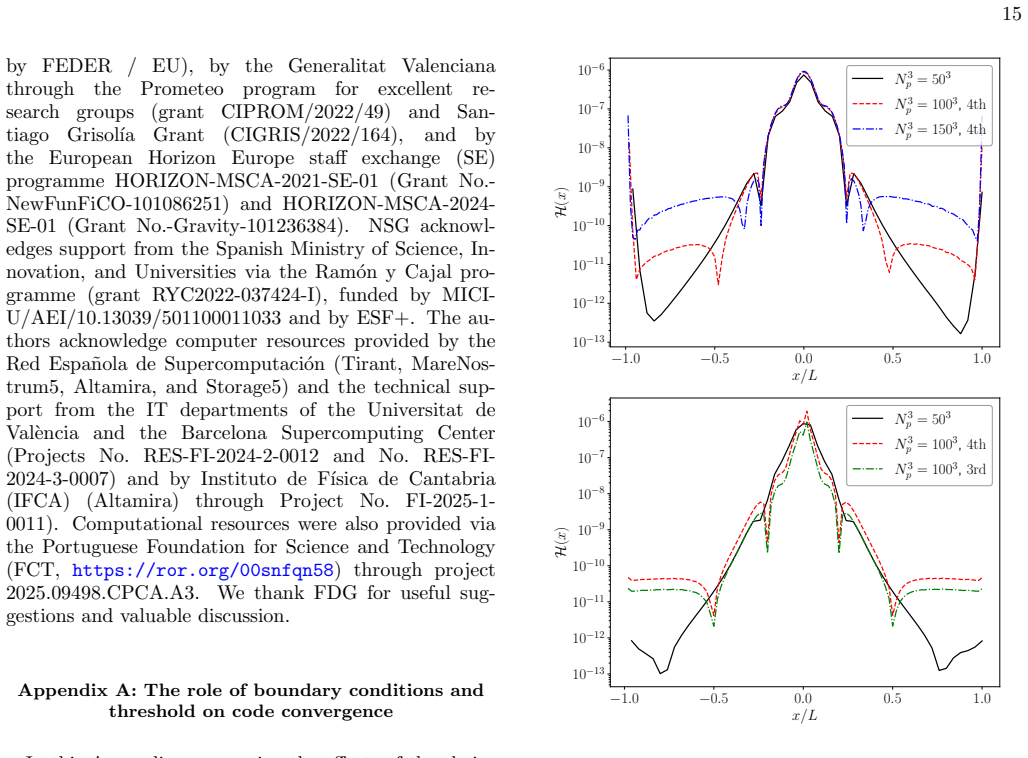
Numerical-relativity simulations with non-trivial matter configurations require initial data that satisfy the Hamiltonian and momentum constraints of the Einstein equations. We construct constraint-satisfying scalar-field initial data using the eXtended Conformally Flat Condition (XCFC) formalism, in which the matter variables are conformally rescaled and an auxiliary vector field is introduced. In doing so, we overcome the issues of local uniqueness and convergence of the solutions that arise in the second-order elliptic equations associated with the constraints. Using an iterative solver method, we demonstrate the convergence of the XCFC approach to a solution for several scalar-field matter systems. Those include Gaussian-like profiles, topological torus configurations, and equal-mass boson star binaries. In particular, for the latter case, it is common to employ the superposition of two isolated boson star solutions in order to build the initial data. We show that our formalism significantly improves upon a superposition approach by generating genuinely constraint-satisfying initial data for boson star binaries.
Editorial analysis
A structured set of objections, weighed in public.
Referee Report
Summary. The manuscript constructs constraint-satisfying scalar-field initial data for numerical relativity using the eXtended Conformally Flat Condition (XCFC) formalism. An iterative solver is applied to the XCFC equations for the conformal factor and auxiliary vector field after conformal rescaling of matter variables. Convergence is reported for Gaussian-like profiles, topological torus configurations, and equal-mass boson star binaries, with the binary case presented as an improvement over the standard superposition of isolated boson-star solutions.
Significance. If the convergence and uniqueness properties hold under the reported conditions, the work supplies a practical route to genuinely constraint-satisfying initial data for boson-star binaries, a configuration frequently needed in numerical-relativity studies of scalar-field compact objects. The method inherits the established XCFC framework and thereby sidesteps local uniqueness difficulties that appear in conventional second-order elliptic formulations of the constraints.
major comments (2)
- [Abstract] Abstract: the statement that convergence is demonstrated for Gaussian, torus, and binary cases supplies no quantitative error measures, convergence rates, or details on data selection, leaving the central claim of generating genuinely constraint-satisfying initial data without verifiable numerical support.
- [Results (binary case)] The iterative solver is stated to converge for the equal-mass binary configuration, yet no tests are described that vary the initial guesses for the metric, conformal factor, or auxiliary vector field; such tests are required to confirm that the obtained solution is independent of starting data and thereby free of the local uniqueness problems that affect standard formulations.
minor comments (2)
- Figure captions and text should explicitly state the norm used to monitor residual convergence (e.g., L2 or L-infinity) and the tolerance at which iteration is halted.
- The precise functional form and parameters of the scalar-field profiles employed for the binary initial data should be listed, together with the corresponding isolated-star solutions used for the superposition comparison.
Simulated Author's Rebuttal
We thank the referee for the detailed and constructive report. We address each major comment below, indicating the revisions we will incorporate to improve the clarity and robustness of the presented results.
read point-by-point responses
-
Referee: [Abstract] Abstract: the statement that convergence is demonstrated for Gaussian, torus, and binary cases supplies no quantitative error measures, convergence rates, or details on data selection, leaving the central claim of generating genuinely constraint-satisfying initial data without verifiable numerical support.
Authors: We agree that the abstract would benefit from quantitative support. In the revised manuscript we will update the abstract to report specific measures, including the L2 norm of the Hamiltonian constraint violation after convergence and the observed convergence rates (approximately second-order) for the Gaussian, torus, and binary configurations. A brief statement on the parameter ranges and grid resolutions used for data selection will also be added, with full details remaining in Section 3. revision: yes
-
Referee: [Results (binary case)] The iterative solver is stated to converge for the equal-mass binary configuration, yet no tests are described that vary the initial guesses for the metric, conformal factor, or auxiliary vector field; such tests are required to confirm that the obtained solution is independent of starting data and thereby free of the local uniqueness problems that affect standard formulations.
Authors: We acknowledge that explicit tests with varied initial guesses would strengthen the uniqueness claim. Although the XCFC formulation is constructed to mitigate the local uniqueness difficulties of the standard second-order elliptic system, the current manuscript does not report such sensitivity tests. We will add a new subsection in the results section describing additional runs in which the initial guesses for the conformal factor and auxiliary vector are perturbed by random noise of different amplitudes; these tests will show convergence to the same final solution within truncation error, thereby supporting independence from the starting data. revision: yes
Circularity Check
No circularity: XCFC solver applied to standard constraints for boson star binaries
full rationale
The paper applies the established XCFC formalism (with conformal rescaling and auxiliary vector field) and an iterative solver directly to the Hamiltonian and momentum constraints for scalar-field configurations including equal-mass boson star binaries. The central result—that the method produces genuinely constraint-satisfying data superior to simple superposition—is the expected numerical outcome of solving the elliptic equations rather than a reduction to fitted inputs or self-referential definitions. No load-bearing self-citations, uniqueness theorems imported from the same authors, or ansatzes smuggled via prior work are required for the derivation; the construction remains self-contained against the external benchmark of the Einstein constraints themselves.
Axiom & Free-Parameter Ledger
axioms (1)
- domain assumption The XCFC formalism, with conformal rescaling of matter variables and an auxiliary vector field, yields well-behaved second-order elliptic equations that admit convergent iterative solutions for scalar-field configurations.
Reference graph
Works this paper leans on
-
[1]
(18) forX i and thus, through Eq
With the conformally rescaled quantities, we solve Eq. (18) forX i and thus, through Eq. (17), ˆAij
- [2]
-
[3]
(20), to guarantee existence and uniqueness of the solu- tion
We then apply the maximum principle in Eq. (20), to guarantee existence and uniqueness of the solu- tion. Solving this equation forN ψ, we compute the lapse function
-
[4]
Finally, as the source in Eq. (21) is fully known, we solve this equation forβ i. Once an initial solution for the metric functions is ob- tained, the code updates their values and recomputes the conformally rescaled components of the stress-energy tensor. This iterative procedure is repeated until conver- gence is achieved, namely the overall residual fa...
-
[5]
M. Alcubierre, Introduction to 3+1 numerical relativity, Introduction to 3+1 Numerical Relativity (2006)
work page 2006
-
[6]
3+1 Formalism and Bases of Numerical Relativity
E. Gourgoulhon, 3+1 formalism and bases of numerical relativity (2007), arXiv:gr-qc/0703035 [gr-qc]
work page internal anchor Pith review Pith/arXiv arXiv 2007
-
[7]
T. W. Baumgarte and S. L. Shapiro,Numerical Relativ- ity: Solving Einstein’s Equations on the Computer(Cam- bridge University Press, 2010)
work page 2010
-
[8]
Elliptic-hyperbolic systems and the Einstein equations
L. Andersson and V. Moncrief, Elliptic hyperbolic sys- tems and the Einstein equations, Annales Henri Poincare 4, 1 (2003), arXiv:gr-qc/0110111
work page internal anchor Pith review Pith/arXiv arXiv 2003
-
[9]
S. Bonazzola, E. Gourgoulhon, P. Grandcl´ ement, and J. Novak, Constrained scheme for the einstein equations based on the dirac gauge and spherical coordinates, Phys- ical Review D70, 10.1103/physrevd.70.104007 (2004)
-
[10]
J. W. York,Sources of Gravitational Radiation, edited by J. W. York (Cambridge University Press, Cambridge,
-
[11]
proceedings of the Battelle Seattle Workshop, July 24-August 4, 1978
work page 1978
-
[12]
G. B. Cook, Initial data for numerical relativity, Living Reviews in Relativity3, 5 (2000)
work page 2000
-
[13]
H. P. Pfeiffer and J. W. York, Extrinsic curvature and the einstein constraints, Phys. Rev. D67, 044022 (2003)
work page 2003
-
[14]
J. W. York, Conformal “thin-sandwich” data for the initial-value problem of general relativity, Phys. Rev. Lett.82, 1350 (1999)
work page 1999
-
[15]
H. P. Pfeiffer, The initial value problem in numerical rel- ativity (2004), arXiv:gr-qc/0412002 [gr-qc]
work page internal anchor Pith review Pith/arXiv arXiv 2004
- [16]
-
[17]
S. Ossokine, F. Foucart, H. P. Pfeiffer, M. Boyle, and B. Szil´ agyi, Improvements to the construction of binary black hole initial data, Classical and Quantum Gravity 32, 245010 (2015)
work page 2015
-
[18]
W. Tichy, The initial value problem as it relates to nu- merical relativity, Reports on Progress in Physics80, 026901 (2016)
work page 2016
-
[19]
J. C. Aurrekoetxea, K. Clough, and E. A. Lim, Cosmol- ogy using numerical relativity, Living Reviews in Rela- tivity28, 5 (2025)
work page 2025
-
[20]
M. Bezares and N. Sanchis-Gual, Exotic compact objects: A recent numerical-relativity perspective, inNew Fron- tiers in GRMHD Simulations(Springer, 2025) pp. 619– 661
work page 2025
-
[21]
A. Arvanitaki, S. Dimopoulos, S. Dubovsky, N. Kaloper, and J. March-Russell, String axiverse, Physical Review D—Particles, Fields, Gravitation, and Cosmology81, 123530 (2010)
work page 2010
-
[22]
A. Arvanitaki and S. Dubovsky, Exploring the string ax- iverse with precision black hole physics, Physical Review D—Particles, Fields, Gravitation, and Cosmology83, 044026 (2011)
work page 2011
-
[23]
F. F. Freitas, C. A. Herdeiro, A. P. Morais, A. Onofre, R. Pasechnik, E. Radu, N. Sanchis-Gual, and R. San- tos, Ultralight bosons for strong gravity applications from simple standard model extensions, Journal of Cosmology and Astroparticle Physics2021(12), 047
-
[24]
Testing the nature of dark compact objects: a status report,
V. Cardoso and P. Pani, Testing the nature of dark com- pact objects: a status report, Living Reviews in Relativ- ity22, 10.1007/s41114-019-0020-4 (2019)
-
[25]
L. Baracket al., Black holes, gravitational waves and fundamental physics: a roadmap, Classical and Quantum Gravity36, 143001 (2019)
work page 2019
-
[26]
D. J. Kaup, Klein-gordon geon, Phys. Rev.172, 1331 (1968)
work page 1968
-
[27]
R. Ruffini and S. Bonazzola, Systems of self-gravitating particles in general relativity and the concept of an equa- tion of state, Phys. Rev.187, 1767 (1969)
work page 1969
-
[28]
S. Yoshida and Y. Eriguchi, Rotating boson stars in gen- eral relativity, Phys. Rev. D56, 762 (1997)
work page 1997
-
[29]
E. Seidel and W.-M. Suen, Dynamical evolution of boson stars: Perturbing the ground state, Phys. Rev. D42, 384 (1990)
work page 1990
-
[30]
E. Seidel and W.-M. Suen, Oscillating soliton stars, Phys. Rev. Lett.66, 1659 (1991)
work page 1991
-
[31]
N. Sanchis-Gual, C. Herdeiro, E. Radu, J. C. Degollado, and J. A. Font, Numerical evolutions of spherical proca stars, Physical Review D95, 104028 (2017)
work page 2017
-
[32]
N. Sanchis-Gual, F. Di Giovanni, M. Zilh˜ ao, C. Herdeiro, P. Cerd´ a-Dur´ an, J. Font, and E. Radu, Nonlinear dy- namics of spinning bosonic stars: formation and stability, Physical review letters123, 221101 (2019)
work page 2019
-
[33]
C. Herdeiro, E. Radu, N. Sanchis-Gual, N. Santos, and E. dos Santos Costa Filho, The non-spherical ground state of proca stars, Physics Letters B852, 138595 (2024)
work page 2024
-
[34]
F. E. Schunck and E. W. Mielke, General relativistic boson stars, Classical and Quantum Gravity20, R301 (2003)
work page 2003
-
[35]
S. L. Liebling and C. Palenzuela, Dynamical boson stars, Living Reviews in Relativity15, 6 (2012)
work page 2012
-
[36]
L. Visinelli, Boson stars and oscillatons: A review, In- ternational Journal of Modern Physics D30, 2130006 (2021), https://doi.org/10.1142/S0218271821300068
- [37]
-
[38]
C. Palenzuela, L. Lehner, and S. L. Liebling, Orbital dy- namics of binary boson star systems, Phys. Rev. D77, 044036 (2008)
work page 2008
-
[39]
N. Sanchis-Gual, J. C. Bustillo, C. Herdeiro, E. Radu, J. A. Font, S. H. W. Leong, and A. Torres-Forn´ e, Im- pact of the wavelike nature of proca stars on their gravitational-wave emission, Phys. Rev. D106, 124011 (2022)
work page 2022
- [40]
-
[41]
B.-X. Ge, E. A. Lim, U. Sperhake, T. Evstafyeva, D. Cors, E. de Jong, R. Croft, and T. Helfer, Dynamics and gravitational radiation of stable and unstable boson- star mergers, Physical Review D112, 124080 (2025)
work page 2025
-
[42]
C. Palenzuela, P. Pani, M. Bezares, V. Cardoso, L. Lehner, and S. Liebling, Gravitational wave signatures of highly compact boson star binaries, Phys. Rev. D96, 104058 (2017)
work page 2017
-
[43]
M. Bezares, C. Palenzuela, and C. Bona, Final fate of compact boson star mergers, Physical Review D95, 124005 (2017)
work page 2017
-
[44]
C. Palenzuela, P. Pani, M. Bezares, V. Cardoso, L. Lehner, and S. Liebling, Gravitational wave signatures of highly compact boson star binaries, Physical Review D96, 104058 (2017)
work page 2017
-
[45]
M. Bezares, M. Boˇ skovi´ c, S. Liebling, C. Palenzuela, P. Pani, and E. Barausse, Gravitational waves and kicks from the merger of unequal mass, highly compact boson stars, Physical Review D105, 064067 (2022)
work page 2022
-
[46]
T. Evstafyeva, U. Sperhake, I. M. Romero-Shaw, and M. Agathos, Gravitational-wave data analysis with high- precision numerical relativity simulations of boson star mergers, Physical Review Letters133, 131401 (2024)
work page 2024
-
[47]
Lessons from binary dynamics of inspiralling equal-mass boson-star mergers
T. Evstafyeva, A. Seifert, U. Sperhake, C. J. Moore, and T. Jain, Lessons from binary dynamics of inspiralling equal-mass boson-star mergers (2026), arXiv:2604.25582 [gr-qc]
work page internal anchor Pith review Pith/arXiv arXiv 2026
-
[48]
N. Sanchis-Gual, M. Zilh˜ ao, C. Herdeiro, F. Di Gio- vanni, J. A. Font, and E. Radu, Synchronized gravita- tional atoms from mergers of bosonic stars, Physical Re- view D102, 101504 (2020)
work page 2020
-
[49]
G. Palloni, N. Sanchis-Gual, J. A. Font, C. Herdeiro, and E. Radu, Eccentric mergers of binary proca stars, Phys. Rev. D112, 104011 (2025)
work page 2025
-
[50]
M. Bezares and C. Palenzuela, Gravitational waves from dark boson star binary mergers, Classical and Quantum Gravity35, 234002 (2018)
work page 2018
-
[51]
N. Sanchis-Gual, C. Herdeiro, J. A. Font, E. Radu, and F. Di Giovanni, Head-on collisions and orbital mergers of proca stars, Phys. Rev. D99, 024017 (2019)
work page 2019
-
[52]
V. Jaramillo, N. Sanchis-Gual, J. Barranco, A. Bernal, J. C. Degollado, C. Herdeiro, M. Megevand, and D. N´ u˜ nez, Head-on collisions ofℓ-boson stars, Phys. Rev. D105, 104057 (2022)
work page 2022
- [53]
- [54]
- [55]
-
[56]
T. Evstafyeva, U. Sperhake, T. Helfer, R. Croft, M. Ra- dia, B.-X. Ge, and E. A. Lim, Unequal-mass boson-star binaries: initial data and merger dynamics, Classical and Quantum Gravity40, 085009 (2023)
work page 2023
-
[57]
F. Atteneder, H. R. R¨ uter, D. Cors, R. Rosca-Mead, D. Hilditch, and B. Br¨ ugmann, Boson star head-on colli- sions with constraint-violating and constraint-satisfying initial data, Phys. Rev. D109, 044058 (2024)
work page 2024
-
[58]
J. C. Aurrekoetxea, K. Clough, and E. A. Lim, Cttk: a new method to solve the initial data constraints in nu- merical relativity, Classical and Quantum Gravity40, 075003 (2023)
work page 2023
-
[59]
N. Siemonsen and W. E. East, Binary boson stars: Merger dynamics and formation of rotating remnant stars, Phys. Rev. D107, 124018 (2023)
work page 2023
-
[60]
N. Siemonsen and W. E. East, Generic initial data for binary boson stars, Phys. Rev. D108, 124015 (2023)
work page 2023
-
[61]
J. C. Aurrekoetxea, S. E. Brady, L. Arest´ e-Sal´ o, J. Bam- ber, L. Chung-Jukko, K. Clough, E. de Jong, M. Elley, P. Figueras, T. Helfer, E. A. Lim, M. Radia, A. Waem- ing, and Z. Wang, Grtresna: An open-source code to solve the initial data constraints in numerical relativity (2025), arXiv:2501.13046 [gr-qc]
-
[62]
H. P. PFEIFFER, The initial value prob- lem in numerical relativity, Journal of Hyper- bolic Differential Equations02, 497 (2005), https://doi.org/10.1142/S0219891605000518
-
[63]
H. P. Pfeiffer and J. W. York, Uniqueness and nonunique- ness in the einstein constraints, Phys. Rev. Lett.95, 091101 (2005)
work page 2005
-
[64]
T. W. Baumgarte, N. O. Murchadha, and H. P. Pfeiffer, Einstein constraints: Uniqueness and nonuniqueness in the conformal thin sandwich approach, Phys. Rev. D75, 044009 (2007)
work page 2007
-
[65]
I. Cordero-Carri´ on, P. Cerd´ a-Dur´ an, H. Dimmelmeier, J. L. Jaramillo, J. Novak, and E. Gourgoulhon, Improved constrained scheme for the einstein equations: An ap- proach to the uniqueness issue, Phys. Rev. D79, 024017 (2009)
work page 2009
-
[66]
J. R. Wilson, G. J. Mathews, and P. Marronetti, Rela- tivistic numerical model for close neutron-star binaries, Phys. Rev. D54, 1317 (1996)
work page 1996
-
[67]
J. A. ISENBERG, Waveless approxima- tion theories of gravity, International Jour- nal of Modern Physics D17, 265 (2008), https://doi.org/10.1142/S0218271808011997
-
[68]
S. Bonazzola, E. Gourgoulhon, P. Grandcl´ ement, and J. Novak, Constrained scheme for the einstein equations based on the dirac gauge and spherical coordinates, Phys. Rev. D70, 104007 (2004)
work page 2004
-
[69]
I. Cordero-Carri´ on, J. M. Ib´ a˜ nez, E. Gourgoulhon, J. L. Jaramillo, and J. Novak, Mathematical issues in a fully constrained formulation of the einstein equations, Phys. Rev. D77, 084007 (2008)
work page 2008
-
[70]
O. Rinne, Constrained evolution in axisymmetry and the gravitational collapse of prolate brill waves, Classical and Quantum Gravity25, 135009 (2008)
work page 2008
-
[71]
Taylor,Partial differential equations: Nonlinear equa- tions, Applied mathematical sciences No
M. Taylor,Partial differential equations: Nonlinear equa- tions, Applied mathematical sciences No. v. 3 (Springer, 1996)
work page 1996
-
[72]
M. Protter and H. Weinberger,Maximum Principles in Differential Equations, Prentice-Hall partial differential equations series (Prentice-Hall, 1967)
work page 1967
-
[73]
L. Evans,Partial Differential Equations, Graduate stud- ies in mathematics (American Mathematical Society, 1998)
work page 1998
-
[74]
F. Di Giovanni, N. Sanchis-Gual, D. Guerra, M. Miravet- Ten´ es, P. Cerd´ a-Dur´ an, and J. A. Font, Impact of ultra- light bosonic dark matter on the dynamical bar-mode instability of rotating neutron stars, Phys. Rev. D106, 18 044008 (2022), arXiv:2206.00977 [gr-qc]
-
[75]
J. Adsuara, I. Cordero-Carri´ on, P. Cerd´ a-Dur´ an, and M. Aloy, Scheduled relaxation jacobi method: Im- provements and applications, Journal of Computational Physics321, 369 (2016)
work page 2016
-
[76]
J. Adsuara, I. Cordero-Carri´ on, P. Cerd´ a-Dur´ an, V. Mewes, and M. Aloy, On the equivalence between the scheduled relaxation jacobi method and richardson’s non- stationary method, Journal of Computational Physics 332, 446 (2017)
work page 2017
-
[77]
F. Banchelli, M. Garcia-Gasulla, F. Mantovani, J. Vinyals, J. Pocurull, D. Vicente, B. Eguzkitza, F. C. C. Galeazzo, M. C. Acosta, and S. Girona, Introducing marenostrum5: A european pre-exascale energy-efficient system designed to serve a broad spectrum of scientific workloads (2025), arXiv:2503.09917 [cs.DC]
-
[78]
S. Santos-P´ erez, I. Cordero-Carri´ on, and P. Cerd´ a- Dur´ an, Reformulation of einstein equations in the fully constrained formulation: Local-uniqueness, post- newtonian expansion, and initial data, Phys. Rev. D112, 024057 (2025)
work page 2025
-
[79]
F. E. Schunck and E. W. Mielke, General relativis- tic boson stars, Class. Quant. Grav.20, R301 (2003), arXiv:0801.0307 [astro-ph]
work page internal anchor Pith review Pith/arXiv arXiv 2003
-
[80]
C. Lazarte, Estrellas deℓ-Proca: generalizaci´ on mul- ticampo en simetr´ ıa esf´ erica de estrellas de Proca con momento angular, Master’s thesis, Universidad Nacional Aut´ onoma de M´ exico (2023)
work page 2023
discussion (0)
Sign in with ORCID, Apple, or X to comment. Anyone can read and Pith papers without signing in.