REVIEW 3 major objections 5 minor 40 references
OASIS: Real-Time Opti-Acoustic Sensing for Intervention Systems in Unstructured Environments
T0 review · 3 major / 5 minor · reviewed 2026-08-15 · deepseek-v4-flash
Pith's one-line read OASIS combines a wrist-mounted sonar and camera to reconstruct underwater workspaces in real time, reporting 18.6 FPS sonar processing and centimetre-level object accuracy in tank tests.
desk verdict OASIS is a genuinely useful integration of real-time sonar voxel carving with optical texturing for underwater manipulation, but the paper's central claim outruns its evidence: the fused pipeline is never timed as a whole and Table III reports no fused accuracy. read the letter →
The pith
A machine-rendered reading of the paper's core claim, the machinery that carries it, and where it could break.
The reading
What carries the argument
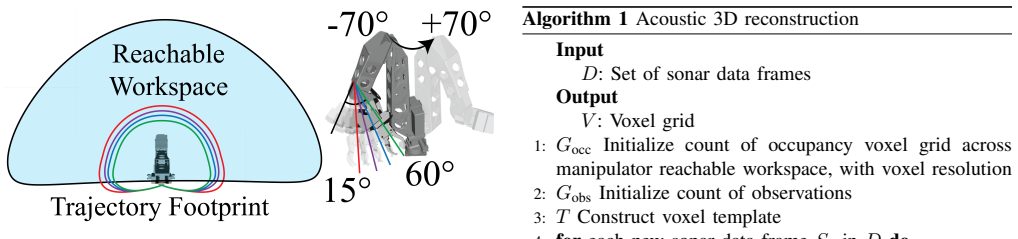
The load-bearing mechanism is a precomputed voxel template combined with ratio voting. The template holds the minimum set of grid cubes needed to represent the sonar's 130-degree horizontal and 20-degree vertical fields of view, so each incoming ping is projected into the template instead of casting every beam and range bin into the world frame, which is what brings per-frame cost down to tens of milliseconds. Each template cube is marked occupied or empty after a statistical deringing step, then transformed into the world frame using the manipulator's forward kinematics. Two count grids accumulate total observations and occupied observations, and a cube survives as occupied only when the ratio $G_{\mathrm{occ}}/G_{\mathrm{obs}}$ exceeds an empirical threshold $t_r$; this voting across intersecting views is what suppresses the elevation ambiguity. For the optical layer, the voxel grid is converted to a mesh, a virtual camera renders a depth image from each optical frame, background segmentation is applied to both optical and depth images, and the segmented pixels are back-projected onto the mesh using the same kinematic pose estimate.
What would settle it
Run the same sweep trajectory twice with a rigid target fixed in the tank and the arm returned to its nominal home pose between runs; if the reconstructed target position shifts by more than a few centimetres, or drifts relative to a laser-measured reference, the fixed-kinematics pose assumption is falsified. A sharper test is to apply a known sagging load to the wrist and check whether the acoustic grid and the optical overlay separate by more than the 5 cm cube size.
Extended reading notes
Core claim
The central discovery is that volumetric sonar carving, which resolves a sonar beam's 20-degree elevation ambiguity by counting how often each cube is observed versus marked occupied across intersecting views, can be made fast enough for real-time use and can then serve as the geometric scaffold for optical texturing. The tank validation reconstructs both submerged objects and the tank wall despite occlusion and reverberation, and dimension measurements from the reconstruction agree with ground truth to within 1.2 cm for individual mesh cells and within roughly 5 to 11 cm for larger objects such as the tank, milk crate, and chain. The paper argues these errors are small enough for collision-safe manipulation, while the optical overlay adds the semantic information the sonar alone cannot provide. The contribution is presented as an extension of prior volumetric sonar reconstruction, with the novelty lying in the real-time pipeline, the deringing and normalization preprocessing, and the eye-in-hand sweep trajectory that gathers diverse views with minimal arm motion.
Load-bearing premise
The pipeline assumes the manipulator's joint-angle sensors and forward kinematics give the true sonar and camera poses, so any undetected wrist deflection, mounting flex, or base motion will misalign the voxel grid and the optical overlay; the paper acknowledges this by stating that the method relies on accurate pose information from a fixed-base manipulator.
Editorial extensions
If this is right
- The paper reports that at 0.05 m voxel resolution each sonar frame is processed in 0.052 s (18.6 FPS), which is faster than the sonar's 10 FPS capture rate, so the map can keep up with the sensor during the sweep.
- The roughly 90-second sweep trajectory produces a reconstruction sufficient to guide the camera arm to close stand-off distances, converting the sonar-only map into a texture-rich scene for a human operator.
- Because the method imposes no assumptions on scene geometry or vehicle motion, reconstruction quality should improve with view diversity, and the eye-in-hand arm supplies that diversity from a short baseline.
- The reported dimension errors, 5.1 to 6.6 cm for acoustic-only measurements and 1.2 to 10.6 cm for optical-overlay measurements, are small relative to the 5 cm cube size and support the paper's claim that the grid is usable for real-time intervention.
- Decimating sonar pixels increases false positives but not false negatives, so the low-resolution occupancy grid preserves the free-space information needed to avoid collisions.
Reading between the lines
- Processing time grows cubically with resolution in this scheme, so the advertised real-time rate is tied to the 5 cm grid; a sparse or hierarchical voxel representation is a natural way to push finer resolutions into the real-time range, though the paper does not test one.
- The paper lists SLAM and dynamic object tracking as future work; if pose registration could come from the sensors rather than fixed-base kinematics, the same voxel-template pipeline would transfer to free-floating vehicle-manipulator systems.
- The optical overlay inherits the failure modes of the background-segmentation step, so objects unlike those in the segmentation model's training data could yield a correct acoustic map while the projected texture mislabels or misplaces them.
- The accuracy figures come from one tank with a small set of objects; a testable extension is to measure reconstruction error with targets at varying ranges and turbidity levels to see whether the same occupancy threshold $t_r$ holds outside the tested conditions.
Signed reviews
Editorial analysis
A structured set of objections, weighed in public.
Referee Report
Summary. The paper introduces OASIS, an opti-acoustic fusion method for real-time 3D reconstruction in underwater manipulation workspaces. The system uses a fixed-base manipulator with an eye-in-hand imaging sonar and optical camera. Sonar frames are processed into a 3D voxel grid via a voxel-carving scheme (Algorithm 1) that extends the authors' prior work [22], with a custom preprocessing step (Algorithm 2) for deringing and intensity normalization. Optical images are then projected onto the reconstructed mesh using a virtual-camera depth render and background segmentation to provide a textured overlay. The method is validated in a tank with a 2.1 m diameter workspace, reporting sonar processing times per frame for several voxel sizes and per-object dimension errors for the acoustic and optical modalities separately. The authors also release code and a dataset.
Significance. If the central claims were fully substantiated, OASIS would be a practical contribution: it demonstrates that volumetric sonar reconstruction can run at interactive rates for a manipulator-mounted sensor, and the eye-in-hand sweep trajectory is a sensible way to gather multi-view data with minimal arm motion. The release of code, dataset, and visualization tools is commendable and will benefit the community. However, the evidence as presented supports only 'real-time sonar voxel carving with qualitative optical texturing,' not 'real-time quantitatively accurate opti-acoustic fusion.' The missing timing and fused-accuracy measurements are the decisive gap between what is claimed and what is shown.
major comments (3)
- [Section IV, Table II] The real-time claim is based solely on the acoustic voxel-update time: Table II reports 0.052 s per sonar frame at 0.05 m resolution (18.6 FPS). The optical fusion pipeline described in Section III-C—Open3D meshing, marching cubes smoothing, Rembg/ISNet background removal, watershed depth masking, virtual-camera depth rendering, and pixel projection—is never timed. Consequently, the abstract's statement that OASIS achieves 'real-time 3D reconstruction' and Table I's entry 'OASIS Real-time (18 Hz)' are not supported for the fused system; 18 Hz is the sonar-only update rate. The authors should either measure and report the end-to-end per-frame latency of the full pipeline, or revise the claims to specify that real-time applies only to the acoustic mapping stage and that optical fusion is an on-demand overlay step.
- [Section IV, Table III] The quantitative evaluation does not test the fused output. Table III reports acoustic-only dimension errors (tank, mesh full width) and optical-only errors (milk crate, mesh 10 cells, chain), but no dimension error is given for the opti-acoustic fused reconstruction. Thus the contribution claim of a 'quantitatively accurate 3D reconstruction' enabled by fusion is not directly demonstrated. The authors should provide a quantitative metric for the fused result—for example, measured dimensions or a point-to-mesh distance of the final textured model against ground truth—or explicitly state that quantitative accuracy is only claimed for the individual modalities.
- [Section VI, Conclusion] The conclusion states that OASIS 'integrates voxel carving and Gaussian splatting techniques for 3D reconstruction.' The method section and Algorithm 1 use voxel carving only; Gaussian splatting is discussed only in the related work and is not part of the proposed pipeline. This is a factual mischaracterization of the method and should be corrected.
minor comments (5)
- [Abstract] The phrase 'real-time 3D reconstruction unstructured underwater workspaces' is missing a preposition; it should read 'real-time 3D reconstruction in unstructured underwater workspaces.'
- [Section III-B, Step 4] The occupancy threshold t_r is said to be 'determined empirically based on the data's false negative rate,' but no details are given about how it was chosen or how sensitive the reported accuracy and real-time performance are to its value. A brief sensitivity statement would strengthen the reproducibility of the method.
- [Section III-C] The phrase 'rendered alongside the meshed voxel grid' is vague. It would be clearer to state explicitly whether the optical pixels are texture-mapped onto the mesh surface, stored as a colored point cloud, or composited as an overlay in a separate layer.
- [Table I] The entry 'OASIS Real-time (18 Hz)' under 'Optimization Time' is misleading because the 18 Hz figure in Table II covers only the sonar voxel update. Add a footnote or change the entry to indicate that the rate is for the acoustic component only.
- [Section IV, Figure 6] The text refers to side-by-side reconstruction results and to objects (a,b), (c,g), etc., but does not describe the layout of Figure 6 or point to specific subfigures in the evaluation. Adding a sentence that guides the reader through the figure would improve clarity.
Circularity Check
No circular derivation found; the self-citation to [22] is background and the main limitations are evidentiary, not circular.
full rationale
OASIS does not derive its conclusions from assumptions that already contain those conclusions. The acoustic reconstruction in Algorithm 1 is a voxel-carving occupancy update with an empirically chosen ratio threshold t_r; the threshold is a tunable parameter, and no reported timing or dimension is defined as t_r. The optical fusion stage projects segmented pixels onto a rendered depth mesh, which is a standard texture-mapping operation rather than a result that assumes the fused reconstruction. The only notable self-citation is [22] (Phung, Billings, and Camilli) as the source of the min-max voxel template, but that citation is explicit background and is not used to justify the claimed speed or accuracy: Table II directly times sonar frame processing and Table III compares measured object dimensions against ground truth, so the central evaluation is externally grounded. The principal weakness is an evidentiary gap rather than circularity: Table II times only the acoustic voxel update and Table III reports acoustic-only and optical-only errors, so the paper does not fully establish that the fused opti-acoustic pipeline runs in real time or that the fused reconstruction is quantitatively accurate. Section V also acknowledges the dependence on accurate fixed-base manipulator pose information. None of these issues make a stated output equal to an input by construction, so the derivation chain is not circular.
Assumptions & free parameters
free parameters (3)
- Occupancy threshold t_r =
not stated
- Voxel grid resolution =
0.05 m (experiments), 0.01 to 0.04 m (variants in Table II)
- Sonar binarization thresholds =
mu_bg + 2 sigma_bg; mu_W + sigma_W
assumptions (4)
- domain assumption Forward kinematics and joint angle sensors of the fixed-base manipulator provide accurate enough poses for sonar and camera projection.
- domain assumption The first 10 sonar range bins (about 5 cm) are always empty and can characterize background noise.
- domain assumption The workspace is small and static, with no dynamic objects or vehicle motion during reconstruction.
- domain assumption Volumetric intersection across sonar views resolves the elevation angle ambiguity sufficiently for obstacle mapping.
Cite this review
Pith. "Pith review of OASIS: Real-Time Opti-Acoustic Sensing for Intervention Systems in Unstructured Environments." pith.science (2026). https://pith.science/paper/R6VMJPOI
@misc{pith2026250812071,
  author       = {Pith},
  title        = {Pith review of: OASIS: Real-Time Opti-Acoustic Sensing for Intervention Systems in Unstructured Environments},
  year         = {2026},
  howpublished = {\url{https://pith.science/paper/R6VMJPOI}},
  note         = {Machine review of arXiv:2508.12071}
}
read the original abstract
High resolution underwater 3D scene reconstruction is crucial for various applications, including construction, infrastructure maintenance, monitoring, exploration, and scientific investigation. Prior work has leveraged the complementary sensing modalities of imaging sonars and optical cameras for opti-acoustic 3D scene reconstruction, demonstrating improved results over methods which rely solely on either sensor. However, while most existing approaches focus on offline reconstruction, real-time spatial awareness is essential for both autonomous and piloted underwater vehicle operations. This paper presents OASIS, an opti-acoustic fusion method that integrates data from optical images with voxel carving techniques to achieve real-time 3D reconstruction unstructured underwater workspaces. Our approach utilizes an "eye-in-hand" configuration, which leverages the dexterity of robotic manipulator arms to capture multiple workspace views across a short baseline. We validate OASIS through tank-based experiments and present qualitative and quantitative results that highlight its utility for underwater manipulation tasks.
Figures


Figures from the paper (3 more)


Reference graph
Works this paper leans on
-
[22]
Sonar-aided ma- nipulation in low-visibility conditions by novice users,
A. Phung, G. Billings, and R. Camilli, “Sonar-aided ma- nipulation in low-visibility conditions by novice users,” in OCEANS 2024 - Halifax , 2024, pp. 1–7
work page 2024
-
[1]
Hybrid visual slam for underwater vehicle manipulator systems,
G. Billings, R. Camilli, and M. Johnson-Roberson, “Hybrid visual slam for underwater vehicle manipulator systems,” IEEE Robotics and Automation Letters , vol. 7, no. 3, pp. 6798–6805, 2022
work page 2022
-
[2]
D. L. Rizzini, F. Kallasi, J. Aleotti, F. Oleari, and S. Caselli, “Integration of a stereo vision system into an autonomous underwater vehicle for pipe manipulation tasks,” Computers & Electrical Engineering , vol. 58, pp. 560–571, 2017
work page 2017
-
[3]
J. Zhang, F. Han, D. Han, J. Yang, W. Zhao, and H. Li, “Advanced underwater measurement system for rovs: Integrating sonar and stereo vision for enhanced subsea infrastructure maintenance,” Journal of Marine Science and Engineering, vol. 12, no. 2, p. 306, 2024
work page 2024
-
[4]
Acoustic measurement of the deepwater horizon macondo well flow rate,
R. Camilli et al. , “Acoustic measurement of the deepwater horizon macondo well flow rate,” Proceedings of the Na- tional Academy of Sciences , vol. 109, no. 50, pp. 20 235– 20 239, 2012
work page 2012
-
[5]
Haptically-enabled co-robotics for remediation of military munitions underwater,
H. Chizeck, “Haptically-enabled co-robotics for remediation of military munitions underwater,” University of Washing- ton, Tech. Rep., 2014
work page 2014
-
[6]
M. Cai, Y . Wang, S. Wang, R. Wang, and M. Tan, “Autonomous manipulation of an underwater vehicle- manipulator system by a composite control scheme with disturbance estimation,” IEEE Transactions on Automation Science and Engineering , vol. 21, no. 1, pp. 1012–1022, 2023
work page 2023
-
[7]
P. Cieslak, P. Ridao, and M. Giergiel, “Autonomous un- derwater panel operation by girona500 uvms: A practical approach to autonomous underwater manipulation,” in 2015 IEEE International conference on robotics and automation (ICRA), IEEE, 2015, pp. 529–536
work page 2015
Show all 40 references
-
[8]
Autonomous underwater intervention,
E. Simetti, “Autonomous underwater intervention,” Current Robotics Reports, vol. 1, no. 3, pp. 117–122, 2020
2020
-
[9]
Opti- acoustic semantic slam with unknown objects in underwater environments,
K. Singh, J. Hong, N. R. Rypkema, and J. J. Leonard, “Opti- acoustic semantic slam with unknown objects in underwater environments,” arXiv preprint arXiv:2403.12837 , 2024
2024 arXiv
-
[10]
Aoneus: A neural rendering framework for acoustic-optical sensor fusion,
M. Qadri, K. Zhang, A. Hinduja, M. Kaess, A. Pediredla, and C. A. Metzler, “Aoneus: A neural rendering framework for acoustic-optical sensor fusion,” in ACM SIGGRAPH 2024 Conference Papers, 2024, pp. 1–12
2024
-
[11]
3-d object modeling from occluding contours in opti-acoustic stereo images,
M Babaee and S Negahdaripour, “3-d object modeling from occluding contours in opti-acoustic stereo images,” in 2013 OCEANS-San Diego, IEEE, 2013, pp. 1–8
2013
-
[12]
Towards large scale optical and acoustic sensor integration for visual- ization,
M. Johnson-Roberson, O. Pizarro, and S. Willams, “Towards large scale optical and acoustic sensor integration for visual- ization,” in OCEANS 2009-EUROPE, IEEE, 2009, pp. 1–4
2009
-
[13]
Robotic tools for deep water archaeol- ogy: Surveying an ancient shipwreck with an autonomous underwater vehicle,
B. Bingham et al., “Robotic tools for deep water archaeol- ogy: Surveying an ancient shipwreck with an autonomous underwater vehicle,” Journal of Field Robotics , vol. 27, no. 6, pp. 702–717, 2010
2010
-
[14]
Underwater terrain recon- struction from forward-looking sonar imagery,
J. Wang, T. Shan, and B. Englot, “Underwater terrain recon- struction from forward-looking sonar imagery,” in 2019 In- ternational Conference on Robotics and Automation (ICRA), IEEE, 2019, pp. 3471–3477
2019
-
[15]
Forward-look 2-d sonar image formation and 3-d reconstruction,
M. D. Aykin and S. Negahdaripour, “Forward-look 2-d sonar image formation and 3-d reconstruction,” in 2013 OCEANS- San Diego, IEEE, 2013, pp. 1–10
2013
-
[16]
Elevatenet: A convolutional neural network for estimating the missing di- mension in 2d underwater sonar images,
R. DeBortoli, F. Li, and G. A. Hollinger, “Elevatenet: A convolutional neural network for estimating the missing di- mension in 2d underwater sonar images,” in 2019 IEEE/RSJ International Conference on Intelligent Robots and Systems (IROS), IEEE, 2019, pp. 8040–8047
2019
-
[17]
Acoustic seafloor mapping using non- standard asv: Technical challenges and innovative solutions,
R. Ferretti et al. , “Acoustic seafloor mapping using non- standard asv: Technical challenges and innovative solutions,” in OCEANS 2023-Limerick, IEEE, 2023, pp. 1–6
2023
-
[18]
Spatial acoustic projection for 3d imaging sonar reconstruction,
S. Arnold and B. Wehbe, “Spatial acoustic projection for 3d imaging sonar reconstruction,” in 2022 International Conference on Robotics and Automation (ICRA) , IEEE, 2022, pp. 3054–3060
2022
-
[19]
On feature matching and image registration for two-dimensional forward-scan sonar imaging,
M. D. Aykin and S. Negahdaripour, “On feature matching and image registration for two-dimensional forward-scan sonar imaging,” Journal of Field Robotics , vol. 30, no. 4, pp. 602–623, 2013
2013
-
[20]
On 3-d target recon- struction from multiple 2-d forward-scan sonar views,
M. D. Aykin and S. Negahdaripour, “On 3-d target recon- struction from multiple 2-d forward-scan sonar views,” in Oceans 2015-Genova, IEEE, 2015, pp. 1–10
2015
-
[21]
Three-dimensional reconstruction of underwater objects using wide-aperture imaging sonar,
T. Guerneve, K. Subr, and Y . Petillot, “Three-dimensional reconstruction of underwater objects using wide-aperture imaging sonar,” Journal of Field Robotics , vol. 35, no. 6, pp. 890–905, 2018
2018
-
[23]
Opti- acoustic stereo imaging: On system calibration and 3-d tar- get reconstruction,
S. Negahdaripour, H. Sekkati, and H. Pirsiavash, “Opti- acoustic stereo imaging: On system calibration and 3-d tar- get reconstruction,” IEEE Transactions on image processing, vol. 18, no. 6, pp. 1203–1214, 2009
2009
-
[24]
Epipolar geometry of opti-acoustic stereo imaging,
S. Negahdaripour, “Epipolar geometry of opti-acoustic stereo imaging,” IEEE transactions on pattern analysis and machine intelligence, vol. 29, no. 10, pp. 1776–1788, 2007
2007
-
[25]
A portable opto-acoustic survey solution for mapping of underwater targets,
B Chemisky, E Nocerino, F Menna, M. Nawaf, and P Drap, “A portable opto-acoustic survey solution for mapping of underwater targets,” The International Archives of the Photogrammetry, Remote Sensing and Spatial Information Sciences, vol. 43, pp. 651–658, 2021
2021
-
[26]
Integration of optical and acoustic sensors for d underwater scene reconstruction.,
N Hurt ´os, X. Cuf´ı Sol`e, and J. Salvi, “Integration of optical and acoustic sensors for d underwater scene reconstruction.,” Instrumentation viewpoint, no. 8, pp. 43–43, 2010
2010
-
[27]
3-d object modeling from 2-d occluding contour correspondences by opti-acoustic stereo imaging,
M. Babaee and S. Negahdaripour, “3-d object modeling from 2-d occluding contour correspondences by opti-acoustic stereo imaging,” Computer Vision and Image Understand- ing, vol. 132, pp. 56–74, 2015
2015
-
[28]
Neus: Learning neural implicit surfaces by volume rendering for multi-view reconstruction,
P. Wang, L. Liu, Y . Liu, C. Theobalt, T. Komura, and W. Wang, “Neus: Learning neural implicit surfaces by volume rendering for multi-view reconstruction,” arXiv preprint arXiv:2106.10689, 2021
2021 arXiv
-
[29]
3d gaussian splatting for real-time radiance field rendering.,
B. Kerbl, G. Kopanas, T. Leimk ¨uhler, and G. Drettakis, “3d gaussian splatting for real-time radiance field rendering.,” ACM Trans. Graph., vol. 42, no. 4, pp. 139–1, 2023
2023
-
[30]
Seasplat: Repre- senting underwater scenes with 3d gaussian splatting and a physically grounded image formation model,
D. Yang, J. J. Leonard, and Y . Girdhar, “Seasplat: Repre- senting underwater scenes with 3d gaussian splatting and a physically grounded image formation model,” arXiv preprint arXiv:2409.17345, 2024
2024 arXiv
-
[31]
Wa- tersplatting: Fast underwater 3d scene reconstruction using gaussian splatting,
H. Li, W. Song, T. Xu, A. Elsig, and J. Kulhanek, “Wa- tersplatting: Fast underwater 3d scene reconstruction using gaussian splatting,” arXiv preprint arXiv:2408.08206, 2024
2024 arXiv
-
[32]
Rtg-slam: Real-time 3d reconstruction at scale using gaussian splatting,
Z. Peng et al. , “Rtg-slam: Real-time 3d reconstruction at scale using gaussian splatting,” in ACM SIGGRAPH 2024 Conference Papers, 2024, pp. 1–11
2024
-
[33]
A method of generating 3d views of aquatic plants with didson,
C. Xu, A. Asada, and K. Abukawa, “A method of generating 3d views of aquatic plants with didson,” in 2011 IEEE Symposium on Underwater Technology and Workshop on Scientific Use of Submarine Cables and Related Technolo- gies, IEEE, 2011, pp. 1–5
2011
-
[34]
Marching cubes: A high resolution 3d surface construction algorithm,
W. E. Lorensen and H. E. Cline, “Marching cubes: A high resolution 3d surface construction algorithm,” in Seminal graphics: pioneering efforts that shaped the field , 1998, pp. 347–353
1998
-
[35]
pmneila, Pymcubes, Accessed: 2025-03-01, 2025
2025
-
[36]
Gatis, Rembg: Background removal tool, Accessed: 2025- 03-01, 2022
D. Gatis, Rembg: Background removal tool, Accessed: 2025- 03-01, 2022
2025
-
[37]
Highly accurate dichotomous image segmentation,
X. Qin, H. Dai, X. Hu, D.-P. Fan, L. Shao, and L. V . Gool, “Highly accurate dichotomous image segmentation,” in ECCV, 2022
2022
-
[38]
Watersheds in digital spaces: An efficient algorithm based on immersion simulations,
L. Vincent and P. Soille, “Watersheds in digital spaces: An efficient algorithm based on immersion simulations,” IEEE Transactions on Pattern Analysis and Machine Intelligence , vol. 13, no. 6, pp. 583–598, 1991
1991
-
[39]
Design of nereid-ui: A remotely operated underwater vehicle for oceanographic access under ice,
A. D. Bowen et al. , “Design of nereid-ui: A remotely operated underwater vehicle for oceanographic access under ice,” in 2014 Oceans-St. John’s , IEEE, 2014, pp. 1–6
2014
-
[40]
Girona 500 auv: From survey to intervention,
D. Ribas, N. Palomeras, P. Ridao, M. Carreras, and A. Mallios, “Girona 500 auv: From survey to intervention,” IEEE/ASME Transactions on mechatronics , vol. 17, no. 1, pp. 46–53, 2011
2011
Reviewed August 15, 2026 · model on record in the stance chip above.
Discussion (0). Continue with ORCID to comment.