REVIEW 3 major objections 4 minor 39 references
One dimensional chains of nickelocene fragments on Au(111)
T0 review · 3 major / 4 minor · reviewed 2026-08-12 · deepseek-v4-flash
Pith's one-line read Nickelocene breaks into self-assembling chains on Au(111)
desk verdict Solid STM/DFT study of nickelocene fragmentation on Au(111) with a convincing type-A assignment and an honest but unresolved type-B identification; worth reviewing, not desk-rejecting. read the letter →
The pith
A machine-rendered reading of the paper's core claim, the machinery that carries it, and where it could break.
The reading
What carries the argument
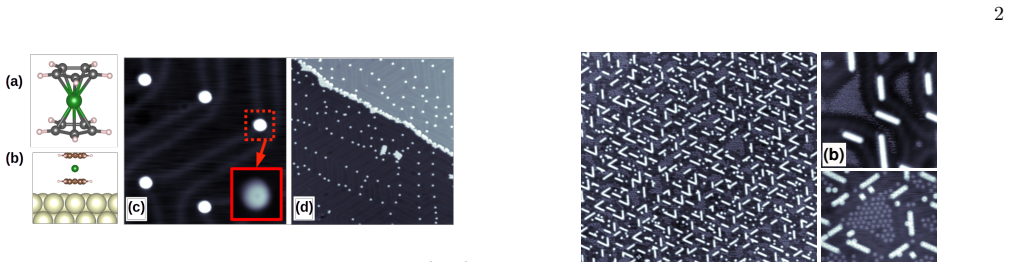
The central object is the NiCp fragment, a nickel atom capped by a cyclopentadienyl ring and adsorbed with the nickel at an FCC hollow site on the Au(111) terrace. The argument is carried by comparing constant-current STM topographies (shape, corrugation, and full width at half maximum) against DFT-simulated STM images of candidate fragments: NiCp, a bare Cp ring, and a single Ni adatom. The discriminating experimental features are the 1.7 Å corrugation of type-A rings, the 5.1 Å chain periodicity matching the <11-2> lattice spacing, and the 0.6 Å corrugation of type-B objects; the chiral chain pattern is reproduced only when steric repulsion between the Cp protons is included. For the <110> dimer, the load-bearing device is an introduced gold adatom in the hollow site between the two NiCp fragments, which supplies the steric bulk needed to match the measured STM image.
What would settle it
A direct measurement that could settle the type-B identity is spin-excitation spectroscopy on individual type-B fragments: a nickel adatom on Au(111) is calculated to retain a magnetic moment of about 0.96 Bohr magnetons with a spin-1/2 system, whereas a Cp ring is non-magnetic, so observing the absence or presence of a spin signature would discriminate between the two assignments. Similarly, atomic-resolution imaging of a <110> dimer that resolves the interstitial gold adatom directly would confirm or rule out the proposed dimer stabilization mechanism.
Extended reading notes
Core claim
The paper's central claim is that type-A fragments are NiCp molecules and type-B fragments are Cp rings. NiCp fragments adsorb with the Ni atom at an FCC hollow site, bind strongly to the surface (4.100 eV), and present a ring-shaped STM appearance with 1.7 Å corrugation; they form one-dimensional chains along the <11-2> directions, spaced by 5.1 Å to match the Au atomic spacing, and the chain's chiral pattern is correctly calculated by DFT when steric Cp-proton repulsion is included. The Cp rings (type-B) appear as featureless low-corrugation objects (0.6 Å) that order into a triangular superlattice with 8.7 Å spacing, explained by short-range repulsion. Both fragments are non-magnetic according to both DFT and the absence of magnetic excitations in dI/dV spectra, in contrast to intact NiCp2. Dimers of NiCp along <110> require an interstitial gold adatom that stabilizes the configuration; this explains why chains grow only along <11-2>, where no extra adatom is needed.
Load-bearing premise
The identification of type-B fragments as Cp rings rests on a difference in simulated image width (7 Å versus 6 Å) that is difficult to verify in real STM images, and if type-B fragments were actually nickel adatoms the entire stoichiometric interpretation of the dissociation would collapse.
Editorial extensions
If this is right
- If the fragment assignment is correct, nickelocene dissociation on Au(111) can be used as a controlled source of NiCp building blocks that self-organize into one-dimensional chains with a direction set by the substrate lattice.
- The steric-hindrance mechanism that produces the chiral chain pattern is general and should predict the chain morphology of similar metallocene fragments on other (111) noble-metal surfaces.
- The requirement of a gold adatom for <110> dimers implies that controlling the adatom supply on the surface would allow switching between chain growth and dimer formation, or building extended <110> structures.
- The finding that both fragments are non-magnetic on Au(111) identifies the substrate as the spin-quenching agent; depositing the same fragments on a decoupling layer or a less-hybridizing metal could preserve their magnetic moment and enable spin-chain studies.
Reading between the lines
- The same dissociation-and-self-assembly logic may extend to other metallocenes such as ferrocene or cobaltocene on Au(111), where the identity of the resulting fragments would be set by the metal atom's preferred adsorption site and its interaction strength.
- The observation that experimental chains rarely exceed ten fragments, combined with the computed strain, suggests that chain length could be tuned by molecular coverage or by modifying the herringbone reconstruction to alter strain relief.
- If type-B fragments are indeed Cp radicals, their low diffusion barrier and repulsive ordering make them a promising testbed for studying two-dimensional molecular lattices with tunable inter-fragment spacing on a metal surface.
Editorial analysis
A structured set of objections, weighed in public.
Referee Report
Summary. The paper reports a combined STM/STS and DFT study of nickelocene (NiCp2) dissociation on Au(111). At 4.2 K the intact molecules adsorb at herringbone elbows and step edges, while deposition at room temperature produces two fragment types: type-A fragments, which form one-dimensional chains along the <11-2> directions, and type-B fragments, which form fairly regular superlattices with a spacing of 8.7 Å. DFT calculations assign type-A to NiCp fragments (Ni on an FCC hollow site capped by a Cp ring) and type-B to Cp radicals. The calculations reproduce the STM profiles of type-A fragments, the chiral patterns in the chains, and the <1-10> dimers, but the latter require inserting an unseen gold adatom into the model. The paper concludes that both fragment types are non-magnetic and proposes metallocene fragments as building blocks for on-surface nanostructures.
Significance. If the fragment assignments are correct, the paper offers a concrete route to controlled self-assembly of metallocene fragments on a noble-metal surface, with quantitative DFT support and plausible binding-energy ordering. The strengths are the good agreement between simulated and measured STM profiles for type-A fragments and chains, the explicit reporting of binding energies, and the use of standard, reproducible DFT methodology (VASP, PBE+vdW, Tersoff-Hamann STM simulations). The main significance is, however, conditional on the chemical identification of the fragments, and the current evidence for the type-B assignment is not conclusive. The paper would be a useful contribution to on-surface synthesis and metallocene surface chemistry if that identification is strengthened or appropriately qualified.
major comments (3)
- [Section II.A, Fig. 4] The identification of type-B fragments as Cp rings is not established by the presented evidence. The text states that a Ni adatom yields a nearly identical STM image, with corrugation 0.9 Å versus 0.8 Å for the Cp fragment and FWHM 7 Å versus 6 Å, and concedes that this FWHM difference is 'difficult to verify in experimental STM images.' No experimental FWHM value is reported, and no quantitative image-comparison metric is given. The STS argument does not discriminate either, because a S=1/2 Ni adatom has no magnetic anisotropy and hence no magnetic excitations, as the authors themselves note. Since the 1:1 NiCp:Cp stoichiometry and the repulsion model for type-B fragments depend on this assignment, additional experimental or theoretical discriminators (e.g., adsorption-site registry, manipulation signatures, XPS, or a quantitative FWHM/line-shape analysis with uncertainties) are needed before the central claim can be accepted.
- [Section III, Fig. 7 and binding energies] The <1-10> dimer model is stabilized by inserting a gold adatom into the hollow site, an entity that is not directly observed and is introduced specifically to make the computed STM image match experiment. The reported binding energy per fragment (EB = 4.322 eV versus 4.100 eV for the isolated fragment) does not account for the energy cost of creating the Au adatom from a reservoir, so the statement that the adatom 'contributes positively' is not demonstrated by these numbers. The binding-energy definition in Section II.A applies to a molecule desorbing from the surface; for the adatom-containing dimer one must compare formation energies with a well-defined Au adatom reference (e.g., from a step edge or kink) or report the adatom formation energy explicitly. A systematic search over alternative configurations without the adatom, rather than introducing one ad hoc, would also strengthen the claim.
- [Section IV, Fig. 8] The chiral pattern in the chains is attributed to the lowest-energy chain configuration, with an energy reduction of 81 meV compared with other configurations, but the manuscript does not state how many chain configurations were considered or how the initial geometries were generated. If the configuration set was guided by the target experimental pattern, the agreement is partly circular. Please specify the configuration search space and report the energies of all considered chain arrangements, including the non-chiral and furthest-separated-H configurations mentioned in the text, so the reader can assess whether the lowest-energy selection was independent of the experimental target.
minor comments (4)
- [Abstract and Conclusions] The abstract contains the typo 'Nc molecules' where NiCp2 molecules is meant; the same typo should be checked throughout the text.
- [Section III, referencing Fig. 6] The sentence 'Figures 7 (a) and (b) show DFT results for a dimer configuration that matches the inter-fragment distance observed experimentally in Fig. 6 (b)' appears to cite the wrong panel, since Fig. 6(b) shows the <1-10> dimer while the DFT result in Fig. 7(a)-(d) is for the <11-2> dimer; this should be corrected to Fig. 6(a).
- [Methods and Fig. 4 comparison] The simulated STM images are evaluated at +1 V, whereas many experimental images are acquired at biases around 20 mV; because STM corrugation and apparent shape can be bias-dependent, a sentence justifying the comparison at different bias voltages would improve the manuscript.
- [Section I, references] Reference 13 (Verlhac et al., Science 366, 623) is cited for tilted NiCp2 STM images, but the description of the tilted-molecule image in Section II would benefit from a slightly more specific explanation of which panel in Fig. 3 resembles those images.
Circularity Check
No significant circularity: the STM/DFT comparison is self-contained; type-B identification is underdetermined but not circular.
full rationale
The central derivation chain is: experimental STM images -> candidate DFT structures -> simulated STM images -> comparison -> chemical assignment. This is a forward-model test, not a reduction of the conclusion into the inputs. No equation in the paper defines one quantity in terms of another in a way that forces the result. The only place where the model is adjusted to match data is the added gold adatom in the <1-10> dimer (Section III), but the paper does not rename this adjustment as a prediction; it explicitly states that introducing the adatom 'achieve[s] excellent agreement,' which is an inference to the best explanation rather than a fitted parameter called a prediction. The identification of type-B fragments is degenerate: the paper states that Cp and Ni adatom simulated images differ only by a FWHM 'difficult to verify in experimental STM images,' and the supporting aggregation argument is circumstantial. This is an underdetermination/correctness risk, not circularity, because the candidate structures are not defined by the conclusions and the chain energies come from DFT minimization. Self-citations (refs. 11, 13, 28) are used for image comparison and repulsion, but they are external experimental results from prior work and are not load-bearing for the new claims. Score 1 reflects minor self-citations with no circular weight.
Assumptions & free parameters
assumptions (5)
- domain assumption PBE+TS approximation to exchange-correlation in DFT
- domain assumption Tersoff-Hamann approximation for STM image simulation
- domain assumption Four-layer Au(111) slab with two bottom layers fixed
- domain assumption The observed objects are dissociation products of NiCp2, not contaminants
- ad hoc to paper Chiral patterns in chains arise from steric hindrance of Cp protons
invented entities (1)
-
Gold adatom in the <1-10> type-A dimer
Cite this review
Pith. "Pith review of One dimensional chains of nickelocene fragments on Au(111)." pith.science (2026). https://pith.science/paper/R7A4FAUA
@misc{pith2026241117527,
  author       = {Pith},
  title        = {Pith review of: One dimensional chains of nickelocene fragments on Au(111)},
  year         = {2026},
  howpublished = {\url{https://pith.science/paper/R7A4FAUA}},
  note         = {Machine review of arXiv:2411.17527}
}
abstract
We investigate the temperature-dependent deposition of nickelocene (NiCp$_2$) molecules on a single crystal Au(111) substrate, revealing distinct adsorption behaviors and structural formations. At low temperatures (4.2 K), individual NiCp$_2$ molecules adsorb on the herringbone elbows and step edges, forming ordered patterns as molecular coverage increases. However, at 77 K, the molecules dissociate, yielding two main fragments: NiCp fragments that are Ni atoms capped by cyclopentadienyl (Cp) rings, which preferentially adsorb at FCC hollow sites, and Cp radical fragments exhibiting strong substrate interactions. NiCp fragments self-assemble into one-dimensional (1-D) chains along the $\langle 1 1 \bar{2} \rangle$ directions, displaying higher protrusion in STM images. The strain and steric hindrance from the Cp protons induce chiral patterns within the chains, which are well-reproduced by our DFT simulations. In contrast, the Cp fragments maintain distances due to short-range repulsive forces and exhibit low diffusion barriers. Interestingly, the fragments are non-magnetic, as confirmed by both STM measurements and DFT calculations, in contrast to the magnetic signals from intact Nc molecules. In addition to linear chains, dimers of the Ni-Cp fragments form along the $\langle 1 \bar{1} 0\rangle$ directions, requiring gold adatoms for their creation. These results demonstrate the feasibility of constructing complex nanostructures based on metallocenes via on-surface synthesis, opening the possibility for realizing low-dimensional magnetic systems by selecting substrates that preserve the magnetic moment of the fragments.
Figures


Figures from the paper (4 more)


Reference graph
Works this paper leans on
-
[1]
author author W. Kaminsky \ and\ author A. Laban ,\ https://doi.org/10.1016/S0926-860X(01)00829-8 journal journal Applied Catalysis A: General \ volume 222 ,\ pages 47 ( year 2001 ) ,\ note celebration Issue NoStop
-
[2]
author author W. Kaminsky ,\ https://doi.org/10.1002/pola.20292 journal journal Journal of Polymer Science Part A: Polymer Chemistry \ volume 42 ,\ pages 3911 ( year 2004 ) ,\ http://arxiv.org/abs/https://onlinelibrary.wiley.com/doi/pdf/10.1002/pola.20292 https://onlinelibrary.wiley.com/doi/pdf/10.1002/pola.20292 NoStop
-
[3]
author author W. Kaminsky \ and\ author M. Arndt ,\ 10.1007/BFb0103631 journal journal Adv. Polym. Sci. \ volume 127 ,\ pages 143 ( year 2007 ) NoStop
-
[4]
author author M. S. \ Shaw , author M. R. \ Bates , author M. D. \ Jones , \ and\ author B. D. \ Ward ,\ 10.1039/D2PY00335J journal journal Polym. Chem. \ volume 13 ,\ pages 3315 ( year 2022 ) NoStop
-
[5]
author author L. Resconi , author L. Cavallo , author A. Fait , \ and\ author F. Piemontesi ,\ 10.1021/cr9804691 journal journal Chemical Reviews \ volume 100 ,\ pages 1253 ( year 2000 ) ,\ note pMID: 11749266 ,\ http://arxiv.org/abs/https://doi.org/10.1021/cr9804691 https://doi.org/10.1021/cr9804691 NoStop
-
[6]
author author J. Okuda ,\ https://doi.org/10.1016/j.jorganchem.2023.122833 journal journal Journal of Organometallic Chemistry \ volume 1000 ,\ pages 122833 ( year 2023 ) NoStop
-
[7]
author author M. Jezequel , author V. Dufaud , author M. J. \ Ruiz-Garcia , author F. Carrillo-Hermosilla , author U. Neugebauer , author G. P. \ Niccolai , author F. Lefebvre , author F. Bayard , author J. Corker , author S. Fiddy , author J. Evans , author J.-P. \ Broyer , author J. Malinge , \ and\ author J.-M. \ Basset ,\ 10.1021/ja000682q journal jou...
-
[8]
author author M. Ormaza , author P. Abufager , author B. Verlhac , author N. Bachellier , author M.-L. \ Bocquet , author N. Lorente , \ and\ author L. Limot ,\ 10.1038/s41467-017-02151-6 journal journal Nature communications \ ( year 2017 a ),\ 10.1038/s41467-017-02151-6 NoStop
Show all 39 references
-
[9]
Wei , author L
author author P. Wei , author L. Sun , author E. Benassi , author Z. Shen , author S. Sanvito , \ and\ author S. Hou ,\ 10.1063/1.3603446 journal journal The Journal of Chemical Physics \ volume 134 ,\ pages 244704 ( year 2011 ) ,\ http://arxiv.org/abs/https://pubs.aip.org/aip...
-
[10]
\ Zhang , author Y
author author G.-P. \ Zhang , author Y. Mu , author M.-Z. \ Wei , author S. Wang , author H. Huang , author G.-c. \ Hu , author Z.-L. \ Li , \ and\ author C. Wang ,\ 10.1039/C7TC05518H journal journal Journal of Materials Chemistry C \ volume 6 ,\ pages 2105 ( year 2018 ) NoStop
-
[11]
Ormaza , author N
author author M. Ormaza , author N. Bachellier , author M. N. \ Faraggi , author B. Verlhac , author P. Abufager , author P. Ohresser , author L. Joly , author M. Romeo , author F. Scheurer , author M.-L. \ Bocquet , author N. Lorente , \ and\ author L. Limot ,\ https://api.se...
2017
-
[12]
Czap , author P
author author G. Czap , author P. J. \ Wagner , author F. Xue , author L. Gu , author J. Li , author J. Yao , author R. Wu , \ and\ author W. Ho ,\ 10.1126/science.aaw7505 journal journal Science \ volume 364 ,\ pages 670 ( year 2019 ) NoStop
-
[13]
Verlhac , author N
author author B. Verlhac , author N. Bachellier , author L. Garnier , author M. Ormaza , author P. Abufager , author R. Robles , author M.-L. \ Bocquet , author M. Ternes , author N. Lorente , \ and\ author L. Limot ,\ 10.1126/science.aax8222 journal journal Science \ volume 3...
-
[14]
\ Braun , author V
author author K.-F. \ Braun , author V. Iancu , author N. Pertaya , author K.-H. \ Rieder , \ and\ author S.-W. \ Hla ,\ 10.1103/PhysRevLett.96.246102 journal journal Phys. Rev. Lett. \ volume 96 ,\ pages 246102 ( year 2006 ) NoStop
2006 doi
-
[15]
Ormaza , author P
author author M. Ormaza , author P. Abufager , author N. Bachellier , author R. Robles , author M. Verot , author T. Le Bahers , author M.-L. \ Bocquet , author N. Lorente , \ and\ author L. Limot ,\ 10.1021/jz5026118 journal journal The Journal of Physical Chemistry Letters \...
-
[16]
Ormaza , author R
author author M. Ormaza , author R. Robles , author N. Bachellier , author P. Abufager , author N. Lorente , \ and\ author L. Limot ,\ 10.1021/acs.nanolett.5b04280 journal journal Nano Lett. \ volume 16 ,\ pages 588 ( year 2016 ) NoStop
-
[17]
Li , author Y
author author S. Li , author Y. M. \ Hamrick , author R. J. \ Van Zee , \ and\ author W. J. \ Weltner ,\ 10.1021/ja00037a078 journal journal Journal of the American Chemical Society \ volume 114 ,\ pages 4433 ( year 1992 ) NoStop
1992 doi
-
[18]
Bachellier , author M
author author N. Bachellier , author M. Ormaza , author M. Faraggi , author B. Verlhac , author M. V\'erot , author T. Le Bahers , author M.-L. \ Bocquet , \ and\ author L. Limot ,\ 10.1103/PhysRevB.93.195403 journal journal Phys. Rev. B \ volume 93 ,\ pages 195403 ( year 2016...
-
[19]
Mier , author B
author author C. Mier , author B. Verlhac , author L. Garnier , author R. Robles , author L. Limot , author N. Lorente , \ and\ author D.-J. \ Choi ,\ 10.1021/acs.jpclett.1c00328 journal journal The Journal of Physical Chemistry Letters \ volume 12 ,\ pages 2983 ( year 2021 ) NoStop
-
[20]
Welipitiya , author C
author author D. Welipitiya , author C. Waldfried , author C. Borca , author P. Dowben , author N. Boag , author H. Jiang , author I. Gobulukoglu , \ and\ author B. Robertson ,\ https://doi.org/10.1016/S0039-6028(98)00742-0 journal journal Surface Science \ volume 418 ,\ pages...
-
[21]
author author D. L. \ Pugmire , author C. M. \ Woodbridge , author S. Root , \ and\ author M. A. \ Langell ,\ 10.1116/1.581854 journal journal Journal of Vacuum Science & Technology A \ volume 17 ,\ pages 1581 ( year 1999 ) ,\ http://arxiv.org/abs/https://pubs.aip.org/avs/jva/...
1999 doi
-
[22]
Pugmire , author C
author author D. Pugmire , author C. Woodbridge , author N. Boag , \ and\ author M. Langell ,\ https://doi.org/10.1016/S0039-6028(00)00939-0 journal journal Surface Science \ volume 472 ,\ pages 155 ( year 2001 ) NoStop
2001 doi
-
[23]
Alessio , author S
author author M. Alessio , author S. Kotaru , author G. Giudetti , \ and\ author A. I. \ Krylov ,\ 10.1021/acs.jpcc.2c05940 journal journal The Journal of Physical Chemistry C \ volume 127 ,\ pages 3647 ( year 2023 ) ,\ http://arxiv.org/abs/https://doi.org/10.1021/acs.jpcc.2c0...
2023 doi
-
[24]
Edmondson \ and\ author A
author author M. Edmondson \ and\ author A. Saywell ,\ 10.1021/acs.nanolett.2c02895 journal journal Nano Letters \ volume 22 ,\ pages 8210 ( year 2022 ) ,\ note publisher: American Chemical Society NoStop
2022 doi
-
[25]
author author J. A. \ Meyer , author I. D. \ Baikie , author E. Kopatzki , \ and\ author R. J. \ Behm ,\ 10.1016/0039-6028(96)00852-7 journal journal Surface Science \ volume 365 ,\ pages L647 ( year 1996 ) NoStop
1996 doi
-
[26]
Repp , author F
author author J. Repp , author F. Moresco , author G. Meyer , author K.-H. \ Rieder , author P. Hyldgaard , \ and\ author M. Persson ,\ 10.1103/PhysRevLett.85.2981 journal journal Phys. Rev. Lett. \ volume 85 ,\ pages 2981 ( year 2000 ) NoStop
-
[27]
Sotthewes , author M
author author K. Sotthewes , author M. Nijmeijer , \ and\ author H. J. W. \ Zandvliet ,\ 10.1103/PhysRevB.103.245311 journal journal Phys. Rev. B \ volume 103 ,\ pages 245311 ( year 2021 ) NoStop
2021 doi
-
[28]
Fernandez-Torrente , author S
author author I. Fernandez-Torrente , author S. Monturet , author K. J. \ Franke , author J. Fraxedas , author N. Lorente , \ and\ author J. I. \ Pascual ,\ 10.1103/PhysRevLett.99.176103 journal journal Physical Review Letters \ volume 99 ,\ pages 176103 ( year 2007 ) NoStop
-
[29]
Mielke , author F
author author J. Mielke , author F. Hanke , author M. V. \ Peters , author S. Hecht , author M. Persson , \ and\ author L. Grill ,\ 10.1021/ja510528x journal journal Journal of the American Chemical Society \ volume 137 ,\ pages 1844 ( year 2015 ) ,\ note pMID: 25494667 ,\ htt...
-
[30]
Robles , author V
author author R. Robles , author V. Zobač , author K. H. A. \ Yeung , author F. Moresco , author C. Joachim , \ and\ author N. Lorente ,\ 10.1039/D0CP01657H journal journal Physical Chemistry Chemical Physics \ volume 22 ,\ pages 15208 ( year 2020 ) ,\ note publisher: The Roya...
-
[31]
author author R. K. \ Berger , author A. Jeindl , author L. H\"ormann , \ and\ author O. T. \ Hofmann ,\ 10.1021/acs.jpcc.2c00994 journal journal The Journal of Physical Chemistry C \ volume 126 ,\ pages 7718 ( year 2022 ) ,\ http://arxiv.org/abs/https://doi.org/10.1021/acs.jp...
2022 doi
-
[32]
Kresse \ and\ author J
author author G. Kresse \ and\ author J. Furthm\"uller ,\ 10.1016/0927-0256(96)00008-0 journal journal Comput. Mater. Sci. \ volume 6 ,\ pages 15 ( year 1996 ) NoStop
1996 doi
-
[33]
Kresse \ and\ author D
author author G. Kresse \ and\ author D. Joubert ,\ 10.1103/PhysRevB.59.1758 journal journal Phys. Rev. B \ volume 59 ,\ pages 1758 ( year 1999 ) NoStop
1999 doi
-
[34]
author author J. P. \ Perdew , author K. Burke , \ and\ author M. Ernzerhof ,\ 10.1103/PhysRevLett.77.3865 journal journal Phys. Rev. Lett. \ volume 77 ,\ pages 3865 ( year 1996 ) NoStop
1996 doi
-
[35]
Tkatchenko \ and\ author M
author author A. Tkatchenko \ and\ author M. Scheffler ,\ 10.1103/PhysRevLett.102.073005 journal journal Phys. Rev. Lett. \ volume 102 ,\ pages 073005 ( year 2009 ) NoStop
2009 doi
-
[36]
Tersoff \ and\ author D
author author J. Tersoff \ and\ author D. R. \ Hamann ,\ 10.1103/PhysRevB.31.805 journal journal Phys. Rev. B \ volume 31 ,\ pages 805 ( year 1985 ) NoStop
1985 doi
-
[37]
\ Bocquet , author H
author author M.-L. \ Bocquet , author H. Lesnard , author S. Monturet , \ and\ author N. Lorente ,\ in\ @noop booktitle Computational Methods in Catalysis and Materials Science ,\ editor edited by\ editor R. A. v. \ Santen \ and\ editor P. Sautet \ ( publisher Wiley-VCH Verla...
2009
-
[38]
Lorente \ and\ author R
author author N. Lorente \ and\ author R. Robles ,\ 10.5281/zenodo.3581159 title STMpw v1.0b2 (Zenodo) , \ howpublished https://doi.org/10.5281/zenodo.3581159 ( year 2019 ) NoStop
2019 doi
-
[39]
Momma \ and\ author F
author author K. Momma \ and\ author F. Izumi ,\ 10.1107/S0021889811038970 journal journal Journal of Applied Crystallography \ volume 44 ,\ pages 1272 ( year 2011 ) NoStop
2011 doi
Reviewed August 12, 2026 · model on record in the stance chip above.
Discussion (0). Continue with ORCID to comment.