REVIEW 2 major objections 6 minor 1 cited by
Optimal Strategies for Multi-parameter Quantum Metrology
T0 review · 2 major / 6 minor · reviewed 2026-08-15 · deepseek-v4-flash
Pith's one-line read The paper claims that, for parallel, sequential, and physically realizable indefinite-causal-order strategies, the optimal multiparameter estimation error is exactly computable as a semidefinite program whose feasible cones reproduce the…
desk verdict A useful extension of conic programming to multi-parameter channel metrology, with a localized but load-bearing proof bug in Appendix D that is likely repairable. read the letter →
The pith
A machine-rendered reading of the paper's core claim, the machinery that carries it, and where it could break.
The reading
What carries the argument
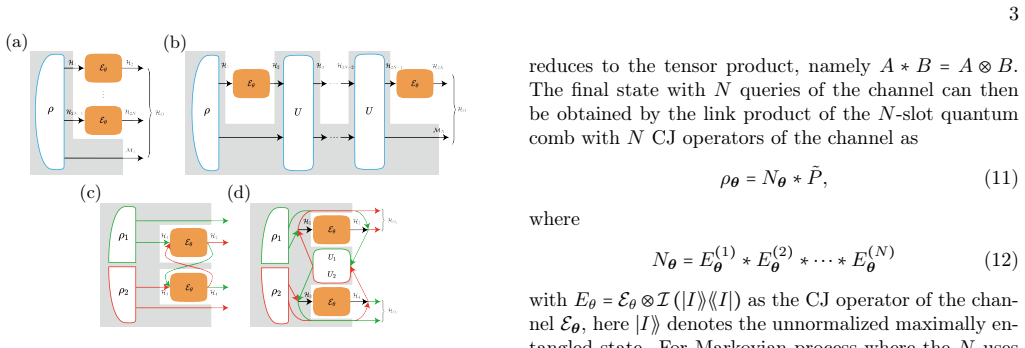
The central object is the auxiliary operator $X=\sum_x v_x v_x^{\mathsf T}\otimes M_x$, built from the estimator deviations $v_x=(1,\Delta\hat\theta(x))$ and the POVM elements $M_x$ on a tensor product of a real reference space $\mathbb{R}^{d+1}$ with the strategy output space. It encodes the estimator and measurement in one variable, making the weighted mean-square error a linear trace objective. The strategy $\widetilde P$ is then absorbed into a contracted variable $\Omega=(I_R\otimes\Phi_{\widetilde P})(X)$, where $\Phi_{\widetilde P}$ is the completely positive map induced by the quantum comb; this removes the bilinear coupling between strategy and measurement. Different precision bounds correspond to different cones $C_k$ on $X$: separable (tight), block-constrained (Nagaoka-Hayashi and SLD), and additionally antisymmetry-constrained (Holevo). The load-bearing step is the proof that these cones survive the strategy contraction and the reverse purification, yielding the equality $\mathrm{SP}_k=\mathrm{QP}_k$.
What would settle it
For a small channel (say two qubits, two parameters, and $N=2$ channel uses), solve the SDP and then grid-search over finite POVMs and locally unbiased estimators; if any explicit strategy beats the SDP value, the claimed equality $\mathrm{SP}_k=\mathrm{QP}_k$ fails. A second test is to check whether every feasible $\Omega$ satisfying the cone and normalization conditions admits a purification through Eqs. (D21)-(D29); a feasible $\Omega$ with no physical lift would also refute the proof.
Extended reading notes
Core claim
For strategies with definite causal order, the paper proves in Appendix D that the conic relaxation is exact: the semidefinite-program optimum $\mathrm{SP}_k$ equals the original optimization $\mathrm{QP}_k$ over all probe states, control operations, and measurements, for the cones $k=2,3,4$ corresponding to the Nagaoka-Hayashi, SLD, and Holevo bounds, and also for the separable cone $k=1$ that gives the tight bound. The proof works by a strategy contraction that absorbs the quantum-comb strategy into the measurement-estimator operator, and then by a purification step that lifts every feasible contracted operator back to a physical strategy and measurement. Indefinite-causal-order strategies that decompose into definite-order sectors, such as causal superposition and the quantum switch, fit inside the same framework. The paper demonstrates the framework on three-parameter magnetometry, reproducing known analytical bounds in the noiseless case and identifying precision hierarchies under noise and energy constraints.
Load-bearing premise
The whole construction rests on the Appendix D step that every feasible compressed strategy can be rebuilt as a physical strategy-and-measurement pair; the paper gives a proof sketch for this step but no independent or machine-checked verification.
Editorial extensions
If this is right
- The same SDP computes the exact Holevo, Nagaoka-Hayashi, and SLD bounds for parallel and sequential strategies with $N$ channel uses, jointly optimizing probe state, controls, and measurement.
- Physically realizable indefinite-causal-order protocols, including causal superposition and the quantum switch, can be included in the optimization, so their multiparameter precision can be compared with definite-order strategies within one framework.
- Energy-budget constraints and finite-memory restrictions become linear or decomposable constraints on the optimization variable, allowing resource-limited sensing protocols to be optimized rather than searched heuristically.
- In the noiseless magnetometry model, the numerical bounds reproduce the known analytical parallel and sequential limits, supporting the claim that the SDP optimum is the true precision bound.
- Resource-constrained comparisons quantify the precision loss from limited energy and memory, giving a practical route from ideal limits to near-term sensor design.
Reading between the lines
- If the conic contraction is as general as the proof suggests, the same $\Omega$ construction should transfer to channel discrimination and Bayesian quantum metrology, problems the paper itself names as future directions.
- The reported ordering (causal superposition and sequential strategies nearly tied, both outperforming parallel and quantum switch) is demonstrated for a particular magnetometry model; treating it as a universal hierarchy would be an extrapolation beyond the paper.
- Because the tight bound's separable cone is not semidefinite representable, the exact SDPs for the other three cones can serve as certified bounds from which to sandwich the tight bound in finite-sample settings.
- The finite-memory identical-control iteration is nonconvex and occasionally fails to converge at high noise; a natural test is whether updating several control positions per step, rather than one randomly chosen site, improves convergence without increasing memory.
Signed reviews
Editorial analysis
A structured set of objections, weighed in public.
Referee Report
Summary. This manuscript develops a conic-programming framework for multiparameter quantum metrology, jointly optimizing probe preparation, intermediate controls, and measurements over parallel, sequential, and indefinite-causal-order strategy classes. The central technical claim is that the tight, Nagaoka-Hayashi, SLD, and Holevo precision bounds can be evaluated by an equivalent conic/SDP problem, with the exact equality SP_k = QP_k proved in Appendix D. The framework is benchmarked against known analytical results for noiseless multiparameter magnetometry (Eqs. (38)-(39) and Appendix F), extended to energy-constrained strategies, and specialized to finite-memory sequential schemes with identical controls. The paper concludes that a strict hierarchy among strategy classes can be identified in the noisy multiparameter regime, with causal superposition nearly matching sequential strategies and outperforming parallel and quantum-SWITCH schemes.
Significance. The contribution is potentially significant: if the exactness result holds, it provides a unified computational tool for determining achievable multiparameter precision limits across qualitatively different causal structures, going beyond the state-estimation conic framework of Ref. [50]. The paper deserves credit for benchmarking the SDP results against independent analytical bounds for parallel and sequential magnetometry, and for explicitly reproducing the optimal probe and control structures in Appendix F. The numerical evidence in Fig. 2(c) is consistent with the formulation, and the resource-constrained and finite-memory extensions address experimentally relevant scenarios. However, the exactness proof is not machine-checked and, as detailed below, contains a gap in the regularization step of the converse direction; the significance of the central claim depends on repairing that step.
major comments (2)
- [Appendix D2, Eqs. (D23)-(D24)] Applying condition (i) in Eq. (21) to Ω_ε in Eq. (D23) gives Tr_R[Ω_ε(|0><0|_R⊗I_S)] = (1−ε)P*⊗I_OS + ε/(∏_{k=1}^{2N} d_k) I_S, whereas the claimed strategy operator in Eq. (D24) satisfies P_ε⊗I_OS = (1−ε)P*⊗I_OS + ε/(∏_{k=1}^{N} d_k) I_S. These agree only when ∏_{k=1}^{2N} d_k = ∏_{k=1}^{N} d_k, which is generically false. Moreover, I_{S_bar}/(∏_{k=1}^{N} d_k) is not a valid sequential comb under Eq. (A1): for N=2, Tr_{H3}[I_{H1H2H3}]/d1d2 = (d3/d1d2) I_{H1H2}, which is not of the required form I_{H2}⊗P^{(1)} with Tr[P^{(1)}]=1 unless d2=d3. The correct normalizing factor would be ∏_{k=1}^{N} d_{2k-1}. Consequently the proof of QP_k ≤ SP_k (Eq. (D38)) is incomplete as written; the numerical benchmarks in Fig. 2(c) do not exercise the regularization and cannot substitute for this argument.
- [Appendix D2, Eqs. (D27)-(D29)] The lift of Ω_ε to a purified strategy is under-specified. The text defines U as a unitary from H_S to H_OM, but the spectral decomposition in Eq. (D25) is of P_ε, which acts on S_bar, not on H_S; the congruence in Eq. (D28) needs U to map S_bar to H_OM with I_{R,OS} acting on the remaining system factor. Please clarify the domains of U and P_ε^{-1/2}; as written, the constructed X_ε is not well-defined.
minor comments (6)
- [Eqs. (D11), (D30), (D31)] The implication symbols in these equations are corrupted ('/Leftr...'), making the logical direction of the cone-preservation claims difficult to verify; please repair the typesetting and re-check each implication.
- [Section V] The notation QP_k is reused for the finite-memory and identical-control problems, whereas QP_k already denotes the original conic problem in Section III; please disambiguate the notation.
- [Main text after Fig. 2] The references to 'Fig. 1(a)' and 'Fig. 1(b)' in the discussion of Fig. 2 should be 'Fig. 2(a)' and 'Fig. 2(b)'.
- [Introduction] There are numerous typographical and spacing errors in the introduction (e.g., 'thesuccessinthesingle-parameterdomain', 'weconsider...'), which should be corrected before publication.
- [Appendix F, Eq. (F9)] The displayed matrix in Eq. (F9) appears to have formatting errors with missing or superfluous entries; please check the matrix against the analytical construction.
- [Section III] The phrase 'the physical implementation of a general ICO is untraceable' is unclear; if 'untraceable' is intended to mean 'not realizable by a finite circuit', please state that explicitly.
Circularity Check
No circularity found: the SDP equivalence and benchmarks rest on external cone characterizations and independent analytical bounds.
full rationale
The central claim, SP_k = QP_k, is derived in the paper from the cone characterizations of Ref. [50]; that reference is not authored by the present authors, and the derivation does not assume the target equality. The objective and constraints in QP_k and SP_k are reformulations of the same estimation problem, and the proof constructs maps in both directions using explicit operators (Eqs. D1-D38). The noiseless benchmarks in Eqs. (38)-(39) are previously published analytical bounds that are not used as inputs to the optimization; the SDP is independently optimized and then compared with them, so this is validation rather than prediction-from-fit. Self-references such as the energy model of Ref. [69] and the single-parameter hierarchy of Ref. [24] are ancillary: the energy model is adopted as a resource measure, and the hierarchy is used for comparison, neither being needed to establish the cone-preservation or the SP_k = QP_k equivalence. The regularization formulas in Appendix D2, Eqs. (D23)-(D24), appear internally inconsistent in normalization, so the converse proof may be incomplete as written, but this is a correctness concern, not a circularity concern. No load-bearing argument reduces to its own input, and no fitted parameter is renamed as a prediction.
Assumptions & free parameters
assumptions (5)
- domain assumption The cone characterizations C1-C4 from Ref. [50] correctly encode the tight, Nagaoka-Hayashi, SLD, and Holevo bounds for a fixed output state.
- standard math The link product and quantum comb formalism correctly model concatenation of strategies with channels, including partial-transpose conventions.
- domain assumption The N channel uses act on mutually distinct Hilbert spaces and are independent (Markovian), giving N_theta as a tensor product in Eq. (12).
- domain assumption The global battery model of Ref. [69] with qubit Hamiltonian |1><1| and degenerate ancillas correctly quantifies strategy energy consumption.
- ad hoc to paper The regularization and limiting procedure in Appendix D2 (Eqs. D22-D24) preserves feasibility, cone membership, and objective value as epsilon goes to zero.
Cite this review
Pith. "Pith review of Optimal Strategies for Multi-parameter Quantum Metrology." pith.science (2026). https://pith.science/paper/RDDOUPUI
@misc{pith2026260801114,
  author       = {Pith},
  title        = {Pith review of: Optimal Strategies for Multi-parameter Quantum Metrology},
  year         = {2026},
  howpublished = {\url{https://pith.science/paper/RDDOUPUI}},
  note         = {Machine review of arXiv:2608.01114}
}
read the original abstract
Estimating multiple unknown parameters simultaneously is essential for practical quantum sensing. However, it faces a fundamental challenge: the optimal strategy for estimating one parameter is often incompatible with that for another, making it impossible to simultaneously achieve the ultimate precision limits for all parameters. Here we develop a general and efficient computational framework that jointly optimizes probe states, control operations, and measurements across different strategy families, including parallel, sequential, and those with indefinite causal order. Our approach provides exact semidefinite-program formulations for several precision bounds, including the Holevo, Nagaoka-Hayashi, and quantum Cram\'er-Rao bounds. We demonstrate the capabilities of the framework in multiparameter magnetometry and frequency estimation, identifying optimal protocols within each class and revealing a strict hierarchy among the achievable performances of different classes in the multiparameter regime. The framework also directly incorporates resource constraints, such as energy budgets, enabling systematic investigation of experimentally realistic sensing scenarios. Furthermore, we develop a finite-memory optimization method for sequential strategies with restricted ancillary-memory dimension. By decomposing the protocol into initial probe preparation and intermediate control operations, this method provides a practical route to designing resource-constrained sequential sensing schemes. Our work establishes a versatile computational tool for determining fundamental precision limits and designing optimal quantum-sensing protocols in complex multiparameter settings.
Figures


Figures from the paper (2 more)


Forward citations
Cited by 1 Pith paper
-
Simultaneous Heisenberg-Limited Multiparameter Metrology via Indefinite Evolution
Indefinite evolution maps two noncommuting signal parameters onto separate degrees of freedom, enabling simultaneous Heisenberg-limited multiparameter estimation.
Reference graph
Works this paper leans on
-
[50]
M. Hayashi and Y. Ouyang, Tight cramér-rao type bounds for multiparameter quantum metrology through conic programming, Quantum7, 1094 (2023)
work page 2023
-
[1]
C. W. Helstrom, Quantum detection and estimation the- ory, Journal of statistical physics1, 231 (1969)
1969
-
[2]
S. L. Braunstein and C. M. Caves, Statistical distance and the geometry of quantum states, Physical Review Letters72, 3439 (1994)
1994
-
[3]
A. S. Holevo,Probabilistic and statistical aspects of quan- tum theory, Vol. 1 (Springer Science & Business Media, 2011)
2011
-
[4]
Oreshkov, F
O. Oreshkov, F. Costa, and Č. Brukner, Quantum corre- lations with no causal order, Nature communications3, 1092 (2012)
2012
-
[5]
Chiribella, G
G. Chiribella, G. M. D’Ariano, P. Perinotti, and B. Val- iron, Quantum computations without definite causal structure, Physical Review A—Atomic, Molecular, and Optical Physics88, 022318 (2013)
2013
- [6]
-
[7]
Giovannetti, S
V. Giovannetti, S. Lloyd, and L. Maccone, Quantum- enhanced measurements: beating the standard quantum limit, Science306, 1330 (2004)
2004
Show all 85 references
-
[8]
Giovannetti, S
V. Giovannetti, S. Lloyd, and L. Maccone, Advances in quantum metrology, Nature photonics5, 222 (2011)
2011
-
[9]
C. L. Degen, F. Reinhard, and P. Cappellaro, Quantum sensing, Reviews of modern physics89, 035002 (2017)
2017
-
[10]
Pezze, A
L. Pezze, A. Smerzi, M. K. Oberthaler, R. Schmied, and P. Treutlein, Quantum metrology with nonclassical states of atomic ensembles, Reviews of Modern Physics 90, 035005 (2018)
2018
-
[11]
X. Yang, J. Thompson, Z. Wu, M. Gu, X. Peng, and J. Du, Probe optimization for quantum metrology via closed-loop learning control, npj Quantum Information 6, 62 (2020)
2020
-
[12]
Zheng, A
T.-X. Zheng, A. Li, J. Rosen, S. Zhou, M. Koppenhöfer, Z. Ma, F. T. Chong, A. A. Clerk, L. Jiang, and P. C. Maurer, Preparation of metrological states in dipolar- interacting spin systems, npj Quantum Information8, 150 (2022)
2022
-
[13]
T. K. Le, H. Q. Nguyen, and L. B. Ho, Variational quan- tum metrology for multiparameter estimation under de- phasing noise, Scientific Reports13, 17775 (2023)
2023
-
[14]
Yuan and C.-H
H. Yuan and C.-H. F. Fung, Optimal feedback scheme and universal time scaling for hamiltonian parameter es- timation, Phys. Rev. Lett.115, 110401 (2015)
2015
-
[15]
Yuan, Sequential feedback scheme outperforms the parallel scheme for hamiltonian parameter estimation, Physical review letters117, 160801 (2016)
H. Yuan, Sequential feedback scheme outperforms the parallel scheme for hamiltonian parameter estimation, Physical review letters117, 160801 (2016)
2016
-
[16]
Pang and A
S. Pang and A. N. Jordan, Optimal adaptive control for quantum metrology with time-dependent hamiltoni- ans, Nature Communications8, 10.1038/ncomms14695 (2017)
2017 doi
-
[17]
Demkowicz-Dobrzański, J
R. Demkowicz-Dobrzański, J. Czajkowski, and P. Sekatski, Adaptive quantum metrology under general markovian noise, Physical Review X7, 041009 (2017)
2017
-
[18]
M. Y. Niu, S. Boixo, V. N. Smelyanskiy, and H. Neven, Universal quantum control through deep reinforcement learning, npj Quantum Information5, 33 (2019)
2019
-
[19]
Valeri, E
M. Valeri, E. Polino, D. Poderini, I. Gianani, G. Corrielli, A. Crespi, R. Osellame, N. Spagnolo, and F. Sciarrino, Experimental adaptive bayesian estimation of multiple phases with limited data, npj Quantum Information6, 92 (2020)
2020
-
[20]
Braun, G
D. Braun, G. Adesso, F. Benatti, R. Floreanini, U. Mar- zolino, M. W. Mitchell, and S. Pirandola, Quantum- enhanced measurements without entanglement, Reviews of Modern Physics90, 035006 (2018)
2018
-
[21]
J. Yang, S. Pang, Y. Zhou, and A. N. Jordan, Opti- mal measurements for quantum multiparameter estima- tion with general states, Physical Review A100, 032104 (2019)
2019
-
[22]
S. Zhou, S. Michalakis, and T. Gefen, Optimal protocols for quantum metrology with noisy measurements, PRX Quantum4, 040305 (2023). 10
2023
-
[23]
L. Wang, H. Chen, and H. Yuan, Tight tradeoff relation and optimal measurement for multi-parameter quantum estimation, arXiv preprint arXiv:2504.09490 (2025)
2025 arXiv
-
[24]
Q. Liu, Z. Hu, H. Yuan, and Y. Yang, Optimal strategies of quantum metrology with a strict hierarchy, Physical Review Letters130, 070803 (2023)
2023
-
[25]
Q. Liu, Z. Hu, H. Yuan, and Y. Yang, Fully-optimized quantum metrology: framework, tools, and applications, Advanced Quantum Technologies7, 2400094 (2024)
2024
-
[26]
Kurdzialek, P
S. Kurdzialek, P. Dulian, J. Majsak, S. Chakraborty, and R. Demkowicz-Dobrzanski, Quantum metrology us- ingquantumcombsandtensornetworkformalism(2024), arXiv preprint arXiv:2403.04854
2024 arXiv
-
[27]
Zhou, J.-T
Z.-Y. Zhou, J.-T. Qiu, and D.-J. Zhang, Strict hierar- chy of optimal strategies for global estimations: Linking global estimations with local ones, Phys. Rev. Res.6, L032048 (2024)
2024
-
[28]
Bavaresco, P
J. Bavaresco, P. Lipka-Bartosik, P. Sekatski, and M. Mehboudi, Designing optimal protocols in bayesian quantum parameter estimation with higher-order oper- ations, Physical Review Research6, 10.1103/physrevre- search.6.023305 (2024)
2024 doi
-
[29]
Das and R
A. Das and R. Demkowicz-Dobrzański, Quantum metrol- ogy in the presence of correlated noise via markovian em- bedding, Phys. Rev. A113, 022418 (2026)
2026
-
[30]
Dulian, S
P. Dulian, S. Kurdziałek, and R. Demkowicz-Dobrzański, Qmetro++–python optimization package for large scale quantum metrology with customized strategy structures, arXiv preprint arXiv:2506.16524 (2025)
2025
-
[31]
Matsuzaki, S
Y. Matsuzaki, S. C. Benjamin, and J. Fitzsimons, Magnetic field sensing beyond the standard quantum limit under the effect of decoherence, Physical Review A—Atomic, Molecular, and Optical Physics84, 012103 (2011)
2011
-
[32]
K. E. Dorfman, F. Schlawin, and S. Mukamel, Nonlin- ear optical signals and spectroscopy with quantum light, Reviews of Modern Physics88, 045008 (2016)
2016
-
[33]
J. Chao, E. Sally Ward, and R. J. Ober, Fisher informa- tion theory for parameter estimation in single molecule microscopy: tutorial, Journal of the Optical Society of America A33, B36 (2016)
2016
-
[34]
Moreau, E
P.-A. Moreau, E. Toninelli, T. Gregory, and M. J. Pad- gett, Imaging with quantum states of light, Nature Re- views Physics1, 367 (2019)
2019
-
[35]
Z. Hou, Z. Zhang, G.-Y. Xiang, C.-F. Li, G.-C. Guo, H. Chen, L. Liu, and H. Yuan, Minimal tradeoff and ul- timate precision limit of multiparameter quantum mag- netometry under the parallel scheme, Physical Review Letters125, 020501 (2020)
2020
-
[36]
super- heisenberg
Z. Hou, Y. Jin, H. Chen, J.-F. Tang, C.-J. Huang, H. Yuan, G.-Y. Xiang, C.-F. Li, and G.-C. Guo, “super- heisenberg” and heisenberg scalings achieved simultane- ously in the estimation of a rotating field, Physical Re- view Letters126, 070503 (2021)
2021
-
[37]
Zhang, L
J. Zhang, L. Wang, Y.-J. Hai, J. Zhang, J. Chu, J. Jiang, W. Huang, Y. Liang, J. Qiu, X. Sun, Z. Tao, L. Zhang, Y. Zhou, Y. Chen, W. Guo, X. Linpeng, S. Liu, W. Ren, Y. Zhong, J. Niu, H. Yuan, and D. Yu, Distributed multi-parameter quantum metrology with a supercon- ducting qu...
2026 doi
-
[38]
H. Chen, Y. Chen, and H. Yuan, Incompatibility mea- sures in multiparameter quantum estimation under hier- archicalquantummeasurements,PhysicalReviewA105, 062442 (2022)
2022
-
[39]
F.AlbarelliandR.Demkowicz-Dobrzański,Probeincom- patibility in multiparameter noisy quantum metrology, Physical Review X12, 011039 (2022)
2022
-
[40]
Gühne, E
O. Gühne, E. Haapasalo, T. Kraft, J.-P. Pellonpää, and R. Uola, Colloquium: Incompatible measurements in quantuminformationscience,ReviewsofModernPhysics 95, 011003 (2023)
2023
-
[41]
Z. Hu, S. Wang, L. Qiao, T. Isogawa, C. Li, Y. Yang, G. Wang, H. Yuan, and P. Cappellaro, Control incom- patibility in multiparameter quantum metrology (2024), arXiv:2411.18896 [quant-ph]
2024 arXiv
-
[42]
H. Chen, L. Wang, and H. Yuan, Simultaneous measure- ment of multiple incompatible observables and tradeoff in multiparameter quantum estimation, npj Quantum In- formation10, 10.1038/s41534-024-00894-x (2024)
2024 doi
-
[43]
Albarelli, J
F. Albarelli, J. F. Friel, and A. Datta, Evaluating the holevo cramér-rao bound for multiparameter quantum metrology, Physical Review Letters123, 10.1103/phys- revlett.123.200503 (2019)
2019 doi
-
[44]
Demkowicz-Dobrzański, W
R. Demkowicz-Dobrzański, W. Górecki, and M. Guţă, Multi-parameter estimation beyond quantum fisher in- formation, Journal of Physics A: Mathematical and The- oretical53, 363001 (2020)
2020
-
[45]
L. O. Conlon, J. Suzuki, P. K. Lam, and S. M. As- sad, Efficient computation of the nagaoka–hayashi bound for multiparameter estimation with separable measure- ments, npj Quantum Information7, 110 (2021)
2021
-
[46]
Hayashi,Asymptotic theory of quantum statistical in- ference: selected papers(World Scientific, 2005)
M. Hayashi,Asymptotic theory of quantum statistical in- ference: selected papers(World Scientific, 2005)
2005
-
[47]
J. Liu, H. Yuan, X.-M. Lu, and X. Wang, Quantum fisher information matrix and multiparameter estima- tion,JournalofPhysicsA:MathematicalandTheoretical 53, 023001 (2020)
2020
-
[48]
Hayashi and Y
M. Hayashi and Y. Ouyang, Finding the optimal probe state for multiparameter quantum metrology using conic programming, npj Quantum Information10, 111 (2024)
2024
-
[49]
J. S. Sidhu and P. Kok, Geometric perspective on quan- tum parameter estimation, AVS Quantum Science2, 10.1116/1.5119961 (2020)
2020 doi
-
[51]
Nagaoka, A new approach to cramér-rao bounds for quantum state estimation, inAsymptotic theory of quan- tum statistical inference: Selected Papers(World Scien- tific, 2005) pp
H. Nagaoka, A new approach to cramér-rao bounds for quantum state estimation, inAsymptotic theory of quan- tum statistical inference: Selected Papers(World Scien- tific, 2005) pp. 100–112
2005
-
[52]
K.Yamagata, A.Fujiwara,andR.D.Gill,Quantumlocal asymptotic normality based on a new quantum likelihood ratio, The Annals of Statistics41, 10.1214/13-aos1147 (2013)
2013 doi
-
[53]
Yang, Memory effects in quantum metrology, Physi- cal Review Letters123, 10.1103/physrevlett.123.110501 (2019)
Y. Yang, Memory effects in quantum metrology, Physi- cal Review Letters123, 10.1103/physrevlett.123.110501 (2019)
2019 doi
-
[54]
L. O. Conlon, J. Suzuki, P. K. Lam, and S. M. Assad, The gap persistence theorem for quantum multiparame- ter estimation (2024), arXiv:2208.07386 [quant-ph]
2024 arXiv
-
[55]
Chapeau-Blondeau, Noisy quantum metrology with the assistance of indefinite causal order, Physical Review A103, 10.1103/physreva.103.032615 (2021)
F. Chapeau-Blondeau, Noisy quantum metrology with the assistance of indefinite causal order, Physical Review A103, 10.1103/physreva.103.032615 (2021)
2021 doi
-
[56]
Mukhopadhyay, M
C. Mukhopadhyay, M. K. Gupta, and A. K. Pati, Su- perposition of causal order as a metrological resource for quantum thermometry (2018), arXiv:1812.07508 [quant- ph]. 11
2018 arXiv
-
[57]
Chiribella, G
G. Chiribella, G. M. D’Ariano, and P. Perinotti, Quan- tum circuit architecture, Physical review letters101, 060401 (2008)
2008
-
[58]
Chiribella, G
G. Chiribella, G. M. D’Ariano, and P. Perinotti, Theoret- ical framework for quantum networks, Physical Review A—Atomic, Molecular, and Optical Physics80, 022339 (2009)
2009
-
[59]
Bisio, G
A. Bisio, G. M. D’Ariano, P. Perinotti, and G. Chiribella, Minimal computational-space implementation of multi- round quantum protocols, Physical Review A—Atomic, Molecular, and Optical Physics83, 022325 (2011)
2011
-
[60]
R. Iten, R. Colbeck, I. Kukuljan, J. Home, and M. Chris- tandl, Quantum circuits for isometries, Phys. Rev. A93, 032318 (2016)
2016
-
[61]
R. Iten, O. Reardon-Smith, E. Malvetti, L. Mon- dada, G. Pauvert, E. Redmond, R. S. Kohli, and R. Colbeck, Introduction to universalqcompiler (2021), arXiv:1904.01072 [quant-ph]
2021 arXiv
-
[62]
Wechs, H
J. Wechs, H. Dourdent, A. A. Abbott, and C. Branciard, Quantum circuits with classical versus quantum con- trol of causal order, PRX Quantum2, 10.1103/prxquan- tum.2.030335 (2021)
2021 doi
-
[63]
Purves and A
T. Purves and A. J. Short, Quantum theory cannot vi- olate a causal inequality, Phys. Rev. Lett.127, 110402 (2021)
2021
-
[64]
Araújo, F
M. Araújo, F. Costa, and Č. Brukner, Computational advantage from quantum-controlled ordering of gates, Physical review letters113, 250402 (2014)
2014
-
[65]
Wechs, H
J. Wechs, H. Dourdent, A. A. Abbott, and C. Branciard, Quantum circuits with classical versus quantum control of causal order, PRX Quantum2, 030335 (2021)
2021
-
[66]
Kurdziałek, W
S. Kurdziałek, W. Górecki, F. Albarelli, and R. Demkowicz-Dobrzański, Using adaptiveness and causal superpositions against noise in quantum metrol- ogy, Physical Review Letters131, 090801 (2023)
2023
-
[67]
Chiribella, G
G. Chiribella, G. M. D’Ariano, P. Perinotti, and B. Val- iron, Quantum computations without definite causal structure, Phys. Rev. A88, 022318 (2013)
2013
-
[68]
Rubino, L
G. Rubino, L. A. Rozema, A. Feix, M. Araújo, J. M. Zeuner, L. M. Procopio, Č. Brukner, and P. Walther, Experimental verification of an indefinite causal order, Science advances3, e1602589 (2017)
2017
-
[69]
Chen and Y
L. Chen and Y. Yang, Optimal quantum metrology un- der energy constraints, Physical Review Letters136, 10.1103/6ghs-frtx (2026)
2026 doi
-
[70]
Liu and Y
Q. Liu and Y. Yang, Efficient tensor networks for control- enhanced quantum metrology, Quantum8, 1571 (2024)
2024
-
[71]
Kurdziałek, P
S. Kurdziałek, P. Dulian, J. Majsak, S. Chakraborty, and R. Demkowicz-Dobrzański, Quantum metrology us- ing quantum combs and tensor network formalism, New Journal of Physics27, 013019 (2025)
2025
-
[72]
Sieniawski and R
S. Sieniawski and R. Demkowicz-Dobrzański, Adaptive quantum channel discrimination using methods of quan- tum metrology, New Journal of Physics28, 024502 (2026)
2026
-
[73]
Zhou and D.-J
Z.-Y. Zhou and D.-J. Zhang, Unified and computable ap- proach to optimal strategies for multiparameter estima- tion (2026), arXiv:2603.06244 [quant-ph]
2026
-
[74]
W.WeiandS.Pang,Aunifiedconic-programmingframe- work for multiparameter quantum metrology with indef- inite causal order (2026)
2026
-
[75]
Diamond and S
S. Diamond and S. Boyd, CVXPY: A Python-embedded modeling language for convex optimization, Journal of Machine Learning Research17, 1 (2016)
2016
-
[76]
Agrawal, R
A. Agrawal, R. Verschueren, S. Diamond, and S. Boyd, A rewriting system for convex optimization problems, Jour- nal of Control and Decision5, 42 (2018)
2018
-
[77]
ApS,The MOSEK Python Fusion API manual
M. ApS,The MOSEK Python Fusion API manual. Ver- sion 11.0.(2025). Appendix A: Expressions for Quantum Strategies Here we introduce the general quantum strategies including definite causal order strategies including sequential and parallel and indefinite causal order ones (ICO)...
2025
-
[78]
These constraints encode the causal ordering of the Nchannel uses and ensure that each intermediate operation is trace preserving after tracing over the corresponding input system
Definite causal order Strategies Given parameterized quantum channels with total Choi-Jamiołkowski (CJ) operatorNθ = ⊗N i=1E(i) θ ∈L(H S), a sequential strategy is represented by a positive semidefinite operatorPsatisfying the recursive quantum-comb normalization conditions P=...
-
[79]
ICO Strategies AnN-partite quantum SWITCH strategy coherently combines theN!possible causal orders of the channels. In the present representation, it is described by a set of positive semidefinite constraints PICO = ∑ π qπPπ⊗I 2π(N), Pπ =ρπ 2π(1)−1( N−1 ⊗ i=1 ∣I⟫⟪I∣ 2π(i),2π(i...
-
[80]
Define Ω=Tr OM [( ˜P∗⊗I R,OS)( IS⊗X ∗)].(D1) Equivalently, Ω= (IR⊗Φ ˜P ∗)(X∗),(D2) where the strategy contractionΦ ˜P ∗ maps operators onHO =H OS ⊗HOM to operators onHS =H OS ⊗HS
Proof ofS P k ≤QP k Suppose first that ˜P∗ is a feasible purified strategy forQ P k, and thatX ∗ ∈C k is the corresponding feasible measurement-estimator operator. Define Ω=Tr OM [( ˜P∗⊗I R,OS)( IS⊗X ∗)].(D1) Equivalently, Ω= (IR⊗Φ ˜P ∗)(X∗),(D2) where the strategy contraction...
-
[81]
Proof ofS P k ≥QP k We now prove the converse direction. LetΩ∗ be a feasible solution ofSP k , and letP ∗ be the strategy operator determined by condition(i), TrR[Ω∗(∣0⟩⟨0∣ R⊗IS)]=P ∗⊗IOS.(D21) IfP ∗ is not strictly positive on its support, we use a standard regularization. Le...
-
[82]
Sequential Strategies We now specialize the affine constraint to the recursiveN-step form. Let the strategy comb and sub-comb be P (N), P(N−1), ..., P (1),(E13) with constraints P=P (N),Tr 2k−1[P (k)]=I 2k−2⊗P (k−1) (k=2,...,N),Tr[P (1)]=1,(E14) together withP⪰0,P (k) ⪰0(k=1,....
-
[83]
Parallel Strategies For parallel strategies, which can be formulated as1-step sequential strategies with P=P (1),Tr[P (1)]=1,(E17) withP (1) ⪰0andP (1) ∈H 1,3,...,2N−1. The dual problem is given by max Q,λ,ω λ+ ∑ i,j ωijδij s.t.W⊗T θ−∣0⟩⟨0∣ R⊗Q− 1 2 ∑ i,j ωij((∣0⟩⟨i∣R+∣i⟩⟨0∣ R...
-
[84]
[15], the optimal control in the sequential feedback scheme is given by U1 =U 2 =⋅⋅⋅=U N =U † M( ˆθ,t),(F1) whereU M(ˆx,t)=e −iH(θ)t ⊗I M
Optimal Control of Sequential Feedback Scheme Following Ref. [15], the optimal control in the sequential feedback scheme is given by U1 =U 2 =⋅⋅⋅=U N =U † M( ˆθ,t),(F1) whereU M(ˆx,t)=e −iH(θ)t ⊗I M. The corresponding probe state is the maximally entangled state∣Φ0⟩= ∣00⟩+∣11⟩...
-
[85]
We denote this reduced state byP (1) =ρ 1,3,...,2N−1 =Tr M1[ρ0], where the full optimal probe state satisfiesρ 0 ∈M 1 ⊗N i=1 H2i−1, as illustrated in Fig
Optimal Probe State of Parallel Strategy For the parallel scheme, the optimization returns the reduced state of the optimal probe on the input systems ⊗N i=1 H2i−1. We denote this reduced state byP (1) =ρ 1,3,...,2N−1 =Tr M1[ρ0], where the full optimal probe state satisfiesρ 0...
Reviewed August 15, 2026 · model on record in the stance chip above.
Discussion (0). Continue with ORCID to comment.