REVIEW 4 major objections 5 minor 1 cited by
A test-time framework that spots high-uncertainty tokens and injects a transient corrective vector before generating them, reducing cascading reasoning errors in LLMs.
Reviewed by Pith at T0; open to challenge. T0 means a machine referee read the full paper against a public rubric. the ladder, T0–T4 →
T0 review · deepseek-v4-flash
2026-08-04 12:37 UTC pith:RDOFTR3A
load-bearing objection A useful test-time intervention with an overstated mechanism: the empirical gains look real, but the 'self-reflection' story and Theorem 1 don't hold up. the 4 major comments →
Self-Reflective Generation at Test Time
The pith
A machine-rendered reading of the paper's core claim, the machinery that carries it, and where it could break.
Core claim
The paper claims that a token-level, proactive intervention at decoding time can correct reasoning trajectories without retraining or full-draft revision. SRGen uses a dynamic entropy threshold—based on the mean and standard deviation of recent token entropies—to flag high-uncertainty positions. At each flagged position, it optimizes a transient vector δ that is added to the final hidden state before sampling. The optimization minimizes a hybrid loss: a cross-entropy term that preserves the fidelity of the already-generated prefix and an entropy-minimization term that sharpens the next-token distribution. The paper shows that this loss is equivalent to a constrained optimization: minimize fu
What carries the argument
The central mechanism is a dynamic entropy-based monitor combined with a transient corrective vector injection. The monitor maintains a sliding window of recent token entropies and triggers intervention when the current entropy exceeds μ + kσ, where μ and σ are the running mean and standard deviation. The correction vector δ is optimized on the fly using a hybrid loss (retrospective context loss and anticipatory entropy minimization) and then added to the final hidden state before sampling. This vector is discarded after each intervention, making the adjustment local and transient. The paper also proves that this hybrid loss is the Lagrangian of a constrained optimization problem, framing th
Load-bearing premise
The paper assumes that high next-token entropy reliably identifies the points where intervention will prevent future reasoning errors, but the experiments only show aggregate accuracy changes and do not isolate whether the flagged tokens are the actual sources of errors.
What would settle it
A concrete test would be to apply SRGen to a set of reasoning problems where the ground-truth error token positions are known (e.g., from human annotation or by corrupting reasoning traces) and check whether the triggered corrections actually align with those error positions. If the method improves accuracy without fixing the actual erroneous tokens, the causal claim would be weakened.
If this is right
- If SRGen is broadly effective, it provides a training-free, plug-and-play method to improve LLM reasoning at inference time, complementing existing training-time and test-time techniques.
- The method could reduce the need for expensive self-consistency sampling by improving single-pass accuracy and making voting over fewer candidates more effective.
- The dynamic entropy thresholding approach might generalize across models and tasks, since it adapts to the entropy profile of each model and context.
- SRGen's composability with methods like SLOT suggests that token-level and sample-level test-time interventions can be combined for additional gains.
Where Pith is reading between the lines
- The paper's evidence suggests that entropy-triggered intervention primarily affects discourse connectives and function words, which may mean the gains come from steering the flow of reasoning rather than correcting specific arithmetic errors—an inference the authors do not fully explore.
- A testable extension would be to analyze whether SRGen's benefits are orthogonal to other training-free interventions like contrastive decoding or layer-wise logit adjustments, potentially offering a general 'uncertainty-aware decoding' framework.
- If the method's gains are driven by sharpening distributions at high-entropy positions, one might expect it to also improve calibration or robustness on out-of-distribution reasoning tasks, though this is not tested in the paper.
Editorial analysis
A structured set of objections, weighed in public.
Referee Report
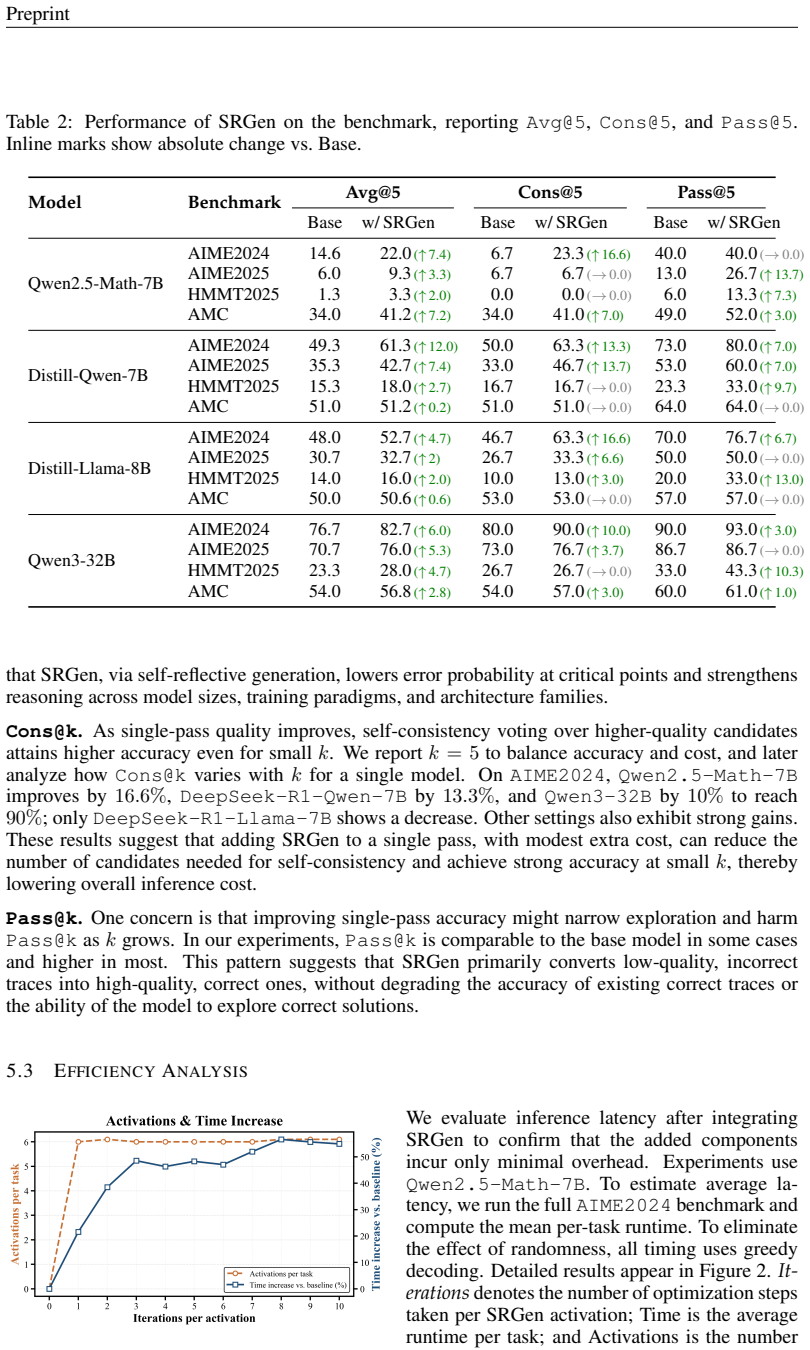
Summary. This paper proposes SRGen, a test-time decoding intervention. At each step, the entropy of the next-token distribution is monitored; if it exceeds a rolling mean + k·std threshold, a small correction vector δ is optimized for a few gradient steps against a hybrid loss (retrospective prefix cross-entropy plus entropy minimization) and added to the final hidden state before sampling. The authors claim this proactively reduces errors at high-uncertainty junctures, improving both Pass@1 and self-consistency over four math benchmarks (AIME2024/2025, HMMT2025, AMC) across four open-weight models. They also provide a theoretical 'derivation' of the hybrid loss as a Lagrangian, an overhead analysis (~50% latency increase), hyperparameter ablations, and composability with SLOT.
Significance. If the mechanism were established, SRGen would be a useful plug-and-play, training-free inference method. The empirical setup is broad (multiple model families, benchmarks) and the paper ships an artifact and promises code; ablations cover key hyperparameters. However, the central causal claim—that high-entropy tokens mark error-prone reasoning steps where intervention prevents errors—is not directly tested, and the theoretical grounding is a tautological scalarization result. Reported gains on small benchmarks lack uncertainty estimates, making the headline improvements fragile. The strengths are the range of models/benchmarks and the explicit composability experiment with SLOT.
major comments (4)
- [Theorem 1 / Appendix B.1] The proof sets ε = L_CE(δ*) after selecting δ*, so feasibility is automatic. Any minimizer of a weighted sum trivially solves the constrained problem with that post-hoc tolerance; this is a known scalarization property, not a derivation of the hybrid loss from a principled constrained optimization. The Remark and Lagrangian discussion overstate the result. To support the claim, the authors need to show a nontrivial ε specified a priori, or prove a correspondence for all λ under explicit KKT conditions rather than asserting it.
- [Stage 1 Eq. (3) and Appendix G] The mechanism claim—reflection at critical tokens prevents errors—is untested. Appendix G shows triggered tokens are predominantly function words and discourse connectives (the, so, but, that, since, wait); no evidence connects these positions to subsequent arithmetic/logical mistakes. The reported gains are consistent with a sharpening artifact: entropy minimization at any high-entropy position makes sampling more greedy, improving single-pass accuracy and self-consistency regardless of 'self-reflection.' Controls are needed, e.g., lowering temperature only at triggered positions, entropy-regularized sampling without δ, or an error-level analysis showing that altered tokens precede the first mistake.
- [Table 2 and Section 5.2] All numbers are point estimates with no confidence intervals. AIME2024 has 30 problems, so a +12.0 pp Pass@1 change is approximately four answers. Several Cons@5 entries show zero change on small benchmarks (e.g., HMMT2025), undermining the 'consistent gains' claim. Report per-benchmark problem counts and bootstrap CIs or per-sample variance. Also, the text says 'only DeepSeek-R1-Llama-7B shows a decrease' (§5.2), but no such model appears in Table 2 and no decrease is shown for the listed Distill-Llama-8B, indicating an error.
- [Appendix D and experimental design] The paper deliberately excludes head-to-head comparisons with post-hoc reflection and, more importantly, provides no baseline that isolates the effect of the corrective vector. A simple sharpening baseline (e.g., applying the same trigger with temperature reduction or with a random/zero δ) would clarify whether the gains come from the δ optimization or merely from distribution sharpening. Without such a control, the central claim that the token-level intervention is 'self-reflective' rather than a generic sharpening heuristic is not established.
minor comments (5)
- [Eq. (3) vs. Eq. (13)] Eq. (3) uses '>' while Eq. (13) in Appendix F uses '≥' for the trigger; align the two definitions.
- [Section 5.1] 'Training epochs t = 3' conflicts with the use of t for token position in Algorithm 1; the inner optimization steps should be denoted consistently (e.g., T = 3).
- [Section 4.3 Eq. (10)] The overhead formula would benefit from defining C_bp and clarifying why a 50% latency increase is described as 'minimal and bounded'; the reported overhead is substantial and should be discussed as a trade-off.
- [Figure 2] The axes are unlabeled; 'Iterations = 0 corresponds to baseline' is clear, but the y-axis for time and the units of 'Activations' should be stated explicitly.
- [Appendix D] The baseline-scope appendix justifies excluding post-hoc methods, but the paper should still cite and qualitatively compare against closely related token-level methods such as DoLa or critical-token-based approaches to position the contribution.
Circularity Check
Theorem 1 is a tautological restatement: the constrained problem's tolerance ε is defined as LCE(δ*) after the fact, so the hybrid loss does not 'emerge' from an independent constrained objective.
specific steps
-
self definitional
[Section 4.2 (Theorem 1 and Remark) and Appendix B.1 (Proof of Thm. 1)]
"Given a trade-off parameter λ∈(0,1), the minimizer δ* of the hybrid loss objective LSRGen(δ;λ) = (1−λ)LCE(δ)+λLAEM(δ), is also the solution to the constrained optimization problem min δ LAEM(δ) s.t. LCE(δ)≤ε. The choice of λ implicitly defines the constraint boundary ε=LCE(δ*), establishing a formal equivalence between tuning the loss weight and setting a fidelity tolerance."
The constraint bound ε is not specified independently; it is defined as LCE(δ*) after δ* has been chosen as the minimizer of the weighted sum. Hence the constrained problem is constructed from the very solution the theorem claims to derive. Any minimizer of a weighted sum trivially minimizes one component subject to the other component being below its own attained value. The theorem therefore restates the definition of the hybrid loss rather than showing that the hybrid loss 'emerges directly' from a principled constrained optimization problem.
full rationale
The only load-bearing circular step is Theorem 1's constrained-optimization equivalence, which is definitional: ε is set to the minimizer's own LCE value, so the equivalence holds by construction. The empirical evaluation is not circular: SRGen's gains are measured against external math benchmarks with fixed decoding settings, no benchmark-derived parameter is renamed as a prediction, and the dynamic entropy threshold is a calibration rule rather than a fitted target. No self-citation chain is load-bearing; the references to prior critical-token and SLOT work are external. Appendix G's observation that triggered tokens are mostly function words is a weakness of the proposed error-prevention mechanism, but it is a correctness/validity concern, not a circularity. Overall, the paper's empirical core is independent, but its headline theoretical justification overstates a tautology, warranting a partial circularity score.
Axiom & Free-Parameter Ledger
free parameters (5)
- k (standard-deviation multiplier) =
k=4
- N (entropy history window) =
N=25
- lambda (loss weight) =
lambda=0.05
- eta (inner learning rate) =
eta=0.01
- T (inner optimization steps) =
T=3
axioms (4)
- domain assumption High next-token entropy identifies tokens where intervention prevents downstream reasoning errors.
- domain assumption A single correction vector delta optimized on the hybrid loss and injected into the hidden state improves next-token decisions without disrupting coherence.
- standard math Weighted-sum scalarization with epsilon = L_CE(delta*) characterizes the constrained solution in Theorem 1.
- domain assumption Benchmark accuracy differences of a few problems are meaningful without confidence intervals.
Cite this review
Pith. "Pith review of Self-Reflective Generation at Test Time." pith.science (2026). https://pith.science/paper/RDOFTR3A
@misc{pith2026251002919,
  author       = {Pith},
  title        = {Pith review of: Self-Reflective Generation at Test Time},
  year         = {2026},
  howpublished = {\url{https://pith.science/paper/RDOFTR3A}},
  note         = {Machine review of arXiv:2510.02919}
}
read the original abstract
Large language models (LLMs) increasingly solve complex reasoning tasks via long chain-of-thought, but their forward-only autoregressive generation process is fragile; early token errors can cascade, which creates a clear need for self-reflection mechanisms. However, existing self-reflection either performs revisions over full drafts or learns self-correction via expensive training, both fundamentally reactive and inefficient. To address this, we propose Self-Reflective Generation at Test Time (SRGen), a lightweight test-time framework that reflects before generating at uncertain points. During token generation, SRGen utilizes dynamic entropy thresholding to identify high-uncertainty tokens. For each identified token, it trains a specific corrective vector, which fully exploits the already generated context for a self-reflective generation to correct the token probability distribution. By retrospectively analyzing the partial output, this self-reflection enables more trustworthy decisions, thereby significantly reducing the probability of errors at highly uncertain points. Evaluated on challenging mathematical reasoning benchmarks and a diverse set of LLMs, SRGen can significantly strengthen model reasoning. Moreover, our findings position SRGen as a plug-and-play method that integrates reflection into the generation process for reliable LLM reasoning, achieving consistent gains with bounded overhead and can be combined with other training-time (e.g., RLHF) and test-time (e.g., SLOT) techniques.
Figures



Forward citations
Cited by 1 Pith paper
-
From Exposure to Internalization: Dual-Stream Calibration for In-context Clinical Reasoning
Dual-Stream Calibration uses entropy minimization and iterative meta-learning at test time to internalize clinical evidence and outperform standard in-context learning baselines on medical tasks.
Reference graph
Works this paper leans on
-
[3]
Zhenni Bi, Kai Han, Chuanjian Liu, Yehui Tang, and Yunhe Wang. Forest-of-thought: Scaling test-time compute for enhancing llm reasoning.arXiv preprint arXiv:2412.09078,
-
[5]
Daya Guo, Dejian Yang, Haowei Zhang, Junxiao Song, Ruoyu Zhang, Runxin Xu, Qihao Zhu, Shirong Ma, Peiyi Wang, Xiao Bi, et al. Deepseek-r1: Incentivizing reasoning capability in llms via reinforcement learning.arXiv preprint arXiv:2501.12948,
-
[6]
Hasan Abed Al Kader Hammoud, Hani Itani, and Bernard Ghanem. Beyond the last answer: Your reasoning trace uncovers more than you think.arXiv preprint arXiv:2504.20708,
-
[7]
Chi Hu, Yimin Hu, Hang Cao, Tong Xiao, and Jingbo Zhu. Teaching language models to self- improve by learning from language feedback.arXiv preprint arXiv:2406.07168,
-
[8]
Slot: Sample-specific language model optimization at test-time.arXiv preprint arXiv:2505.12392,
Yang Hu, Xingyu Zhang, Xueji Fang, Zhiyang Chen, Xiao Wang, Huatian Zhang, and Guo- jun Qi. Slot: Sample-specific language model optimization at test-time.arXiv preprint arXiv:2505.12392,
-
[9]
First-step advantage: Impor- tance of starting right in multi-step math reasoning
Kushal Jain, Moritz Miller, Niket Tandon, and Kumar Shridhar. First-step advantage: Impor- tance of starting right in multi-step math reasoning. In Wanxiang Che, Joyce Nabende, Eka- terina Shutova, and Mohammad Taher Pilehvar (eds.),Findings of the Association for Computa- tional Linguistics: ACL 2025, pp. 766–778, Vienna, Austria, July
2025
-
[10]
Association for Com- putational Linguistics. ISBN 979-8-89176-256-5. doi: 10.18653/v1/2025.findings-acl.42. URL https://aclanthology.org/2025.findings-acl.42/. Aviral Kumar, Vincent Zhuang, Rishabh Agarwal, Yi Su, John D Co-Reyes, Avi Singh, Kate Baumli, Shariq Iqbal, Colton Bishop, Rebecca Roelofs, et al. Training language models to self-correct via rein...
Pith/arXiv arXiv 2025
-
[11]
Yafu Li, Xuyang Hu, Xiaoye Qu, Linjie Li, and Yu Cheng. Test-time preference optimization: On-the-fly alignment via iterative textual feedback.arXiv preprint arXiv:2501.12895,
-
[12]
Ruotian Ma, Peisong Wang, Cheng Liu, Xingyan Liu, Jiaqi Chen, Bang Zhang, Xin Zhou, Nan Du, and Jia Li. S 2 r: Teaching llms to self-verify and self-correct via reinforcement learning.arXiv preprint arXiv:2502.12853,
-
[13]
Self-taught self-correction for small language models.arXiv preprint arXiv:2503.08681,
Viktor Moskvoretskii, Chris Biemann, and Irina Nikishina. Self-taught self-correction for small language models.arXiv preprint arXiv:2503.08681,
-
[14]
11 Preprint Debjit Paul, Robert West, Antoine Bosselut, and Boi Faltings. Making reasoning matter: Measur- ing and improving faithfulness of chain-of-thought reasoning.arXiv preprint arXiv:2402.13950,
-
[15]
Chen Qian, Dongrui Liu, Haochen Wen, Zhen Bai, Yong Liu, and Jing Shao. Demystifying reason- ing dynamics with mutual information: Thinking tokens are information peaks in llm reasoning. arXiv preprint arXiv:2506.02867,
-
[16]
Nishad Singhi, Hritik Bansal, Arian Hosseini, Aditya Grover, Kai-Wei Chang, Marcus Rohrbach, and Anna Rohrbach. When to solve, when to verify: Compute-optimal problem solving and generative verification for llm reasoning.arXiv preprint arXiv:2504.01005,
-
[17]
Confidence improves self-consistency in llms.arXiv preprint arXiv:2502.06233,
Amir Taubenfeld, Tom Sheffer, Eran Ofek, Amir Feder, Ariel Goldstein, Zorik Gekhman, and Gal Yona. Confidence improves self-consistency in llms.arXiv preprint arXiv:2502.06233,
-
[18]
Qwen2 technical report.arXiv preprint arXiv:2407.10671,
Qwen Team. Qwen2 technical report.arXiv preprint arXiv:2407.10671,
-
[19]
Atom of thoughts for markov llm test-time scaling.arXiv preprint arXiv:2502.12018,
Fengwei Teng, Zhaoyang Yu, Quan Shi, Jiayi Zhang, Chenglin Wu, and Yuyu Luo. Atom of thoughts for markov llm test-time scaling.arXiv preprint arXiv:2502.12018,
-
[20]
Jean Vassoyan, Nathana¨el Beau, and Roman Plaud. Ignore the kl penalty! boosting exploration on critical tokens to enhance rl fine-tuning.arXiv preprint arXiv:2502.06533,
-
[22]
Self-consistency improves chain of thought reasoning in language models
Xuezhi Wang, Jason Wei, Dale Schuurmans, Quoc Le, Ed Chi, Sharan Narang, Aakanksha Chowdh- ery, and Denny Zhou. Self-consistency improves chain of thought reasoning in language models. arXiv preprint arXiv:2203.11171,
-
[24]
Textgrad: Automatic” differentiation” via text.arXiv preprint arXiv:2406.07496,
Mert Yuksekgonul, Federico Bianchi, Joseph Boen, Sheng Liu, Zhi Huang, Carlos Guestrin, and James Zou. Textgrad: Automatic” differentiation” via text.arXiv preprint arXiv:2406.07496,
-
[25]
First return, entropy-eliciting explore.arXiv preprint arXiv:2507.07017,
Tianyu Zheng, Tianshun Xing, Qingshui Gu, Taoran Liang, Xingwei Qu, Xin Zhou, Yizhi Li, Zhou- futu Wen, Chenghua Lin, Wenhao Huang, et al. First return, entropy-eliciting explore.arXiv preprint arXiv:2507.07017,
-
[26]
12 Preprint Zhi Zhou, Tan Yuhao, Zenan Li, Yuan Yao, Lan-Zhe Guo, Xiaoxing Ma, and Yu-Feng Li. Bridging internal probability and self-consistency for effective and efficient llm reasoning.arXiv preprint arXiv:2502.00511,
-
[27]
Uncertainty-guided chain-of-thought for code generation with llms.arXiv preprint arXiv:2503.15341,
Yuqi Zhu, Ge Li, Xue Jiang, Jia Li, Hong Mei, Zhi Jin, and Yihong Dong. Uncertainty-guided chain-of-thought for code generation with llms.arXiv preprint arXiv:2503.15341,
-
[28]
Existing approaches largely fall into two categories
13 Preprint A RELATEDWORK Self-Reflection in LLMs.Self-reflection seeks to move LLMs from impulsive first-pass outputs to more deliberative and accurate responses. Existing approaches largely fall into two categories. (1) Post hoc iterative refinement. These methods use multi-stage inference pipelines: the model first drafts an answer, then critiques it, ...
2023
-
[29]
critical
formalize the generate, critique, and refine loop. While effective, they incur substantial latency and computational overhead because they require multiple full forward passes. (2) Training for intrinsic self-correction. This line embeds self-correction directly in the parameters, typically via fine-tuning on corrective data or reinforcement learning (RL)...
2022
-
[30]
or for localized iterative refinement that probes the solution space more deeply (Qian et al., 2025). (3) Pruning search: low- confidence tokens trigger the removal of less promising paths within self-consistency frameworks (Fu et al., 2025; Taubenfeld et al., 2025; Zhou et al., 2025). We introduce a new paradigm for the use of critical tokens. SRGen empl...
2025
-
[2017]
Shenzhi Wang, Le Yu, Chang Gao, Chujie Zheng, Shixuan Liu, Rui Lu, Kai Dang, Xionghui Chen, Jianxin Yang, Zhenru Zhang, et al. Beyond the 80/20 rule: High-entropy minority tokens drive effective reinforcement learning for llm reasoning.arXiv preprint arXiv:2506.01939,
-
[2022]
Qwen3 technical report.arXiv preprint arXiv:2505.09388,
An Yang, Anfeng Li, Baosong Yang, Beichen Zhang, Binyuan Hui, Bo Zheng, Bowen Yu, Chang Gao, Chengen Huang, Chenxu Lv, et al. Qwen3 technical report.arXiv preprint arXiv:2505.09388,
-
[2023]
Deep think with confidence.arXiv preprint arXiv:2508.15260,
Yichao Fu, Xuewei Wang, Yuandong Tian, and Jiawei Zhao. Deep think with confidence.arXiv preprint arXiv:2508.15260,
-
[2024]
Accessed: 2025-09-14. Yuntao Bai, Saurav Kadavath, Sandipan Kundu, Amanda Askell, Jackson Kernion, Andy Jones, Anna Chen, Anna Goldie, Azalia Mirhoseini, Cameron McKinnon, et al. Constitutional ai: Harm- lessness from ai feedback.arXiv preprint arXiv:2212.08073,
Pith/arXiv arXiv 2025
-
[2025]
URLhttps: //matharena.ai/. 10 Preprint Shelly Bensal, Umar Jamil, Christopher Bryant, Melisa Russak, Kiran Kamble, Dmytro Mo- zolevskyi, Muayad Ali, and Waseem AlShikh. Reflect, retry, reward: Self-improving llms via reinforcement learning.arXiv preprint arXiv:2505.24726,
discussion (0)
Sign in with ORCID, Apple, or X to comment. Anyone can read and Pith papers without signing in.