REVIEW 5 major objections 6 minor 29 references
Cog-TiPRO: Iterative Prompt Refinement with LLMs to Detect Cognitive Decline via Longitudinal Voice Assistant Commands
T0 review · 5 major / 6 minor · reviewed 2026-08-07 · deepseek-v4-flash
Pith's one-line read Daily at-home voice assistant commands, processed with LLM-refined linguistic features, HuBERT acoustic embeddings, and temporal transformers, can distinguish mild cognitive impairment from healthy aging at 73.80% accuracy in a pilot of…
desk verdict Real longitudinal VAS dataset and a clear pipeline, but the headline accuracy is not yet credible until the prompt-optimization split is documented as LOSO-nested. read the letter →
The pith
A machine-rendered reading of the paper's core claim, the machinery that carries it, and where it could break.
The reading
What carries the argument
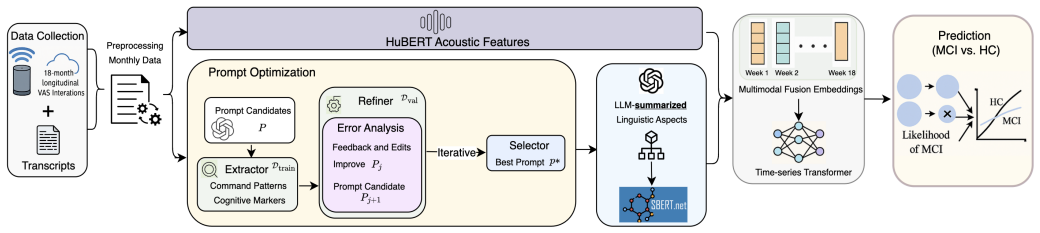
The load-bearing mechanism is the iterative prompt refinement loop, which treats the LLM as both feature extractor and classifier. Starting from a human-written prompt with context, instructions, and few-shot exemplars, an Extractor produces linguistic feature summaries, a Refiner uses F1-driven error analysis to rewrite the prompt, and a Selector picks the best prompt after three iterations; selected summaries are embedded with Sentence-BERT and fused with HuBERT acoustic vectors into a monthly sequence that a transformer time-series model classifies. The temporal backbone is iTransformer, a transformer variant that treats the feature channels of each month as tokens, which the authors find consistently outperforms PatchTST on this task.
What would settle it
Run the same 15-participant data through a version of Cog-TiPRO where prompt optimization is provably nested: for each held-out participant, build the validation minibatch exclusively from the remaining 14 participants and record the leave-one-subject-out accuracy. If the 73.80% figure drops substantially toward the no-optimization baseline, the original result depended on prompt selection seeing held-out transcripts; if it stays near 73.80%, the result is robust to that partition detail.
Extended reading notes
Core claim
The central claim is that mild cognitive impairment can be detected from longitudinal voice assistant command histories better than from any single modality. The paper proposes Cog-TiPRO, in which an LLM prompt is iteratively refined over three rounds—extracting linguistic features, acting as a classifier, analyzing errors, and rewriting the prompt—before a selected prompt produces feature summaries that are embedded by Sentence-BERT. These linguistic embeddings are concatenated with HuBERT acoustic embeddings into a monthly multimodal time series, which iTransformer classifies as MCI or healthy control. With GPT4o-mini as the LLM and iTransformer as the temporal model, the framework reports 73.80% accuracy and 72.67% F1-score on leave-one-subject-out cross-validation, a 27.13% improvement over its prompt-optimization-free baseline, and an ablation attributes the largest single gain to iterative prompt refinement.
Load-bearing premise
The load-bearing assumption is that the small validation set used to choose the optimized prompt is drawn only from the training participants in each round of testing, never from the one participant being held out; the paper does not explicitly confirm this, and if the held-out participant's transcripts leak into prompt selection, the reported accuracy would be inflated.
Editorial extensions
If this is right
- If accurate, the framework offers a passive, in-home screening signal that requires no structured clinical task or examiner.
- The same pipeline could be applied to other voice assistant platforms and smart speakers, since it relies on standard transcripts and audio.
- The LLM-extracted feature categories give clinicians a concrete behavioral vocabulary—repetition bursts, failed self-corrections, narrow command repertoires—for interpreting automated alerts.
- Longitudinal 18-month sequences provide a natural setup for tracking decline over time rather than only classifying current cognitive status.
Reading between the lines
- A larger cohort with more participants per group would reveal whether the 73.80% figure is stable or overfit to the 15-person sample; the paper itself reports a pilot.
- Because the prompt optimization step chooses the prompt by validation F1 on a minibatch, the exact nesting of that minibatch within leave-one-subject-out folds is a natural place to look for label leakage.
- The reported linguistic features suggest testable hypotheses: for instance, MCI participants' command repetition rate and repair-abandonment rate should correlate with MoCA sub-scores on attention and language.
- If the acoustic branch contributes independent signal, fusing it with lexical features may also work on transcripts alone from other home assistants, enabling privacy-preserving text-only monitoring.
Editorial analysis
A structured set of objections, weighed in public.
Referee Report
Summary. The paper presents Cog-TiPRO, a framework that uses LLM-driven iterative prompt refinement to extract linguistic features from short, unstructured voice assistant commands, fuses these with HuBERT acoustic embeddings, and feeds the resulting 1152-dimensional monthly sequences into a transformer-based time-series classifier (PatchTST or iTransformer). The authors report a pilot study over 18 months with 15 older adults (8 MCI, 7 HC) and claim 73.80% accuracy and 72.67% F1 for MCI detection with iTransformer, outperforming a baseline by 27.13%. They also qualitatively report LLM-extracted linguistic markers associated with MCI, such as reduced lexical diversity, disfluency, and repetitive commands.
Significance. If the central performance claim is valid, this is a potentially valuable pilot contribution: it suggests that passive, at-home voice assistant data, processed with LLM-derived features and temporal modeling, could support low-cost longitudinal cognitive monitoring. The paper is commendable for evaluating a wide range of LLMs and transformer baselines, for providing an ablation of the main components, and for explicitly acknowledging limitations such as the small sample and computational overhead. The proposed pipeline is concrete and mostly reproducible in intent. However, the validity of the headline accuracy is not yet established because the evaluation protocol leaves open a label-leakage channel in the prompt-optimization loop, and several details of the data aggregation and statistical reporting are missing. The qualitative feature analysis is suggestive but not quantitatively validated. The contribution is real but needs to be confirmed with a leakage-free protocol and appropriate uncertainty estimates.
major comments (5)
- [Section VI and Algorithm 1] The prompt-optimization procedure is not specified as nested inside each leave-one-subject-out (LOSO) fold. The text states only that "For prompt optimization, we use a minibatch of size 64 (51 train, 13 validation)" and Section V.A.2 describes selecting P* via Eq. (7) and using the same Dval to drive the Refiner's error analysis (Eq. (6)). If the 13 validation instances, or the few-shot exemplars in P_exemplars (Section V.A.1), include transcripts from the held-out participant, then the prompt is tuned on the test subject's data before features are extracted for that subject. This would inflate the reported 73.80% accuracy / 72.67% F1. Please state explicitly whether the minibatch and P_exemplars are regenerated per LOSO fold using only the 14 training participants, and if not, re-run the evaluation with the optimization fully nested in the training folds.
- [Algorithm 1 and Section VI] Algorithm 1 as written does not correspond to the claimed LOSO protocol. Lines 12–18 iterate over all participants i and train the final transformer on the full dataset (line 17: "Θ ← T(Z(i), y(i))"), with no fold loop and no held-out participant. Similarly, lines 3 and 13 extract features from all i,t without restricting to a training fold. This makes it impossible for a reader to verify that the held-out subject is excluded from all stages that involve learning or selection. Please provide a fold-aware version of Algorithm 1 and specify, for each stage (prompt initialization, prompt refinement, prompt selection, final transformer training), exactly which participants' data are used.
- [Section IV and Section V.B] The aggregation of multiple voice commands within a month into a single feature vector is unspecified. Equation (8) writes v_i_t = H(A_i_t) with v_i_t in R^768, and Eq. (9) similarly treats X_i_t as a single transcript, but the dataset described in Section III has roughly 47 commands per week per participant. It is not explained how HuBERT embeddings and LLM feature summaries are pooled across the many commands in a month, nor how months with no commands are handled in the sequence Z_i ∈ R^(t×1152). Without this, the temporal input to the transformer is not well-defined, and the reported performance cannot be reproduced or correctly interpreted.
- [Abstract, Section VII.A, Table I, Table II] The claimed improvement of "27.13%" is inconsistent across the paper. The abstract says the approach "outperforms its baseline by 27.13%"; Section VII.A states that with GPT4o-mini and iTransformer there is "a 19.87% improvement over its baseline (53.93% acc)"; and Table II shows that the full model's accuracy (73.80%) is 27.13 percentage points above the w/o-Prompt variant (46.67%). The reported improvement number depends on which baseline is meant. Please define the baseline clearly and use the same definition in the abstract, main text, and tables.
- [Section VI and VII] With only 15 participants, a single subject corresponds to roughly 6.7% accuracy, yet the paper reports only averages over five random seeds and no confidence intervals, standard deviations, or per-subject results. Additionally, the best result is selected post hoc from a large grid of LLMs (Table I) and two transformer architectures. The lack of uncertainty quantification and multiple-comparison awareness makes the headline 73.80% accuracy difficult to interpret. Please report per-fold predictions, variance across seeds, and ideally a statistical test or a corrected selection procedure.
minor comments (6)
- [Introduction] The word "contributations" appears in the contributions list; it should be "contributions."
- [Section VII.A] The sentence "BioBERT shows the lowest performance ... indicating that domain-specific pretraining on medical data is more beneficial than on biomedical data" is confusing as written because BioBERT is biomedical and MedBERT is medical; please rephrase for clarity.
- [Figure 2] The prompt templates and error-analysis feedback in Figure 2 are too small to read in the PDF version; please provide a higher-resolution figure or include the full prompts in an appendix.
- [References] Reference [22] is cited for PatchTST, but the listed paper "Time Series is a Special Sequence: Forecasting with Sample Convolution and Interaction" appears to describe a different method; please verify that the PatchTST citation is correct.
- [Section V.A.1] The description of P_exemplars says it includes "few-shot examples of command transcripts from both cognitive status groups," but it is not stated how many examples are used or whether they are drawn from the training folds only; please clarify (this is related to the leakage concern in the major comments).
- [Section VII.C] The linguistic features in Table III are presented as "uniquely characterize" patterns; given the small sample and qualitative nature, a more cautious wording such as "are consistent with" or "suggest" would be more appropriate.
Circularity Check
The LOSO accuracy claim is not circular on its face, but the paper's 'discovery' of MCI linguistic features is largely a restatement of (i) the MCI markers already embedded in the initial prompt and (ii) a label-guided prompt-optimization loop.
-
renaming known result
[Section V.A.1 (Initial Prompt Design); compared with Section VII.C (Analysis of LLM-extracted Linguistic Features)]
"Pcontext provides background information about MCI-related cognitive markers, including lexical complexity, syntactic structure, disfluency, and semantic patterns."
The initial prompt already specifies the exact families of markers that the LLM is asked to extract. Section VII.C then presents seven LLM-extracted feature categories (reduced lexical diversity, weak semantic coherence, weaker grammatical structures, disfluency, etc.) as 'identified' characteristics of MCI. Those categories are the same categories supplied in Pcontext, so the 'identification' reduces by construction to the prompt's own specified context; it is a renaming or regurgitation of the input markers rather than an independent finding from the voice-command data.
-
fitted input called prediction
[Section V.A.2 (Iterative Prompt Optimization); compared with Section VII.C (Analysis of LLM-extracted Linguistic Features)]
"It evaluates the LLM’s predictions using F1-score on a validation minibatch (Dval) and performs error analysis to identify specific cases where the LLM produces incorrect predictions with Pj."
The prompt that generates the linguistic features is itself a fitted object: the Refiner edits Pj based on error analysis over labels in Dval, and P* is chosen as the prompt with highest validation F1 (Eq. 7). The features produced by this label-tuned prompt are then reported as evidence that 'MCI participants exhibit difficulties...' in Table III / Section VII.C. This is a fitted input being presented as a discovered pattern: the feature summaries are the output of a prompt selected to maximize discrimination on the validation labels, so the observed MCI/HC differences are forced by the optimization, not independently observed.
full rationale
The central accuracy claim (73.80% accuracy, 72.67% F1 under leave-one-subject-out evaluation) is a supervised prediction benchmark and is not circular by construction: the transformer is trained on training-fold participants and evaluated on a held-out participant, assuming the protocol is correctly nested. The two flagged circular steps concern the paper's secondary claim to 'identify linguistic features that uniquely characterize' MCI. First, the initial prompt Pcontext already enumerates the MCI marker families (lexical complexity, syntactic structure, disfluency, semantic patterns), so the later feature taxonomy in Table III is seeded by the prompt itself. Second, the iterative prompt optimizer uses validation F1 and error analysis to edit the prompt, so the features extracted with P* are label-fitted; reporting them as an independent characterization of MCI overstates what the pipeline establishes. These issues do not invalidate the LOSO accuracy comparison itself, but they do mean the 'linguistic feature discovery' portion of the paper is circular. Separately, a correctness risk noted in review is that Section VI specifies a prompt-optimization minibatch of 64 (51 train, 13 validation) but never states that this split is regenerated inside each LOSO fold; if the held-out participant's transcripts appear in Dval, the headline accuracy would be leakage-inflated. That is a protocol-completeness gap rather than a demonstrated circular reduction, so it is not counted in the score. Self-citations in the reference list are not load-bearing: they support the VAS data-collection context and prior related work, but the iTransformer/HuBERT/SBERT components and the LOSO evaluation are external and independently checkable.
Assumptions & free parameters
free parameters (3)
- MaxIter (iterative prompt refinement iterations) =
3
- Prompt optimization minibatch sizes =
64 (51 train, 13 validation)
- Best model selection (LLM and transformer) =
GPT4o-mini + iTransformer
assumptions (5)
- domain assumption MoCA score < 26 is a valid label for MCI; score >= 26 is healthy control
- domain assumption HuBERT embeddings contain MCI-relevant acoustic markers
- ad hoc to paper The LLM can reliably extract and summarize MCI-relevant linguistic features from short, noisy commands
- ad hoc to paper No label leakage between prompt optimization validation data and the held-out LOSO test subject
- ad hoc to paper Monthly aggregation of arbitrary numbers of voice commands into a single 1152-dimension vector preserves the cognitive signal
Cite this review
Pith. "Pith review of Cog-TiPRO: Iterative Prompt Refinement with LLMs to Detect Cognitive Decline via Longitudinal Voice Assistant Commands." pith.science (2026). https://pith.science/paper/RDQZNK5C
@misc{pith2026250517137,
  author       = {Pith},
  title        = {Pith review of: Cog-TiPRO: Iterative Prompt Refinement with LLMs to Detect Cognitive Decline via Longitudinal Voice Assistant Commands},
  year         = {2026},
  howpublished = {\url{https://pith.science/paper/RDQZNK5C}},
  note         = {Machine review of arXiv:2505.17137}
}
read the original abstract
Early detection of cognitive decline is crucial for enabling interventions that can slow neurodegenerative disease progression. Traditional diagnostic approaches rely on labor-intensive clinical assessments, which are impractical for frequent monitoring. Our pilot study investigates voice assistant systems (VAS) as non-invasive tools for detecting cognitive decline through longitudinal analysis of speech patterns in voice commands. Over an 18-month period, we collected voice commands from 35 older adults, with 15 participants providing daily at-home VAS interactions. To address the challenges of analyzing these short, unstructured and noisy commands, we propose Cog-TiPRO, a framework that combines (1) LLM-driven iterative prompt refinement for linguistic feature extraction, (2) HuBERT-based acoustic feature extraction, and (3) transformer-based temporal modeling. Using iTransformer, our approach achieves 73.80% accuracy and 72.67% F1-score in detecting MCI, outperforming its baseline by 27.13%. Through our LLM approach, we identify linguistic features that uniquely characterize everyday command usage patterns in individuals experiencing cognitive decline.
Figures

Reference graph
Works this paper leans on
-
[1]
R. C. Petersen, O. Lopez, M. J. Armstrong, T. S. Getchius, M. Ganguli, D. Gloss, G. S. Gronseth, D. Marson, T. Pringsheim, G. S. Day et al. , “Practice guideline update summary: Mild cognitive impairment: Report of the guideline development, dissemination, and implementation sub- committee of the american academy of neurology,” Neurology, vol. 90, no. 3, ...
work page 2018
-
[2]
Missed and delayed diagnosis of dementia in primary care: prevalence and contributing factors,
A. Bradford, M. E. Kunik, P. Schulz, S. P. Williams, and H. Singh, “Missed and delayed diagnosis of dementia in primary care: prevalence and contributing factors,” Alzheimer disease and associated disorders , vol. 23, no. 4, p. 306, 2009
work page 2009
-
[3]
The diagnosis and management of mild cognitive impairment: a clinical review,
K. M. Langa and D. A. Levine, “The diagnosis and management of mild cognitive impairment: a clinical review,” Jama, vol. 312, no. 23, pp. 2551–2561, 2014
work page 2014
-
[4]
The montreal cognitive assessment (moca),
J. Hobson, “The montreal cognitive assessment (moca),” Occupational Medicine, vol. 65, no. 9, pp. 764–765, 2015
work page 2015
-
[5]
Automatic speech analysis for the assessment of patients with predementia and alzheimer’s disease,
A. K ¨onig, A. Satt, A. Sorin, R. Hoory, O. Toledo-Ronen, A. Der- reumaux, V . Manera, F. Verhey, P. Aalten, P. H. Robertet al., “Automatic speech analysis for the assessment of patients with predementia and alzheimer’s disease,” Alzheimer’s & Dementia: Diagnosis, Assessment & Disease Monitoring , vol. 1, no. 1, pp. 112–124, 2015
work page 2015
-
[6]
Objective assessment of vocal tremor,
J. Peplinski, V . Berisha, J. Liss, S. Hahn, J. Shefner, S. Rutkove, K. Qi, and K. Shelton, “Objective assessment of vocal tremor,” in ICASSP 2019-2019 IEEE International Conference on Acoustics, Speech and Signal Processing (ICASSP) . IEEE, 2019, pp. 6386–6390
work page 2019
-
[7]
Evaluating voice-assistant commands for dementia detection,
X. Liang, J. A. Batsis, Y . Zhu, T. M. Driesse, R. M. Roth, D. Kotz, and B. MacWhinney, “Evaluating voice-assistant commands for dementia detection,” Computer Speech & Language , vol. 72, p. 101297, 2022
work page 2022
-
[8]
The natural history of alzheimer’s disease: description of study cohort and accuracy of diagnosis,
J. T. Becker, F. Boiler, O. L. Lopez, J. Saxton, and K. L. McGonigle, “The natural history of alzheimer’s disease: description of study cohort and accuracy of diagnosis,” Archives of neurology , vol. 51, no. 6, pp. 585–594, 1994
work page 1994
Show all 29 references
-
[9]
Multilingual alzheimer’s dementia recognition through spontaneous speech: a signal processing grand challenge,
S. Luz, F. Haider, D. Fromm, I. Lazarou, I. Kompatsiaris, and B. MacWhinney, “Multilingual alzheimer’s dementia recognition through spontaneous speech: a signal processing grand challenge,” in ICASSP 2023-2023 IEEE International Conference on Acoustics, Speech and Signal Proce...
2023
-
[10]
Unveil multi-picture descriptions for multilingual mild cognitive impairment detection via contrastive learning,
K. Qi, J. Cheng, Y . Zhu, H. Amiri, and X. Liang, “Unveil multi-picture descriptions for multilingual mild cognitive impairment detection via contrastive learning,” arXiv preprint arXiv:2505.17067 , 2025
2025 arXiv
-
[11]
The pittsburgh aphasia corpus: A resource for the study of aphasia and dementia,
J. T. Becker, F. Boller, O. L. Lopez, J. Saxton, and K. L. McGonigle, “The pittsburgh aphasia corpus: A resource for the study of aphasia and dementia,” Aphasiology, vol. 8, no. 6, pp. 511–524, 1994
1994
-
[12]
Exploiting longitudinal speech sessions via voice assistant systems for early detection of cognitive decline,
K. Qi, J. Shi, C. Summerour, J. A. Batsis, and X. Liang, “Exploiting longitudinal speech sessions via voice assistant systems for early detection of cognitive decline,” in 2024 IEEE International Conference on E-health Networking, Application & Services (HealthCom) . IEEE, 202...
2024
-
[13]
Smartphone-based digital phenotyping for dry eye toward point-of-care diagnosis,
J. Robin, Y . Jia, T. Shirai, M. Thurmon, J. Du, A. Sanseau, G. Hristu, M. Dabbah, V . Rao, S. Kinoshita et al. , “Smartphone-based digital phenotyping for dry eye toward point-of-care diagnosis,” The Ocular Surface, vol. 18, no. 2, pp. 286–294, 2020
2020
-
[14]
Bert: Pre-training of deep bidirectional transformers for language understanding,
J. Devlin, M.-W. Chang, K. Lee, and K. Toutanova, “Bert: Pre-training of deep bidirectional transformers for language understanding,” in Proceedings of the 2019 Conference of the North American Chapter of the Association for Computational Linguistics: Human Language Technologi...
2019
-
[15]
Profiling patient transcript using large language model reasoning augmentation for alzheimer’s disease detection,
C.-P. Chen and J.-L. Li, “Profiling patient transcript using large language model reasoning augmentation for alzheimer’s disease detection,” in 2024 46th Annual International Conference of the IEEE Engineering in Medicine and Biology Society (EMBC) . IEEE, 2024, pp. 1–4
2024
-
[16]
Enhancing early detection of cognitive decline in the elderly: a comparative study utilizing large language models in clinical notes,
P. Du, Novoa-Laurentiev et al., “Enhancing early detection of cognitive decline in the elderly: a comparative study utilizing large language models in clinical notes,” EBioMedicine, vol. 109, 2024
2024
-
[17]
A new tool for assessing mobile device proficiency in older adults: the mobile device proficiency questionnaire,
N. A. Roque and W. R. Boot, “A new tool for assessing mobile device proficiency in older adults: the mobile device proficiency questionnaire,” Journal of Applied Gerontology , vol. 37, no. 2, pp. 131–156, 2018
2018
-
[18]
Sentence-bert: Sentence embeddings using siamese bert-networks,
N. Reimers and I. Gurevych, “Sentence-bert: Sentence embeddings using siamese bert-networks,” arXiv preprint arXiv:1908.10084 , 2019
1908 arXiv
-
[19]
Automatic prompt optimization with
R. Pryzant, D. Iter, J. Li, Y . T. Lee, C. Zhu, and M. Zeng, “Automatic prompt optimization with” gradient descent” and beam search,” arXiv preprint arXiv:2305.03495, 2023
2023 arXiv
-
[20]
Optimizing instructions and demonstrations for multi- stage language model programs,
K. Opsahl-Ong, M. J. Ryan, J. Purtell, D. Broman, C. Potts, M. Zaharia, and O. Khattab, “Optimizing instructions and demonstrations for multi- stage language model programs,” EMNLP, 2024
2024
-
[21]
Hubert: Self-supervised speech representation learning by masked prediction of hidden units,
W.-N. Hsu, B. Bolte, Y .-H. H. Tsai, K. Lakhotia, R. Salakhutdinov, and A. Mohamed, “Hubert: Self-supervised speech representation learning by masked prediction of hidden units,” IEEE/ACM transactions on audio, speech, and language processing , vol. 29, pp. 3451–3460, 2021
2021
-
[22]
Time series is a special sequence: Forecasting with sample convolution and interaction,
M. Nie, D. Xue, R. Gao, X. Xu, W. Nie, Z. Tasneem, L. Yu, Y . Li, J. Song, A. Z. Qin et al. , “Time series is a special sequence: Forecasting with sample convolution and interaction,” arXiv preprint arXiv:2106.09305, 2022
2022 arXiv
-
[23]
itransformer: Inverted transformers are effective for time series forecasting,
Y . Liu, H. Hu, S. Jiang, H. Xie, X. Yu, and other, “itransformer: Inverted transformers are effective for time series forecasting,” in Advances in Neural Information Processing Systems , vol. 36, 2023
2023
-
[24]
Qwen technical report,
J. Bai, S. Lv, H. Qin, Z. Liu, S. Liu, Z. Lin et al. , “Qwen technical report,” arXiv preprint arXiv:2309.16609 , 2023
2023 arXiv
-
[25]
Scaling instruction-finetuned language models,
H. W. Chung, L. Hou, S. Longpre, B. Zoph, Y . Tay, W. Fedus, E. Li, X. Wang, M. Dehghani, S. Brahma et al., “Scaling instruction-finetuned language models,” arXiv preprint arXiv:2210.11416 , 2022
2022 arXiv
-
[26]
Chatglm: A family of large language models from glm-130b to glm-4 all tools,
T. GLM, A. Zeng, B. Xu, B. Wang, C. Zhang, D. Yin et al., “Chatglm: A family of large language models from glm-130b to glm-4 all tools,” arXiv preprint arXiv:2406.12793 , 2024
2024 arXiv
-
[27]
The llama 3 herd of models,
A. Grattafiori, A. Dubey, A. Jauhri, A. Pandey, A. Kadian, A. Al-Dahle, A. Letman, A. Mathur, A. Schelten, A. Vaughan et al. , “The llama 3 herd of models,” arXiv preprint arXiv:2407.21783 , 2024
2024 arXiv
-
[28]
Gpt-4 technical report,
J. Achiam, S. Adler, S. Agarwal, L. Ahmad, I. Akkaya, F. L. Aleman, D. Almeida, J. Altenschmidt, S. Altman, S. Anadkat et al. , “Gpt-4 technical report,” arXiv preprint arXiv:2303.08774 , 2023
2023 arXiv
-
[29]
UMB@PerAnsSumm 2025: Enhancing perspective-aware summarization with prompt optimization and super- vised fine-tuning,
K. Qi, Y . Zhu, and X. Liang, “UMB@PerAnsSumm 2025: Enhancing perspective-aware summarization with prompt optimization and super- vised fine-tuning,” in CL4Health @NAACL, Albuquerque, New Mexico, May 2025, pp. 437–444
2025
Reviewed August 7, 2026 · model on record in the stance chip above.
Discussion (0). Sign in to comment.