REVIEW 4 major objections 6 minor 2 cited by
A Step-by-Step Guide to Creating a Robust Autonomous Drone Testing Pipeline
T0 review · 4 major / 6 minor · reviewed 2026-08-07 · deepseek-v4-flash
Pith's one-line read A four-stage pipeline—software simulation, hardware-in-the-loop, controlled flights, and in-field trials—is presented as the route to safe autonomous drone deployment.
desk verdict A useful, clearly written tutorial on staged drone testing, with no new research results and a safety claim that outruns its self-reported case study. read the letter →
The pith
A machine-rendered reading of the paper's core claim, the machinery that carries it, and where it could break.
The reading
What carries the argument
The carrying object is the testing pipeline itself: four stages that progressively substitute real hardware and real environment for simulation. SIL (software-in-the-loop) runs the drone's software against a high-fidelity simulator such as AirSim; HIL (hardware-in-the-loop) keeps the simulated world but replaces the flight controller and companion computer with physical hardware; controlled real-world testing moves to indoor arenas or netted enclosures; in-field testing flies in open operational environments. The marker-based autonomous landing system is the concrete mechanism tying the stages together: each stage exposes failures such as marker loss under glare, latency from a non-optimized inference stack, or wind-induced drift, and the paper shows how those failures drive iterative improvements. The named components that carry the demonstration are the ArUco marker detector, the ROS modular architecture, PX4/Pixhawk flight control, and a Jetson Nano with TensorRT inference.
What would settle it
Compare failure rates of teams that follow the full four-stage pipeline against teams that go straight to field testing. If drones that pass SIL and HIL fail in their first field missions at the same rate as untested drones, or if the measured SIL/HIL-to-field success correlation is near zero across several missions, the claim that the pipeline minimizes deployment risk is false.
Extended reading notes
Core claim
The paper's central claim is that a systematic four-stage pipeline, moving from SIL simulation to HIL validation to controlled indoor flight to open in-field trials, provides comprehensive validation and minimizes deployment risk for autonomous drones. Each stage catches a different class of failure: SIL verifies perception, planning, and control logic under repeatable simulation; HIL exposes hardware-software integration issues, latency, and thermal or inference bottlenecks; controlled real-world testing reveals physical and environmental effects in a safe setting; and in-field testing validates end-to-end behavior under wind, GPS variability, and changing light. The marker-based autonomous landing system is the evidence running through the paper: three generations of that system improved failure rates in SIL, an optimized HIL configuration achieved landing accuracy within ±5 cm, and field trials revealed wind-induced drift that was then reduced by retuning the controller. The conclusion restates the claim: following this pipeline prepares drones for safe and reliable real-world operations.
Load-bearing premise
The pipeline's promise of comprehensive validation rests on the assumption that defects and behaviors observed in SIL and HIL predict real-world performance well enough that passing those stages justifies field deployment.
Editorial extensions
If this is right
- Defects that only appear when real hardware is in the loop, such as inference latency, thermal limits, and interface mismatches, can be caught before field trials.
- Repeated SIL testing can drive design upgrades: the marker-based landing system's three generations show progressively lower collision and failure rates as detection and planning modules are replaced.
- Controlled real-world tests expose environmental effects that simulation misses, such as wind-induced landing drift, enabling targeted retuning of stabilization parameters.
- Teams progressing through the staged pipeline should be better positioned to document validation evidence and meet regulatory requirements before open-environment deployment.
- Adopting neurosymbolic test generation, co-simulation, and digital twins is presented as the natural next step to cover edge cases that current SIL and HIL stages miss.
Reading between the lines
- Beyond the paper: the pipeline's risk-reduction claim is testable by comparing field failure rates of teams that follow all four stages with teams that skip straight to flight; the paper does not supply that comparison.
- Beyond the paper: the same staged logic could plausibly transfer to other modular cyber-physical systems, but the paper does not show that transferability outside drones.
- Beyond the paper: the digital-twin trend implies that simulation evidence might eventually count toward certification, dissolving the boundary between testing and operation; the paper does not make that regulatory argument.
Editorial analysis
A structured set of objections, weighed in public.
Referee Report
Summary. This paper presents a step-by-step guide to building a four-stage testing pipeline for autonomous drones: software-in-the-loop (SIL) simulation, hardware-in-the-loop (HIL) testing, controlled real-world testing, and in-field testing. It includes setup instructions for AirSim and ROS, MAVROS/PX4 HIL integration, indoor and outdoor test procedures, and a discussion of future trends (neurosymbolic/LLM-based testing, co-simulation, digital twins). The guide is illustrated throughout with a marker-based autonomous landing system (MLS) used as a running example. The abstract and conclusion claim that following this pipeline enables developers to 'achieve comprehensive validation, minimize deployment risks, and prepare autonomous drones for safe and reliable real-world operations.'
Significance. The paper's practical value lies in its detailed, executable guidance: concrete commands, package layouts, launch files, and a demonstrated case study. If the central claim were supported, the paper would be a useful resource for drone teams, consolidating common practice into a single structured workflow. The authors deserve credit for the level of operational detail and for explicitly addressing safety and regulatory steps. However, the evidence adduced for the pipeline's effectiveness is limited: case-study results are self-reported and lack trial-level statistics, and the paper's own limitations sections acknowledge that simulation-to-field transfer is not well characterized. The work is better described as a practice-oriented tutorial than as a validated methodology.
major comments (4)
- [§2.1.2, §2.2.1, and Conclusion] The abstract and conclusion assert that the pipeline yields 'comprehensive validation' and 'minimized deployment risks.' This claim depends on the premise that passing SIL and HIL stages predicts real-world performance. The paper's own text states the opposite tendency: §2.1.2 says simulator limitations 'reduce predictive accuracy and restrict the transferability of insights from simulation to field deployment,' and §2.2.1 says simulated sensor noise profiles 'often do not precisely match those observed in actual drone hardware.' Neither the case study nor any other evidence quantifies these gaps. As written, the conclusion overstates what the paper demonstrates. Please either supply empirical evidence of transfer validity (e.g., comparing HIL pass/fail and field outcomes across multiple failures) or soften the headline claim to describe the pipeline as a recommended practice rather than a validated guarantee.
- [§2.2.2 and §2.3.2] The landing accuracy values '±5 cm' (indoor) and '±15 cm' (outdoor) are presented as results, but no methodology is given: number of trials, environmental conditions, ground-truth measurement (motion capture? manual?), and variance are all unspecified. Without these details, the numbers do not constitute reproducible evidence. The authors should report the trial data or present the figures only as qualitative observations.
- [§3.1] The NeuroStrata example is introduced as a 'representative example' of neurosymbolic testing, based on reference [76], a preprint with substantial author overlap. No experiments are described in this paper. If the future-trends section is intended as speculation, the text should say so explicitly rather than implying that these methods are currently performing the described functions.
- [§2.1.2 case study] The SIL case study reports MLS-V1 to V3 improvements (failure rates, collision rates) without any quantitative data: no successful trial counts, failure counts, or error metrics per version. For a guide whose central claim is risk reduction, these anchor results need to be available or explicitly marked as illustrative rather than measured.
minor comments (6)
- [§2.2.1] The heading 'Install MA VROS' contains a typo; it should read 'Install MAVROS.'
- [Appendix D] `marker_detector.py` uses the deprecated `cv2.aruco.Dictionary_get` and `cv2.aruco.DetectorParameters_create` APIs; in current OpenCV versions these have been replaced by `cv2.aruco.getPredefinedDictionary` and `cv2.aruco.DetectorParameters`. Also, `self.camera_matrix` is set as a Python list and later converted with `np.array`, but the list contains nested lists which should be explicitly cast to `np.float32` to avoid dtype issues in `estimatePoseSingleMarkers`.
- [§2.1.1] The ROS installation instructions use `apt-key add`, which is deprecated, and download the ROS signing key from a `master` branch URL that may change; consider recommending the current keyring procedure.
- [§2.3.2] The phrase 'consistently reaching within ±5 cm ... across multiple trials' would benefit from stating the number of trials and the observed range, since 'consistently' is otherwise undefined.
- [§2.4.3] 'maximum flight altitude (limited to 10–12 meters)' is ambiguous; if the range is 10 to 12 meters, please write '10 to 12 meters.'
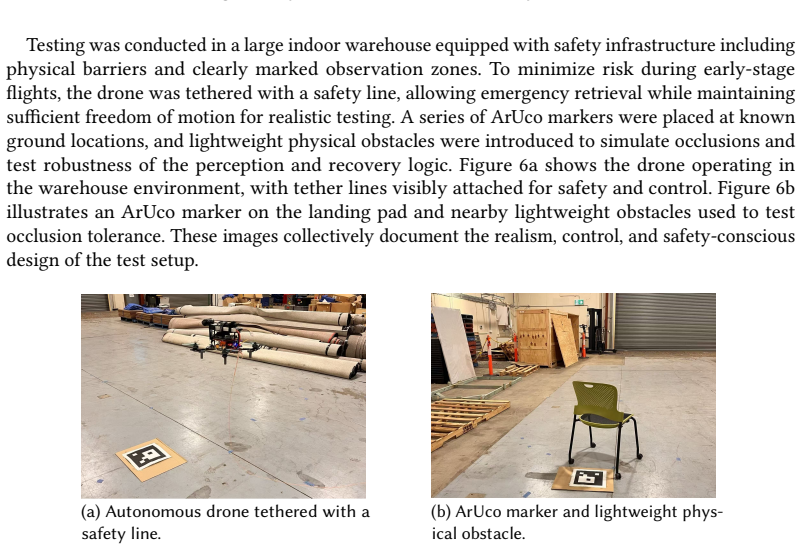
- [Figures 5 and 6] Figures 5 and 6 appear to be photographs from the authors' own test campaign; if previously published in [61], that source should be credited in the captions.
Circularity Check
No circular derivation: the paper is a practical guide with no fitted predictions; self-citations are illustrative, not load-bearing.
full rationale
This paper is a practical engineering guide rather than a formal derivation, so there is no equation chain in which a fitted parameter or defined quantity is renamed as a prediction. The four-stage SIL-HIL-controlled-in-field sequence is presented as standard practice and is grounded in external references (AirSim, Gazebo, PX4, ArduPilot, Horri et al., the Harbin motion-capture testbed, Waymo/Baidu road-testing data) alongside the authors' marker-landing case study from refs [40,61]. The case study is self-reported, and the paper itself admits in Section 2.1.2 that simulator limitations 'reduce predictive accuracy and restrict the transferability of insights from simulation to field deployment' and in Section 2.2.1 that 'simulated sensor noise profiles often do not precisely match those observed in actual drone hardware'; these admissions weaken empirical support for the headline claim but are correctness and evidence concerns, not circularity. The NeuroStrata discussion [76] is a co-author self-citation, but it sits in the future-trends section and is not used to justify the core pipeline claim. No equation, fitted value, or definition reduces the conclusion to its inputs, so no circular step can be exhibited.
Assumptions & free parameters
assumptions (3)
- domain assumption The four-stage pipeline (SIL, HIL, controlled real-world, in-field) is an appropriate and sufficient validation sequence for autonomous drones.
- domain assumption Behavior observed in simulation and HIL transfers to real-world field performance.
- domain assumption The self-cited case-study measurements from refs [40] and [61] are accurate and methodologically sound.
Cite this review
Pith. "Pith review of A Step-by-Step Guide to Creating a Robust Autonomous Drone Testing Pipeline." pith.science (2026). https://pith.science/paper/RDYHQOAQ
@misc{pith2026250611400,
  author       = {Pith},
  title        = {Pith review of: A Step-by-Step Guide to Creating a Robust Autonomous Drone Testing Pipeline},
  year         = {2026},
  howpublished = {\url{https://pith.science/paper/RDYHQOAQ}},
  note         = {Machine review of arXiv:2506.11400}
}
read the original abstract
Autonomous drones are rapidly reshaping industries ranging from aerial delivery and infrastructure inspection to environmental monitoring and disaster response. Ensuring the safety, reliability, and efficiency of these systems is paramount as they transition from research prototypes to mission-critical platforms. This paper presents a step-by-step guide to establishing a robust autonomous drone testing pipeline, covering each critical stage: Software-in-the-Loop (SIL) Simulation Testing, Hardware-in-the-Loop (HIL) Testing, Controlled Real-World Testing, and In-Field Testing. Using practical examples, including the marker-based autonomous landing system, we demonstrate how to systematically verify drone system behaviors, identify integration issues, and optimize performance. Furthermore, we highlight emerging trends shaping the future of drone testing, including the integration of Neurosymbolic and LLMs, creating co-simulation environments, and Digital Twin-enabled simulation-based testing techniques. By following this pipeline, developers and researchers can achieve comprehensive validation, minimize deployment risks, and prepare autonomous drones for safe and reliable real-world operations.
Figures


Figures from the paper (3 more)


Forward citations
Cited by 2 Pith papers
-
Validating Terrain Models in Digital Twins for Trustworthy sUAS Operations
A three-axis validation framework (unit to acceptance, simulation to real flight, simple to harsh terrain) is demonstrated on a drone terrain model, with geolocation errors of 1.5-4.2m and over 10m under poor GPS.
-
Regression Testing Optimization for ROS-based Autonomous Systems: A Comprehensive Review of Techniques
A survey that categorizes 122 papers on regression test optimization and argues ROS-based autonomous systems need new semantic and neurosymbolic approaches.
Reference graph
Works this paper leans on
-
[76]
Xi Zheng, Ziyang Li, Ivan Ruchkin, Ruzica Piskac, and Miroslav Pajic. 2025. NeuroStrata: Harnessing Neurosymbolic Paradigms for Improved Design, Testability, and Verifiability of Autonomous CPS.ArXivabs/2502.12267 (2025)
arXiv 2025
-
[1]
Afsoon Afzal, Deborah S Katz, Claire Le Goues, and Christopher S Timperley. 2020. A study on the challenges of using robotics simulators for testing.arXiv preprint arXiv:2004.07368(2020)
arXiv 2020
-
[2]
Nourdine Aliane. 2024. A Survey of Open-Source UAV Autopilots.Electronics13, 23 (2024), 4785
work page 2024
-
[3]
Yagna SH Annadata, Aiswariya Thazhathethil, Vishnuvaradhan Moganarengam, and Tooraj Nikoubin. 2025. Enhancing Drone-Based Precision Agriculture: Performance Optimization of TinyML Models on Edge Devices and Adaptive Path Planning.SN Computer Science6, 2 (2025), 132
work page 2025
-
[4]
Angelos Antonopoulos, Michail G Lagoudakis, and Panagiotis Partsinevelos. 2022. A ROS multi-tier UAV localization module based on GNSS, inertial and visual-depth data.Drones6, 6 (2022), 135
work page 2022
-
[5]
ApolloAuto. 2023. Apollo. https://github.com/ApolloAuto/apollo
work page 2023
-
[6]
ArduPilot. 2025. ArduPilot. https://github.com/ArduPilot/ardupilot
work page 2025
-
[7]
ArduPilot. 2025. ArduPilot - Versatile, Trusted, Open. https://ardupilot.org/
work page 2025
Show all 80 references
-
[8]
PX4 Autopilot. 2025. PX4 Autopilot User Guide. https://docs.px4.io/main/en/
2025
-
[9]
AutowareFoundation. 2025. Autoware. https://github.com/autowarefoundation/autoware
2025
-
[10]
Thom Badings, Licio Romao, Alessandro Abate, and Nils Jansen. 2023. Probabilities are not enough: Formal controller synthesis for stochastic dynamical models with epistemic uncertainty. InProceedings of the AAAI Conference on Artificial Intelligence, Vol. 37. 14701–14710
2023
-
[11]
Benewake. 2025. TFmini Plus 12 m IP65 Protected LiDAR. https://en.benewake.com/TFminiPlus/index.html
2025
-
[12]
Gary Bradski. 2000. The opencv library.Dr. Dobb’s Journal: Software Tools for the Professional Programmer25, 11 (2000), 120–123
2000
-
[13]
Flavia Causa and Giancarmine Fasano. 2021. Multiple UAVs trajectory generation and waypoint assignment in urban environment based on DOP maps.Aerospace Science and Technology110 (2021), 106507. A Step-by-Step Guide to Creating a Robust Autonomous Drone Testing Pipeline 33
2021
-
[14]
Chenyi Chen, Ari Seff, Alain Kornhauser, and Jianxiong Xiao. 2015. Deepdriving: Learning affordance for direct perception in autonomous driving. InProceedings of the IEEE international conference on computer vision. 2722–2730
2015
-
[15]
DHL Freight Connections. 2024. Future of Freight: Use of Drones in Logistics. https://dhl-freight-connections.com/en/ solutions/future-of-freight-the-use-of-drones-in-logistics/
2024
-
[16]
CUAV. 2025. CUAV X7+ Pro Pixhawk For PX4 APM Controller. https://store.cuav.net/shop/x7-pro/
2025
-
[17]
CUAV. 2025. NEO 3 Global Satellite Navigation Module. https://www.cuav.net/en/neo-3-en/
2025
-
[18]
Yao Deng, Xi Zheng, Mengshi Zhang, Guannan Lou, and Tianyi Zhang. 2022. Scenario-based test reduction and prioritization for multi-module autonomous driving systems. InProceedings of the 30th ACM Joint European Software Engineering Conference and Symposium on the Foundations o...
2022
-
[19]
Yao Deng, Xi Zheng, Tianyi Zhang, Huai Liu, Guannan Lou, Miryung Kim, and Tsong Yueh Chen. 2023. A Declarative Metamorphic Testing Framework for Autonomous Driving.IEEE Transactions on Software Engineering49 (2023), 1964–1982
2023
-
[20]
California DMV. 2024. Disengagement Reports. https://www.dmv.ca.gov/portal/vehicle-industry-services/autonomous- vehicles/disengagement-reports/
2024
-
[21]
Alexey Dosovitskiy, German Ros, Felipe Codevilla, Antonio Lopez, and Vladlen Koltun. 2017. CARLA: An open urban driving simulator. InConference on robot learning. PMLR, 1–16
2017
-
[22]
EASA. 2025. Drone Regulatory System. https://www.easa.europa.eu/en/domains/drones-air-mobility/drones-air- mobility-landscape/Understanding-European-Drone-Regulations-and-the-Aviation-Regulatory-System
2025
-
[23]
Elham Fakhraian, Ivana Semanjski, Silvio Semanjski, and El-Houssaine Aghezzaf. 2023. Towards safe and efficient unmanned aircraft system operations: Literature review of digital twins’ applications and european union regulatory compliance.Drones7, 7 (2023), 478
2023
-
[24]
Epic Games. 2025. Unreal Engine. https://www.unrealengine.com
2025
-
[25]
Sergio Garrido-Jurado, Rafael Muñoz-Salinas, Francisco José Madrid-Cuevas, and Manuel Jesús Marín-Jiménez. 2014. Automatic generation and detection of highly reliable fiducial markers under occlusion.Pattern Recognition47, 6 (2014), 2280–2292
2014
-
[26]
Gazebo. 2025. Gazebo. https://gazebosim.org
2025
-
[27]
Cláudio Gomes, Casper Thule, David Broman, Peter Gorm Larsen, and Hans Vangheluwe. 2018. Co-simulation: a survey.ACM Computing Surveys (CSUR)51, 3 (2018), 1–33
2018
-
[28]
GreyB. 2024. Precision Agriculture Drones: An AgriTech Trend in 2024. https://www.greyb.com/blog/precision- agriculture-drones/
2024
-
[29]
Johvany Gustave, Jamy Chahal, and Assia Belbachir. 2020. Functional Architecture using ROS for Autonomous UAVs.. InICINCO. 506–512
2020
-
[30]
Peter E Hart, Nils J Nilsson, and Bertram Raphael. 1968. A formal basis for the heuristic determination of minimum cost paths.IEEE transactions on Systems Science and Cybernetics4, 2 (1968), 100–107
1968
-
[31]
HIGHTOPO. 2025. Low-Altitude Economy Management Platform - Drone Delivery Management Sys- tem. https://hightopo.medium.com/low-altitude-economy-management-platform-drone-delivery-management- system-0edc30247506
2025
-
[32]
Armin Hornung, Kai M Wurm, Maren Bennewitz, Cyrill Stachniss, and Wolfram Burgard. 2013. OctoMap: An efficient probabilistic 3D mapping framework based on octrees.Autonomous robots34 (2013), 189–206
2013
-
[33]
Nadjim Horri and Mikolaj Pietraszko. 2022. A tutorial and review on flight control co-simulation using matlab/simulink and flight simulators.Automation3, 3 (2022), 486–510
2022
-
[34]
Intel. 2025. Depth Camera D435. https://www.intelrealsense.com/depth-camera-d435/
2025
-
[35]
Maxwell J Jacobson and Yexiang Xue. 2025. Integrating symbolic reasoning into neural generative models for design generation.Artificial Intelligence339 (2025), 104257
2025
-
[36]
Hyeong Ryeol Kam, Sung-Ho Lee, Taejung Park, and Chang-Hun Kim. 2015. Rviz: a toolkit for real domain data visualization.Telecommunication Systems60 (2015), 337–345
2015
-
[37]
Sertac Karaman and Emilio Frazzoli. 2011. Sampling-based algorithms for optimal motion planning.The international journal of robotics research30, 7 (2011), 846–894
2011
-
[38]
Hemani Kaushal and Georges Kaddoum. 2016. Optical communication in space: Challenges and mitigation techniques. IEEE communications surveys & tutorials19, 1 (2016), 57–96
2016
-
[39]
Sajad Khatiri, Sebastiano Panichella, and Paolo Tonella. 2023. Simulation-based test case generation for unmanned aerial vehicles in the neighborhood of real flights. In2023 IEEE Conference on Software Testing, Verification and Validation (ICST). IEEE, 281–292
2023
-
[40]
Linfeng Liang, Yao Deng, Kye Morton, Valtteri Kallinen, Alice James, Avishkar Seth, Endrowednes Kuantama, Subhas Mukhopadhyay, Richard Han, and Xi Zheng. 2025. GARL: Genetic Algorithm-Augmented Reinforcement Learning to Detect Violations in Marker-Based Autonomous Landing Syst...
2025
-
[41]
Tom Looman. 2024. Unreal Engine 5.5 Performance Highlights. https://www.tomlooman.com/unreal-engine-5-5- performance-highlights/
2024
-
[42]
Guannan Lou, Yao Deng, Xi Zheng, Mengshi Zhang, and Tianyi Zhang. 2022. Testing of autonomous driving systems: where are we and where should we go?. InProceedings of the 30th ACM Joint European Software Engineering Conference and Symposium on the Foundations of Software Engine...
2022
-
[43]
MathWorks. 2025. Simulink. https://www.mathworks.com/products/simulink.html
2025
-
[44]
MAVROS. 2025. MAVROS. https://github.com/MAVLink/MAVROS
2025
-
[45]
Lorenz Meier, Dominik Honegger, and Marc Pollefeys. 2015. PX4: A node-based multithreaded open source robotics framework for deeply embedded platforms. In2015 IEEE international conference on robotics and automation (ICRA). IEEE, 6235–6240
2015
-
[46]
Mayank Mittal, Rohit Mohan, Wolfram Burgard, and Abhinav Valada. 2019. Vision-based autonomous UAV navigation and landing for urban search and rescue. InThe International Symposium of Robotics Research. Springer, 575–592
2019
-
[47]
UAV Navigation. 2024. VECTOR-HIL: An Essential Tool for the Development and Validation of UAVs in Controlled Environments. https://www.uavnavigation.com/company/blog/vector-hil-essential-tool-development-and-validation- uavs-controlled-environments
2024
-
[48]
Gorilla Netting. 2025. Netted Drone Enclosures. https://www.gorillanetting.com/services/commercial-netting/netted- drone-enclosures/
2025
-
[49]
PR Newswire. 2021. Baidu Tops Beijing Autonomous Vehicles Road Test Report for the Third Consecutive Year. https://www.prnewswire.com/news-releases/baidu-tops-beijing-autonomous-vehicles-road-test-report-for-the- third-consecutive-year-301222929.html
2021
-
[50]
NOKOV. 2025. Indoor Motion Capture-Based UAV Flight Control Testing Platform. https://www.nokov.com/support/ case_studies_detail/Laboratory-Experiment-System-of-Multi-Rotor-UAV-Based-on-Motion-Capture-System.html
2025
-
[51]
NVIDIA. 2025. NVIDIA Jetson Nano. https://www.nvidia.com/en-au/autonomous-machines/embedded-systems/jetson- nano/product-development/
2025
-
[52]
NVIDIA. 2025. TensorRT. https://github.com/NVIDIA/TensorRT
2025
-
[53]
NVIDIA. 2025. What Is a Digital Twin? https://www.nvidia.com/en-us/glossary/digital-twin/
2025
-
[54]
Pixhawk. [n. d.]. Holybro Pixhawk 4 Mini. https://docs.px4.io/main/en/flight_controller/pixhawk4_mini.html
-
[55]
Morgan Quigley, Ken Conley, Brian Gerkey, Josh Faust, Tully Foote, Jeremy Leibs, Rob Wheeler, Andrew Y Ng, et al
-
[56]
Adil Rasheed, Omer San, and Trond Kvamsdal. 2020. Digital twin: Values, challenges and enablers from a modeling perspective.IEEE access8 (2020), 21980–22012
2020
-
[57]
Guodong Rong, Byung Hyun Shin, Hadi Tabatabaee, Qiang Lu, Steve Lemke, M¯artin, š Možeiko, Eric Boise, Geehoon Uhm, Mark Gerow, Shalin Mehta, et al. 2020. Lgsvl simulator: A high fidelity simulator for autonomous driving. In 2020 IEEE 23rd International conference on intellige...
2020
-
[58]
ROS. 2025. Understanding real-time programming. https://docs.ros.org/en/foxy/Tutorials/Demos/Real-Time- Programming.html
2025
-
[59]
Emrullah ŞAHiN, Naciye Nur Arslan, and Durmuş Özdemir. 2025. Unlocking the black box: an in-depth review on interpretability, explainability, and reliability in deep learning.Neural Computing and Applications37, 2 (2025), 859–965
2025
-
[60]
Mrinmoy Sarkar, Xuyang Yan, Shamila Nateghi, Bruce J Holmes, Kyriakos G Vamvoudakis, and Abdollah Homaifar
-
[61]
Sebastian Schroder, Yao Deng, Alice James, Avishkar Seth, Kye Morton, Subhas Mukhopadhyay, Richard Han, and Xi Zheng. 2025. Towards Robust Autonomous Landing Systems: Iterative Solutions and Key Lessons Learned.arXiv preprint arXiv:2505.12176(2025)
2025 arXiv
-
[62]
2015.Smart autonomous aircraft: flight control and planning for UA V
Yasmina Bestaoui Sebbane. 2015.Smart autonomous aircraft: flight control and planning for UA V. Crc Press
2015
-
[63]
Shital Shah, Debadeepta Dey, Chris Lovett, and Ashish Kapoor. 2018. Airsim: High-fidelity visual and physical simulation for autonomous vehicles. InField and Service Robotics: Results of the 11th International Conference. Springer, 621–635
2018
-
[64]
Hazim Shakhatreh, Ahmad H Sawalmeh, Ala Al-Fuqaha, Zuochao Dou, Eyad Almaita, Issa Khalil, Noor Shamsiah Othman, Abdallah Khreishah, and Mohsen Guizani. 2019. Unmanned aerial vehicles (UAVs): A survey on civil applications and key research challenges.Ieee Access7 (2019), 48572–48634
2019
-
[65]
Nabil Shaukat, Shival Dubey, Bilal Kaddouh, Andy Blight, Lenka Mudrich, Pedro Ribeiro, Hugo Araujo, Rob Richardson, Louise Dennis, Ana Cavalcanti, et al. 2024. Trustworthy ROS Software Architecture for Autonomous Drones Missions: From RoboChart Modelling to ROS Implementation....
2024
-
[66]
Ioan A Sucan, Mark Moll, and Lydia E Kavraki. 2012. The open motion planning library.IEEE Robotics & Automation Magazine19, 4 (2012), 72–82
2012
-
[67]
Simon Suo, Sebastian Regalado, Sergio Casas, and Raquel Urtasun. 2021. Trafficsim: Learning to simulate realistic multi-agent behaviors. InProceedings of the IEEE/CVF Conference on Computer Vision and Pattern Recognition. 10400– 10409
2021
-
[68]
Fei Tao, Qinglin Qi, Lihui Wang, and AYC Nee. 2019. Digital twins and cyber–physical systems toward smart manufacturing and industry 4.0: Correlation and comparison.Engineering5, 4 (2019), 653–661
2019
-
[69]
TWAICE. 2025. This software determines how healthy expensive batteries still are. https://www.twaice.com/newsroom/ twaice-software
2025
-
[70]
András Varga and Rudolf Hornig. 2008. An overview of the OMNeT++ simulation environment. InProceedings of the 1st international conference on Simulation tools and techniques for communications, networks and systems & workshops. 1–10
2008
-
[71]
Waymo. 2025. Waymo - Self-Driving Cars - Autonomous Vehicles - Ride-Hail. https://waymo.com/
2025
-
[72]
Wired. 2022. Drones Have Transformed Blood Delivery in Rwanda. https://www.wired.com/story/drones-have- transformed-blood-delivery-in-rwanda/
2022
-
[73]
HAWK’S WORK. 2025. F450 Drone Kit. https://www.hawks-work.com/products/f450-drone-kit-to-build-diy-450mm- wheelbase-4-axis-multi-rotor-drone-kit-d
2025
-
[74]
Smart Drones World. 2024. 10 Stunning Examples of Drone Aerial Photography. https://smart-drones-world.com/ reviews/10-stunning-examples-of-drone-aerial-photography/
2024
-
[75]
Bohan Zhang and Ankit Agrawal. 2024. DroneWiS: Automated Simulation Testing of small Unmanned Aerial System in Realistic Windy Conditions. InProceedings of the 39th IEEE/ACM International Conference on Automated Software Engineering. 2358–2361
2024
-
[77]
Xin Zhou, Zhepei Wang, Hongkai Ye, Chao Xu, and Fei Gao. 2020. Ego-planner: An esdf-free gradient-based local planner for quadrotors.IEEE Robotics and Automation Letters6, 2 (2020), 478–485
2020
-
[78]
drone_name
Xingkui Zhu, Shuchang Lyu, Xu Wang, and Qi Zhao. 2021. TPH-YOLOv5: Improved YOLOv5 based on transformer prediction head for object detection on drone-captured scenarios. InProceedings of the IEEE/CVF international conference on computer vision. 2778–2788. 36 Jiang et al. A Pac...
2021
-
[2009]
InICRA workshop on open source software, Vol
ROS: an open-source Robot Operating System. InICRA workshop on open source software, Vol. 3. Kobe, 5
-
[2022]
InIntelligent Systems and Applications: Proceedings of the 2021 Intelligent Systems Conference (IntelliSys) Volume 1
A framework for testing and evaluation of operational performance of multi-UAV systems. InIntelligent Systems and Applications: Proceedings of the 2021 Intelligent Systems Conference (IntelliSys) Volume 1. Springer, 355–374
2021
Reviewed August 7, 2026 · model on record in the stance chip above.
Discussion (0). Sign in to comment.