REVIEW 2 major objections 3 minor 1 cited by
Near-Unity Charge Readout in a Nonlinear Resonator without Matching
T0 review · 2 major / 3 minor · reviewed 2026-08-07 · deepseek-v4-flash
Pith's one-line read A nonlinear resonator can read single-electron charge states with near-unity reflection contrast even without impedance matching, by converting the sensor's dissipation into a frequency shift.
desk verdict A clean demonstration that nonlinear operation converts a QD sensor's dissipation into a frequency shift, yielding near-unity contrast without matching—worth a serious referee despite the high-drive κ_s caveat. read the letter →
The pith
A machine-rendered reading of the paper's core claim, the machinery that carries it, and where it could break.
The reading
What carries the argument
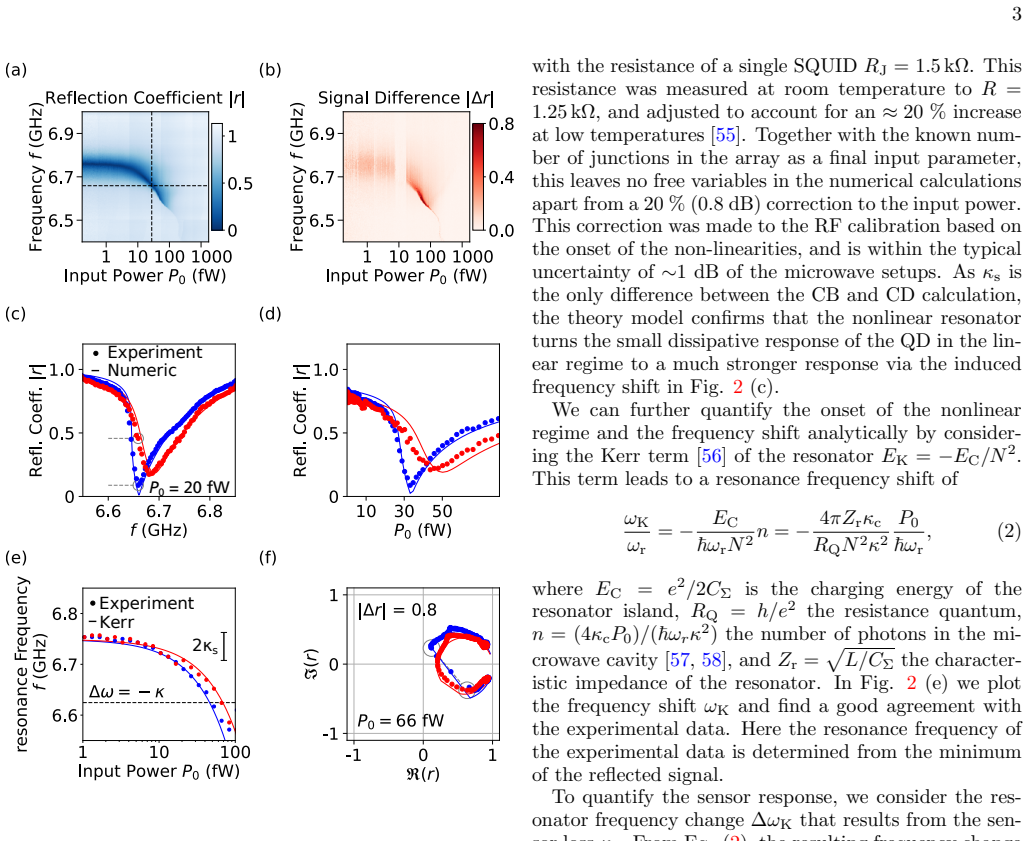
The load-bearing element is the SQUID-array nonlinear resonator: a series array of $N=13$ superconducting quantum interference devices provides a Josephson inductance that becomes amplitude-dependent at high drive, making the resonator a Duffing oscillator with Kerr coefficient $E_K=-E_C/N^2$. The sensor quantum dot is modeled as an ohmic conductance $G$ that adds dissipation $\kappa_s=G/C_\Sigma$ to the resonator. The argument runs through the harmonic-balance equation for the phase amplitude and the Kerr frequency shift $\omega_K/\omega_r=-(4\pi Z_r\kappa_c/R_Q N^2\kappa^2)(P_0/\hbar\omega_r)$, which together show that at the operating point $\omega_K=-\kappa$ the sensor-induced damping shifts the onset of nonlinearity by $\Delta\omega_K\approx 2\kappa_s$. This converts a small dissipative change into a large frequency shift, giving a near-unity reflection change without impedance matching.
What would settle it
Measure the Coulomb-blockade-to-degeneracy frequency shift and reflection contrast while sweeping drive power up to and past 66 fW: the shift should rise to about $2\kappa_s\approx 56$ MHz and $|\Delta r|$ to about 0.8 near the onset $\omega_K=-\kappa$; if the shift saturates or the contrast peaks below 0.8 as the resonator voltage approaches 80 µV, the fixed-resistor model of the sensor is wrong.
Extended reading notes
Core claim
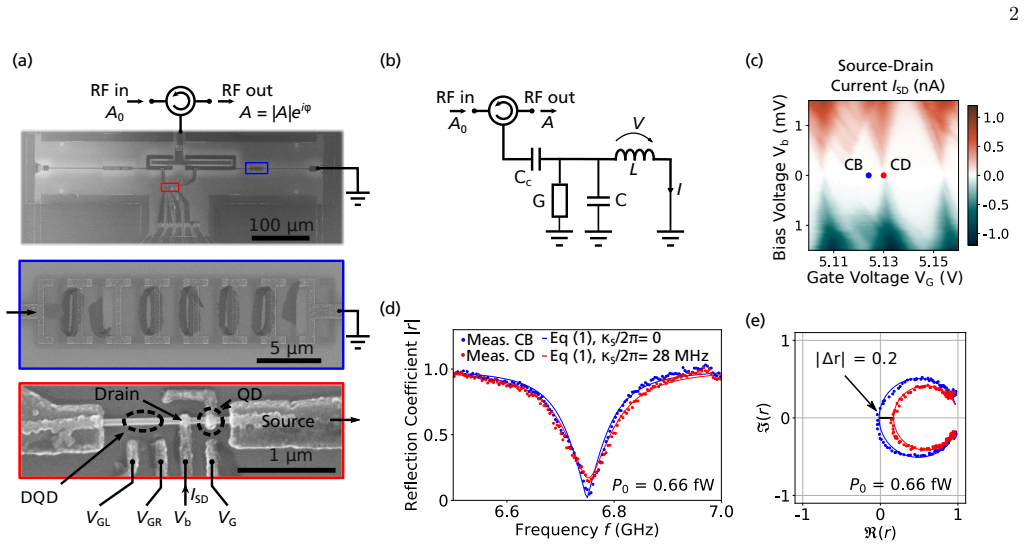
The central finding is that in a SQUID-array nonlinear resonator, the dissipation added by a charge-sensing quantum dot does not just widen the resonance line; it shifts the frequency at which the nonlinear Kerr response turns on. Working at the input power where the Kerr shift equals the linewidth, $\omega_K=-\kappa$, the authors derive $\Delta\omega_K\approx 2\kappa_s$ for the frequency shift caused by the sensor damping $\kappa_s$, and they observe this shift between Coulomb-blockade and Coulomb-degeneracy states. Because the shift moves the steep edge of the bifurcated resonator response, the reflected amplitude changes by $|\Delta r|=0.8$, near unity, even though the device parameters $\kappa_i\approx\kappa_c>\kappa_s$ are far from the matched condition $\kappa_s\gtrsim\kappa_c\gg\kappa_i$ required for a large linear response. Experimentally, the nonlinear readout reaches 0.9 fidelity at 80 ns integration time, an order of magnitude faster than the linear readout after accounting for the larger drive power.
Load-bearing premise
The prediction assumes the sensing dot damps the resonator exactly like a fixed resistor even when the readout signal is strong enough to start disturbing the dot; if the dot's response weakens at high drive, the frequency shift and speed gain shrink.
Editorial extensions
If this is right
- Resonator-based charge detectors no longer need to satisfy the matching condition $\kappa_s\gtrsim\kappa_c\gg\kappa_i$, so the input coupling $\kappa_c$ can be made much larger without killing the signal.
- Charge readout speed is no longer set directly by the sensor damping $\kappa_s$; the bottleneck shifts to the resonator linewidth, which can be increased toward the quantum dot's intrinsic $G/C_{QD}$ response rate.
- The same device protects both charge states from the readout drive: one state blocks conduction through the sensor, and the other shifts the resonator mode away from the drive frequency.
- With a coupling $\kappa_c/\kappa_s=10$, simulated in the supplement, a near-unity signal is still maintained, supporting the claim that an order-of-magnitude speed increase is achievable and that sub-10 ns readout is realistic after further optimization.
Reading between the lines
- Because the mechanism only requires a dissipative sensor element, a single-electron transistor or quantum point contact should be able to replace the quantum dot and inherit the same unmatched nonlinear readout.
- The protection of the conducting state by detuning suggests the readout drive may also reduce microwave-induced heating and sensor-induced dephasing; the paper identifies this as future work rather than demonstrating it.
- A practical design rule follows from the trade-off identified in the paper: raise the Kerr onset power $P_0$ by increasing $N$ and $\kappa_c$ while keeping the resonator voltage below the sensor linewidth, since exceeding that linewidth reduces $\kappa_s$ and erodes the contrast.
Editorial analysis
A structured set of objections, weighed in public.
Referee Report
Summary. The paper reports experiments and modeling of a SQUID-array nonlinear resonator coupled to a quantum-dot charge sensor. In the linear regime, the sensor conductance adds damping κ_s to the resonator, but because the device is not impedance-matched (κ_i ≈ κ_c and κ_s < κ_c), the reflection change between Coulomb-blockade and Coulomb-degeneracy states is only |Δr| = 0.2. Driving the resonator into the nonlinear regime turns this dissipative response into a frequency shift of the nonlinear resonance, yielding |Δr| = 0.8 at P0 = 66 fW and enabling charge-state discrimination at an integration time of 80 ns, compared with about 200 μs for the linear case at the same fidelity. The authors derive an approximate frequency shift Δω ≈ 2κ_s, support the mechanism with a harmonic-balance numerical model using parameters extracted from low-power linear fits, and simulate a device with larger input coupling to predict an order-of-magnitude increase in resonator response speed.
Significance. If the mechanism holds, this is a significant conceptual advance for dispersive-style charge readout of dissipative sensors: it shows experimentally that the impedance-matching requirement can be circumvented by operating the resonator in the nonlinear regime, and it demonstrates a large measured speed improvement (from 200 μs to 80 ns for 90% fidelity). The central experimental result is credible and is backed by direct time-domain fidelity measurements, by an analytical Kerr-shift derivation (Eqs. (2)-(3)), and by a numerical model that reproduces the 20-fW line cuts without free parameters in the nonlinear part of the model. The main weakness is that the quantitative prediction Δω ≈ 2κ_s and the simulated speed gain assume an amplitude-independent ohmic sensor conductance κ_s = G/CΣ, while the paper itself notes that κ_s is expected to decrease at the high microwave amplitudes used for the ultrafast readout. This limits the strength of the projected speed claims but does not invalidate the measured near-unity contrast.
major comments (2)
- [Supplement A, Eq. (5); main text, paragraph beginning 'With the τ=80 ns readout...'] The theoretical model and the speed projection assume that the quantum-dot sensor can be represented as a frequency- and amplitude-independent ohmic conductance, κ_s = G/CΣ. Supplement A itself notes that finite-frequency conductance usually differs from the low-frequency value, and the main text states that at V = 80 μV the microwave amplitude is comparable to the QD linewidth and that κ_s reduces when the amplitude exceeds the linewidth. The measured 66-fW readout point and the Supplement D simulation (V = 60 μV) are exactly in this regime. The quantitative claims Δω ≈ 2κ_s (Eq. (3)) and the simulated order-of-magnitude bandwidth gain are therefore not supported unless the amplitude dependence of κ_s is measured or bounded. The experimental observation of 0.8 contrast at 66 fW is not in question, but its interpretation as a shift produced by a constant κ_s is.
- [Eq. (3) and Fig. 2(e); main text paragraph 'To quantify the sensor response...'] Equation (3) and the Δω ≈ 2κ_s result are derived under the condition ω_K = -κ, i.e., near the bifurcation threshold, with the prefactor caveat given in Supplement C. The data that produce the maximum contrast and the 80-ns readout, however, are taken at P0 = 66 fW, which is well above the P0 = 20 fW used for the numerical comparison and the line cuts. The paper does not show that the threshold-derived frequency shift quantitatively applies to the 66-fW operating condition. Please either justify the extrapolation to this operating point or restrict the quantitative predictions (Δω ≈ 2κ_s and the resulting speed limit) to the threshold regime.
minor comments (3)
- [Main text, 'To model the response theoretically'] The sentence 'this leaves no free variables in the numerical calculations apart from a 20% (0.8 dB) correction to the input power' is misleading, because the single-SQUID resistance R_J is also adjusted by about 20% from the room-temperature value. If both values are independently calibrated, please say so; otherwise report the sensitivity of the calculated response to these two corrections.
- [Fig. 3(d)-(e) and following text] The linear reference data are measured at P0 = 0.66 fW, and the comparison is shifted by the expected 10x signal-amplitude factor. This is a reasonable compensation, but because the linear resonator at P0 = 66 fW would itself be nonlinear, the 'more than an order of magnitude' speed advantage is an extrapolation rather than a direct fixed-power comparison. Please state this explicitly in the text.
- [Acknowledgements] The acknowledgements contain a typo: 'Wet thank' should be 'We thank'.
Circularity Check
No significant circularity: the headline frequency-shift prediction is derived from independent linear-regime fits and verified on nonlinear data without refitting the readout signal.
full rationale
The paper's central chain is: (i) fit κc and κi from the Coulomb-blockade linear response and κs from the Coulomb-degeneracy linear response using Eq. (1); (ii) solve the Josephson/Duffing equation of motion, Eqs. (5)-(6), with these fixed parameters and no additional free variable apart from a 0.8 dB power-calibration correction; (iii) derive the Kerr frequency shift, Eq. (2), and the CB-to-CD shift, Eq. (3), which reduces to Δω≈2κs only after expanding in κs≪κCB at the onset condition ωK=-κ. The observed 0.8 nonlinear contrast and the 80 ns readout are compared with these predictions rather than being used to re-extract κs, so the main claim is not equivalent to its input by construction. The self-citations (e.g., Refs. [45], [57], [58]) supply independent earlier measurements or standard photon-number relations and are not invoked as an authority to forbid alternatives. The acknowledged high-drive caveat—V=80 µV is comparable to the sensor linewidth, and κs is expected to drop—limits the extrapolated 10 ns projection, but this is a stated assumption/limitation, not a circular reduction: the model and the extrapolation would fail in the same way if the assumption were wrong, rather than being true by definition. No predicted quantity equals a fitted parameter or a self-citation by construction.
Assumptions & free parameters
free parameters (5)
- kappa_c (input coupling) =
62 MHz
- kappa_i (internal loss) =
60 MHz
- kappa_s (sensor damping at Coulomb degeneracy) =
28 MHz
- R_J (single SQUID resistance) =
1.5 kOhm
- Input power calibration correction =
20 percent (0.8 dB)
assumptions (5)
- domain assumption Josephson array is described by semiclassical relations I=I0 sin(phi) and V=(hbar N/2e) d(phi)/dt with a sinusoidal drive.
- domain assumption sin(phi) is approximated as phi minus phi^3/6 and the harmonic balance keeps only the fundamental mode.
- domain assumption The quantum dot acts as an ohmic conductance G with RF sensor damping kappa_s=G/C_Sigma, independent of drive amplitude up to V=80 microvolts.
- domain assumption The linear-cavity photon number n=4 kappa_c P0/(hbar omega_r kappa^2) applies at the nonlinear operating point.
- standard math Bifurcation threshold analysis uses kappa much smaller than omega_r.
Cite this review
Pith. "Pith review of Near-Unity Charge Readout in a Nonlinear Resonator without Matching." pith.science (2026). https://pith.science/paper/RERSQ752
@misc{pith2026250517709,
  author       = {Pith},
  title        = {Pith review of: Near-Unity Charge Readout in a Nonlinear Resonator without Matching},
  year         = {2026},
  howpublished = {\url{https://pith.science/paper/RERSQ752}},
  note         = {Machine review of arXiv:2505.17709}
}
read the original abstract
In this paper, we present a nonlinear resonator performing the readout of a charge-sensing quantum dot. We show that by driving the resonator in the nonlinear regime, we achieve a near-unity signal. This despite not satisfying the impedance matching requirements necessary for such large signals in the linear regime. Our experiments, supported by numerical calculations, demonstrate that the signal increase stems from the sensor dissipation shifting the onset of the nonlinear resonator response. By lifting the matching requirement, we increase the bandwidth limit of resonator readout-based charge detection by an order of magnitude, opening up the avenue to ultra-fast charge detectors.
Figures

Forward citations
Cited by 1 Pith paper
-
Current-based RF charge sensing in a carbon nanotube
Current-mode RF readout of a suspended carbon-nanotube charge sensor at an RLC resonance yields 0.15 µe/√Hz sensitivity and SNR 17 single-shot DQD charge readout in 3.56 µs.
Reference graph
Works this paper leans on
-
[1]
R. J. Schoelkopf, P. Wahlgren, A. A. Kozhevnikov, P. Delsing, and D. E. Prober, The radio-frequency single- electron transistor (RF-SET): A fast and ultrasensitive electrometer, Science280, 1238 (1998)
1998
-
[2]
J. P. Pekola, O.-P. Saira, V. F. Maisi, A. Kemppinen, M. M¨ ott¨ onen, Y. A. Pashkin, and D. V. Averin, Single- electron current sources: Toward a refined definition of the ampere, Rev. Mod. Phys.85, 1421 (2013)
2013
-
[3]
Chatterjee, P
A. Chatterjee, P. Stevenson, S. De Franceschi, A. Morello, N. P. de Leon, and F. Kuemmeth, Semicon- ductor qubits in practice, Nature Reviews Physics3, 157 (2021)
2021
-
[4]
Burkard, T
G. Burkard, T. D. Ladd, A. Pan, J. M. Nichol, and J. R. Petta, Semiconductor spin qubits, Rev. Mod. Phys.95, 025003 (2023)
2023
-
[5]
M. W. Keller, A. L. Eichenberger, J. M. Martinis, and N. M. Zimmerman, A capacitance standard based on counting electrons, Science285, 1706 (1999)
work page 1999
-
[6]
S. Gustavsson, R. Leturcq, M. Studer, I. Shorubalko, T. Ihn, K. Ensslin, D. Driscoll, and A. Gossard, Elec- tron counting in quantum dots, Surface Science Reports 64, 191 (2009)
work page 2009
-
[7]
Gustavsson, R
S. Gustavsson, R. Leturcq, B. Simoviˇ c, R. Schleser, T. Ihn, P. Studerus, K. Ensslin, D. C. Driscoll, and A. C. Gossard, Counting statistics of single electron transport in a quantum dot, Phys. Rev. Lett.96, 076605 (2006)
2006
- [8]
Show all 67 references
-
[9]
K¨ ung, C
B. K¨ ung, C. R¨ ossler, M. Beck, M. Marthaler, D. S. Gol- ubev, Y. Utsumi, T. Ihn, and K. Ensslin, Irreversibility on the level of single-electron tunneling, Phys. Rev. X2, 6 011001 (2012)
2012
-
[10]
J. V. Koski, V. F. Maisi, J. P. Pekola, and D. V. Averin, Experimental realization of a Szilard engine with a single electron, Proc. Natl. Acad. Sci. USA111, 13786 (2014)
2014
-
[11]
Wagner, P
T. Wagner, P. Strasberg, J. C. Bayer, E. P. Rugerami- gabo, T. Brandes, and R. J. Haug, Strong suppression of shot noise in a feedback-controlled single-electron tran- sistor, Nat. Nanotech.12, 218 (2017)
2017
-
[12]
Tanttu, B
T. Tanttu, B. Hensen, K. W. Chan, C. H. Yang, W. W. Huang, M. Fogarty, F. Hudson, K. Itoh, D. Culcer, A. Laucht, A. Morello, and A. Dzurak, Controlling spin- orbit interactions in silicon quantum dots using magnetic field direction, Phys. Rev. X9, 021028 (2019)
2019
-
[13]
Ranni, E
A. Ranni, E. T. Mannila, A. Eriksson, D. S. Golubev, J. P. Pekola, and V. F. Maisi, Local and nonlocal two- electron tunneling processes in a Cooper pair splitter, Phys. Rev. Lett.129, 207703 (2022)
2022
-
[14]
Barker, M
D. Barker, M. Scandi, S. Lehmann, C. Thelander, K. A. Dick, M. Perarnau-Llobet, and V. F. Maisi, Experimen- tal verification of the work fluctuation-dissipation rela- tion for information-to-work conversion, Phys. Rev. Lett. 128, 040602 (2022)
2022
-
[15]
Zenelaj, P
D. Zenelaj, P. P. Potts, and P. Samuelsson, Full counting statistics of the photocurrent through a double quantum dot embedded in a driven microwave resonator, Phys. Rev. B106, 205135 (2022)
2022
-
[16]
T. M. Buehler, D. J. Reilly, R. P. Starrett, N. A. Court, A. R. Hamilton, A. S. Dzurak, and R. G. Clark, Devel- opment and operation of the twin radio frequency single electron transistor for cross-correlated charge detection, J. Appl. Phys.96, 4508 (2004)
2004
-
[17]
Bylander, T
J. Bylander, T. Duty, and P. Delsing, Current measure- ment by real-time counting of single electrons, Nature 434, 361 (2005)
2005
-
[18]
S. J. Angus, A. J. Ferguson, A. S. Dzurak, and R. G. Clark, A silicon radio-frequency single electron transis- tor, Appl. Phys. Lett92, 112103 (2008)
2008
-
[19]
J. P. Dehollain, J. T. Muhonen, K. Y. Tan, A. Saraiva, D. N. Jamieson, A. S. Dzurak, and A. Morello, Single- shot readout and relaxation of singlet and triplet states in exchange-coupled 31P electron spins in silicon, Phys. Rev. Lett.112, 236801 (2014)
2014
-
[20]
W. Lu, Z. Ji, L. Pfeiffer, K. W. West, and A. J. Rimberg, Real-time detection of electron tunnelling in a quantum dot, Nature423, 422 (2003)
2003
-
[21]
J. M. Elzerman, R. Hanson, L. H. Willems van Beveren, B. Witkamp, L. M. K. Vandersypen, and L. P. Kouwen- hoven, Single-shot read-out of an individual electron spin in a quantum dot, Nature430, 431 (2004)
2004
-
[22]
D. J. Reilly, C. M. Marcus, M. P. Hanson, and A. C. Gossard, Fast single-charge sensing with a RF quantum point contact, Appl. Phys. Lett.91, 162101 (2007)
2007
-
[23]
Barthel, M
C. Barthel, M. Kjærgaard, J. Medford, M. Stopa, C. M. Marcus, M. P. Hanson, and A. C. Gossard, Fast sensing of double-dot charge arrangement and spin state with a radio-frequency sensor quantum dot, Phys. Rev. B81, 161308 (2010)
2010
-
[24]
Keith, M
D. Keith, M. G. House, M. B. Donnelly, T. F. Watson, B. Weber, and M. Y. Simmons, Single-shot spin readout in semiconductors near the shot-noise sensitivity limit, Phys. Rev. X9, 041003 (2019)
2019
-
[25]
V. O. Turin and A. N. Korotkov, Analysis of the radio- frequency single-electron transistor with large quality factor, Appl. Phys. Lett83, 2898 (2003)
2003
-
[26]
N. Ares, F. J. Schupp, A. Mavalankar, G. Rogers, J. Grif- fiths, G. A. C. Jones, I. Farrer, D. A. Ritchie, C. G. Smith, A. Cottet, G. A. D. Briggs, and E. A. Laird, Sen- sitive radio-frequency measurements of a quantum dot by tuning to perfect impedance matching, Phys. Rev. Ap...
2016
-
[27]
Vigneau, F
F. Vigneau, F. Fedele, A. Chatterjee, D. Reilly, F. Kuem- meth, M. F. Gonzalez-Zalba, E. Laird, and N. Ares, Probing quantum devices with radio-frequency reflectom- etry, Appl. Phys. Rev.10, 021305 (2023)
2023
-
[28]
Siddiqi, R
I. Siddiqi, R. Vijay, F. Pierre, C. M. Wilson, M. Met- calfe, C. Rigetti, L. Frunzio, and M. H. Devoret, RF- driven Josephson bifurcation amplifier for quantum mea- surement, Phys. Rev. Lett.93, 207002 (2004)
2004
-
[29]
Wallraff, D
A. Wallraff, D. I. Schuster, A. Blais, L. Frunzio, J. Ma- jer, M. H. Devoret, S. M. Girvin, and R. J. Schoelkopf, Approaching unit visibility for control of a superconduct- ing qubit with dispersive readout, Phys. Rev. Lett.95, 060501 (2005)
2005
-
[30]
Lupa¸ scu, E
A. Lupa¸ scu, E. F. C. Driessen, L. Roschier, C. J. P. M. Harmans, and J. E. Mooij, High-contrast dispersive read- out of a superconducting flux qubit using a nonlinear res- onator, Phys. Rev. Lett.96, 127003 (2006)
2006
-
[31]
Sunada, K
Y. Sunada, K. Yuki, Z. Wang, T. Miyamura, J. Ilves, K. Matsuura, P. A. Spring, S. Tamate, S. Kono, and Y. Nakamura, Photon-noise-tolerant dispersive readout of a superconducting qubit using a nonlinear purcell fil- ter, PRX Quantum5, 010307 (2024)
2024
-
[32]
Y. Ye, J. B. Kline, S. Chen, A. Yen, and K. P. O’Brien, Ultrafast superconducting qubit readout with the quar- ton coupler, Sci. Adv.10, eado9094 (2024)
2024
-
[33]
Morello, J
A. Morello, J. J. Pla, F. A. Zwanenburg, K. W. Chan, K. Y. Tan, H. Huebl, M. M¨ ott¨ onen, C. D. Nugroho, C. Yang, J. A. van Donkelaar, A. D. C. Alves, D. N. Jamieson, C. C. Escott, L. C. L. Hollenberg, R. G. Clark, and A. S. Dzurak, Single-shot readout of an electron spin in ...
2010
-
[34]
J. Park, H. Jang, H. Sohn, J. Yun, Y. Song, B. Kang, L. E. A. Stehouwer, D. D. Esposti, G. Scappucci, and D. Kim, Passive and active suppression of transduced noise in silicon spin qubits, Nat. Commun.16, 78 (2025)
2025
-
[35]
Haldar, M
S. Haldar, M. Munk, H. Havir, W. Khan, S. Lehmann, C. Thelander, K. A. Dick, P. Samuelsson, P. P. Potts, and V. F. Maisi, Coherence of an electronic two-level system under continuous charge sensing by a quantum dot de- tector, Phys. Rev. Lett.134, 023601 (2025)
2025
-
[36]
Haldar, D
S. Haldar, D. Barker, H. Havir, A. Ranni, S. Lehmann, K. A. Dick, and V. F. Maisi, Continuous microwave pho- ton counting by semiconductor-superconductor hybrids, Phys. Rev. Lett.133, 217001 (2024)
2024
-
[37]
Hermon, E
Z. Hermon, E. Ben-Jacob, and G. Sch¨ on, Charge solitons in one-dimensional arrays of serially coupled Josephson junctions, Phys. Rev. B54, 1234 (1996)
1996
-
[38]
M. A. Castellanos-Beltran and K. W. Lehnert, Widely tunable parametric amplifier based on a superconducting quantum interference device array resonator, Appl. Phys. Lett91, 083509 (2007)
2007
-
[39]
Hutter, E
C. Hutter, E. A. Thol´ en, K. Stannigel, J. Lidmar, and D. B. Haviland, Josephson junction transmission lines as tunable artificial crystals, Phys. Rev. B83, 014511 (2011)
2011
-
[40]
M. T. Bell, I. A. Sadovskyy, L. B. Ioffe, A. Y. Kitaev, and M. E. Gershenson, Quantum superinductor with tunable nonlinearity, Phys. Rev. Lett.109, 137003 (2012). 7
2012
-
[41]
Altimiras, O
C. Altimiras, O. Parlavecchio, P. Joyez, D. Vion, P. Roche, D. Esteve, and F. Portier, Tunable microwave impedance matching to a high impedance source using a Josephson metamaterial, Appl. Phys. Lett103, 212601 (2013)
2013
-
[42]
Stockklauser, P
A. Stockklauser, P. Scarlino, J. V. Koski, S. Gasparinetti, C. K. Andersen, C. Reichl, W. Wegscheider, T. Ihn, K. Ensslin, and A. Wallraff, Strong coupling cavity QED with gate-defined double quantum dots enabled by a high impedance resonator, Phys. Rev. X7, 011030 (2017)
2017
-
[43]
Harabula, T
M.-C. Harabula, T. Hasler, G. F¨ ul¨ op, M. Jung, V. Ran- jan, and C. Sch¨ onenberger, Measuring a quantum dot with an impedance-matching on-chip superconducting LCresonator at gigahertz frequencies, Phys. Rev. Appl. 8, 054006 (2017)
2017
-
[44]
de Jong, C
D. de Jong, C. G. Prosko, D. M. A. Waardenburg, L. Han, F. K. Malinowski, P. Krogstrup, L. P. Kouwenhoven, J. V. Koski, and W. Pfaff, Rapid microwave-only char- acterization and readout of quantum dots using multi- plexed gigahertz-frequency resonators, Phys. Rev. Appl. 16, 01...
2021
-
[45]
Havir, S
H. Havir, S. Haldar, W. Khan, S. Lehmann, K. A. Dick, C. Thelander, P. Samuelsson, and V. F. Maisi, Quan- tum dot source-drain transport response at microwave frequencies, Phys. Rev. B108, 205417 (2023)
2023
-
[46]
G¨ oppl, A
M. G¨ oppl, A. Fragner, M. Baur, R. Bianchetti, S. Filipp, J. M. Fink, P. J. Leek, G. Puebla, L. Steffen, and A. Wall- raff, Coplanar waveguide resonators for circuit quantum electrodynamics, J. Appl. Phys.104, 113904 (2008)
2008
-
[47]
Probst, F
S. Probst, F. B. Song, P. A. Bushev, A. V. Ustinov, and M. Weides, Efficient and robust analysis of complex scat- tering data under noise in microwave resonators, Rev. Sci. Instrum.86, 024706 (2015)
2015
-
[48]
Ranni, H
A. Ranni, H. Havir, S. Haldar, and V. F. Maisi, High impedance Josephson junction resonators in the trans- mission line geometry, Appl. Phys. Lett.123, 114002 (2023)
2023
-
[49]
Rieger, S
D. Rieger, S. G¨ unzler, M. Spiecker, A. Nambisan, W. Wernsdorfer, and I. Pop, Fano interference in mi- crowave resonator measurements, Phys. Rev. Appl.20, 014059 (2023)
2023
-
[50]
Kaplunenko and G
V. Kaplunenko and G. Fischer, Josephson junction ar- rays as a variable inductor in RF circuits and tunable filters, Supercond. Sci. Technol.17, S145 (2004), 6th Eu- ropean Conference on Applied Superconductivity (EU- CAS 2003), Sorrento, ITALY, SEP 14-18, 2003
2004
-
[51]
E. A. Thol´ en, A. Erg¨ ul, E. M. Doherty, F. M. Weber, F. Gr´ egis, and D. B. Haviland, Nonlinearities and para- metric amplification in superconducting coplanar waveg- uide resonators, Appl. Phys. Lett90, 253509 (2007)
2007
-
[52]
L. S. Bishop, E. Ginossar, and S. M. Girvin, Response of the strongly driven Jaynes-Cummings oscillator, Phys. Rev. Lett.105, 100505 (2010)
2010
-
[53]
F. R. Ong, M. Boissonneault, F. Mallet, A. Palacios- Laloy, A. Dewes, A. C. Doherty, A. Blais, P. Bertet, D. Vion, and D. Esteve, Circuit QED with a nonlin- ear resonator: AC-Stark shift and dephasing, Phys. Rev. Lett.106, 167002 (2011)
2011
-
[54]
Frasca, I
S. Frasca, I. Arabadzhiev, S. B. de Puechredon, F. Oppliger, V. Jouanny, R. Musio, M. Scigliuzzo, F. Minganti, P. Scarlino, and E. Charbon, NbN films with high kinetic inductance for high-quality compact su- perconducting resonators, Phys. Rev. Appl.20, 044021 (2023)
2023
-
[55]
Holmqvist, M
T. Holmqvist, M. Meschke, and J. P. Pekola, Double ox- idation scheme for tunnel junction fabrication, J. Vac. Sci. & Techol. B26, 28 (2008)
2008
-
[56]
J. Koch, T. M. Yu, J. Gambetta, A. A. Houck, D. I. Schuster, J. Majer, A. Blais, M. H. Devoret, S. M. Girvin, and R. J. Schoelkopf, Charge-insensitive qubit design de- rived from the Cooper pair box, Phys. Rev. A76, 042319 (2007)
2007
-
[57]
Haldar, H
S. Haldar, H. Havir, W. Khan, S. Lehmann, C. The- lander, K. A. Dick, and V. F. Maisi, Energetics of mi- crowaves probed by double quantum dot absorption, Phys. Rev. Lett.130, 087003 (2023)
2023
-
[58]
Andersson, H
S. Andersson, H. Havir, A. Ranni, S. Haldar, and V. F. Maisi, High-impedance microwave resonators with two- photon nonlinear effects, Nat. Commun.16, 552 (2025)
2025
-
[59]
Schaller, G
G. Schaller, G. Kießlich, and T. Brandes, Low- dimensional detector model for full counting statistics: Trajectories, back action, and fidelity, Phys. Rev. B82, 041303 (2010)
2010
-
[60]
Chen, H.-X
L. Chen, H.-X. Li, Y. Lu, C. W. Warren, C. J. Kriˇ zan, S. Kosen, M. Rommel, S. Ahmed, A. Osman, J. Bizn´ arov´ a, A. Fadavi Roudsari, B. Lienhard, M. Ca- puto, K. Grigoras, L. Gr¨ onberg, J. Govenius, A. F. Kockum, P. Delsing, J. Bylander, and G. Tancredi, Transmon qubit read...
2023
-
[61]
T. Frey, P. J. Leek, M. Beck, K. Ensslin, A. Wallraff, and T. Ihn, Characterization of a microwave frequency resonator via a nearby quantum dot, Appl. Phys. Lett 98, 262105 (2011)
2011
-
[62]
Cornia, F
S. Cornia, F. Rossella, V. Demontis, V. Zannier, F. Bel- tram, L. Sorba, M. Affronte, and A. Ghirri, Microwave- assisted tunneling in hard-wall InAs/InP nanowire quan- tum dots, Sci. Rep.9, 19523 (2019)
2019
-
[63]
T. Ihn, S. Gustavsson, U. Gasser, B. K¨ ung, T. M¨ uller, R. Schleser, M. Sigrist, I. Shorubalko, R. Leturcq, and K. Ensslin, Quantum dots investigated with charge de- tection techniques, Solid State Communications149, 1419 (2009), fundamental Phenomena and Applications of Qua...
2009
-
[64]
Mavalankar, T
A. Mavalankar, T. Pei, E. M. Gauger, J. H. Warner, G. A. D. Briggs, and E. A. Laird, Photon-assisted tunnel- ing and charge dephasing in a carbon nanotube double quantum dot, Phys. Rev. B93, 235428 (2016)
2016
-
[65]
Kirchmair, B
G. Kirchmair, B. Vlastakis, Z. Leghtas, S. E. Nigg, H. Paik, E. Ginossar, M. Mirrahimi, L. Frunzio, S. M. Girvin, and R. J. Schoelkopf, Observation of quantum state collapse and revival due to the single-photon Kerr effect, Nature495, 205 (2013)
2013
-
[66]
I.-C. Hoi, A. F. Kockum, T. Palomaki, T. M. Stace, B. Fan, L. Tornberg, S. R. Sathyamoorthy, G. Johans- son, P. Delsing, and C. M. Wilson, Giant cross–Kerr ef- fect for propagating microwaves induced by an artificial atom, Phys. Rev. Lett.111, 053601 (2013)
2013
-
[67]
Yamaji, S
T. Yamaji, S. Kagami, A. Yamaguchi, T. Satoh, K. Koshino, H. Goto, Z. R. Lin, Y. Nakamura, and T. Ya- mamoto, Spectroscopic observation of the crossover from a classical duffing oscillator to a Kerr parametric oscilla- tor, Phys. Rev. A105, 023519 (2022). 8 I. SUPPLEMENT AL MA...
2022
Reviewed August 7, 2026 · model on record in the stance chip above.
Discussion (0). Continue with ORCID to comment.