Gaussian fluctuations in the tunneling probability of a closed universe
Pith reviewed 2026-05-20 17:03 UTC · model grok-4.3
The pith
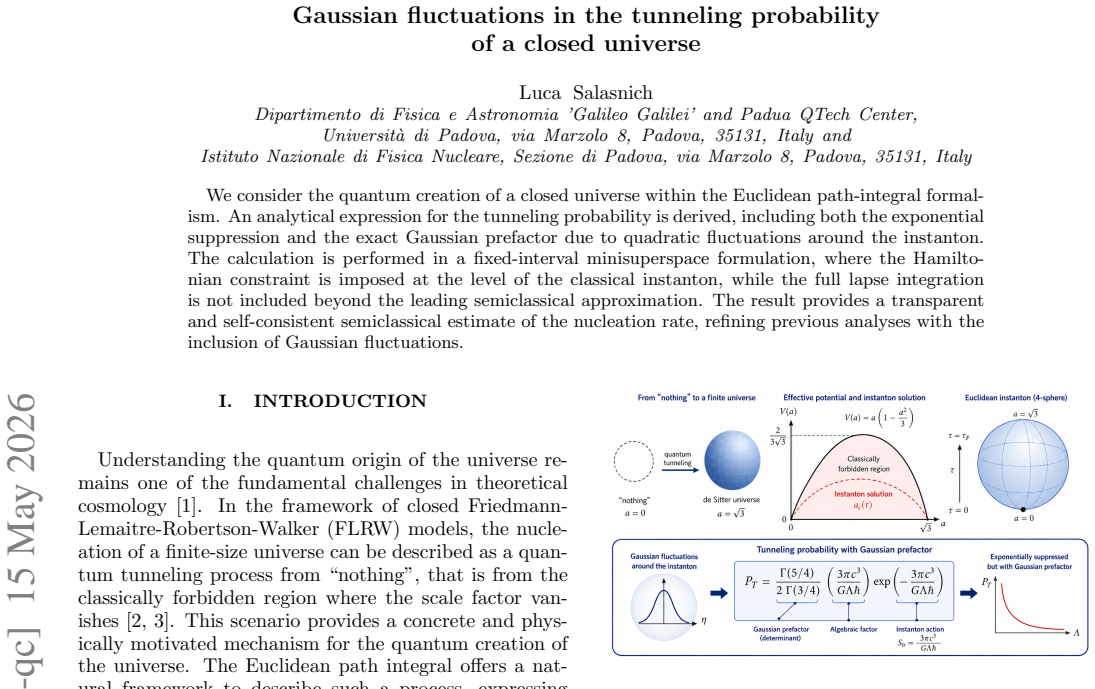
The tunneling probability for a closed universe includes an exact Gaussian prefactor from quadratic fluctuations around the instanton.
A machine-rendered reading of the paper's core claim, the machinery that carries it, and where it could break.
Core claim
An analytical expression for the tunneling probability is derived, including both the exponential suppression and the exact Gaussian prefactor due to quadratic fluctuations around the instanton. The calculation is performed in a fixed-interval minisuperspace formulation, where the Hamiltonian constraint is imposed at the level of the classical instanton, while the full lapse integration is not included beyond the leading semiclassical approximation. The result provides a transparent and self-consistent semiclassical estimate of the nucleation rate, refining previous analyses with the inclusion of Gaussian fluctuations.
What carries the argument
The exact Gaussian prefactor due to quadratic fluctuations around the instanton in the Euclidean path integral for minisuperspace.
If this is right
- The nucleation rate receives a well-defined Gaussian correction from quadratic fluctuations.
- Previous semiclassical estimates are refined by the inclusion of this exact prefactor.
- The result yields a transparent semiclassical estimate of the creation probability.
Where Pith is reading between the lines
- The same fluctuation analysis might apply to instantons in other quantum cosmology setups with more degrees of freedom.
- Direct lattice or numerical path-integral evaluations could test the predicted prefactor value.
- This correction could influence estimates of the initial conditions for inflationary models.
Load-bearing premise
The Hamiltonian constraint is imposed at the level of the classical instanton rather than integrating over the full lapse function.
What would settle it
A numerical computation of the full path integral without fixing the interval that produces a different prefactor would falsify the derived analytical expression.
Figures
read the original abstract
We consider the quantum creation of a closed universe within the Euclidean path-integral formalism. An analytical expression for the tunneling probability is derived, including both the exponential suppression and the exact Gaussian prefactor due to quadratic fluctuations around the instanton. The calculation is performed in a fixed-interval minisuperspace formulation, where the Hamiltonian constraint is imposed at the level of the classical instanton, while the full lapse integration is not included beyond the leading semiclassical approximation. The result provides a transparent and self-consistent semiclassical estimate of the nucleation rate, refining previous analyses with the inclusion of Gaussian fluctuations.
Editorial analysis
A structured set of objections, weighed in public.
Referee Report
Summary. The manuscript derives an analytical expression for the tunneling probability of a closed universe in the Euclidean path-integral formalism. It obtains both the exponential suppression from the instanton action and an exact Gaussian prefactor arising from quadratic fluctuations of the minisuperspace variable around the instanton. The calculation is performed in a fixed-interval minisuperspace model in which the Hamiltonian constraint is imposed only on the classical background solution, with the full integration over the lapse not carried beyond the leading semiclassical order.
Significance. If the central derivation is correct, the result supplies a concrete, analytically tractable semiclassical nucleation rate that includes the leading fluctuation correction. This refines earlier instanton-based estimates by making the prefactor explicit rather than leaving it as an unspecified normalization. The transparent treatment of the quadratic fluctuations around the instanton is a clear technical contribution within the minisuperspace approximation.
major comments (1)
- Abstract and §2 (method): the claim of an 'exact Gaussian prefactor' is obtained while holding the time interval fixed and enforcing the Hamiltonian constraint only at the classical level. The skeptic correctly notes that a complete one-loop treatment requires expanding the action to quadratic order in both the scale-factor fluctuation and δN, then performing the Gaussian integral over the lapse fluctuation. The manuscript does not demonstrate that this additional integration leaves the reported prefactor unchanged; this step is load-bearing for the assertion that the prefactor is the complete semiclassical result rather than an artifact of the gauge choice.
minor comments (1)
- The abstract and introduction would benefit from a brief explicit statement of the minisuperspace Lagrangian and the precise definition of the fixed interval before the fluctuation analysis begins.
Simulated Author's Rebuttal
We thank the referee for their careful reading and constructive comments on our manuscript. The major concern regarding the scope of the Gaussian prefactor in the fixed-interval formulation is addressed point by point below. We have revised the manuscript to clarify the limitations of the approximation without overstating the result.
read point-by-point responses
-
Referee: Abstract and §2 (method): the claim of an 'exact Gaussian prefactor' is obtained while holding the time interval fixed and enforcing the Hamiltonian constraint only at the classical level. The skeptic correctly notes that a complete one-loop treatment requires expanding the action to quadratic order in both the scale-factor fluctuation and δN, then performing the Gaussian integral over the lapse fluctuation. The manuscript does not demonstrate that this additional integration leaves the reported prefactor unchanged; this step is load-bearing for the assertion that the prefactor is the complete semiclassical result rather than an artifact of the gauge choice.
Authors: We agree that a fully gauge-invariant one-loop calculation would require expanding to quadratic order in both the scale-factor fluctuation and the lapse fluctuation δN, followed by integration over δN. Our manuscript is explicitly restricted to the fixed-interval minisuperspace model in which the time interval is held fixed and the Hamiltonian constraint is satisfied only by the classical instanton. Within this controlled setting the lapse is fixed at its classical value, so the quadratic action contains only the scale-factor fluctuation; the resulting Gaussian integral produces the reported prefactor exactly. We do not claim that this prefactor survives unchanged after a subsequent integration over δN. To address the referee's concern we have revised the abstract and §2 to state explicitly that the prefactor is the exact result for scale-factor fluctuations with fixed lapse and classical constraint enforcement, and we have added a short paragraph discussing the relation of this result to a more complete treatment that would include δN. These changes make the scope and limitations of the calculation transparent while preserving the technical contribution of the analytic Gaussian evaluation in the fixed-interval framework. revision: yes
Circularity Check
Derivation self-contained in standard semiclassical path-integral methods
full rationale
The paper derives the tunneling probability and Gaussian prefactor from quadratic fluctuations around the instanton in a fixed-interval minisuperspace model, explicitly noting that the Hamiltonian constraint is imposed only at the classical level and full lapse integration is omitted beyond leading order. This is presented as a transparent semiclassical estimate grounded in the Euclidean path-integral formalism, with no reduction of the claimed analytical result to a fitted parameter, self-definition, or load-bearing self-citation chain. The approach follows external standard methods without the result being equivalent to its inputs by construction.
Axiom & Free-Parameter Ledger
axioms (2)
- domain assumption Euclidean path-integral formalism applies to quantum creation of closed universes
- domain assumption Minisuperspace reduction with fixed time interval is valid for the semiclassical limit
Lean theorems connected to this paper
-
IndisputableMonolith/Foundation/AbsoluteFloorClosure.leanreality_from_one_distinction unclear?
unclearRelation between the paper passage and the cited Recognition theorem.
fixed-interval minisuperspace formulation, where the Hamiltonian constraint is imposed at the level of the classical instanton, while the full lapse integration is not included beyond the leading semiclassical approximation
What do these tags mean?
- matches
- The paper's claim is directly supported by a theorem in the formal canon.
- supports
- The theorem supports part of the paper's argument, but the paper may add assumptions or extra steps.
- extends
- The paper goes beyond the formal theorem; the theorem is a base layer rather than the whole result.
- uses
- The paper appears to rely on the theorem as machinery.
- contradicts
- The paper's claim conflicts with a theorem or certificate in the canon.
- unclear
- Pith found a possible connection, but the passage is too broad, indirect, or ambiguous to say the theorem truly supports the claim.
Reference graph
Works this paper leans on
-
[1]
In this approximation we get δ2SE δa(τ)δa(τ ′) =δ(τ−τ ′) h − √ 3A d2 dτ 2 − √ 3A i .(22) The Euclidean propagator for this quadratic problem is exactly that of an inverted harmonic oscillator of effec- tive massm= √ 3Aand effective frequencyω= 1. For the harmonic oscillator of frequencyω, in real time the prefactor of the propagator is [18, 19] F= r mω 2π...
work page 2023
-
[2]
Dodelson,Modern Cosmology(Academic Press, San Diego, 2003)
S. Dodelson,Modern Cosmology(Academic Press, San Diego, 2003). Official link:https: //www.elsevier.com/books/modern-cosmology/ dodelson/978-0-12-219141-1
work page 2003
-
[3]
D. Atkatz and H. Pagels, Origin of the universe as a quantum tunneling event, Phys. Rev. D25, 2065 (1982). DOI:https://doi.org/10.1103/PhysRevD.25.2065
-
[4]
Vilenkin, Creation of the universe from nothing, Phys
A. Vilenkin, Creation of the universe from nothing, Phys. Lett. B117, 25 (1982). DOI:https://doi.org/ 10.1016/0370-2693(82)90866-8
-
[5]
Linde, Quantum creation of an inflationary universe, Sov
A.D. Linde, Quantum creation of an inflationary universe, Sov. Phys. JET60, 211 (1984). Offi- cial link:http://www.jetp.ras.ru/cgi-bin/e/index/ e/60/2/p211?a=list
work page 1984
-
[6]
Ya.B. Zeldovich and A.A. Starobinsky, Quantum creation of a universe with nontrivial topology, Soviet Astronomy Lett.10, 135 (1984). Official link:https://ui.adsabs. harvard.edu/abs/1984SvAL...10..135Z. 6
work page 1984
-
[7]
Rubakov, Quantum mechanics in the tunneling universe, Phys
V.A. Rubakov, Quantum mechanics in the tunneling universe, Phys. Lett. B148, 280 (1984). DOI:https: //doi.org/10.1016/0370-2693(84)90088-1
-
[8]
Vilenkin, Boundary conditions in quantum cosmology, Phys
A. Vilenkin, Boundary conditions in quantum cosmology, Phys. Rev. D33, 3560 (1986). DOI:https://doi.org/ 10.1103/PhysRevD.33.3560
-
[9]
A. Vilenkin and M. Yamada, Tunneling wave function of the universe, Phys. Rev. D98, 066003 (2018). DOI: https://doi.org/10.1103/PhysRevD.98.066003
-
[10]
Jia, Truly Lorentzian quantum cosmology, Phys
D. Jia, Truly Lorentzian quantum cosmology, Phys. Rev. D108, 103540 (2023). DOI:https://doi.org/10.1103/ PhysRevD.108.103540
work page 2023
-
[11]
Lehners, Review of the no-boundary wave function, Phys
J.-L. Lehners, Review of the no-boundary wave function, Phys. Rep.1022, 1 (2023). DOI:https://doi.org/10. 1016/j.physrep.2023.06.002
work page 2023
-
[12]
de Alwis, Wave function of the Universe and CMB fluctuations, Phys
S.P. de Alwis, Wave function of the Universe and CMB fluctuations, Phys. Rev. D100, 043544 (2019). DOI: https://doi.org/10.1103/PhysRevD.100.043544
-
[13]
J.J. Halliwell, J.B. Hartle, T. Hertog, O. Janssen, and Y. Vreys, What is the no-boundary wave function of the Universe?, Phys. Rev. D99, 043526 (2019). DOI:https: //doi.org/10.1103/PhysRevD.99.043526
-
[14]
J. Feldbrugge, J.-L. Lehners, and N. Turok, Lorentzian quantum cosmology, Phys. Rev. D95, 103508 (2017). DOI:https://doi.org/10.1103/PhysRevD.95.103508
-
[15]
M. Honda, H. Matsui, K. Okabayashi, and T. Ter- ada, Resurgence in Lorentzian quantum cosmology: No- boundary saddles and resummation of quantum gravity corrections around tunneling saddle points, Phys. Rev. D110, 083508 (2024). DOI:https://doi.org/10.1103/ PhysRevD.110.083508
work page 2024
-
[16]
V. Mondal and S. Chakraborty, Lorentzian quantum cosmology with torsion, Phys. Rev. D109, 043525 (2024). DOI:https://doi.org/10.1103/PhysRevD.109. 043525
-
[17]
M. Motaharfar and P. Singh, Quantum gravita- tional non-singular tunneling wavefunction proposal, arXiv:2304.06760 [gr-qc] (2023). DOI:https://doi.org/ 10.48550/arXiv.2304.06760
-
[18]
DeWitt, Quantum theory of gravity
B. DeWitt, Quantum theory of gravity. I. The canonical theory, Phys. Rev.160, 1113 (1967). DOI:https://doi. org/10.1103/PhysRev.160.1113
-
[19]
R. Feynman and A.R. Hibbs,Quantum Mechanics and Path Integrals. Emended Edition(Dover, Mi- neola, NY, 2010). Official link:https://store. doverpublications.com/products/9780486477220
-
[20]
A. Altland and B. Simons,Condensed Matter Field The- ory(Cambridge Univ. Press, Cambridge, 2010). DOI: https://doi.org/10.1017/CBO9780511789984
-
[21]
J. Hartle and S. Hawking, Wave function of the Universe, Phys. Rev. D28, 2960 (1983). DOI:https://doi.org/ 10.1103/PhysRevD.28.2960
-
[22]
Linde,Inflation and Quantum Cosmology(Aca- demic Press, Boston, 1990)
A. Linde,Inflation and Quantum Cosmology(Aca- demic Press, Boston, 1990). Official link:https: //www.sciencedirect.com/book/9780124501751/ inflation-and-quantum-cosmology
-
[23]
Coleman, Fate of the false vacuum: Semiclassical theory, Phys
S. Coleman, Fate of the false vacuum: Semiclassical theory, Phys. Rev. D15, 2929 (1977). DOI:https: //doi.org/10.1103/PhysRevD.15.2929
-
[24]
C.G. Callan and S. Coleman, Fate of the false vacuum. II. First quantum corrections, Phys. Rev. D16, 1762 (1977). DOI:https://doi.org/10.1103/PhysRevD.16.1762
-
[25]
I. M. Gel’fand and A. M. Yaglom, Integration in func- tional spaces and its applications in quantum physics, J. Math. Phys.1, 48 (1960). DOI:https://doi.org/10. 1063/1.1703636
work page 1960
-
[26]
K. Kirsten and A. J. McKane, Functional determi- nants by contour integration methods, Ann. Phys. 308, 502 (2003). DOI:https://doi.org/10.1016/ S0003-4916(03)00149-0
work page 2003
-
[27]
I.S. Gradshteyn and I.M. Ryzhik,Table of In- tegrals, Series, and Products(Academic Press, 1980). Official link:https://www.elsevier.com/ books/table-of-integrals-series-and-products/ gradshteyn/978-0-12-384933-5
work page 1980
-
[28]
F. Mushtaq, X. Tiecheng, M. Yasir, F. Javed, M. Alo- saimi, and R.M. Zulqarnain, Imprints of magnetic charge on the particle orbits, weak gravitational lensing and black hole shadows, Phys. Dark Universe50, 102109 (2025). DOI:https://doi.org/10.1016/j.dark.2025. 102109
-
[29]
S. Kala, H. Nandan, and P. Sharma, Shadow and weak gravitational lensing of a rotating regular black hole in a non-minimally coupled Einstein-Yang-Mills theory in the presence of plasma, Eur. Phys. J. Plus 137, 457 (2022). DOI:https://doi.org/10.1140/epjp/ s13360-022-02634-6. Appendix In this Appendix we provide the technical details of the calculation of...
-
[30]
Since the transfor- mation is isospectral, the functional determinants ofL and ˜Lcoincide
gives a Schr¨ odinger-like (more precisely, Sturm-Liouville type) differential equa- tion 0 = ˜Lχ(τ) = − d2 dτ 2 +U(τ) χ(τ) (33) with U(τ) =− 3 4 − 1 12 1 sin2 τ√ 3 .(34) This transformation rewrites the original Sturm-Liouville problem in a Schr¨ odinger-like form with standard second- derivative structure, so that the Gel’fand-Yaglom theo- rem [24, 25] ...
discussion (0)
Sign in with ORCID, Apple, or X to comment. Anyone can read and Pith papers without signing in.