REVIEW 3 major objections 5 minor 83 references
Optimal control of a dissipative micromaser quantum battery in the ultrastrong coupling regime
T0 review · 3 major / 5 minor · reviewed 2026-08-03 · deepseek-v4-flash
Pith's one-line read Dissipation suppresses the unbounded energy growth of an ultrastrong-coupling micromaser quantum battery and, together with optimized control of qubit preparation and interaction times, yields a finite-ergotropy steady state.
desk verdict Solid micromaser-battery charging results, but the passive-feedback stabilization claim likely confuses daemonic ergotropy with the ergotropy of the battery state itself. read the letter →
The pith
A machine-rendered reading of the paper's core claim, the machinery that carries it, and where it could break.
The reading
What carries the argument
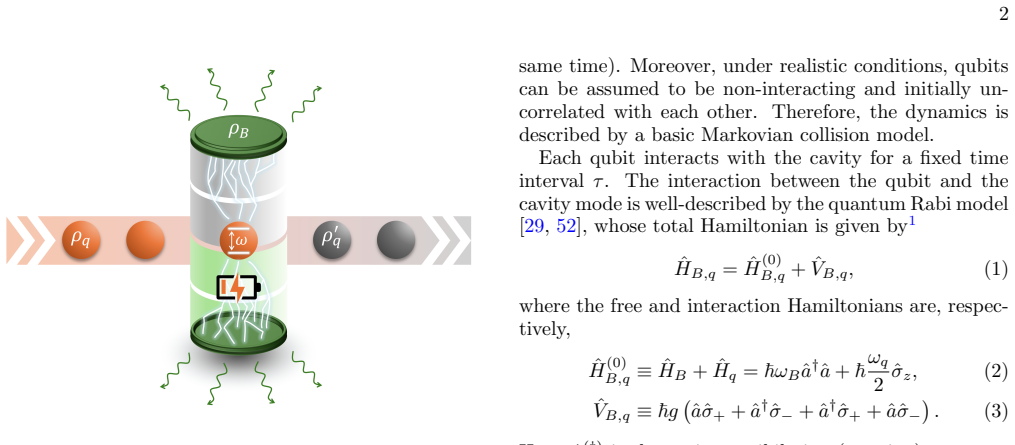
The argument is carried by the quantum Rabi Hamiltonian H = ω a†a + (ω/2)σ_z + g(aσ_+ + a†σ_- + a†σ_+ + aσ_-), whose counter-rotating terms (a†σ_+ and aσ_-) are kept, not dropped by the rotating-wave approximation. Dissipation is added through a GKLS master equation with Lindblad operators built from V = (a + a†) ⊗ I_q and an Ohmic spectral density, so the bath acts on the cavity during every collision. These two ingredients together produce the finite-ergotropy steady state; the optimal-control layer tunes q and {τ_k} to maximize final ergotropy, and the measurement of the outgoing qubit implements passive feedback that holds ergotropy constant.
What would settle it
A concrete falsifier: simulate the same micromaser with a realistic circuit-QED loss rate of γ/ω ≈ 10^-4 in a sufficiently large Fock basis; if cavity energy and ergotropy do not level off into a finite plateau, or if the optimized protocol no longer consistently beats the π-pulse protocol, the paper's central claim fails. Repeating the simulation with a non-Markovian bath provides a second check.
Extended reading notes
Core claim
The central discovery is that, contrary to the intuition that losses only degrade a quantum battery, they stabilize a micromaser battery operating in the ultrastrong-coupling regime. Simulating each qubit-cavity collision with a GKLS master equation in which the cavity couples to an Ohmic thermal bath, the authors find that cavity energy and ergotropy no longer grow indefinitely but converge to well-defined steady-state values, with purity higher than in the closed case. The steady-state ergotropy is nonzero, meaning part of the stored energy remains extractable. On top of this, numerical optimization of the qubit preparation parameter q and the per-collision interaction times τ_k produces f
Load-bearing premise
The load-bearing premise is that the environment during each qubit–cavity collision is a Markovian, weakly coupled Ohmic bath whose loss rate (γ/ω ≈ 0.045) is large enough to keep the Fock-space truncation honest; if the true baths are much weaker or non-Markovian, the steady-state stabilization and the optimized-protocol gains may not survive.
Editorial extensions
If this is right
- In the USC regime, counter-rotating terms by themselves lead to unbounded energy growth; dissipation must be included to get finite, extractable stored energy.
- For the parameters studied, optimizing qubit preparation and interaction times over a finite stream of five qubits yields higher final ergotropy than the Jaynes–Cummings π-pulse benchmark at every coupling strength g in [0.1, 0.7].
- Measuring each charger qubit after its collision, with optimized parameters, maintains the ergotropy approximately constant over tens of collisions, whereas both free decay and continued qubit injection without measurement lose ergotropy.
- Stronger ultrastrong coupling (larger g) leads to faster charging and higher steady-state energy and ergotropy, so USC remains beneficial once dissipation stabilizes the dynamics.
- Because the simulations use a loss rate about two orders of magnitude larger than typical circuit-QED values, the authors state that real-device performance should be at least as good, not worse.
Reading between the lines
- If the GKLS model is right, a direct experimental test is to measure the ergotropy plateau at realistic loss rates around γ/ω ≈ 10^-4; the paper predicts it should appear at higher energy than in the γ/ω ≈ 0.045 simulations, since the larger loss was a computational compromise.
- The passive-feedback mechanism suggests that projective measurement alone—without using outcomes to update controls—can function as a stabilizing resource in repeated-interaction quantum devices, which may transfer to other open-system tasks beyond batteries.
- The collision-map structure hints that the steady state is a fixed point of a dissipative map; making that map explicit could yield analytic bounds on the maximal extractable ergotropy and on the tradeoff between charging speed and purity.
- A multiobjective optimization of charging power versus stored ergotropy, or a non-Markovian extension with correlated charger qubits, are natural next steps that the paper's own outlook sketches.
Editorial analysis
A structured set of objections, weighed in public.
Referee Report
Summary. The paper studies a dissipative micromaser quantum battery in the ultrastrong-coupling (USC) regime. The battery is a single-mode cavity charged by a stream of qubits interacting through the Rabi Hamiltonian, with dissipation modeled by a GKLS master equation built from the dressed eigenbasis. The authors find that dissipation prevents unbounded energy growth and leads to finite steady-state energy and ergotropy. They then optimize the qubit preparation parameter q and collision times {τ_k} to maximize final ergotropy over five collisions, benchmarking against a Jaynes–Cummings π-pulse protocol. For stabilization, they propose a 'passive-feedback' scheme in which each qubit is measured after interaction, and they optimize q and {τ_k} to minimize deviations of a trajectory-averaged ergotropy from its post-charging value. The central claim is that USC and dissipation, combined with optimal control, enhance both charging performance and long-term stability against losses.
Significance. If the results hold as stated, the paper would make a useful contribution to quantum-battery research by connecting USC physics, open-system dynamics, and optimal control. The model setup follows standard definitions of ergotropy and the GKLS master equation, and the numerical study includes multiple random initial guesses for the BFGS optimizer, a π-pulse benchmark, and a Wigner-function analysis. However, the stabilization claim, which is central to the paper's message, rests on a trajectory-averaged ergotropy that may not correspond to the work extractable from the unconditional battery state. The dissipation rate used is also two orders of magnitude above experimentally reported values, a limitation that the authors acknowledge but do not resolve. With appropriate reframing or additional simulations, the core numerical results could still be valuable, but the present formulation overstates the 'stability against losses' conclusion.
major comments (3)
- [Sec. III C 2, Eqs. (16)–(17), Fig. 6] The stabilization metric \bar{E}(k) is a measurement-branch average, not the ergotropy of the battery state. Because outcomes are not fed back, the unconditional post-measurement state is ρ_B=Σ_γ p_γ ρ_γ, whose ergotropy can be much smaller than Σ_γ p_γ E(ρ_γ); e.g., a 50/50 mixture of |0> and |1> has zero ergotropy while the branch average is ω/2. Thus Fig. 6 demonstrates daemonic/conditional ergotropy, not stable energy in the battery state. This directly affects the central 'long-term stability against losses' claim. The paper should compute E(ρ_B) for the unconditional state or explicitly frame the result as measurement-assisted ergotropy requiring the record.
- [Sec. III B and Sec. IV] The simulations use γ/ω≈0.045, about two orders of magnitude above the circuit-QED values cited (γ/ω∼10^-4). The authors acknowledge this is artificial and conjecture that weaker dissipation would improve performance, but no evidence is provided for that extrapolation; indeed, at lower γ the Fock-space truncation saturates, so the steady-state and optimized-control results may not carry over. Please provide a γ-sweep with convergence checks, or restrict the conclusions to the high-dissipation regime.
- [Sec. III C 2, Fig. 6] The stabilization protocol is demonstrated for a single parameter set (g=0.7, N=10, η=0.01, β=450). The general conclusion about long-term stability would require at least a scan over g and a robustness check over random initial guesses for the optimization. As written, the claim is supported at only one point in parameter space.
minor comments (5)
- [General] The notation uses the same symbol E for both energy and ergotropy (e.g., Fig. 2 panels a and c, Fig. 3 panels a and c). This is confusing; suggest using a distinct calligraphic symbol, e.g., \mathcal{E}, for ergotropy.
- [Sec. III, numerical methods] No Fock-space truncation dimension is reported. Please state the truncation cutoff and provide convergence checks for the largest g and for the stabilization protocol.
- [Sec. III C 1] The text says the optimized protocol 'consistently achieves higher final ergotropy' but Fig. 4(a) shows the π-pulse protocol can temporarily exceed the optimized one at intermediate collisions. Clarify that the comparison is for the final ergotropy, not at every step.
- [Sec. II B, Eq. (13)] The Heaviside function at ω=0 is not specified; for a continuous spectral density this is a measure-zero point, but a brief definition would avoid ambiguity.
- [Data availability] The paper uses QuTiP and scipy.optimize, but no code, data, or commit hash is provided. For a numerical study centered on optimization, making the code available would greatly strengthen reproducibility.
Circularity Check
No significant circularity: the paper's derivations are self-contained numerical optimizations; self-citations are motivational, not load-bearing.
full rationale
I walked the claimed derivation chain. The central results are numerical solutions of well-posed dynamical equations: the GKLS master equation (10) with a specified V = (a+a†)⊗I_q (12), Ohmic spectral density (14), and chosen parameters. The optimized charging protocol maximizes the final ergotropy via a cost function C = -E_F, and the reported improvement over the π-pulse benchmark is a numerical comparison, not a quantity fitted to the target. The stabilization protocol minimizes C = Σ(Ē(k)-E_in)^2 (17), so showing the optimized protocol keeps Ē(k) near E_in is an optimization outcome, not a circular derivation; the comparison against dissipation-only and no-measurement injection is meaningful. The paper's citations to the authors' prior work [31,33] are used to motivate the USC micromaser setting and to note earlier interaction-picture treatments; they do not carry the load of any derived prediction. The paper explicitly acknowledges the computationally motivated large dissipation rate γ/ω≈0.045 and a forthcoming manuscript [53]; these are limitations/caveats, not circular inputs. One substantive concern, that Ē(k) in Eq. (16) is a trajectory-averaged conditional ergotropy rather than the ergotropy of the unconditional post-measurement state, would be a physical/correctness issue about information-assisted work extraction, not a circularity in the derivation chain. Under the rules of this pass, I find no step where a result reduces by definition or by self-citation to its own inputs.
Assumptions & free parameters
free parameters (5)
- Coupling strength g =
0.1–0.8
- Qubit population inversion q =
Optimized
- Interaction times τ_k =
Optimized
- Environment coupling η =
0.01
- Bath inverse temperature β =
450
assumptions (4)
- domain assumption Markovian GKLS master equation (10) with local Lindblad operators (11–13)
- domain assumption The qubit–cavity system couples to the bath only through V̂ = (a + a†) ⊗ I_q
- domain assumption Ohmic spectral density with exponential cutoff (14)
- domain assumption The Rabi Hamiltonian (1) is the correct interaction for the ultrastrong regime
Cite this review
Pith. "Pith review of Optimal control of a dissipative micromaser quantum battery in the ultrastrong coupling regime." pith.science (2026). https://pith.science/paper/RGAFBJTT
@misc{pith2026260110281,
  author       = {Pith},
  title        = {Pith review of: Optimal control of a dissipative micromaser quantum battery in the ultrastrong coupling regime},
  year         = {2026},
  howpublished = {\url{https://pith.science/paper/RGAFBJTT}},
  note         = {Machine review of arXiv:2601.10281}
}
read the original abstract
We investigate the open-system dynamics of a micromaser quantum battery in the ultrastrong-coupling (USC) regime. The battery consists of a quantized harmonic mode sequentially interacting, via the Rabi Hamiltonian, with a stream of qubits acting as chargers. USC enhances the charging speed but also induces unbounded energy growth and highly mixed cavity states. Dissipation suppresses this behavior, driving the system to a steady state with finite energy and ergotropy. Using optimal control theory, we show that the interplay between USC and dissipation enhances both charging performance and long-term stability against losses.
Figures


Figures from the paper (3 more)


Reference graph
Works this paper leans on
-
[1]
Charging process Our goal is to design an optimal charging protocol for the micromaser quantum battery that maximizes the stored ergotropy, under the constraint of a limited amount of resources, i.e., a finite stream of qubits. We optimize over two sets of control parameters: the initial population inversion of the qubit,q(see equation (4)), which is take...
-
[2]
QUANTUM” and from the Euro- pean Union-NextGenerationEU through the “Solid State Quantum Batteries: Characterization and Optimization
Stabilization Charging a battery is only the first step in its opera- tion; the second is stabilizing the injected energy against losses. After optimizing the charging process, we now turn to the problem of stabilizing the ergotropy stored at the end of the charging stage. Our goal is to iden- tify a strategy that maintains the ergotropy of the bat- tery ...
2022
-
[3]
Benenti, G
G. Benenti, G. Casati, D. Rossini, and G. Strini,Princi- ples of Quantum Computation and Information, 2nd ed. (World Scientific, Singapore, 2018). 11
2018
-
[4]
Ac ´ ın, I
A. Ac ´ ın, I. Bloch, H. Buhrman, T. Calarco, C. Eichler, J. Eisert, D. Esteve, N. Gisin, S. J. Glaser, F. Jelezko, S. Kuhr, M. Lewenstein, M. F. Riedel, P. O. Schmidt, R. Thew, A. Wallraff, I. Walmsley, and F. K. Wilhelm, The quantum technologies roadmap: a European com- munity view, New Journal of Physics20, 080201 (2018)
2018
-
[5]
Laucht, F
A. Laucht, F. Hohls, N. Ubbelohde, M. Fernando Gonzalez-Zalba, D. J. Reilly, S. Stobbe, T. Schr¨ oder, P. Scarlino, J. V. Koski, A. Dzurak, C.-H. Yang, J. Yoneda, F. Kuemmeth, H. Bluhm, J. Pla, C. Hill, J. Salfi, A. Oiwa, J. T. Muhonen, E. Verhagen, M. D. LaHaye, H. H. Kim, A. W. Tsen, D. Culcer, A. Geresdi, J. A. Mol, V. Mohan, P. K. Jain, and J. Baugh, ...
2021
-
[6]
Campbell, I
S. Campbell, I. D’Amico, M. A. Ciampini, J. Anders, N. Ares, S. Artini, A. Auff` eves, L. B. Oftelie, L. P. Bettmann, M. V. Bonan¸ ca, T. Busch, M. Campisi, M. F. Cavalcante, L. A. Correa, E. Cuestas, C. B. Dag, S. Dago, S. Deffner, A. del Campo, A. Deutschmann- Olek, S. Donadi, E. Doucet, C. Elouard, K. Ensslin, P. Erker, N. Fabbri, F. Fedele, G. Fiusa, ...
2025
-
[7]
Alicki and M
R. Alicki and M. Fannes, Entanglement boost for ex- tractable work from ensembles of quantum batteries, Phys. Rev. E87, 042123 (2013)
2013
-
[8]
Campaioli, S
F. Campaioli, S. Gherardini, J. Q. Quach, M. Polini, and G. M. Andolina, Colloquium: Quantum batteries, Rev. Mod. Phys.96, 031001 (2024)
2024
Show all 83 references
-
[9]
Ferraro, F
D. Ferraro, F. Cavaliere, M. G. Genoni, G. Benenti, and M. Sassetti, Opportunities and challenges of quantum batteries, Nature Reviews Physics 10.1038/s42254-025- 00906-5 (2026)
2026 doi
-
[10]
Campaioli, F
F. Campaioli, F. A. Pollock, F. C. Binder, L. C´ eleri, J. Goold, S. Vinjanampathy, and K. Modi, Enhancing the charging power of quantum batteries, Phys. Rev. Lett. 118, 150601 (2017)
2017
-
[11]
Ferraro, M
D. Ferraro, M. Campisi, G. M. Andolina, V. Pellegrini, and M. Polini, High-power collective charging of a solid- state quantum battery, Phys. Rev. Lett.120, 117702 (2018)
2018
-
[12]
Juli` a-Farr´ e, T
S. Juli` a-Farr´ e, T. Salamon, A. Riera, M. N. Bera, and M. Lewenstein, Bounds on the capacity and power of quantum batteries, Phys. Rev. Res.2, 023113 (2020)
2020
-
[13]
J.-Y. Gyhm, D. ˇSafr´ anek, and D. Rosa, Quantum charg- ing advantage cannot be extensive without global opera- tions, Phys. Rev. Lett.128, 140501 (2022)
2022
-
[14]
Rinaldi, R
D. Rinaldi, R. Filip, D. Gerace, and G. Guarnieri, Re- liable quantum advantage in quantum battery charging, Phys. Rev. A112, 012205 (2025)
2025
-
[15]
G. M. Andolina, V. Stanzione, V. Giovannetti, and M. Polini, Genuine quantum advantage in anharmonic bosonic quantum batteries, Phys. Rev. Lett.134, 240403 (2025)
2025
-
[16]
Cavaliere, D
F. Cavaliere, D. Ferraro, M. Carrega, G. Benenti, and M. Sassetti, Quantum advantage bounds for a multipar- tite gaussian battery (2025), arXiv:2510.24162 [quant- ph]
2025
-
[17]
J. Q. Quach, K. E. McGhee, L. Ganzer, D. M. Rouse, B. W. Lovett, E. M. Gauger, J. Keeling, G. Cerullo, D. G. Lidzey, and T. Virgili, Superabsorption in an organic mi- crocavity: Toward a quantum battery, Science Advances 8, eabk3160 (2022)
2022
-
[18]
Hymas, J
K. Hymas, J. B. Muir, D. Tibben, J. van Embden, T. Hi- rai, C. J. Dunn, D. E. G´ omez, J. A. Hutchison, T. A. Smith, and J. Q. Quach, Experimental demonstration of a scalable room-temperature quantum battery (2025), arXiv:2501.16541 [quant-ph]
2025 arXiv
-
[19]
Joshi and T
J. Joshi and T. S. Mahesh, Experimental investigation of a quantum battery using star-topology nmr spin systems, Phys. Rev. A106, 042601 (2022)
2022
-
[20]
C.-K. Hu, J. Qiu, P. J. P. Souza, J. Yuan, Y. Zhou, L. Zhang, J. Chu, X. Pan, L. Hu, J. Li, Y. Xu, Y. Zhong, S. Liu, F. Yan, D. Tan, R. Bachelard, C. J. Villas-Boas, A. C. Santos, and D. Yu, Optimal charging of a supercon- ducting quantum battery, Quantum Science and Technol- ...
2022
-
[21]
Gemme, M
G. Gemme, M. Grossi, D. Ferraro, S. Vallecorsa, and M. Sassetti, Ibm quantum platforms: A quantum battery perspective, Batteries8, 43 (2022)
2022
-
[22]
Gemme, M
G. Gemme, M. Grossi, S. Vallecorsa, M. Sassetti, and D. Ferraro, Qutrit quantum battery: Comparing different charging protocols, Phys. Rev. Res.6, 023091 (2024)
2024
-
[23]
Razzoli, G
L. Razzoli, G. Gemme, I. Khomchenko, M. Sassetti, H. Ouerdane, D. Ferraro, and G. Benenti, Cyclic solid- state quantum battery: thermodynamic characterization and quantum hardware simulation, Quantum Science and Technology10, 015064 (2025)
2025
-
[24]
Navid Elyasi, M
S. Navid Elyasi, M. A. C. Rossi, and M. G. Genoni, Experimental simulation of daemonic work extraction in open quantum batteries on a digital quantum computer, Quantum Science and Technology10, 025017 (2025)
2025
-
[25]
Rodr ´ ıguez, D
C. Rodr ´ ıguez, D. Rosa, and J. Olle, Artificial intelligence discovery of a charging protocol in a micromaser quantum battery, Phys. Rev. A108, 042618 (2023)
2023
-
[26]
P. A. Erdman, G. M. Andolina, V. Giovannetti, and F. No´ e, Reinforcement learning optimization of the charging of a Dicke quantum battery, Phys. Rev. Lett. 133, 243602 (2024)
2024
-
[27]
Evangelakos, E
V. Evangelakos, E. Paspalakis, and D. Stefanatos, Fast charging of an Ising-spin-pair quantum battery using op- timal control, Phys. Rev. A110, 052601 (2024)
2024
-
[28]
Evangelakos, E
V. Evangelakos, E. Paspalakis, and D. Stefanatos, Rapid charging of a two-qubit quantum battery by transverse field amplitude and phase control, Quantum Science and Technology10, 035024 (2025)
2025
-
[29]
Meschede, H
D. Meschede, H. Walther, and G. M¨ uller, One-atom maser, Phys. Rev. Lett.54, 551 (1985)
1985
-
[30]
Filipowicz, J
P. Filipowicz, J. Javanainen, and P. Meystre, Quantum and semiclassical steady states of a kicked cavity mode, J. Opt. Soc. Am. B3, 906 (1986)
1986
-
[31]
Meystre and M
P. Meystre and M. Sargent, eds.,Elements of Quantum Optics, 4th ed. (Springer Berlin Heidelberg, 2007)
2007
-
[32]
Ciccarello, S
F. Ciccarello, S. Lorenzo, V. Giovannetti, and G. M. Palma, Quantum collision models: Open system dynam- ics from repeated interactions, Physics Reports954, 1 (2022). 12
2022
-
[33]
Shaghaghi, V
V. Shaghaghi, V. Singh, G. Benenti, and D. Rosa, Mi- cromasers as quantum batteries, Quantum Science and Technology7, 04LT01 (2022)
2022
-
[34]
Salvia, M
R. Salvia, M. Perarnau-Llobet, G. Haack, N. Brunner, and S. Nimmrichter, Quantum advantage in charging cavity and spin batteries by repeated interactions, Phys. Rev. Res.5, 013155 (2023)
2023
-
[35]
Shaghaghi, V
V. Shaghaghi, V. Singh, M. Carrega, D. Rosa, and G. Be- nenti, Lossy micromaser battery: Almost pure states in the Jaynes-–Cummings regime, Entropy25, 430 (2023)
2023
-
[36]
Massa, F
N. Massa, F. Cavaliere, and D. Ferraro, The collisional charging of a transmon quantum battery, Batteries11, 240 (2025)
2025
-
[37]
Ciuti, G
C. Ciuti, G. Bastard, and I. Carusotto, Quantum vac- uum properties of the intersubband cavity polariton field, Phys. Rev. B72, 115303 (2005)
2005
-
[38]
A. A. Anappara, S. De Liberato, A. Tredicucci, C. Ciuti, G. Biasiol, L. Sorba, and F. Beltram, Signatures of the ultrastrong light-matter coupling regime, Phys. Rev. B 79, 201303 (2009)
2009
-
[39]
Forn-D ´ ıaz, J
P. Forn-D ´ ıaz, J. Lisenfeld, D. Marcos, J. J. Garc ´ ıa-Ripoll, E. Solano, C. J. P. M. Harmans, and J. E. Mooij, Ob- servation of the Bloch-Siegert shift in a qubit-oscillator system in the ultrastrong coupling regime, Phys. Rev. Lett.105, 237001 (2010)
2010
-
[40]
Niemczyk, F
T. Niemczyk, F. Deppe, H. Huebl, E. P. Menzel, F. Hocke, M. J. Schwarz, J. J. Garcia-Ripoll, D. Zueco, T. H¨ ummer, E. Solano, A. Marx, and R. Gross, Circuit quantum electrodynamics in the ultrastrong-coupling regime, Nature Physics6, 772 (2010)
2010
-
[41]
Blais, A
A. Blais, A. L. Grimsmo, S. M. Girvin, and A. Wallraff, Circuit quantum electrodynamics, Rev. Mod. Phys.93, 025005 (2021)
2021
-
[42]
Yoshihara, T
F. Yoshihara, T. Fuse, S. Ashhab, K. Kakuyanagi, S. Saito, and K. Semba, Superconducting qubit–oscillator circuit beyond the ultrastrong-coupling regime, Nature Physics13, 44 (2017)
2017
-
[43]
K. V. Hovhannisyan, F. Barra, and A. Imparato, Charg- ing assisted by thermalization, Phys. Rev. Res.2, 033413 (2020)
2020
-
[44]
Crescente, M
A. Crescente, M. Carrega, M. Sassetti, and D. Ferraro, Ultrafast charging in a two-photon dicke quantum bat- tery, Phys. Rev. B102, 245407 (2020)
2020
-
[45]
Dou, Y.-Q
F.-Q. Dou, Y.-Q. Lu, Y.-J. Wang, and J.-A. Sun, Ex- tended dicke quantum battery with interatomic interac- tions and driving field, Phys. Rev. B105, 115405 (2022)
2022
-
[46]
Crescente, D
A. Crescente, D. Ferraro, and M. Sassetti, Boosting en- ergy transfer between quantum devices through spec- trum engineering in the dissipative ultrastrong coupling regime, Phys. Rev. Res.6, 023092 (2024)
2024
-
[47]
Cavaliere, G
F. Cavaliere, G. Gemme, G. Benenti, D. Ferraro, and M. Sassetti, Dynamical blockade of a reservoir for op- timal performances of a quantum battery, Communica- tions Physics8, 76 (2025)
2025
-
[48]
Manzano, A short introduction to the Lindblad master equation, AIP Advances10, 025106 (2020)
D. Manzano, A short introduction to the Lindblad master equation, AIP Advances10, 025106 (2020)
2020
-
[49]
Campaioli, J
F. Campaioli, J. H. Cole, and H. Hapuarachchi, Quan- tum master equations: Tips and tricks for quantum op- tics, quantum computing, and beyond, PRX Quantum5, 020202 (2024)
2024
-
[50]
Breuer and F
H.-P. Breuer and F. Petruccione,The Theory of Open Quantum Systems(Oxford University Press, 2007)
2007
-
[51]
Vacchini,Open Quantum Systems: Foundations and Theory, 1st ed., Graduate Texts in Physics (Springer, Cham, 2024)
B. Vacchini,Open Quantum Systems: Foundations and Theory, 1st ed., Graduate Texts in Physics (Springer, Cham, 2024)
2024
-
[52]
C. P. Koch, U. Boscain, T. Calarco, G. Dirr, S. Fil- ipp, S. J. Glaser, R. Kosloff, S. Montangero, T. Schulte- Herbr¨ uggen, D. Sugny, and F. K. Wilhelm, Quantum op- timal control in quantum technologies. Strategic report on current status, visions and goals for research in Eu...
2022
-
[53]
Haroche and J.-M
S. Haroche and J.-M. Raimond,Exploring the Quantum: Atoms, Cavities, and Photons(Oxford University Press, 2006)
2006
-
[54]
Braak, Integrability of the Rabi model, Phys
D. Braak, Integrability of the Rabi model, Phys. Rev. Lett.107, 100401 (2011)
2011
-
[55]
Razzoli, M
L. Razzoli, M. Crotti, and G. Benenti (2026), manuscript in preparation
2026
-
[56]
Frisk Kockum, A
A. Frisk Kockum, A. Miranowicz, S. De Liberato, S. Savasta, and F. Nori, Ultrastrong coupling between light and matter, Nature Reviews Physics1, 19 (2019)
2019
-
[57]
A. E. Allahverdyan, R. Balian, and T. M. Nieuwenhuizen, Maximal work extraction from finite quantum systems, Europhysics Letters67, 565 (2004)
2004
-
[58]
Rossini, G
D. Rossini, G. M. Andolina, and M. Polini, Many-body localized quantum batteries, Phys. Rev. B100, 115142 (2019)
2019
-
[59]
Pusz and S
W. Pusz and S. L. Woronowicz, Passive states and KMS states for general quantum systems, Communications in Mathematical Physics58, 273 (1978)
1978
-
[60]
Lenard, Thermodynamical proof of the Gibbs formula for elementary quantum systems, Journal of Statistical Physics19, 575 (1978)
A. Lenard, Thermodynamical proof of the Gibbs formula for elementary quantum systems, Journal of Statistical Physics19, 575 (1978)
1978
-
[61]
Kossakowski, On quantum statistical mechanics of non-Hamiltonian systems, Reports on Mathematical Physics3, 247 (1972)
A. Kossakowski, On quantum statistical mechanics of non-Hamiltonian systems, Reports on Mathematical Physics3, 247 (1972)
1972
-
[62]
Lindblad, On the generators of quantum dynamical semigroups, Communications in Mathematical Physics 48, 119 (1976)
G. Lindblad, On the generators of quantum dynamical semigroups, Communications in Mathematical Physics 48, 119 (1976)
1976
-
[63]
Gorini, A
V. Gorini, A. Kossakowski, and E. C. G. Sudarshan, Completely positive dynamical semigroups ofN-level systems, Journal of Mathematical Physics17, 821 (1976)
1976
-
[64]
Albash, S
T. Albash, S. Boixo, D. A. Lidar, and P. Zanardi, Quan- tum adiabatic Markovian master equations, New Journal of Physics14, 123016 (2012)
2012
-
[65]
Cenedese, S
G. Cenedese, S. T. Mister, M. Antezza, G. Benenti, and G. De Chiara, Thermodynamics and protection of dis- crete time crystals, Phys. Rev. B112, 054303 (2025)
2025
-
[66]
J. R. Johansson, P. D. Nation, and F. Nori, QuTiP: An open-source Python framework for the dynamics of open quantum systems, Computer Physics Communications 183, 1760 (2012)
2012
-
[67]
J. R. Johansson, P. D. Nation, and F. Nori, QuTiP 2: A Python framework for the dynamics of open quantum systems, Computer Physics Communications184, 1234 (2013)
2013
-
[68]
Virtanen, R
P. Virtanen, R. Gommers, T. E. Oliphant, M. Haber- land, T. Reddy, D. Cournapeau, E. Burovski, P. Pe- terson, W. Weckesser, J. Bright, S. J. van der Walt, M. Brett, J. Wilson, K. J. Millman, N. Mayorov, A. R. J. Nelson, E. Jones, R. Kern, E. Larson, C. J. Carey, ˙I. Po- lat, Y...
2020
-
[69]
Beaudoin, J
F. Beaudoin, J. M. Gambetta, and A. Blais, Dissipation 13 and ultrastrong coupling in circuit QED, Phys. Rev. A 84, 043832 (2011)
2011
-
[70]
J. M. Fink, M. G¨ oppl, M. Baur, R. Bianchetti, P. J. Leek, A. Blais, and A. Wallraff, Climbing the Jaynes– Cummings ladder and observing its nonlinearity in a cav- ity QED system, Nature454, 315 (2008)
2008
-
[71]
A. L. Grimsmo and S. Parkins, Cavity-QED simulation of qubit-oscillator dynamics in the ultrastrong-coupling regime, Phys. Rev. A87, 033814 (2013)
2013
-
[72]
Mazzoncini, V
F. Mazzoncini, V. Cavina, G. M. Andolina, P. A. Erd- man, and V. Giovannetti, Optimal control methods for quantum batteries, Phys. Rev. A107, 032218 (2023)
2023
-
[73]
J. C. L´ opez Carre˜ no, Wigner function of observed quan- tum systems, New Journal of Physics27, 043009 (2025)
2025
-
[74]
W. B. Case, Wigner functions and weyl transforms for pedestrians, American Journal of Physics76, 937 (2008)
2008
-
[75]
H. M. Wiseman and G. J. Milburn,Quantum Measure- ment and Control(Cambridge University Press, 2009)
2009
-
[76]
Albarelli and M
F. Albarelli and M. G. Genoni, A pedagogical introduc- tion to continuously monitored quantum systems and measurement-based feedback, Physics Letters A494, 129260 (2024)
2024
-
[77]
M. T. Mitchison, J. Goold, and J. Prior, Charging a quantum battery with linear feedback control, Quantum 5, 500 (2021)
2021
-
[78]
Yao and X
Y. Yao and X. Q. Shao, Optimal charging of open spin- chain quantum batteries via homodyne-based feedback control, Phys. Rev. E106, 014138 (2022)
2022
-
[79]
de Oliveira Junior, J
A. de Oliveira Junior, J. B. Brask, and R. Chaves, A friendly guide to exorcising Maxwell’s demon, PRX Quantum6, 030201 (2025)
2025
-
[80]
Francica, J
G. Francica, J. Goold, F. Plastina, and M. Paternostro, Daemonic ergotropy: Enhanced work extraction from quantum correlations, npj Quantum Information3, 12 (2017)
2017
-
[81]
Manzano, F
G. Manzano, F. Plastina, and R. Zambrini, Optimal work extraction and thermodynamics of quantum measure- ments and correlations, Phys. Rev. Lett.121, 120602 (2018)
2018
-
[82]
Morrone, M
D. Morrone, M. A. Rossi, and M. G. Genoni, Daemonic ergotropy in continuously monitored open quantum bat- teries, Phys. Rev. Appl.20, 044073 (2023)
2023
-
[83]
Cenedese, G
G. Cenedese, G. Benenti, D. Ferraro, and M. G. Genoni, Boosting work extraction in quantum bat- teries via continuous environment monitoring (2025), arXiv:2512.05244 [quant-ph]
2025 arXiv
Reviewed August 3, 2026 · model on record in the stance chip above.
Discussion (0). Continue with ORCID to comment.