DiskMINT-GARDEN: Self-consistent Models to Estimate Disk Masses
Pith reviewed 2026-06-26 01:22 UTC · model grok-4.3
The pith
Self-consistent models with grain-surface chemistry estimate protoplanetary disk gas masses from ALMA data in agreement with dynamical estimates.
A machine-rendered reading of the paper's core claim, the machinery that carries it, and where it could break.
Core claim
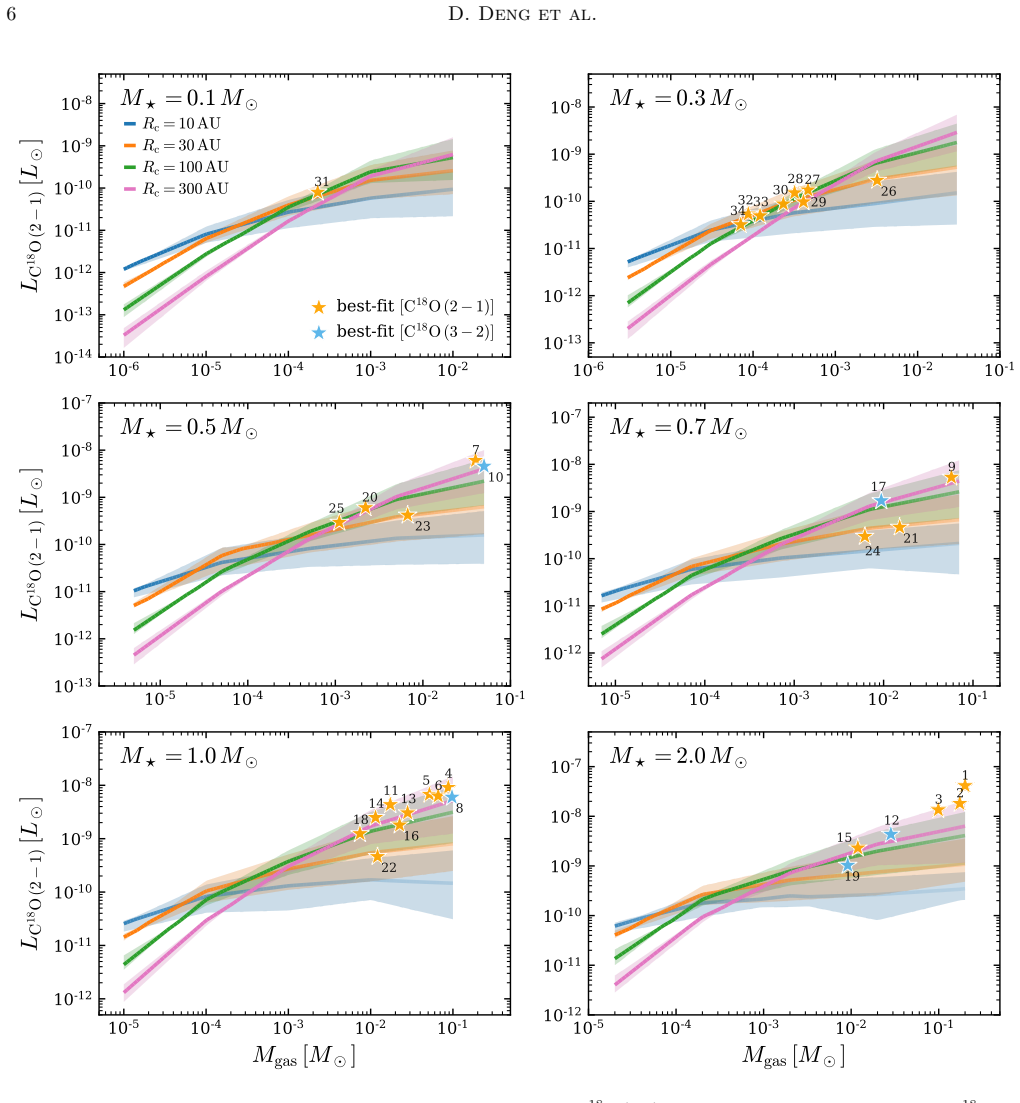
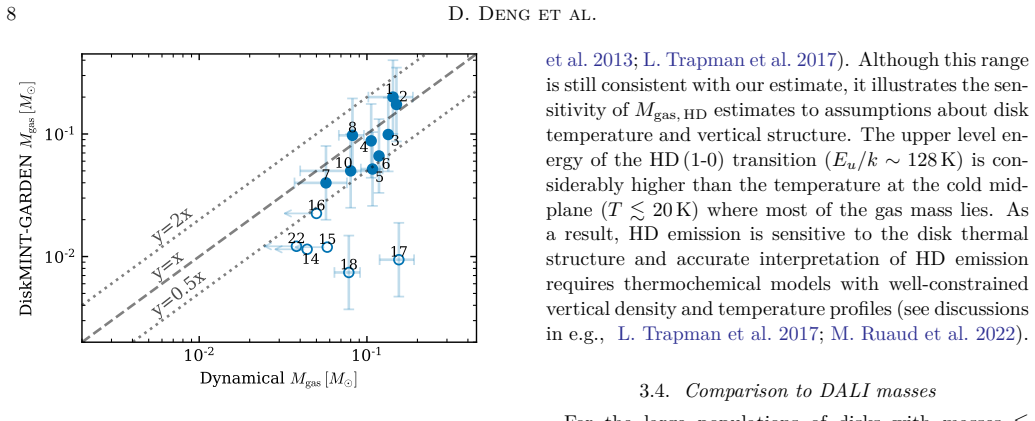
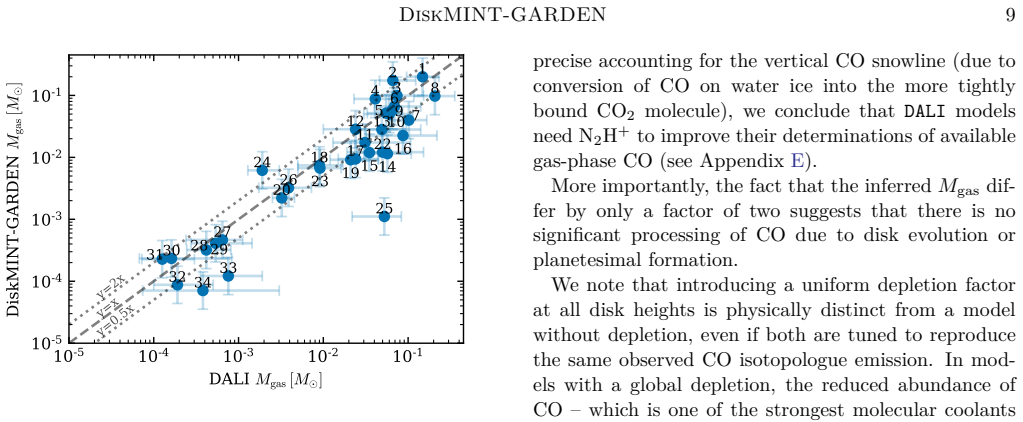
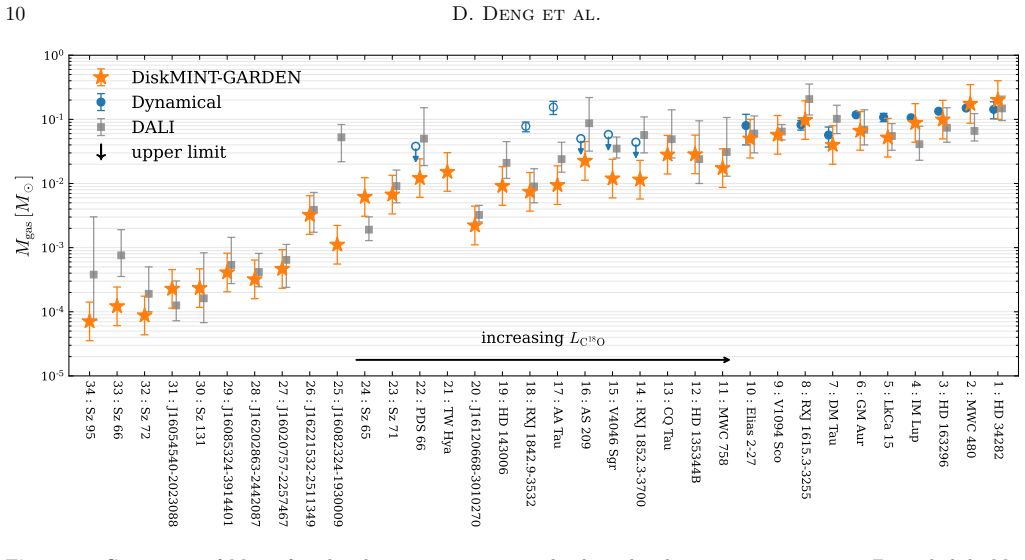
DiskMINT-GARDEN is a grid spanning stellar mass 0.1-2.0 solar masses, gas disk mass 10^-5 to 0.1 times stellar mass, dust-to-gas ratio 0.003-0.1, and radius 10-300 au. It generates synthetic ALMA observables using DiskMINT's coupling of hydrostatic structure, continuum and line transfer, and reduced CO chemistry with freeze-out, grain-surface conversion to CO2, and isotope-selective photodissociation. A trained regression model maps observed dust continuum and C18O fluxes back to the input parameters. For 34 disks the resulting gas masses agree with independent dynamical and HD estimates, and the implemented chemistry reproduces the data without invoking additional evolutionary depletion.
What carries the argument
The DiskMINT-GARDEN model grid together with its trained machine-learning regression model that maps synthetic ALMA observables to gas mass, dust-to-gas ratio, and characteristic radius.
If this is right
- Gas masses inferred from continuum and C18O data using the trained model agree with dynamical and HD estimates across the 34-disk sample.
- Grain-surface chemistry implemented in DiskMINT accounts for the CO depletion previously required by codes such as DALI.
- Extant ALMA data indicate little additional chemical processing from disk evolutionary processes beyond the included reactions.
Where Pith is reading between the lines
- The regression model enables rapid mass estimates for future large ALMA disk surveys once trained on the grid.
- If the reduced network remains sufficient across more disks, models of disk evolution can omit strong ad-hoc depletion factors.
- Extending the grid to additional molecular lines would test whether the current chemistry fully captures the observables.
Load-bearing premise
The reduced CO chemical network with freeze-out, grain-surface conversion to CO2, and isotope-selective photodissociation is sufficient to match observed fluxes without extra evolutionary depletion mechanisms.
What would settle it
A disk whose gas mass measured directly by HD lines or dynamical methods differs substantially from the DiskMINT-GARDEN inference would falsify the claim that the network suffices.
Figures
read the original abstract
We present DiskMINT-GARDEN, a grid of self-consistent models together with a fast, open source inference tool for disk masses. The grid is built on DiskMINT, a tool which couples hydrostatic disk structure, continuum/line radiative transfer, and a reduced CO chemical network including freeze-out, grain-surface conversion, and isotope-selective photodissociation. DiskMINT-GARDEN model grid spans a large range of stellar mass ($0.1-2.0\,M_\odot$), gas disk mass ($10^{-5}-10^{-1}\,M_\star$), dust-to-gas ratio ($0.003-0.1$), and characteristic radius ($10-300\,{\rm au}$), and provides synthetic ALMA observables. We train a machine-learning regression model to infer the disk mass, dust-to-gas mass ratio, and disk size from the dust continuum and $\mathrm{C^{18}O}$ line observations. Applying DiskMINT-GARDEN to archival ALMA data of 34 disks, we find gas masses in good agreement with dynamical and HD-based estimates. Comparing our results with estimates from chemical modeling using DALI, we find that their need for large-scale elemental or CO depletion can be accounted for by grain-surface chemistry implemented in DiskMINT, with CO conversion to CO$_2$ being one of the main reactions. Therefore, extant data suggest little chemical processing due to disk evolutionary processes.
Editorial analysis
A structured set of objections, weighed in public.
Referee Report
Summary. The paper presents DiskMINT-GARDEN, a grid of self-consistent models built on DiskMINT that couples hydrostatic disk structure, continuum/line radiative transfer, and a reduced CO chemical network (freeze-out, grain-surface conversion to CO2, isotope-selective photodissociation). Synthetic ALMA observables are generated across stellar mass 0.1-2.0 M_sun, gas mass 10^{-5}-10^{-1} M_star, dust-to-gas 0.003-0.1, and radius 10-300 au. An ML regressor is trained to infer gas mass, dust-to-gas ratio, and size from dust continuum and C18O line data. Application to archival ALMA observations of 34 disks yields gas masses in agreement with dynamical and HD-based estimates; the authors conclude that grain-surface chemistry accounts for apparent depletion previously requiring ad-hoc factors in DALI models, implying little additional evolutionary chemical processing.
Significance. If the claims hold, the work supplies an open-source, fast inference tool for disk masses that incorporates self-consistent chemistry rather than post-hoc depletion factors. The reported agreement with independent dynamical/HD masses for 34 disks, together with the attribution of CO depletion to the included grain-surface reactions, would reduce reliance on evolutionary depletion mechanisms and provide a reproducible framework for interpreting ALMA data on protoplanetary disks.
major comments (2)
- [Abstract] Abstract (final sentence) and results on 34-disk sample: the central claim that the reduced CO network (freeze-out + grain-surface CO→CO2 + isotope-selective photodissociation) suffices without additional evolutionary depletion is load-bearing, yet the manuscript provides no explicit test (e.g., comparison of χ^{2} or line fluxes) showing that adding extra depletion mechanisms does not improve the match to the same ALMA data.
- [ML regression] ML regressor training (grid and inference sections): because the regressor is trained exclusively on synthetic observables generated from the DiskMINT grid, the reported agreement with external dynamical/HD masses must be accompanied by quantitative out-of-sample metrics (cross-validation R^{2}, bias, and performance on parameter combinations outside the training grid) to confirm the agreement is not an artifact of model dependence.
minor comments (2)
- [Model grid] The parameter ranges and sampling of the model grid are stated but the number of models and the exact hyperparameter choices for the ML regressor are not listed; these details are needed for reproducibility.
- [Results] Figure captions for the application to the 34 disks should explicitly state which ALMA bands/lines were used as inputs to the regressor and whether any post-processing (e.g., beam convolution) was applied uniformly.
Simulated Author's Rebuttal
We thank the referee for the constructive review and recommendation of minor revision. We respond to each major comment below.
read point-by-point responses
-
Referee: [Abstract] Abstract (final sentence) and results on 34-disk sample: the central claim that the reduced CO network (freeze-out + grain-surface CO→CO2 + isotope-selective photodissociation) suffices without additional evolutionary depletion is load-bearing, yet the manuscript provides no explicit test (e.g., comparison of χ^{2} or line fluxes) showing that adding extra depletion mechanisms does not improve the match to the same ALMA data.
Authors: We agree that an explicit test comparing fits with and without additional depletion would strengthen the claim. In the revised manuscript we will add such a comparison for the 34-disk sample, reporting χ² values and line flux residuals for models that include extra evolutionary depletion factors versus the baseline DiskMINT-GARDEN grid. This will show whether the grain-surface reactions already provide an adequate match. revision: yes
-
Referee: [ML regression] ML regressor training (grid and inference sections): because the regressor is trained exclusively on synthetic observables generated from the DiskMINT grid, the reported agreement with external dynamical/HD masses must be accompanied by quantitative out-of-sample metrics (cross-validation R^{2}, bias, and performance on parameter combinations outside the training grid) to confirm the agreement is not an artifact of model dependence.
Authors: The agreement with independent dynamical and HD masses (derived without reference to our chemical network or radiative transfer) already provides evidence that the results are not an artifact of model dependence. Nevertheless, to address the request directly we will add quantitative out-of-sample metrics, including cross-validation R², bias, and performance on held-out parameter combinations, to the revised manuscript. revision: yes
Circularity Check
No significant circularity detected
full rationale
The paper constructs a model grid using DiskMINT (with its reduced CO network), generates synthetic ALMA observables, trains an ML regressor to map observables back to parameters, and applies the regressor to real archival data. Inferred masses are then compared to independent dynamical and HD-based estimates. This external validation step, plus the direct comparison to DALI results, keeps the central claims (network sufficiency and lack of extra evolutionary depletion) falsifiable against real observations rather than reducing to the model's own inputs by construction. No self-definitional equations, fitted inputs renamed as predictions, or load-bearing self-citations appear in the provided text.
Axiom & Free-Parameter Ledger
free parameters (1)
- ML regression hyperparameters
axioms (2)
- domain assumption Hydrostatic equilibrium determines the vertical disk structure
- domain assumption The reduced CO chemical network captures the dominant processes affecting C18O emission
Reference graph
Works this paper leans on
-
[1]
Gas mass tracers in protoplanetary disks: CO is still the best
Gas Mass Tracers in Protoplanetary Disks: CO is Still the Best. , keywords =. doi:10.3847/1538-4357/aa9227 , archivePrefix =. 1710.02993 , primaryClass =
work page internal anchor Pith review Pith/arXiv arXiv doi:10.3847/1538-4357/aa9227
-
[2]
The Astrophysical Journal , author =. 2023 , pages =. doi:10.3847/1538-4357/acdfcc , abstract =
-
[3]
The Astrophysical Journal , publisher =
Deng, Dingshan and Gorti, Uma and Pascucci, Ilaria and Ruaud, Maxime , month = dec, year =. The Astrophysical Journal , publisher =. doi:10.3847/1538-4357/ae0e66 , abstract =
-
[4]
Multiwavelength optical properties of compact dust aggregates in protoplanetary disks , volume =. Astronomy and Astrophysics , author =. 2016 , note =. doi:10.1051/0004-6361/201526048 , abstract =
-
[5]
Bottou, Léon , editor =. Large-. Proceedings of. 2010 , pages =
2010
-
[6]
Journal of Machine Learning Research , author =
Scikit-learn:. Journal of Machine Learning Research , author =. 2011 , pages =
2011
-
[7]
, year = 1974, month = sep, volume =
The evolution of viscous discs and the origin of the nebular variables. , volume =. Monthly Notices of the Royal Astronomical Society , author =. 1974 , note =. doi:10.1093/mnras/168.3.603 , abstract =
-
[8]
P.; and Juhasz, A
Dullemond, C. P.; and Juhasz, A. ; and Pohl, A. ; and Sereshti, F. ; and Shetty, R. ; and Peters, T. ; and Commercon, B. ; and Flock, M. , year =. \
-
[9]
The Astrophysical Journal , author =
Photoevaporation of. The Astrophysical Journal , author =. 2009 , note =. doi:10.1088/0004-637X/690/2/1539 , abstract =
-
[10]
Gorti, U. and Dullemond, C. P. and Hollenbach, D. , month = nov, year =. Time. The Astrophysical Journal , publisher =. doi:10.1088/0004-637X/705/2/1237 , abstract =
-
[11]
Astronomy & Astrophysics , author =
X-shooter spectroscopy of young stellar objects in. Astronomy & Astrophysics , author =. 2017 , pages =. doi:10.1051/0004-6361/201629929 , abstract =
-
[12]
An IUE Atlas of Pre-Main-Sequence Stars. III. Co-added Final Archive Spectra from the Long-Wavelength Cameras. , keywords =. doi:10.1086/375445 , adsurl =
-
[13]
New evolutionary models for pre-main sequence and main sequence low-mass stars down to the hydrogen-burning limit , volume =. Astronomy and Astrophysics , author =. 2015 , note =. doi:10.1051/0004-6361/201425481 , abstract =
work page internal anchor Pith review doi:10.1051/0004-6361/201425481 2015
-
[14]
The ALMA Survey of Gas Evolution of PROtoplanetary Disks (AGE-PRO)
Deng, Dingshan and. The ALMA Survey of Gas Evolution of PROtoplanetary Disks (AGE-PRO). III. Dust and Gas Disk Properties in the Lupus Star-forming Region. , keywords =. doi:10.3847/1538-4357/add43a , archivePrefix =. 2506.10734 , primaryClass =
-
[15]
doi:10.5281/zenodo.8115820 , url =
DingshanDeng/DiskMINT: DiskMINT v1.7.0 Release , month = TBA, year = 2026, publisher =. doi:10.5281/zenodo.8115820 , url =
-
[16]
The ALMA Survey of Gas Evolution of PROtoplanetary Disks (AGE-PRO). V. Protoplanetary Gas Disk Masses. , keywords =. doi:10.3847/1538-4357/adcd6e , archivePrefix =. 2506.10738 , primaryClass =
-
[17]
The tensile strength of ice and dust aggregates and its dependence on particle properties. , keywords =. doi:10.1093/mnras/sty1550 , adsurl =
-
[18]
Protostars and Planets VII , year = 2023, editor =
Setting the Stage for Planet Formation: Measurements and Implications of the Fundamental Disk Properties. Protostars and Planets VII , year = 2023, editor =. doi:10.48550/arXiv.2203.09818 , archivePrefix =. 2203.09818 , primaryClass =
-
[19]
Astronomy and Astrophysics , author =
Global. Astronomy and Astrophysics , author =. 2009 , note =. doi:10.1051/0004-6361/200811220 , abstract =
-
[20]
The dust subdisk in the protoplanetary nebula. , volume =. Icarus , author =. 1995 , note =. doi:10.1006/icar.1995.1058 , abstract =
-
[21]
Flaring vs. self-shadowed disks:. Astronomy and Astrophysics , author =. 2004 , note =. doi:10.1051/0004-6361:20031768 , abstract =
-
[22]
Global Modeling of Nebulae with Particle Growth, Drift, and Evaporation Fronts. I. Methodology and Typical Results. , keywords =. doi:10.3847/0004-637X/818/2/200 , archivePrefix =. 1506.01420 , primaryClass =
work page internal anchor Pith review Pith/arXiv arXiv doi:10.3847/0004-637x/818/2/200
-
[23]
Brown Dwarfs , year = 2003, editor =
Model Atmospheres and Spectra: The Role of Dust. Brown Dwarfs , year = 2003, editor =
2003
-
[24]
16th Cambridge Workshop on Cool Stars, Stellar Systems, and the Sun , year = 2011, editor =
Model Atmospheres From Very Low Mass Stars to Brown Dwarfs. 16th Cambridge Workshop on Cool Stars, Stellar Systems, and the Sun , year = 2011, editor =
2011
-
[25]
Gaia. Astronomy and Astrophysics , author =. 2023 , note =. doi:10.1051/0004-6361/202243940 , abstract =
-
[26]
The Astrophysical Journal , author =. 2016 , note =. doi:10.3847/0004-637x/832/2/110 , abstract =
-
[27]
Constraining the turbulence and the dust disk in. Astronomy & Astrophysics , author =. 2023 , pages =. doi:10.1051/0004-6361/202244869 , abstract =
-
[28]
The Astrophysical Journal Letters , author =
A. The Astrophysical Journal Letters , author =. 2023 , pages =. doi:10.3847/2041-8213/acb651 , abstract =
-
[29]
Dynamical mass measurements of two protoplanetary discs. , keywords =. doi:10.1093/mnras/stac3223 , archivePrefix =. 2211.03712 , primaryClass =
-
[30]
The Astrophysical Journal , author =
Constraining. The Astrophysical Journal , author =. 2018 , pages =. doi:10.3847/1538-4357/aade96 , abstract =
-
[31]
The Astrophysical Journal Supplement Series , author =
Molecules with. The Astrophysical Journal Supplement Series , author =. 2021 , note =. doi:10.3847/1538-4365/ac1580 , abstract =
-
[32]
Ansdell and J
M. Ansdell and J. P. Williams and N. van der Marel and J. M. Carpenter and G. Guidi and M. Hogerheijde and G. S. Mathews and C. F. Manara and A. Miotello and A. Natta and I. Oliveira and M. Tazzari and L. Testi and E. F. van Dishoeck and S. E. van Terwisga , doi =. ALMA SURVEY OF LUPUS PROTOPLANETARY DISKS. I. DUST AND GAS MASSES , volume =. The Astrophys...
-
[33]
A Steeper than Linear Disk Mass-Stellar Mass Scaling Relation
A Steeper than Linear Disk Mass-Stellar Mass Scaling Relation. , keywords =. doi:10.3847/0004-637X/831/2/125 , archivePrefix =. 1608.03621 , primaryClass =
work page internal anchor Pith review Pith/arXiv arXiv doi:10.3847/0004-637x/831/2/125
-
[34]
The VLA view of the HL Tau Disk - Disk Mass, Grain Evolution, and Early Planet Formation
The VLA View of the HL Tau Disk: Disk Mass, Grain Evolution, and Early Planet Formation. , keywords =. doi:10.3847/2041-8205/821/1/L16 , archivePrefix =. 1603.03731 , primaryClass =
work page internal anchor Pith review Pith/arXiv arXiv doi:10.3847/2041-8205/821/1/l16 2041
-
[35]
One Solution to the Mass Budget Problem for Planet Formation: Optically Thick Disks with Dust Scattering. , keywords =. doi:10.3847/2041-8213/ab1f8c , archivePrefix =. 1904.02127 , primaryClass =
work page internal anchor Pith review Pith/arXiv arXiv doi:10.3847/2041-8213/ab1f8c 2041
-
[36]
The Astrophysical Journal , author =
Measuring the. The Astrophysical Journal , author =. 2023 , note =. doi:10.3847/1538-4357/aca52b , abstract =
-
[37]
The Astrophysical Journal , author =
Determining. The Astrophysical Journal , author =. 2023 , pages =. doi:10.3847/1538-4357/aca905 , abstract =
-
[38]
Consistent \ Dust\ and \ Gas\ \ Models\ for \ Protoplanetary\ \ Disks\
P Woitke and I Kamp and S Antonellini and F Anthonioz and C Baldovin-Saveedra and A Carmona and O Dionatos and C Dominik and J Greaves and M Güdel and J D Ilee and A Liebhardt and F Menard and M Min and C Pinte and C Rab and L Rigon and W F Thi and N Thureau and L B F M Waters , doi =. Consistent \ Dust\ and \ Gas\ \ Models\ for \ Protoplanetary\ \ Disks\...
-
[39]
Woitke and I
P. Woitke and I. Kamp and W.-F. Thi , doi =. Radiation thermo-chemical models of protoplanetary disks , volume =. Astronomy & Astrophysics , keywords =
-
[40]
Trapman and A
L. Trapman and A. Miotello and M. Kama and E. F. Van Dishoeck and S. Bruderer , doi =. Far-infrared HD emission as a measure of protoplanetary disk mass , volume =. Astronomy and Astrophysics , keywords =
-
[41]
Hollenbach , doi =
Maxime Ruaud and Uma Gorti and David J. Hollenbach , doi =. C <sup>18</sup> O Emission as an Effective Measure of Gas Masses of Protoplanetary Disks , volume =. The Astrophysical Journal , month =
-
[42]
A three-phase approach to grain surface chemistry in protoplanetary disks: Gas, ice surfaces and ice mantles of dust grains , volume =
Maxime Ruaud and Uma Gorti , doi =. A three-phase approach to grain surface chemistry in protoplanetary disks: Gas, ice surfaces and ice mantles of dust grains , volume =. The Astrophysical Journal , keywords =
-
[43]
Accretion and the Evolution of T Tauri Disks , volume =
Lee Hartmann and Nuria Calvet and Erik Gullbring and Paola D'Alessio , doi =. Accretion and the Evolution of T Tauri Disks , volume =. The Astrophysical Journal , keywords =
-
[44]
Mass measurements in protoplanetary disks from hydrogen deuteride
Mass Measurements in Protoplanetary Disks from Hydrogen Deuteride. , keywords =. doi:10.3847/0004-637X/831/2/167 , archivePrefix =. 1608.07817 , primaryClass =
work page internal anchor Pith review Pith/arXiv arXiv doi:10.3847/0004-637x/831/2/167
-
[45]
An old disk still capable of forming a planetary system. , keywords =. doi:10.1038/nature11805 , archivePrefix =. 1303.1107 , primaryClass =
-
[46]
Bergin, Edwin A. and Williams, Jonathan P. The Determination of Protoplanetary Disk Masses. Formation, Evolution, and Dynamics of Young Solar Systems. 2017. doi:10.1007/978-3-319-60609-5_1
-
[47]
The dry and carbon-poor inner disk of TW Hydrae: evidence for a massive icy dust trap. , keywords =. doi:10.1051/0004-6361/201936638 , archivePrefix =. 1911.11152 , primaryClass =
-
[48]
CO Depletion in Protoplanetary Disks: A Unified Picture Combining Physical Sequestration and Chemical Processing. , keywords =. doi:10.3847/1538-4357/aba75d , archivePrefix =. 2007.09517 , primaryClass =
-
[49]
Depletion of gaseous CO in protoplanetary disks by surface-energy-regulated ice formation. Nature Astronomy , keywords =. doi:10.1038/s41550-022-01741-9 , archivePrefix =. 2208.13806 , primaryClass =
-
[50]
The Astrophysical Journal , author =
Large. The Astrophysical Journal , author =. 2023 , pages =. doi:10.3847/1538-4357/ace4bf , abstract =
-
[51]
Miotello and S
A. Miotello and S. Bruderer and E. F. Van Dishoeck , doi =. Protoplanetary disk masses from CO isotopologue line emission , volume =. Astronomy and Astrophysics , keywords =
-
[52]
Miotello and E
A. Miotello and E. F. van Dishoeck and M. Kama and S. Bruderer , doi =. Determining protoplanetary disk gas masses from CO isotopologues line observations , volume =. Astronomy & Astrophysics , keywords =
-
[53]
Miotello and E
A. Miotello and E. F. van Dishoeck and J. P. Williams and M. Ansdell and G. Guidi and M. Hogerheijde and C. F. Manara and M. Tazzari and L. Testi and N. van der Marel and S. van Terwisga , doi =. Lupus disks with faint CO isotopologues: low gas/dust or high carbon depletion? , volume =. Astronomy & Astrophysics , keywords =
-
[54]
An ALMA Survey of CO isotopologue emission from Protoplanetary Disks in Chamaeleon I
An ALMA Survey of CO Isotopologue Emission from Protoplanetary Disks in Chamaeleon I. , keywords =. doi:10.3847/1538-4357/aa78fc , archivePrefix =. 1706.03320 , primaryClass =
work page internal anchor Pith review Pith/arXiv arXiv doi:10.3847/1538-4357/aa78fc
-
[55]
The Astrophysical Journal , author =
Systematic. The Astrophysical Journal , author =. 2019 , note =. doi:10.3847/1538-4357/ab38b9 , abstract =
-
[56]
The Astrophysical Journal , author =
The. The Astrophysical Journal , author =. 2021 , pages =. doi:10.3847/1538-4357/abd255 , abstract =
-
[57]
Astronomy and Astrophysics , author =
Direct imaging of extra-solar planets in star forming regions. Astronomy and Astrophysics , author =. 2012 , note =. doi:10.1051/0004-6361/201219662 , abstract =
-
[58]
The Astrophysical Journal Supplement Series , author =
Molecules with. The Astrophysical Journal Supplement Series , author =. 2021 , note =. doi:10.3847/1538-4365/ac1438 , abstract =
-
[59]
The \. The Astrophysical Journal Letters , author =. 2018 , keywords =. doi:10.3847/2041-8213/aaf741 , abstract =
work page internal anchor Pith review doi:10.3847/2041-8213/aaf741 2018
-
[60]
The Astrophysical Journal Supplement Series , author =
Molecules with. The Astrophysical Journal Supplement Series , author =. 2021 , note =. doi:10.3847/1538-4365/ac1432 , abstract =
-
[61]
Astronomy and Astrophysics , author =
Searching for gas-rich disks around. Astronomy and Astrophysics , author =. 2007 , note =. doi:10.1051/0004-6361:20065174 , abstract =
-
[62]
The Astrophysical Journal , author =
The \. The Astrophysical Journal , author =. 2018 , pages =. doi:10.3847/2041-8213/aaf740 , abstract =
-
[63]
Astronomy and Astrophysics , author =
Probing dust grain evolution in. Astronomy and Astrophysics , author =. 2008 , note =. doi:10.1051/0004-6361:200810121 , abstract =
-
[64]
The Astrophysical Journal , author =
Disks around. The Astrophysical Journal , author =. 2018 , keywords =. doi:10.3847/1538-4357/aab846 , abstract =
-
[65]
Physical model and observational evidence in MAPS disks
Rotation curves in protoplanetary disks with thermal stratification:. Astronomy & Astrophysics , author =. 2024 , pages =. doi:10.1051/0004-6361/202348546 , abstract =
-
[66]
Astronomy and Astrophysics , author =
The disk-bearing young star. Astronomy and Astrophysics , author =. 2010 , note =. doi:10.1051/0004-6361/201014386 , abstract =
-
[67]
2021 , note =
Astrophysics Source Code Library , author =. 2021 , note =
2021
-
[68]
Monthly Notices of the Royal Astronomical Society , author =
Optical constants of cosmic carbon analogue grains -. Monthly Notices of the Royal Astronomical Society , author =. 1996 , note =. doi:10.1093/mnras/282.4.1321 , abstract =
-
[69]
Astronomy and Astrophysics , author =
Steps toward interstellar silicate mineralogy. Astronomy and Astrophysics , author =. 1995 , note =
1995
-
[70]
Berechnung verschiedener physikalischer. Annalen der Physik , author =. 1935 , note =. doi:10.1002/andp.19354160705 , abstract =
-
[71]
, year = 1983, month = sep, volume =
The determination of cloud masses and dust characteristics from submillimetre thermal emission. , year = 1983, month = sep, volume =
1983
-
[72]
Hendler, Nathanial P. and Mulders, Gijs D. and Pascucci, Ilaria and Greenwood, Aaron and Kamp, Inga and Henning, Thomas and M. 2017 , journal =. doi:10.3847/1538-4357/aa71b8 , issn =
-
[73]
Circumstellar Dust Disks in Taurus-Auriga: The Submillimeter Perspective
Circumstellar Dust Disks in Taurus-Auriga: The Submillimeter Perspective. , keywords =. doi:10.1086/432712 , archivePrefix =. astro-ph/0506187 , primaryClass =
work page internal anchor Pith review Pith/arXiv arXiv doi:10.1086/432712
-
[74]
Protostars and Planets VII , year = 2023, editor =
Demographics of Young Stars and their Protoplanetary Disks: Lessons Learned on Disk Evolution and its Connection to Planet Formation. Protostars and Planets VII , year = 2023, editor =. doi:10.48550/arXiv.2203.09930 , archivePrefix =. 2203.09930 , primaryClass =
-
[75]
Astronomy & Astrophysics , author =
On the underestimation of dust mass in protoplanetary disks:. Astronomy & Astrophysics , author =. 2022 , note =. doi:10.1051/0004-6361/202244505 , abstract =
-
[76]
Zhang, Xin and Cao, Li and Meng, Xianmin , number =. 2019 , journal =. doi:10.1007/s10509-019-3501-8 , issn =
-
[77]
The Astrophysical Journal , author =
The. The Astrophysical Journal , author =. 2018 , note =. doi:10.3847/2041-8213/aaf743 , abstract =
-
[78]
The Astrophysical Journal , author =
Porous. The Astrophysical Journal , author =. 2023 , pages =. doi:10.3847/1538-4357/acdb4e , abstract =
-
[79]
Dust mass in protoplanetary disks with porous dust opacities , url =
Liu, Yao and Roussel, Hélène and Linz, Hendrik and Fang, Min and Wolf, Sebastian and Kirchschlager, Florian and Henning, Thomas and Yang, Haifeng and Du, Fujun and Flock, Mario and Wang, Hongchi , month = oct, year =. Dust mass in protoplanetary disks with porous dust opacities , url =
-
[80]
Astronomy and Astrophysics , author =
Direct mapping of the temperature and velocity gradients in discs:. Astronomy and Astrophysics , author =. 2018 , note =. doi:10.1051/0004-6361/201731377 , abstract =
discussion (0)
Sign in with ORCID, Apple, or X to comment. Anyone can read and Pith papers without signing in.